Have you ever stopped while writing an email, essay, resume, or text because you couldn’t decide between Affect vs Effect? You’re not alone. These two words look and sound similar, but they usually play different roles in a sentence. One commonly describes an action on something, while the other commonly names the result of that action.
The easiest way to remember the difference is to think about action and result. If something changes or influences another thing, you usually need affect. If you’re talking about the result of that change, you usually need effect.
This guide explains the meaning, history, grammar, synonyms, examples, common mistakes, regional differences, and best word choices for different situations. By the end, you’ll have simple ways to choose the right word without stopping to second guess yourself.
What is the difference between affect and effect?
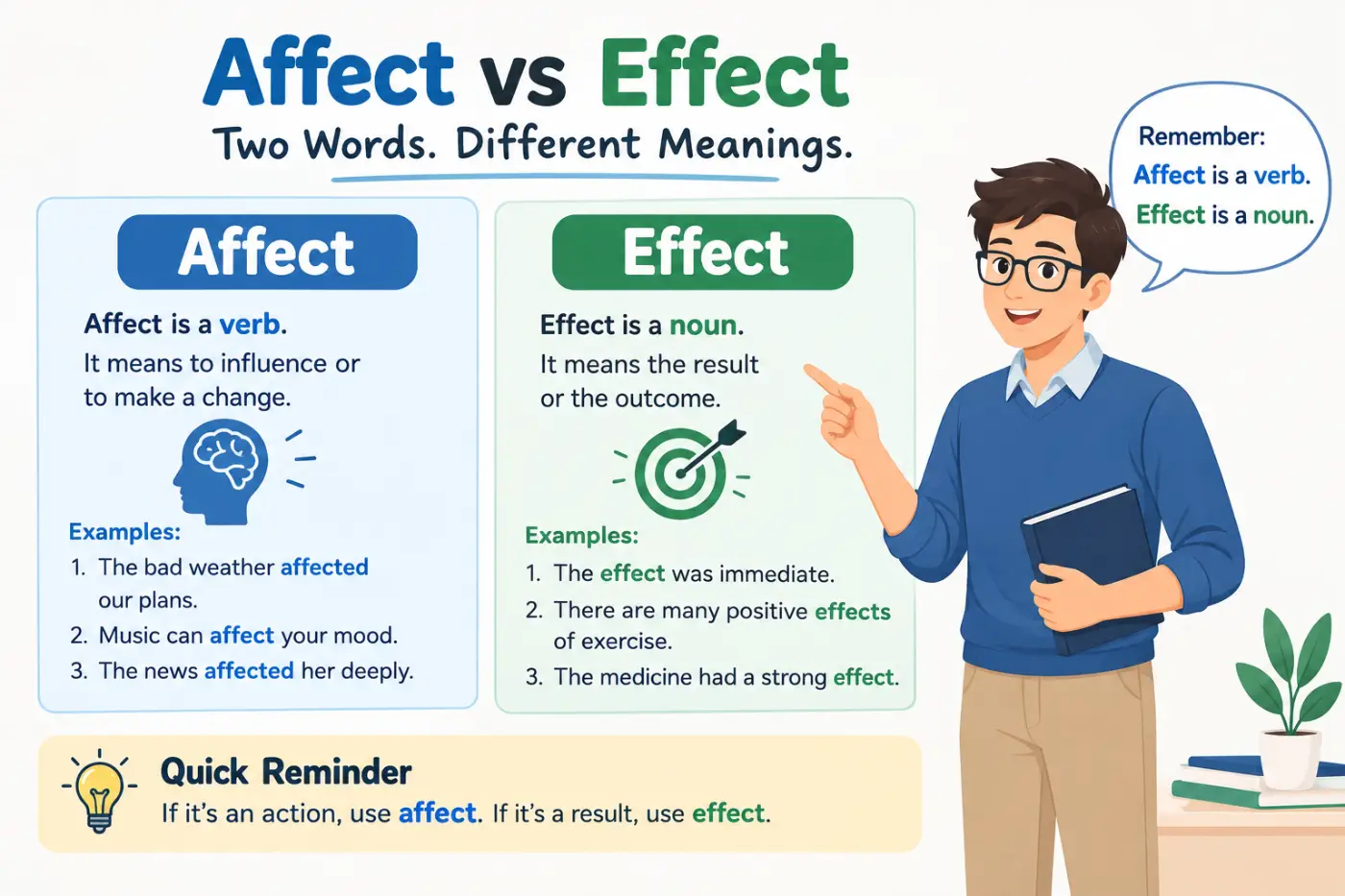
The main difference between Affect vs Effect is their most common grammatical use.
Affect is usually a verb. It means to influence, change, or have an impact on something.
Effect is usually a noun. It means the result, consequence, or outcome produced by something.
| Word | Usual role | Basic meaning | Example |
|---|---|---|---|
| Affect | Verb | To influence or change | The weather affected our plans. |
| Effect | Noun | A result or consequence | The weather had an effect on our plans. |
Compare these two sentences:
The loud noise affected my concentration.
Here, affected describes what the noise did. It influenced concentration.
The loud noise had an effect on my concentration.
Here, effect names the result or influence produced by the noise.
There are exceptions. Effect can also be a verb, usually meaning to cause something to happen or bring about a change. Affect can also be a noun in psychology, where it refers to the visible expression of emotion.
For everyday American English, though, the simple rule works most of the time:
Affect = influence.
Effect = result.
Where did affect and effect come from?
The history of these words helps explain why they look so similar.
Both words are connected to Latin roots. Affect comes from Latin afficere, meaning to do something to, influence, or act upon. Over time, the word developed into the English verb we use for influencing or changing something.
Effect comes from Latin efficere, meaning to accomplish, complete, or bring about. Its history is connected with the idea of something being produced as a result of an action.
Their shared history is one reason learners often confuse them. They have related meanings, similar spelling, and similar pronunciation. Still, their everyday grammatical jobs are different.
Think of a simple cause and result:
Heavy rain affects traffic.
The rain influences traffic.
Heavy rain has an effect on traffic.
The traffic problem is the result or consequence connected to the rain.
This cause and result relationship gives you a useful mental picture:
Cause or influence → affect → result → effect
That pattern won’t solve every unusual use, but it handles the vast majority of sentences you’ll write in school, at work, and in everyday communication.
What does affect mean in simple English?
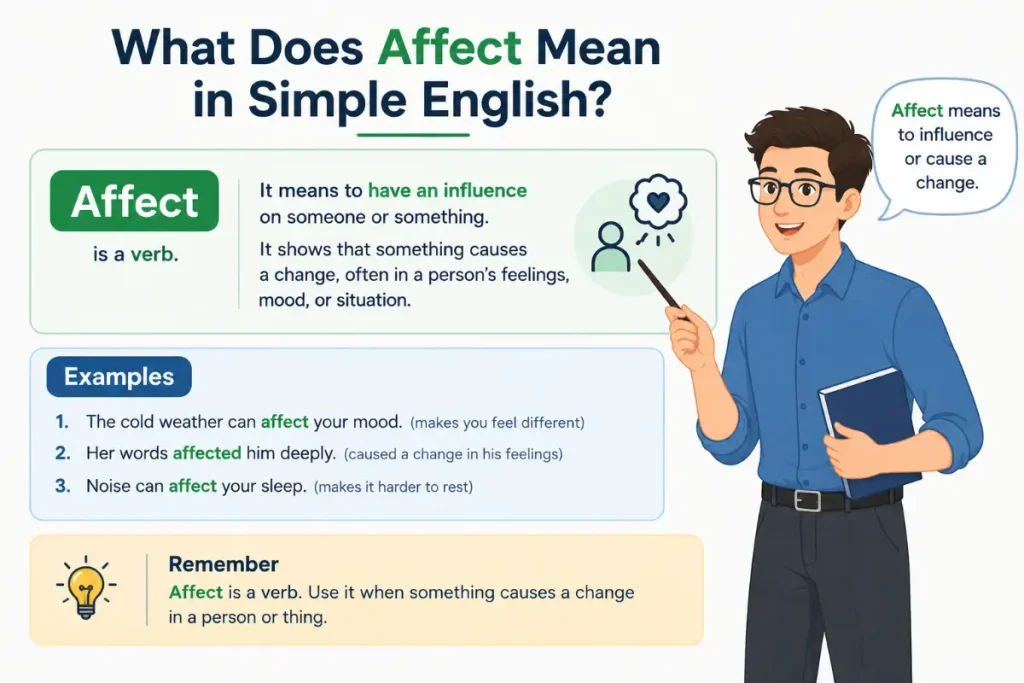
Affect usually means to influence, change, or make a difference to something.
It normally acts as a verb.
For example:
Lack of sleep can affect your memory.
The meaning is that lack of sleep can influence or change how well you remember things.
Here are more examples:
The price increase affected our budget.
Her decision affected the entire team.
In each sentence, something is influencing another person, thing, situation, or process.
A useful replacement test is to substitute influence.
If the sentence still makes sense, affect is probably correct.
The new rule affected our schedule.
Becomes:
The new rule influenced our schedule.
That works, so affected is the natural choice.
What does effect mean in simple English?
Effect usually means a result, consequence, or change caused by something.
It normally acts as a noun.
For example:
The new rule had a major effect on our schedule.
Here, effect is the result produced by the rule.
You can often replace effect with words such as result, outcome, or consequence.
The medicine had an effect on her pain.
You could say:
The medicine had an impact on her pain.
Or:
The medicine produced a result in her condition.
The exact replacement depends on the sentence, but the basic idea stays the same.
What are the most useful synonyms for affect and effect?
The best substitute depends on the meaning and tone of your sentence. Some words are close in meaning but aren’t perfect replacements in every situation.
The table below gives you more than 20 useful alternatives related to influencing something or describing a result.
Not every synonym can replace affect or effect directly. For example, result is usually a noun, while influence is often a verb or noun. Always check the grammar of the entire sentence.
Which synonyms are mild and which are strong?
Not every word communicates the same level of influence. Choosing the right strength can make your writing more accurate.
Mild words for influence
Use these when the change is small or subtle:
touch
nudge
guide
shape
influence
Example:
His advice influenced my decision.
This does not necessarily mean his advice completely changed the decision. It simply played a role.
Medium strength words
These suggest a clearer or more noticeable change:
affect
impact
alter
modify
change
Example:
The delay affected our travel plans.
The delay caused a noticeable difference.
Strong words
These suggest major influence or change:
transform
control
determine
reshape
revolutionize
Example:
The invention transformed the industry.
This communicates a much larger change than affected.
Strong words for negative results
When a result is harmful, these choices can be more precise:
harm
damage
disrupt
undermine
destroy
For example:
The storm damaged several buildings.
This is more specific than:
The storm affected several buildings.
The second sentence is grammatically correct, but the first tells the reader exactly what happened.
How do affect and effect work as different parts of speech?
Understanding parts of speech makes Affect vs Effect much easier.
Affect as a verb
This is the most common everyday use.
The noise affected my sleep.
The new policy affected employees.
Stress can affect your health.
Affect answers the question: What did it influence or change?
Effect as a noun
This is also extremely common.
The noise had an effect on my sleep.
The policy had an effect on employees.
Stress can have an effect on your health.
Effect answers the question: What result or consequence happened?
Effect as a verb
This use is less common in casual conversation.
As a verb, effect means to cause something to happen or bring about a change.
For example:
The new manager hopes to effect major changes in the company.
This does not simply mean influence the changes. It means bring those changes about.
Another example:
The organization worked to effect a change in the law.
This use often appears in formal, academic, legal, or professional writing.
Affect as a noun
Affect as a noun is mainly used in psychology and related fields.
It describes the visible expression of emotion.
For example:
The patient showed a flat affect.
Here, affect refers to outward emotional expression. This is different from the everyday verb affect.
For most general writing, you won’t need this specialized noun form.
How are affect and effect used in American English?
American English uses the same basic distinction found in standard English.
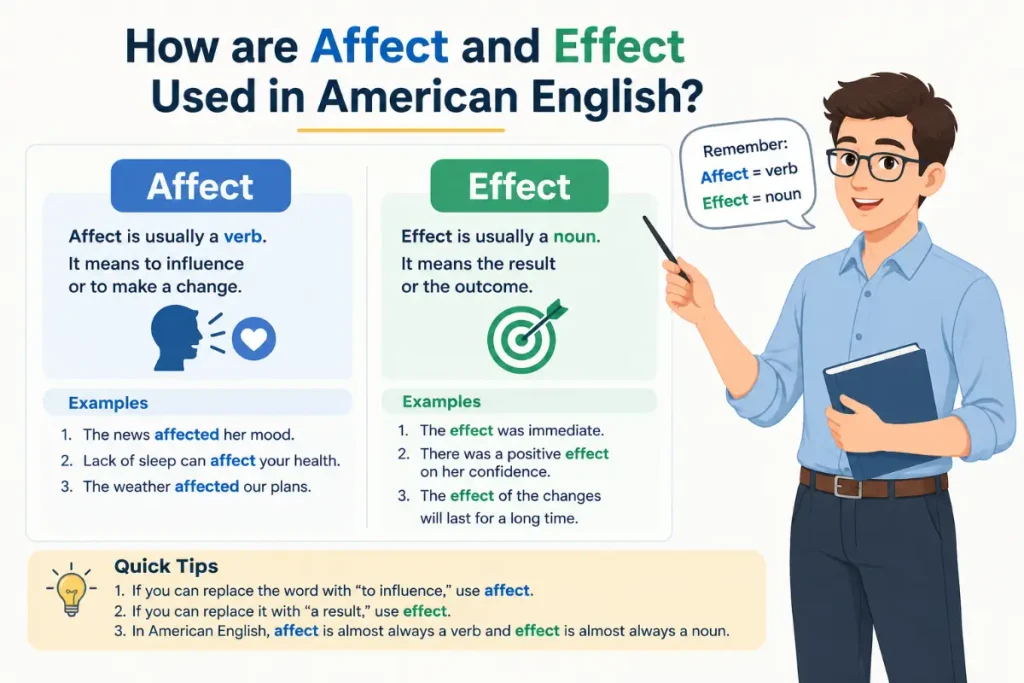
In everyday US writing:
Affect is usually the verb meaning influence.
Effect is usually the noun meaning result.
For example:
The heat affected the workers.
The heat had an effect on the workers.
The pronunciation can also cause confusion. In many common uses, the two words sound different enough when spoken carefully, but fast speech can make them seem similar to learners.
British English follows the same main distinction. There are no major US versus UK differences that change the basic rule.
Which word should you use in a resume?
For a resume, choose the word that clearly describes an action or result.
Use affect when you’re describing how something influenced a process.
Example:
Implemented a new filing system that affected daily workflow.
Use effect when you’re describing a measurable result.
Example:
Implemented a new filing system that had a positive effect on processing time.
In professional writing, a specific result is often stronger than a vague statement.
Instead of:
My work affected company performance.
Try:
My work reduced processing time by 20 percent.
The second sentence tells the reader exactly what changed.
Which word should you use in an essay?
In an essay, both words can be useful.
Use affect when explaining how one factor influences another.
Example:
Social media can affect the way teenagers communicate.
Use effect when discussing the result of a cause.
Example:
One effect of excessive screen time is reduced sleep.
Academic writing often uses cause and effect relationships, so knowing this distinction is especially helpful.
A useful sentence pattern is:
Cause affects X.
The effect of the cause is Y.
For example:
High temperatures affect crop production. One effect is lower agricultural output.
Which word should you use in a text message?
In casual texting, the same grammar rules apply.
That decision affected me.
That had a big effect on me.
You don’t need to change the word because the message is informal.
What changes in texting is usually the amount of detail. A short message might say:
That really affected me.
Or:
That had a huge effect on me.
Both are natural. The first focuses on influence. The second focuses on the result.
Which word should you use when speaking?
In everyday conversation, affect and effect are both common.
You might say:
The weather really affected our plans.
Or:
The weather had a big effect on our plans.
The first is shorter and more direct.
The second puts more attention on the result.
When speaking, don’t choose a word simply because it sounds more formal. Choose the one that matches the sentence structure.
What are some real examples of affect and effect?
Here are original examples from common situations.
School
A lack of sleep can affect a student’s ability to focus.
One effect of poor preparation is lower test confidence.
Work
The software update affected the way employees entered data.
The software update had a noticeable effect on productivity.
Weather
Heavy snow affected morning traffic.
The effect of the snow was visible across the city.
Health
Stress can affect your sleep.
Exercise can have a positive effect on your mood.
Money
Higher prices affected our monthly budget.
The effect of higher prices was easy to see at the grocery store.
Family
Moving to another city affected the children.
One effect of the move was that the family spent less time with relatives.
Technology
The new feature affected how users searched for information.
The feature had an unexpected effect on search behavior.
Environment
Air pollution can affect plant growth.
One effect of pollution is reduced air quality.
Sports
The injury affected the player’s performance.
The injury had a serious effect on the team’s strategy.
Communication
A rude message can affect a person’s feelings.
The effect of the message lasted for several days.
These examples show the same basic pattern again and again. Affect describes influence. Effect identifies the resulting change or consequence.
Affect vs impact: what’s the difference?
Affect and impact are often close in meaning, but they aren’t always interchangeable.
As a verb, affect means to influence something.
The weather affected our plans.
Impact can also be used as a verb meaning to have an effect on something.
The weather impacted our plans.
In modern American English, the verb impact is common, especially in business, education, and professional writing.
Still, affect is often the simpler choice when you only mean influence.
There is also a noun form:
The decision had an impact on sales.
You can say:
The decision had an effect on sales.
Both are natural. Impact can sometimes sound stronger or more noticeable, while effect is a broad word for a result or consequence.
Effect vs result: what’s the difference?
Effect and result are close, but they emphasize slightly different ideas.
A result is what happens after an action or event.
An effect is also a result, but the word often highlights the influence produced by a cause.
Compare:
The result of the test was surprising.
This focuses on the final outcome.
The test had a surprising effect on the students.
This focuses on how the test influenced the students.
In many sentences, either word may work. The best choice depends on what you want the reader to notice.
What are the most common mistakes with affect and effect?
The most common mistake is using effect as the verb when the sentence needs affect.
Incorrect:
The weather effected our plans.
Correct:
The weather affected our plans.
Another common mistake is using affect after phrases such as have an.
Incorrect:
The decision had an affect on sales.
Correct:
The decision had an effect on sales.
The phrase have an effect on is especially useful to memorize.
Mistake with affect as a noun
Some writers use affect when they mean emotional impact.
For example:
The movie had a strong affect on me.
For normal everyday writing, this should be:
The movie had a strong effect on me.
The noun affect has a specialized psychological meaning, so don’t use it simply because you’re talking about feelings.
Mistake with effect as a verb
Consider:
The new rule effected employee behavior.
If you mean the rule influenced employee behavior, use:
The new rule affected employee behavior.
If you mean the rule brought about or caused a particular change, effected may be correct, but that is a more formal construction.
When should you not use affect?
Don’t use affect simply because you’re describing something that happened.
For example:
The effect of the storm was severe.
Here, you’re naming the result, so effect is correct.
You also shouldn’t use affect when a more specific word communicates your meaning better.
Instead of:
The accident affected the car.
You might say:
The accident damaged the car.
The word damaged tells the reader exactly what happened.
Affect is useful when the exact type of influence is not the main point.
When should you not use effect?
Don’t use effect when you need the common verb meaning influence.
Incorrect:
The noise effected my concentration.
Correct:
The noise affected my concentration.
Also avoid effect when you simply mean change or influence and a clearer verb would make the sentence easier to understand.
Instead of:
The new schedule effected employee behavior.
You might write:
The new schedule changed employee behavior.
Clear writing usually beats complicated wording.
What are the antonyms of affect and effect?
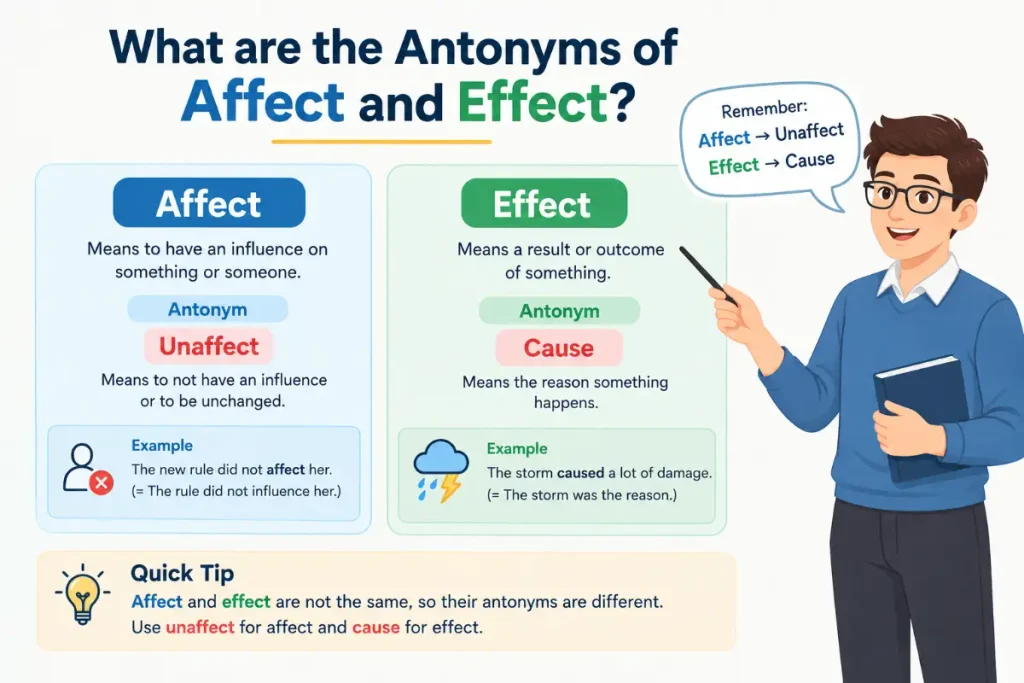
The opposite of affect depends on the meaning.
Possible antonyms include:
ignore
leave unchanged
preserve
maintain
protect
For example:
The noise affected my concentration.
An opposite idea would be:
The noise did not change my concentration.
For effect, the antonym depends on the context.
Possible opposites include:
cause nothing
lack of result
inaction
unchanged condition
There isn’t one universal antonym for either word because their meanings change with context.
What are the easiest tricks for remembering affect and effect?
Try these simple memory tricks.
Remember A for action
Affect is usually an action word because it is usually a verb.
The heat affected the plants.
The heat did something to the plants.
Remember E for end result
Effect is usually the end result.
The effect of the heat was visible.
You’re talking about what happened as a result.
Use the influence test
Replace affect with influence.
The decision affected sales.
The decision influenced sales.
If that works, affect is likely correct.
Use the result test
Replace effect with result.
The effect was unexpected.
The result was unexpected.
If that works, effect is likely correct.
Memorize one useful phrase
Remember:
Have an effect on.
For example:
Exercise has a positive effect on health.
This phrase appears frequently in school, workplace, medical, and everyday writing.
Can affect and effect ever be interchangeable?
Sometimes the ideas can overlap, but the words are not freely interchangeable.
Compare:
The new law affected businesses.
The new law had an effect on businesses.
These sentences communicate almost the same idea.
The difference is grammatical.
In the first sentence, affected is the verb.
In the second sentence, effect is the noun.
The sentence structure determines which word fits.
There are also cases where the meanings are not interchangeable at all.
The effect of the medicine was immediate.
You cannot replace effect with affect without changing the grammar and meaning.
How do you choose the right word quickly?
When you’re unsure about Affect vs Effect, ask three questions.
Is the word describing an influence?
Use affect.
The delay affected our plans.
Is the word naming a result?
Use effect.
The delay had an effect on our plans.
Is effect being used as a formal verb meaning cause?
Use effect only if you mean bring about or cause.
The committee hopes to effect major changes.
For normal everyday writing, the first two questions will solve most problems.
What should you remember about affect and effect?
| If you mean | Use | Example |
|---|---|---|
| Influence | Affect | Noise can affect your sleep. |
| Change | Affect | The decision affected our plans. |
| Result | Effect | The effect was unexpected. |
| Consequence | Effect | The change had a serious effect. |
| Outcome | Effect | The final effect was positive. |
| Bring about a change | Effect as a verb | They hoped to effect reform. |
| Visible emotional expression | Affect as a noun | The patient showed flat affect. |
The key is not to memorize dozens of complicated rules. Start with the common uses.
Affect = influence.
Effect = result.
Then check the grammar of your sentence.
Final answer about affect and effect
The simplest way to remember Affect vs Effect is to connect each word with its most common job. Affect is usually a verb that means to influence or change something. Effect is usually a noun that means the result or consequence of something.
For example, you can say, The rain affected our plans, because the rain influenced the plans. You can also say, The rain had an effect on our plans, because you’re naming the result.
Don’t worry about the less common forms until you understand these basic uses. Once you can identify an action and a result, most sentences become much easier. When you’re unsure, try the influence test for affect and the result test for effect. Those two quick checks will help you choose correctly in emails, essays, resumes, texts, and everyday conversations.
Conclusion
Understanding Affect vs Effect becomes much easier when you focus on the basic difference between influence and result. Affect is usually a verb that means to influence or change something, while effect is usually a noun that means the result or consequence of an action.
For example, stress can affect your sleep, while lack of sleep can have an effect on your health. When you’re unsure, try replacing the word with influence or result. If influence fits, use affect. If result fits, use effect. With a little practice, you’ll be able to choose the right word naturally in emails, essays, resumes, texts, and everyday conversations.
Frequently Asked Questions
What is the easiest way to remember affect and effect?
Remember that affect usually means influence, while effect usually means result. Think A for action and E for end result.
Is it affect or effect on people?
Usually, it is affect when you mean influence people, and effect after the phrase have an effect on. For example, The news affected people and The news had an effect on people are both correct.
Is affect a verb or a noun?
Affect is usually a verb in everyday English, meaning to influence or change something. It can also be a noun in psychology, where it refers to the visible expression of emotion.
Is effect a verb or a noun?
Effect is usually a noun meaning a result or consequence. It can also be a verb meaning to bring about or cause something, especially in formal writing.
What’s another way to say affect?
Common alternatives include influence, change, impact, alter, shape, modify, guide, and sway. The best choice depends on how strong or specific the influence is.
What’s another way to say effect?
Common alternatives include result, outcome, consequence, impact, reaction, response, and aftermath. Some choices are stronger or more negative than others.
How can I quickly tell the difference between affect and effect?
Ask if you mean influence or result. If you mean influence, use affect in most everyday sentences. If you mean result, use effect.

Daniel Grammarfield — The Language Learner
Age: 28Occupation: ESL Learner & Digital Professional
Bio:Daniel is a non-native English speaker who wants to communicate more confidently at work and online. He uses Synotrench to improve grammar, understand confusing words, learn correct sentence structures, and build everyday English skills. He prefers simple explanations with practical examples.
Goals:
Master English grammar rules
Avoid common language mistakes
Improve professional communication
Learn English through real-life examples
Quote:“Learning English is not about memorizing rules — it’s about expressing ideas clearly.”
3 thoughts on “Affect vs Effect: The Best Simple Guide (2026)”