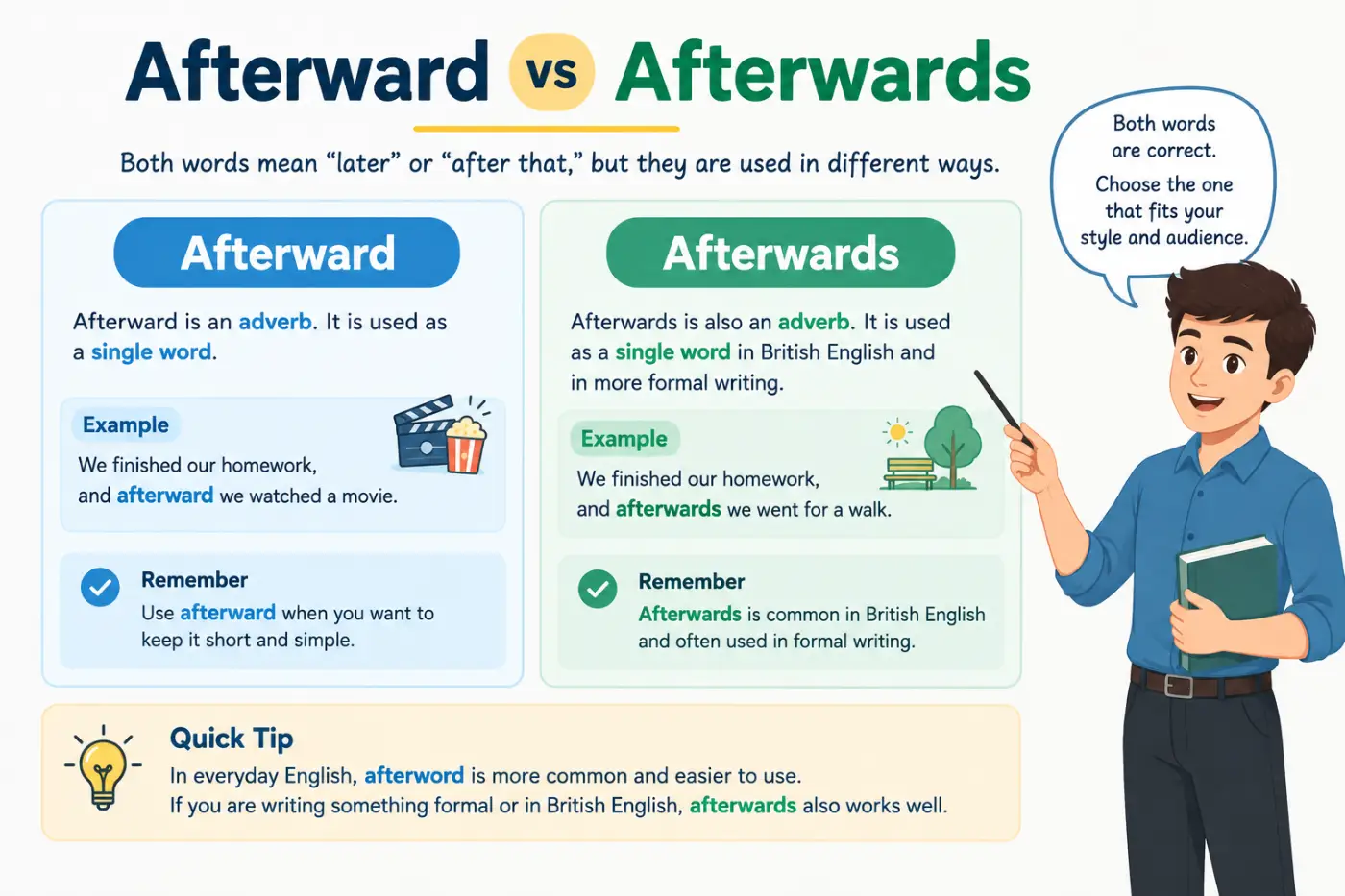
When you’re writing an email, essay, resume, or even a quick text, you may stop at a small word choice: Afterward vs Afterwards. Both forms can look right, and both are common in English. That can make the choice feel harder than it should be.
The good news is simple. Afterward and afterwards have the same basic meaning: they mean at a later time or after something has happened. The main difference is regional preference, not meaning.
In American English, afterward is generally the more common choice. In British English and some other varieties of English, afterwards is also very common. Neither form is grammatically wrong when used correctly.
This guide explains the meaning, history, regional differences, tone, synonyms, common mistakes, and best choices for emails, essays, resumes, texts, and conversation. You’ll also see plenty of examples so you can choose the form that sounds natural in your situation.
What do afterward and afterwards mean?
Afterward and afterwards are adverbs. They tell us that something happens after another event, action, or period of time.
Consider this sentence:
I finished my homework and went outside afterward.
Here, afterward means after finishing the homework.
You could also write:
I finished my homework and went outside afterwards.
The meaning stays the same.
Both words can refer to a time that comes after something already mentioned or understood. They often appear at the end of a sentence, but they can also appear in other positions.
For example:
We went to dinner afterward.
Afterwards, we went to dinner.
She called me afterward.
Afterwards, she called me.
In each pair, the meaning is essentially identical.
The important point is that afterward and afterwards do not describe two different kinds of time. The extra s in afterwards does not create a new meaning.
Is afterward a different word from afterwards?
No. The two words have the same basic meaning and perform the same grammatical job.
The main difference is usage preference.
American English tends to favor afterward, while British English commonly uses afterwards. However, both forms can appear in many varieties of English.
This is similar to several other English pairs in which one regional form is more common than another.
For a U.S. audience, afterward is usually the safest natural choice.
What is the difference between afterward and afterwards?
The difference is mainly regional and stylistic.
| Feature | Afterward | Afterwards |
|---|---|---|
| Meaning | At a later time | At a later time |
| Part of speech | Adverb | Adverb |
| Common in U.S. English | Very common | Common but less preferred |
| Common in British English | Common | Very common |
| Formal writing | Appropriate | Appropriate |
| Informal writing | Natural | Natural |
| Meaning changes | No | No |
If you’re writing for a general American audience, afterward is usually the more natural option.
If you’re writing for a British audience, afterwards may sound more familiar.
Neither spelling automatically makes a sentence more formal or more correct.
What are the best synonyms for afterward and afterwards?
There are many ways to express the idea of something happening later. The best choice depends on the situation, tone, and exact meaning you want.
Some alternatives are close replacements. Others have slightly different meanings.
Not every synonym can replace afterward in every sentence.
For example, eventually can suggest that something took time or happened after delays. Afterward simply establishes what happened later.
Compare:
She apologized afterward.
She eventually apologized.
The first sentence says the apology happened after another event. The second suggests that the apology happened after some waiting, delay, or sequence of events.
That small difference matters.
Which synonyms sound casual or conversational?
In speech and casual messages, people often choose simpler phrases.
Common options include:
- Later.
- Later on.
- After that.
- Soon after.
- After a while.
- Down the line.
- From then on.
Examples:
I’ll text you later.
We can talk about that later on.
After that, we just went home.
We can figure out the details down the line.
These forms are especially useful when you want your writing to sound relaxed.
Which words express different levels of time?
Not every alternative expresses exactly the same amount of time.
You can think of time expressions on a rough scale.
Mild or general later time
These don’t tell the reader exactly how much time passed.
- Later.
- Afterward.
- Afterwards.
- Then.
- After that.
Example:
We talked afterward.
The sentence does not tell us if the conversation happened five minutes later or several hours later.
Short time afterward
These suggest that the next event happened fairly soon.
- Soon after.
- Shortly afterward.
- Not long afterward.
- Right after.
- Immediately afterward.
Example:
She finished the presentation and left shortly afterward.
Long or uncertain later time
These suggest a larger gap or an unspecified future point.
- Much later.
- Eventually.
- At a later date.
- At some point later.
- Down the line.
Example:
Much later, he realized why the decision mattered.
This distinction is useful because afterward itself does not tell us how long the gap was.
What part of speech are afterward and afterwards?
Both afterward and afterwards are adverbs.
An adverb can modify or give information about a verb, adjective, another adverb, or an entire clause. In this case, these words provide information about when an action happens.
Example:
We talked afterward.
The word afterward tells us when we talked.
Another example:
She apologized afterward.
Again, the word explains when the apology happened.
The words can also appear at the beginning of a sentence:
Afterward, we went home.
Afterwards, they discussed the problem.
Because they are adverbs, they don’t normally function as nouns.
You would not normally write:
The afterward was difficult.
That construction is incorrect for ordinary English.
You can also use the noun aftermath, but that is a different word with a different meaning.
Is afterwards more common in British English?
Yes. Afterwards is very common in British English and other varieties influenced by British usage.
For example:
We went out for dinner afterwards.
She called me afterwards.
Afterwards, they returned to the hotel.
These sentences are natural and correct.
British speakers also use afterward, so the distinction is not absolute. Regional preference is better understood as a tendency rather than a strict grammar rule.
The same principle applies to many vocabulary differences between American and British English. A word can be perfectly correct in both varieties while one form feels more natural to a particular audience.
Which should you use in an essay?
For an American English essay, afterward is a clear and natural choice.
Example:
After the experiment, the students discussed their results afterward.
This sentence repeats the time relationship.
Better:
After the experiment, the students discussed their results.
Or:
The students completed the experiment and discussed their results afterward.
Academic writing also gives you alternatives such as subsequently and following this.
Example:
The researchers collected the samples and subsequently analyzed them.
However, simple writing is often clearer.
You don’t need a formal synonym every time you want to show sequence.
Which should you use in an email?
For an American workplace email, afterward is natural and professional.
Example:
I’ll send the revised document afterward.
Another example:
We can discuss the budget afterward.
If you want a slightly more direct tone, you can often use later.
Example:
I’ll send the revised document later.
Both are fine. The choice depends on what you mean.
Later can refer to a later time without necessarily connecting it to a specific event. Afterward usually points back to something already mentioned.
Compare:
I’ll call you later.
I’ll call you afterward.
The first simply means at a later time.
The second suggests after another event or action.
Which should you use when speaking?
In American English, afterward is a very natural spoken choice.
For example:
We’ll talk about it afterward.
I felt tired afterward.
Let’s get something to eat afterward.
In casual speech, later may be even more common.
For example:
I’ll see you later.
I’ll call you later.
The difference is that later is broader. Afterward usually connects the later action to something that has already happened.
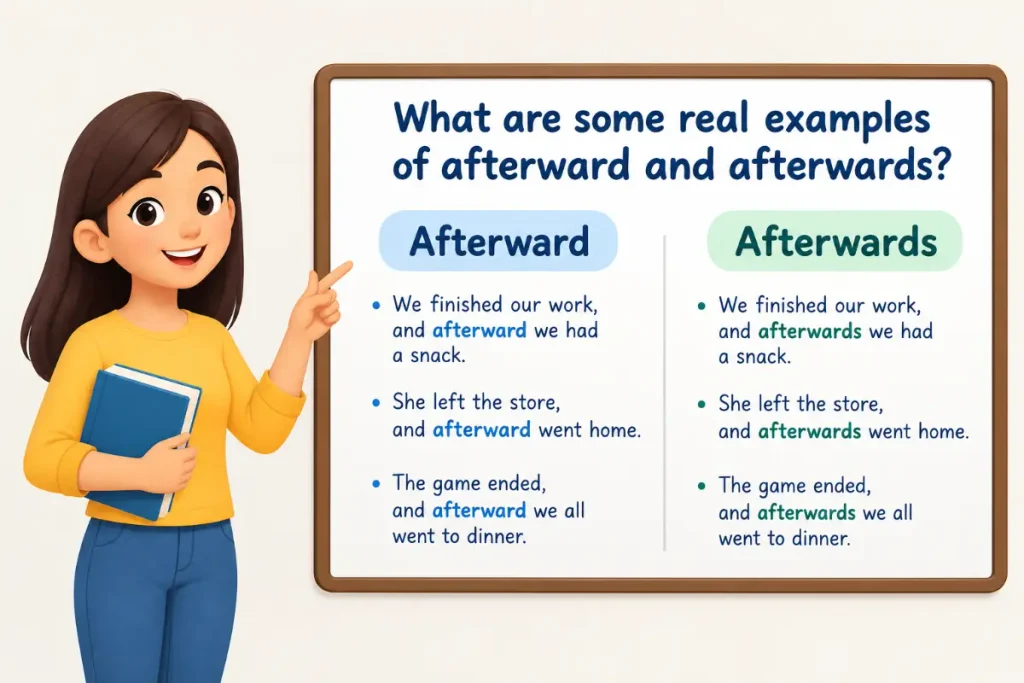
What are some real examples of afterward and afterwards?
Here are examples from different everyday situations.
- School
I studied for the test and watched a movie afterward.
- Work
We finished the meeting and discussed the next steps afterward.
- Travel
They checked into the hotel and went sightseeing afterward.
- Family
We had dinner together and cleaned the kitchen afterward.
- Exercise
She went for a run and stretched afterward.
- Shopping
I went to the grocery store and stopped at the pharmacy afterward.
- Healthcare
The patient rested afterward and reported feeling better.
- Entertainment
We watched the movie and talked about the ending afterward.
- Social events
They attended the party and went home afterward.
- School writing
The students completed the activity and wrote about their experience afterward.
- Business
The manager reviewed the proposal and contacted the client afterward.
- Travel planning
We visited the museum and had lunch afterward.
- Personal communication
I’ll explain everything afterward.
- Sports
The team practiced for two hours and held a short meeting afterward.
- Daily routine
I took a shower and got ready for bed afterward.
These examples show why the word is useful. It creates a clear connection between two events without making the sentence complicated.
Afterward vs later: what’s different?
Afterward and later are close, but they don’t always mean exactly the same thing.
Later simply means at a time after now or after another reference point.
Afterward usually means after a particular event or action that has already been mentioned.
Compare:
I’ll call you later.
I’ll call you afterward.
In the first sentence, we don’t know what event the call will follow.
In the second sentence, the context usually tells us what afterward refers to.
For example:
I’ll finish the meeting and call you afterward.
Now the relationship is clear. The call happens after the meeting.
A useful rule is:
Use later for general future time. Use afterward when you mean after a specific event.
Afterward vs after that: what’s different?
Afterward and after that are extremely close.
Example:
We finished dinner and went for a walk afterward.
We finished dinner. After that, we went for a walk.
Both clearly show sequence.
The difference is mostly sentence structure and style.
After that can feel more conversational and can point directly to a specific event.
Afterward is shorter and often fits smoothly at the end of a sentence.
Choose the one that makes your sentence easier to read.
Afterward vs thereafter: what’s different?
These words are related but not interchangeable in every situation.
Afterward means at a later time.
Thereafter usually means from that point onward or after that event for the period that follows.
Compare:
He moved to Chicago and worked there afterward.
He moved to Chicago and lived there thereafter.
The second sentence suggests that the later period continued from that point.
Thereafter also has a more formal tone. It is common in legal, historical, and formal writing.
For ordinary American English, afterward is usually simpler.
What are common mistakes with afterward and afterwards?
The words themselves are easy once you understand their meaning, but several mistakes appear in sentences using them.
Mistake 1: Treating afterwards as incorrect
Some writers believe the s in afterwards makes the word wrong.
It does not.
Afterwards is a standard English adverb.
Example:
We went home afterwards.
This is grammatically correct.
Mistake 2: Assuming afterward is always the only correct form
This is also incorrect.
Afterward is common and natural, especially in American English, but afterwards is also standard English.
The right choice can depend on regional preference.
Mistake 3: Using both after and afterward unnecessarily
Consider:
After the meeting, we talked afterward.
This can be grammatically understandable, but it is often repetitive because both parts already establish the same time relationship.
Better:
After the meeting, we talked.
Or:
We finished the meeting and talked afterward.
Mistake 4: Confusing afterward with afterword
These are different words.
Afterward means at a later time.
Afterword is a section at the end of a book.
Example:
The author explained the research in the afterword.
Do not confuse the two.
Mistake 5: Using afterward when you mean eventually
Consider:
She eventually finished the project.
This means she finished it after some time or delay.
You could say:
She finished the project afterward.
But that sentence needs a reference point. It means she finished it after something else.
For example:
She attended the training and finished the project afterward.
The words aren’t interchangeable in every context.
When should you not use afterward?
There are situations where another expression is clearer.
When you mean a general future time
Use later.
Less natural:
I’ll call you afterward.
This can be correct, but it may sound incomplete if no event has been mentioned.
Better:
I’ll call you later.
When you mean immediately after
Use right after or immediately afterward.
Example:
I’ll call you immediately afterward.
This gives the reader a stronger sense of timing.
When you mean from that point onward
Use thereafter or from then on.
Example:
From then on, she arrived early every morning.
When you mean after a long delay
Use eventually or much later.
Example:
Eventually, he understood the problem.
The word afterward alone doesn’t communicate the delay.
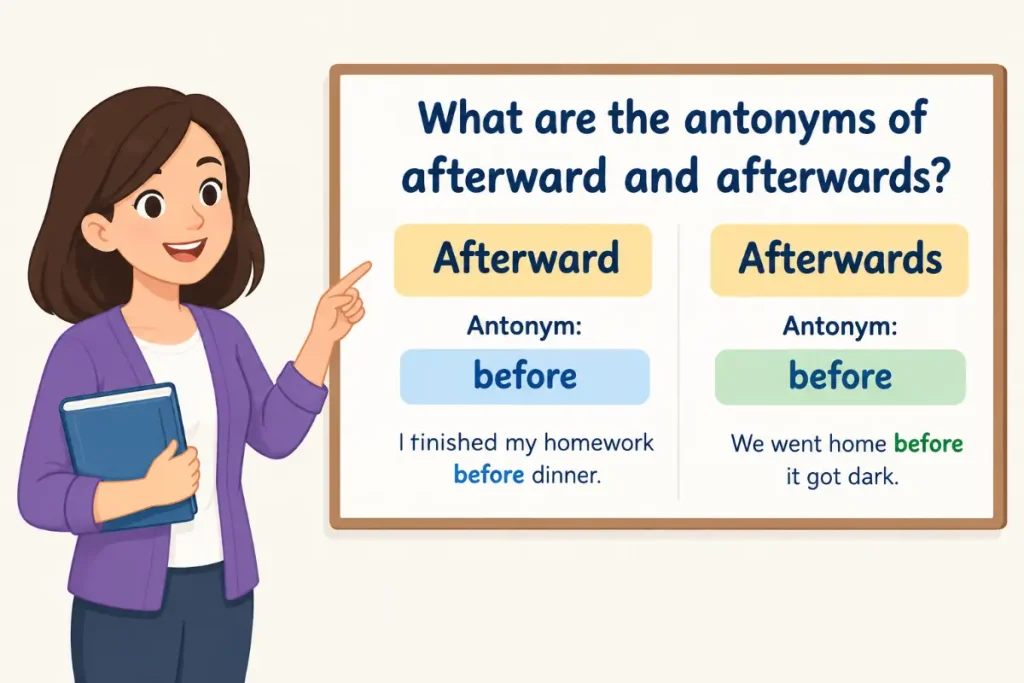
What are the antonyms of afterward and afterwards?
The best opposite depends on the sentence.
Common contrasting time expressions include:
| Antonym or contrast | Meaning | Example |
|---|---|---|
| Before | Earlier than something | I saw her before lunch. |
| Previously | At an earlier time | We had previously discussed it. |
| Earlier | Before the present or another time | She arrived earlier. |
| Prior to | Before something | He called prior to the meeting. |
| In advance | Before an event | Please prepare in advance. |
| First | Before another step | We should eat first. |
| Until then | Up to a specified point | Wait here until then. |
For example:
We went shopping afterward.
The contrast could be:
We went shopping beforehand.
Beforehand is especially useful when the action happens before a known event.
How do you choose the right word quickly?
A few simple questions can make the choice easy.
Ask if you mean after a specific event
If yes, afterward or afterwards may work.
Example:
We went home afterward.
Ask if you simply mean a later time
If yes, later may be more natural.
Example:
I’ll call you later.
Ask if you need a formal word
If yes, consider subsequently or thereafter, depending on the exact meaning.
Example:
The results were subsequently reviewed.
Ask who your readers are
For American readers, afterward is usually the most natural default.
For British readers, afterwards is also highly natural.
Ask if you need to show a short time gap
Use soon after, shortly afterward, or right after.
Example:
She left shortly afterward.
Ask if you mean a long delay
Use eventually or much later.
Example:
Much later, they discovered the truth.
Can afterward come at the beginning of a sentence?
Yes.
Example:
Afterward, we went to the restaurant.
This position is perfectly natural.
You can also put it at the end:
We went to the restaurant afterward.
The ending position is especially common in everyday American English.
Another example:
Afterward, she called her parents.
She called her parents afterward.
Both are correct.
Can you use afterward with a comma?
Yes, but comma use depends on placement.
When the word begins a sentence as an introductory adverb, a comma often makes the sentence easier to read.
Example:
Afterward, we went home.
At the end of a sentence, you don’t need a comma before it.
Example:
We went home afterward.
The same pattern works with afterwards.
Example:
Afterwards, we went home.
We went home afterwards.
Does afterward sound formal?
No. Afterward is generally neutral.
It works in everyday conversation, school writing, workplace communication, and many types of professional writing.
Examples:
I’ll call you afterward.
The team discussed the results afterward.
The researchers analyzed the data afterward.
For highly formal writing, subsequently may sometimes fit better, but there is no rule saying you need a formal alternative.
Clear writing is often better than unnecessarily complicated writing.
Is afterwards informal?
Not necessarily.
Afterwards is a standard English word. It can appear in casual, professional, academic, and literary writing.
Its main distinction from afterward is regional preference.
For example:
The researchers reviewed the findings afterwards.
That sentence is perfectly acceptable.
Why do some adverbs have an extra s?
English has several adverbs that can appear with or without an s in certain cases.
Words such as toward and towards are a well known example.
Similarly, afterward and afterwards both exist.
Language often develops multiple forms over time. Speakers in different regions may prefer one form without considering the other incorrect.
This is one reason English can contain pairs that look slightly different but perform the same grammatical function.
The extra s in afterwards does not mean the word has a different definition.
Can you use both forms in the same article?
Yes, but consistency is usually better.
If you’re writing for a U.S. audience, using afterward throughout the article will create a consistent American English style.
If you’re writing for a British audience, afterwards may fit naturally.
You don’t need to force both forms into your writing just to show that they exist.
Choose the form that matches your audience and use it naturally.
Conclusion
The choice between afterward and afterwards is much simpler than it first appears. Both words mean at a later time, and both are standard English. The main difference is regional preference. Afterward is especially common in American English, while afterwards is particularly common in British English.
Choose based on your audience, not on the idea that one form is correct and the other is wrong. For U.S. writing, afterward is an easy default. If you want a different shade of meaning, consider words such as later, after that, subsequently, or eventually, but make sure the replacement matches the timing you mean.
Frequently Asked Questions
Is afterward or afterwards correct in American English?
Both are correct, but afterward is generally the more common choice in American English.
Is afterward or afterwards more British?
Afterwards is very common in British English, although British speakers also use afterward.
What’s another way to say afterward?
Common alternatives include later, after that, soon after, subsequently, and later on, depending on the exact meaning and tone.
Does afterward mean the same thing as later?
They are similar, but afterward usually refers to a time after a particular event, while later has a broader meaning.
Can I use afterward in formal writing?
Yes. Afterward is a standard neutral adverb and works well in professional, academic, and formal writing.
Is afterwards a grammar mistake?
No. Afterwards is a standard English word and is especially common in British English and other varieties.
Should I use afterward or afterwards in an American essay?
For an American audience, afterward is a natural default, but afterwards is not grammatically wrong.

Daniel Grammarfield — The Language Learner
Age: 28Occupation: ESL Learner & Digital Professional
Bio:Daniel is a non-native English speaker who wants to communicate more confidently at work and online. He uses Synotrench to improve grammar, understand confusing words, learn correct sentence structures, and build everyday English skills. He prefers simple explanations with practical examples.
Goals:
Master English grammar rules
Avoid common language mistakes
Improve professional communication
Learn English through real-life examples
Quote:“Learning English is not about memorizing rules — it’s about expressing ideas clearly.”
2 thoughts on “Afterward vs Afterwards: The Best Simple Guide (2026)”