You’re writing an email about a computer accessory, finishing an essay, or texting someone about a charger, and suddenly you stop: should you write adapter vs adaptor? Both spellings look right, and both appear in real English. That can make this small spelling choice surprisingly confusing.
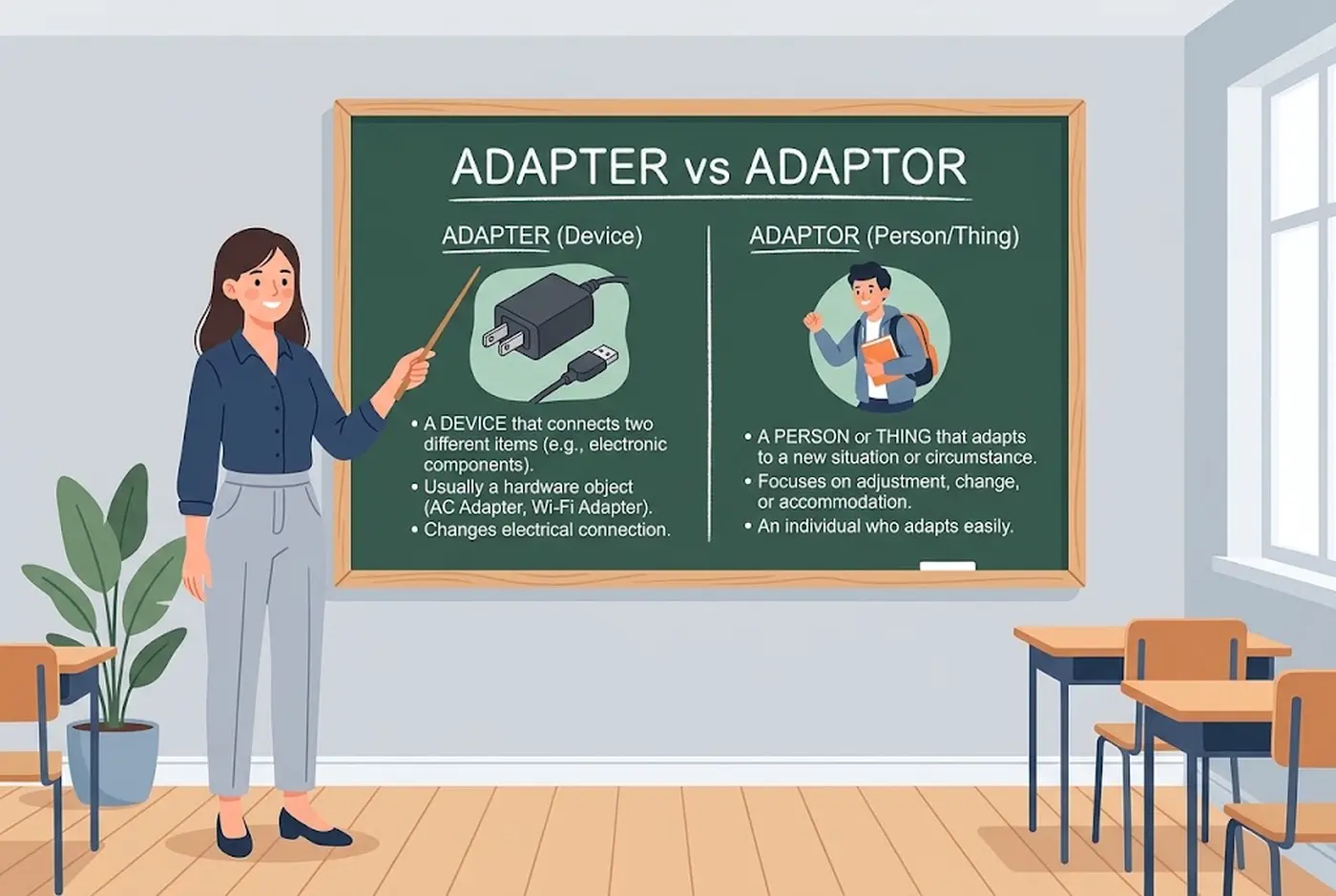
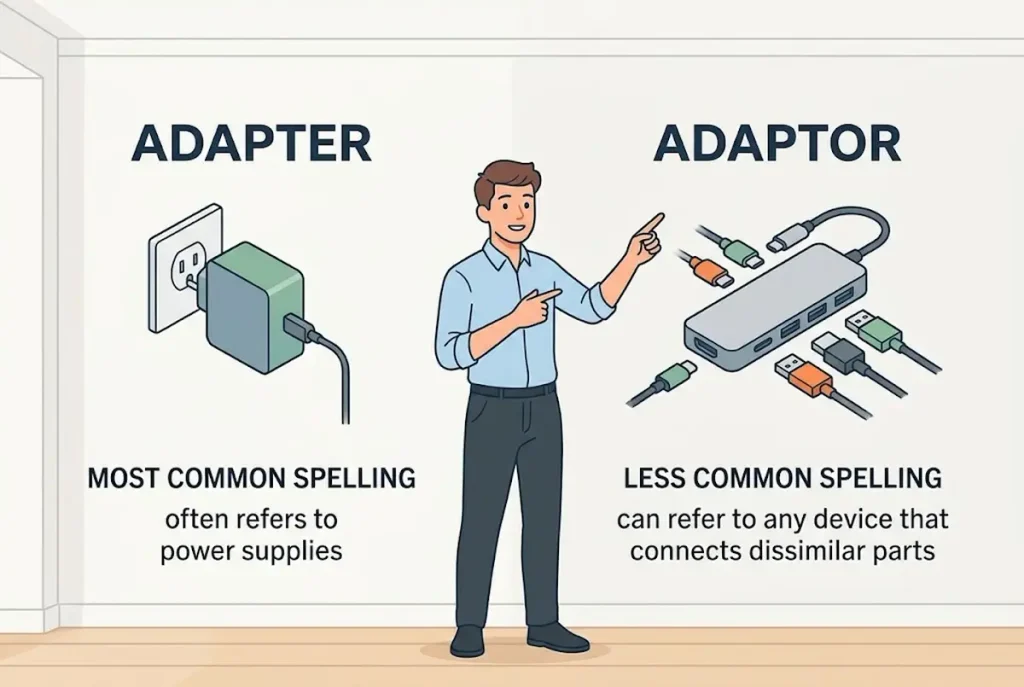
Adapter and adaptor are usually interchangeable spellings for the same noun. In US English, adapter is the usual choice, while British English accepts both adapter and adaptor.
In this guide, you’ll learn where the words came from, how their meanings developed, which related words fit different situations, and which form works best in emails, resumes, essays, texts, and everyday speech. You’ll also see real examples, close word comparisons, common mistakes, and quick rules you can remember.
What do adapter and adaptor mean?
When comparing adapter vs adaptor, the first thing to understand is that the two spellings normally describe the same basic idea. An adapter or adaptor is something that helps one thing fit, connect, or work with another thing.
For example, imagine that your laptop has one kind of port but your monitor uses another. A small device can help connect the two. You might call that device an adapter or an adaptor.
Where did adapter and adaptor come from?
The noun adapter appeared in English around 1801. At first, it referred to a person who adapts something for a particular purpose. By 1808, the word was also being used for a mechanical means of adapting objects so they could fit or work together. The electrical engineering sense developed later, by the early twentieth century. The word comes from adapt.
The verb adapt entered English through Old French and ultimately comes from Latin adaptare, meaning to adjust or fit. The Latin word combines elements connected with the ideas of moving toward something and fitting or joining it.
That history gives us a useful memory trick.
Adapt means to make something fit a new purpose. An adapter is something, or sometimes someone, that helps make that fit happen.
Is adapter or adaptor more common in American English?
For most American writing, adapter is the natural choice. If you are writing for an American audience, using adapter will usually look familiar and standard.
You might see phrases such as:
- Power adapter.
- USB adapter.
- Network adapter.
- Audio adapter.
- Wireless adapter.
- Travel adapter.
- HDMI adapter.
Cambridge’s American English dictionary uses adapter for the device meaning.
Is adaptor correct in British English?
Yes. Adaptor is an accepted British English spelling. British English uses both forms, so you may see adapter and adaptor in British writing. Cambridge specifically lists adaptor as an alternative form of adapter in its British English information.
For example, British readers may encounter:
- Power adaptor.
- Travel adaptor.
- USB adaptor.
- Network adaptor.
At the same time, adapter is also used in British English. So it would be inaccurate to say that British English always uses adaptor.
Adapter vs Adaptor in a quick comparison
| Feature | Adapter | Adaptor |
|---|---|---|
| Basic meaning | A device or person that adapts | A device or person that adapts |
| US English | Very common | Accepted but less usual |
| British English | Common | Common |
| Technical writing | Very common | Also used |
| Device meaning | Yes | Yes |
| Person meaning | Yes | Yes |
| Pronunciation | Usually the same | Usually the same |
| Main difference | Spelling | Spelling variant |
The important point is that the two forms normally do not describe two different kinds of equipment.
What are 25 useful words related to adapter?
There is no single perfect synonym for adapter because the best replacement depends on what the device actually does.
A connector may simply join two things. A converter may change one type of signal or power into another. A coupler may join components. A dongle may be a small electronic accessory. Not every word in this table can replace adapter in every sentence. That distinction matters.
For example, a charger is not automatically an adapter. A cable is not automatically an adapter. A connector is not automatically an adapter. These words overlap in some situations, but their meanings are not identical.
Which synonyms work for different meanings?
When choosing a related word, first ask what the device actually does.
If it simply joins two pieces, connector may be accurate.
If it connects two networks or systems, interface or bridge may fit.
This is why blindly replacing one word with another can make a sentence less accurate.
What are synonyms for adapter from mild to strong?
Intensity is not a perfect category for this noun because an adapter does not normally express an emotion or degree of force.
However, you can organize related terms by how much change they suggest.
Mild connection words
These suggest that two things are simply being joined.
- Connector.
- Link.
- Coupler.
- Fitting.
- Attachment.
Example:
The connector joins the two cables.
Moderate compatibility words
These suggest that something is being made suitable for another system.
- Adapter.
- Interface.
- Compatibility device.
- Bridge.
- Integration device.
Example:
The adapter allows the older device to connect to the new computer.
Stronger transformation words
These suggest that the device changes the form, format, signal, or function.
- Converter.
- Conversion unit.
- Transformation device.
- Reconfiguration unit.
Example:
The converter changes the digital signal into an analog signal.
The difference is useful because adapter is often broad, while converter can describe a more specific kind of change.
What part of speech is adapter?
Adapter is primarily a noun.
It names a person or thing.
Examples include:
- The adapter is on the desk.
- I bought a new adapter.
- The adapter connects the two devices.
- The adapter stopped working.
- The adapter was included with the monitor.
The related word adapt is a verb.
Example:
The software can adapt to different systems.
Adaptable is an adjective.
Example:
The design is adaptable to different environments.
Adaptation is a noun.
Example:
The adaptation made the story easier to perform on stage.
Adaptive is an adjective.
Example:
The system uses adaptive technology.
This family of words is useful because they share the same basic idea of adjustment and suitability.
What does adapter mean when it refers to a person?
The word is not limited to electronics.
An adapter can also be a person who changes an existing work so it can be used in another form.
For example, a person might adapt a novel into a screenplay.
You could write:
The adapter changed several scenes for the stage version.
This meaning is especially useful in discussions about:
- Movies.
- Theater.
- Screenplays.
- Television.
- Literature.
- Stage productions.
- Audio drama.
- Retellings.
So the word can describe both a physical device and a person who modifies creative work.

Which word should you use in a resume?
For a resume, use adapter when you are discussing technology, equipment, or a person who adapts creative material.
However, your choice should depend on the exact meaning.
For a technical resume:
I installed and maintained network adapters for office computers.
For a creative resume:
I worked as an adapter on a stage production based on a short novel.
In American English, adapter is generally the safer spelling for a professional resume.
Avoid changing the spelling just to sound more formal. Adaptor is not automatically more professional.
Which spelling is best in an essay?
For an American English essay, adapter is usually the easiest choice.
For example:
The researcher used a special adapter to connect the instrument to the computer.
If your teacher or institution follows British English, adaptor can also be appropriate.
The most important thing is consistency.
If your essay uses American spelling throughout, use adapter.
If you are following British spelling conventions and have chosen adaptor, keep that style consistent.
Which spelling works best in a text message?
Text messages are flexible, but adapter is still the clearest everyday choice for most American readers.
You might text:
I forgot my laptop adapter.
Or:
Do you have a phone adapter I can borrow?
You do not need a complicated synonym when a simple word works.
In casual writing, people may also say plug, converter, or dongle, but these words should only be used when they accurately describe the object.
Which spelling should you use in an email?
For an American business email, adapter is a strong default.
Example:
Could you please bring the HDMI adapter to the meeting?
Another example:
The new monitor needs a different power adapter.
If you are communicating with a British organization, adaptor may fit the organization’s preferred spelling, but adapter is still recognized in British English.
Which spelling should you use when speaking?
You can use either form in speech because the difference is mainly written spelling.
The pronunciation is normally the same or very close, so listeners usually cannot tell which spelling you would use on paper.
That means you should focus on the meaning rather than trying to pronounce the two forms differently.
If someone says “adapter,” they are not necessarily using an American form. If someone says “adaptor,” the spoken difference is generally not meaningful.
What are real examples of adapter and adaptor?
Here are original examples covering technology, work, travel, education, and everyday conversation.
- I need a new adapter for my laptop.
- The camera came with a small power adapter.
- We used an adapter to connect the old monitor to the new computer.
- Please bring the USB adapter to the conference room.
- The travel adapter works with the wall socket in several countries.
- My headphones need an adapter because the phone does not have the older port.
- The technician replaced the damaged network adapter.
- The printer works correctly after we installed the correct adapter.
- I left my power adapter at the hotel.
- The engineer designed an adapter for the older equipment.
- The theater adapter changed the novel so it could be performed on stage.
- The film adapter removed several scenes from the original book.
- Our team needs an adapter that supports the older connection.
- She bought a camera adapter before the photography trip.
- The computer recognized the wireless adapter immediately.
- The adapter lets the two systems communicate.
- The technician checked the adapter before replacing the entire cable.
- The travel adaptor was packed inside the suitcase.
- The company ordered several network adaptors for the new office.
- The adapter was smaller than I expected.
These sentences show why context matters. The word can describe a physical component, a technical device, or a person working with creative material.
Adapter vs converter: what is the difference?
Adapter is a broader word, while converter often suggests that something is being changed from one form to another.
An adapter may simply make two incompatible connections work together.
A converter may actually change a signal, format, measurement, voltage, or other form.
Compare these examples.
| Adapter | Converter |
|---|---|
| Connects equipment | Changes one form into another |
| Often solves compatibility problems | Often performs a transformation |
| Can involve physical connections | Can involve signals, formats, or power |
| Broad term | More specific in many technical contexts |
For example:
The HDMI adapter connects my computer to the monitor.
The signal converter changes the video signal into a format the monitor can use.
There can be overlap, though. Some products are marketed as adapters even though they perform conversion. Product names are not always perfect technical classifications.
Adapter vs connector: what is the difference?
A connector is usually the part that physically joins two components.
An adapter often does more than simply connect. It can make two different connection types compatible.
For example:
The connector joins two matching cables.
The adapter allows a cable with one connector type to work with a device using another type.
Think of it this way:
Connector means join. Adapter means make compatible.
The distinction is not absolute, but it is useful in everyday technical writing.
Adapter vs dongle: are they the same?
Not exactly.
A dongle is an informal technology term for a small device that plugs into a computer or another piece of equipment.
Some dongles function as adapters, but not every dongle should be called an adapter.
For example, a USB device used to provide wireless access might be called a dongle. A small USB accessory that changes one port type to another can also be described as an adapter.
So dongle is more casual and technology focused, while adapter is broader and more neutral.
Adapter vs power supply: what is the difference?
A power supply provides electrical power to equipment.
An adapter can sometimes be part of that power system, but the two terms are not always interchangeable.
For example:
My laptop power adapter is plugged into the wall.
That sentence works because the device changes and supplies power in the way the laptop needs.
But you should not automatically call every power supply an adapter.
A battery, power bank, internal power supply, and wall charger can all provide power without being the same kind of device.
What are the most common mistakes with adapter and adaptor?
Several mistakes appear again and again.
Mistake 1: Thinking adaptor is always wrong
It is not.
Adaptor is an accepted spelling, particularly in British English.
Mistake 2: Thinking adapter and adaptor have different meanings
In most ordinary contexts, they have the same meaning.
The spelling does not normally tell the reader that one device performs a different job.
Mistake 3: Assuming adaptor is always British
British English accepts adaptor, but it also uses adapter.
So it is better to say that adaptor is common and accepted in British usage rather than claiming that it belongs exclusively to Britain.
Mistake 4: Calling every connector an adapter
A connector and an adapter can overlap, but they are not always identical.
A connector may simply join matching parts.
An adapter often helps different systems or connection types work together.
Mistake 5: Calling every converter an adapter
A converter may perform a real transformation.
If the technical function matters, use the more precise term.
Mistake 6: Changing the spelling randomly
If you are writing a technical document, choose a spelling style and keep it consistent.
Switching between adapter and adaptor for no reason can make the document look poorly edited.
Mistake 7: Using slang in formal writing
Words such as dongle or brick may be normal in casual technology conversations, but they may not be suitable for a formal report.
Use the precise technical term when accuracy matters.
When should you not use adapter or adaptor?
There are situations where another word is more accurate.
Do not use adapter simply because two things are related.
Use cable when you mean a cable.
Use connector when you mean the connecting part.
Use charger when you mean equipment designed to charge a battery.
Use converter when the important function is changing one type of signal, format, or electrical characteristic into another.
Use interface when you are describing a boundary or connection point between systems.
Use attachment when you mean something added to a larger object.
For example, saying “I need a new adapter” may be too vague if the person actually needs a charging cable.
Clear writing depends on choosing the word that describes the function accurately.
What are the antonyms of adapter?
There is no single perfect opposite of adapter.
The closest opposite ideas depend on the context.
Possible contrasting terms include:
- Mismatch.
- Incompatibility.
- Disconnect.
- Separation.
- Nonmatching component.
- Fixed component.
- Unmodified system.
These are not exact dictionary antonyms.
For example, if an adapter makes two systems compatible, then incompatibility describes the condition that exists without successful adaptation.
What should you remember about adapter vs adaptor?
When thinking about adapter vs adaptor, keep the rule simple.
- Both spellings are accepted.
- Both normally have the same meaning.
- Adapter is the usual choice for American English.
- British English accepts both forms.
- Adaptor is not automatically more formal.
- Adapter is not automatically more technical.
- The spelling does not normally change the meaning.
- Use connector when you mean a simple joining part.
- Use converter when the device changes something from one form to another.
- Keep your spelling consistent in formal writing.
If you are writing for a general American audience and you have no special style requirement, adapter is usually the safest choice.
How can you choose the right word quickly?
You can make the choice in a few seconds by asking three questions.
Is it connecting two things?
If yes, words such as connector, coupler, or adapter may work.
Is it making two different systems compatible?
If yes, adapter is often a good choice.
What is the best spelling for American readers?
For American readers, adapter is generally the most natural spelling.
Use it in:
- School essays.
- Business emails.
- Resumes.
- Product descriptions.
- Technical documents.
- Blog posts.
- Text messages.
- General web content.
For example:
The wireless adapter allows the computer to connect to the network.
This looks natural to an American reader.
What is the best spelling for British readers?
For British readers, you can use adapter or adaptor.
If your organization has a style guide, follow it.
If it uses adaptor consistently, use adaptor.
If it uses adapter, use adapter.
The important point is not to present one as the only legitimate British spelling. Cambridge recognizes both forms.
Why does spelling consistency matter?
Spelling consistency helps readers trust your writing.
Imagine a technical manual that uses adapter on one page, adaptor on another, and converter for the same product elsewhere.
The reader may wonder if these words refer to different components.
Even when two spellings are both correct, changing between them without a reason can create confusion.
For a professional document, choose the spelling that matches your audience and style guide.
For US English, adapter is a strong default.
For British English, either accepted form can work.
What should a teacher tell students about adapter and adaptor?
A simple classroom explanation would be:
Adapter and adaptor are two accepted spellings of the same word. Adapter is more common in American English, while British English uses both forms.
Students do not need to memorize a complicated rule.
They only need to remember the regional preference and the basic meaning.
If the assignment follows US English, write adapter.
If the assignment follows British English, check the style being used and stay consistent.
The bigger vocabulary lesson is also useful: similar words are not always exact synonyms.
A connector, converter, cable, charger, and adapter may all appear in the same technology conversation, but each word can describe a different function.
Final tips for using adapter correctly
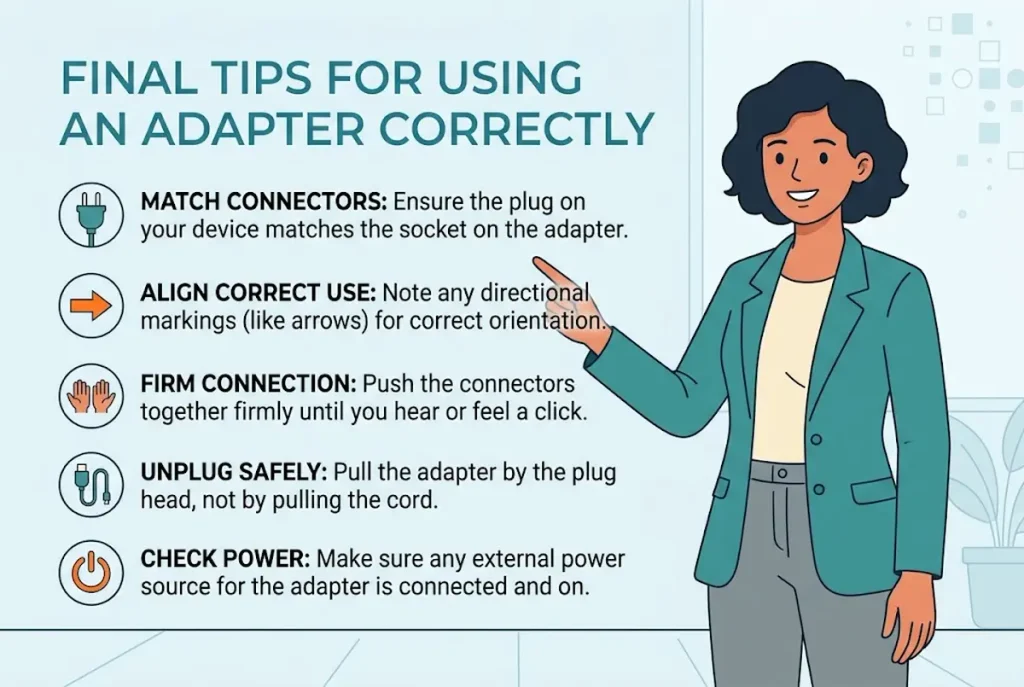
Here are the quickest rules to keep in mind.
- Choose adapter for most American English writing.
- Remember that adaptor is also a valid spelling.
- Do not assume adaptor has a different meaning.
- Do not assume adaptor is more formal.
- Use connector when the main function is joining.
- Use converter when the main function is changing one form into another.
- Use dongle only when the informal technology term fits.
- Use charger or power supply when that is the actual function.
- Follow your workplace or school style guide.
- Stay consistent throughout the same document.
- Check the technical meaning before choosing a synonym.
- Do not change a correct spelling just because another version looks unfamiliar.
Conclusion
When you compare adapter vs adaptor, the main difference is spelling rather than meaning. Both forms can refer to a device or person that helps something work in a different setting. American English generally favors adapter, while British English accepts both adapter and adaptor.
The safest choice for US writing is simple: use adapter. If you are writing for a British audience, either spelling can work, especially when you follow the style already used by the publication or organization.
Also remember that related words such as connector, converter, interface, and dongle are not perfect replacements in every situation. Choose the word that describes the actual function of the object. Once you understand that distinction, this spelling question becomes much easier.
Frequently Asked Questions
Is adapter or adaptor correct?
Both are correct spellings in English. Adapter is generally preferred in American English, while British English accepts both forms.
Is adaptor British or American?
Adaptor is especially common in British English, but it is not exclusively British. British English also uses adapter.
Is adapter more correct than adaptor?
Neither spelling is universally more correct. The preferred form depends mainly on regional usage and the style being followed.
What’s another way to say adapter?
Depending on the context, you can use words such as connector, converter, coupler, interface, fitting, or dongle. These words have related meanings but are not always exact replacements.
Does adapter mean the same as adaptor?
Yes. In ordinary usage, adapter vs adaptor refers to two spelling forms of the same noun, not two different objects.
What is the difference between an adapter and a converter?
An adapter usually helps different equipment or connection types work together, while a converter often changes one type of signal, format, or other form into another.
Should I use adapter in American English?
Yes. Adapter is the natural default for most American English writing, including emails, essays, resumes, and technical content.

Daniel Grammarfield — The Language Learner
Age: 28Occupation: ESL Learner & Digital Professional
Bio:Daniel is a non-native English speaker who wants to communicate more confidently at work and online. He uses Synotrench to improve grammar, understand confusing words, learn correct sentence structures, and build everyday English skills. He prefers simple explanations with practical examples.
Goals:
Master English grammar rules
Avoid common language mistakes
Improve professional communication
Learn English through real-life examples
Quote:“Learning English is not about memorizing rules — it’s about expressing ideas clearly.”
2 thoughts on “Adapter vs Adaptor Best Simple Guide (2026)”