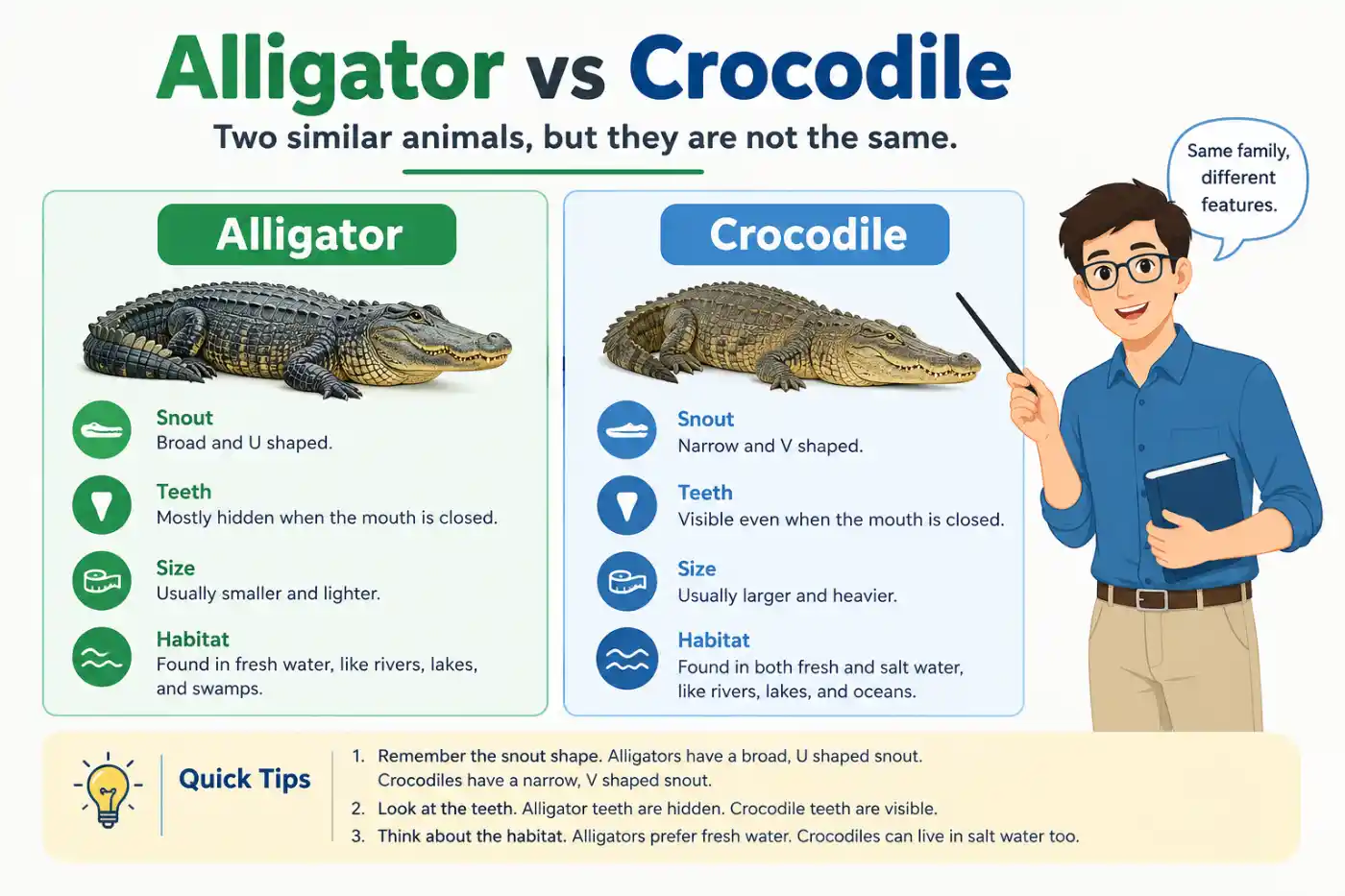
If you’ve ever stopped while watching Alligator vs Crocodile a wildlife documentary, writing a school essay, or answering a question about reptiles, you may have wondered about the difference between an alligator and a crocodile. At first glance, they look almost identical. Both are large reptiles with long tails, powerful jaws, rough skin, and a very old evolutionary history.
An alligator is also generally associated with freshwater habitats in the United States and China. Crocodiles have a much wider global range and can live in freshwater, saltwater, and coastal environments, depending on the species.
This guide explains the differences in appearance, habitat, behavior, size, diet, word origins, vocabulary, common mistakes, and real life usage. It also covers how to describe these reptiles clearly in an essay, email, conversation, or classroom answer.
What is the difference between an alligator and a crocodile?
The main difference between an alligator and a crocodile is the shape of the snout, the way the teeth appear when the mouth is closed, and the animal’s geographic range.
| Feature | Alligator | Crocodile |
|---|---|---|
| Snout | Broad and rounded | Narrower and more pointed |
| Closed mouth | Lower teeth are mostly hidden | Some lower teeth can remain visible |
| Fourth lower tooth | Usually hidden | Often visible |
| Common habitat | Freshwater and wetlands | Freshwater, wetlands, rivers, and coastal areas |
| Main modern range | United States and China | Africa, Asia, Australia, and the Americas |
| Body shape | Usually broader | Often more slender |
| Saltwater tolerance | Lower overall | Some species tolerate saltwater well |
| Appearance | Often darker | Often lighter or olive colored |
| Typical behavior | Often less aggressive toward humans | Behavior varies greatly by species |
| Species diversity | Two living alligator species | More than a dozen living crocodile species |
These differences are useful clues, but nature does not always follow a perfect visual checklist. Young animals can be harder to identify, and lighting can change how their colors appear.
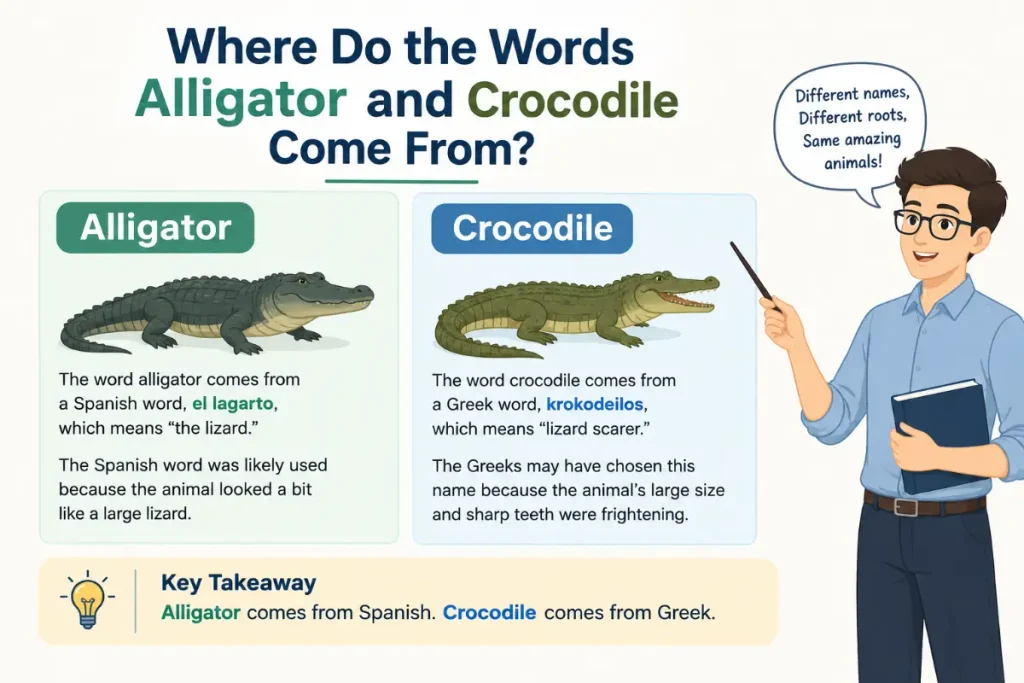
Where do the words alligator and crocodile come from?
The word alligator comes from Spanish. Early Spanish explorers used a form related to el lagarto, meaning “the lizard,” when describing the large reptiles found in the Americas. English speakers eventually adapted the expression into alligator.
The word crocodile has an older history. It can be traced through Latin and Greek forms connected with krokódilos, an ancient Greek word used for a kind of lizard or crocodilian animal.
So, the two names did not develop as simple English pairs. They came through different language histories and became established as names for different groups of reptiles.
This history also explains why the words don’t have ordinary synonyms in the same way that words such as happy and joyful do.
Are alligator and crocodile synonyms?
No. Alligator and crocodile are not true synonyms.
They are names for different groups of crocodilian reptiles. Both belong to the broader reptile group known as Crocodylia, but an alligator is not simply another word for a crocodile.
This distinction matters in scientific writing, school assignments, wildlife descriptions, and factual articles.
For example:
An alligator was resting near the edge of the pond.
A crocodile was swimming across the river.
Replacing one word with the other can change the factual meaning of the sentence.
Because these animals are related, people often use the names loosely in everyday speech. Still, they are not interchangeable.
What related words should you know?
Since these animal names do not have 20 or 30 true synonyms, it would be misleading to create a fake synonym list. Instead, the table below gives useful related terms. These words help you describe, identify, or discuss crocodilians more precisely.
Simple related words
| Word | Meaning | Tone | Example |
|---|---|---|---|
| Reptile | A cold blooded vertebrate with scales | Simple | An alligator is a reptile. |
| Animal | A living creature | Simple | The animal moved into the water. |
| Predator | An animal that hunts other animals | Simple | The crocodile is an effective predator. |
| Hunter | An animal that catches prey | Simple | The crocodile is a patient hunter. |
| Jaw | The bone structure around the mouth | Simple | Its jaws are extremely powerful. |
| Teeth | Hard structures used for biting | Simple | The animal has many sharp teeth. |
| Tail | The long rear part of the body | Simple | Its tail pushed it through the water. |
| Snout | The projecting nose and mouth area | Simple | Look at the shape of its snout. |
Everyday related words
| Word | Meaning | Tone | Example |
|---|---|---|---|
| Gator | Informal short form of alligator | Everyday | We saw a gator near the marsh. |
| Croc | Informal short form of crocodile | Everyday | The guide spotted a croc in the river. |
| Swamp | Wet land with standing or slow moving water | Everyday | Several alligators live in the swamp. |
| Marsh | Wet grassy land | Everyday | The animal disappeared into the marsh. |
| River | A natural flowing body of water | Everyday | A crocodile was seen near the river. |
| Pond | A small body of still water | Everyday | The alligator stayed near the pond. |
| Wetland | Land covered or saturated with water | Everyday | Wetlands provide important habitat. |
| Hatchling | A recently hatched young animal | Everyday | The hatchlings stayed close to their mother. |
Informal terms and expressions
| Word | Meaning | Tone | Example |
|---|---|---|---|
| Gator | Short informal form of alligator | Slang or informal | The guide said a gator was nearby. |
| Croc | Short informal form of crocodile | Slang or informal | The camera captured a croc in the water. |
| Big reptile | Casual description of a large reptile | Informal | We saw a big reptile near the bank. |
| River predator | Casual description of a hunting reptile near a river | Informal | The river predator stayed below the surface. |
| Swamp reptile | Casual description connected with swamp habitat | Informal | The swamp reptile moved quietly through the reeds. |
These terms are related vocabulary, not interchangeable replacements. For example, gator can replace alligator in informal American English, but predator cannot. Predator describes a role, not the animal’s exact identity.
How can you tell an alligator from a crocodile?
The snout is one of the quickest clues.
An alligator normally has a wider, more rounded snout. It can look somewhat U shaped when viewed from above.
A crocodile usually has a narrower and more pointed snout. The shape can look closer to a V.
The teeth provide another useful clue. When an alligator closes its mouth, its upper jaw is wider than its lower jaw, so the lower teeth are generally hidden. When a crocodile closes its mouth, its upper and lower jaws fit differently, allowing some lower teeth to remain visible.
The fourth lower tooth is particularly useful. In many crocodile species, a large tooth near the front of each side can remain visible when the mouth is closed.
Color can help, but it should not be your first test. Alligators are often darker, while crocodiles can appear gray, olive, brown, or greenish. Color varies with species, age, environment, and lighting.
What does an alligator look like?
An alligator usually has a broad head, rounded snout, dark skin, and a powerful tail.
The American alligator is especially well known in the southeastern United States. Adult animals can become very large, although size varies by sex, age, habitat, and individual.
Young alligators often have bright yellow markings on a darker background. These markings can help them blend into vegetation and shadow.
What does a crocodile look like?
A crocodile generally has a longer and narrower head than an alligator. Its snout often appears more pointed.
Crocodile species vary greatly in size and appearance. Some have broad snouts, so snout shape alone should not be treated as an absolute rule.
Crocodiles also have strong tails that help them move through water. Their eyes and nostrils sit high on the head, allowing them to remain mostly submerged while watching and breathing.
What do alligators and crocodiles eat?
Both groups are carnivorous predators, although their diets change with age, body size, location, and available prey.
Young animals may eat insects, small fish, crustaceans, frogs, and other small creatures.
Larger animals can eat fish, birds, turtles, mammals, and other animals that come close to the water.
Large crocodilians can use powerful jaws to capture prey. They often rely on stealth rather than chasing animals for long distances.
An animal may remain almost motionless in the water and wait for prey to approach. This hunting method is one reason crocodilians are often described as ambush predators.
How do alligators and crocodiles behave?
Both animals spend a lot of time in or around water, but they also come onto land.
They are ectothermic animals, meaning they rely heavily on external sources of heat to regulate body temperature. You may see them lying in the sun to warm themselves.
They can also become more active during warmer periods.
Behavior varies among species and individuals. Some crocodilians are highly territorial. Mothers can protect nests and young. Young animals often stay in areas where they can find food and shelter.
People should never assume that a crocodilian is harmless simply because it appears still. A quiet animal can still react quickly when approached.
Which animal is more dangerous?
There is no useful one word answer because risk depends on the species, location, size of the animal, and situation.
Some crocodile species have been responsible for serious attacks on humans. Large crocodiles living near people can present significant danger.
American alligators can also attack people, although most encounters do not result in an attack.
The safest rule is simple: never approach, feed, touch, or intentionally disturb a wild crocodilian.
Local wildlife agencies provide specific safety rules for areas where these reptiles live.
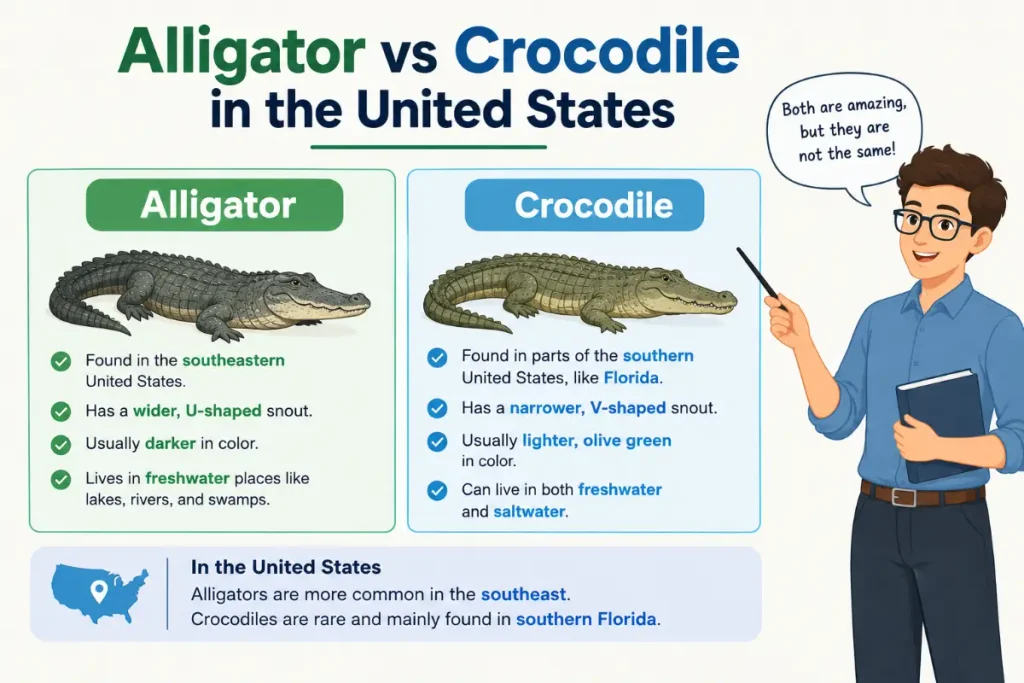
Alligator vs crocodile in the United States
In the United States, the animal most people encounter is the American alligator.
American crocodiles also live in the country, but their natural distribution is much more limited. They are primarily associated with southern Florida.
This creates an interesting regional distinction.
If someone in Louisiana or much of the southeastern United States says they saw a gator, they are almost certainly referring to an alligator.
In southern Florida, both alligators and crocodiles can occur, so physical identification becomes more important.
The word gator is especially common in American English. It is an informal shortened form of alligator.
In British English
The basic animal distinction is the same in British English.
British speakers use alligator for the relevant animals and crocodile for crocodiles.
The difference is more noticeable in cultural references and vocabulary. American English frequently uses gator as an informal short form, especially in regions where alligators are common.
British English can use croc as an informal short form of crocodile, though the word also appears in international English.
Neither gator nor croc should be treated as a formal scientific term.
How should you use the term in a resume?
Animal names rarely belong on a resume unless the job involves wildlife, biology, conservation, education, veterinary work, research, or a related field.
If you need to describe professional experience, use the specific animal name.
Example:
Conducted field observations of American alligators in protected wetland habitats.
Another example:
Assisted with educational programs focused on crocodilian conservation.
Avoid using a casual word such as gator in a formal resume unless it is part of an official name or quoted material.
How should you use the words in an email?
In a professional email, choose the exact term you need.
Example:
During our field visit, we observed an American alligator near the edge of the wetland.
If you are writing to a wildlife professional, precise language is especially helpful.
Example:
Could you confirm the species identified in the photograph? I initially thought it was an alligator, but the snout appears narrower than expected.
That wording is better than confidently naming an animal when the photograph is unclear.
How should you use the terms in a text message?
Texting is more flexible.
A person might write:
We just saw a gator near the lake!
That sounds natural in casual American English.
Someone might also write:
There was a huge croc in the river!
The important point is that informal language does not change the biological distinction. Gator still means alligator, and croc generally means crocodile.
How should you use the words when speaking?
In everyday conversation, people sometimes use the terms loosely.
If you are speaking with friends, a sentence such as this sounds natural:
We saw a gator at the park.
In a classroom, museum, documentary, or professional setting, use the precise name.
For example:
The animal in this photograph is an American alligator.
Precise vocabulary helps listeners understand exactly what you mean.
What are some real examples of the difference?
Here are several examples from different situations.
- The alligator rested on the muddy bank while several birds moved nearby.
- The crocodile slipped beneath the surface of the river without making much noise.
- A broad, rounded snout can be a useful clue when identifying an alligator.
- The guide explained that the visible lower tooth suggested the animal was a crocodile.
- We watched a young alligator swimming across the pond.
- The wildlife researcher studied crocodile behavior near the coast.
- The child learned that an alligator and a crocodile are related but not the same animal.
- The photographer stayed inside the vehicle while observing the crocodile.
- Several alligators were resting along the edge of the wetland.
- The museum display explained how crocodilians have changed over millions of years.
- The teacher asked students to compare the snout shapes of an alligator and a crocodile.
- The wildlife officer warned visitors not to feed the alligator.
- The documentary showed a crocodile moving between a river and a coastal area.
- The student used the term crocodilian because the exact species was not clear.
- The guide used the informal word gator while talking to the visitors.
These examples show why context matters. The best word is the one that accurately identifies the animal or describes the specific idea.
Alligator vs caiman: what is the difference?
Alligators and caimans are closely related, but they are not the same animals.
Both belong to the alligator family, Alligatoridae. Caimans are native mainly to Central and South America.
Caimans can resemble alligators, which can make identification difficult for beginners.
The word alligator refers specifically to members of the alligator group, while caiman refers to several related crocodilian species.
This is another reason why crocodilian is useful when you want a broader scientific term.
what’s the difference in teeth?
Teeth provide one of the easiest clues.
An alligator generally has an upper jaw that is wider than the lower jaw. When its mouth closes, the upper jaw covers most of the lower teeth.
A crocodile usually has a more interlocking tooth arrangement. Some lower teeth remain visible when the mouth is closed.
The large fourth lower tooth is particularly noticeable in many crocodiles.
However, don’t identify an animal from one tooth alone. Species vary, and a photograph may not show enough of the mouth to make a reliable identification.
what’s the difference in snout shape?
An alligator usually has a wider U shaped snout.
A crocodile usually has a narrower V shaped snout.
This is one of the most commonly taught identification rules.
There is an important limitation, though. Crocodile species do not all have exactly the same head shape. Some can have relatively broad snouts.
The safest approach is to combine several clues:
- Snout shape.
- Tooth visibility.
- Geographic location.
- Habitat.
- Overall body shape.
- Known species in the area.
Using several clues is more reliable than depending on one feature.
which one has a wider snout?
The alligator generally has the wider and more rounded snout.
The crocodile usually has a narrower and more pointed snout.
This is a useful quick identification clue, especially when you can see the animal’s head from above.
which one lives in saltwater?
Some crocodiles are well adapted to saltwater and coastal environments.
Saltwater crocodiles are especially well known for this ability. They can move through marine and coastal waters and travel between islands and mainland areas.
Alligators are mainly associated with freshwater habitats. They can tolerate some exposure to saltwater, but they are not as strongly adapted to marine environments as certain crocodile species.
What are the closest terms to alligator and crocodile?
The closest broad term is crocodilian.
Crocodilian is useful because it covers a wider group that includes crocodiles, alligators, caimans, and gharials.
Other useful related terms include reptile, predator, carnivore, wetland animal, aquatic reptile, ambush predator, hatchling, juvenile, adult, snout, jaw, habitat, and conservation species.
These terms should not be treated as synonyms.
For example, reptile is a broad biological category. Crocodilian is a more specific group. Alligator is narrower still.
Think of the terms as levels of classification rather than interchangeable vocabulary.
What are the common mistakes?
Several mistakes appear again and again when people discuss these reptiles.
Calling every crocodilian a crocodile
This is the biggest vocabulary mistake.
Crocodile is the name of one group of crocodilians. It is not a universal word for every member of the larger group.
Assuming all crocodilians look identical
They share many features, but species differ in size, snout shape, color, habitat, and behavior.
Using size as the only clue
A large alligator can be bigger than a young crocodile. Size alone does not identify the animal.
Relying only on color
Color changes with age, species, environment, water conditions, and lighting.
Assuming every crocodile lives in saltwater
Many crocodile species live mainly in freshwater habitats. Saltwater ability is especially notable in certain species.
Assuming alligators are harmless
Alligators are wild predators. They should be treated with caution and respect.
Treating gator as a formal scientific term
Gator is an informal American English form of alligator.
Using crocodilian as a direct synonym for crocodile
Crocodilian is broader. It includes several related groups.
When should you not use the word alligator?
Do not use alligator when you know the animal is a crocodile, caiman, or gharial.
For example, if you are describing a Nile crocodile, calling it an alligator is factually incorrect.
Also avoid using alligator when the species has not been identified and the available evidence does not support that conclusion.
In that situation, crocodilian may be more accurate.
For example:
The photograph appears to show a crocodilian, but the species cannot be confirmed from the image.
That sentence is safer than guessing.
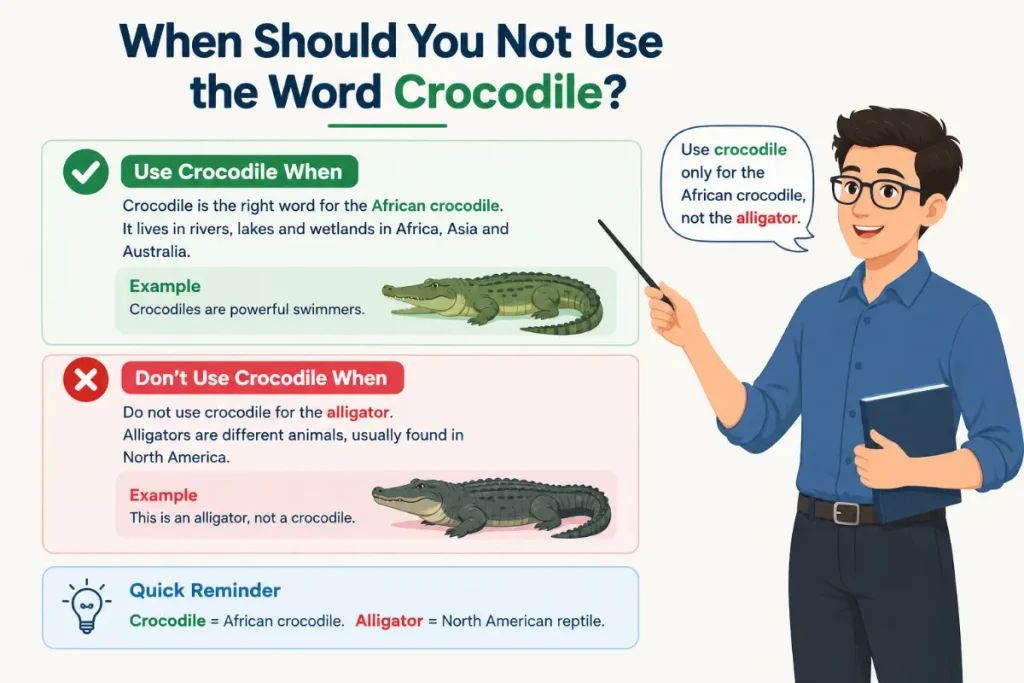
When should you not use the word crocodile?
Do not use crocodile as a general replacement for every crocodilian.
If you are describing an American alligator, use alligator.
If you are unsure, use crocodilian when the broader group is what you mean.
For example:
The researcher studied crocodilians in the wetland.
That sentence does not claim that the animals were specifically crocodiles.
What are the antonyms?
Alligator and crocodile do not have true antonyms.
An antonym is a word with an opposite meaning, such as hot and cold or large and small.
There is no single opposite of alligator or crocodile.
You can describe contrasting characteristics using words such as:
| Word | Opposite or contrast |
|---|---|
| Large | Small |
| Adult | Juvenile |
| Wild | Captive |
| Aquatic | Terrestrial |
| Carnivorous | Herbivorous |
| Living | Extinct |
| Freshwater | Saltwater |
These are contrasts related to description, not antonyms of the animal names themselves.
Conclusion
The simplest way to understand Alligator or Crocodile is to remember that they are related but different reptiles. Alligators generally have broad, rounded snouts and mostly hide their lower teeth when their mouths are closed. Crocodiles usually have narrower, more pointed snouts and can show some lower teeth.
Location can also provide a useful clue. American alligators are strongly associated with the southeastern United States, while crocodiles occur across a much wider part of the world. Some crocodiles are also highly adapted to coastal and saltwater environments.
The two names are not synonyms, so using the correct term makes your writing more accurate. When the exact animal is unclear, crocodilian can be a useful broader term. Once you know these basic clues, identifying and describing these impressive reptiles becomes much easier.
Frequently Asked Questions
What is the easiest way to tell an alligator from a crocodile?
Look at the snout and teeth. Alligators usually have wider U shaped snouts and mostly hide their lower teeth when their mouths are closed, while crocodiles generally have narrower snouts and can show lower teeth.
Is an alligator a type of crocodile?
No. An alligator and a crocodile are different types of crocodilians. They belong to the same broader group but are not the same animal.
Which is bigger, an alligator or a crocodile?
Some crocodile species grow much larger than American alligators. The saltwater crocodile is among the largest living reptiles, while large American alligators can also reach impressive lengths.
What’s another way to say alligator?
Gator is the most common informal alternative to alligator in American English. In formal writing, alligator is usually the better choice.
What’s the main difference between an alligator and a crocodile?
The clearest differences are snout shape, tooth visibility, and geographic range. Alligators generally have broader snouts, while crocodiles usually have narrower snouts.
Can alligators live in saltwater?
Alligators can tolerate some saltwater exposure, but they are mainly freshwater animals. Certain crocodile species are much better adapted to marine and coastal environments.
Is alligator vs crocodile a useful comparison for an essay?
Yes. Comparing snout shape, teeth, habitat, geographic range, size, and behavior gives you several clear points to discuss. Using specific examples also makes the comparison stronger.

Daniel Grammarfield — The Language Learner
Age: 28Occupation: ESL Learner & Digital Professional
Bio:Daniel is a non-native English speaker who wants to communicate more confidently at work and online. He uses Synotrench to improve grammar, understand confusing words, learn correct sentence structures, and build everyday English skills. He prefers simple explanations with practical examples.
Goals:
Master English grammar rules
Avoid common language mistakes
Improve professional communication
Learn English through real-life examples
Quote:“Learning English is not about memorizing rules — it’s about expressing ideas clearly.”
2 thoughts on “Alligator vs Crocodile: The Ultimate Simple Guide (2026)”