If you are writing an email, essay, resume, or text and stop at the words Adapt vs Adopt, you are not alone. These two words look and sound similar, but they have different meanings. Using the wrong one can change the message you want to give.
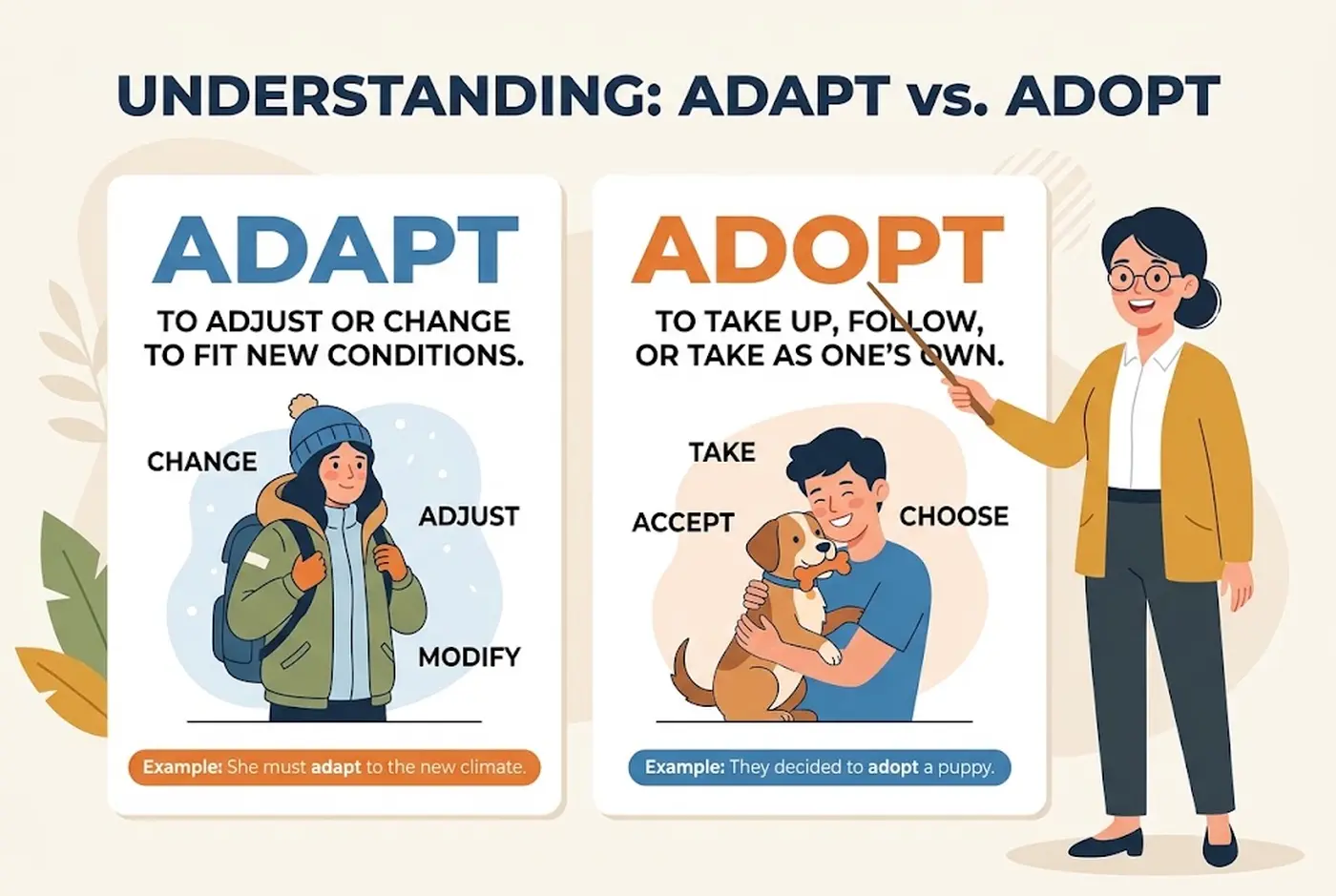
Adapt means to change something so it works better in a new situation. Adopt means to accept, choose, or begin using something.
A simple way to remember the difference is this: adapt means change, while adopt means accept or use. You might adapt a plan after a problem appears. You might adopt a new plan because you decide to use it.
This guide explains the meaning, origin, synonyms, examples, common mistakes, regional use, and best word choices for different situations. You will also see how these words work in resumes, essays, emails, conversations, and everyday writing.
What Do Adapt and Adopt Mean?
The main difference is about change versus choice.
Adapt means to modify something so it fits a new condition, purpose, person, or environment. The original thing usually remains, but some part of it changes.
For example:
The teacher adapted the lesson for younger students.
The lesson already existed. The teacher changed it so it would work better for the students.
Adopt means to accept, choose, or start using something. It often describes a method, idea, rule, habit, policy, or practice that someone decides to use.
For example:
The school adopted a new reading program.
The school chose to use a new program.
Here is the core difference.
| Word | Basic meaning | Simple example |
|---|---|---|
| Adapt | Change something to fit a new situation | We adapted the plan. |
| Adopt | Accept or begin using something | We adopted the plan. |
Notice how one letter changes the word, but the meaning changes too.
If you adapt a plan, you change the plan.
If you adopt a plan, you choose to use the plan.
Where Did Adapt Come From?
The word adapt comes from the Latin word adaptare, which means to fit or adjust something to another purpose.
The idea of fitting is still clear in modern English. When you adapt something, you make it suitable for a different situation.
Think about a piece of clothing.
If a jacket is too large, a tailor can adapt it by changing its size. The jacket is still the same basic jacket, but it has been changed to fit the person.
The same idea works with plans, stories, teaching methods, technology, and behavior.
A company may adapt its business plan.
A writer may adapt a novel for a movie.
A teacher may adapt an activity for students with different needs.
A person may adapt to a new environment.
The word can describe both changing something and adjusting yourself.
Where Did Adopt Come From?
The word adopt also comes from Latin. It developed from adoptare, which means to choose or take for oneself.
That meaning helps explain modern uses of the word.
When you adopt an idea, you accept it.
When you adopt a method, you begin using it.
The word therefore has a strong connection with accepting, choosing, or taking something as your own.
This gives you a useful memory trick.
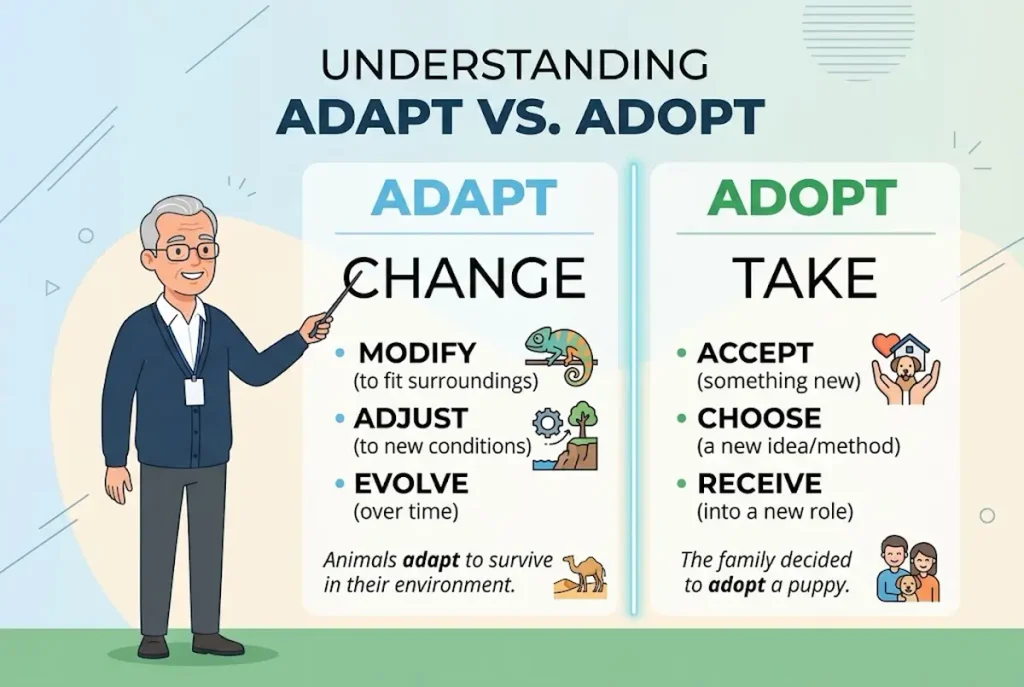
Adapt is about fitting. Adopt is about choosing.
How Can You Remember Adapt vs Adopt Easily?
A quick memory trick can make the difference easier.
Think of the first part of adapt as being connected to adjustment. You adapt something when you change it to fit.
Think of adopt as being connected to acceptance. You adopt something when you choose or accept it.
| If you mean… | Use |
|---|---|
| Change to fit | Adapt |
| Adjust | Adapt |
| Modify | Adapt |
| Accept | Adopt |
| Choose | Adopt |
| Begin using | Adopt |
| Take up a practice | Adopt |
| Accept as your own | Adopt |
Try this question when you are unsure:
Am I changing it, or am I choosing it?
If you are changing it, adapt is usually the right word.
If you are choosing or accepting it, adopt is usually the right word.
What Are the Best Synonyms for Adapt?
The best synonym depends on how much change is involved and how formal the situation is. Some words are very simple, while others work better in professional or academic writing.
Simple Synonyms for Adapt
| Word | Meaning | Tone | Example |
|---|---|---|---|
| Change | Make something different | Simple | We changed the plan. |
| Adjust | Make a small change | Neutral | Adjust the schedule. |
| Alter | Change part of something | Neutral | We altered the design. |
| Modify | Make changes to improve or fit | Neutral | She modified the lesson. |
| Fit | Make suitable for something | Simple | We fitted the plan to the new needs. |
| Revise | Change after reviewing | Neutral | He revised his approach. |
| Fix | Change something to solve a problem | Casual | We fixed the process. |
These words work well in everyday writing and conversation.
Everyday Synonyms for Adapt
| Word | Meaning | Tone | Example |
|---|---|---|---|
| Adjust | Change slightly | Everyday | I adjusted my schedule. |
| Change | Make different | Everyday | She changed her approach. |
| Modify | Change to suit a purpose | Everyday | We modified the activity. |
| Rework | Work on something again | Casual | They reworked the plan. |
| Update | Make something current | Everyday | We updated the system. |
| Revise | Improve through changes | Neutral | I revised my essay. |
| Reshape | Change the form or structure | Neutral | The team reshaped the strategy. |
Formal Synonyms for Adapt
| Word | Meaning | Tone | Example |
|---|---|---|---|
| Modify | Change for a specific purpose | Formal | The researchers modified the procedure. |
| Adjust | Alter to fit conditions | Formal | The company adjusted its policy. |
| Revise | Improve after review | Academic | The author revised the argument. |
| Transform | Change greatly | Strong and formal | Technology transformed the industry. |
| Accommodate | Change to meet a need | Formal | The policy accommodates different needs. |
| Reconfigure | Change the arrangement or structure | Technical | Engineers reconfigured the system. |
| Tailor | Design or change for a specific need | Professional | We tailored the service to customers. |
Slang and Casual Alternatives for Adapt
Slang does not always have a perfect one word replacement for adapt, but casual expressions can communicate the same general idea.
| Word or phrase | Meaning | Tone | Example |
|---|---|---|---|
| Switch things up | Make things different | Casual | We switched things up. |
| Change it around | Rearrange or alter something | Casual | Let’s change it around. |
| Tweak | Make a small change | Casual | I tweaked the design. |
| Rework | Change something again | Casual | We reworked the schedule. |
| Roll with it | Adjust to what happens | Very casual | Things changed, so we rolled with it. |
| Go with the flow | Accept and adjust to events | Very casual | We went with the flow. |
The safest choice in formal writing is usually adjust, modify, revise, accommodate, or tailor, depending on the meaning.
What Are the Best Synonyms for Adopt?
Adopt also has many related words, but they do not all work in every situation.
Simple Synonyms for Adopt
| Word | Meaning | Tone | Example |
|---|---|---|---|
| Accept | Agree to take or receive | Simple | She accepted the new rule. |
| Choose | Select something | Simple | We chose a new method. |
| Use | Begin using something | Simple | They use a new system. |
| Take | Accept or begin using | Simple | He took the new approach. |
| Pick | Choose something | Casual | They picked a new strategy. |
| Follow | Use a rule or method | Everyday | We follow the new process. |
Everyday Synonyms for Adopt
| Word | Meaning | Tone | Example |
|---|---|---|---|
| Accept | Agree to something | Neutral | The group accepted the proposal. |
| Choose | Select intentionally | Neutral | She chose a different method. |
| Embrace | Accept willingly | Positive | The team embraced the new idea. |
| Take up | Begin using or doing | Everyday | He took up the new habit. |
| Follow | Use a rule or method | Everyday | They followed the new policy. |
| Implement | Put a plan into action | Professional | The company implemented the policy. |
| Approve | Officially accept | Formal | The board approved the proposal. |
How Do Adapt and Adopt Work as Different Parts of Speech?
Both words can work as verbs.
Adapt as a Verb
The most common form is the verb adapt.
Example:
She adapted the lesson for her students.
The word can also describe a person adjusting to circumstances.
Example:
Children often adapt quickly to new environments.
Common forms include adapts, adapted, adapting, and adaptation.
Adopt as a Verb
The most common form is also the verb adopt.
Example:
The company adopted a new policy.
Common forms include adopts, adopted, adopting, and adoption.
The noun forms are useful too.
Adaptation means the process or result of adapting.
Adoption means the act or process of adopting.
Compare these:
The adaptation of the story changed several characters.
The adoption of the new policy happened in June.
The two nouns follow the same basic difference as the verbs.
Adapt vs Adopt in US and UK English
The meanings of adapt and adopt are essentially the same in American and British English.
You can use both words naturally in the United States, the United Kingdom, Canada, Australia, and other English speaking regions.
The spelling of related words can sometimes vary between US and UK English. For example, British English often uses adaptation and adoption in the same way as American English, so there is no major regional difference to worry about here.
The main challenge is not regional spelling. It is choosing the correct meaning.
A US writer might say:
The company adapted its strategy.
A UK writer can say:
The company adapted its strategy.
Both sentences have the same basic meaning.
The same applies to:
The school adopted a new policy.
There is no special American or British version of the word that changes this distinction.
Which Word Is Best for an Essay?
In an essay, choose the word based on the relationship between the original idea and the new situation.
Use adapt when something changes to fit.
Example:
The author adapted the traditional story for a modern audience.
Use adopt when someone accepts or chooses an idea.
Example:
Many schools adopted project based learning.
Academic writing often benefits from precise verbs. If you mean change, do not use adopt just because it sounds formal.
If you mean accept or choose, do not use adapt.
Which Word Is Best for Texting?
In casual texting, both words are correct.
Example:
We need to adapt to the new schedule.
Example:
I think we should adopt the new plan.
In very casual messages, people may use simpler phrases such as change it, adjust it, go with it, or use it.
For example:
We need to change the plan.
That can sound more natural in a quick text than:
We need to adapt the plan.
The best choice depends on your relationship with the reader and the situation.
Which Word Is Best for Email?
For professional emails, both words can be useful.
Use adapt when you are discussing changes.
Example:
We may need to adapt the schedule because the delivery date has changed.
Use adopt when you are discussing a new method or decision.
Example:
The team has decided to adopt the new reporting process.
A useful email distinction is:
Adapt the existing process.
Adopt a new process.
That small difference can make professional writing much clearer.
Which Word Is Best for Speaking?
In conversation, both words are common.
You might say:
We had to adapt to the weather.
Or:
The team decided to adopt a different approach.
When speaking with someone who is learning English, simpler words may be easier.
Instead of:
We need to adapt our strategy.
You could say:
We need to change our strategy.
Instead of:
We adopted a new approach.
You could say:
We started using a new approach.
The meaning stays clear.
What Are Some Real Life Examples of Adapt and Adopt?
Here are examples from school, work, family life, technology, travel, and everyday situations.
Example One
The teacher adapted the lesson for students who needed extra help.
The lesson was changed to fit their needs.
Example Two
The school adopted a new attendance policy.
The school accepted and began using the policy.
Example Three
I had to adapt to my new work schedule.
The speaker changed their routine to fit the new schedule.
Example Four
Our company adopted a new customer service system.
The company chose to use a new system.
Example Five
The filmmaker adapted the book for the screen.
The original story was changed to work as a movie.
Example Six
She quickly adapted to life in a new city.
She adjusted herself to a new environment.
Example Seven
The team adopted a healthier workplace policy.
The team accepted and began following the policy.
Example Eight
We adapted the recipe because we did not have all the ingredients.
The recipe was changed to fit the available ingredients.
Example Nine
He adopted a morning exercise routine.
He chose to begin following the routine.
Example Ten
The business adapted its website for mobile users.
The website was changed so it would work better on mobile devices.
Adapt vs Adjust: What Is the Difference?
Adapt and adjust are close in meaning, but they are not always interchangeable.
Adjust often suggests a smaller or more limited change.
Adapt can suggest a broader change made to fit new conditions.
For example:
She adjusted the chair.
This suggests a specific physical change.
She adapted to the new workplace.
This suggests a broader process of getting used to a new situation.
Sometimes both can work, but the meaning and emphasis may change.
Adapt vs Modify: What Is the Difference?
Modify usually means to change something, often in a specific or limited way.
Adapt focuses more strongly on making something suitable for a new purpose or situation.
Compare:
The engineer modified the machine.
This simply tells us that the machine was changed.
The engineer adapted the machine for use in extreme temperatures.
This explains why the machine was changed. It was changed so it could work in a different situation.
So modify focuses on the change itself.
Adapt often focuses on the reason for the change.
Adopt vs Accept: What Is the Difference?
Accept is broader than adopt.
You can accept an apology, gift, invitation, explanation, or decision.
You usually adopt something that you choose to take up, use, or make part of your life or system.
Compare:
I accepted the invitation.
I adopted a new study method.
The first sentence means you agreed to receive or take part in something.
The second means you began using a particular method.
This is why accept cannot replace adopt in every sentence.
What Are the Most Common Mistakes With Adapt and Adopt?
One common mistake is using adopt when the intended meaning is change.
Incorrect idea:
We adopted the old plan to fit the new situation.
If you mean that you changed the old plan, use adapt.
Better:
We adapted the old plan to fit the new situation.
Another mistake is using adapt when you mean choose or begin using.
Incorrect idea:
The company adapted a new software system.
If the company chose to start using the system, use adopted.
Better:
The company adopted a new software system.
A third mistake happens when writers confuse adapt to with adopt.
Correct:
She adapted to her new environment.
Correct:
She adopted a new routine.
The first means she adjusted to the environment.
The second means she chose a routine.
What Are the Antonyms of Adapt and Adopt?
The opposite of adapt can depend on context.
Useful antonyms include:
- Resist.
- Preserve.
- Maintain.
- Keep.
- Reject change.
- Remain unchanged.
For example:
The company refused to adapt to market changes.
The company stayed with its old approach.
The antonyms of adopt are more directly connected to rejection.
- Reject.
- Refuse.
- Abandon.
- Oppose.
- Discard.
- Decline.
For example:
The board rejected the proposed policy.
This means the board did not accept or adopt it.
A two word memory rule works well:
Adapt means fit. Adopt means choose.
What Related Words Should You Know?
Learning related forms can make the distinction easier.
| Word | Meaning | Example |
|---|---|---|
| Adapt | Change to fit | We adapted the plan. |
| Adapted | Changed to fit | The course was adapted. |
| Adapting | Changing to fit | She is adapting quickly. |
| Adaptation | A changed version or process of adjustment | The film is an adaptation. |
| Adopt | Accept or begin using | They adopted the method. |
| Adopted | Accepted or began using | The policy was adopted. |
| Adopting | Accepting or beginning to use | They are adopting new rules. |
| Adoption | The act of accepting or taking up | The adoption of the policy took time. |
Notice that adaptation and adoption are not interchangeable.
An adaptation is something that has been changed to fit.
An adoption is the act of accepting or choosing something.
What Is the Difference Between Adaptation and Adoption?
The noun forms follow the same basic rule.
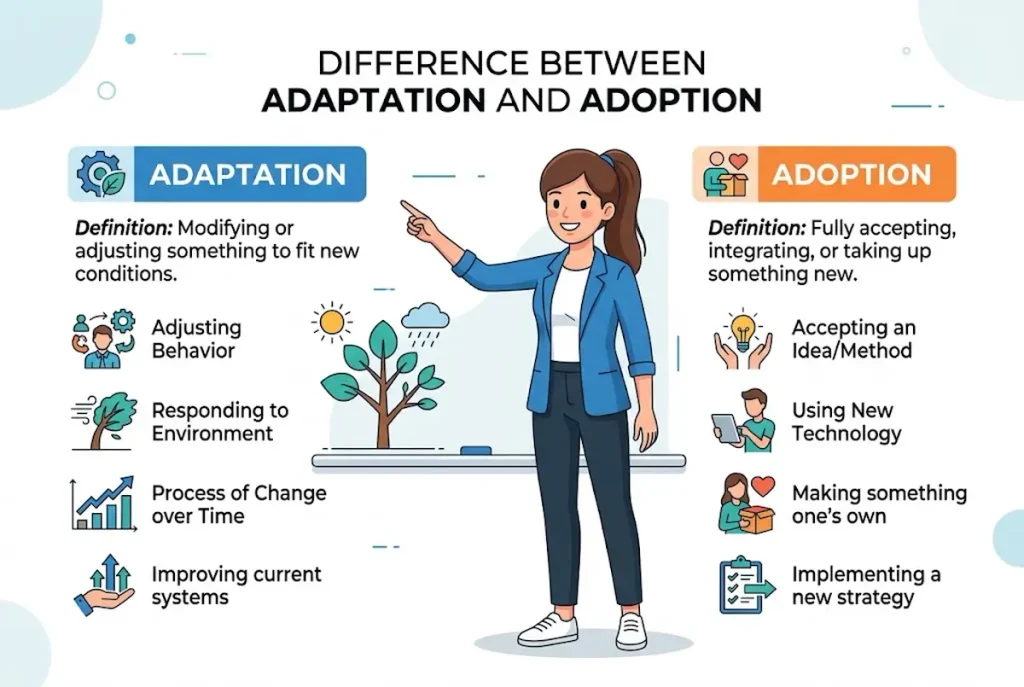
Adaptation refers to changing something so it fits a new purpose or situation. It can also refer to a version of a work created for another format.
Example:
The movie is an adaptation of a novel.
Adoption refers to accepting, choosing, or taking something as your own.
Example:
The adoption of the new policy happened last month.
You can use the same memory trick:
Adaptation means fitting through change.
Adoption means accepting or choosing.
How Do These Words Work in Business English?
Business writing uses both words frequently.
A business may adapt its strategy when customer needs change.
A business may adopt a new strategy after deciding that it should be used.
For example:
The company adapted its marketing strategy after customer behavior changed.
The company adopted a new marketing strategy in January.
The first sentence focuses on modification.
The second focuses on the decision to use the strategy.
Business writers should be careful with these words because the distinction can show exactly what happened.
How Do These Words Work in Technology?
Technology provides many natural examples.
A developer may adapt an application for mobile devices.
A company may adopt a new software platform.
A team may adapt its workflow after installing new technology.
A business may adopt cloud based tools.
The pattern is simple:
Change the existing thing and you adapt it.
Choose the new thing and you adopt it.
Can You Use Adapt and Adopt in the Same Sentence?
Yes. Sometimes using both words makes the difference especially clear.
For example:
The company adopted a new strategy and later adapted it to fit local customers.
The company first chose the strategy. Then it changed the strategy to suit a specific situation.
Another example is:
The school adopted a new curriculum but adapted several lessons for younger students.
The school accepted the curriculum, while teachers changed parts of it.
These sentences show that the two actions can happen together.
Quick Comparison Table
| Feature | Adapt | Adopt |
|---|---|---|
| Main idea | Change to fit | Accept or choose |
| Common pattern | Adapt to | Adopt something |
| Personal adjustment | Yes | Usually no |
| New policy | Can adapt an existing policy | Can adopt a new policy |
| New habit | Can adapt your behavior | Can adopt a habit |
| Story for a movie | Adapt a story | Not normally |
| New method | Adapt an existing method | Adopt a new method |
| Main memory word | Change | Choose |
| Noun form | Adaptation | Adoption |
Conclusion
The easiest way to understand Adapt vs Adopt is to focus on the action taking place. Adapt means changing something so it fits a new situation, purpose, or need. Adopt means accepting, choosing, or beginning to use something.
You adapt a lesson for students, adapt to a new environment, or adapt a story for a movie. You adopt a new habit, adopt a policy, or adopt an idea.
The two words may look similar, but their core meanings are different. When you are unsure, ask yourself whether you are changing something or choosing something. That quick question will help you select the right word in emails, essays, resumes, conversations, and everyday writing.
Frequently Asked Questions
What is the simple difference between Adapt and Adopt?
Adapt means to change something so it fits a new situation, while adopt means to accept, choose, or begin using something. Think change for adapt and choice for adopt.
Is it adapt to or adopt to?
Use adapt to when you mean adjust to a situation. For example, she adapted to her new job. Adopt normally takes an object, such as adopt a plan or adopt a habit.
Can I use adapt and adopt for the same idea?
Yes, but the meaning changes. In Adapt vs Adopt, adapt means you change the idea, while adopt means you accept or choose the idea.
What is another way to say adapt?
Another way to say adapt is adjust, modify, alter, revise, tailor, or accommodate, depending on the context. Adjust is often the simplest everyday alternative.
What is another way to say adopt?
Another way to say adopt is accept, choose, embrace, implement, institute, or take up, depending on the context. Accept is broader, while implement focuses on putting a plan into action.
Should I say adapt a plan or adopt a plan?
Both can be correct, but they mean different things. Adapt a plan means change the plan, while adopt a plan means accept or choose the plan for use.
How can I remember Adapt vs Adopt?
Remember adapt equals change and adopt equals choose. If you are making something fit a new situation, use adapt; if you are accepting or beginning to use something, use adopt.

Daniel Grammarfield — The Language Learner
Age: 28Occupation: ESL Learner & Digital Professional
Bio:Daniel is a non-native English speaker who wants to communicate more confidently at work and online. He uses Synotrench to improve grammar, understand confusing words, learn correct sentence structures, and build everyday English skills. He prefers simple explanations with practical examples.
Goals:
Master English grammar rules
Avoid common language mistakes
Improve professional communication
Learn English through real-life examples
Quote:“Learning English is not about memorizing rules — it’s about expressing ideas clearly.”
2 thoughts on “Adapt vs Adopt: The Ultimate Simple Guide (2026)”