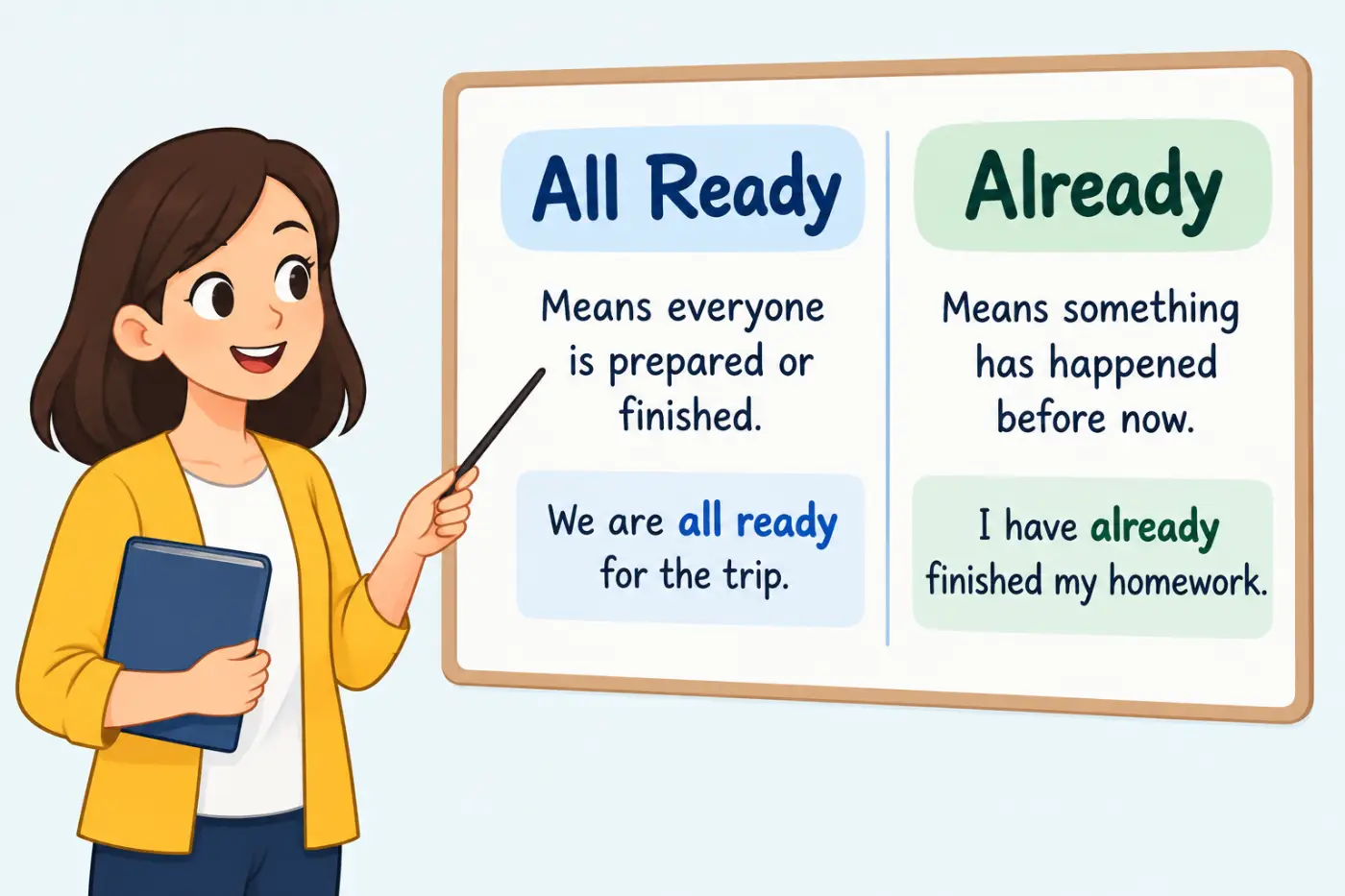
If you’re writing All Ready vs Already an email, essay, resume, or quick text, you may stop at a sentence like, “I’m all ready to leave” or “I’m already here.” The two expressions look almost identical, but they don’t mean the same thing. Knowing the difference can help you avoid a small mistake that changes the meaning of your sentence.
All ready means completely prepared. Already means something happened before now or sooner than expected.
The easiest way to remember it is simple: all ready = fully prepared, while already = by now or before this time. The first expression describes a state of preparation. The second usually talks about time.
This guide explains the meaning, origin, synonyms, common mistakes, regional usage, and best choices for emails, essays, resumes, texts, and everyday speech. You’ll also see plenty of examples so you can recognize the difference quickly.
What does all ready mean?
All ready is a two word phrase made from the word all and the adjective ready. It means completely prepared, fully prepared, or prepared in every necessary way.
For example:
We are all ready for the meeting.
This tells the reader that everyone is prepared for the meeting.
You can also use it for one person:
I’m all ready to go.
Here, the speaker is saying that everything is prepared and they can leave.
The word all adds the idea of completeness. It suggests that nothing important remains to be done.
Compare these sentences:
The students are all ready for the test.
The students have prepared themselves.
The test has started before the current moment.
Those sentences describe two different ideas. One focuses on preparation. The other focuses on time.
When should you use all ready?
Use all ready when you want to say that someone or something is completely prepared.
Common patterns include:
I am all ready to leave.
We are all ready for dinner.
The documents are all ready.
Is everyone all ready?
The house is all ready for the guests.
The phrase can describe people, objects, plans, events, rooms, documents, or other things that can be prepared.
What does already mean?
Already is an adverb. It usually means that something happened before now, before a particular time, or sooner than someone expected.
For example:
I have already finished my homework.
The homework was completed before the present moment.
Another example is:
She already knows the answer.
This means she knew the answer before the time being discussed.
Already can also show surprise about how quickly something happened.
You are already home?
The speaker may be surprised because they expected the person to arrive later.
Unlike all ready, already doesn’t describe complete preparation. It gives information about time or timing.
Consider:
I’m all ready.
This means:
I’m completely prepared.
Now consider:
I’m already here.
This means:
I arrived here before now.
The words may sound similar when spoken quickly, but their meanings are quite different.
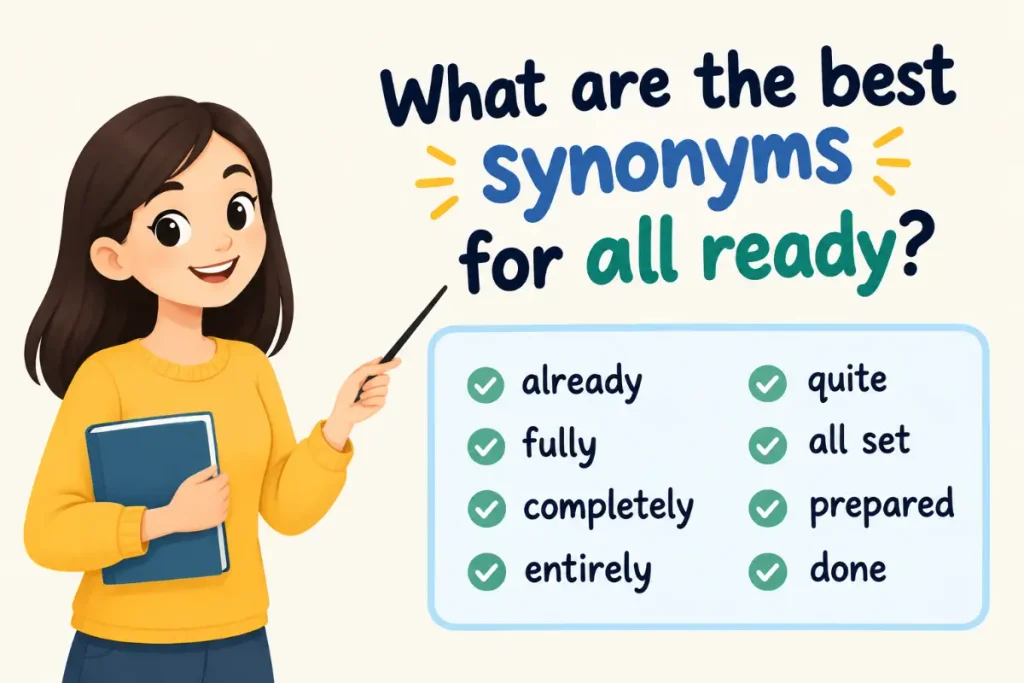
What are the best synonyms for all ready?
The best synonym for all ready depends on the situation. If you’re speaking casually, prepared or set may work well. In formal writing, fully prepared or completely prepared may be clearer.
Here is a broad synonym list covering simple, everyday, formal, and informal choices.
Some of these expressions aren’t exact replacements in every sentence. Prepared is usually the safest direct substitute. Set works well in casual conversation. Fully prepared is useful in formal writing.
Which synonyms for ready sound mild or strong?
Synonyms can express different levels of preparation. Choosing the right strength makes your writing more natural.
Mild ways to say ready
These suggest basic preparation:
Ready
Set
Good
Prepared
Example:
The room is ready for the guests.
This makes a simple statement without adding much emotion.
Medium strength ways to say ready
These suggest that everything necessary has been handled:
All set
Fully prepared
Organized
In place
Good to go
Example:
Everything is in place for tomorrow’s event.
This sounds more complete than simply saying the event is ready.
Strong ways to say ready
These suggest thorough preparation, confidence, or enthusiasm:
Completely prepared
Fully equipped
Primed
Poised
Raring to go
Example:
The team is fully equipped and ready for the challenge.
The choice depends on what you want the reader to feel. A resume may need a professional phrase such as fully prepared. A text message might sound more natural with all set.
What parts of speech are involved?
The two expressions work differently because their grammatical roles are different.
All ready is a phrase containing an adjective.
Already is an adverb.
The adjective ready describes a person or thing.
The students are ready.
The adverb already modifies a verb, verb phrase, adjective, or sometimes another adverb by adding a time meaning.
The students have already arrived.
It can also appear before an adjective:
The room is already clean.
Here, already tells us that the room became clean before the time being discussed.
This difference can help you identify the correct spelling. If you’re describing someone’s preparation, think all ready. If you’re talking about something that happened before now, think already.
Is all ready different from all set?
Yes. All ready and all set are close in meaning, but they aren’t identical in every context.
All ready emphasizes preparation.
Compare:
The students are all ready for the exam.
The students are all set for the exam.
Both are natural. The second sounds slightly more conversational.
You can also say:
Are you all set?
This is extremely common in American English, especially in everyday conversation.
For formal writing, prepared may be a better choice:
The students are fully prepared for the examination.
What are the best word choices for a resume?
On a resume, use professional terms such as prepared, qualified, equipped, organized, completed, or ready.
Avoid relying on casual expressions such as good to go, ready to roll, or raring to go.
For example:
Prepared financial reports for monthly management reviews.
Fully prepared training materials for new employees.
Organized project files and client documentation.
A resume should communicate skills and results clearly. A casual phrase can make a professional statement sound less precise.
If you need to say that a project is finished, completed or finalized may be stronger choices.
Which word works best in an essay?
For an essay, prepared, ready, fully prepared, completed, or organized will usually work better than slang.
For example:
The researchers were fully prepared to conduct the study.
Or:
The materials were carefully organized before the experiment began.
In academic writing, precise language matters. All ready isn’t wrong, but it can sound conversational.
If your essay is personal or informal, the phrase may fit naturally:
By the time the ceremony began, we were all ready to leave.
The right choice depends on the voice of the essay.
What should you use in a text message?
Texting is more flexible. Natural choices include:
all set
ready
good to go
all ready
For example:
I’m all ready.
I’m all set.
Ready when you are.
These expressions sound natural in casual American English.
You can also use already in a text when you’re talking about something that has happened:
I’m already there.
I already ate.
She’s already home.
Remember that changing the space can change the meaning.
Which choice works best in an email?
For a casual email, both forms can appear naturally.
I’m all ready for tomorrow’s meeting.
This tells the reader you’re fully prepared.
I’ve already sent the documents.
This tells the reader that the documents were sent before now.
For a professional email, you might choose more precise wording:
I’ve completed the preparation for tomorrow’s meeting.
Or:
I’ve already sent the requested documents.
The important part is to decide if you’re describing preparation or timing.
How should you use them in everyday speech?
In conversation, both expressions are common, but already often appears much more frequently because it can be used with many different verbs and situations.
Examples include:
I’ve already eaten.
She already knows.
They’ve already left.
We already talked about this.
For preparation, speakers commonly use:
I’m ready.
We’re all set.
I’m all ready to go.
We’re good to go.
American English often favors short conversational expressions, so all set and good to go can sound especially natural in casual speech.
What are some real examples of all ready and already?
The following examples show the difference in everyday situations.
1. Getting ready for work
I’m all ready for work.
The speaker has finished getting prepared.
2. Talking about breakfast
I’ve already eaten breakfast.
The speaker ate before now.
3. Preparing for a trip
We’re all ready for our flight.
Everything needed for the trip has been prepared.
4. Talking about arrival
We’re already at the airport.
They arrived at the airport before the current moment.
5. Preparing a presentation
The presentation is all ready for tomorrow.
The presentation has been prepared.
6. Talking about completed work
I already finished the presentation.
The presentation was completed earlier.
7. Getting children ready
The kids are all ready for school.
The children are prepared to leave.
8. Talking about school
The kids have already left for school.
Their departure happened earlier.
9. Preparing dinner
Dinner is all ready.
The food has been prepared and is ready to serve.
10. Talking about eating
We’ve already had dinner.
Dinner happened before now.
11. Preparing for a meeting
Everyone is all ready for the meeting.
Everyone is prepared.
12. Talking about meeting preparation
We’ve already discussed the main issue.
The discussion happened earlier.
13. Preparing a package
Your package is all ready to ship.
Everything is prepared for shipping.
14. Talking about shipping
Your package has already shipped.
The shipment happened before now.
15. Preparing to leave
I’m all ready to leave.
The person has completed their preparation.
These examples show the basic pattern clearly. Preparation calls for all ready. Earlier timing calls for already.
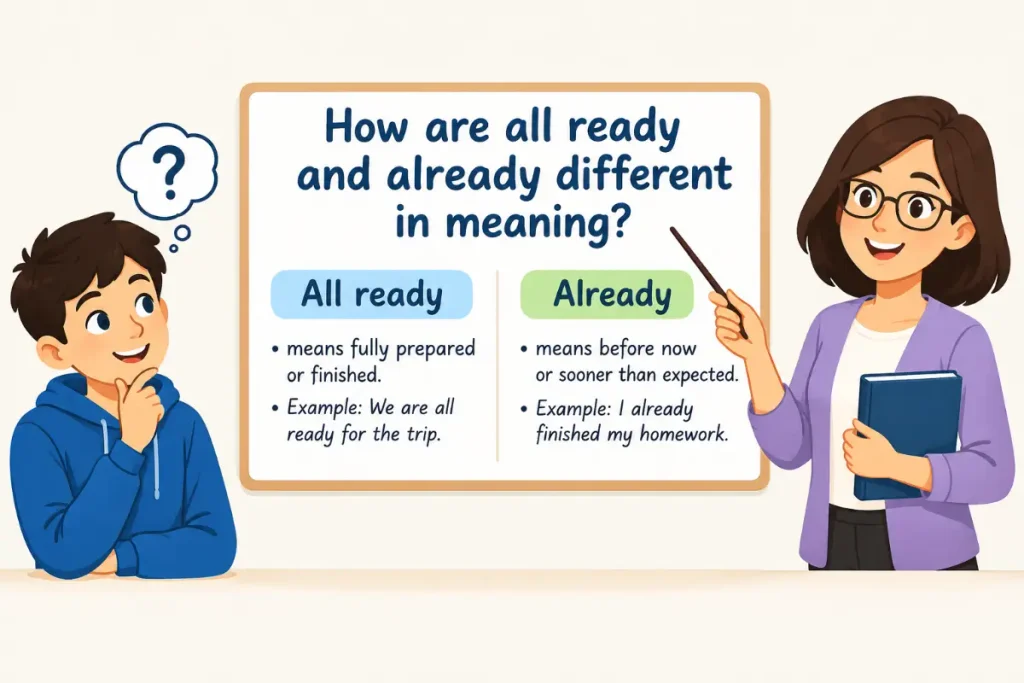
How are all ready and already different in meaning?
The most important difference is preparation versus time.
| Expression | Main idea | Example |
|---|---|---|
| All ready | Completely prepared | We are all ready for the trip. |
| Already | Before now or sooner than expected | We have already booked the trip. |
The first sentence tells us about the travelers’ preparation.
The second tells us about the timing of the booking.
This is why you can’t simply choose the spelling based on how the words sound.
All ready vs all set: what’s the difference?
All ready and all set can both mean completely prepared.
Compare:
We’re all ready to leave.
This emphasizes preparation.
We’re all set to leave.
This can emphasize that everything is taken care of.
In casual American conversation, all set is extremely useful:
Are you all set?
Yep, I’m all set.
In formal writing, use prepared when you want a more professional tone.
Already vs before: what’s the difference?
Already often means something happened before the present time or before a particular expected time.
I’ve already finished.
Before is broader. It can refer to an earlier time, event, or point in a sequence.
I’ve seen that movie before.
Notice the difference in focus.
Already often suggests that something has happened sooner than expected or that its completion matters now.
Before simply identifies an earlier occurrence.
You can sometimes use both:
I’ve already seen this movie before.
This is grammatically possible, but in many situations it sounds repetitive. A natural speaker would often say:
I’ve already seen this movie.
or:
I’ve seen this movie before.
What are the most common mistakes?
One of the biggest mistakes is writing already when you mean all ready.
Incorrect for the intended meaning:
Are you already for the trip?
Correct:
Are you all ready for the trip?
The sentence asks if someone is completely prepared.
Another common mistake is separating already when it should be one word.
Incorrect:
I have all ready finished my homework.
Correct:
I have already finished my homework.
Here, the meaning is that the homework was completed before now.
A third mistake is using the wrong form because the words sound similar.
Incorrect:
We’re already to leave.
Correct:
We’re all ready to leave.
The sentence describes preparation, not earlier timing.
When should you not use all ready?
Don’t use all ready when you mean before now.
For example:
I have already completed the form.
Not:
I have all ready completed the form.
Also, don’t use all ready when the sentence needs an adverb that modifies an action.
She has already called me.
Here, already tells us when the calling happened.
If you wrote all ready, you’d change the meaning and make the sentence incorrect for the intended idea.
When should you not use already?
Don’t use already when you simply mean completely prepared.
For example:
We are all ready for the presentation.
If you write:
We are already for the presentation.
the sentence is incorrect because already cannot replace the phrase in this structure.
You can use already with a verb:
We have already prepared the presentation.
Now the word works because it tells us that the preparation happened earlier.
This distinction is one of the easiest ways to catch the mistake.
What are the antonyms of all ready?
The opposite of being ready is being unprepared, unready, or not ready.
Useful opposites include:
Unprepared
Unready
Not ready
Incomplete
Unfinished
Unorganized
Unprepared is usually the clearest choice.
Example:
The team was unprepared for the sudden change.
For an object or task, unfinished may be more accurate:
The report is unfinished.
What are the antonyms of already?
The opposite of already depends on the sentence.
Common alternatives include:
Not yet
Still
Later
Soon
The clearest direct contrast is often not yet.
Compare:
I’ve already finished.
I haven’t finished yet.
Another example:
She has already arrived.
She hasn’t arrived yet.
This creates a useful memory pair:
already = it happened by now
yet = it hasn’t happened by now
How can you quickly choose the right word?
Use a simple meaning test.
Ask yourself:
Am I talking about preparation?
If yes, use all ready.
Am I talking about something that happened before now?
If yes, use already.
You can also replace the expression mentally.
If completely prepared fits, choose all ready.
We are completely prepared for the trip.
So:
We are all ready for the trip.
If before now fits, choose already.
I finished the work before now.
So:
I have already finished the work.
This trick works in most everyday situations.
What should you remember about the spelling?
The space is meaningful.
All ready contains two words.
Already contains one word.
Try to see the meaning inside the spelling:
all + ready = completely prepared
already = before now
If you’re unsure, check the sentence’s meaning instead of relying on pronunciation.
This is especially helpful because the two expressions can sound very similar when spoken quickly.
Are all ready and already pronounced the same?
They can sound similar, but they aren’t the same expression.
All ready has two separate words, so careful speech may give the phrase a clearer separation.
Already is pronounced as one word.
In fast conversation, the difference can become less obvious. That’s one reason learners sometimes confuse them in writing.
The spelling, grammar, and meaning are better clues than sound alone.
Are all ready and already different in American and British English?
The distinction between the two forms is standard in both American and British English.
All ready means completely prepared.
Already means before now or sooner than expected.
There isn’t a major US versus UK difference in the basic rule.
However, vocabulary and preferred expressions can vary by region. American speakers commonly use casual expressions such as all set and good to go, while other English speaking regions may have different preferences in particular situations.
The core spelling distinction remains the same.
If you’re writing for a US audience, you can safely use both forms according to their meanings.
What should you use when speaking to someone casually?
Casual speech gives you several natural choices.
If you mean prepared:
I’m ready.
I’m all set.
If you mean something happened before now:
I’ve already done it.
I already know.
She’s already here.
We already left.
The context usually makes the meaning clear.
What are some quick editing examples?
Here are several sentences that show how a small spelling change affects meaning.
Wrong for the intended meaning:
I’m already to leave.
Correct:
I’m all ready to leave.
The speaker is completely prepared.
Wrong for the intended meaning:
I have all ready finished it.
Correct:
I have already finished it.
The work was completed before now.
Correct:
The children are all ready for bed.
They are prepared for bed.
Correct:
The children are already in bed.
They got into bed before now.
Correct:
The food is all ready.
The food has been prepared.
Correct:
The food is already cold.
It became cold before the current moment.
These pairs are useful because they show that even a tiny spacing difference can change the message.
What is the easiest memory trick?
Think about the word all.
When you write all ready, imagine saying:
completely ready
The word all adds completeness.
When you write already, imagine saying:
by now
That gives you a fast mental shortcut:
all ready = completely ready
already = by now
For example:
I’m all ready to go.
Replace it with:
I’m completely ready to go.
The meaning works.
Now:
I’ve already gone.
Replace already with:
I’ve gone by now.
The time meaning works.
This simple test can prevent most mistakes.
Why does this difference matter?
The difference may seem small, but correct word choice makes writing easier to understand.
Compare:
The students are all ready.
This tells us the students are prepared.
The students are already here.
This tells us they arrived before now.
A reader doesn’t have to guess your meaning.
That matters in emails, school assignments, work documents, applications, messages, and everyday communication. Small grammar choices can make a sentence much clearer.
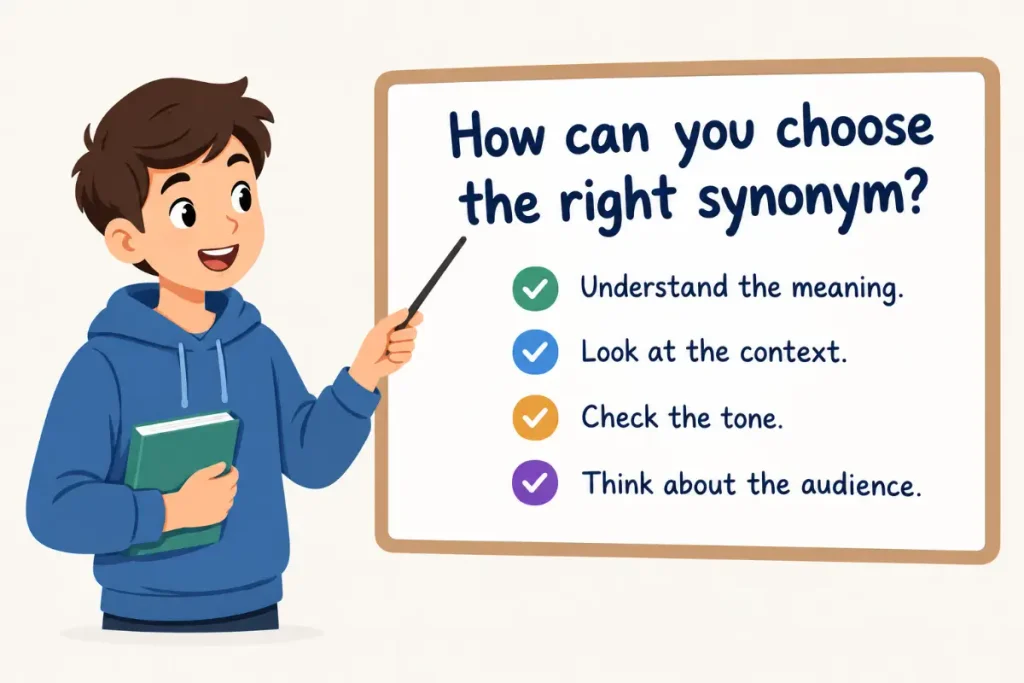
How can you choose the right synonym?
Start with the level of formality.
For simple writing, use:
ready
prepared
set
For everyday conversation, use:
all set
good to go
ready to roll
For formal writing, use:
fully prepared
equipped
organized
completed
finalized
For energetic informal writing, use:
geared up
raring to go
The goal isn’t to use the biggest word. The goal is to use the word that matches your meaning and audience.
What is the final rule to remember?
There is one rule that covers nearly every case:
Use all ready when someone or something is completely prepared. Use already when something happened before now or sooner than expected.
Try these final examples:
We are all ready for the party.
Everyone is prepared.
We have already arrived at the party.
The arrival happened before now.
Is your report all ready?
Is the report completely prepared?
Have you already submitted your report?
Was the report submitted before now?
Once you connect all ready with preparation and already with time, the difference becomes much easier to remember.
Conclusion
The difference between all ready vs already comes down to two simple ideas: preparation and time. All ready means completely prepared, while already means something happened before now or sooner than expected. The two forms may sound similar, but they perform different jobs in a sentence.
Use all ready in sentences such as, “We are all ready for the trip.” Use already in sentences such as, “We have already packed our bags.” When you’re unsure, replace the expression with completely prepared or before now. The version that keeps the intended meaning is usually the right choice.
With this simple test, you can avoid the mistake in emails, essays, work documents, texts, and everyday conversations.
Frequently Asked Questions
Is all ready one word or two words?
All ready is two words when you mean completely prepared. Already is one word when you mean before now or sooner than expected.
What is the difference between all ready and already?
All ready means completely prepared, while already refers to something that happened before now or earlier than expected.
Is it correct to say I am all ready?
Yes, I am all ready is correct when you mean that you are completely prepared. For example, “I am all ready to leave.”
Is already a synonym for all ready?
No, already isn’t a direct synonym for all ready. Already expresses time, while all ready describes a state of preparation.
What’s another way to say all ready?
You can say prepared, fully prepared, all set, set, or good to go, depending on the situation and level of formality.
Can I use all ready in formal writing?
Yes, but prepared or fully prepared may sound more professional in formal documents. All ready is natural, but it often has a conversational feel.
How do I remember the difference between all ready and already?
Think all ready = completely prepared and already = by now. If you’re talking about preparation, use the two word phrase; if you’re talking about earlier timing, use the single word.

Daniel Grammarfield — The Language Learner
Age: 28Occupation: ESL Learner & Digital Professional
Bio:Daniel is a non-native English speaker who wants to communicate more confidently at work and online. He uses Synotrench to improve grammar, understand confusing words, learn correct sentence structures, and build everyday English skills. He prefers simple explanations with practical examples.
Goals:
Master English grammar rules
Avoid common language mistakes
Improve professional communication
Learn English through real-life examples
Quote:“Learning English is not about memorizing rules — it’s about expressing ideas clearly.”
3 thoughts on “All Ready vs Already: The Best Simple Guide (2026)”