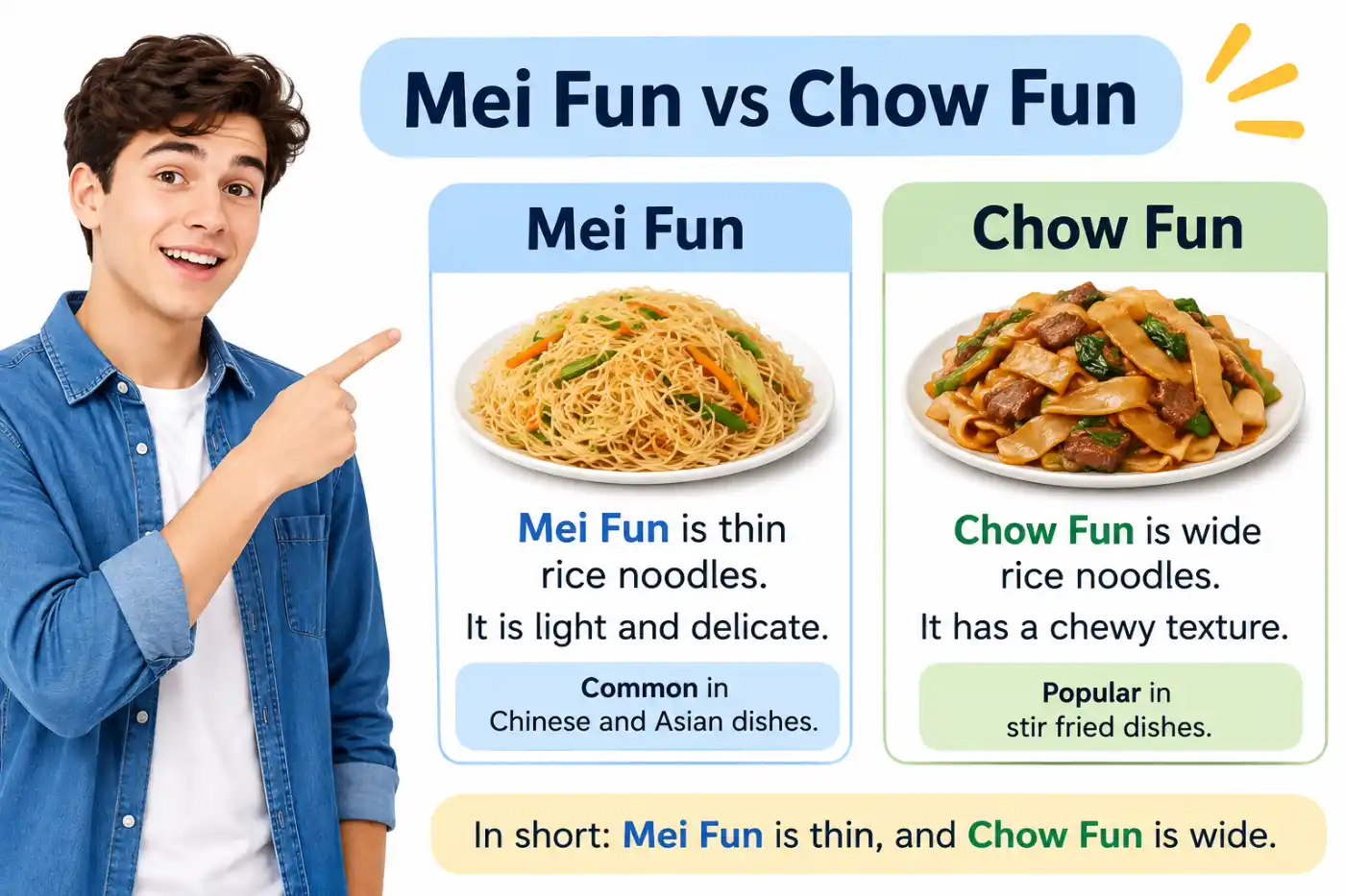
When ordering mei fun vs chow fun Chinese takeout, you might notice two popular noodle dishes on the menu. Both come with vegetables, savory sauces, and your choice of meat or seafood. However, one uses thin rice noodles, while the other features wide, flat rice noodles. Choosing the wrong one can change the texture and feel of your meal.
Mei fun and chow fun are both Chinese rice noodle dishes, but they differ mainly in noodle shape, thickness, texture, and cooking style. Mei fun uses thin rice vermicelli, while chow fun uses wide, flat rice noodles.
Understanding the difference makes it easier to order at a Chinese restaurant, follow a recipe, or choose the right noodles at an Asian grocery store. Although the dishes share some ingredients, they offer different eating experiences.
This guide explains their meanings, origins, ingredients, cooking methods, regional differences, and popular variations. You’ll also learn which dish works best for stir frying, soups, and different meals.
What Is the Difference Between Mei Fun vs Chow Fun?
The biggest difference is the shape and thickness of the rice noodles. Mei fun contains very thin, round rice noodles. Chow fun uses wide, flat rice noodles that look more like ribbons.
Here is a quick comparison.
| Feature | Mei Fun | Chow Fun |
|---|---|---|
| Main ingredient | Rice flour | Rice flour |
| Noodle shape | Thin and round | Wide and flat |
| Noodle thickness | Very thin | Thick and broad |
| Texture | Light and delicate | Soft and chewy |
| Cooking style | Stir frying, boiling, and soaking | Mostly stir frying |
| Popular dish | Singapore mei fun | Beef chow fun |
| Sauce coverage | Sauce coats many thin strands | Sauce coats wide noodle surfaces |
| Eating experience | Light and slightly springy | Chewy and satisfying |
| Common ingredients | Vegetables, shrimp, pork, and eggs | Beef, bean sprouts, onions, and scallions |
Which One Has Thinner Noodles?
Mei fun has thinner noodles. They are usually delicate, lightweight, and round. Their narrow shape allows them to absorb seasoning quickly.
Chow fun noodles are much wider. Their flat shape gives them a soft, chewy texture that holds up well during high heat cooking.
If you prefer light noodles, mei fun is a good choice. If you enjoy thick, chewy noodles, chow fun may suit you better.
Which One Is Better for Stir Frying?
Both work well in stir fries, but chow fun is especially popular for high heat cooking.
Its broad noodles can develop slightly browned edges when cooked properly in a hot wok. Mei fun also works well in stir fries, but cooks need to handle it carefully because the thin strands can break or become mushy.
For a classic Chinese restaurant stir fry, beef chow fun is a popular choice. For a lighter noodle dish with vegetables and shrimp, mei fun is an excellent option.
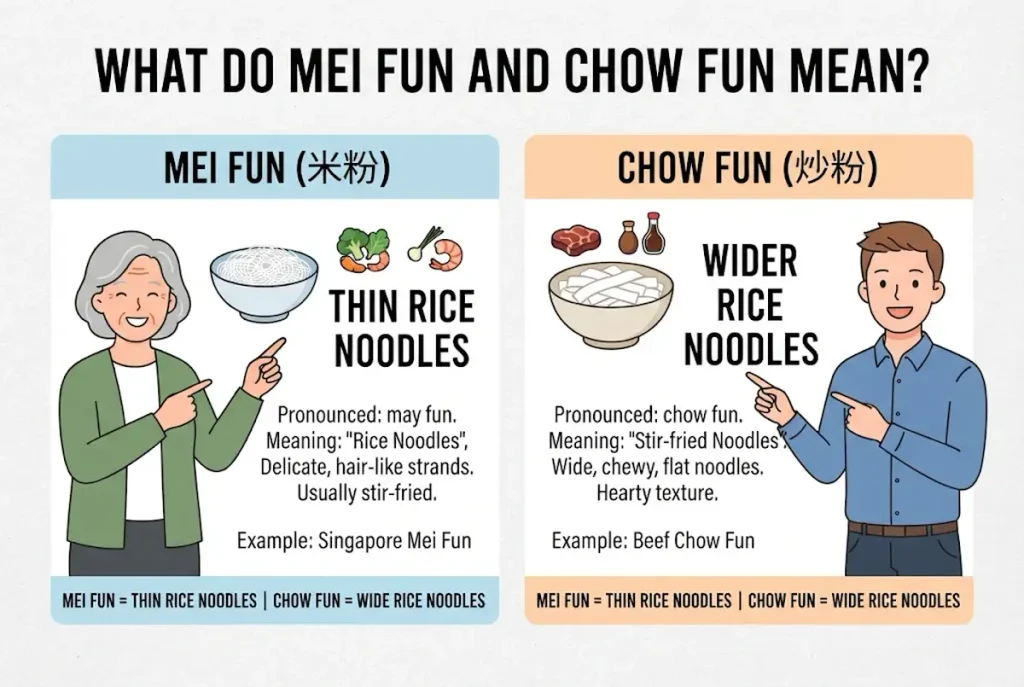
What Do Mei Fun and Chow Fun Mean?
The names come from Chinese food terminology and are commonly used in Chinese restaurants, especially in Cantonese cooking.
What Does Mei Fun Mean?
Mei fun, also written as mai fun or mifen in some romanization systems, refers to thin rice noodles.
The name is associated with the Cantonese term for rice vermicelli. These noodles are made mainly from rice flour and water. Manufacturers form the mixture into very thin strands, which are dried or sold fresh.
In everyday restaurant language, the name can refer to both the noodles and the finished noodle dish.
For example, shrimp mei fun is a dish made with thin rice noodles, shrimp, vegetables, and seasonings.
What Does Chow Fun Mean?
Chow fun is a Cantonese-style noodle dish made with wide, flat rice noodles.
The name comes from Cantonese food terminology. Chow refers to frying or stir frying, while fun refers to noodles. The name therefore describes a fried noodle dish.
One famous example is beef chow fun, which combines broad rice noodles with beef, bean sprouts, scallions, soy sauce, and other seasonings.
Unlike thin rice vermicelli, these noodles have a broad surface and a chewy bite.
Why Do Restaurants Use Different Spellings?
Chinese food names often have different English spellings because people have written Chinese sounds using different romanization systems.
You may see:
- Mei fun.
- Mai fun.
- Mai fen.
- Rice vermicelli.
- Chow fun.
- Chao fun.
- Beef ho fun.
What Are the Origins of These Chinese Noodle Dishes?
Both noodle styles have roots in Chinese food culture. Rice has been a major ingredient in many parts of southern China for centuries, especially in areas where rice grows well.
Rice flour provides a useful base for making different noodle shapes. Cooks and food producers developed several methods to turn rice into thin strands, flat sheets, and other forms.
Where Did Mei Fun Originate?
Rice vermicelli is strongly associated with southern Chinese food traditions. It became popular in Cantonese cooking and other regional cuisines.
The noodles are also widely used in Southeast Asian cooking. Chinese migration helped spread rice noodle dishes to places such as Singapore, Malaysia, Thailand, and other parts of the region.
As these dishes developed, cooks added local spices, vegetables, seafood, and sauces.
Singapore-style mei fun is a well-known example. Despite its name, it is commonly associated with Chinese restaurant cooking and uses curry seasoning for a distinctive yellow color and savory flavor.
Where Did Chow Fun Originate?
Chow fun is closely connected to Cantonese cuisine in southern China.
Wide rice noodles are especially associated with Guangdong and Hong Kong food traditions. Their soft texture and broad shape make them suitable for quick wok cooking.
Beef chow fun became a popular Cantonese dish. Cooks stir fry wide rice noodles with beef, bean sprouts, scallions, and soy-based seasoning.
The dish became popular in Chinese restaurants around the world because of its rich flavor, smoky aroma, and satisfying texture.
What Ingredients Do These Noodle Dishes Contain?
The noodles are similar in their basic ingredients, but the toppings and seasonings can vary widely.
What Is Mei Fun Made Of?
Traditional rice vermicelli is mainly made from rice flour and water. Some commercial products contain additional starches to improve their texture.
A typical stir-fried version may include:
- Thin rice vermicelli.
- Shrimp, chicken, pork, or beef.
- Scrambled eggs.
- Cabbage and carrots.
- Bell peppers.
- Bean sprouts.
- Garlic and onions.
- Soy sauce and other seasonings.
What Is Chow Fun Made Of?
Wide rice noodles are usually made from rice flour and water. Fresh versions are commonly produced by steaming rice batter into thin sheets and cutting those sheets into wide strips.
A typical beef version includes:
- Wide, flat rice noodles.
- Thinly sliced beef.
- Bean sprouts.
- Scallions.
- Garlic.
- Light soy sauce.
- Dark soy sauce.
- Oyster sauce.
- Cooking oil.
Do Both Dishes Taste the Same?
No. Both have a mild rice flavor, but their toppings, sauces, and cooking methods create different results.
Mei fun often has a lighter texture. Its thin strands mix easily with vegetables, eggs, and seasonings.
Chow fun usually has a richer, more substantial bite. Its wide noodles hold sauce on their surfaces and can develop a smoky flavor during wok cooking.
Neither noodle has a strong flavor on its own. Most of the taste comes from the ingredients and seasonings added during preparation.
What Are the Main Types and Alternate Names?
Chinese restaurant menus use several names for rice noodles. Some refer to the noodle itself, while others describe a particular dish or cooking method.
The following table explains common names you may encounter.
| Word or Name | Meaning | Tone | Example |
|---|---|---|---|
| Mei fun | Thin rice vermicelli | Everyday | I ordered shrimp mei fun. |
| Mai fun | Alternate spelling of mei fun | Everyday | Mai fun is listed on the menu. |
| Mai fen | Mandarin-style romanization | Formal | Mai fen is a thin rice noodle. |
| Mi fen | Mandarin pinyin for rice vermicelli | Formal | Mi fen is sold in dried bundles. |
| Rice vermicelli | Thin rice noodles | Simple | Rice vermicelli cooks quickly. |
| Rice sticks | Thin or narrow rice noodles | Everyday | Buy rice sticks for the recipe. |
| Rice noodles | General name for noodles made from rice | Simple | Rice noodles are common in Asian cooking. |
| Chow fun | Stir-fried wide rice noodle dish | Everyday | Beef chow fun is popular. |
| Flat rice noodles | General description of broad rice noodles | Simple | Flat rice noodles are used for beef stir fry. |
| Rice noodle ribbons | Descriptive name for wide, flat strips | Simple | Rice noodle ribbons feel soft and chewy. |
| Stir-fried rice noodles | General name for rice noodles cooked in a wok | Everyday | Stir-fried rice noodles make a filling meal. |
| Beef ho fun | Wide rice noodles prepared with beef | Everyday | Beef ho fun is a Cantonese favorite. |
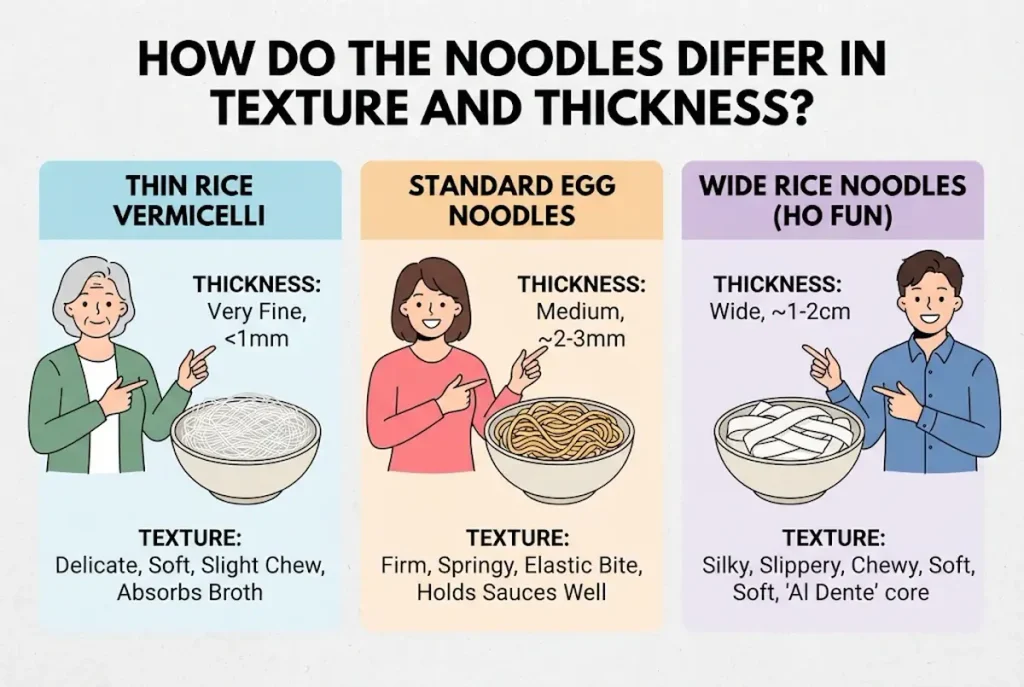
How Do the Noodles Differ in Texture and Thickness?
Noodle texture is one of the easiest ways to recognize these dishes.
Is Mei Fun Soft or Chewy?
Mei fun is generally soft, delicate, and slightly springy when cooked correctly.
Its thin strands can absorb seasoning quickly. However, they can also become sticky or mushy if they soak for too long or cook for too long.
Dried rice vermicelli usually needs soaking before stir frying. The exact soaking time depends on the brand and noodle thickness.
Is Chow Fun Soft or Chewy?
Chow fun is usually soft, slippery, and chewy.
Fresh wide rice noodles have a smooth surface. They can feel slightly stretchy when picked up with chopsticks.
Their broad shape also makes them more noticeable in every bite. When cooked over high heat, the noodles can pick up a lightly toasted aroma known as wok hei.
Which Noodles Absorb More Sauce?
Both absorb flavor, but they do it differently.
Mei fun has many thin strands, so seasoning can spread throughout the noodle mixture. Chow fun has broad surfaces that hold sauces and cooking juices.
The final taste depends more on the recipe than the noodle shape alone.
How Are Mei Fun and Chow Fun Cooked?
The preparation method matters because rice noodles can easily lose their texture when handled incorrectly.
How Do You Cook Mei Fun?
Dried rice vermicelli usually needs to be softened before cooking.
A common preparation method includes these steps:
- Place the dried noodles in a bowl.
- Add warm water according to the package instructions.
- Soak until the strands become flexible but remain slightly firm.
- Drain the water thoroughly.
- Prepare vegetables, meat, eggs, and seasonings.
How Do You Cook Chow Fun?
Chow fun usually requires less preparation when you buy it fresh.
A common cooking method looks like this:
- Separate the fresh rice noodles gently.
- Slice the beef or other protein into thin pieces.
- Prepare bean sprouts, scallions, and garlic.
- Heat a wok until very hot.
- Cook the protein until nearly done.
What Is the Difference Between Dry and Wet Chow Fun?
These names describe the amount of sauce in the finished dish.
What Is Dry Chow Fun?
Dry chow fun is stir-fried with a relatively small amount of sauce.
The noodles are usually coated with soy-based seasoning rather than covered in gravy. A good version has a smoky aroma, soft texture, and lightly browned surfaces.
Beef chow fun is one of the best-known examples.
What Is Wet Chow Fun?
Wet chow fun contains more sauce, often in the form of a savory gravy.
The noodles may be served with meat, vegetables, and a thicker sauce poured over them. The result is softer and more saucy than the dry version.
If you enjoy dishes with plenty of sauce, wet chow fun may be a better choice.
What Is the Difference Between Singapore Mei Fun and Regular Mei Fun?
Singapore mei fun is a seasoned noodle dish made with thin rice vermicelli. It is often cooked with curry powder, eggs, shrimp, pork, and vegetables.
Regular mei fun does not have one fixed seasoning style. It can be prepared with garlic, soy sauce, seafood, meat, or vegetables.
| Feature | Regular Mei Fun | Singapore Mei Fun |
|---|---|---|
| Noodle type | Thin rice vermicelli | Thin rice vermicelli |
| Seasoning | Varies by recipe | Commonly curry powder |
| Color | Usually white or light brown | Often yellow |
| Flavor | Mild and savory | Savory and mildly spicy |
| Common additions | Vegetables, meat, eggs | Shrimp, pork, eggs, vegetables |
| Cooking method | Varies | Usually stir-fried |
Are These Noodles Different in American and British English?
The main difference is not American versus British English. It is the way restaurants and food suppliers use Chinese names and English spellings.
How Do American Chinese Restaurants Use These Names?
In the United States, menus commonly use names such as:
- Shrimp mei fun.
- Singapore mei fun.
- Beef chow fun.
- Vegetable chow fun.
- Chicken chow fun.
Are the Names Different in British English?
British Chinese restaurants may use spellings such as ho fun, ho fan, or hor fun.
The terms depend on the restaurant, its regional cooking traditions, and its preferred romanization.
There is no reliable rule that all British restaurants use one spelling and all American restaurants use another.
When ordering, describing the shape is often more useful than relying on spelling alone.
Which Noodles Should You Choose for Different Meals?
The best choice depends on your recipe, the texture you enjoy, and the kind of meal you want.
Which Noodles Are Best for a Resume or Food Description?
If you’re writing a restaurant menu, food review, or professional food description, use the specific noodle name.
For example:
Our restaurant serves stir-fried rice vermicelli with fresh vegetables and shrimp.
This description is more useful than simply calling the dish Chinese noodles.
For a wide noodle dish, write:
Our beef chow fun features tender beef, flat rice noodles, and fresh bean sprouts.
Which Noodles Are Best for an Essay?
For a school essay or food article, explain the shape before discussing the flavor.
Example:
Thin rice vermicelli is commonly used in mei fun dishes, while broad rice noodles are popular in Cantonese-style chow fun.
This sentence makes the distinction clear to readers who may not know Chinese food terminology.
Which Noodles Are Best for Texting?
For casual messages, simple descriptions work best.
Example:
I want the thin rice noodles tonight, not the wide ones.
You can also use the dish names if the person already knows them.
Example:
Let’s order Singapore mei fun and beef chow fun.
Can You Substitute One Noodle for the Other?
Yes, you can substitute one for the other in some recipes, but the finished meal will have a different texture.
Can You Use Mei Fun Instead of Chow Fun?
You can use thin rice vermicelli in a stir-fry that normally calls for wide rice noodles. However, the dish will feel lighter and less chewy.
Mei fun also cooks faster, so you should adjust the cooking time. Add the noodles near the end and toss them gently.
Can You Use Chow Fun Instead of Mei Fun?
You can replace thin rice vermicelli with wide rice noodles in some recipes, but the result will be much heavier.
The broad noodles need different preparation and cooking times. They also won’t create the same texture as fine rice strands.
Which Substitution Works Better?
The better substitution depends on the meal.
| Recipe | Better Choice | Reason |
|---|---|---|
| Singapore noodles | Mei fun | Thin strands work best with curry seasoning. |
| Beef stir fry | Chow fun | Wide noodles hold their shape well. |
| Light vegetable noodles | Mei fun | The thin texture feels less heavy. |
| Cantonese beef noodles | Chow fun | Wide rice noodles are traditional. |
| Quick noodle salad | Mei fun | Thin strands mix easily with other ingredients. |
| Saucy noodle dish | Chow fun | Broad noodles work well with thicker sauces. |
Are Mei Fun vs Chow Fun Healthy?
Both can fit into a balanced meal. Their nutritional value depends on the ingredients, portion size, cooking oil, and sauce.
Which Noodles Have More Calories?
Neither noodle automatically has more calories in every serving.
Both are rice-based, and their calorie content depends on their moisture level and how much you eat. A finished stir-fry may contain extra calories from oil, meat, eggs, and sauces.
Restaurant portions can also vary considerably.
Which Is Better for a Gluten-Free Diet?
Plain rice noodles are naturally gluten-free when made without wheat-based ingredients.
However, a complete restaurant dish may contain gluten from soy sauce, marinades, sauces, or shared cooking equipment.
If you need to avoid gluten, ask the restaurant to check the ingredients and preparation process. Don’t assume a rice-based dish is automatically safe.
Which Is Better for a Vegetarian Meal?
Either can work well in a vegetarian meal.
You can order vegetable versions with mushrooms, cabbage, carrots, bean sprouts, and tofu.
However, some restaurants use oyster sauce or meat-based seasonings even in vegetable dishes. Ask about the ingredients if you follow a vegetarian diet.
What Are the Common Mistakes People Make When Ordering These Noodles?
People often confuse these dishes because both contain rice noodles. A few simple mistakes can lead to ordering the wrong meal.
Confusing Thin Rice Noodles With Wide Rice Noodles
The most common mistake is assuming both names describe the same noodle.
Remember that mei fun uses thin strands, while chow fun uses wide, flat noodles.
Thinking All Mei Fun Is Curry-Flavored
Singapore mei fun commonly contains curry seasoning, but not every mei fun dish does.
The word mei fun describes the thin noodle style. It doesn’t automatically tell you which sauce or spices the cook will use.
Thinking Chow Fun Always Contains Beef
Beef chow fun is popular, but beef is not required.
Restaurants may offer chicken, shrimp, pork, tofu, or vegetable versions.
Confusing Chow Fun With Chow Mein
These dishes have different noodles.
Chow fun commonly uses wide rice noodles, while chow mein generally uses wheat-based noodles. Their ingredients and cooking methods can vary, but the main distinction is the type of noodle.
Assuming Every Rice Noodle Is Gluten-Free
Rice is naturally gluten-free, but additional ingredients can change the finished dish.
Always check the product label or restaurant ingredients if gluten avoidance is necessary.
Cooking Both Noodles for the Same Amount of Time
Thin vermicelli and wide rice noodles have different preparation needs.
Mei fun can become mushy when overcooked. Wide rice noodles can stick together or break if handled roughly.
Follow the package instructions and adjust the cooking method to the noodle’s condition.
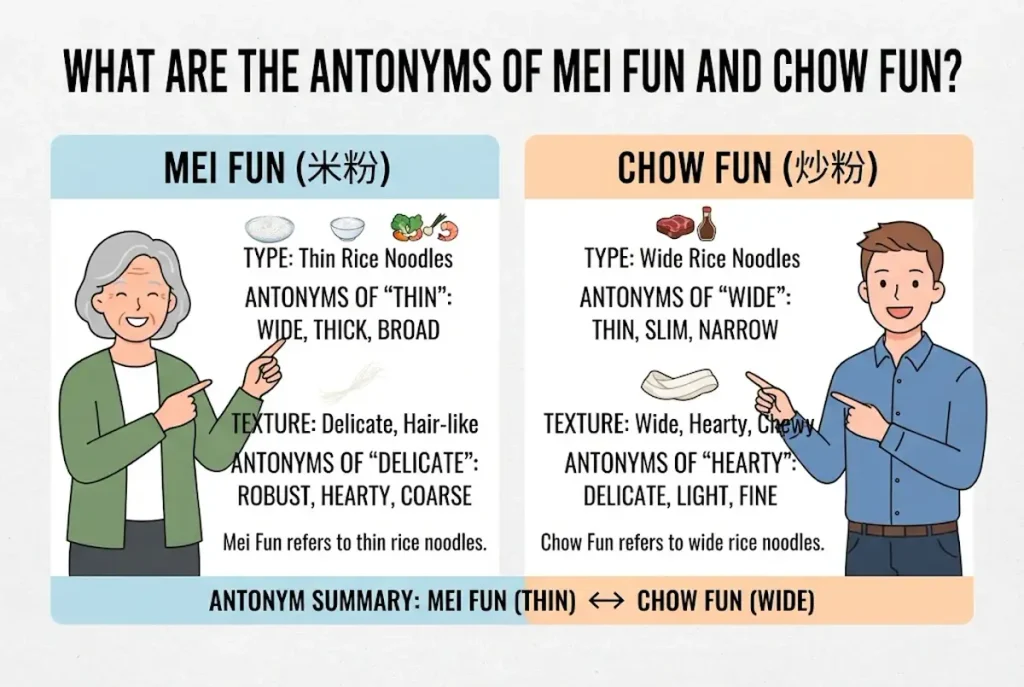
What Are the Antonyms of Mei Fun and Chow Fun?
These food names don’t have true linguistic antonyms because they identify particular noodle styles and dishes.
However, you can describe their contrasts using opposite texture and shape terms.
| Mei Fun or Chow Fun Feature | Opposite Description |
|---|---|
| Thin | Thick |
| Narrow | Wide |
| Delicate | Hearty |
| Light texture | Dense texture |
| Soft and springy | Firm and less flexible |
| Thin strands | Broad ribbons |
What Are the Quick Tips for Choosing the Right Noodles?
Use these simple tips when ordering food or preparing a rice noodle recipe.
- Choose mei fun if you enjoy thin, delicate rice noodles.
- Choose chow fun if you prefer wide, chewy rice noodles.
- Order Singapore mei fun if you enjoy curry-seasoned noodles.
- Choose beef chow fun for a classic Cantonese-style stir-fry.
- Use dried vermicelli for recipes that require thin rice strands.
Conclusion
Understanding the difference between these two Chinese noodle dishes makes ordering and cooking much easier. Mei fun uses thin rice vermicelli, giving it a delicate texture that works well with vegetables, seafood, and curry seasoning.
Chow fun uses broad, flat rice noodles that provide a soft, chewy bite and work especially well in Cantonese stir-fries.The best choice depends on your taste and the meal you’re preparing.
Choose thin noodles for a lighter dish and wide noodles for a more substantial stir-fry. Remember that sauces, toppings, and cooking methods also affect the final flavor. Once you recognize their shapes, choosing between them becomes simple. Try both dishes to discover which texture you enjoy most.
Frequently Asked Questions
What is the main difference between mei fun vs chow fun?
The main difference is noodle shape and texture. Mei fun uses thin rice vermicelli, while chow fun uses wide, flat rice noodles.
Is mei fun made from rice or wheat?
Mei fun is generally made from rice flour and water. Check the product label because some commercial varieties may contain additional starches.
Is chow fun the same as ho fun?
Not exactly. Ho fun refers to the wide, flat rice noodles, while chow fun commonly describes a stir-fried dish made with those noodles.
Which is healthier, mei fun or chow fun?
Neither is automatically healthier. Their nutritional value depends on portion size, cooking oil, sauces, protein, and vegetables.
What’s another way to say mei fun?
Rice vermicelli, rice sticks, and thin rice noodles are common descriptive names for mei fun. Some menus also use the spelling mai fun.
Does Singapore mei fun come from Singapore?
The restaurant dish is commonly associated with Cantonese and Hong Kong-style cooking. Its name doesn’t mean it is a traditional Singaporean dish.
Can I use regular rice noodles instead of chow fun noodles?
Yes, but choose wide, flat rice noodles for the closest result. Thin rice vermicelli will produce a different texture and cooking experience.
Are mei fun and chow fun spicy?
Neither dish has to be spicy. Their flavor depends on the recipe, although Singapore mei fun often includes curry seasoning and may have mild heat.

Daniel Grammarfield — The Language Learner
Age: 28Occupation: ESL Learner & Digital Professional
Bio:Daniel is a non-native English speaker who wants to communicate more confidently at work and online. He uses Synotrench to improve grammar, understand confusing words, learn correct sentence structures, and build everyday English skills. He prefers simple explanations with practical examples.
Goals:
Master English grammar rules
Avoid common language mistakes
Improve professional communication
Learn English through real-life examples
Quote:“Learning English is not about memorizing rules — it’s about expressing ideas clearly.”
3 thoughts on “Mei Fun vs Chow Fun: Ultimate Guide to the Differences”