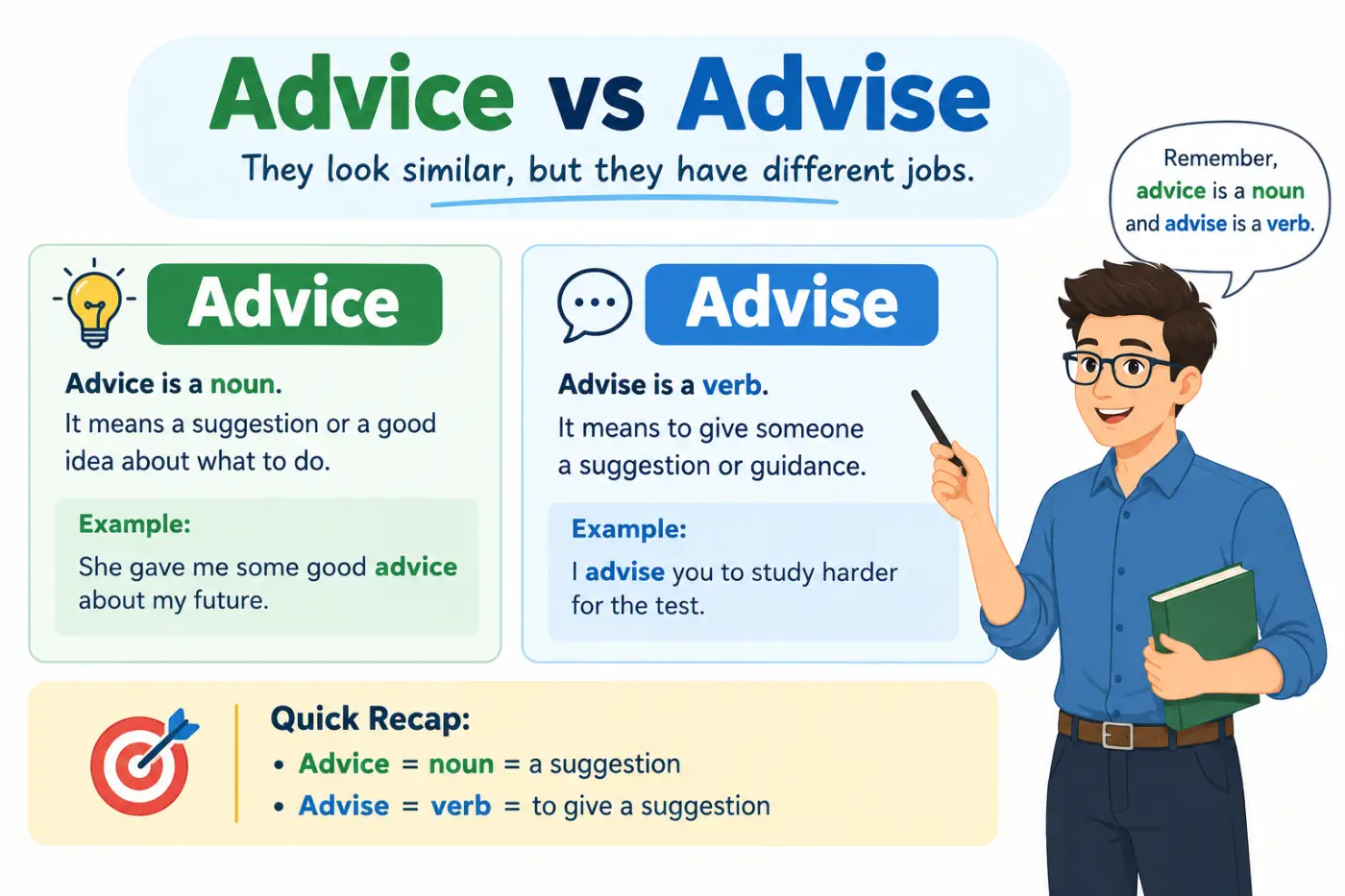
Have you ever stopped while writing an email, essay, resume, or text because you weren’t sure if you should write Advice vs Advise? You’re not alone. These two words look almost the same, and they are closely related. The main difference is simple: one is a noun, and the other is a verb.
Advice is a noun that means a suggestion or helpful opinion. Advise is a verb that means to give someone advice or recommend an action.
Once you remember that difference, choosing the right word becomes much easier. This guide explains their meanings, origins, pronunciation, synonyms, examples, common mistakes, regional usage, and the best choice for different situations.
What Is the Difference Between Advice vs Advise?
The easiest way to understand Advice vs Advise is to look at their jobs in a sentence.
| Word | Part of speech | Meaning | Example |
|---|---|---|---|
| Advice | Noun | A helpful suggestion or recommendation | She gave me good advice. |
| Advise | Verb | To give a suggestion or recommendation | She advised me to wait. |
Think of it this way:
Advice is something you give. Advise is the action of giving it.
For example:
I need your advice.
I advise you to wait.
The first sentence needs a noun because advice is the thing the person wants. The second sentence needs a verb because advised describes the action.
This small grammar difference explains most of the confusion.
What Does Advice Mean?
Advice is a noun. It refers to an opinion, suggestion, recommendation, or helpful information given to someone.
People usually give advice because they want to help another person make a decision or handle a situation.
Here are some simple examples:
My teacher gave me useful advice.
I need some advice about my resume.
Her advice helped me solve the problem.
He asked his father for advice.
The word can refer to one suggestion or a general collection of suggestions.
For example:
My doctor gave me some advice.
She gave me three pieces of advice.
Notice something important in the second example. We usually don’t say three advices. The standard expression is three pieces of advice.
Advice is normally an uncountable noun in English.
What Does Advise Mean?
Advise is a verb. It means to give someone advice, recommend something, or tell someone what you think they should do.
For example:
I advise you to save your work.
The teacher advised us to study early.
My manager advised me to apply for the position.
The verb can appear in different forms:
Advise.
Advises.
Advised.
Advising.
The spelling changes, but the basic meaning remains connected to giving a recommendation or useful guidance.
Where Did Advice and Advise Come From?
The words advice and advise have the same basic historical family. Both came into English through Old French and ultimately trace back to Latin roots connected with seeing, considering, or taking counsel.
Their close relationship explains why they look so similar.
English developed a useful distinction between the noun and verb forms. The noun became advice, while the verb became advise.
The spelling is nearly identical, but the final sound is different.
This creates another useful clue.
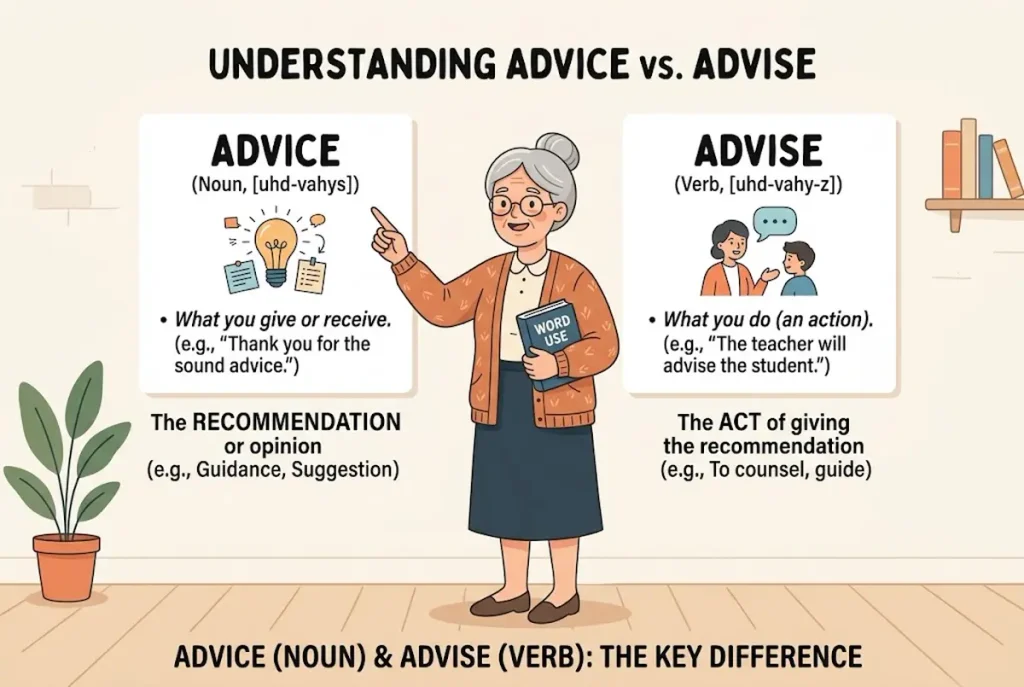
Advice ends with an s sound.
Advise ends with a z sound.
You can hear the difference when the words are spoken.
That sound difference doesn’t always help when you’re writing, but it can help you remember that the two words have different grammatical roles.
How Do You Remember Advice vs Advise?
A simple memory trick is to connect the c in advice with the idea of counsel.
You can also remember this sentence:
I give advice. I advise someone.
Here are a few patterns worth memorizing:
Give advice.
Ask for advice.
Receive advice.
Offer advice.
Follow advice.
Advise someone.
Advise someone to act.
Once these patterns become familiar, the difference feels natural.
Which Synonyms Sound Mild or Strong?
Not every suggestion has the same force. Some words sound gentle, while others communicate urgency.
Mild Suggestions
These words usually sound friendly and low pressure.
Tip.
Suggestion.
Idea.
Opinion.
Perspective.
Example:
You might want to check the introduction again.
This sounds softer than:
You must rewrite the introduction.
Medium Strength Suggestions
These words communicate clearer guidance.
Advice.
Guidance.
Recommendation.
Direction.
Feedback.
Example:
My teacher recommended adding another example.
The speaker gives a clear suggestion without sounding aggressive.
Strong Suggestions
These words show urgency or authority.
Warning.
Urge.
Insist.
Direct.
Instruct.
Example:
The doctor urged him to seek help immediately.
The word urged is much stronger than suggested.
Which Words Are Nouns and Which Are Verbs?
Understanding parts of speech makes the difference much easier.
Nouns
Advice.
Suggestion.
Recommendation.
Guidance.
Tip.
Opinion.
Feedback.
Counsel.
Warning.
Direction.
Input.
Perspective.
These words name a thing, idea, or form of guidance.
Verbs
Advise.
Suggest.
Recommend.
Guide.
Warn.
Urge.
Encourage.
Counsel.
Direct.
Instruct.
For example:
She gave me useful advice.
She advised me to wait.
He made a recommendation.
He recommended a different option.
This noun and verb pattern appears throughout English.
Is Advice Countable or Uncountable?
Advice is normally an uncountable noun.
That means we generally don’t use it as an advice or advices in standard English.
Incorrect:
She gave me an advice.
Correct:
She gave me some advice.
You can also say:
She gave me a piece of advice.
He gave me two pieces of advice.
We received several pieces of advice.
The expression piece of advice is especially useful when you want to count individual suggestions.
Is Advise a Noun or a Verb?
Advise is a verb.
It describes the action of giving advice or making a recommendation.
For example:
I advise you to check your email.
The teacher advised us to arrive early.
The manager advises employees to save their files.
A useful grammar pattern is:
Advise + person + to + verb
Examples:
I advised him to wait.
She advised me to call first.
They advised us to leave early.
Another common pattern is:
Advise against + noun or verb ending in ing
Examples:
The doctor advised against heavy exercise.
The guide advised against traveling alone at night.
How Are Advice and Advise Pronounced?
The spelling difference is small, but the pronunciation is different.
Advice ends with an s sound.
Advise ends with a z sound.
You can think of the difference like this:
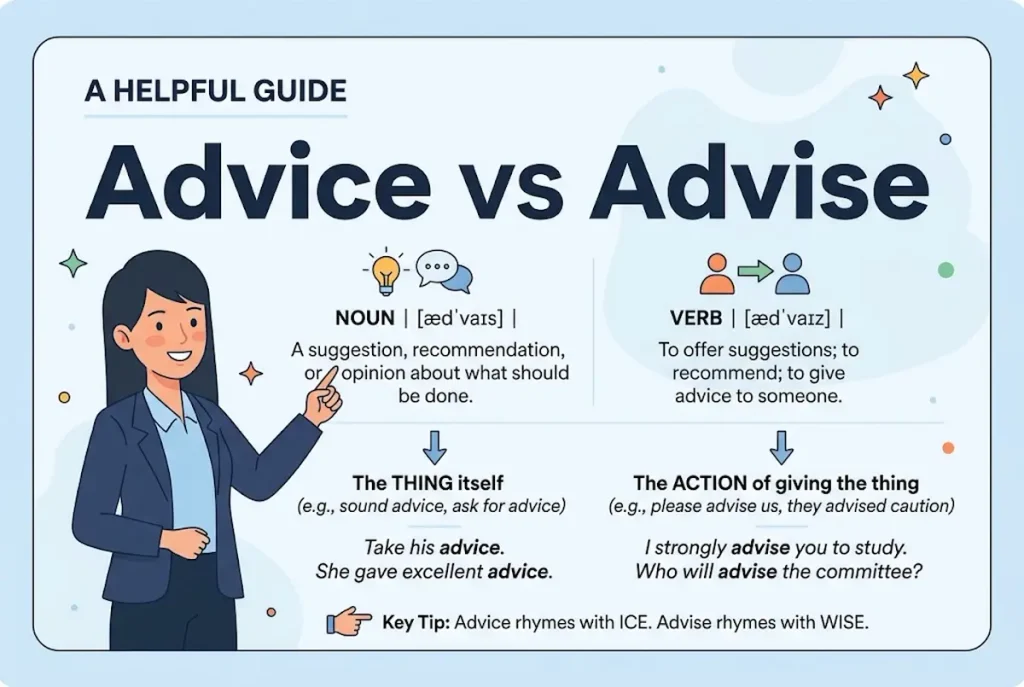
Advice has a sound similar to the ending in nice.
Advise has a sound similar to the ending in wise.
This pronunciation difference is especially useful when listening to someone speak.
It can also help you remember that the words are not simply two spellings of the same grammatical form.
Do Americans and British Speakers Use Advice and Advise Differently?
The basic distinction between advice and advise is the same in American English and British English.
Both varieties use advice as a noun and advise as a verb.
For example, American English:
My teacher gave me some advice.
British English:
My teacher gave me some advice.
American English:
She advised me to wait.
British English:
She advised me to wait.
There is no major regional grammar difference that changes the basic rule.
One small related point is that British English uses advice in some formal expressions that may sound less common in casual American conversation. However, the noun and verb distinction remains the same.
Which Word Is Best for a Resume?
Should You Use Advice or Advise on a Resume?
For a resume, use advise when describing an action you performed.
Example:
Advised clients on software solutions.
Advised team members on project procedures.
These sentences describe what you did.
Use advice when referring to guidance as a noun.
Example:
Provided financial advice to customers.
Offered technical advice to new employees.
For professional writing, verbs such as advised, guided, recommended, and counseled can make your responsibilities clear.
Which Word Is Best for an Essay?
Should You Use Advice or Advise in an Essay?
Use advice when the sentence needs a noun.
Example:
Students often need practical advice when choosing a career.
Use advise when the sentence needs a verb.
Example:
Teachers often advise students to review their work.
Academic writing may also use formal alternatives such as recommend, suggest, guidance, and recommendation.
For example:
The study recommends further research.
The findings suggest a different approach.
The report provides guidance for future researchers.
Which Word Is Best in an Email?
Should You Use Advice or Advise in an Email?
Both words are common in emails.
Use advice when you’re asking for or referring to guidance.
Example:
Could you give me some advice about this project?
Use advise when you’re telling someone what you recommend.
Example:
I advise you to review the document before sending it.
In a professional email, I advise you to… can sound quite formal. Depending on your relationship with the reader, I recommend… or I suggest… may sound more natural.
Which Word Is Best in a Text Message?
Should You Use Advice or Advise in a Text?
In casual texting, advice is very common.
Example:
Can I get your advice?
I need some advice.
What advice would you give me?
Advise is also correct, but it can sound more formal.
For example:
I’d advise you to wait.
This is grammatically correct, but a casual speaker might simply write:
I’d suggest waiting.
The best choice depends on the tone of the conversation.
Which Word Is Best When Speaking?
How Do People Use Advice and Advise in Conversation?
Both words appear naturally in spoken English.
Examples include:
Can I ask your advice?
What would you advise me to do?
My parents gave me good advice.
I’d advise you to call first.
The pronunciation difference can help you recognize the words when listening.
What Are Some Real Examples of Advice and Advise?
Here are original examples from common situations.
School
My teacher gave me some helpful advice before the exam.
The counselor advised me to choose classes that matched my goals.
Work
My manager gave me useful advice about handling customers.
She advised me to check the report twice.
Family
My father always gives me practical advice.
He advised me to think before making a decision.
Travel
Can you give me some advice about visiting New York?
My friend advised me to book the hotel early.
Money
I asked my brother for advice about saving money.
The financial planner advised us to create a budget.
Writing
I need some advice about my introduction.
My editor advised me to shorten the first paragraph.
Health
The doctor gave me useful advice about sleep.
The doctor advised me to rest for a few days.
Technology
Could you give me some advice about buying a laptop?
My colleague advised me to compare the specifications first.
Relationships
She asked her sister for advice.
Her sister advised her to have an honest conversation.
Everyday decisions
Thanks for the advice.
I’d advise you to wait until tomorrow.
Advice vs Suggestion What Is the Difference?
Advice often carries the idea that the speaker has useful knowledge, experience, or judgment.
Suggestion can be lighter and more open ended.
Compare these:
My doctor gave me advice about my diet.
My friend suggested trying a new restaurant.
The first sentence sounds more serious and connected to expertise.
The second sentence simply offers an idea.
A suggestion doesn’t always imply that the speaker believes it is the best choice.
Advice vs Recommendation What Is the Difference?
Advice and recommendation can overlap, but recommendation often suggests that something is specifically suitable or preferred.
For example:
My friend gave me advice about studying.
My professor recommended this book.
The first sentence is broad.
The second sentence points toward a specific choice.
A recommendation can also sound more formal or professional.
For example:
The committee recommended several changes.
The doctor recommended additional testing.
Advice vs Guidance What Is the Difference?
Guidance usually suggests broader or continuing support.
Advice can be a single suggestion.
For example:
She gave me advice about my interview.
She provided guidance throughout my career.
Advice can solve one immediate problem.
Guidance often describes help over a longer period.
This difference is useful in professional, educational, and mentoring contexts.
Advice vs Feedback What Is the Difference?
Feedback usually responds to something someone has already done.
Advice can be given before an action takes place.
For example:
My teacher gave me advice before the presentation.
My teacher gave me feedback after the presentation.
Advice helps you decide what to do.
Feedback helps you understand how something went and how it could improve.
The two can overlap, but the timing and purpose are often different.
What Are the Most Common Mistakes?
Mistake One Using Advise as a Noun
Incorrect:
I need your advise.
Correct:
I need your advice.
Advice is the noun.
Mistake Two Using Advice as a Verb
Incorrect:
I advice you to wait.
Correct:
I advise you to wait.
Advise is the verb.
Mistake Three Writing Advices
Incorrect:
She gave me many advices.
Correct:
She gave me a lot of advice.
Also correct:
She gave me several pieces of advice.
Mistake Four Writing an Advice
Incorrect:
He gave me an advice.
Correct:
He gave me some advice.
Also correct:
He gave me a piece of advice.
Mistake Five Confusing the Pronunciation
Some learners focus only on spelling and miss the difference in sound.
Remember:
Advice ends with an s sound.
Advise ends with a z sound.
Mistake Six Using Formal Language in a Casual Situation
The sentence “I advise you to reconsider” is correct, but it can sound serious.
In a friendly conversation, “I’d suggest reconsidering” may sound more natural.
Grammar accuracy matters, but tone matters too.
When Should You Not Use Advice?
There are situations where another word is more precise.
Don’t use advice when you really mean an instruction.
For example:
Follow the safety instructions.
Here, instructions are specific directions about what to do.
Don’t use advice when you mean someone’s reaction to completed work.
Use feedback instead.
Don’t use advice when you simply mean a personal belief.
Opinion may be more accurate.
Don’t use advice when you mean a legal professional’s service or representation. In some contexts, counsel is the more precise term.
Choosing a related word can make your meaning clearer.
What Are the Antonyms of Advice?
There isn’t one perfect opposite of advice because advice can mean several kinds of guidance.
Depending on the context, possible contrasting ideas include:
Ignoring.
Neglect.
Misinformation.
Discouragement.
Misguidance.
Silence.
Indecision.
For example, if someone gives helpful guidance, ignoring that guidance could be the opposite action.
If someone gives correct advice, misinformation may be the opposite in terms of accuracy.
How Can You Choose the Right Word Quickly?
Use these simple questions.
Are You Naming the Guidance?
Use advice.
I need your advice.
Are You Giving the Guidance?
Use advise.
I advise you to wait.
Are You Offering a Light Idea?
Use suggestion.
I have a suggestion.
Are You Recommending a Specific Choice?
Use recommendation.
She made a recommendation.
Are You Helping Someone Over Time?
Use guidance.
He provided career guidance.
Are You Commenting on Completed Work?
Use feedback.
My teacher gave me feedback.
Are You Warning Someone About Danger?
Use warning or warn.
They warned us about the storm.
This quick system can help you choose the most precise word instead of automatically using advice or advise.
What Is the Easiest Rule to Remember?
The simplest rule is this:
Advice is the thing. Advise is the action.
You can also memorize two short sentences:
I need advice.
I advise you.
If you’re talking about the guidance itself, use advice.
If you’re talking about giving the guidance, use advise.
Another useful test is to look at the word around the blank.
If the blank follows words such as my, your, some, much, or good, you probably need advice.
For example:
Your ___ was helpful.
Some ___ would be useful.
Her ___ helped me.
If the blank describes an action, you probably need advise.
For example:
I ___ you to wait.
They ___ us to leave.
She ___ me to call first.
Advice vs Advise Quick Comparison
| Feature | Advice | Advise |
|---|---|---|
| Part of speech | Noun | Verb |
| Main meaning | Helpful suggestion | Give a suggestion |
| Common phrase | Give advice | Advise someone |
| Countable | Usually uncountable | Not applicable |
| Example | I need advice. | I advise you to wait. |
| Final sound | S sound | Z sound |
| Related word | Advice | Advising |
| Common error | Advices | Advice as a verb |

Final Takeaway for Writers
When you’re deciding between these words, don’t focus on their spelling first. Focus on what the word is doing in the sentence.
If you’re naming a suggestion or guidance, choose advice.
If you’re describing the action of giving that guidance, choose advise.
The same rule works in emails, essays, resumes, conversations, school assignments, and professional writing. Once you connect the noun with the thing being given and the verb with the action of giving it, the difference becomes much easier to remember.
Conclusion
Understanding Advice vs Advise becomes simple once you remember their roles in a sentence. Advice is a noun that means a helpful suggestion or recommendation, while advise is a verb that means to give that suggestion. You can say, “She gave me good advice,” but “She advised me to wait.”
Also remember that advice is usually uncountable, so use phrases like “some advice” or “a piece of advice,” not “an advice.” When you focus on whether you’re talking about the guidance itself or the action of giving it, you’ll choose the correct word with confidence.
Frequently Asked Questions
Is advice a noun or a verb?
Advice is a noun that means a suggestion, recommendation, or helpful guidance. The related verb is advise.
Is advise a noun or a verb?
Advise is a verb. It means to give someone a suggestion, recommendation, or guidance.
Can I say I need an advice?
No, standard English normally uses advice as an uncountable noun. Say “I need some advice” or “I need a piece of advice.”
What’s another way to say advice?
Common alternatives include suggestion, guidance, recommendation, tip, feedback, opinion, counsel, and input. The best choice depends on the exact situation.
What’s another way to say advise?
You can often use suggest, recommend, guide, counsel, warn, encourage, or urge. Each word has a slightly different level of strength or meaning.
What is the easiest way to remember Advice vs Advise?
Remember that advice is the thing you give, while advise is the action of giving it. You can say “give advice” and “advise someone.”
Does American English use advice and advise differently?
No, the basic distinction is the same in American and British English. Advice is the noun, while advise is the verb.

Daniel Grammarfield — The Language Learner
Age: 28Occupation: ESL Learner & Digital Professional
Bio:Daniel is a non-native English speaker who wants to communicate more confidently at work and online. He uses Synotrench to improve grammar, understand confusing words, learn correct sentence structures, and build everyday English skills. He prefers simple explanations with practical examples.
Goals:
Master English grammar rules
Avoid common language mistakes
Improve professional communication
Learn English through real-life examples
Quote:“Learning English is not about memorizing rules — it’s about expressing ideas clearly.”
3 thoughts on “Advice vs Advise Best Simple Guide (2026)”