
Imagine you’re writing medal vs meddle an email about a sports competition. You want to tell someone that your friend received an award for excellent performance. You type, “She won a gold meddle.” The sentence looks reasonable, but there’s a spelling mistake that changes its meaning completely.
This is a common problem with words that sound alike but have different meanings. Medal and meddle are two such words. They have similar pronunciations, but you cannot use them in the same situations.
The simple answer is that a medal is an award, usually made of metal, given to recognize achievement, bravery, or success. To meddle means to interfere in someone else’s affairs or get involved in something without being invited.
Understanding medal vs meddle will help you avoid spelling mistakes in school assignments, professional emails, social media posts, and everyday conversations. Although both words sound alike in many English accents, their meanings, grammatical roles, and uses are quite different.
In this guide, you’ll learn their definitions, origins, pronunciation, synonyms, common mistakes, and practical examples. You’ll also discover which word works best in formal writing, casual conversations, and different professional situations.
What Is the Difference Between Medal vs Meddle?
The main difference is that medal is primarily a noun that refers to an award or commemorative object, while meddle is a verb that means to interfere in something that does not concern you.
Both words are spelled with five letters, and they sound alike in many American English accents. However, their meanings are completely different.
| Word | Part of Speech | Meaning | Example |
|---|---|---|---|
| Medal | Noun | An award given for achievement or service | He received a gold medal. |
| Medal | Verb | To award someone a medal | The committee will medal the winner. |
| Meddle | Verb | To interfere in another person’s affairs | Stop trying to meddle in my business. |
What Does Medal Mean?
A medal is a small, usually flat piece of metal that represents an achievement, honor, or special event.
People commonly receive medals for winning sports competitions, serving their country, showing bravery, or performing exceptionally well.
Medals often have special designs, symbols, dates, or inscriptions. They may also come in different colors, such as gold, silver, and bronze.
For example:
- The swimmer won a gold medal at the national championship.
- My grandfather received a military medal for his service.
- The school awarded her a medal for academic excellence.
What Does Meddle Mean?
Meddle is a verb that means to interfere in another person’s activities, decisions, or private matters without a good reason or invitation.
It usually carries a negative meaning because it suggests that someone is getting involved where they are not wanted.
For example:
- Please don’t meddle in my personal affairs.
- Her neighbor always tries to meddle in family matters.
Meddle can also describe touching or changing something that you should leave alone.
Example: Do not meddle with the electrical equipment unless you know how it works.
The word often appears with the prepositions in and with.
- Meddle in someone’s affairs.
- Meddle with someone’s belongings.
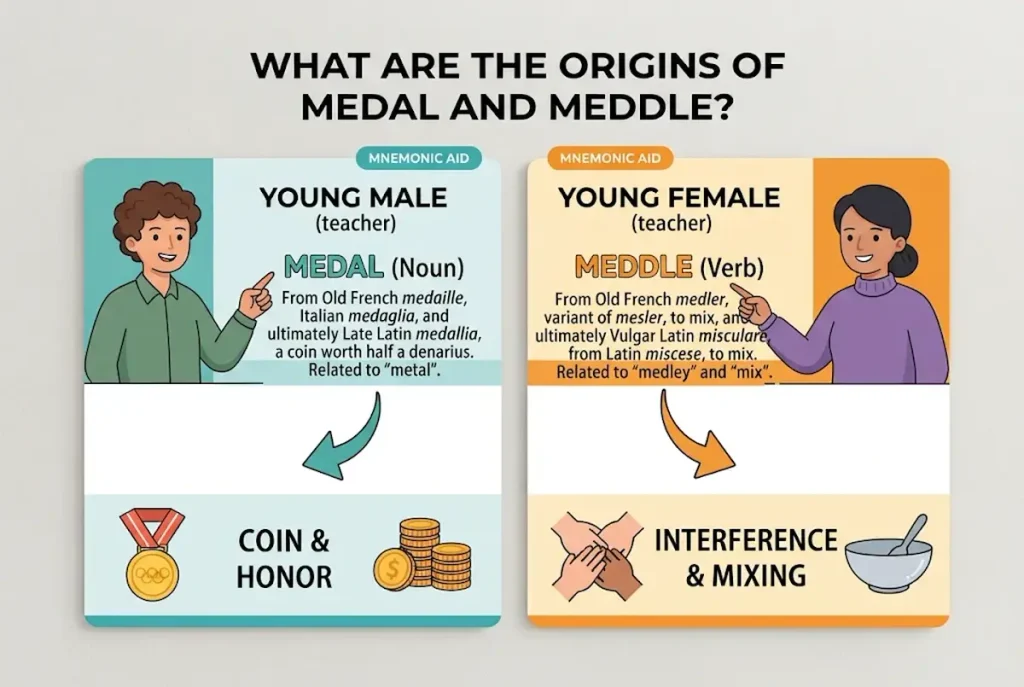
What Are the Origins of Medal and Meddle?
Although these words look and sound similar, they developed from different historical sources. Their histories explain why they have unrelated meanings.
Where Did the Word Medal Come From?
The noun medal entered English during the 1580s. It came through French médaille from Italian medaglia.
According to historical etymological sources, the Italian word may have developed from Vulgar Latin expressions connected with metal coins. Another proposed explanation connects it with Late Latin medialia, meaning little halves.
The earliest English uses referred to a metal disk carrying a figure or inscription. Over time, people began using medals to remember important people, institutions, and historical events.
By the 18th century, the word had also developed its familiar meaning as an award for achievement or merit. Etymology, Origin & Meaning
Today, medals are common in sports, education, military service, and public ceremonies.
Some familiar expressions include:
- Gold medal.
- Silver medal.
- Bronze medal.
- Medal of honor.
- Olympic medal.
- Military medal.
Where Did the Word Meddle Come From?
Meddle has a much older history than medal.
It appeared in Middle English during the early 14th century. It came from Old French and Old North French forms such as medler and mesler, which meant to mix, mingle, or blend.
These older forms ultimately connect to the Latin verb miscere, meaning to mix.
At first, meddle could describe mixing different things together. During the late 14th century, its meaning developed toward becoming involved in another person’s activities or concerns.
Eventually, the negative meaning of interfering unnecessarily became its main modern use. Etymology, Origin & Meaning+1
This history gives the word an interesting connection with its modern meaning. When someone meddles, they figuratively mix themselves into a situation that may not concern them.
Related words include:
- Meddler.
- Meddling.
- Meddlesome.
Do Medal and Meddle Have the Same Origin?
No. They have separate etymological histories.
Medal developed through French and Italian words associated with metal objects and coins. Meddle developed from French words meaning to mix or mingle, with roots in Latin.
Their similar appearance is a coincidence rather than evidence of a shared meaning.
What Are the Best Synonyms for Medal and Meddle?
The best replacement depends on the meaning you want to express. Medal has synonyms related to awards and recognition, while meddle has synonyms related to interference and unwanted involvement.
The following table groups useful alternatives by tone and gives a practical example for each word.
Simple Synonyms for Medal and Meddle
These words work well in everyday writing and basic English conversations.
| Word | Meaning | Tone | Example |
|---|---|---|---|
| Award | Something given for achievement | Simple | She received an award for her performance. |
| Prize | Something won in a competition | Simple | He won a prize for his painting. |
| Honor | Recognition for an achievement | Simple | The award was a great honor. |
| Badge | A small object showing achievement or membership | Simple | The scout received a badge. |
| Interfere | To get involved in something unnecessarily | Simple | Don’t interfere with their plans. |
| Intrude | To enter someone’s private space or affairs | Simple | I don’t want to intrude on your privacy. |
| Disturb | To interrupt or bother someone | Simple | Please don’t disturb their meeting. |
| Touch | To handle or make contact with something | Simple | Don’t touch the equipment. |
Everyday Synonyms for Medal and Meddle
These alternatives are useful in conversations, school assignments, and general writing.
| Word | Meaning | Tone | Example |
|---|---|---|---|
| Trophy | An object given as a prize | Everyday | The team displayed its trophy. |
| Ribbon | A strip of material given as recognition | Everyday | She earned a blue ribbon. |
| Token | An object representing appreciation or recognition | Everyday | He received a small token of thanks. |
| Decoration | An award recognizing service or achievement | Everyday | The soldier received a decoration. |
| Butt in | To enter a conversation without invitation | Casual | Please don’t butt in while we’re talking. |
| Pry | To ask about private matters | Everyday | Stop trying to pry into my life. |
| Nose around | To search or investigate unnecessarily | Casual | He likes to nose around other people’s business. |
| Tamper | To interfere with something improperly | Everyday | Someone tried to tamper with the equipment. |
Formal Synonyms for Medal and Meddle
Use these alternatives when writing reports, academic papers, professional documents, or formal messages.
| Word | Meaning | Tone | Example |
|---|---|---|---|
| Accolade | An expression of praise or recognition | Formal | Her research earned international accolades. |
| Commendation | Official praise for good work or service | Formal | He received a commendation for his service. |
| Distinction | Special recognition for excellence | Formal | She graduated with distinction. |
| Medallion | A large or decorative medal like object | Formal | The museum displayed an ancient medallion. |
| Intrusion | Unwanted involvement in private affairs | Formal | The decision was considered an intrusion. |
| Interposition | Involvement between people or events | Formal | His interposition complicated the discussion. |
| Encroachment | Gradual movement into another person’s rights or space | Formal | The policy prevented encroachment on private rights. |
| Intervention | Action taken to become involved in a situation | Formal | The intervention helped resolve the dispute. |
Which Synonyms Are Best From Mild to Strong?
Not every alternative has the same level of meaning. Some words describe harmless involvement, while others suggest serious interference. Choosing the right expression helps readers understand your message more clearly.
Medal Synonyms From Basic to Strong Recognition
The following words describe different levels or forms of recognition.
| Intensity | Word | Meaning | Example |
|---|---|---|---|
| Mild | Token | A small sign of appreciation | She received a token of appreciation. |
| Mild | Badge | A simple sign of achievement | He earned a badge for completing the task. |
| Moderate | Prize | A reward for winning | She received a prize for her artwork. |
| Moderate | Award | Recognition for good work | He received an award for excellent service. |
| Strong | Distinction | Recognition for outstanding performance | She graduated with distinction. |
| Strong | Accolade | High praise for an achievement | His work earned several accolades. |
| Strong | Decoration | An official award for service or bravery | The officer received a military decoration. |
Meddle Synonyms From Mild to Strong Interference
The intensity of interference can change depending on the situation.
| Intensity | Word | Meaning | Example |
|---|---|---|---|
| Mild | Involve | Take part in an activity | I don’t want to involve myself in their discussion. |
| Mild | Interrupt | Stop someone while they are doing something | Please don’t interrupt our meeting. |
| Moderate | Interfere | Become involved without permission | Stop interfering with my work. |
| Moderate | Intrude | Enter someone’s private affairs | He continued to intrude on her privacy. |
| Moderate | Pry | Try to discover private information | She kept prying into his personal life. |
| Strong | Tamper | Improperly change or handle something | Someone tampered with the evidence. |
| Strong | Trespass | Enter an area or property without permission | They trespassed on private property. |
| Strong | Sabotage | Deliberately damage or disrupt something | The employee tried to sabotage the project. |
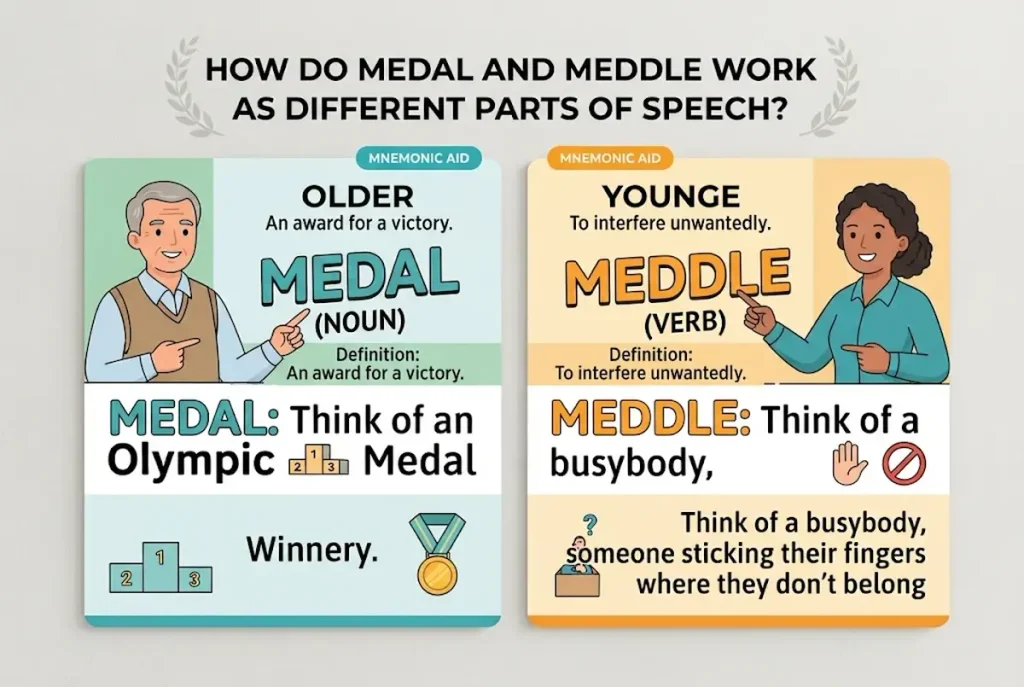
How Do Medal and Meddle Work as Different Parts of Speech?
Understanding parts of speech makes it easier to place each word correctly in a sentence.
Is Medal a Noun or a Verb?
Medal is mainly a noun, but English also uses it as a verb.
As a noun, it refers to an award or a commemorative metal object.
Examples:
- The athlete proudly displayed her medal.
- His medal represented years of hard work.
- The museum has a collection of historical medals.
As a verb, medal means to win or receive a medal, especially in a sports competition.
Examples:
- She hopes to medal at the world championship.
- The team medaled in three different events.
- Two athletes from the country medaled at the tournament.
Is Meddle a Noun or a Verb?
Meddle is a verb. It describes the action of interfering or becoming involved unnecessarily.
Examples:
- Don’t meddle in my relationship.
- He meddles with things he doesn’t understand.
- The government should avoid meddling in private business matters.
| Form | Part of Speech | Meaning | Example |
|---|---|---|---|
| Meddle | Verb | Interfere unnecessarily | Don’t meddle in their affairs. |
| Meddles | Verb | Present tense for he, she, or it | She meddles in everyone’s business. |
| Meddled | Past tense verb | Interfered in the past | He meddled with the documents. |
| Meddling | Verb or adjective | Interfering or getting involved | The neighbors are meddling again. |
| Meddler | Noun | A person who interferes | Nobody likes an unwanted meddler. |
| Meddlesome | Adjective | Likely to interfere | His meddlesome behavior caused problems. |
Are Medal and Meddle Different in American and British English?
The spelling and basic meanings of these words remain the same in American and British English. Both varieties use medal for an award and meddle for unnecessary interference.
However, there are a few details worth understanding.
Do Americans and British People Pronounce These Words Differently?
In many American and British accents, medal and meddle are pronounced alike.
Their pronunciation is commonly represented as /ˈmɛd.əl/. The first syllable receives the stress.
Because they are pronounced alike, they are often treated as homophones.
However, regional accents can affect the exact vowel and final syllable. The safest approach is to learn their meanings and spellings instead of relying only on sound.
Is the Spelling of Medal Different in the UK?
The noun medal has the same spelling in both countries.
The verb has a regional spelling difference in some forms:
| American English | British English |
|---|---|
| Medaled | Medalled |
| Medaling | Medalling |
Which Spelling Should International Writers Use?
Choose the spelling system that matches your audience or publication.
For a US audience, use American spelling consistently. For a British audience, follow British spelling conventions.
If you’re writing for an international audience, medal and meddle are understood in both varieties, so the main concern is choosing the correct word for the meaning.
Which Word Should You Use in Emails Resumes and Essays?
The right choice depends on your message. Think about the idea you want to communicate before selecting a spelling.
Which Word Is Better for a Resume?
Use medal when discussing a real award, competition result, or achievement that demonstrates your skills.
Example: Received a gold medal in the regional science competition for an innovative research project.
You can also use award or recognition when the achievement does not involve an actual medal.
Do not use meddle to describe your professional accomplishments unless you are discussing interference or inappropriate involvement.
Example: Avoided meddling in colleagues’ responsibilities while supporting independent teamwork.
This sentence uses the verb correctly, but it would usually be an unusual way to describe a positive resume achievement.
Which Word Is Correct in an Essay?
Use medal when writing about sports, historical awards, military recognition, or academic achievements.
Example: The athlete received a gold medal after breaking the national record.
Use meddle when discussing interference in politics, personal relationships, scientific research, or other matters.
Example: Governments should not meddle in the private decisions of individuals without a valid reason.
In academic writing, you may replace meddle with interfere or intervene when a more formal tone is appropriate.
Which Word Should You Use in Text Messages?
For texting, choose the word that matches your intended meaning.
If you’re talking about someone’s achievement, use medal.
Example: Congratulations! You really deserved that gold medal.
If you’re telling someone to stay out of your business, use meddle.
Example: Please stop trying to meddle in my relationship.
In casual messages, you can also use expressions such as butt in or stick your nose into something.
What Are Some Examples of Medal and Meddle in Real Life?
Seeing both words in different situations makes their meanings easier to remember. Here are 14 original examples from everyday life, education, sports, work, and personal relationships.
Examples Using Medal
1. Sarah proudly wore her gold medal during the school award ceremony.
2. The runner received a silver medal after finishing second in the race.
3. My grandfather keeps his military medal in a wooden display case.
4. The university awarded him a medal for his outstanding academic performance.
5. Every participant received a small medal at the end of the swimming competition.
6. The athlete trained for years to earn an Olympic medal.
7. Her medal became a reminder of the difficult journey she had completed.
8. The national team hopes to medal in several events this season.
Examples Using Meddle
9. My brother always tries to meddle in my personal decisions.
10. The teacher asked the students not to meddle with the laboratory equipment.
11. Nobody wants an outsider to meddle in their family disagreements.
12. The supervisor warned employees not to meddle with confidential company records.
13. She refused to let her friends meddle in her career choices.
14. The children were told not to meddle with the electrical wires.
What Is the Difference Between Medal and Award?
Medal and award are closely related, but they do not mean exactly the same thing.
An award is a general form of recognition given for achievement, service, or excellence. A medal is a specific type of object that can serve as an award.
| Feature | Medal | Award |
|---|---|---|
| Meaning | A metal object or a recognition received in a competition | Recognition or a prize for achievement |
| Form | Usually a physical object | Physical or nonphysical |
| Use | Sports, military service, ceremonies | Education, employment, sports, and other fields |
| Example | She received a gold medal. | She received an award for leadership. |
What Is the Difference Between Meddle and Interfere?
Meddle and interfere are similar because both describe becoming involved in something. However, their tones and uses are slightly different.
Interfere is a broader word. It can describe unwanted involvement, an interruption, or something that prevents an activity from happening properly.
Meddle usually has a stronger personal sense of unnecessary or unwanted involvement.
| Feature | Meddle | Interfere |
|---|---|---|
| Meaning | Get involved without being invited or having a good reason | Become involved in a way that affects something |
| Tone | Usually negative | Negative or neutral, depending on context |
| Common use | Personal affairs and private matters | Work, relationships, activities, and processes |
| Example | Stop meddling in my marriage. | Noise can interfere with communication. |
What Are the Most Common Mistakes With Medal and Meddle?
Writers often confuse these words because their pronunciation is similar. However, several simple checks can prevent mistakes.
Using Meddle When You Mean an Award
Incorrect: He received a gold meddle for winning the race.
Correct: He received a gold medal for winning the race.
Why? The sentence describes an object given to recognize an achievement. The correct noun is medal.
Using Medal When You Mean Interference
Incorrect: Stop trying to medal in my personal business.
Correct: Stop trying to meddle in my personal business.
Why? The sentence describes unwanted involvement. The correct verb is meddle.
Confusing Meddle With Meddling
Incorrect: She is always meddle in other people’s decisions.
Correct: She is always meddling in other people’s decisions.
Why? After is always, the sentence needs the appropriate verb form. Meddling describes an ongoing action.
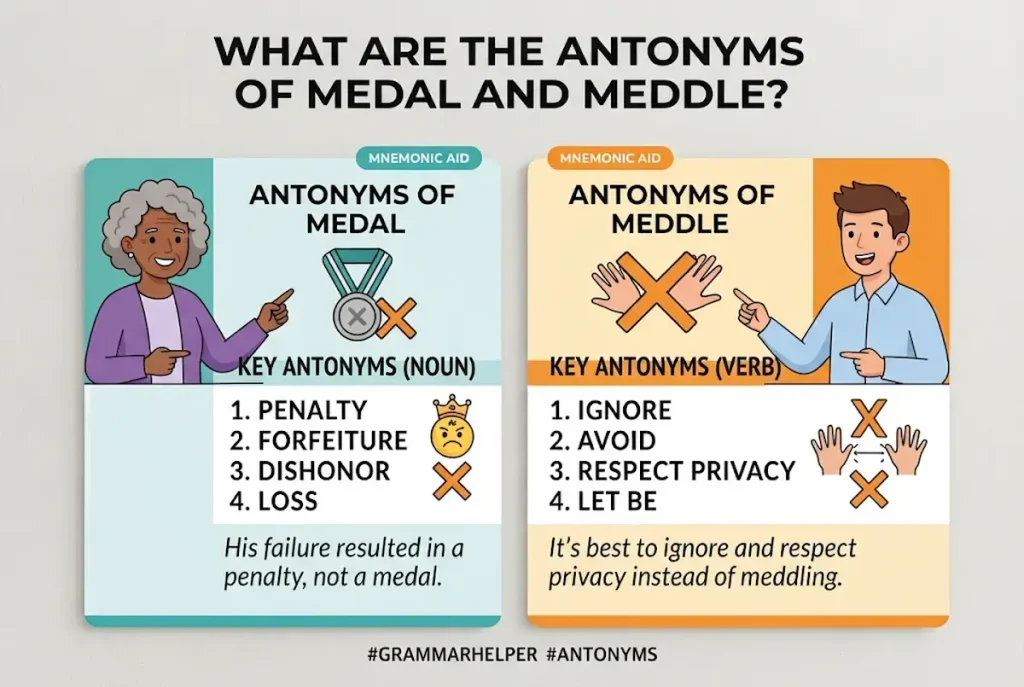
What Are the Antonyms of Medal and Meddle?
Antonyms are words with opposite meanings. Medal and meddle do not have exact opposites because they describe different things. However, you can use contrasting words depending on the sentence.
Antonyms Related to Medal
A medal represents recognition or achievement. Words that express the opposite idea include:
| Word | Meaning |
|---|---|
| Disgrace | Loss of respect or honor |
| Failure | Lack of success |
| Dishonor | Loss of respect or reputation |
| Punishment | A penalty for wrongdoing |
| Defeat | Losing a competition |
Antonyms Related to Meddle
Meddle describes unnecessary interference. Its opposite ideas include:
| Word | Meaning |
|---|---|
| Ignore | Pay no attention to something |
| Avoid | Stay away from involvement |
| Respect | Accept another person’s rights or choices |
| Withdraw | Remove yourself from a situation |
| Refrain | Choose not to do something |
What Are the Quick Tips for Choosing the Correct Word?
Remember these simple rules whenever you are unsure about the spelling.
- Think about an award. If you’re talking about winning or receiving recognition, write medal.
- Think about interference. If someone is getting involved in another person’s affairs, write meddle.
- Check the part of speech. Medal is mainly a noun, while meddle is a verb.
- Remember the spelling. Medal has one d, while meddle has two d’s.
- Read the entire sentence. Make sure the word communicates the meaning you intend.
Conclusion
Understanding medal vs meddle becomes much easier when you remember their different purposes. A medal is an award that recognizes achievement, bravery, or success. Meddle is an action that involves interfering in someone else’s affairs or handling something without permission.
Although these words sound alike in many English accents, their grammatical roles and meanings are different. Use medal when discussing competitions, honors, and achievements. Choose meddle when describing unwanted involvement or interference.
Before submitting an email, essay, or professional document, take a moment to check the meaning of the word. A small spelling change can make a big difference in your message. With regular practice, you’ll be able to use both words correctly and confidently.
Frequently Asked Questions
What is the main difference between medal and meddle?
Medal is an award given for achievement, while meddle means to interfere in someone else’s affairs. The two words sound alike in many English accents but have different meanings.
Is medal a noun or a verb?
Medal is mainly a noun, but it can also function as a verb. As a noun, it describes an award, while the verb means to win or receive a medal in a competition.
Is meddle always a negative word?
Meddle usually has a negative meaning because it describes unwanted involvement. It often suggests that someone is interfering in matters that do not concern them.
What is another way to say meddle?
Other ways to say meddle include interfere, intrude, pry, butt in, and tamper. The best alternative depends on the situation and the level of involvement.
Are medal and meddle pronounced the same?
Yes, they are homophones in many American and British English accents. Both commonly have the pronunciation /ˈmɛd.əl/, although regional accents can affect their exact sounds.
Should I write gold medal or gold meddle?
Write gold medal because it refers to an award made of metal. Gold meddle is incorrect when describing a sports or achievement award.
What does meddle in someone’s business mean?
It means getting involved in another person’s private affairs without being invited or having a good reason. It often expresses annoyance with unwanted interference.
Can medal be used as a verb?
Yes. Medal can be used as a verb meaning to win or receive a medal in a competition. For example, She hopes to medal at the national championships.

Daniel Grammarfield — The Language Learner
Age: 28Occupation: ESL Learner & Digital Professional
Bio:Daniel is a non-native English speaker who wants to communicate more confidently at work and online. He uses Synotrench to improve grammar, understand confusing words, learn correct sentence structures, and build everyday English skills. He prefers simple explanations with practical examples.
Goals:
Master English grammar rules
Avoid common language mistakes
Improve professional communication
Learn English through real-life examples
Quote:“Learning English is not about memorizing rules — it’s about expressing ideas clearly.”
1 thought on “Medal vs Meddle: Best and Simple Guide to the Difference”