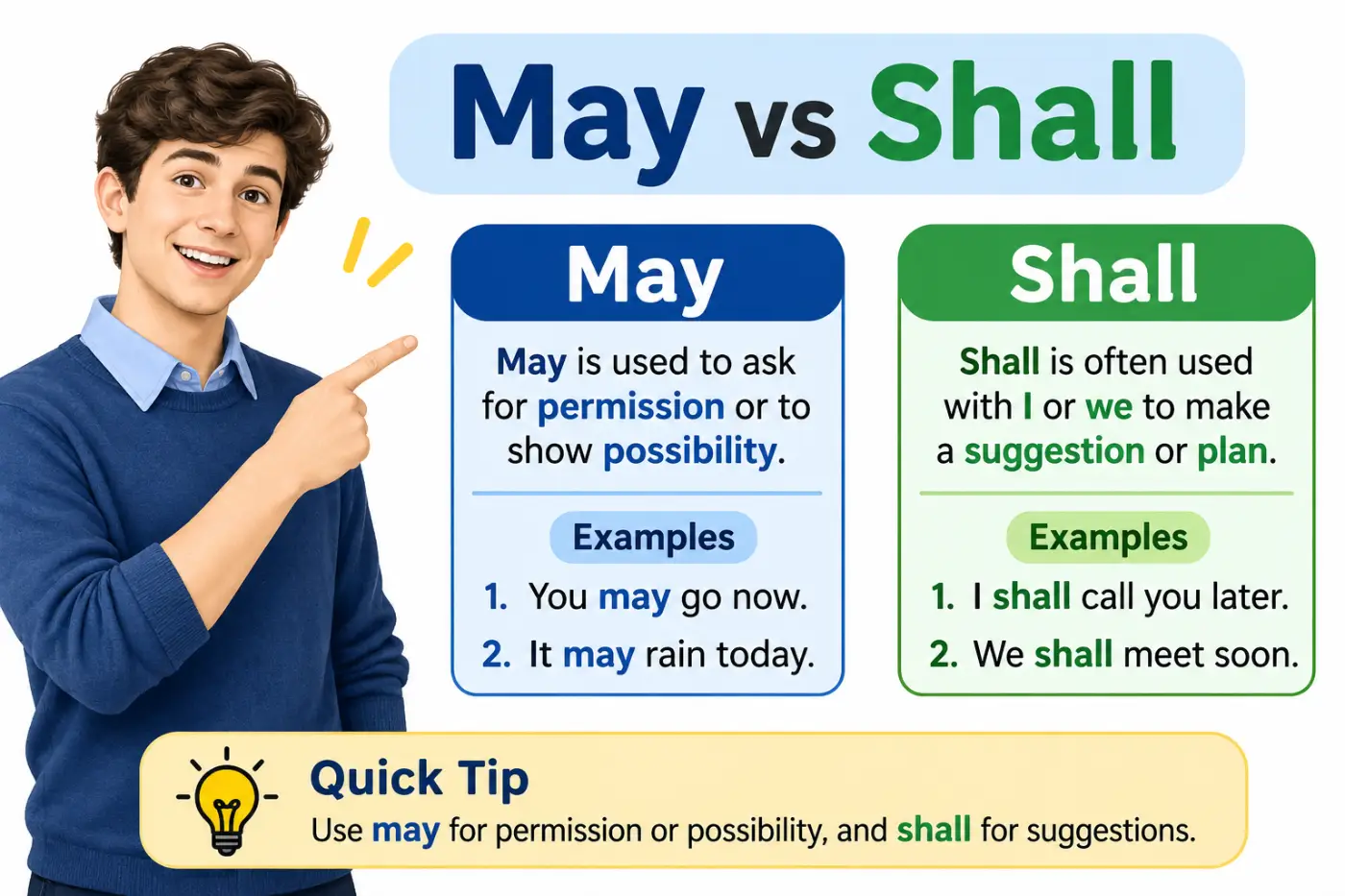
When writing may vs shall an email, school assignment, business letter, or formal agreement, choosing the right helping verb can change the tone of your sentence. You might use may to ask for permission, but shall can express a duty, promise, or future action. Although both words are modal verbs, they don’t always serve the same purpose.
The main difference between these two words comes down to meaning and tone. May often expresses permission, possibility, or uncertainty. Shall commonly expresses a future action, an offer, a suggestion, or a formal requirement.
Both words have a long history in English, and their use has changed over time. Modern American English also uses them differently from older grammar rules. This guide explains their meanings, origins, common uses, examples, and differences so you can choose the right word with confidence.
What Do May vs Shall Mean in Simple English?
May and shall are modal auxiliary verbs. They work with the base form of another verb to express ideas such as possibility, permission, intention, and obligation.
However, each word has its own common uses.
What Does May Mean?
May usually expresses permission or possibility. It can show that something is allowed or that something might happen.
For example:
- You may leave the classroom now.
- It may rain this afternoon.
- She may join us for dinner.
What Does Shall Mean?
Shall often expresses a future action, an offer, a suggestion, or a formal duty. It sounds more formal than will in many everyday situations.
For example:
- I shall contact you tomorrow.
- Shall we start the meeting?
- You shall receive a written response.
What Are the Origins of May and Shall?
Understanding the history of these words helps explain why they have different meanings today.
Where Did the Word May Come From?
May comes from the Old English word mæg, which was related to the verb magan. This older verb expressed ability, power, or strength.
Over time, the word developed into a modal verb that could express permission and possibility. Its meaning gradually expanded beyond the idea of being able to do something.
Today, may commonly appears in sentences about permission, uncertainty, and possibility.
Example: Employees may work from home on Fridays.
Here, may tells employees that working from home is allowed.
Where Did the Word Shall Come From?
Shall comes from the Old English word sceal. It originally expressed duty, obligation, or necessity.
The word developed from an idea of owing something or being required to do something. Over time, it also became a way to talk about future actions.
Today, shall can express a future event, a suggestion, an offer, or a formal obligation.
Example: The company shall provide the required equipment.
In this sentence, shall describes a formal responsibility.
What Are the Main Uses of May and Shall?
Both words can appear in different situations. Their meanings depend on the sentence and the speaker’s intention.
| Use | May | Shall |
|---|---|---|
| Permission | Common | Rare in modern everyday English |
| Possibility | Common | Not a usual choice |
| Future action | Possible but less common | Traditional and formal |
| Offer | Less common | Common in questions |
| Suggestion | Not a usual choice | Common |
| Legal duty | Sometimes | Common in formal legal language |
| Polite request | Common | Used in specific questions |
When Should You Use May?
Use may when you want to express:
- Permission: You may use my computer.
- Possibility: The package may arrive tomorrow.
- Polite requests: May I ask you a question?
- Formal wishes: May your dreams come true.
- Uncertain plans: We may visit the museum next weekend.
When Should You Use Shall?
Use shall when you want to express:
- A future action: I shall return before sunset.
- An offer: Shall I carry your bag?
- A suggestion: Shall we go for a walk?
- A formal commitment: The seller shall deliver the goods.
- A strong promise: I shall never forget your kindness.

What Words Can You Use Instead of May and Shall?
May and shall don’t have perfect replacements in every sentence. Their alternatives depend on the meaning you want to express.
For example, can may replace may when asking about permission in casual conversation. However, can doesn’t always carry the same formal tone.
Similarly, will can replace shall in many future statements, but it doesn’t always communicate the same legal or formal duty.
The following tables show useful alternatives.
What Are Common Synonyms for May?
These words and phrases can express permission, possibility, or uncertainty.
| Word | Meaning | Tone | Example |
|---|---|---|---|
| Can | Be allowed or able to | Everyday | You can use this room. |
| Could | A possible or polite action | Polite | Could I borrow your pen? |
| Might | Something is possible | Neutral | It might snow tonight. |
| Possibly | Perhaps something can happen | Neutral | We can possibly finish today. |
| Perhaps | Maybe | Everyday | Perhaps she will call. |
| Maybe | Possibly | Casual | Maybe he is at home. |
| Be allowed to | Have permission | Neutral | You are allowed to leave. |
| Be permitted to | Have official permission | Formal | Visitors are permitted to enter. |
| Be authorized to | Have official approval | Formal | Staff are authorized to access the records. |
| Be entitled to | Have a right to something | Formal | Members are entitled to a refund. |
| Be free to | Have the choice to act | Everyday | You are free to ask questions. |
| Be possible | Have a chance of happening | Neutral | It is possible that she will come. |
| Be likely to | Have a good chance of happening | Neutral | Prices are likely to increase. |
| Be able to | Have the ability or opportunity | Everyday | I may be able to help. |
| Have permission to | Receive approval | Neutral | Students have permission to leave early. |
| Have the option to | Have a choice | Everyday | You have the option to cancel. |
| Be conceivable | Be possible to imagine | Formal | It is conceivable that plans may change. |
| Be plausible | Seem reasonable or possible | Formal | His explanation is plausible. |
| Be acceptable | Be allowed or suitable | Neutral | This solution may be acceptable. |
| Be eligible to | Meet the requirements | Formal | You may be eligible to apply. |
| Be permitted | Be officially allowed | Formal | Photography is permitted here. |
| Have the right to | Be legally or morally allowed | Neutral | You have the right to appeal. |
What Are Common Synonyms for Shall?
Shall has different alternatives depending on whether it expresses the future, an offer, a suggestion, or an obligation.
| Word | Meaning | Tone | Example |
|---|---|---|---|
| Will | Express a future action | Everyday | I will call you tomorrow. |
| Must | Express a strong requirement | Strong | You must submit the form. |
| Should | Express advice or expectation | Neutral | You should complete the task. |
| Ought to | Express duty or advice | Formal | We ought to help them. |
| Need to | Express necessity | Everyday | You need to arrive early. |
| Have to | Express an obligation | Everyday | I have to finish this work. |
| Be required to | Have an official duty | Formal | Employees are required to attend. |
| Be obligated to | Have a duty | Formal | The buyer is obligated to pay. |
| Be expected to | Be required or anticipated | Neutral | You are expected to follow the rules. |
| Be responsible for | Have a duty | Neutral | The manager is responsible for safety. |
| Undertake to | Formally promise to do something | Formal | The company undertakes to provide support. |
How Do May vs Shall Differ in Strength and Tone?
The strength of a modal verb depends on its purpose. May can sound uncertain when it expresses possibility, but it can sound official when it grants permission. Shall can sound formal, firm, or polite depending on the sentence.
Which Words Express Mild Possibility?
When you want to describe something that could happen, these expressions are useful:
- Perhaps: Perhaps we will meet again.
- Maybe: Maybe the store is still open.
- Could: The problem could happen again.
- Might: She might visit us tomorrow.
- May: The delivery may arrive today.
Which Words Express Stronger Duty?
When you need to communicate responsibility or a requirement, choose words carefully.
- Should: You should check your answers.
- Ought to: We ought to respect other people’s opinions.
- Need to: You need to complete the application.
- Have to: I have to attend the meeting.
- Must: All visitors must show identification.
How Do May and Shall Work as Different Parts of Speech?
Both words mainly function as modal auxiliary verbs. They don’t normally act as ordinary nouns or adjectives.
However, they have different grammatical patterns and uses.
How Is May Used as a Modal Verb?
May is followed by the base form of a verb.
Correct: She may attend the event.
Incorrect: She may attends the event.
You can use may in several sentence patterns:
| Sentence Type | Structure | Example |
|---|---|---|
| Positive | Subject + may + base verb | He may come. |
| Negative | Subject + may not + base verb | She may not agree. |
| Question | May + subject + base verb? | May I enter? |
| Possibility | Subject + may + base verb | It may rain. |
How Is Shall Used as a Modal Verb?
Shall also takes the base form of a verb.
Correct: We shall discuss the matter tomorrow.
Incorrect: We shall discusses the matter tomorrow.
Common patterns include:
| Sentence Type | Structure | Example |
|---|---|---|
| Positive | Subject + shall + base verb | I shall return. |
| Negative | Subject + shall not + base verb | We shall not forget. |
| Question | Shall + subject + base verb? | Shall we begin? |
| Offer | Shall + I + base verb? | Shall I help you? |
| Suggestion | Shall + we + base verb? | Shall we go outside? |
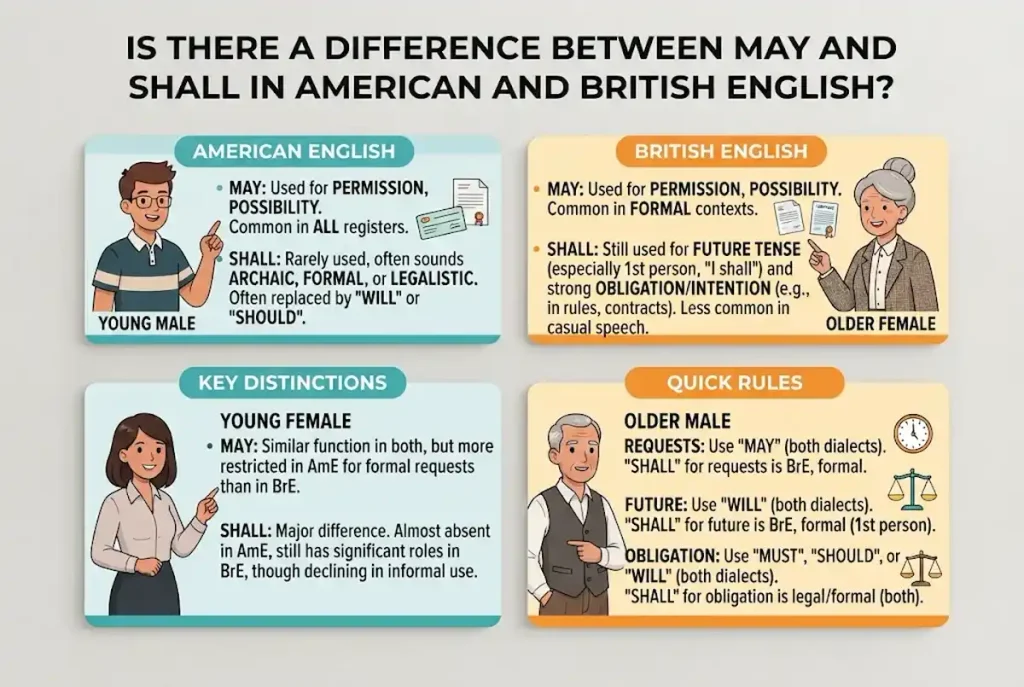
Is There a Difference Between May and Shall in American and British English?
Yes. Both American and British English use may and shall, but shall has a stronger traditional role in British English.
How Do Americans Use May vs Shall?
In American English, may is common in formal permission requests and statements about possibility.
Examples:
- May I speak with the manager?
- You may enter the building.
- The weather may improve tomorrow.
Americans generally use will instead of shall for ordinary future statements.
For example:
Common American English: I will call you tomorrow.
More formal or traditional: I shall call you tomorrow.
Shall still appears in American legal writing, contracts, regulations, and polite questions.
How Do British Speakers Use May and Shall?
British English also uses may for permission and possibility.
Examples:
- You may leave now.
- It may rain later.
- May I use your phone?
Shall is traditionally more common in British English, especially with I and we when discussing future actions.
For example:
I shall see you tomorrow.
We shall discuss the plan later.
However, will is also common in British English. Modern speakers often choose will for ordinary future statements.
Which Word Should You Use in a Resume?
In a resume, choose clear action verbs instead of relying on shall or may. Employers usually want to see what you have done, what skills you have, and what results you can deliver.
For example:
Less effective: I shall complete assigned tasks on time.
Better: I complete assigned tasks on time and meet project deadlines.
Another example:
Less effective: I may help the company improve its workflow.
Better: I helped improve the team’s workflow and reduce delays.
If you’re describing a possible future responsibility, use language that sounds confident without making promises you can’t guarantee.
Example: Prepared to support daily operations and coordinate team projects.
Which Word Should You Use in an Essay?
In an academic essay, may works well when you discuss possibilities, interpretations, or uncertain results.
Example: This evidence may suggest a connection between sleep and memory.
Shall is less common in ordinary academic writing. However, it can appear in formal statements, research plans, or legal discussions.
Example: The following section shall examine the main causes of the problem.
For most school and college essays, will, should, must, or may will sound more natural, depending on your intended meaning.
Which Word Sounds Better in a Text Message?
In casual texting, may and shall can sound formal or old-fashioned. Your choice depends on the message.
Use may when you want to sound polite or describe a possibility.
Example: I may be a little late.
Use shall when making a playful or polite suggestion.
Example: Shall we grab some food?
Most people would use simpler alternatives in everyday messages.
Examples:
- Can I call you?
- I might come later.
- Should we leave now?
What Are 15 Example Sentences Using May and Shall?
Examples make the difference easier to understand. The following sentences show how both words work in school, work, home, travel, and everyday conversations.
Examples With May
- You may submit your assignment before Friday.
- May I use your phone for a moment?
- The teacher may announce the results tomorrow.
- We may visit our grandparents this weekend.
- This medicine may cause mild side effects.
- Students may use the library after class.
- The company may open a new office next year.
- May I have another glass of water?
- She may need extra time to finish the project.
- The meeting may begin at 10 a.m.
Examples With Shall
- I shall complete the report by tomorrow.
- Shall we discuss the problem after lunch?
- Shall I help you carry those boxes?
- We shall remember this special day.
- The tenant shall pay the rent on the first day of each month.
- Shall we invite our friends to dinner?
- I shall send you the details by email.
- The organization shall provide safety equipment.
- Shall I close the door?
- We shall continue our work after the break.
What Is the Difference Between May and Might?
May and might both express possibility, but might often suggests a lower level of certainty.
| May | Might |
|---|---|
| The trip may happen. | The trip might happen. |
| She may join us. | She might join us. |
| It may rain tonight. | It might rain tonight. |
What Is the Difference Between Shall and Will?
Shall and will can both describe future actions, but will is much more common in modern everyday English.
| Shall | Will |
|---|---|
| I shall call you tomorrow. | I will call you tomorrow. |
| We shall finish the work. | We will finish the work. |
| Shall we begin? | Will we begin? |
What Is the Difference Between May and Can?
May and can can both appear in permission questions, but they have slightly different tones.
May is traditionally more formal and polite. Can is more common in everyday conversation.
| May | Can |
|---|---|
| May I leave early? | Can I leave early? |
| You may use my laptop. | You can use my laptop. |
| May I ask a question? | Can I ask a question? |
What Are the Common Mistakes People Make With May and Shall?
Many learners understand the basic meanings but make mistakes when using these words in sentences. Learning a few simple rules can help you avoid them.
Using May With the Wrong Verb Form
May must be followed by the base form of a verb.
Incorrect: She may goes to school tomorrow.
Correct: She may go to school tomorrow.
Don’t add s, es, or ed directly after the modal verb.
Using Shall for Every Future Sentence
Shall can describe future actions, but it isn’t the most natural choice in every situation.
Unnatural in everyday American English: I shall visit the store tomorrow.
More natural: I will visit the store tomorrow.
Use shall when you want a formal tone or when the sentence expresses a suggestion or offer.
Confusing Permission With Possibility
May can express both permission and possibility. The context tells readers which meaning you intend.
Example: You may leave now.
This usually gives permission.
Example: You may feel tired after the journey.
This expresses possibility.
Don’t assume that every sentence with may is about permission.
Using Shall When You Mean Permission
Shall isn’t normally used to grant everyday permission.
Unnatural: You shall use my computer.
Natural: You may use my computer.
The first sentence sounds like a command or formal declaration. The second clearly gives permission.
Forgetting the Base Verb After Shall
Shall must also be followed by the base form of a verb.
Incorrect: We shall discusses the issue.
Correct: We shall discuss the issue.
The same rule applies to other modal verbs, including can, could, should, and might.
Using May Not Without Checking Its Meaning
May not can express a lack of permission or a possibility that something won’t happen.
Example: You may not enter this area.
This usually means entry is not allowed.
Example: She may not attend the meeting.
This can mean that she might not attend.
If the meaning isn’t clear from context, rewrite the sentence.
For example:
Entry is not permitted in this area.
She might be unable to attend the meeting.
When Should You Avoid Using May vs Shall?
Both words are useful, but they aren’t always the best choices.
Avoid may when you need to express a definite future plan or a strong promise.
Less direct: I may send the file tomorrow.
Clearer: I will send the file tomorrow.
Avoid shall when writing casual messages that don’t need a formal tone.
Less natural: I shall meet you at the café.
More natural: I’ll meet you at the café.
Also, avoid using shall in a legal document without understanding its intended effect. Legal wording can create duties or rights, and the meaning may depend on the full document and applicable law.
What Are the Antonyms of May and Shall?
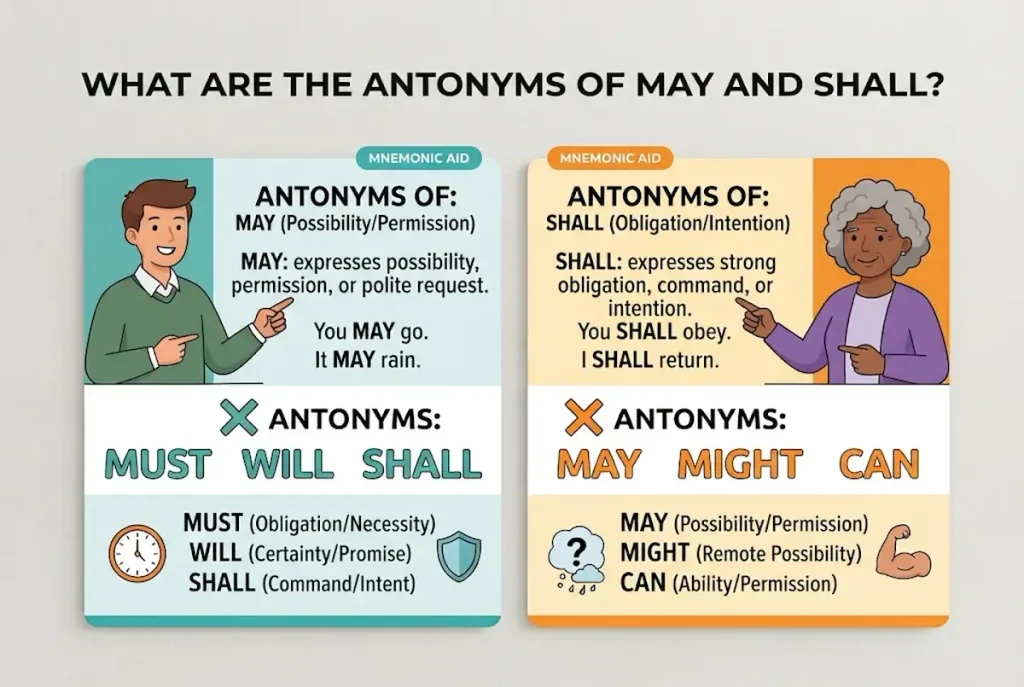
May and shall don’t have one perfect opposite in every situation. Their antonyms depend on how you’re using them.
Opposites of May
When may expresses permission, possible opposites include:
- Must not.
- Cannot.
- Is prohibited from.
- Is not permitted to.
Example: Visitors may enter this room.
Opposite: Visitors must not enter this room.
When may expresses possibility, words such as impossible or cannot express an opposite idea.
Example: The plan may succeed.
Opposite: The plan cannot succeed.
Opposites of Shall
When shall expresses an obligation, possible opposites include:
- Need not.
- Is not required to.
- Is free to refuse.
Example: The employee shall attend the meeting.
Opposite: The employee is not required to attend the meeting.
What Are the Quick Tips for Choosing May or Shall?
Use these simple rules when writing or speaking.
- Use may to give permission. Example: You may leave now.
- Use may to express possibility. Example: It may rain later.
- Use may in polite permission requests. Example: May I come in?
- Use shall to make an offer. Example: Shall I help you?
- Use shall to make a suggestion. Example: Shall we start?
- Use shall for formal duties when the wording calls for it. Example: The supplier shall deliver the order.
- Use will for most ordinary future statements in American English.
- Use might when you want to express a possibility that sounds less certain.
- Follow both modal verbs with the base form of a verb.
- Check the full sentence before choosing a replacement.
Conclusion
Understanding the difference between may and shall helps you write clearer emails, essays, business documents, and everyday messages. May usually expresses permission or possibility, while shall commonly communicates a future action, offer, suggestion, or formal obligation.
In modern American English, will is more natural than shall for most ordinary future statements. However, shall remains useful in polite questions, formal writing, and legal language.
Always consider the meaning and tone of your sentence before choosing either word. With regular practice, you’ll find it easier to use both correctly. Pay attention to how people use these verbs in real conversations and written documents, and your grammar will become more natural over time.
Frequently Asked Questions
Is may more polite than shall?
May is commonly used for polite permission requests, such as May I come in? Shall is often used for polite offers and suggestions, such as Shall I help you?
Can I use shall instead of will?
Yes, you can use shall instead of will in some future statements, especially in formal or traditional English. However, will is more common in everyday American English.
Does may mean permission or possibility?
May can express both permission and possibility. For example, You may leave now gives permission, while It may rain tonight describes a possibility.
Is shall still used in modern English?
Yes, shall is still used in modern English, especially in polite questions, formal writing, contracts, and legal documents. It is less common in ordinary future statements.
What is the difference between may and shall in a contract?
In contracts, may often gives a person permission or discretion, while shall commonly expresses a duty or requirement. The exact legal meaning depends on the wording and applicable law.
Can I use may and shall with he or she?
Yes, both words can be used with he, she, it, I, you, we, and they. Always follow them with the base form of the main verb.
What’s another way to say may or shall?
For may, you can use might, could, can, or be permitted to, depending on the meaning. For shall, alternatives include will, must, should, and have to.
Which word should I use in American English?
Use may for permission and possibility. Use shall for offers, suggestions, and formal obligations. For most ordinary future statements, choose will.

Daniel Grammarfield — The Language Learner
Age: 28Occupation: ESL Learner & Digital Professional
Bio:Daniel is a non-native English speaker who wants to communicate more confidently at work and online. He uses Synotrench to improve grammar, understand confusing words, learn correct sentence structures, and build everyday English skills. He prefers simple explanations with practical examples.
Goals:
Master English grammar rules
Avoid common language mistakes
Improve professional communication
Learn English through real-life examples
Quote:“Learning English is not about memorizing rules — it’s about expressing ideas clearly.”
2 thoughts on “May vs Shall: The Ultimate Guide to the Difference”