Have you ever written an email, essay, resume, or text and stopped to ask yourself, “Should I say accurate or correct?” The two words look very similar, and in many sentences, they can both seem possible. Still, they do not always carry the same meaning.
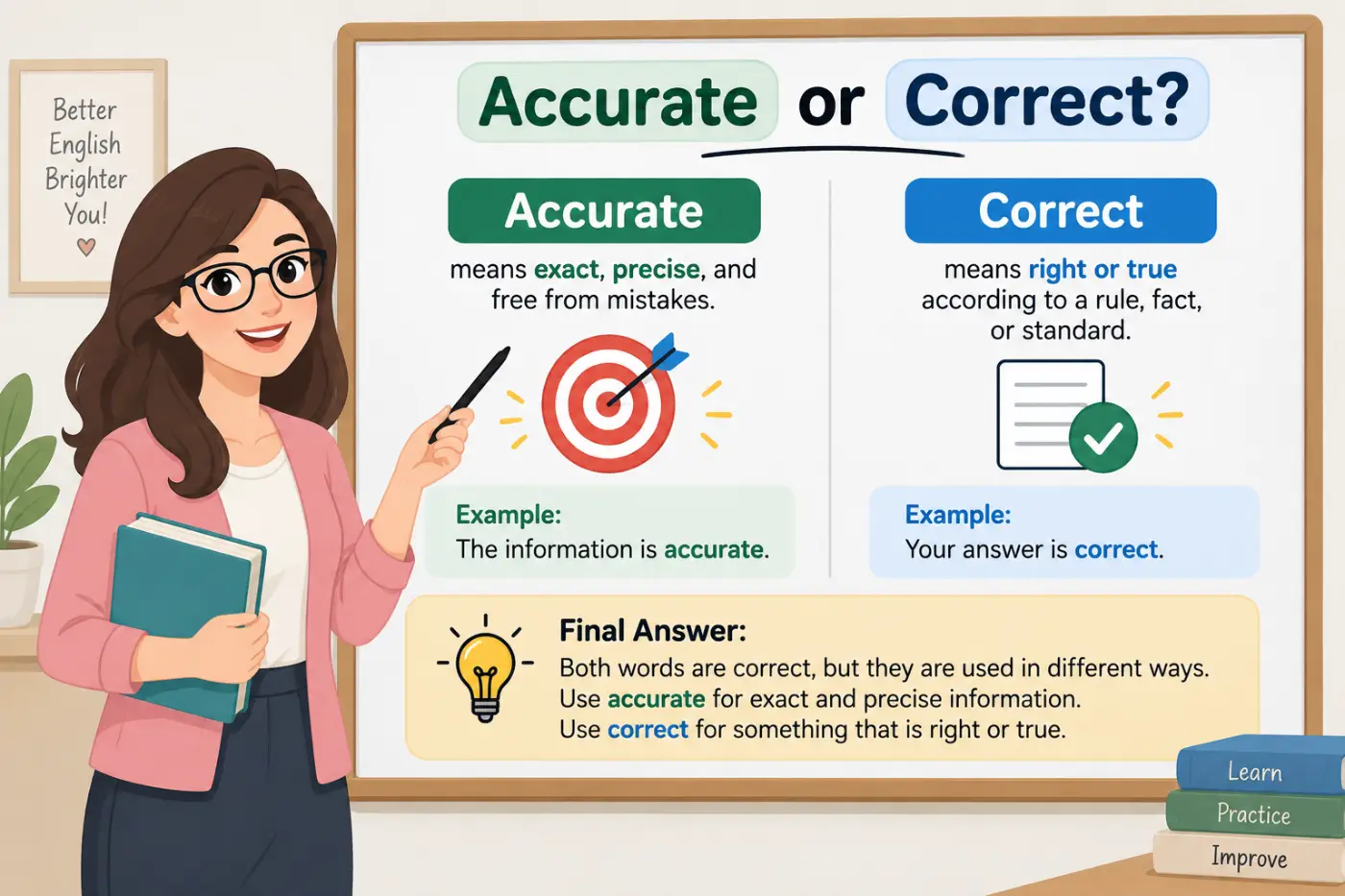
The simplest answer is this: accurate usually means factually or precisely right, while correct usually means free from mistakes or following the accepted rule. The right choice depends on what you are describing.
You may talk about an accurate measurement, an accurate description, or an accurate prediction. You may talk about a correct answer, correct spelling, or correct grammar. Sometimes both words work, but one can sound more natural or precise than the other.
In this guide, you will learn the meaning and origin of both words, explore more than 30 useful alternatives, compare their strength and tone, and see which word works best in resumes, essays, emails, texts, and everyday speech. You will also learn common mistakes and simple ways to choose the right word.
What do accurate or correct mean?
Accurate means close to the true value, fact, detail, or reality. It often focuses on precision and factual truth.
Correct means right, free from an error, or acceptable according to a rule, standard, fact, or expected answer. It often focuses on avoiding mistakes.
For example:
| Word | Main idea | Example |
|---|---|---|
| Accurate | Factually or precisely right | The report contains accurate information. |
| Correct | Right or free from mistakes | Your answer is correct. |
The difference can be small, but it matters in certain situations.
If a weather report says the temperature is 72°F and the real temperature is 72°F, the report is accurate. If a student chooses the expected answer on a test, the answer is correct.
A useful shortcut is:
Accurate = matches the facts or reality.
Correct = does not contain a mistake and follows the expected standard.
Where do accurate and correct come from?
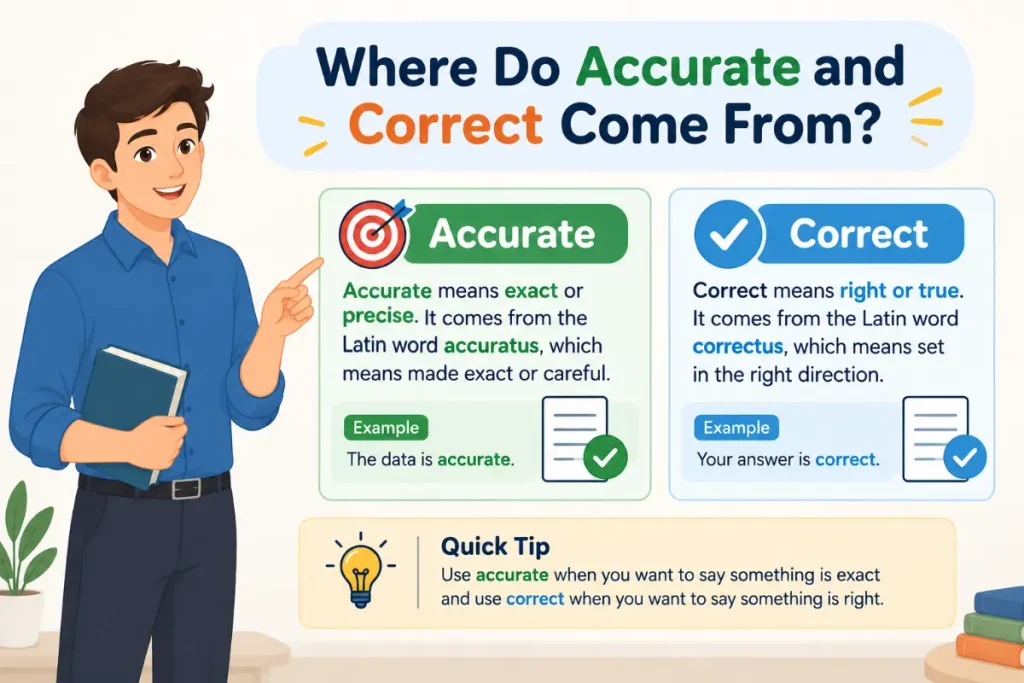
The word accurate comes from the Latin word accuratus, which is connected with the idea of doing something carefully. Its history gives the word a strong connection to care, precision, and exactness.
Over time, English speakers began using accurate to describe information, measurements, descriptions, records, and statements that closely match reality.
The word correct also comes from Latin. It developed from correctus, which is related to the idea of making something right or straight. This history fits its modern meaning because correct often describes something that has no error or follows an accepted rule.
These origins help explain the difference between the two words.
Accurate has a strong connection with precision and truth.
Correct has a strong connection with rightness and standards.
That is why an answer can be correct without needing to be extremely precise.
For example, imagine someone asks, “How many people attended the event?”
You answer, “About 500 people.”
If around 500 people really attended, your answer may be accurate enough for the situation.
If the official number is exactly 497, then “497 people attended” is more precise.
Which synonyms are mild and which are strong?
The strength of a synonym matters because some words suggest only basic correctness, while others suggest extremely high precision.
What words mean mildly correct?
For a basic idea of rightness, use words such as:
- Right.
- Correct.
- True.
- Sound.
- Valid.
These words work well when you simply want to say that something is not wrong.
Example:
“Your answer is correct.”
This does not tell us how detailed or precise the answer is. It simply says the answer meets the expected standard.
What words mean clearly accurate?
For stronger factual accuracy, consider:
- Accurate.
- Precise.
- Exact.
- Factual.
- Reliable.
- Verifiable.
These words give the reader more information about why something can be trusted.
Example:
“The database contains accurate customer information.”
Here, the focus is on the information matching reality.
What words suggest extremely careful accuracy?
For a very high level of care or precision, use:
- Exact.
- Precise.
- Meticulous.
- Rigorous.
- Exacting.
Example:
“The engineer took precise measurements.”
The word precise tells the reader that small differences matter.
What casual words suggest strong agreement?
In informal speech, you can use:
- Spot on.
- Dead on.
- Nailed it.
- Bullseye.
- On target.
Example:
“Your guess was spot on.”
These expressions are natural in conversation but should usually be avoided in formal academic writing.
How do work as different parts of speech?
Both accurate and correct are mainly adjectives.
You can use them before nouns:
“The report is accurate.”
“She gave the correct answer.”
They can also appear after linking verbs:
“The information seems accurate.”
“His answer was correct.”
Their related forms are different.
What is the adverb form of accurate?
The adverb is accurately.
Example:
“She described the event accurately.”
Other related forms include:
- Accuracy.
- Accurately.
- Inaccurate.
- Inaccuracy.
What are the related forms of correct?
Common forms include:
- Correctly.
- Correction.
- Correctness.
- Incorrect.
- Incorrectly.
Example:
“She answered the question correctly.”
The noun correction is especially common when someone changes a mistake.
Example:
“The teacher made a correction to my sentence.”
What is the difference between words?
The main difference is the focus of the sentence.
Accurate focuses on closeness to facts, reality, measurements, or details.
Correct focuses on being right, avoiding an error, or meeting a rule or standard.
Consider these examples:
“The map is accurate.”
This means the map represents the real location correctly and precisely.
“The answer is correct.”
This means the answer matches the expected answer.
Now imagine a student writes:
“New York is the largest city in the United States by population.”
That statement can be described as correct because it matches the accepted fact.
If the student gives detailed population data, the data can be described as accurate if the numbers closely match the real figures.
When should you use accurate in a resume?
Use accurate in a resume when you want to show careful work, reliable records, precise information, or attention to detail.
Good examples include:
“I maintained accurate customer records.”
“I prepared accurate financial reports.”
Accurate works especially well for jobs involving:
- Data entry.
- Accounting.
- Research.
- Customer service.
- Administration.
- Healthcare records.
- Inventory.
- Technical documentation.
Instead of saying:
“I am good at making things right.”
You could write:
“I maintained accurate records and checked data for errors.”
That sounds clearer and more professional.
When should you use correct in a resume?
Use correct when you want to emphasize fixing mistakes, following procedures, or applying rules properly.
Examples include:
“I corrected data entry errors.”
“I checked invoices for correct pricing.”
In resumes, correct often works better as part of a specific action.
For example:
“I corrected billing errors before invoices were sent.”
This is stronger than simply writing:
“I was correct with invoices.”
The first sentence shows what you actually did.
What word works best in an essay?
Both words can work in an essay, but accurate is often useful when discussing facts, evidence, descriptions, statistics, or research.
Examples:
“The study provides accurate information about student behavior.”
“The historical account is considered accurate.”
“The graph gives an accurate picture of population growth.”
Use correct when discussing answers, rules, interpretations, or statements.
Examples:
“The second interpretation is correct.”
“The correct spelling is necessary in formal writing.”
“The correct answer can be found by solving the equation.”
In academic writing, you may also use more specific words such as precise, valid, factual, or reliable.
What word works best in an email?
The best choice depends on what you are discussing.
Use accurate for information and records.
Example:
“Please make sure the customer information is accurate before sending the report.”
Use correct for errors and changes.
Example:
“Please correct the address before sending the package.”
Another example:
“Could you confirm that these figures are accurate?”
This sounds natural because figures can be compared with real data.
What word works best in a text message?
In texting, correct and right are usually more natural than formal alternatives.
You could write:
“Yep, that’s correct.”
“Right, that’s what I meant.”
“Your guess was spot on.”
“That’s exactly right.”
If you are talking about factual information, accurate can still work:
“Is that information accurate?”
However, a casual speaker might simply say:
“Is that information right?”
The best choice depends on how formal the conversation is.
What word works best when speaking?
In everyday conversation, right is often the most natural choice.
For example:
“You’re right.”
“That’s correct.”
“Is that accurate?”
“Your estimate was spot on.”
If you are discussing facts, measurements, or information, accurate can sound more specific.
For example:
“Is this information accurate?”
If you are confirming an answer, correct is often better.
For example:
“Yes, that answer is correct.”
What are some real examples in daily life?
The difference becomes easier when you see both words in realistic situations.
Example 1: Checking a phone number.
“Please make sure the phone number is accurate.”
Here, accurate means the number matches the real number.
Example 2: Answering a quiz.
“Your answer is correct.”
The answer matches the expected answer.
Example 3: Checking a report.
“The sales figures are accurate.”
The figures closely match the real sales data.
Example 4: Fixing a mistake.
“Please correct the spelling mistake.”
Correct is a verb here, meaning to fix something that is wrong.
Example 5: Describing a person.
“The article gives an accurate description of the suspect.”
The description closely matches the real person.
Example 6: Following instructions.
“You need to use the correct settings.”
Correct means the settings meet the required standard.
Example 7: Measuring a room.
“We need an accurate measurement before ordering the carpet.”
Precision matters because a small error could cause a problem.
Example 8: Completing a form.
“Make sure your address is correct.”
The address needs to be the right address.
Example 9: Reporting research.
“The researcher collected accurate data.”
The data needs to reflect reality.
Example 10: Giving an answer.
“That is the correct answer.”
The answer matches the expected solution.
Accurate vs exact: What is the difference?
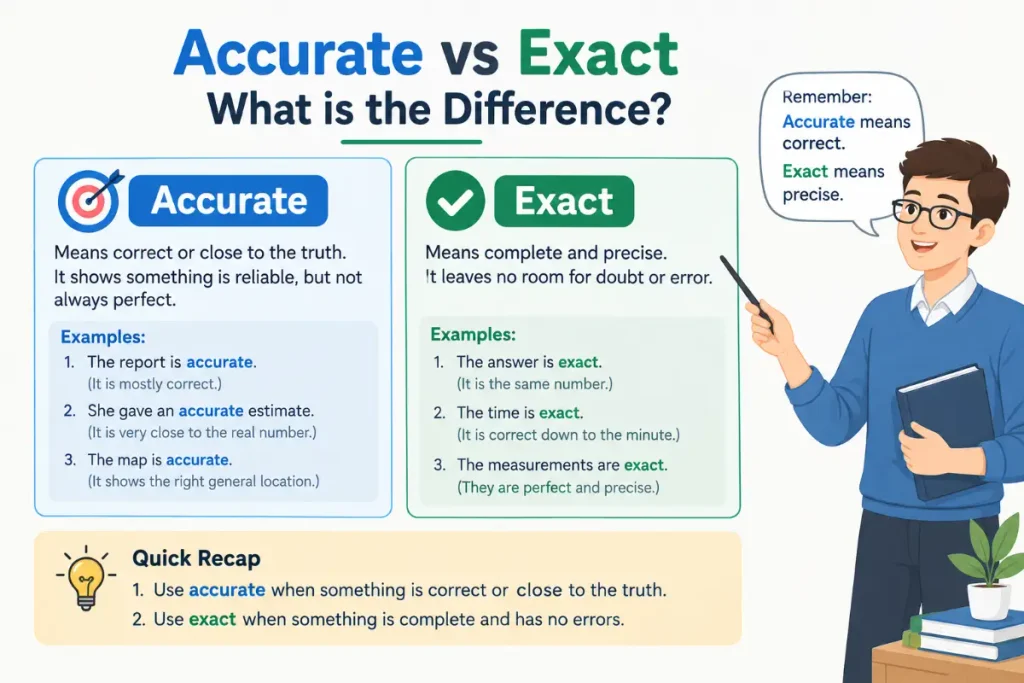
Accurate means something closely matches reality or the truth.
Exact means something matches a specific value or detail with complete precision.
For example:
“The measurement is accurate.”
This means the measurement is close to the true measurement.
“The measurement is exact.”
This suggests a much stronger level of precision.
Imagine the real length of a table is 100 centimeters.
A measurement of 99.9 centimeters can be highly accurate.
An exact measurement would be 100 centimeters.
In everyday English, these words can overlap, but exact usually places more emphasis on complete precision.
Correct vs right: What is the difference?
Correct and right are often interchangeable, especially when talking about answers.
For example:
“Your answer is correct.”
“Your answer is right.”
Both sound natural.
The difference is mainly tone.
Correct can sound more formal or objective.
Right sounds more conversational.
Compare:
“The correct answer is C.”
“Yeah, C is right.”
The first sentence fits a test or textbook. The second sounds natural in casual conversation.
Accurate vs precise: What is the difference?
Accurate means close to the true value.
Precise means exact, specific, or consistent in detail.
A measurement can be precise without being accurate.
For example, imagine a broken scale always shows 70.2 kilograms when the person’s real weight is 72 kilograms.
The scale may give repeated results of 70.2 kilograms. Those results are precise because they are consistent, but they are not accurate because they do not match reality.
This distinction is especially important in science, statistics, engineering, and research.
Correct vs valid: What is the difference?
Correct usually means something is right or free from error.
Valid often means something is logically sound, acceptable, or officially recognized.
For example:
“Your answer is correct.”
“The argument is valid.”
You can use valid when discussing reasoning, methods, documents, tickets, arguments, or official conditions.
For example:
“This is a valid passport.”
“This is a valid argument.”
“This coupon is still valid.”
Correct would not work naturally in all of these sentences.
Accurate vs factual: What is the difference?
Accurate describes information that matches reality.
Factual describes information that is based on facts rather than opinions or guesses.
For example:
“The report is accurate.”
This says the report correctly represents the facts.
“The report is factual.”
This emphasizes that the report contains facts.
A statement can be factual but still contain an error. For that reason, factual and accurate are related but not identical.
Are Words interchangeable in US English?
In US English, the words often overlap, especially when discussing answers, information, and statements.
For example:
“The information is accurate.”
“The information is correct.”
Both can sound natural.
Still, accurate often feels more connected to facts, measurements, records, and descriptions.
Correct often feels more connected to answers, rules, spelling, grammar, and mistakes.
This is not an absolute rule. Native speakers may use the words differently depending on context.
Are words different in UK English?
There is no major US and UK difference in the basic meanings.
British and American speakers generally understand both words in the same way.
Some surrounding expressions may vary by region, but the core distinction remains useful:
Accurate focuses on factual or precise representation.
Correct focuses on rightness and accepted standards.
So you do not need a different grammar rule simply because you are writing for a British audience.
What are the best alternatives?
The best alternative depends on your purpose.
| Situation | Useful word | Example |
|---|---|---|
| Basic conversation | Right | You are right. |
| Facts | Accurate | The information is accurate. |
| Exact details | Precise | Her answer was precise. |
| Exact value | Exact | Give me the exact amount. |
| Academic writing | Valid | The argument is valid. |
| Research | Reliable | The source is reliable. |
| Facts and evidence | Factual | The report is factual. |
| Professional records | Accurate | We need accurate records. |
| Casual conversation | Spot on | Your guess was spot on. |
| Formal technical work | Rigorous | The process was rigorous. |
| Very careful work | Meticulous | He kept meticulous records. |
| Casual texting | Right | That’s right. |
The key is not to replace the original word just to sound more sophisticated.
A simple word is often better if it communicates the idea clearly.
What common mistakes should you avoid?
Mistake 1: Using accurate for every kind of right answer.
Some learners think accurate always means correct.
For example:
“The correct answer is 12.”
This is more natural than:
“The accurate answer is 12.”
Mistake 2: Using correct when precision matters.
Consider:
“We need a correct measurement.”
This is understandable, but:
“We need an accurate measurement.”
is usually more natural.
The second sentence clearly focuses on measurement quality.
Mistake 3: Using exact when you only mean generally right.
Do not use exact when an estimate is acceptable.
For example:
“The report gives an exact estimate.”
This can sound contradictory because an estimate is not necessarily exact.
Try:
“The report gives an accurate estimate.”
Mistake 4: Using slang in formal writing.
Expressions such as “spot on,” “dead on,” and “nailed it” work well in casual speech.
They may not fit a school essay, research paper, business report, or formal email.
Mistake 5: Confusing correct and correctly.
Correct is commonly an adjective.
“Your answer is correct.”
Correctly is an adverb.
“You answered correctly.”
Do not write:
“You answered correct.”
In standard formal English, use:
“You answered correctly.”
Mistake 6: Confusing accurate and accurately.
Accurate is an adjective.
“The report is accurate.”
Accurately is an adverb.
“She described the event accurately.”
Mistake 7: Thinking longer words are always better.
A common writing mistake is replacing simple words with complicated ones.
If “correct” clearly communicates your meaning, use correct.
If “accurate” is the natural word, use accurate.
Clear writing is more useful than impressive sounding vocabulary.
When should you not use accurate?
Avoid accurate when your main meaning is about following a rule or selecting the expected answer.
For example:
“The correct spelling is necessary.”
This focuses on the accepted spelling.
“The accurate spelling” sounds less natural because spelling is usually judged against an established standard.
Likewise:
“Choose the correct answer.”
This is the normal expression for a test or quiz.
You could use accurate when discussing information, descriptions, measurements, statistics, or factual claims.
When should you not use correct?
Avoid correct when your main meaning is about precision or closeness to reality.
For example:
“We need an accurate measurement.”
This is more natural than:
“We need a correct measurement.”
Another example is:
“The article gives an accurate description of the building.”
Here, accurate highlights how closely the description matches the real building.
What are the antonyms?
The main antonyms of accurate include:
- Inaccurate.
- Imprecise.
- Incorrect.
- Unreliable.
- False.
- Wrong.
The main antonyms of correct include:
- Incorrect.
- Wrong.
- False.
- Mistaken.
- Erroneous.
- Invalid.
The best antonym depends on the sentence.
For example:
“Accurate information” → “inaccurate information.”
“Correct answer” → “incorrect answer.”
“Correct spelling” → “incorrect spelling.”
“Accurate measurement” → “inaccurate measurement.”
How can you quickly choose the right word?
Use these simple questions.
Are you talking about facts or reality?
Choose accurate.
Example:
“Is this information accurate?”
Are you talking about an answer?
Choose correct.
Example:
“Your answer is correct.”
Are you talking about measurement?
Choose accurate.
Example:
“We need an accurate measurement.”
Are you talking about spelling or grammar?
Usually choose correct.
Example:
“This is the correct spelling.”
Are you talking about following a rule?
Choose correct.
Example:
“Use the correct format.”
Are you talking about detailed precision?
Choose accurate or precise, depending on the sentence.
Example:
“The report contains accurate data.”
“The scientist recorded precise measurements.”
Are you writing formally?
Choose the simplest word that gives the exact meaning.
Do not replace a clear word with slang or an unnecessarily complicated synonym.

What should you remember about accurate or correct?
The easiest rule is to connect each word with its main idea.
Accurate connects with facts, reality, measurements, details, and precision.
Correct connects with answers, rules, spelling, grammar, and mistakes.
But English has overlap. Native speakers may use both words in some situations.
For example:
“The information is accurate.”
“The information is correct.”
Both are natural.
The difference becomes clearer when the noun changes.
“Correct answer” is very common.
“Accurate measurement” is very common.
“Correct spelling” is very common.
“Accurate description” is very common.
Learning these common combinations can help you sound natural without memorizing complicated grammar rules.
Quick comparison table
| Feature | Accurate | Correct |
|---|---|---|
| Main idea | Matches reality | Free from error |
| Common with facts | Yes | Yes |
| Common with answers | Sometimes | Very common |
| Common with measurements | Very common | Less common |
| Common with spelling | Less common | Very common |
| Common with grammar | Less common | Very common |
| Focus on precision | Strong | Moderate |
| Focus on rules | Moderate | Strong |
| Formal use | Very common | Very common |
| Casual use | Common | Very common |
Quick tips for choosing the right synonym
- Use accurate for information that matches reality.
- Use correct for answers that meet an expected standard.
- Use precise when small details or measurements matter.
- Use exact when there is no acceptable difference.
- Use right for simple everyday conversation.
- Use valid for arguments, documents, methods, or official conditions.
- Use reliable for sources, systems, or information you can trust.
- Use factual when you want to emphasize facts rather than opinions.
- Use spot on in casual speech.
- Use meticulous when describing very careful work.
- Check the noun before choosing a synonym.
- Prefer familiar words in everyday writing.
- Avoid slang in formal academic and professional writing.
- Do not use a stronger word simply to sound smarter.
- Ask yourself if the sentence is about truth, precision, rules, or answers.
Conclusion
Choosing the right word becomes much easier when you focus on the main idea. These words can both describe something that is right, but they often highlight different qualities. Accurate usually points to facts, measurements, details, and a close match with reality. Correct usually points to answers, rules, spelling, grammar, or something free from error.
You do not need to memorize every synonym in this guide. Start with the common combinations you see most often. Think of an accurate measurement and information, correct answer, spelling, and grammar. Then consider the tone of your writing before choosing a stronger or more casual alternative.
The best word is the one that communicates your meaning clearly. Simple, natural English is often stronger than complicated vocabulary.
Frequently Asked Questions
What is the main difference?
Accurate usually means something matches facts or reality, while correct usually means something is right or free from mistakes.
Is word better for information?
Accurate is often the better choice when you want to emphasize that information matches reality or reliable facts.
What is another way to say words?
Depending on the situation, you can use right, exact, precise, factual, reliable, valid, sound, spot on, or on target.
Is correct more formal than right?
Correct can sound more formal or objective, while right is more common in everyday conversation. Both are standard English.
What word should I use for a precise measurement?
Use accurate when the measurement needs to match the real value, and use precise when you want to emphasize exact detail or consistency.
Is accurate the same as exact?
No. Accurate means close to the true value, while exact usually means completely precise with no meaningful difference.

Daniel Grammarfield — The Language Learner
Age: 28Occupation: ESL Learner & Digital Professional
Bio:Daniel is a non-native English speaker who wants to communicate more confidently at work and online. He uses Synotrench to improve grammar, understand confusing words, learn correct sentence structures, and build everyday English skills. He prefers simple explanations with practical examples.
Goals:
Master English grammar rules
Avoid common language mistakes
Improve professional communication
Learn English through real-life examples
Quote:“Learning English is not about memorizing rules — it’s about expressing ideas clearly.”
2 thoughts on “Accurate or Correct: The Ultimate Word Guide (2026)”