
Imagine you’re writing led vs lead a school assignment, work email, or resume. You want to explain that someone guided a team through a difficult project. You type, She lead the team successfully. Then you pause and wonder if you should write led or lead.
This confusion is common because these two words have the same spelling pattern but different meanings and pronunciations. One is usually the past tense of a verb, while the other can be a present-tense verb, an adjective, or a noun.
The basic rule is simple: Led is the past tense and past participle of lead. Lead is the present-tense verb meaning to guide or direct. Lead can also refer to a type of metal.
Understanding the difference will help you avoid spelling mistakes in professional documents, essays, emails, and everyday conversations. This guide covers their meanings, origins, pronunciation, synonyms, examples, grammar rules, and common mistakes.
What Is the Difference Between Led and Lead?
Led and lead are related words, but they don’t serve the same purpose in every sentence.
Led is the past tense and past participle of the verb lead. It describes an action that happened in the past. Lead is the base form of the verb and usually describes guiding, directing, or showing someone the way.
However, lead has another meaning. As a noun, it refers to a heavy metal with the chemical symbol Pb.
| Word | Meaning | Part of Speech | Example |
|---|---|---|---|
| Led | Guided or directed in the past | Verb | She led the team last year. |
| Lead | To guide or direct | Verb | She will lead the team tomorrow. |
| Lead | A heavy chemical element | Noun | Lead is used in some industrial products. |
Consider these examples:
- Present: The teacher will lead the discussion.
- Past: The teacher led the discussion yesterday.
- Metal: The old pipes contained lead.
The first two sentences describe the same action at different times. The third uses lead as the name of a metal.
When Should You Use Led?
Use led when describing an action that already happened.
Examples:
- The manager led the meeting yesterday.
- My father led our family through a difficult period.
- The captain led the team to victory.
- She led the project during its final stage.
In each example, the action took place in the past.
When Should You Use Lead?
Use lead when describing an action in the present or future, or when using it in an infinitive phrase.
Examples:
- I lead a small team at work.
- She will lead the next meeting.
- They want to lead the project.
- Good teachers lead their students by example.
You can also use lead as a noun when referring to the metal.
Example:
Lead is a toxic metal that can harm human health.

What Is the Origin of Led vs Lead?
Understanding the history of these words makes their relationship easier to remember.
Where Does the Word Lead Come From?
The verb lead comes from the Old English word lǣdan, which meant to guide, bring, or cause someone to go in a particular direction.
Over time, its meaning expanded. Today, lead can describe guiding people, managing a team, directing an activity, or showing the way.
Examples include:
- A teacher leads students through a lesson.
- A manager leads a business team.
- A guide leads visitors through a museum.
- A coach leads players during a match.
The noun lead, meaning the metal, has a different historical origin. It comes from Old English lēad, which referred to the metallic substance.
Although both words have the same modern spelling, their histories and meanings are different.
Where Does the Word Led Come From?
Led developed as the past-tense form of the Old English verb lǣdan.
English uses different forms of verbs to show when an action happens. In this case, lead changes to led when describing a completed action.
For example:
- Present: I lead the group.
- Past: I led the group.
- Past participle: I have led the group.
Unlike regular verbs such as walk and walked, lead doesn’t form its past tense by adding -ed. It is an irregular verb.
That’s why writing leaded when you mean guided is incorrect.
How Do You Pronounce Led and Lead?
Pronunciation is one of the easiest ways to recognize the difference between these words.
Although they share similar spelling, their sounds are different.
| Word | Pronunciation | Sound | Meaning |
|---|---|---|---|
| Led | /lɛd/ | Like bed | Past tense of lead |
| Lead (verb) | /liːd/ | Like need | Guide or direct |
| Lead (metal) | /lɛd/ | Like bed | Chemical element |
The verb lead rhymes with need, while led rhymes with bed.
The metal lead has the same pronunciation as led.
This difference matters because readers usually understand the intended meaning from context, but speakers must use the correct pronunciation.
Why Does Lead Have Two Pronunciations?
English has many words with the same spelling but different pronunciations and meanings.
Lead is one example.
When it means to guide or direct, it has a long e sound.
Example:
The coach will lead the players onto the field.
When it refers to the metal, it has a short e sound.
Example:
The workers tested the water for lead.
The sentence usually makes the intended meaning clear.
What Are the Best Synonyms for Led and Lead?
The words led and lead have several alternatives. However, the best replacement depends on the meaning of the sentence.
When lead means to guide someone, you can use words such as direct, manage, guide, supervise, or oversee.
When led describes a completed action, use the past-tense form of an appropriate alternative.
The following tables group useful alternatives by tone.
Simple Synonyms for Lead and Led
| Word | Meaning | Tone | Example |
|---|---|---|---|
| Guide | Show someone the right direction | Simple | She guided the students through the lesson. |
| Help | Give someone support | Simple | He helped the team complete the task. |
| Direct | Tell people what to do | Simple | The manager directed the workers. |
| Show | Help someone understand or follow something | Simple | The teacher showed the class how to solve the problem. |
| Manage | Take responsibility for a group or activity | Simple | She managed the project successfully. |
| Teach | Help someone learn | Simple | He taught the children how to swim. |
| Control | Have power over an activity or situation | Simple | The supervisor controlled the process. |
| Support | Help someone achieve a goal | Simple | The coach supported the players throughout the season. |
Everyday Synonyms for Lead and Led
| Word | Meaning | Tone | Example |
|---|---|---|---|
| Head | Be in charge of a group | Everyday | She headed the marketing team. |
| Run | Manage an activity or organization | Everyday | He ran the department for five years. |
| Oversee | Watch and manage work | Everyday | The director oversaw the entire project. |
| Supervise | Watch over people or activities | Everyday | She supervised the new employees. |
| Coordinate | Organize different activities or people | Everyday | He coordinated the school event. |
| Organize | Arrange people or activities | Everyday | They organized the training session. |
| Mentor | Guide someone through learning or development | Everyday | She mentored several new employees. |
| Conduct | Organize and carry out an activity | Everyday | The researcher conducted the study. |
Formal Synonyms for Lead and Led
| Word | Meaning | Tone | Example |
|---|---|---|---|
| Direct | Provide instructions or guidance | Formal | The director directed the research team. |
| Administer | Manage or organize an operation | Formal | She administered the training program. |
| Govern | Control or manage an organization or area | Formal | The council governed the institution. |
| Preside | Lead an official meeting or event | Formal | The chairperson presided over the meeting. |
| Command | Give orders or exercise authority | Formal | The officer commanded the unit. |
| Facilitate | Make a process easier | Formal | The manager facilitated the discussion. |
| Orchestrate | Organize several activities or people | Formal | She orchestrated the company’s expansion. |
| Spearhead | Lead an important effort or campaign | Formal | He spearheaded the new research project. |
Informal and Slang Alternatives for Lead and Led
| Word or Expression | Meaning | Tone | Example |
|---|---|---|---|
| Take charge | Accept responsibility for something | Informal | She took charge of the event. |
| Call the shots | Make important decisions | Informal | The manager calls the shots. |
| Take the reins | Become responsible for leading something | Informal | He took the reins of the business. |
| Be at the helm | Be in a leadership position | Informal | She was at the helm during the company’s growth. |
| Step up | Take responsibility when needed | Informal | He stepped up when the team needed help. |
| Take the lead | Become the person guiding an activity | Informal | Our team took the lead in the competition. |
| Run the show | Be in control of an activity | Slang | She ran the show during the event. |
| Call the tune | Decide how something should happen | Informal | The project manager called the tune. |
These alternatives can make your writing more varied. However, they don’t all have identical meanings.
For example, mentor focuses on helping someone develop, while command suggests authority and control.
What Are the Synonyms for Led and Lead by Intensity?
Different situations require different levels of leadership or involvement.
A person may offer basic guidance, manage a small activity, or take complete responsibility for a major project.
Choosing the right word helps readers understand the level of responsibility involved.
Mild Alternatives
These words describe basic help or guidance without suggesting complete authority.
| Word | Meaning | Example |
|---|---|---|
| Help | Provide assistance | She helped the team finish the assignment. |
| Assist | Support someone with a task | He assisted the manager during the meeting. |
| Guide | Show someone the way | The teacher guided the students. |
| Support | Provide encouragement or help | She supported the new employees. |
Moderate Alternatives
These words suggest active responsibility for people, tasks, or projects.
| Word | Meaning | Example |
|---|---|---|
| Manage | Organize and control work | He managed the department. |
| Supervise | Monitor and direct activities | She supervised the staff. |
| Coordinate | Arrange activities and people | They coordinated the campaign. |
| Oversee | Take responsibility for monitoring work | The director oversaw the project. |
Strong Alternatives
These words suggest significant authority, influence, or responsibility.
| Word | Meaning | Example |
|---|---|---|
| Command | Exercise authority over others | The officer commanded the team. |
| Govern | Control an organization or area | The council governed the region. |
| Spearhead | Lead an important initiative | She spearheaded the reform. |
| Orchestrate | Organize a complex operation | He orchestrated the entire campaign. |
| Direct | Take control of an activity | The supervisor directed the operation. |
Not every strong word is suitable for every situation. For example, command may sound too forceful in a friendly workplace, while guide may be more appropriate.
How Do Led and Lead Work as Different Parts of Speech?
The word lead can function as a verb or a noun. It can also appear as an adjective in certain expressions. Led functions as a verb form.
Understanding these roles will help you use both words correctly.
Lead as a Verb
As a verb, lead means to guide, direct, manage, or influence someone or something.
Examples:
- I lead a team of designers.
- Good communication can lead to better results.
- She wants to lead the company.
- The evidence may lead us to the answer.
Notice that lead doesn’t always mean managing people. It can also describe something that causes a particular result.
Led as a Verb
Led is the past tense and past participle of lead.
Examples:
- She led the meeting yesterday.
- He has led several successful projects.
- They led the campaign last year.
- The investigation led to new discoveries.
The word led describes a completed action or appears after an auxiliary verb such as has or have.
Lead as a Noun
As a noun, lead has several meanings.
It can refer to the chemical element, an advantage in a competition, a clue in an investigation, or a potential customer.
Examples:
- The old paint contained lead.
- Our team has a five-point lead.
- The detective followed an important lead.
- The salesperson received a new business lead.
The pronunciation depends on the meaning. The metal is pronounced like led, while the other common noun meanings are pronounced like the verb lead.
Lead as an Adjective
Lead can also function as an adjective in certain expressions.
For example:
- The lead actor received an award.
- She played the lead role in the production.
- The lead singer performed beautifully.
In these examples, lead means main or most important.
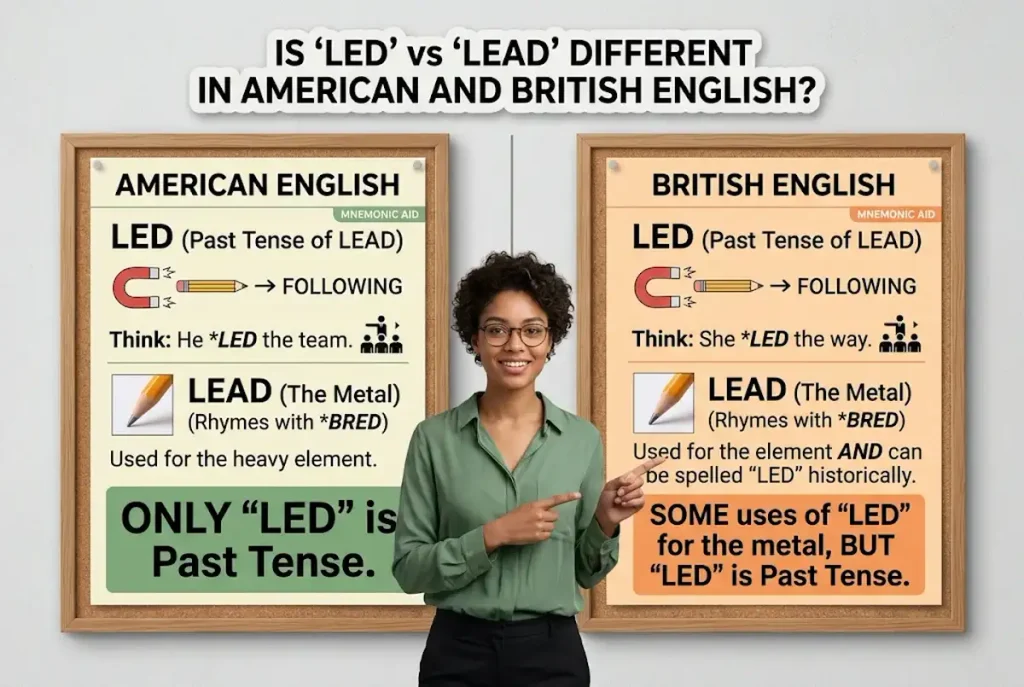
Is Led vs Lead Different in American and British English?
The spelling and basic meanings of led and lead are the same in American and British English.
Both varieties use led as the past tense of lead. They also use lead for the present-tense verb and the metal.
| Usage | American English | British English |
|---|---|---|
| Present-tense verb | Lead | Lead |
| Past-tense verb | Led | Led |
| Metal | Lead | Lead |
| Past participle | Led | Led |
| Leadership meaning | Lead | Lead |
Which Word Should You Use in Different Writing Situations?
The correct choice depends on the time of the action and the message you want to communicate.
Which Word Is Best for a Resume?
Use lead when describing your current responsibilities. Use led when describing completed work or previous positions.
Examples:
- Lead a team of ten employees to achieve monthly targets.
- Led a marketing campaign that increased customer engagement.
- Lead project planning and coordinate daily operations.
Which Word Is Best for an Essay?
Academic writing often uses both forms to explain leadership, historical events, research, and cause-and-effect relationships.
Examples:
- The president led the country through a difficult period.
- Strong leadership can lead to positive social changes.
- The research findings led to a new scientific discovery.
Which Word Is Best for Texting?
In text messages, the correct spelling still matters, even when the tone is casual.
Examples:
- She led the team to victory!
- Who will lead the meeting tomorrow?
- I think you should lead the group.
Which Word Is Best for Professional Emails?
Professional emails often describe completed tasks, current responsibilities, or future plans.
Examples:
- I led the previous training session.
- Your guidance led to a successful result.
- Our department continues to lead the project.
Which Word Is Best for Speaking?
Both words are common in everyday conversations.
Use lead when discussing present or future actions. Use led when describing something that happened before.
Examples:
- Who will lead the discussion?
- She led us to the correct building.
- This decision may lead to better results.
What Are 15 Correct Examples of Led and Lead in Sentences?
The following examples show how both words work in different real-life situations.
Led in Sentences
- The teacher led the students through a difficult science lesson.
- Sarah led the marketing team during the product launch.
- The captain led his players to an important victory.
- My parents led our family through challenging times.
- The manager led the meeting with confidence.
- Her research led to an important discovery.
- The guide led the tourists through the historic museum.
- The new strategy led to higher sales.
- He has led several successful business projects.
- The president led the country during a period of change.
Lead in Sentences
- She will lead the next team meeting.
- Good planning can lead to better results.
- I lead a group of experienced designers.
- The coach wants to lead the players to success.
- Strong communication skills help managers lead their teams.
What Is the Difference Between Led and Guided?
Led and guided are similar because both describe helping someone move in a particular direction or complete an activity.
However, they don’t always communicate the same level of responsibility.
| Led | Guided |
|---|---|
| Often suggests taking responsibility or directing others. | Often suggests providing help or advice. |
| Can involve authority and decision-making. | Usually focuses on support and direction. |
| She led the department. | She guided the new employees. |
| The captain led the team. | The coach guided the players. |
What Is the Difference Between Led and Managed?
Led and managed are closely related, especially in business and professional writing.
However, led often focuses on direction, influence, and leadership. Managed usually emphasizes organizing resources, people, and daily responsibilities.
| Led | Managed |
|---|---|
| Focuses on providing direction. | Focuses on organizing and controlling work. |
| Often involves motivating people toward a goal. | Often involves handling daily operations. |
| She led the project team. | She managed the project budget. |
| He led the company through major changes. | He managed the company’s daily operations. |
What Are the Common Mistakes When Using Led and Lead?
Writers often confuse these words because their spelling is similar. The following mistakes are worth avoiding.
Using Lead Instead of Led for a Past Action
Incorrect: She lead the team last year.
Correct: She led the team last year.
The action happened in the past, so you need the past-tense form.
Using Led Instead of Lead for a Present Action
Incorrect: I led a team of five employees every day.
Correct: I lead a team of five employees every day.
If you’re describing a current responsibility, use lead.
However, if the sentence refers to a previous job, led may be correct.
Writing Leaded Instead of Led
Incorrect: He leaded the discussion yesterday.
Correct: He led the discussion yesterday.
Lead is an irregular verb. Its past tense is led, not leaded.
Confusing the Verb With the Metal
Incorrect: The workers found led in the old pipes.
Correct: The workers found lead in the old pipes.
The metal is spelled lead but pronounced like led.
Forgetting the Past Participle Form
Incorrect: She has lead the department for three years.
Correct: She has led the department for three years.
After has or have, use the past participle led when describing the action of guiding or directing.
Using the Wrong Pronunciation
Remember these two sounds:
- Lead as a verb sounds like need.
- Led sounds like bed.
- Lead as a metal also sounds like bed.
Pronouncing them correctly helps listeners understand the intended meaning.
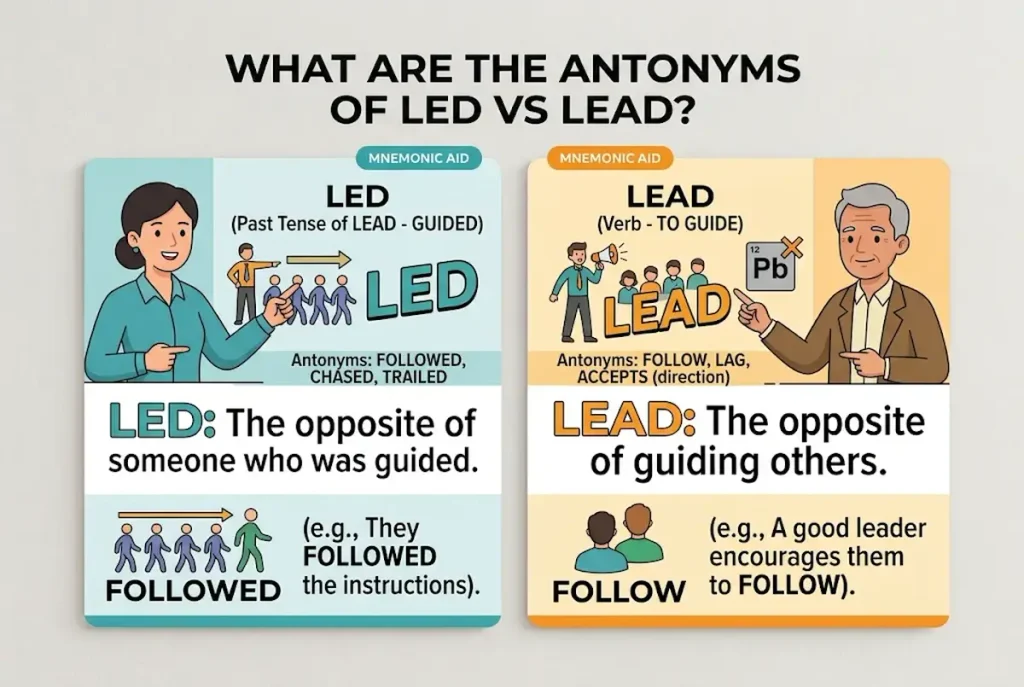
What Are the Antonyms of Led vs Lead?
The opposite of lead depends on how the word is being used.
When lead means guide or direct, possible opposites include follow, obey, trail, and lag behind.
| Word | Opposite Meaning | Example |
|---|---|---|
| Follow | Go behind someone | The students followed the teacher. |
| Obey | Follow someone’s instructions | The workers obeyed the supervisor. |
| Trail | Fall behind | Our team trailed the competition. |
| Lag | Move or progress more slowly | The company lagged behind its competitors. |
| Mislead | Give someone incorrect information | The false report misled the readers. |
What Are the Quick Tips for Choosing Led or Lead?
Use these simple tips to select the correct form.
- Check the time. If the action happened in the past, use led.
- Use lead for present actions. For example, I lead a team.
- Remember future tense. Write will lead, not will led.
- Check auxiliary verbs. Use has led, have led, and had led.
- Remember the metal. Lead is also the name of a chemical element.
Conclusion
The correct choice depends on the meaning and tense of your sentence. Lead is the present-tense verb meaning to guide, direct, or manage someone or something. Led is its past tense and past participle, so use it when describing an action that has already happened.
For example, write I lead the team when discussing a current responsibility, but write I led the team when talking about a previous experience. Remember that lead can also refer to a metal, a clue, or an advantage, depending on the context.
Once you understand these differences, choosing the right spelling becomes much easier. Pay attention to verb tense, pronunciation, and sentence meaning, and you’ll avoid this common English grammar mistake.
Frequently Asked Questions
Is it led or lead when talking about the past?
Led is the correct past-tense form of the verb lead. For example, She led the team last year.
Is lead ever the correct past tense?
No, lead is not the past tense of the verb meaning to guide. The correct past form is led.
How do you pronounce led and lead?
Led rhymes with bed, while the verb lead rhymes with need. Lead, when referring to the metal, has the same pronunciation as led.
What’s the difference between led and lead in a sentence?
Lead describes guiding or directing in the present or base form, while led describes the same action in the past. For example, I lead the team today, but I led the team yesterday.
Is it has led or has lead?
Has led is correct when describing someone who guided or directed something. For example, She has led the department for five years.
Is lead a noun or a verb?
Lead can be both a noun and a verb. As a verb, it means to guide or direct, while as a noun, it can refer to a metal, clue, advantage, or potential customer.
Is leaded a real word?
Yes, leaded is a real word in certain contexts, such as leaded glass or leaded fuel. However, it isn’t the correct past tense of the verb lead when it means to guide someone.
Why do led and lead have different pronunciations?
They have different pronunciations because English spelling doesn’t always follow one consistent sound pattern. The verb lead has a long e sound, while led and the metal lead have a short e sound.

Daniel Grammarfield — The Language Learner
Age: 28Occupation: ESL Learner & Digital Professional
Bio:Daniel is a non-native English speaker who wants to communicate more confidently at work and online. He uses Synotrench to improve grammar, understand confusing words, learn correct sentence structures, and build everyday English skills. He prefers simple explanations with practical examples.
Goals:
Master English grammar rules
Avoid common language mistakes
Improve professional communication
Learn English through real-life examples
Quote:“Learning English is not about memorizing rules — it’s about expressing ideas clearly.”
2 thoughts on “Led vs Lead: The Ultimate Guide to the Difference”