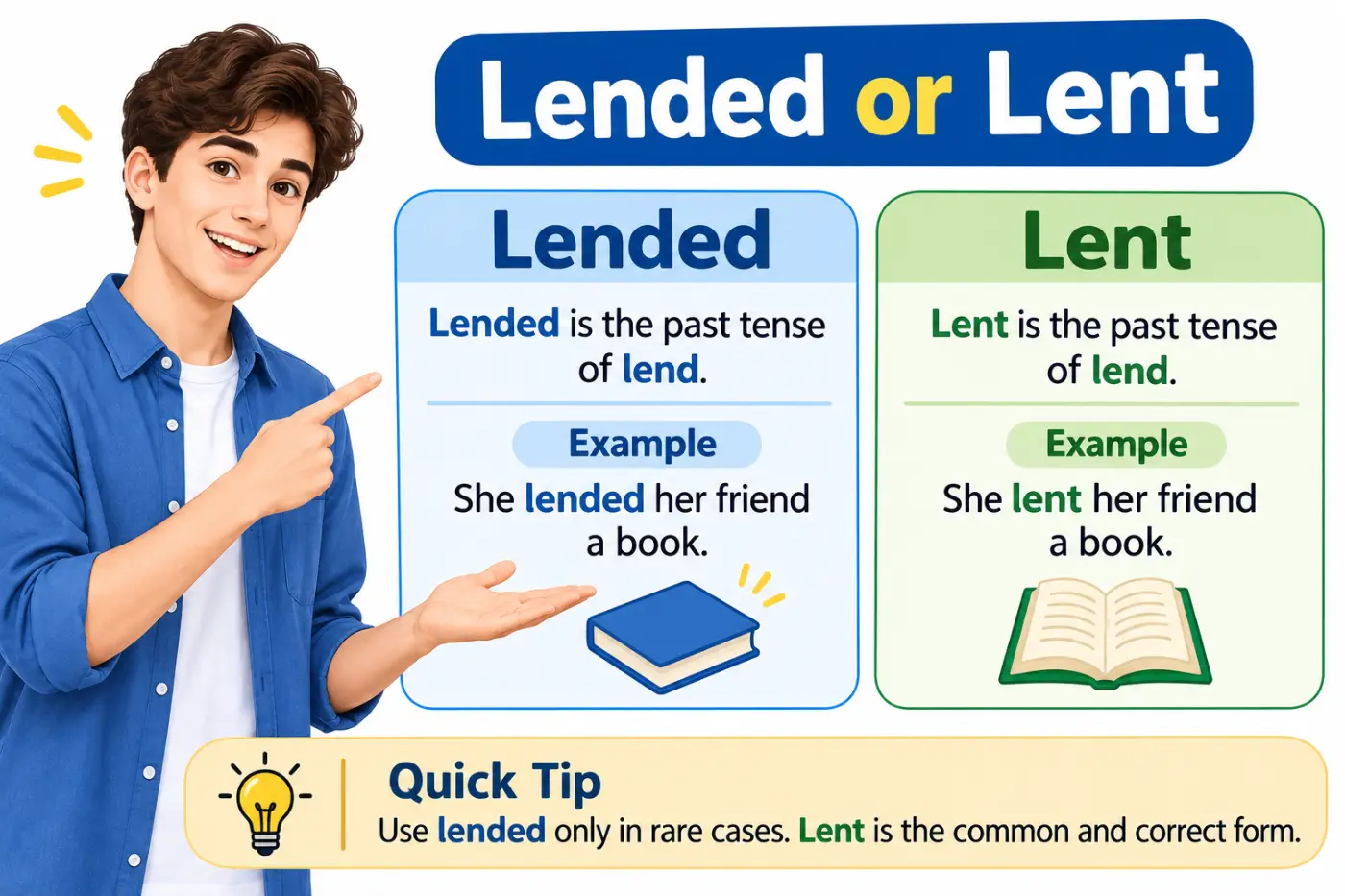
Have you ever written lended or lent an email saying, I lended my friend some money, and then wondered if the sentence was correct? This small spelling choice can cause confusion in school assignments, work messages, and everyday conversations.
The correct past tense of lend is lent. The word lended is not the standard form in modern English. For example, you should write, I lent my brother twenty dollars, not I lended my brother twenty dollars.
Lend is an irregular verb, which means it does not form its past tense by simply adding -ed. Instead, its form changes from lend to lent. This rule also applies when you use the present perfect or past perfect tense.
This guide explains the meaning and history of both forms. You’ll also find useful alternatives, examples, common mistakes, and tips for choosing the right word in emails, essays, resumes, texts, and everyday conversations.
What Is the Difference Between Lended and Lent?
The main difference is that lent is the standard past tense and past participle of the verb lend. In contrast, lended is a nonstandard form that most English speakers should avoid in formal and everyday writing.
| Word | Grammar role | Correct usage | Example |
|---|---|---|---|
| Lend | Base form and present tense | Correct | I lend books to my friends. |
| Lent | Past tense | Correct | I lent her my notebook yesterday. |
| Lent | Past participle | Correct | I have lent him my car before. |
| Lended | Nonstandard past form | Avoid | I lended him my car. |
The verb lend means to give someone something temporarily. The other person is expected to return it.
For example:
- I lend my sister my laptop when she needs it.
- I lent my sister my laptop last week.
- I have lent my sister my laptop several times.
Notice how the verb changes according to the tense. The base form is lend, while lent works as both the simple past form and the past participle.
Why Is Lent the Correct Form?
English has two main types of verbs: regular and irregular.
Regular verbs usually form their past tense by adding -ed. For example:
| Present | Past |
|---|---|
| Walk | Walked |
| Help | Helped |
| Clean | Cleaned |
| Open | Opened |
| Borrow | Borrowed |
However, irregular verbs follow different patterns. Their spelling or sound may change in the past tense.
For example:
| Present | Past |
|---|---|
| Send | Sent |
| Spend | Spent |
| Build | Built |
| Keep | Kept |
| Lend | Lent |
Because lend is irregular, adding -ed does not produce its standard past form.
What Do Lend and Lent Mean in Simple English?
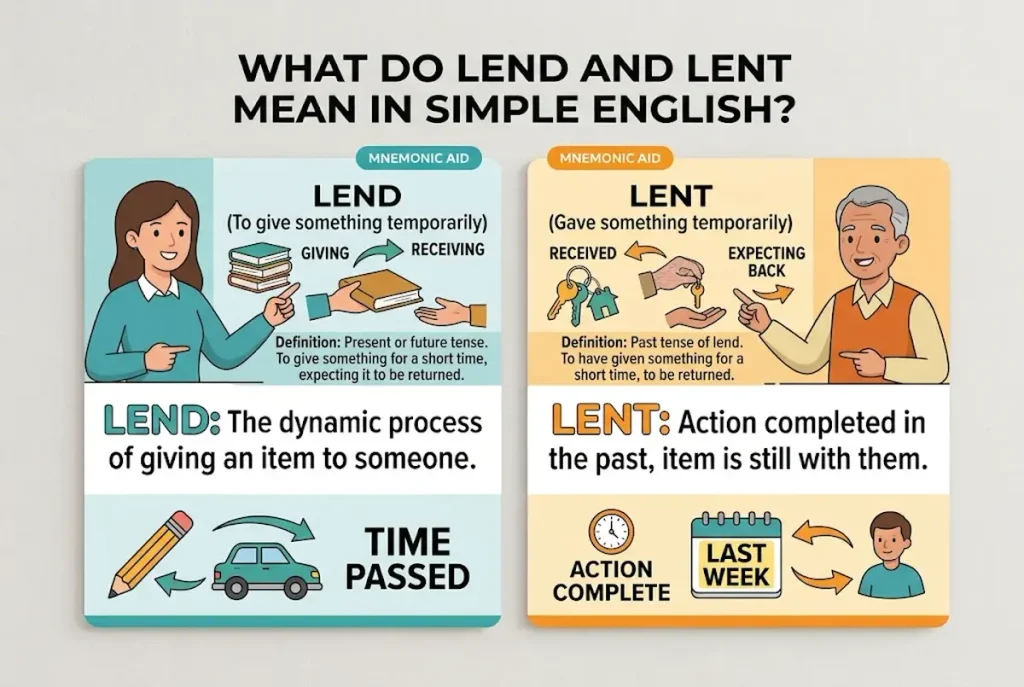
The verb lend means to let someone use something for a limited time. You give the person an item, money, or another resource, and you normally expect them to return it.
The word lent carries the same meaning, but it describes an action that happened in the past or works with an auxiliary verb.
Consider these examples:
- Present: I lend my neighbor my tools.
- Past: I lent my neighbor my tools yesterday.
- Present perfect: I have lent my neighbor my tools before.
- Past perfect: I had lent my neighbor my tools before he bought his own.
The meaning stays the same. Only the tense changes.
What Is the Meaning of Lend?
Lend is a verb that describes giving something to another person temporarily.
For example:
- Can you lend me your phone?
- The bank lends money to qualified customers.
- My teacher will lend me a dictionary.
- I usually lend my books to classmates.
You can lend physical objects, money, services, or support.
What Is the Meaning of Lent?
Lent is the simple past tense and past participle of lend.
Use it when the lending action has already happened or when a helping verb requires a past participle.
For example:
- She lent me her bicycle last Saturday.
- They lent their equipment to the school.
- I have lent him money before.
- The company had lent its office space to another organization.
Lent can also refer to a religious season in Christianity. In that context, it is a noun and has a completely different use.
For example: Many Christians observe Lent before Easter.
The meaning depends on the sentence.
What Is the Origin of Lend and Lent?
The word lend has a long history in English. It comes from Old English lendan, which meant to grant or provide something temporarily.
The word developed from older Germanic language forms. Over time, English speakers continued using lend for the act of giving something to another person with the expectation of getting it back.
Lent developed as the past tense and past participle form of lend. English changed the vowel and final consonant pattern instead of adding the regular -ed ending.
This type of change is common in irregular verbs.
For example:
- Send became sent.
- Spend became spent.
- Build became built.
- Lend became lent.
The form lended appeared as a possible regularized form in some historical or nonstandard uses. However, modern standard English uses lent.
Why Does English Use Lent Instead of Lended?
English contains many irregular verbs that developed through older language patterns. Their past forms often come from historical sound changes.
The verb lend belongs to a group of words with related forms, such as send and spend. Their past forms use a changed ending rather than the regular -ed pattern.
You don’t need to memorize the full language history to use the verb correctly. Just remember that lend changes to lent.
What Are Some Synonyms for Lend and Lent?
There are several words you can use instead of lend or lent. However, these alternatives do not all have exactly the same meaning.
Some describe giving something temporarily. Others describe providing financial support, allowing access, or sharing an item.
The best choice depends on what you are giving and the situation.
Simple Synonyms for Lend
| Word | Meaning | Tone | Example |
|---|---|---|---|
| Give | Provide something to someone | Simple | I gave him my extra pencil. |
| Share | Let someone use or enjoy something | Friendly | She shared her notes with me. |
| Loan | Give something temporarily | Simple | He loaned me his bicycle. |
| Offer | Make something available | Neutral | I offered her my umbrella. |
| Let | Allow someone to use something | Casual | My brother let me use his phone. |
| Provide | Make something available | Neutral | The school provided us with books. |
| Supply | Give something needed | Neutral | The company supplied the team with equipment. |
Everyday Synonyms for Lend
| Word | Meaning | Tone | Example |
|---|---|---|---|
| Borrow out | Give something for temporary use | Informal | She borrowed out her old books. |
| Hand over | Give something to another person | Casual | He handed over the keys for the weekend. |
| Pass along | Give something to someone else | Friendly | I passed along my notes to Mia. |
| Make available | Allow someone to use something | Neutral | The library made extra computers available. |
| Allow | Give permission to use something | Neutral | They allowed us to use their equipment. |
| Share out | Distribute something among people | Casual | The teacher shared out the supplies. |
| Let someone use | Give temporary permission to use something | Everyday | I let my cousin use my camera. |
Formal Synonyms for Lend
| Word | Meaning | Tone | Example |
|---|---|---|---|
| Advance | Provide money before it is due | Formal | The company advanced him the required funds. |
| Extend | Provide credit or financial support | Formal | The bank extended a loan to the business. |
| Grant | Give permission, money, or support | Formal | The organization granted the school extra funding. |
| Furnish | Supply something needed | Formal | The department furnished the team with equipment. |
| Allocate | Set aside resources for someone | Formal | The agency allocated funds to the project. |
| Disburse | Pay out money | Financial | The bank disbursed the approved amount. |
| Entrust | Give something into another person’s care | Formal | She entrusted the documents to her assistant. |
Slang and Casual Alternatives
| Word | Meaning | Tone | Example |
|---|---|---|---|
| Spot | Give someone money temporarily | Casual | Can you spot me ten dollars? |
| Front | Provide money before it is repaid | Slang | He fronted me the cash for lunch. |
| Hook up | Provide someone with something they need | Informal | My friend hooked me up with a spare charger. |
| Share | Let someone use something | Casual | I’ll share my headphones with you. |
| Cover | Pay for something temporarily | Casual | She covered my ticket until payday. |
| Float | Provide temporary financial help | Informal | My brother floated me some money. |
| Chip in | Contribute money to a shared cost | Casual | Everyone chipped in for the supplies. |
Some alternatives are not direct replacements. For example, chip in means to contribute toward a shared cost, while lend means to give something temporarily with an expectation of return.
Also, borrow out is not a common standard expression in American English. Use lend or loan instead.
Which Synonyms Are Best From Mild to Strong?
Words related to lending can suggest different levels of help, responsibility, or financial commitment.
A simple way to choose is to think about the size and purpose of what you are providing.
| Level | Word | Meaning | Example |
|---|---|---|---|
| Mild | Share | Let someone use something | I shared my notes with her. |
| Mild | Offer | Make something available | He offered me his umbrella. |
| Mild | Let | Give permission | She let me use her desk. |
| Moderate | Lend | Give something temporarily | I lent him my camera. |
| Moderate | Loan | Provide something for temporary use | The bank loaned money to the company. |
| Moderate | Supply | Provide needed items | They supplied the workers with tools. |
| Strong | Advance | Provide money ahead of time | The employer advanced her some money. |
| Strong | Finance | Provide money for a project or purchase | The bank financed the construction. |
| Strong | Underwrite | Agree to support financial risk | The company underwrote the project. |
These words describe different kinds of support. Finance and underwrite usually involve formal financial arrangements, not simply letting a friend use an item.
Are Lend and Lent Different Parts of Speech?
The words have different grammatical forms, but they belong to the same verb.
Lend as a Base Verb
Lend is the base form of the verb. It appears after modal verbs, in commands, and in present tense sentences with subjects such as I, you, we, and they.
Examples:
- Please lend me your dictionary.
- I can lend you some money.
- They lend sports equipment to students.
- Will you lend me your charger?
Lends as a Present Tense Verb
Use lends with a singular third person subject in the simple present tense.
Examples:
- My uncle lends money to family members.
- The library lends books to local residents.
- This company lends equipment to small businesses.
Lent as a Past Tense Verb
Use lent when the action happened in the past.
Examples:
- She lent me her jacket yesterday.
- We lent our car to our neighbors.
- The teacher lent us a reference book.
Lent as a Past Participle
Use lent with helping verbs such as has, have, and had.
Examples:
- I have lent him my notes before.
- She has lent her car to her cousin.
- They had lent the equipment to another team.
Lent is not normally used as an adjective. In most sentences, it functions as a verb form. Its separate use as a religious noun is unrelated to the act of lending.
Is Lend or Lent More Common in American and British English?
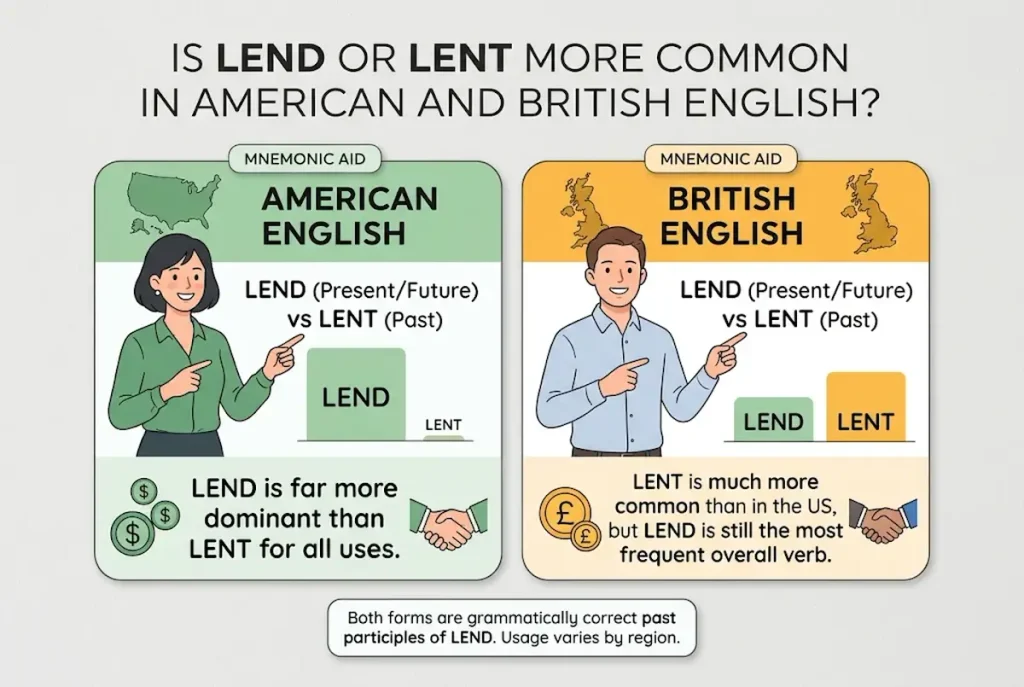
American and British English both use lend as the base verb and lent as its standard past tense and past participle.
There is no major regional difference in this verb pattern.
| Situation | American English | British English |
|---|---|---|
| Present tense | I lend books. | I lend books. |
| Past tense | I lent her money. | I lent her money. |
| Present perfect | I have lent him a book. | I have lent him a book. |
| Question | Can you lend me a pen? | Can you lend me a pen? |
Some vocabulary choices may differ by region, but the main verb forms remain the same.
For example, Americans commonly use loan as a verb in sentences such as I loaned him my car. British speakers also understand this use, although lend is often the more familiar everyday choice.
The important point is that lended is not the standard past tense in either variety of English.
Which Word Should You Use in a Resume?
When writing a resume, use the correct verb form based on the action and its timing. In many professional situations, a more specific word can communicate your work more clearly.
For example:
- Correct: I lent equipment to new employees during training.
- More professional: I provided equipment to new employees during training.
- More specific: I managed the distribution of equipment across three departments.
A resume should focus on your responsibilities and results. The word provided may sound more suitable than lent when describing a workplace task.
Use lent when you genuinely mean that you gave someone temporary use of something.
Which Word Should You Use in an Essay?
In an essay, use lent when describing a past action. Avoid lended because it does not follow standard English grammar.
Examples:
- Correct: The teacher lent several books to the students.
- Incorrect: The teacher lended several books to the students.
- Improved: The school library provided additional books to students.
You can also choose a more precise word based on the topic.
For example, use donated when someone gives something permanently without expecting it back. Use loaned when the item or money must be returned.
Which Word Should You Use in Texting?
In casual messages, use lent when you are talking about something you gave someone temporarily in the past.
Examples:
- I lent him my charger yesterday.
- She lent me her jacket.
- I can lend you my headphones tomorrow.
- Who lent you that book?
You may hear people say lended in casual conversation, but that does not make it the standard written form.
A short message can still use correct grammar. You don’t need formal language to write clearly.
Which Word Should You Use in an Email?
In professional emails, use lent for past actions and lend for present or future actions.
Examples:
Past action: I lent the department my presentation equipment last week.
Current offer: I can lend you the reference materials for the meeting.
Formal alternative: I have provided the team with the required documents.
If you are writing to a manager, customer, or colleague, choose the word that describes the action accurately. You can use provided or supplied when the situation sounds more professional than a personal loan.
Which Word Sounds Natural in Everyday Speaking?
Use lent when talking about something you gave someone in the past.
Examples:
- I lent him my car last weekend.
- My sister lent me her favorite book.
- They lent us some chairs for the party.
- Who lent you that jacket?
In everyday speech, people sometimes create regular past forms for irregular verbs. However, lent remains the accepted form in standard American English.
Practice using the correct form in short sentences. This makes it easier to use naturally during conversations.
What Are Some Example Sentences With Lend and Lent?
The following examples show how the verb works in common situations. They cover money, school, family, work, travel, and everyday communication.
Examples With Lend
- Can you lend me your laptop for an hour?
- My parents often lend money to relatives.
- The library will lend you books for three weeks.
- I can lend you my umbrella because it’s raining.
- Banks lend money to people who meet their requirements.
- Will your friend lend you a bicycle for the trip?
- The teacher agreed to lend us some science equipment.
- I don’t usually lend my car to other people.
- Can the school lend students extra calculators?
- My neighbor may lend us a ladder this afternoon.
Examples With Lent
- I lent my brother twenty dollars last Friday.
- Sarah lent me her notes before the exam.
- The company lent its conference room to a local group.
- My father lent me his old camera for the weekend.
- We lent our chairs to the neighbors for their party.
- The bank lent the business enough money to expand.
- She lent her coat to a friend who felt cold.
- They lent the school several computers for the project.
- I have lent that book to three different classmates.
- The museum had lent the painting to another gallery.
Lent in Questions
- Who lent you this book?
- Did you lend him your calculator?
- Have they lent you the money yet?
- Why did she lend her car to a stranger?
- How many books have you lent this year?
These examples show that the correct form depends on the sentence structure. Use lend for the base form and lent for the past tense or past participle.
What Is the Difference Between Lent and Loaned?
Lent and loaned can both describe giving something to another person temporarily. However, they differ slightly in how people use them.
| Lent | Loaned |
|---|---|
| Past tense and past participle of lend | Past tense and past participle of loan |
| Common in everyday English | Often used in financial or formal contexts |
| Works for money and physical items | Works for money and physical items |
| I lent her my bike. | I loaned her my bike. |
Both sentences are correct.
For example:
- My friend lent me fifty dollars.
- My friend loaned me fifty dollars.
The first sentence uses the past form of lend. The second uses the past form of loan.
In American English, loan is commonly used as a verb. In some contexts, people prefer lend because it sounds more natural and conversational.
Choose the word that fits your sentence and audience.
What Is the Difference Between Lent and Borrowed?
Lent and borrowed describe the same exchange from opposite sides.
When you lend something, you give it to another person temporarily. When you borrow something, you receive it temporarily and must usually return it.
| Lent | Borrowed |
|---|---|
| Describes giving something temporarily | Describes receiving something temporarily |
| The lender gives the item | The borrower receives the item |
| I lent him my pen. | He borrowed my pen. |
| She lent me her car. | I borrowed her car. |
Think about the direction of the action.
If you give someone your book, you lend it. If someone gives you a book to use, you borrow it.
A common mistake is using borrow when the sentence needs lend.
Incorrect: Can you borrow me your pen?
Correct: Can you lend me your pen?
You can also say, Can I borrow your pen?
What Common Mistakes Should You Avoid?
Many English learners understand the meaning of lend but make mistakes when changing it into the past tense. A few simple rules can help you avoid these errors.
Adding ED to Lend
The most common mistake is adding -ed to create lended.
Incorrect: I lended him my bicycle.
Correct: I lent him my bicycle.
Remember that lend is an irregular verb. Its past form is lent.
Using Lent With Will
After the modal verb will, use the base form lend.
Incorrect: I will lent you my book.
Correct: I will lend you my book.
Modal verbs such as can, could, should, and will take the base form of the main verb.
Using Lend After Have
When you use have, has, or had to form a perfect tense, use the past participle lent.
Incorrect: I have lend her my notes.
Correct: I have lent her my notes.
Confusing Lend With Borrow
Lend means to give something temporarily. Borrow means to receive something temporarily.
Incorrect: She borrowed me her laptop.
Correct: She lent me her laptop.
Using Lent for a Future Action
Lent describes a completed past action or works as a past participle. Use lend when the action will happen in the future.
Incorrect: I will lent you the money tomorrow.
Correct: I will lend you the money tomorrow.
Treating Every Loan as a Gift
Lending does not usually mean giving something away permanently.
For example, if you lend a friend your book, you expect the friend to return it. If you give the book as a gift, you do not expect it back.
Use donate or give when the transfer is permanent.
What Are the Antonyms of Lend and Lent?
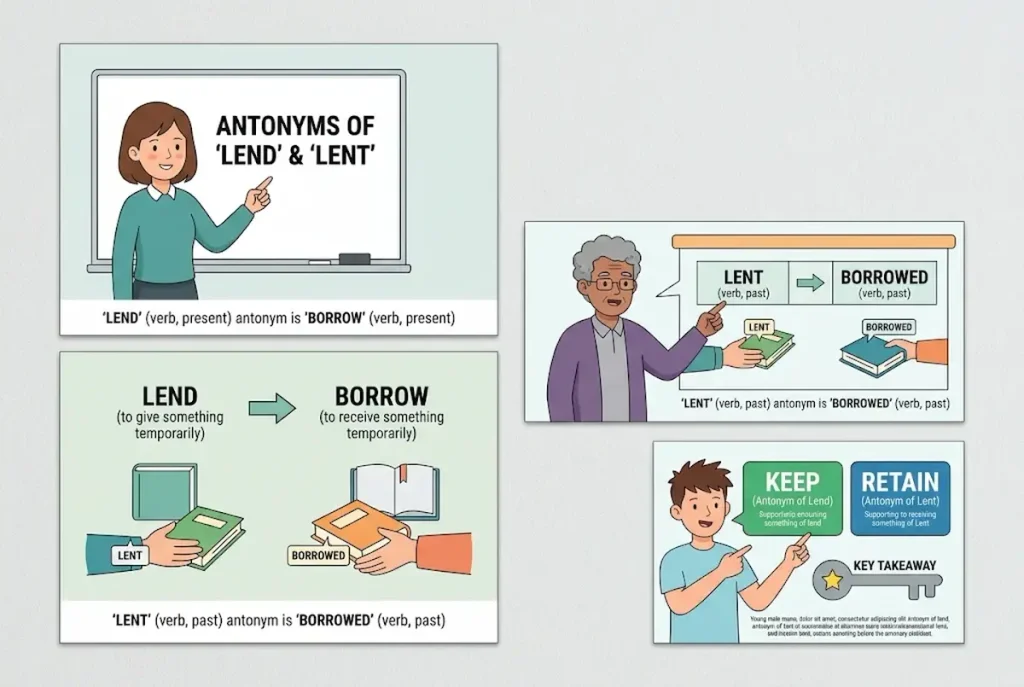
An antonym is a word with an opposite or contrasting meaning. The best opposite of lend is usually borrow because the two words describe opposite sides of the same exchange.
Other words may work in specific situations.
| Word | Meaning | Example |
|---|---|---|
| Borrow | Receive something temporarily | I borrowed her dictionary. |
| Keep | Continue to have something | He kept the book instead of returning it. |
| Retain | Continue holding or possessing something | The company retained its equipment. |
| Withhold | Refuse to give something | The bank withheld the funds. |
| Take | Receive or remove something | She took the book from the table. |
These words are not perfect opposites in every sentence. Borrow is the closest match when you are describing a temporary exchange between two people.
How Can You Choose the Correct Word Every Time?
You can remember the correct form with a few quick checks.
- Use lend for the base form and present tense with I, you, we, and they.
- Use lends with he, she, or it in the simple present tense.
- Use lent for actions completed in the past.
- Use lent after have, has, or had.
- Use lend after modal verbs such as can, could, should, and will.
- Use borrow when you receive something temporarily.
- Use loan as an alternative verb when it fits the tone.
- Avoid lended in standard writing.
A useful memory trick is to connect lend with send. The past form of send is sent, and the past form of lend is lent.
You can also practice with this pattern:
- Today, I lend.
- Yesterday, I lent.
- I have lent before.
Once you remember these three forms, the grammar becomes much easier.
Conclusion
The correct past tense and past participle of lend is lent. It follows an irregular verb pattern, so you should not add -ed to create its past form. Use lend for the base form, lends with a singular third person subject in the present tense, and lent for past actions or perfect tenses.
Also, remember the difference between lending and borrowing. Lending means giving something temporarily, while borrowing means receiving it temporarily. These small grammar rules can make your emails, school assignments, and everyday messages clearer. With a little practice, you’ll be able to choose the right form naturally and avoid a common English mistake.
Frequently Asked Questions
Is lended a real word?
Lended appears in some nonstandard and historical uses, but it is not the accepted past tense of lend in modern standard English. Use lent instead.
Is lent or lended grammatically correct?
Lent is the grammatically correct past tense and past participle of lend. For standard writing and speech, avoid lended.
What is the past tense of lend?
The past tense of lend is lent. For example, I lent my friend a book yesterday.
What is the past participle of lend?
The past participle is lent. Use it with have, has, or had, as in I have lent her my notebook.
Can I say I have lended you money?
No. The standard form is I have lent you money. The verb lend uses lent as its past participle.
What’s another way to say lent?
You can use loaned, provided, or gave temporarily, depending on the meaning. Loaned is especially useful when describing money or something given for temporary use.
Is lent the same as borrowed?
No. Lent means you gave something to someone temporarily, while borrowed means you received something temporarily. The words describe opposite sides of the same exchange.
Why doesn’t lend become lended?
Lend is an irregular verb, so it does not follow the usual rule of adding -ed. Its standard past tense and past participle form is lent.

Daniel Grammarfield — The Language Learner
Age: 28Occupation: ESL Learner & Digital Professional
Bio:Daniel is a non-native English speaker who wants to communicate more confidently at work and online. He uses Synotrench to improve grammar, understand confusing words, learn correct sentence structures, and build everyday English skills. He prefers simple explanations with practical examples.
Goals:
Master English grammar rules
Avoid common language mistakes
Improve professional communication
Learn English through real-life examples
Quote:“Learning English is not about memorizing rules — it’s about expressing ideas clearly.”
1 thought on “Lended or Lent: The Best Guide to the Correct Past Tense”