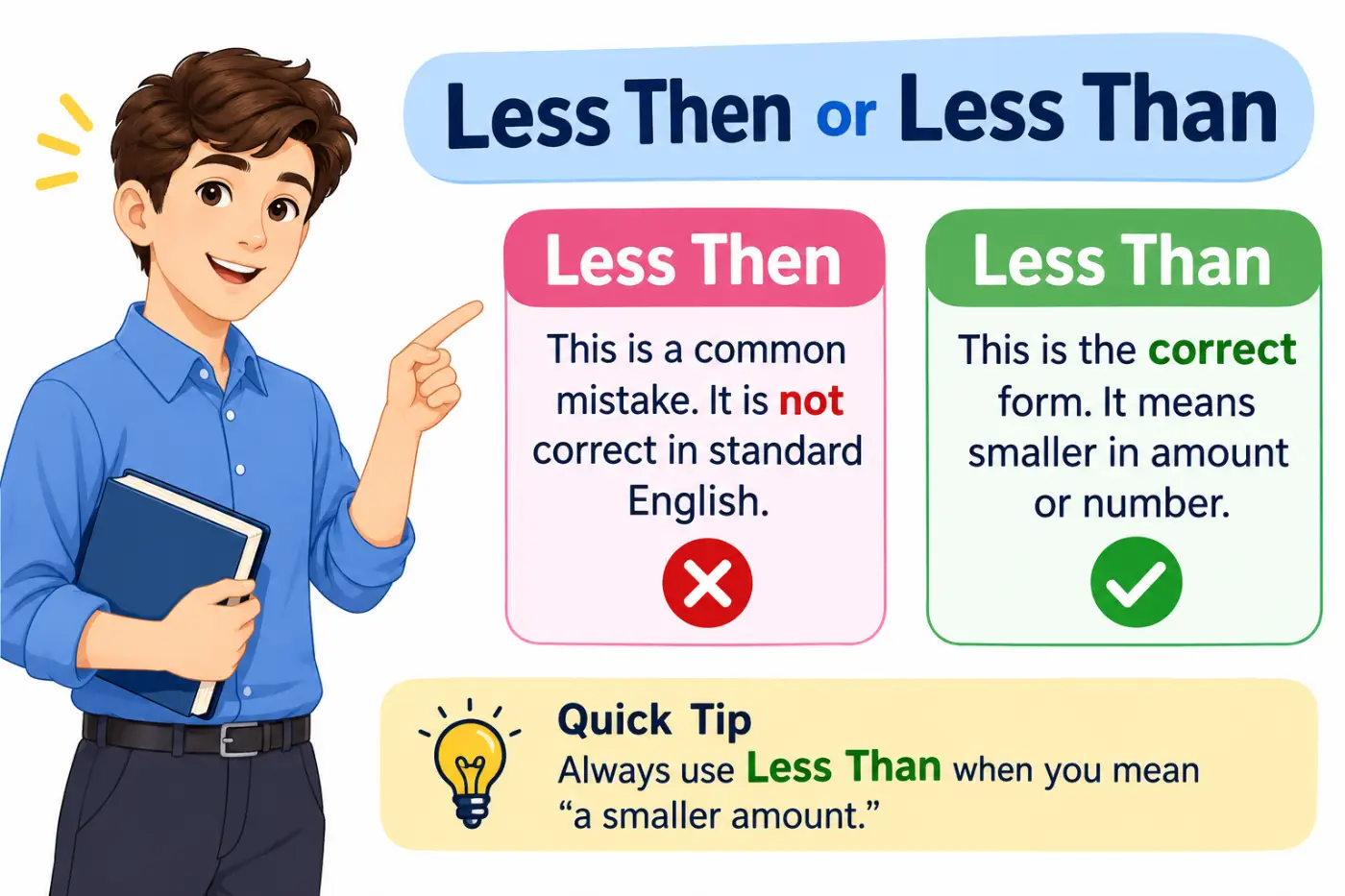
When writing a school assignment, sending an email, or checking a sentence, you might pause over the phrases less then and less than. They look almost identical, but only one is correct when you want to compare amounts, sizes, or numbers. Choosing the wrong word can make a sentence look careless.
The correct phrase is less than. Use it when you mean a smaller amount, a lower number, or a shorter distance. The word then usually relates to time, order, or the next step in a sequence.
The difference is simple once you understand what each word does. Less compares amounts, while then connects ideas or tells readers what happens next. They are not interchangeable.
This guide explains the meaning and origin of both words, gives you more than 30 useful alternatives, and shows how to choose the right phrase in emails, essays, resumes, texts, and everyday conversations. You’ll also find clear examples, common mistakes, and answers to frequently asked questions.
What Is the Difference Between Less Then and Less Than?
The main difference comes down to the meaning of then and than.
Less than is the correct phrase for comparing quantities, numbers, amounts, ages, prices, and measurements. It means a smaller amount or a lower value.
Less then is usually a spelling mistake when someone wants to make a comparison. However, the words less and then can appear next to each other in a sentence when they have separate meanings.
Consider these examples:
| Phrase | Meaning | Example |
|---|---|---|
| Less than | A smaller amount or number | The box weighs less than five pounds. |
| Less then | Usually incorrect for comparison | The box weighs less then five pounds. |
When Should You Use Than?
Use than when comparing two or more things.
Examples:
- My brother is younger than I am.
- This laptop costs less than $500.
- We finished the project in less than two hours.
- The new road is shorter than the old one.
- She received fewer complaints than last month.
When Should You Use Then?
Use then when talking about time, order, or what happens next.
Examples:
- Finish your homework, then watch television.
- I lived in Texas back then.
- First, open the document. Then, check the spelling.
- We went to dinner and then visited our friends.
- If you agree, then we can begin.

What Are the Origins of Less Then and Less Than?
Understanding where these words came from can make their meanings easier to remember. Although then and than look similar, they developed different uses in English.
Where Does the Word Less Come From?
The word less comes from Old English lǣssa, which meant smaller, fewer, or not as much. It developed from an older Germanic language form.
Today, less describes a smaller amount or degree.
For example:
- I need less sugar in my coffee.
- This route takes less time.
- We have less work today.
Where Does the Word Than Come From?
The word than developed from Old English þanne and related forms. It became a common word for making comparisons.
Its main job is to connect two parts of a comparison.
For example:
- This book is better than the last one.
- My house is smaller than yours.
- The test was easier than I expected.
Where Does the Word Then Come From?
Then comes from Old English þænne and related historical forms. It has traditionally referred to time, sequence, or a point in a series of events.
Today, it commonly means at that time, next, or in that case.
Examples:
- I was living in Florida then.
- Wash the vegetables, then cut them.
- If the store is closed, then we’ll come back tomorrow.
What Words Can You Use Instead of Less Than?
The best alternative depends on your sentence. Some expressions work well in casual conversations, while others suit formal reports, academic writing, or business communication.
The following table gives you more than 30 related words and expressions. These are not all exact replacements. Each one has a slightly different meaning, so choose the option that fits your comparison.
Simple Alternatives
| Word | Meaning | Tone | Example |
|---|---|---|---|
| Under | Below a number or limit | Simple | The bag weighs under ten pounds. |
| Below | Lower than a stated value | Simple | The temperature stayed below 40 degrees. |
| Smaller than | Having a lower size or amount | Simple | This room is smaller than ours. |
| Lower than | At a lower level or value | Simple | The price is lower than expected. |
| Fewer than | A smaller number of countable items | Simple | Fewer than twenty people attended. |
| Not as much as | A smaller amount | Simple | I spent not as much as I planned. |
| Short of | Not reaching a particular amount | Simple | We are short of the required total. |
| Underneath | Directly below something | Simple | The number appears underneath the title. |
Everyday Alternatives
| Word | Meaning | Tone | Example |
|---|---|---|---|
| Less | A smaller amount | Everyday | I need less time to finish. |
| Lower | Reduced in amount or level | Everyday | The store offers lower prices. |
| Smaller | Not as large | Everyday | We chose a smaller package. |
| Fewer | A smaller number | Everyday | Fewer students joined the club. |
| Not as many as | A smaller number of items or people | Everyday | We invited not as many people as last year. |
| Not quite | Slightly below a target | Everyday | The total was not quite $100. |
| Just under | A little below a number | Everyday | The drive takes just under an hour. |
| Slightly below | A little lower than a value | Everyday | Sales were slightly below the target. |
Formal Alternatives
| Word | Meaning | Tone | Example |
|---|---|---|---|
| Inferior to | Lower in quality or standard | Formal | The older model was inferior to the new one. |
| Below the threshold | Under a required limit | Formal | The result remained below the threshold. |
| Subordinate to | Lower in rank or importance | Formal | This role is subordinate to the director’s position. |
| Decreased from | Reduced compared with an earlier value | Formal | Revenue decreased from last year’s total. |
| Lower in value than | Having a smaller numerical value | Formal | The second result was lower in value than the first. |
| Less significant than | Not as important | Formal | The change was less significant than expected. |
| Shorter in duration than | Taking less time | Formal | The meeting was shorter in duration than planned. |
| Below the stated amount | Not reaching a given quantity | Formal | The payment was below the stated amount. |
Which Alternatives Are Best for Different Levels of Comparison?
You can choose a more accurate expression by thinking about how large the difference is.
Mild Differences
Use these expressions when two amounts are close:
- Slightly less than.
- A little under.
- Just below.
- A bit lower than.
- Marginally below.
Moderate Differences
Use these when the gap is noticeable but not extreme:
- Considerably less than.
- Noticeably below.
- Much lower than.
- Significantly under.
- Substantially below.
Strong Differences
Use these when one amount is far below another:
- Far less than.
- Well below.
- Nowhere near.
- Much smaller than.
- A fraction of.
How Do You Choose the Right Word by Part of Speech?
The correct expression also depends on what your sentence compares. Some words describe amounts, while others describe numbers, qualities, or actions.
Use Less With Amounts
Less usually refers to uncountable nouns or general quantities.
Examples:
- We need less water.
- She spends less money now.
- The new process requires less effort.
Use Fewer With Countable Nouns
Fewer refers to things you can count individually.
Examples:
- There are fewer cars on the road.
- The class has fewer students today.
- We received fewer applications this year.
Use Lower With Levels and Values
Lower works well for prices, temperatures, scores, rates, and levels.
Examples:
- The company announced lower prices.
- The temperature is lower than yesterday.
- His score was lower than mine.
Use Smaller With Size or Scale
Smaller describes physical size, scale, or sometimes a numerical amount.
Examples:
- This package is smaller than the other one.
- We selected a smaller office.
- The second number is smaller than the first.
Use Then for Sequence and Time
Then is an adverb in many common sentences. It can show when something happened or what comes next.
Examples:
- We lived there then.
- Read the instructions, then begin.
- She was younger then.
Is There a Difference in American and British English?
There is no major difference between American and British English in the use of than and then. Both varieties use than for comparisons and then for time or sequence.
The same grammar rule applies in the United States, the United Kingdom, Canada, and Australia.
For example, these sentences are correct in both American and British English:
- The train takes less than an hour.
- We had fewer visitors than last week.
- Finish your meal, then leave the table.
Some regional differences appear in punctuation, vocabulary, and writing style, but they do not change the basic distinction between these two words.
One related point is the use of less and fewer. In careful writing, many speakers use fewer with countable nouns and less with uncountable amounts. In everyday English, however, less sometimes appears with countable measurements, money, time, and distances.
For example, less than ten miles and less than five dollars are both natural expressions.
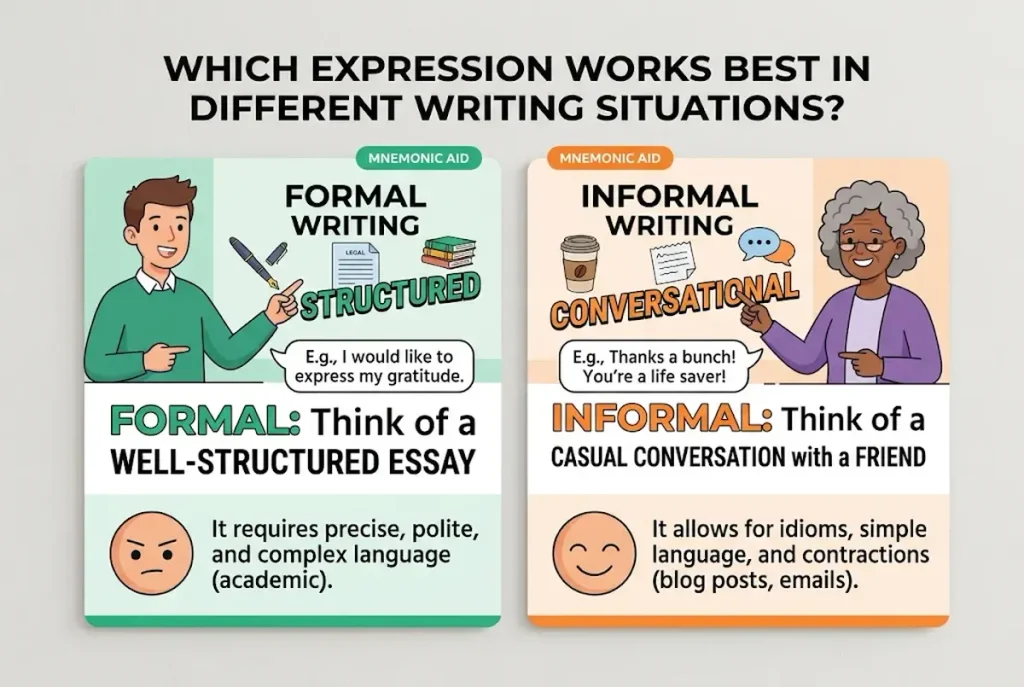
Which Expression Works Best in Different Writing Situations?
The right wording depends on your audience and purpose. A casual text can sound different from a formal report, but the comparison rule stays the same.
What Should You Use on a Resume?
On a resume, use clear and specific language to describe reduced costs, time, errors, or workload.
You can use expressions such as:
- Reduced processing time by less than two days.
- Managed a team of fewer than ten employees.
- Completed projects under budget.
What Should You Use in an Essay?
In an essay, choose precise language that supports your argument. Less than works well for numbers, measurements, and quantities.
Examples:
- Less than half of the participants supported the proposal.
- The study included fewer than 100 students.
- The second explanation is less convincing than the first.
What Should You Use in Text Messages?
In a text message, simple language is usually best. You don’t need a complicated expression when a short comparison will do.
Examples:
- I’ll be there in less than ten minutes.
- It costs under $20.
- We waited less than an hour.
What Should You Use in Emails?
For work or school emails, use direct and polite language. Less than, fewer than, below, and under are useful choices.
Examples:
- The report should take less than one hour to complete.
- We received fewer than 15 responses.
- The final cost is below the approved budget.
What Should You Use in Everyday Speech?
In conversation, people often use under, less than, and fewer than.
Examples:
- The store is less than a mile away.
- The meal cost under $15.
- There were fewer than ten people there.
What Are Some Examples of Less Than in Real Sentences?
Seeing the phrase in different situations can help you understand how to use it correctly. The examples below cover money, time, school, work, travel, shopping, and daily life.
Examples About Money and Shopping
- This jacket costs less than $60.
- I paid less than expected for the new phone.
- The store sold fewer than 50 items during the morning sale.
- We spent less than our original shopping budget.
- The repair should cost under $100.
Examples About Time and Distance
- The meeting lasted less than an hour.
- My office is less than two miles from home.
- The package arrived in fewer than three days.
- We reached the station in less than 15 minutes.
- The trip took slightly less time than we expected.
Examples About School and Education
- Fewer than 20 students attended the extra class.
- The assignment took less than two hours to complete.
- His answer was shorter than the teacher expected.
- The school received fewer applications this year.
- The final score was below the class average.
Examples About Work and Business
- The company completed the project in less than six months.
- Our team made fewer mistakes than last quarter.
- The department spent less money on office supplies.
- The new process takes less time than the old one.
- The final report contained fewer than 30 pages.
Examples About Health and Daily Life
- The recipe needs less than one cup of sugar.
- She slept for less than six hours last night.
- The child weighs less than 40 pounds.
- I drink less coffee than I used to.
- The exercise takes less than ten minutes.
Less Than vs Under: What’s the Difference?
Less than and under often express the same basic idea. Both can mean below a certain amount or limit.
However, under is usually shorter and more conversational. Less than often sounds more precise in formal comparisons.
| Less Than | Under |
|---|---|
| The ticket costs less than $25. | The ticket costs under $25. |
| The child is less than five years old. | The child is under five. |
| The trip takes less than an hour. | The trip takes under an hour. |
Less Than vs Fewer Than: What’s the Difference?
Less than and fewer than both describe smaller quantities, but they usually work with different types of nouns.
Use less with uncountable nouns, such as water, money, time, and sugar. Use fewer with countable nouns, such as books, people, cars, and students.
| Less Than | Fewer Than |
|---|---|
| We need less than five gallons of water. | We need fewer than five bottles of water. |
| She spent less than $100. | She bought fewer than 100 items. |
| The meeting took less than two hours. | Fewer than ten people attended. |
A simple way to remember the difference is to ask if you can count the items separately.
If you can count them, fewer is usually the better choice. If you’re talking about a general amount, less is usually appropriate.
What Are the Most Common Mistakes With Then and Than?
The words are easy to confuse because they differ by only one letter. Still, a few common mistakes can make your writing unclear.
Using Then for a Comparison
Incorrect: The new phone costs less then the old one.
Correct: The new phone costs less than the old one.
The sentence compares two prices, so it needs than.
Using Than for Sequence
Incorrect: Finish your lunch, than go outside.
Correct: Finish your lunch, then go outside.
The sentence gives two steps in order, so then is correct.
Mixing Up Less and Fewer
Incorrect: There were less than ten students in the room.
Better: There were fewer than ten students in the room.
Students are countable, so fewer is the more appropriate choice in careful writing.
Using Less Than Without a Clear Comparison
Unclear: The price is less than.
Clear: The price is less than $50.
A comparison needs a value, limit, or other point of reference. Without it, the reader may not understand what the amount is below.
Assuming Then Is Always Wrong After Less
The words less and then can appear next to each other when they serve separate grammatical purposes.
For example:
She wanted nothing less than success, then she changed her mind.
Here, less than introduces a comparison or strong expression, while then introduces the next event. The words are not being used as one incorrect phrase.
The important point is to check the job each word performs in the sentence.
When Should You Avoid Using Less Than?
The expression is useful, but it does not fit every comparison. Choose a different word when your sentence describes a number, quality, rank, or relationship more accurately.
Avoid using less than in these situations:
- When counting separate objects. Use fewer than for countable nouns in careful writing. For example, say fewer than ten books.
- When describing a sequence. Use then to show what happens next. For example, finish the task, then send the email.
- When comparing quality. Use worse than, inferior to, or not as good as when discussing quality.
- When describing physical position. Use below or underneath when you mean a lower physical location.
- When describing rank. Use lower than or subordinate to when discussing position in an organization.
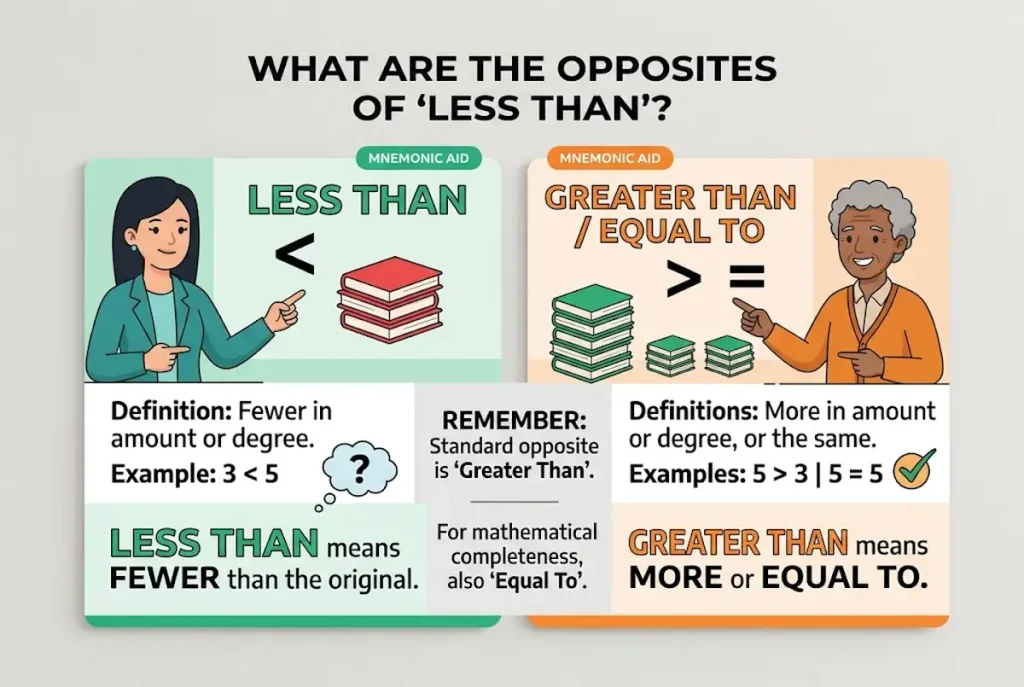
What Are the Opposites of Less Than?
The opposite depends on the kind of comparison you’re making.
| Expression | Opposite | Example |
|---|---|---|
| Less than | More than | The box weighs more than ten pounds. |
| Less | More | We need more time. |
| Fewer than | More than | More than 20 people attended. |
| Lower than | Higher than | The temperature is higher than yesterday. |
| Smaller than | Larger than | This room is larger than the other one. |
| Below | Above | The score is above average. |
| Under | Over | The total is over $100. |
What Are the Best Tips for Choosing Than or Then?
You can avoid most spelling mistakes by checking the meaning of the sentence before choosing a word.
Here are six simple tips:
- Use than for comparisons. If you’re comparing prices, ages, amounts, sizes, or numbers, choose than.
- Use then for time and order. If you mean next, afterward, or at that time, choose then.
- Remember the comparison test. If you can replace the word with compared with, than is probably correct.
- Remember the sequence test. If you can replace the word with next or afterward, then is probably correct.
- Check countable nouns. Use fewer for individual items and less for general amounts in careful writing.
For example:
- The room is smaller than the kitchen. This is a comparison.
- Clean the room, then organize the kitchen. This is a sequence.
Conclusion
The difference between these two words is small in spelling but important in meaning. Use than when you compare amounts, numbers, sizes, ages, or measurements. Use then when you describe time, order, or the next event. For example, the correct sentence is The journey takes less than two hours.
If you’re giving instructions, you might write Finish your work, then take a break. The easiest way to remember the rule is to connect than with comparisons and then with what happens next.
Once you understand that difference, you’ll find it much easier to write clear emails, school assignments, reports, and everyday messages. Check the meaning of your sentence, choose the right word, and your writing will be clearer.
Frequently Asked Questions
Is less then ever grammatically correct?
The two words can appear next to each other in a sentence, but they usually do not form a correct comparison phrase. When you mean a smaller amount or number, write less than.
Should I write less then or less than?
Write less than when comparing quantities, prices, ages, distances, or measurements. Use then when describing time or the next step in a sequence.
Why do people confuse then and than?
People often confuse them because their spellings are very similar and they sound alike in some accents. Remember that than introduces comparisons, while then usually refers to time or order.
Is less than the same as under?
They often have the same meaning when describing a value below a limit. For example, less than $20 and under $20 both mean that the price is below $20.
Can I use fewer than instead of less than?
You can use fewer than when comparing countable things, such as books, students, or cars. Use less than for general amounts, such as water, money, or time.
What’s another way to say less than?
You can use under, below, lower than, or slightly less than, depending on the sentence. For countable items, fewer than is often more accurate.
Is less then correct in American English?
No, not when you want to make a comparison. American English follows the same rule: use than for comparisons and then for time or sequence.
How can I remember the difference between then and than?
Remember that than compares two things, while then tells you what happens next or refers to a time. This simple test works in most everyday sentences.

Daniel Grammarfield — The Language Learner
Age: 28Occupation: ESL Learner & Digital Professional
Bio:Daniel is a non-native English speaker who wants to communicate more confidently at work and online. He uses Synotrench to improve grammar, understand confusing words, learn correct sentence structures, and build everyday English skills. He prefers simple explanations with practical examples.
Goals:
Master English grammar rules
Avoid common language mistakes
Improve professional communication
Learn English through real-life examples
Quote:“Learning English is not about memorizing rules — it’s about expressing ideas clearly.”
2 thoughts on “Less Then or Less Than: The Best Grammar Guide”