Have you ever stopped while writing an email, school assignment, or business report because you weren’t sure if you should use inter vs intra? These two prefixes look similar, but they communicate different ideas. Choosing the wrong one can change the meaning of your sentence, especially in academic, professional, and scientific writing.
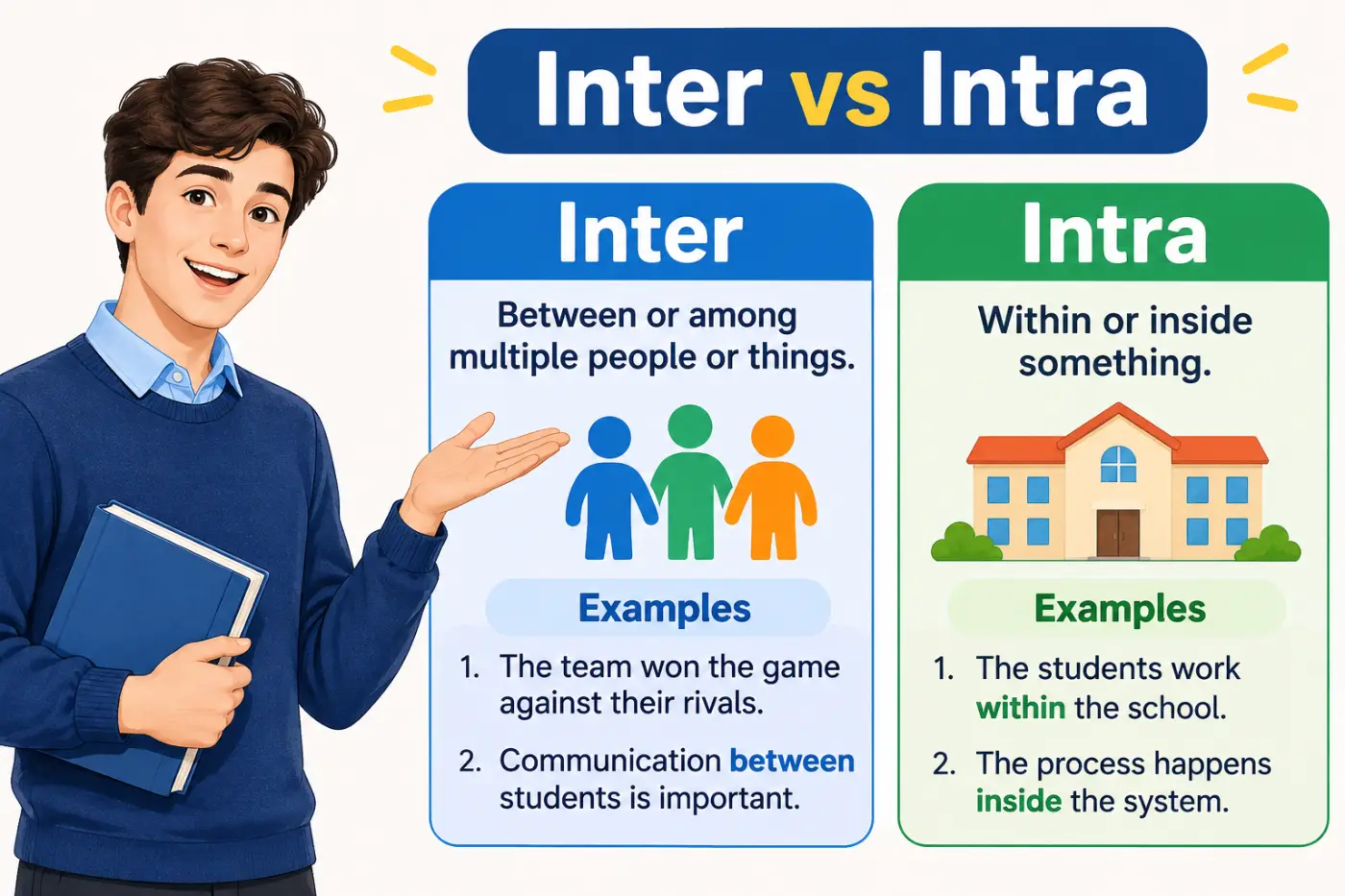
The main difference is simple: inter means between or among two or more people, places, groups, or things. Intra means within or inside a single person, place, group, or system.
For example, an international competition involves participants from different countries, while an intramural competition takes place within one school or organization. Both words describe relationships, but they point in different directions.
Understanding these prefixes will help you choose accurate words in essays, emails, resumes, reports, and everyday conversations. This guide explains their meanings, origins, common combinations, examples, synonyms, and practical differences so you can use them with confidence.
What Is the Difference Between Inter and Intra?
The difference comes down to the relationship between the people, places, or things being discussed.
- Inter describes something that happens between or among separate groups, people, places, or systems.
- Intra describes something that happens inside one group, person, place, or system.
Think of inter as a connection across boundaries and intra as an activity within a boundary.
| Prefix | Simple Meaning | Main Idea | Example |
|---|---|---|---|
| Inter | Between or among | Connection between separate things | International |
| Intra | Within or inside | Activity inside one thing | Intramural |
Consider these two sentences:
- The company organized an interdepartmental meeting involving its marketing and sales teams.
- The company organized an intradepartmental meeting for employees in its marketing department.
The first sentence describes communication between two different departments. The second describes communication within one department.
This distinction is useful because both prefixes can appear in words that describe meetings, communication, relationships, activities, and processes.

Where Do Inter and Intra Come From?
Understanding the origins of these prefixes makes their meanings easier to remember.
What Is the Origin of Inter?
Inter comes from the Latin word inter, which means between or among. English adopted this prefix through Latin and French influences.
It appears in many English words that describe relationships or connections involving separate people, groups, locations, or systems.
Common examples include:
- International: Between or involving different nations.
- Interpersonal: Between two or more people.
- Interconnected: Connected with one another.
- Interdepartmental: Involving different departments.
- Intercontinental: Between different continents.
The original idea remains consistent. Something involving inter usually crosses a boundary or connects separate parts.
What Is the Origin of Intra?
Intra comes from the Latin word intra, meaning within or inside. It developed as a prefix used to describe something occurring inside a particular boundary or structure.
You can see this meaning in words such as:
- Intramural: Taking place within one school or institution.
- Intravenous: Within or into a vein.
- Intracellular: Located or occurring inside a cell.
- Intrastate: Within one state.
- Intranet: A private network operating within an organization.
The meaning stays focused on an internal location, process, or relationship.
Why Are These Prefixes Easy to Confuse?
Both prefixes describe relationships, and many words containing them look similar. However, their Latin origins provide a reliable clue.
Remember these two ideas:
- Inter = between separate things.
- Intra = within one thing.
For instance, interschool activities involve different schools, while intraschool activities take place within a single school.
Once you understand the original meanings, unfamiliar words become easier to interpret.
What Are the Best Synonyms and Related Words?
Inter and intra are prefixes, not ordinary standalone adjectives in most English sentences. Therefore, they don’t have direct synonyms that work in every situation.
However, you can replace words containing these prefixes with expressions that communicate the same relationship.
The following table groups useful alternatives by tone and context.
Simple Words for Everyday English
| Word or Expression | Meaning | Tone | Example |
|---|---|---|---|
| Between | Involving separate things | Simple | Communication between teams improved. |
| Within | Inside a particular group | Simple | Rules within the school changed. |
| Among | Involving several people or things | Simple | Trust grew among employees. |
| Inside | Located in something | Simple | The discussion stayed inside the department. |
| Across | Extending between separate groups | Simple | Cooperation across schools increased. |
| Outside | Beyond an internal boundary | Simple | The organization invited outside partners. |
| Shared | Used or experienced by different groups | Simple | The teams created a shared plan. |
| Internal | Belonging to one organization or system | Simple | Internal communication improved. |
Everyday Words for Common Situations
| Word or Expression | Meaning | Tone | Example |
|---|---|---|---|
| Mutual | Shared by two or more parties | Everyday | Both departments reached a mutual agreement. |
| Joint | Involving separate people or groups | Everyday | The schools planned a joint event. |
| Combined | Brought together | Everyday | The teams submitted a combined report. |
| Teamwide | Involving an entire team | Everyday | We introduced a teamwide training session. |
| Groupwide | Affecting a whole group | Everyday | The change required groupwide approval. |
| Departmental | Related to a department | Everyday | The company held a departmental meeting. |
| Cross-team | Involving different teams | Everyday | Cross-team communication reduced delays. |
| In-house | Taking place within an organization | Everyday | The company provided in-house training. |
Formal Words for Academic and Professional Writing
| Word or Expression | Meaning | Tone | Example |
|---|---|---|---|
| Interorganizational | Between separate organizations | Formal | Interorganizational cooperation supported the project. |
| Intraorganizational | Within one organization | Formal | Intraorganizational policies guide employee behavior. |
| Interdepartmental | Between different departments | Formal | Interdepartmental coordination improved productivity. |
| Intradepartmental | Within one department | Formal | Intradepartmental communication helped resolve the issue. |
| Interpersonal | Between individuals | Formal | Interpersonal relationships influence teamwork. |
| Intrapersonal | Within an individual | Formal | Intrapersonal reflection can improve self-awareness. |
| Interinstitutional | Between separate institutions | Formal | Interinstitutional research created new opportunities. |
| Intrastate | Within one state | Formal | Intrastate transportation follows state regulations. |
Informal and Conversational Expressions
| Word or Expression | Meaning | Tone | Example |
|---|---|---|---|
| Across the board | Affecting different areas or groups | Informal | The company improved communication across the board. |
| Team to team | Between separate teams | Informal | The managers discussed the problem team to team. |
| Within the group | Inside one group | Informal | We solved the issue within the group. |
| In-house | Managed inside an organization | Informal | We handle website updates in-house. |
| All together | Involving everyone in a group | Informal | The staff worked all together on the project. |
| Back and forth | Moving or communicating between parties | Informal | The departments exchanged messages back and forth. |
These alternatives aren’t interchangeable in every sentence. For example, internal communication usually describes communication inside an organization, while interpersonal communication describes communication between people.
Choose an alternative based on the exact relationship you want to explain.
How Do Inter and Intra Words Differ by Intensity?
Inter and intra don’t describe different levels of strength. Instead, they describe different types of relationships.
However, the words built from these prefixes can express different levels of connection, involvement, or activity.
Mild or Limited Connections
These expressions describe basic relationships between groups or activities inside a group.
| Expression | Meaning | Example |
|---|---|---|
| Intergroup | Between different groups | Intergroup discussions encouraged cooperation. |
| Intragroup | Within one group | Intragroup activities improved teamwork. |
| Interpersonal | Between people | Interpersonal communication helps build trust. |
| Intrapersonal | Within an individual | Intrapersonal awareness supports personal growth. |
Moderate or Active Connections
These terms describe regular cooperation, communication, or interaction.
| Expression | Meaning | Example |
|---|---|---|
| Interdepartmental | Between departments | Interdepartmental planning improved the project. |
| Intradepartmental | Within a department | Intradepartmental training helped new employees. |
| Interorganizational | Between organizations | Interorganizational cooperation supported the research. |
| Intraorganizational | Within an organization | Intraorganizational changes affected staff members. |
Strong or Extensive Connections
These expressions often describe larger systems, structures, or networks.
| Expression | Meaning | Example |
|---|---|---|
| Intercontinental | Between continents | Intercontinental trade supports global business. |
| International | Between countries | International agreements support cooperation. |
| Intracellular | Inside a cell | Intracellular activity affects cell function. |
| Intraspecific | Within the same species | Intraspecific competition occurs among members of one species. |
The important point is that intensity doesn’t determine the correct prefix. The number of groups or the location of an activity does.
For example, a small international meeting still uses inter because it involves different nations. A major intrastate transportation system uses intra because it operates within one state.
How Do Inter and Intra Work as Parts of Speech?
Inter and intra are prefixes. They attach to other word parts to create complete words.
They don’t usually function as independent nouns or verbs in standard English. Instead, the complete word determines its grammatical role.
Inter and Intra as Adjectives
Many words beginning with these prefixes function as adjectives. They describe a noun by explaining its relationship or location.
Examples:
- Interpersonal communication helps people understand one another.
- Intracellular processes take place inside cells.
- Interdepartmental meetings bring different teams together.
- Intragroup relationships develop within a particular group.
In these examples, the complete words describe communication, processes, meetings, and relationships.
Inter and Intra in Scientific Terms
Scientific vocabulary frequently uses these prefixes to explain locations and relationships.
Consider these examples:
| Term | Part of Speech | Meaning |
|---|---|---|
| Intercellular | Adjective | Located or occurring between cells |
| Intracellular | Adjective | Located or occurring inside cells |
| Interpersonal | Adjective | Related to relationships between people |
| Intrapersonal | Adjective | Related to processes within an individual |
| Intervertebral | Adjective | Located between vertebrae |
| Intravenous | Adjective | Within or administered into a vein |
These terms are especially useful in biology, medicine, psychology, and other scientific fields.
Can Inter and Intra Be Used as Nouns?
No, not normally as standalone nouns in standard English.
For example, you shouldn’t write:
- The inter was successful.
- The intra happened yesterday.
Instead, use the complete word or explain the relationship with a suitable phrase.
Correct alternatives:
- The international meeting was successful.
- The internal meeting happened yesterday.

Is There an American and British English Difference?
The basic meanings of these prefixes are the same in American and British English.
Both varieties use inter for relationships between separate people, groups, or locations. Similarly, both use intra for activities or processes within a particular group or boundary.
For example:
| Word | American English | British English |
|---|---|---|
| International | Between countries | Between countries |
| Interpersonal | Between people | Between people |
| Intramural | Within an institution | Within an institution |
| Intravenous | Within or into a vein | Within or into a vein |
| Intrastate | Within one US state | Usually less relevant to UK contexts |
Some words have different levels of popularity depending on the region.
For example, intrastate is strongly connected with the American system of states. British English speakers may use phrases such as within the same region or within the country instead.
However, the underlying meanings don’t change.
Which Word Should You Use in Different Writing Situations?
Choosing the right expression depends on your audience and purpose. A formal report may require technical vocabulary, while a text message usually needs simpler language.
Which Prefix Is Best for a Resume?
Use inter when describing experience involving multiple teams, departments, or organizations. Use intra when discussing responsibilities or activities inside one organization or department.
Resume examples:
- Coordinated interdepartmental projects to improve communication between sales and marketing teams.
- Managed intradepartmental training for new employees.
- Developed interpersonal relationships with clients and colleagues.
- Improved internal communication across multiple company divisions.
These sentences explain your responsibilities more clearly than vague statements such as worked with people or helped the team.
Which Prefix Is Best for an Essay?
Academic writing often requires precise language. Inter and intra help explain relationships between different subjects and processes inside a particular system.
Essay examples:
- International trade influences economic relationships between countries.
- Intragroup communication can affect student participation.
- Interpersonal relationships play an important role in social development.
- Intracellular processes help maintain normal cell function.
For a school assignment, explain technical terms the first time you use them. This helps readers understand your argument without searching for unfamiliar vocabulary.
Which Prefix Is Best for Texting?
In casual messages, simple expressions are usually easier to understand than technical words.
For example:
- We need better communication between our teams.
- The problem started inside our group.
- Our schools are planning a joint event.
- The discussion stayed within our department.
You can use words such as interdepartmental or intragroup when your friends or coworkers understand them. However, everyday phrases often make messages sound more natural.
Which Prefix Is Best for Professional Emails?
Choose the prefix based on the people or departments involved.
Use inter for communication or activities between separate groups. Use intra for something that takes place inside one organization or department.
Email examples:
- We have scheduled an interdepartmental meeting for Thursday.
- Please review the new intranet guidelines before the internal training session.
- Our team is working with another company on an interorganizational project.
- The updated intradepartmental process will begin next Monday.
If your audience doesn’t regularly use technical vocabulary, replace complicated terms with direct explanations.
For example, instead of writing:
Our interdepartmental coordination requires improvement.
You could write:
Communication between our departments needs improvement.
Which Prefix Is Best for Speaking?
In conversations, use familiar words unless you’re discussing a technical subject.
For example:
- The two departments are working together.
- The activity takes place within our school.
- We need better communication between employees.
- The process happens inside the cell.
However, inter and intra words are perfectly acceptable in professional conversations, classroom discussions, and scientific presentations.
The goal is to make your meaning clear, not to make every sentence sound complicated.
What Are Some Practical Examples of Inter and Intra?
Examples make these prefixes easier to recognize. The following sentences cover school, business, science, technology, sports, and everyday situations.
Examples of Inter in Sentences
- The international conference welcomed researchers from twelve countries.
- The company improved interdepartmental communication by organizing weekly meetings.
- Interpersonal skills helped the new manager build strong relationships with employees.
- The two universities started an interinstitutional research project.
- Intercontinental flights connect travelers across different continents.
- The teacher encouraged interschool competitions to promote teamwork.
- The organization developed an interconnected network of local offices.
- International students shared their experiences during the cultural exchange.
- The two companies signed an interorganizational agreement.
- The manager encouraged interaction between employees from different departments.
Each example describes a relationship or connection involving separate people, places, groups, or systems.
Examples of Intra in Sentences
- The school organized an intramural basketball tournament for its students.
- Intracellular activities help cells perform their normal functions.
- The company introduced an intranet for sharing internal information.
- Intrapersonal reflection helped the student understand personal strengths.
- The intrastate transportation system connects cities within the same state.
- The doctor explained how an intravenous treatment works.
- Intragroup cooperation helped the students complete their assignment.
- The company reviewed its intraorganizational communication policies.
- The scientist studied intracellular changes during the experiment.
- The school arranged an intradepartmental meeting for its science teachers.
These examples show that the prefix identifies something happening inside a defined group, organization, location, or system.
Examples That Show Both Prefixes Together
Comparing the prefixes in the same situation makes their meanings even clearer.
| Situation | Inter Example | Intra Example |
|---|---|---|
| Schools | Interschool competition | Intraschool competition |
| Departments | Interdepartmental meeting | Intradepartmental meeting |
| Groups | Intergroup communication | Intragroup communication |
| Organizations | Interorganizational cooperation | Intraorganizational cooperation |
| Cells | Intercellular communication | Intracellular communication |
| State activities | Interstate travel | Intrastate travel |
| Teams | Interaction between teams | Cooperation within a team |
Inter vs Intra in Similar Words
Some words containing these prefixes look almost identical. However, their meanings can be quite different. Understanding the small difference helps you avoid mistakes in academic and professional writing.
Interstate vs Intrastate
Both words describe transportation, trade, or activities involving states. The difference is the location of the activity.
| Interstate | Intrastate |
|---|---|
| Involves two or more states. | Takes place within one state. |
| Connects separate states. | Operates inside a single state. |
| Example: Interstate transportation connects Texas and Oklahoma. | Example: Intrastate transportation connects cities within Texas. |
Interpersonal vs Intrapersonal
These words are common in psychology, education, communication, and personal development.
| Interpersonal | Intrapersonal |
|---|---|
| Describes relationships or communication between people. | Describes thoughts, feelings, or processes within one person. |
| Focuses on interaction with others. | Focuses on self-awareness and personal understanding. |
| Example: Interpersonal skills improve teamwork. | Example: Intrapersonal awareness supports personal growth. |
Intergroup vs Intragroup
These terms are useful when discussing teamwork, education, social behavior, and organizational relationships.
| Intergroup | Intragroup |
|---|---|
| Describes relationships between separate groups. | Describes relationships within one group. |
| Focuses on cooperation or conflict between groups. | Focuses on cooperation or conflict among members of one group. |
| Example: Intergroup activities brought two classes together. | Example: Intragroup activities helped students work as a team. |
What Are the Common Mistakes When Using These Prefixes?
Even experienced writers sometimes confuse these terms. Most mistakes happen because people focus on how the words look instead of what they mean.
Using Inter When You Mean Within
Inter describes a relationship between separate things. It doesn’t normally describe an activity happening inside one group.
Incorrect: The company organized an interdepartmental meeting for employees in the marketing department only.
Better: The company organized an intradepartmental meeting for employees in the marketing department.
The corrected sentence makes it clear that the meeting involves members of one department.
Using Intra When You Mean Between Groups
Intra describes something inside a particular boundary. It isn’t the right choice for activities involving separate organizations or departments.
Incorrect: The two universities created an intrainstitutional partnership.
Better: The two universities created an interinstitutional partnership.
The partnership connects two separate institutions, so inter is the appropriate prefix.
Confusing Interpersonal With Intrapersonal
These words are not interchangeable.
Incorrect: Good intrapersonal communication helps you communicate with coworkers.
Better: Good interpersonal communication helps you communicate with coworkers.
The second sentence is correct because communication with coworkers involves other people.
Assuming Every Similar Word Has the Same Meaning
Some words share a prefix but describe different subjects.
For example:
- International refers to relationships between nations.
- Interpersonal refers to relationships between people.
- Intercellular refers to something between cells.
Adding Prefixes Without Checking Standard Usage
Not every combination of inter or intra is a commonly accepted English word.
Writers sometimes create unusual combinations that sound reasonable but aren’t standard terms.
If you’re unsure, consult a reliable dictionary or subject-specific reference. This is especially useful when writing medical, scientific, or legal documents.
What Are the Antonyms of Inter and Intra?
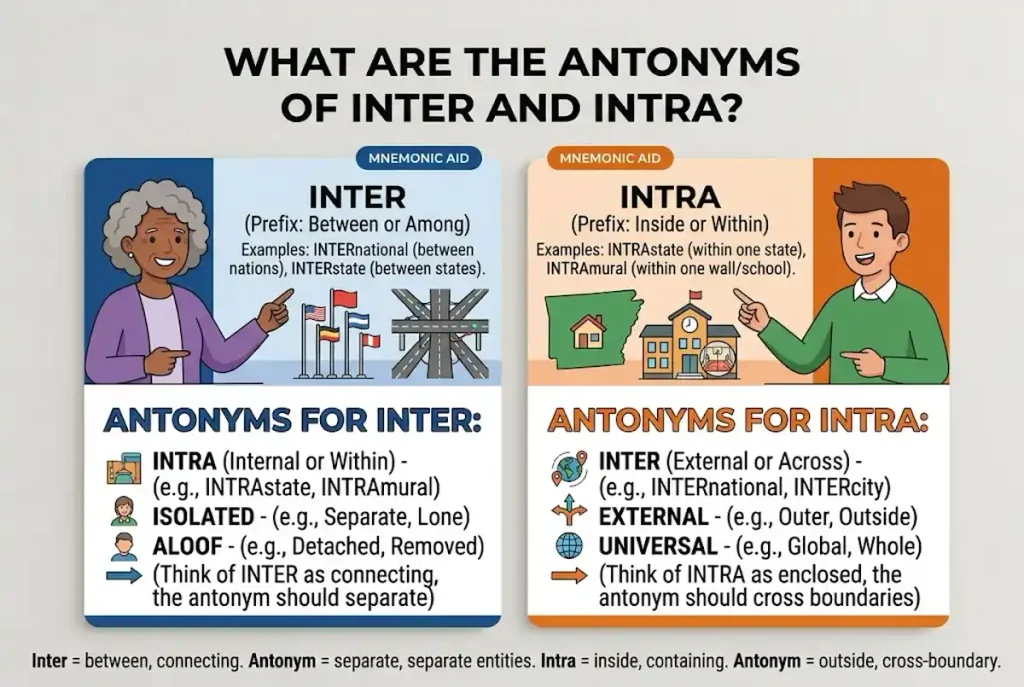
Inter and intra don’t have perfect antonyms because they’re prefixes that express different relationships. However, several words can communicate opposite ideas in particular contexts.
| Prefix or Concept | Opposing Expression | Example |
|---|---|---|
| Inter | Within | Between departments vs within a department |
| Intra | Between | Inside a group vs between groups |
| Internal | External | Internal communication vs external communication |
| Inward | Outward | Inward movement vs outward movement |
| Connected | Separate | Connected organizations vs separate organizations |
What Are the Quick Tips for Choosing the Correct Prefix?
If you regularly confuse these terms, use the following simple tips before writing.
- Think about the boundary. If something crosses a boundary between separate groups, use inter.
- Think about the location. If something happens inside one group or system, use intra.
- Count the groups involved. Two or more separate groups usually point toward inter.
- Remember the common examples. International means between nations, while intrastate means within one state.
- Read the sentence again. Ask yourself if the word describes a connection between separate things or an activity within one thing.
Conclusion
The main difference between inter and intra is the relationship they describe. Inter refers to something between or among separate people, groups, places, or systems. Intra refers to something within a particular person, group, place, or system.
For example, an interdepartmental meeting involves different departments, while an intradepartmental meeting involves employees from the same department.
Both prefixes appear in everyday, academic, scientific, and professional vocabulary. You don’t need to memorize every word containing them. Instead, learn their basic meanings and use the surrounding context to guide your choice.
Once you recognize the difference between outside connections and internal activities, choosing the correct prefix becomes much easier. Practice with familiar examples, and you’ll develop a better understanding of both terms.
Frequently Asked Questions
What does inter mean in simple English?
Inter means between or among two or more separate people, groups, places, or things. For example, international describes something involving different countries.
What does intra mean in simple English?
Intra means within or inside a particular person, group, place, or system. For example, intramural describes an activity that takes place within one institution.
Is inter the opposite of intra?
They express contrasting relationships, but they aren’t exact opposites in every situation. Inter describes connections between separate things, while intra describes activities or relationships within one thing.
What’s another way to say inter or intra?
For inter, you can use between, among, or across, depending on the sentence. For intra, you can use within, inside, or internal.
What is an example of inter and intra in a sentence?
An interdepartmental meeting involves employees from different departments. An intradepartmental meeting involves employees from the same department.
Is interpersonal inter or intra?
Interpersonal uses inter because it describes relationships or communication between people. Intrapersonal uses intra because it describes thoughts, feelings, and processes within an individual.
Are inter and intra used in American and British English?
Yes. Both American and British English use these prefixes with the same basic meanings. However, certain terms, such as intrastate, are more common in specific regional contexts.
How can I remember the difference between inter and intra?
Remember that inter means between and intra means inside. Think of international as involving different nations and intramural as taking place within one institution.

Daniel Grammarfield — The Language Learner
Age: 28Occupation: ESL Learner & Digital Professional
Bio:Daniel is a non-native English speaker who wants to communicate more confidently at work and online. He uses Synotrench to improve grammar, understand confusing words, learn correct sentence structures, and build everyday English skills. He prefers simple explanations with practical examples.
Goals:
Master English grammar rules
Avoid common language mistakes
Improve professional communication
Learn English through real-life examples
Quote:“Learning English is not about memorizing rules — it’s about expressing ideas clearly.”
1 thought on “Inter vs Intra: The Guide to Understand the Difference”