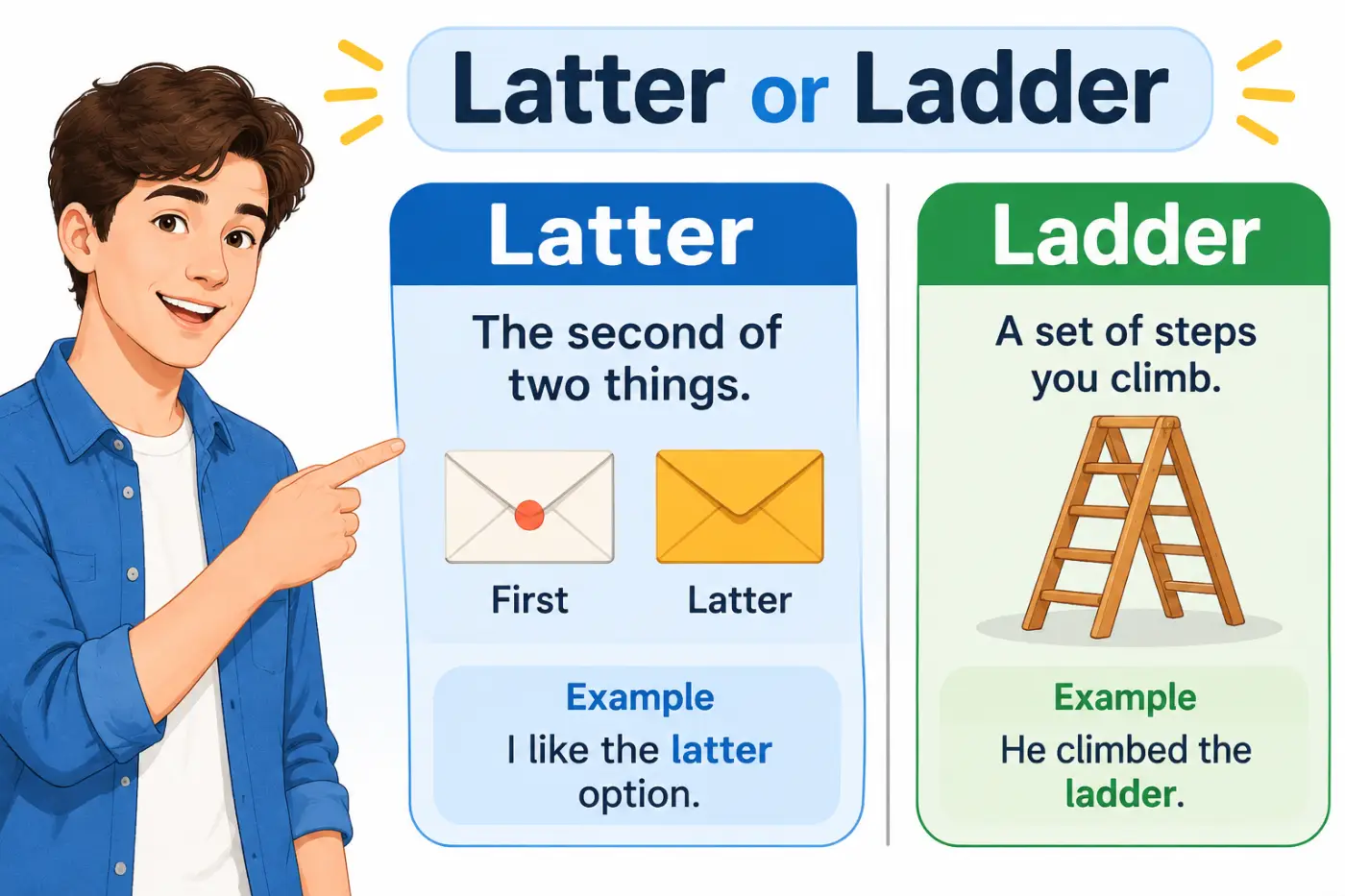
Imagine you’re writing an email about two job candidates. You want to recommend the second person, but you’re unsure if you should use latter or ladder. Both words sound similar, and their spellings differ by only one letter. However, they have completely different meanings.
This confusion often happens in school assignments, business emails, conversations, and everyday writing. One word refers to the second of two things mentioned, while the other names an object used for climbing.
The simple answer is that latter means the second of two previously mentioned people or things, while ladder is a structure with steps or rungs that helps people climb. They aren’t interchangeable.
Understanding their meanings will help you avoid spelling mistakes and choose the right word in context. This guide explains their definitions, origins, synonyms, pronunciation, grammar, examples, and common mistakes.
What Is the Difference Between Latter and Ladder?
The main difference is their meaning and how you use them in a sentence.
- Latter refers to the second of two people, choices, or things mentioned earlier.
- Ladder is a piece of equipment with steps or rungs that people use to climb up or down.
Although these words look and sound similar, they serve different purposes.
| Word | Meaning | Part of Speech | Example |
|---|---|---|---|
| Latter | The second of two things mentioned | Adjective or pronoun | I prefer the latter option. |
| Ladder | A climbing structure with steps or rungs | Noun | He climbed the ladder carefully. |
What Does Latter Mean in Simple English?
Latter means the second person or thing in a pair that you have already mentioned.
For example:
I can study English or French. I prefer the latter.
In this sentence, latter refers to French because it is the second language mentioned.
You can use it to avoid repeating the name of the second choice. It is especially common in formal writing, academic discussions, and professional communication.
More examples:
- Between tea and coffee, I prefer the latter.
- We discussed two plans, but the latter seemed more practical.
- Sarah and Emily applied for the position. The latter received the job.
In each example, latter points to the second item in a pair.
What Does Ladder Mean in Simple English?
A ladder is a structure with two long sides connected by horizontal steps called rungs. People use it to reach high places.
For example:
The painter used a ladder to reach the ceiling.
Ladders are common in homes, workplaces, construction sites, gardens, and emergency services.
Common types include:
- Step ladder: A self-supporting ladder with steps.
- Extension ladder: A ladder that extends to reach higher places.
- Folding ladder: A ladder that folds for storage.
- Fixed ladder: A ladder permanently attached to a building or structure.
- Telescopic ladder: A ladder that extends and collapses into a smaller size.
Where Do the Words Latter and Ladder Come From?
The origins of these words explain why they have different meanings despite their similar spelling.
What Is the Origin of Latter?
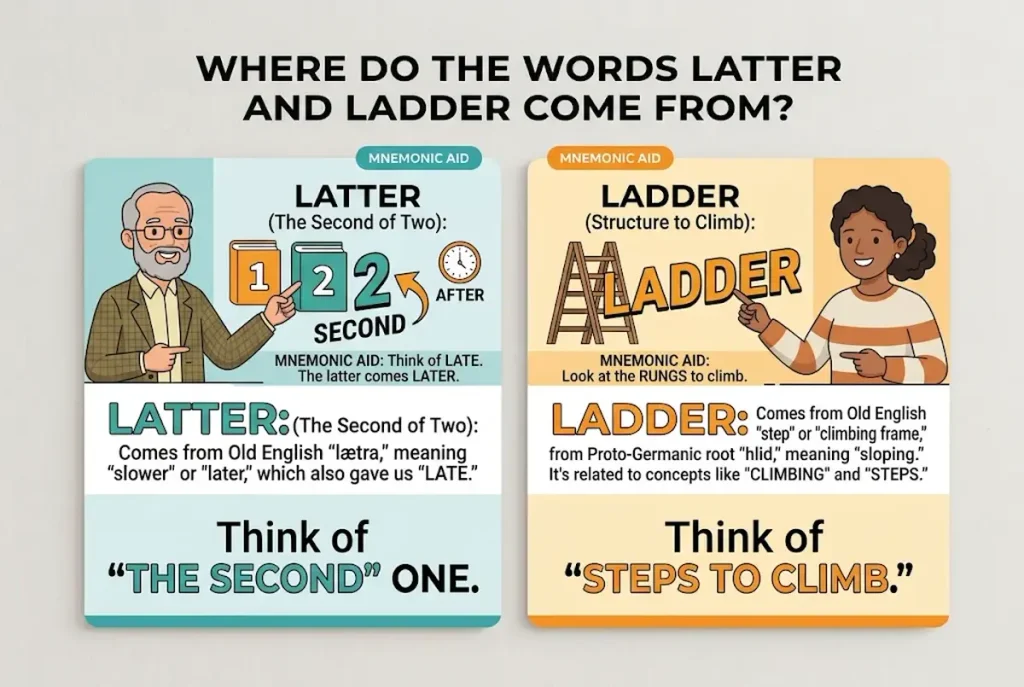
Latter comes from Old English lætra, which was the comparative form of læt, meaning slow or late.
Over time, the word developed into latter and became associated with the second of two things mentioned.
It is related to the word late, but its modern meaning is more specific.
For example:
The company offered two solutions. The latter was more affordable.
Here, latter refers to the second solution.
The word is especially useful when discussing two choices without repeating their names.
What Is the Origin of Ladder?
Ladder comes from Old English hlæder, which referred to a climbing structure.
Its meaning has remained closely connected to equipment used for reaching higher places.
For centuries, people have used ladders in construction, farming, household work, and other activities.
Today, the word also appears in expressions that describe progress or position.
Examples include:
- Career ladder: The stages of professional advancement.
- Social ladder: A person’s position in society.
- Ladder of success: A series of steps toward achievement.
Why Are Latter and Ladder So Easy to Confuse?
The two words are easy to mix up because they have similar spellings and nearly identical pronunciations in many American English accents.
However, their meanings are completely different.
Remember:
- Latter is connected with the second choice.
- Ladder is connected with climbing.
What Are the Best Synonyms and Related Words for Latter and Ladder?
Latter and ladder don’t share synonyms because they have different meanings. However, several words and expressions can replace them in suitable sentences.
The following tables group useful alternatives by tone and writing style.
What Words Can Replace Latter?
Use these words when referring to the second item in a pair or the final part of something already mentioned.
Simple Alternatives
| Word or Expression | Meaning | Tone | Example |
|---|---|---|---|
| Second | Coming after the first | Simple | I prefer the second option. |
| Last | Coming after the other item in a pair | Simple | The last choice was better. |
| Final | Coming at the end | Simple | We selected the final option. |
| Other | The remaining person or thing | Simple | The other choice was cheaper. |
| Next | Following something else | Simple | The next option was more useful. |
| Remaining | Still left after others are considered | Simple | The remaining choice was suitable. |
| Final one | The last item in a group | Simple | The final one was my favorite. |
Everyday Alternatives
| Word or Expression | Meaning | Tone | Example |
|---|---|---|---|
| The second one | The second item mentioned | Everyday | I would choose the second one. |
| The other one | The alternative item | Everyday | The other one looks better. |
| The last one | The final item in a pair or sequence | Everyday | I liked the last one. |
| The final choice | The selected option at the end | Everyday | The final choice saved money. |
| The second option | The second available possibility | Everyday | The second option is easier. |
| The other choice | The alternative possibility | Everyday | We decided to take the other choice. |
| The latter choice | The second of two choices | Everyday | The latter choice was more practical. |
Formal Alternatives
| Word or Expression | Meaning | Tone | Example |
|---|---|---|---|
| Subsequent | Following something earlier | Formal | Subsequent events changed the decision. |
| Successive | Following one after another | Formal | Successive stages improved the process. |
| Concluding | Coming at the end | Formal | The concluding section summarizes the results. |
| Final alternative | The last available choice | Formal | The final alternative offered better value. |
| Second-mentioned | The item named second | Formal | The second-mentioned proposal was accepted. |
| Subsequent option | A choice presented later | Formal | The subsequent option required less funding. |
| Concluding choice | The choice made at the end | Formal | The concluding choice reflected the committee’s decision. |
What Words Can Replace Ladder?
The word ladder names a climbing structure, but other terms can describe similar equipment or objects.
Simple Alternatives
| Word or Expression | Meaning | Tone | Example |
|---|---|---|---|
| Steps | Surfaces used for climbing | Simple | He used the steps to reach the platform. |
| Stairs | A set of steps between levels | Simple | She walked up the stairs. |
| Rungs | Horizontal bars on a ladder | Simple | The ladder has ten rungs. |
| Climbing equipment | Tools used for climbing | Simple | The workers checked their climbing equipment. |
| Step ladder | A self-supporting climbing structure | Simple | He opened the step ladder. |
| Access steps | Steps that provide a way to reach a place | Simple | The workers installed access steps. |
Everyday Alternatives
| Word or Expression | Meaning | Tone | Example |
|---|---|---|---|
| Extension ladder | An adjustable ladder that extends | Everyday | He used an extension ladder to clean the roof. |
| Folding ladder | A ladder that folds for storage | Everyday | We keep a folding ladder in the garage. |
| Climbing frame | A structure designed for climbing | Everyday | Children played on the climbing frame. |
| Step stool | A small platform used to reach higher places | Everyday | She stood on a step stool to reach the shelf. |
| Telescopic ladder | A ladder that extends and collapses | Everyday | The repairman carried a telescopic ladder. |
| Portable ladder | A ladder that can be moved | Everyday | The portable ladder was easy to store. |
Formal Alternatives
| Word or Expression | Meaning | Tone | Example |
|---|---|---|---|
| Access structure | A structure that provides access to a higher place | Formal | Workers inspected the access structure. |
| Climbing apparatus | Equipment designed for climbing | Formal | The climbing apparatus required maintenance. |
| Vertical access equipment | Equipment used to reach elevated areas | Formal | The team checked its vertical access equipment. |
| Ascending structure | A structure used to move upward | Formal | The facility installed a new ascending structure. |
| Fixed access ladder | A permanently installed climbing structure | Formal | The technician inspected the fixed access ladder. |
| Extension apparatus | Equipment that extends to provide additional reach | Formal | The maintenance team tested the extension apparatus. |
Do Latter and Ladder Have Different Levels of Intensity?
Neither word describes a level of strength or intensity. They have separate meanings, so you can’t arrange them from mild to strong.
However, you can understand their different uses by looking at simple and more specific expressions.
Simple Uses of Latter
- The second choice.
- The other option.
- The last of two items.
More Specific Uses of Latter
- The latter proposal.
- The latter approach.
- The latter-mentioned candidate.
Simple Uses of Ladder
- A small ladder.
- A household ladder.
- A folding ladder.
More Specific Uses of Ladder
- An extension ladder.
- An industrial ladder.
- A fixed access ladder.
How Do Latter and Ladder Work as Different Parts of Speech?
Understanding their grammatical roles can help you use both words correctly.
Is Latter an Adjective or a Pronoun?
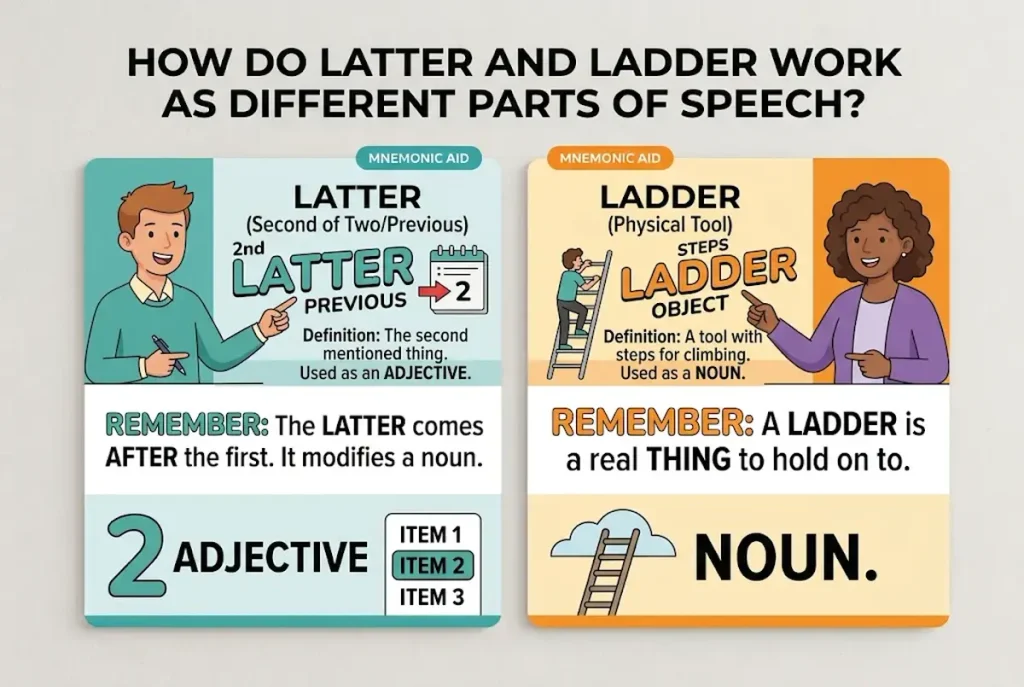
Latter can function as an adjective or a pronoun.
As an adjective, it describes the second of two people or things mentioned.
Examples:
- The latter option was more affordable.
- We discussed two plans, but the latter plan was easier to complete.
- The latter candidate had more experience.
Is Ladder a Noun or a Verb?
Ladder is mainly used as a noun.
Examples:
- The ladder is leaning against the wall.
- Please bring the ladder from the garage.
- The worker climbed the ladder carefully.
What Are Some Related Forms of Latter and Ladder?
| Word | Word Type | Meaning |
|---|---|---|
| Latter | Adjective or pronoun | The second of two things mentioned |
| Latterly | Adverb | Recently or in the later part of a period |
| Late | Adjective or adverb | Occurring after the expected time |
| Latest | Adjective | Most recent |
| Ladder | Noun | A structure used for climbing |
| Laddered | Verb or adjective | Arranged in levels or marked by ladder-like runs in fabric |
| Laddering | Noun or verb form | The act of arranging in levels or stages |
Are Latter and Ladder Different in American and British English?
The meanings of latter and ladder are the same in American and British English.
Both varieties use latter to refer to the second of two things previously mentioned. Both also use ladder for a climbing structure.
There are a few regional vocabulary differences worth knowing.
| Word or Expression | American English | British English |
|---|---|---|
| Latter | The second of two mentioned items | The second of two mentioned items |
| Ladder | A climbing structure | A climbing structure |
| Step ladder | Common term | Common term |
| Extension ladder | Common term | Common term |
| Ladder in clothing | A run or damaged area in fabric | A common term for a run in tights or stockings |
| Run in clothing | Common American expression | Also understood, but ladder is common |
Which Word Should You Use in Different Writing Situations?
Your choice depends on what you’re trying to communicate. Latter is useful when comparing two things, while ladder is appropriate when discussing climbing equipment or figurative progress.
Which Word Is Best for a Resume?
Use latter when referring to the second of two professional options or responsibilities. Use ladder when discussing career growth or professional advancement.
Resume examples:
- I received two job offers and accepted the latter.
- Developed skills that supported my progress up the corporate ladder.
- Helped junior employees advance on the professional ladder.
Which Word Is Best for an Essay?
Latter is useful in academic writing when comparing two ideas, arguments, or subjects.
Examples:
- The study examines traditional and modern teaching methods. The latter approach encourages independent learning.
- Two theories explain the issue, but the latter provides stronger evidence.
- Students can choose between online and classroom learning. The latter offers direct interaction with teachers.
Which Word Is Best for Texting?
In casual messages, both words are easy to use when the meaning is clear.
Examples:
- I like the latter option better.
- Can you bring the ladder?
- Between the blue and black shoes, I’ll take the latter.
Which Word Is Best for Professional Emails?
Use latter when referring to the second of two previously discussed choices. Use ladder when discussing career growth, equipment, or workplace safety.
Email examples:
- We discussed two project timelines. I recommend the latter.
- Please arrange for someone to inspect the office ladder.
- Between the two proposed solutions, the latter appears more cost-effective.
Which Word Is Best for Speaking?
In everyday conversations, ladder is common when discussing equipment. Latter is more common in formal or careful speech.
Examples:
- I need a ladder to change the light bulb.
- We can travel by bus or train. I’d prefer the latter.
- Please move the ladder away from the doorway.
What Are 15 Correct Examples of Latter and Ladder in Sentences?
These original examples show how both words work in different situations.
Examples of Latter in Sentences
- I can choose between mathematics and science, but I prefer the latter.
- The company offered two positions, and she accepted the latter.
- We discussed two possible solutions, but the latter was more effective.
- John and Michael attended the interview, and the latter received the job.
- The teacher explained two grammar rules, and the latter was easier to understand.
- You can buy a new phone or repair your old one. The latter is less expensive.
- Both restaurants have excellent food, but I prefer the latter.
- The author compared traditional education with online learning and supported the latter.
- The first proposal required more money, while the latter offered better results.
- Between reading a book and watching a documentary, I would choose the latter.
Examples of Ladder in Sentences
- My father used a ladder to paint the outside walls.
- The worker carefully climbed the ladder to repair the roof.
- Please put the ladder back in the storage room.
- She bought a folding ladder for cleaning the windows.
- The firefighter carried a ladder toward the burning building.
- The company helped employees move up the corporate ladder.
- The gardener used a ladder to trim the tall tree.
- A damaged ladder can create serious safety risks.
- He placed the ladder against the wall before climbing.
- Hard work and experience helped her climb the career ladder.
What Is the Difference Between Latter and Other Similar Words?
Latter is sometimes confused with other words that describe order, position, or time. Understanding these differences will help you select the right expression.
Latter vs Later: What’s the Difference?
| Latter | Later |
|---|---|
| Refers to the second of two things mentioned. | Refers to a time after the present or a previously mentioned time. |
| Usually used when comparing two items. | Used when discussing time or sequence. |
| I prefer the latter choice. | I’ll call you later. |
| The latter proposal was accepted. | The meeting started later than expected. |
Latter vs Last: What’s the Difference?
Both words can refer to something near the end, but they aren’t always interchangeable.
| Latter | Last |
|---|---|
| Usually identifies the second of two things mentioned. | Identifies the final item in a sequence. |
| The latter option is cheaper. | The last option is cheaper. |
| Used mainly for pairs. | Can be used for two or more items. |
What Common Mistakes Should You Avoid When Using Latter and Ladder?
These words are easy to remember once you understand their meanings. Still, several mistakes can appear in everyday writing.
Using Ladder When Referring to the Second Choice
Incorrect: I compared two phones and selected the ladder.
Correct: I compared two phones and selected the latter.
The sentence discusses two choices, not climbing equipment.
Using Latter When Talking About Climbing Equipment
Incorrect: He placed the latter against the wall to reach the roof.
Correct: He placed the ladder against the wall to reach the roof.
A physical climbing structure is called a ladder.
Using Latter After Mentioning Three or More Things
Incorrect: I like apples, oranges, and bananas. I prefer the latter.
Better: I like apples, oranges, and bananas. I prefer the last option.
Traditionally, latter identifies the second of two things. Use last when referring to the final item in a longer list.
Using Latter Without Mentioning Two Things First
Incorrect: The latter was very expensive.
Better: We considered two laptops. The latter was very expensive.
Your reader needs to know which two things you’re comparing. Otherwise, the reference is unclear.
Confusing Latter With Later
Incorrect: I’ll finish my homework latter.
Correct: I’ll finish my homework later.
Use later when talking about something happening after the present time.
Using Ladder When You Mean Career Progress
Incorrect: She climbed the latter at her company.
Correct: She climbed the career ladder at her company.
The expression career ladder describes professional advancement. It doesn’t refer to a second choice.
What Are the Antonyms of Latter and Ladder?
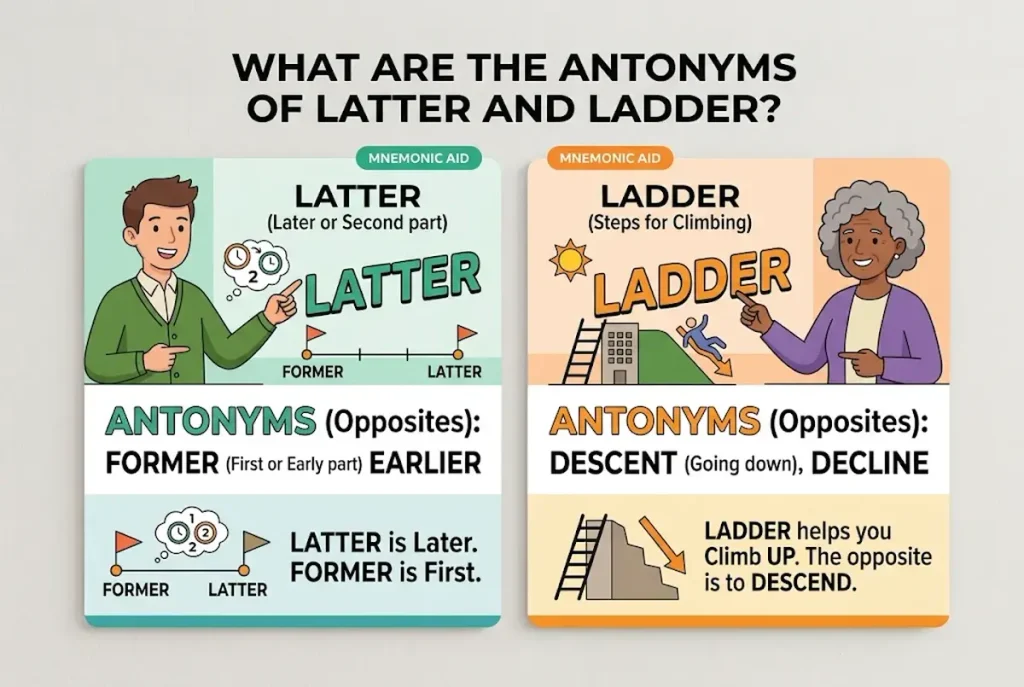
Neither word has one perfect opposite in every situation. However, several words express contrasting meanings.
| Word | Opposite or Contrasting Term | Explanation |
|---|---|---|
| Latter | Former | Former refers to the first of two things mentioned. |
| Latter | Earlier | Refers to something that comes before another. |
| Latter | Initial | Refers to the beginning or first stage. |
| Ladder | Stairs | A different structure used for moving between levels. |
| Ladder | Ramp | A sloping surface used to move between different heights. |
| Ladder | Elevator | A machine that moves people between floors. |
The most important opposite to remember is former.
What Are the Quick Tips for Choosing the Correct Word?
Use these simple tips to avoid confusion.
- Remember the meaning of each word. Latter means the second of two things, while ladder means climbing equipment.
- Look at the context. If you’re comparing two choices, latter is usually correct.
- Check the number of items. Use latter for a pair, not normally for a list of three or more.
- Think about physical objects. If the sentence describes climbing, painting, or reaching a high place, use ladder.
- Remember former and latter together. Former identifies the first item, while latter identifies the second.
- Don’t confuse latter with later. Later describes time, while latter identifies the second item mentioned.
- Read the sentence again. Make sure your word communicates the meaning you intend.
A useful memory trick is to connect ladder with the word rungs. A ladder has rungs that help people climb, while latter helps identify the second choice.
Conclusion
The correct choice depends on the meaning of your sentence. Latter refers to the second of two people or things mentioned earlier, while ladder is a structure with steps or rungs used for climbing.
For example, if you compare tea and coffee and choose coffee, you can say you prefer the latter. However, if you need to reach a high shelf, you need a ladder.
Also, remember that latter is traditionally used for two items, not a long list. If you’re discussing time, use later instead. These small differences can make your writing more accurate and easier to understand. Practice using both words in everyday sentences, and you’ll quickly learn when each one belongs.
Frequently Asked Questions
What is the main difference between latter and ladder?
Latter refers to the second of two things mentioned, while ladder is a climbing structure with steps or rungs. Their meanings are different even though their pronunciations are similar.
Is latter the same as later?
No, latter and later have different meanings. Latter identifies the second of two things, while later refers to a time in the future or after something else.
Can I use latter for three things?
Traditionally, no. Latter refers to the second of two items, so use last or final when referring to the final item in a list of three or more.
What’s another word for latter?
You can use second, the second one, or the other option, depending on your sentence. Former is also related, but it refers to the first of two things.
What is the opposite of latter?
Former is the most common opposite of latter. Former refers to the first of two things mentioned, while latter refers to the second.
Is ladder a noun or a verb?
Ladder is mainly a noun that describes a climbing structure. It can also function as a verb in specialized contexts, such as arranging investments in stages.
How do you remember the difference between latter and ladder?
Remember that a ladder has rungs for climbing, while latter identifies the second choice. This simple connection makes the spelling difference easier to remember.
Are latter and ladder pronounced the same in American English?
Yes, they are pronounced the same in many American English accents. Their spelling and meaning are different, so you must use the sentence context to choose the correct word.

Daniel Grammarfield — The Language Learner
Age: 28Occupation: ESL Learner & Digital Professional
Bio:Daniel is a non-native English speaker who wants to communicate more confidently at work and online. He uses Synotrench to improve grammar, understand confusing words, learn correct sentence structures, and build everyday English skills. He prefers simple explanations with practical examples.
Goals:
Master English grammar rules
Avoid common language mistakes
Improve professional communication
Learn English through real-life examples
Quote:“Learning English is not about memorizing rules — it’s about expressing ideas clearly.”
4 thoughts on “Latter or Ladder: The Best Way to Know the Difference”