Imagine you’re writing Its vs It’s an email, school assignment, or social media post. You type a sentence like The dog wagged its tail, but then you wonder if you should write it’s tail instead. Both forms look almost identical, yet only one is correct in this sentence.
The confusion between these two words is common because they sound exactly the same. However, they have different meanings and grammatical uses. One shows possession, while the other is a contraction of it is or it has.
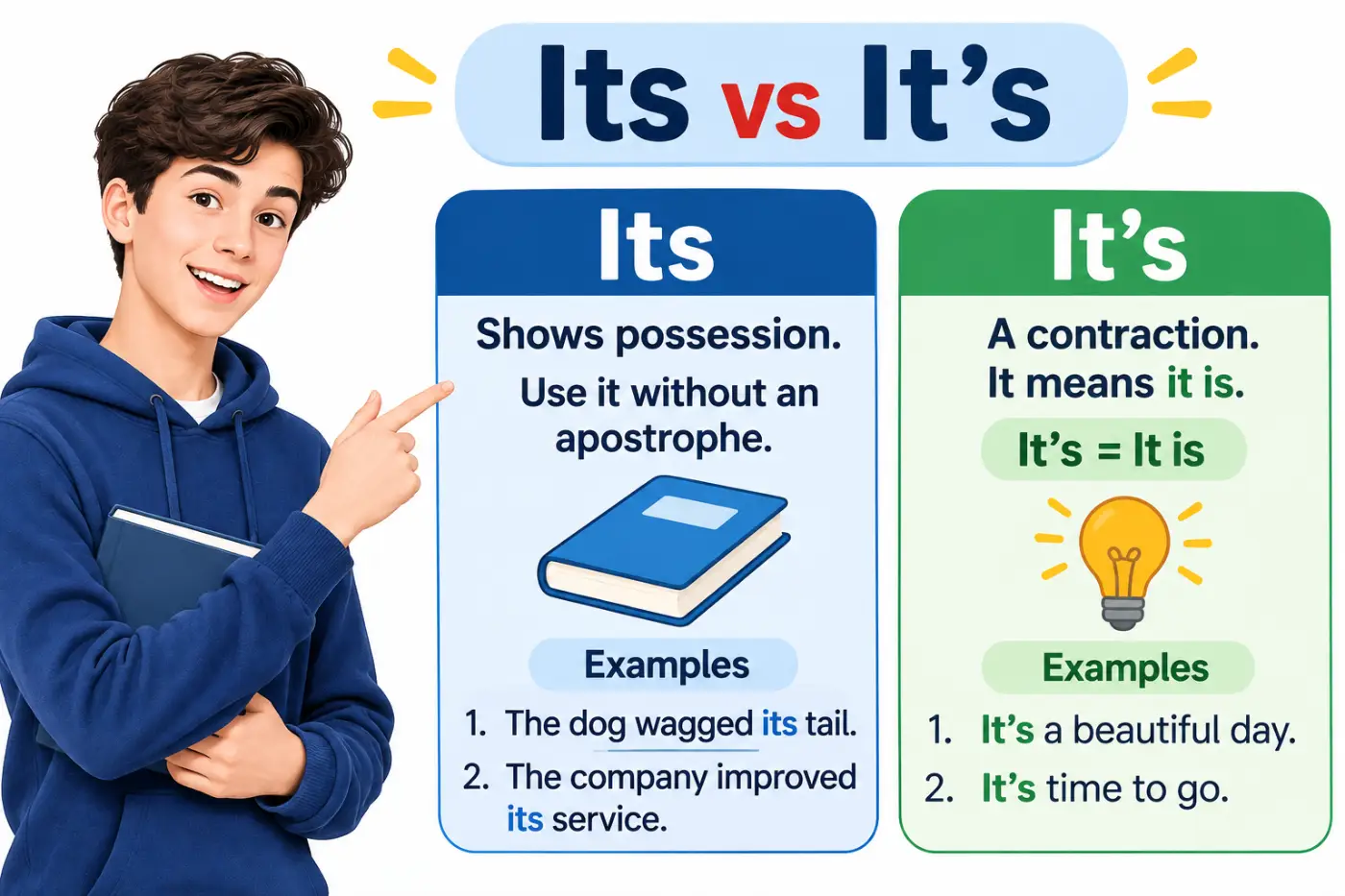
Its shows ownership or possession. It’s means it is or it has. Remember this simple rule, and you’ll avoid most mistakes involving these words.
In this guide, you’ll learn their meanings, origins, grammar rules, examples, synonyms, and differences in American and British English. You’ll also discover how to use them correctly in emails, essays, resumes, and everyday conversations.
What Is the Difference Between Its and It’s?
The main difference is that its is a possessive word, while it’s is a contraction.
Both words refer to it, but they perform different jobs in a sentence.
| Word | Meaning | Grammatical Use | Example |
|---|---|---|---|
| Its | Belonging to it | Possessive determiner | The cat cleaned its paws. |
| It’s | It is | Contraction | It’s a beautiful day. |
| It’s | It has | Contraction | It’s been a long day. |
The easiest way to understand the difference is to look at what each word replaces.
When Should You Use Its?
Use its when you want to show that something belongs to an animal, object, place, organization, or other thing.
Examples:
- The dog wagged its tail.
- The company changed its policies.
- The tree lost its leaves.
- The computer needs its battery replaced.
- The school updated its website.
In each sentence, its shows ownership or association.
Unlike regular possessive nouns, such as John’s or Sarah’s, its doesn’t use an apostrophe.
When Should You Use It’s?
Use it’s when you mean it is or it has.
Examples:
- It’s raining outside.
- It’s a wonderful opportunity.
- It’s been a busy week.
- It’s getting late.
- It’s already finished.
You can check your sentence by replacing it’s with it is or it has.
For example:
- It’s cold today.
- It is cold today.
The sentence still makes sense, so it’s is correct.
Another example:
- It’s been a difficult year.
- It has been a difficult year.
This sentence also works, so the contraction is correct.
However, if neither expanded form makes sense, you probably need its.

What Do Its and It’s Mean in Simple English?
Although these words look similar, their meanings are easy to separate once you understand their grammar.
What Does Its Mean?
Its means belonging to it. It shows that an object, animal, place, or organization owns something or has a particular feature.
For example:
The bird built its nest in the tree.
Here, its tells us that the nest belongs to the bird.
Other examples include:
- The phone lost its connection.
- The restaurant changed its menu.
- The baby opened its eyes.
- The country celebrated its independence.
- The company announced its latest product.
Its can also describe features, parts, qualities, and characteristics.
For example, in The house lost its original color, its connects the house with one of its features.
What Does It’s Mean?
It’s is a shortened form of it is or it has. The apostrophe shows that letters have been removed.
When it’s means it is, it connects the subject with a description or condition.
Examples:
- It’s beautiful.
- It’s important.
- It’s too expensive.
- It’s difficult to understand.
When it’s means it has, it often appears with a past participle or a phrase describing something that has happened.
Examples:
- It’s started raining.
- It’s been a long time.
- It’s already happened.
- It’s become more popular.
The surrounding words help you identify which meaning is intended.
What Is the Origin of Its and It’s?
Both forms developed from the English pronoun it, but their spelling and grammatical history are different.
Where Does the Word Its Come From?
The word its developed as the possessive form of it. Older forms of English sometimes used his to refer to things without a specific gender.
Over time, English developed a separate possessive form, its, to make ownership clearer.
The modern form became established in the English language during the early modern period.
Today, its works like other possessive determiners, including:
- His.
- Her.
- Their.
- My.
- Your.
- Our.
For example:
- The dog lost its toy.
- The boy lost his toy.
- The girl lost her toy.
Each word identifies the owner of something.
Where Does the Word It’s Come From?
It’s developed as a contraction of it is and it has.
English speakers have used contractions for centuries to make speech and writing shorter and more natural.
The apostrophe marks the missing letters.
For example:
- It is becomes it’s.
- It has becomes it’s.
This spelling follows the general English practice of using apostrophes to show omitted letters in contractions.
The apostrophe also helps distinguish it’s from the possessive form its.
What Are the Best Synonyms and Related Words for Its and It’s?
Its and it’s don’t have direct synonyms that work in every sentence because they serve different grammatical purposes.
However, you can use other possessive words, contractions, or complete expressions to communicate similar meanings.
The following tables organize useful alternatives by tone and context.
Simple Alternatives for Its and It’s
| Word or Expression | Meaning | Tone | Example |
|---|---|---|---|
| His | Belonging to a male person or animal | Simple | The boy picked up his bag. |
| Her | Belonging to a female person or animal | Simple | The girl opened her book. |
| Their | Belonging to people or things | Simple | The students brought their books. |
| My | Belonging to the speaker | Simple | My phone is new. |
| Your | Belonging to the person being addressed | Simple | Your room looks clean. |
| Our | Belonging to a group that includes the speaker | Simple | Our school has a library. |
| It is | Expanded form of it’s | Simple | It is a sunny day. |
| It has | Expanded form of it’s | Simple | It has started working. |
Everyday Alternatives and Related Expressions
| Word or Expression | Meaning | Tone | Example |
|---|---|---|---|
| Belongs to it | Shows ownership | Everyday | The toy belongs to it. |
| Owned by it | Indicates possession | Everyday | The equipment is owned by the company. |
| Connected to it | Associated with something | Everyday | The problem is connected to it. |
| Part of it | Belonging to a larger whole | Everyday | The handle is part of it. |
| Associated with it | Related to something | Everyday | The feature is associated with it. |
| That is | Refers to or identifies something | Everyday | That’s a useful idea. |
| That has | Shows that something possesses or has done something | Everyday | That has changed recently. |
| It remains | Indicates a continuing condition | Everyday | It remains an important issue. |
Formal Alternatives for Academic and Professional Writing
| Word or Expression | Meaning | Tone | Example |
|---|---|---|---|
| Its own | Belonging exclusively to it | Formal | The organization has its own research center. |
| Its respective | Belonging to each particular thing | Formal | Each department submitted its respective report. |
| Its individual | Belonging to one particular thing | Formal | Every system has its individual requirements. |
| Its particular | Related to its specific features | Formal | The device has its particular advantages. |
| Its original | Belonging to its earliest form | Formal | The building retained its original design. |
| It is | Full form of the contraction | Formal | It is necessary to review the findings. |
| It has | Full form of the contraction | Formal | It has produced positive results. |
| It appears | Indicates how something seems | Formal | It appears to be functioning correctly. |

How Do Its and It’s Differ by Intensity?
Its and it’s don’t express different levels of strength or emotion. They have separate grammatical functions.
However, the expressions used around them can communicate different levels of importance, ownership, or certainty.
Mild Expressions
These expressions describe basic possession or simple conditions.
| Expression | Meaning | Example |
|---|---|---|
| Its part | A part belonging to something | The machine needs its part replaced. |
| It’s okay | Something is acceptable | It’s okay to make mistakes. |
| Its place | A location belonging to something | The object returned to its place. |
| It’s fine | Something is satisfactory | It’s fine to wait another day. |
Moderate Expressions
These examples communicate clearer ownership or stronger descriptions.
| Expression | Meaning | Example |
|---|---|---|
| Its own | Belonging specifically to it | The company has its own office. |
| It’s important | Something has importance | It’s important to follow instructions. |
| Its main feature | Its most important characteristic | Its main feature is the large screen. |
| It’s valuable | Something has considerable value | It’s valuable to learn new skills. |
Strong Expressions
These examples communicate greater importance, uniqueness, or emphasis.
| Expression | Meaning | Example |
|---|---|---|
| Its greatest strength | Its most important advantage | Its greatest strength is reliability. |
| Its only purpose | The single reason for its existence | Its only purpose is to protect the equipment. |
| It’s absolutely necessary | Something is essential | It’s absolutely necessary to check the results. |
| Its defining feature | A characteristic that makes it recognizable | Its defining feature is its unique design. |
How Do Its and It’s Work as Different Parts of Speech?
Understanding their grammatical roles makes the difference easier to remember.
Is Its a Possessive Pronoun or Possessive Determiner?
Its is a possessive determiner when it appears before a noun.
Examples:
- The cat moved its head.
- The school changed its schedule.
- The company improved its services.
In each example, its comes before a noun and identifies ownership or association.
Some grammar references also describe its as a possessive pronoun form. However, in standard sentences such as these, it functions as a possessive determiner because it modifies a noun.
Is It’s a Contraction?
Yes. It’s is a contraction of it is or it has.
Examples:
- It’s raining. (It is raining.)
- It’s beautiful. (It is beautiful.)
- It’s been repaired. (It has been repaired.)
Can Its Be Used as a Noun?
No. Its doesn’t normally work as a standalone noun in standard English.
Incorrect: The its belongs to the dog.
Correct: The toy belongs to the dog.
Use its before a noun when showing possession.
Can It’s Be Used as a Possessive Word?
No. It’s cannot show possession.
Incorrect: The dog wagged it’s tail.
Correct: The dog wagged its tail.
The apostrophe changes the grammatical meaning. That’s why this small spelling difference matters.
Is Its vs It’s Different in American and British English?
No. Both American and British English follow the same spelling and grammar rules for these words.
Its shows possession, while it’s means it is or it has.
| Usage | American English | British English |
|---|---|---|
| Possession | The dog wagged its tail. | The dog wagged its tail. |
| It is | It’s raining. | It’s raining. |
| It has | It’s been repaired. | It’s been repaired. |
| Formal writing | It is important. | It is important. |
Which Word Should You Use in Different Writing Situations?
Your choice depends on whether you’re showing ownership or using a shortened verb phrase.
Which Form Is Best for a Resume?
Use its when describing the features, achievements, or responsibilities of an organization, product, or system.
Use it’s when you mean it is or it has, although the full form may sound more formal.
Resume examples:
- The company improved its customer service process.
- The software increased its processing speed.
- The organization expanded its operations.
- It’s important to demonstrate measurable results.
For a professional resume, focus on clear statements and strong action verbs. Avoid contractions if you’re following a formal resume style.
Which Form Is Best for an Essay?
Both forms are correct in essays when used properly.
Use its to describe ownership or characteristics. Use it’s when you mean it is or it has.
Essay examples:
- Every country has its own cultural traditions.
- The internet has changed its role in modern education.
- It’s important to understand the effects of climate change.
- It’s been argued that technology can improve learning.
If your assignment requires formal academic language, consider writing it is or it has instead of using contractions.
Which Form Is Best for Texting?
Both forms are common in text messages.
Examples:
- It’s a great movie!
- The dog lost its toy.
- It’s getting late.
Which Form Is Best for Professional Emails?
Use its when describing a company’s products, policies, services, or features.
Use it’s when writing a sentence that means it is or it has.
Email examples:
- The company has updated its payment policy.
- The department has changed its meeting schedule.
- It’s important to review the attached document.
Which Form Is Best for Speaking?
In spoken English, both forms sound the same because the apostrophe doesn’t change pronunciation.
Examples:
- It’s a beautiful morning.
- The dog hurt its leg.
- It’s been a long day.
What Are 10 Examples of Its and It’s in Sentences?
The following examples show how both forms work in real situations.
Examples of Its
- The dog wagged its tail when its owner returned home.
- The company changed its working hours last month.
- The school announced its annual sports competition.
- The tree lost its leaves during the winter.
- The phone stopped working because its battery was damaged.
- The bird built its nest near the window.
- Every country has its own traditions and customs.
- The restaurant updated its menu for the summer.
- The computer needs its software updated.
- The organization celebrated its tenth anniversary.
Examples of It’s
- It’s a beautiful day to visit the park.
- It’s important to complete your homework on time.
- It’s been several months since we last met.
- It’s getting difficult to understand the instructions.
- It’s already started raining outside.
- It’s a good idea to save money for emergencies.
- It’s become easier to learn new languages online.
- It’s not necessary to buy an expensive phone.
- It’s been a wonderful experience working with this team.
- It’s possible to improve your writing with regular practice.
What Is the Difference Between Its and Their?
Its and their are both possessive determiners, but they refer to different subjects.
Its refers to a singular thing, animal, organization, or other entity. Their usually refers to multiple people or things, and it can also refer to a person when using singular they.
| Its | Their |
|---|---|
| Refers to a singular thing or entity | Usually refers to multiple people or things |
| The company changed its rules. | The employees changed their schedules. |
| The dog found its toy. | The dogs found their toys. |
| The school updated its website. | The schools updated their websites. |
What Is the Difference Between Its and It Is?
Its and it is have different grammatical structures.
Its is a possessive determiner. It is is a subject followed by a linking verb.
Examples:
- The company changed its policy.
- It is a good company.
You cannot replace its with it is without changing the sentence.
Incorrect: The company changed it is policy.
Correct: The company changed its policy.
Similarly, you cannot replace it is with its.
Incorrect: Its important to follow the rules.
Correct: It’s important to follow the rules.
The correct form depends on the meaning and structure of the sentence.
What Are the Common Mistakes When Using Its and It’s?
Even experienced writers sometimes make these mistakes because both forms sound identical.
Using It’s to Show Possession
Incorrect: The bird spread it’s wings.
Correct: The bird spread its wings.
The sentence describes something belonging to the bird, so you need its.
Forgetting the Apostrophe in a Contraction
Incorrect: Its going to rain tomorrow.
Correct: It’s going to rain tomorrow.
The intended meaning is It is going to rain tomorrow. Therefore, the apostrophe is necessary.
Confusing Its With Its’
Some writers mistakenly add an apostrophe after its.
Incorrect: The company updated its’ website.
Correct: The company updated its website.
Its never takes an apostrophe when showing possession. Its’ is not a standard English spelling.
Assuming Every Possessive Word Needs an Apostrophe
Many possessive nouns use apostrophes, but possessive determiners such as its, his, hers, ours, yours, and theirs do not.
Examples:
- The dog lost its collar.
- Sarah lost her keys.
- The students brought their books.
Don’t apply the same apostrophe rule to every possessive form.
Using It’s When You Mean It Has Incorrectly
It’s can mean it has, but the surrounding grammar must support that meaning.
Correct: It’s been a long day.
Incorrect: It’s a new battery.
The second sentence means It is a new battery, so it is correct as a contraction. However, if you’re trying to show that something owns a battery, you need its.
Correct: The device needs its battery replaced.
What Are the Antonyms of Its and It’s?
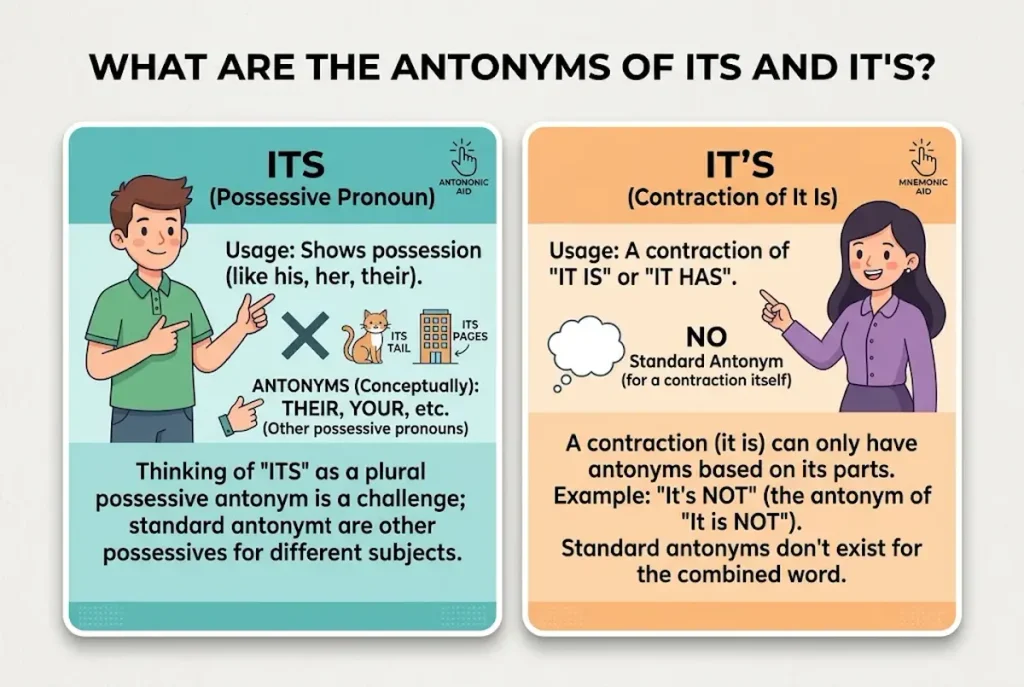
Its and it’s don’t have direct antonyms because they are grammatical forms rather than words describing opposite qualities.
However, some expressions can communicate contrasting ideas.
| Word or Expression | Meaning | Example |
|---|---|---|
| Someone else’s | Belonging to another person | This is someone else’s bag. |
| Not belonging to it | Showing a lack of ownership | The item is not belonging to that collection. |
| External | Located outside something | The device has an external battery. |
| Separate | Not connected or belonging together | The two departments have separate budgets. |
| Independent | Not controlled by another thing | The organization operates independently. |
What Are the Quick Tips for Choosing Between Its and It’s?
Use these simple checks whenever you’re unsure.
- Replace it’s with it is. If the sentence still makes sense, it’s is probably correct.
- Replace it’s with it has. Check if the sentence remains grammatically correct.
- Look for ownership. If the word shows that something belongs to an object, animal, or organization, use its.
- Remember that possessive its has no apostrophe.
- Remember that it’s always needs an apostrophe when it means it is or it has.
- Read the whole sentence. The words around the expression often reveal its intended meaning.
- Check your writing before publishing. Grammar tools can help, but always review the sentence yourself.
A useful memory trick is to associate the apostrophe with missing letters. It’s contains an apostrophe because it is a shortened form. Its has no apostrophe because it already functions as a possessive word.
Conclusion
The difference between these two words is simple once you remember their grammatical jobs. Its shows possession and tells readers that something belongs to an animal, object, place, or organization. It’s is a contraction that means it is or it has.
For example, The dog wagged its tail uses its because the tail belongs to the dog. However, It’s a friendly dog uses it’s because the sentence means It is a friendly dog.
Both forms are correct, but they cannot replace each other. Always check the meaning before choosing the spelling. With regular practice, you’ll recognize the correct form naturally and avoid one of the most common mistakes in English writing.
Frequently Asked Questions
When should I use its or it’s?
Use its to show possession and it’s when you mean it is or it has. For example, The cat cleaned its paws and It’s a cute cat are both correct.
Is its ever written with an apostrophe?
No, its never needs an apostrophe when showing possession. The spelling it’s is reserved for the contractions it is and it has.
What’s an easy way to remember its vs it’s?
Replace it’s with it is or it has. If the sentence makes sense, use it’s; if you mean something belongs to it, use its.
Is it’s short for it has?
Yes, it’s can mean it has or it is. For example, It’s been raining means It has been raining.
Is its vs it’s the same in American and British English?
Yes, both American and British English follow the same spelling and grammar rules. Its shows possession, while it’s is a contraction.
Can I use it’s in formal writing?
Yes, it’s is grammatically correct, but some formal writing styles prefer the full forms it is and it has. Follow the style requirements of your assignment or organization.
Why doesn’t its have an apostrophe?
Its doesn’t have an apostrophe because it is already the standard possessive form of it. Unlike contractions, possessive determiners such as its don’t use apostrophes.
Which is correct: the company changed it’s or its policy?
The correct expression is The company changed its policy. The word its shows that the policy belongs to the company.

Daniel Grammarfield — The Language Learner
Age: 28Occupation: ESL Learner & Digital Professional
Bio:Daniel is a non-native English speaker who wants to communicate more confidently at work and online. He uses Synotrench to improve grammar, understand confusing words, learn correct sentence structures, and build everyday English skills. He prefers simple explanations with practical examples.
Goals:
Master English grammar rules
Avoid common language mistakes
Improve professional communication
Learn English through real-life examples
Quote:“Learning English is not about memorizing rules — it’s about expressing ideas clearly.”
4 thoughts on “Its vs It’s: The Ultimate Guide to the Difference (2026)”