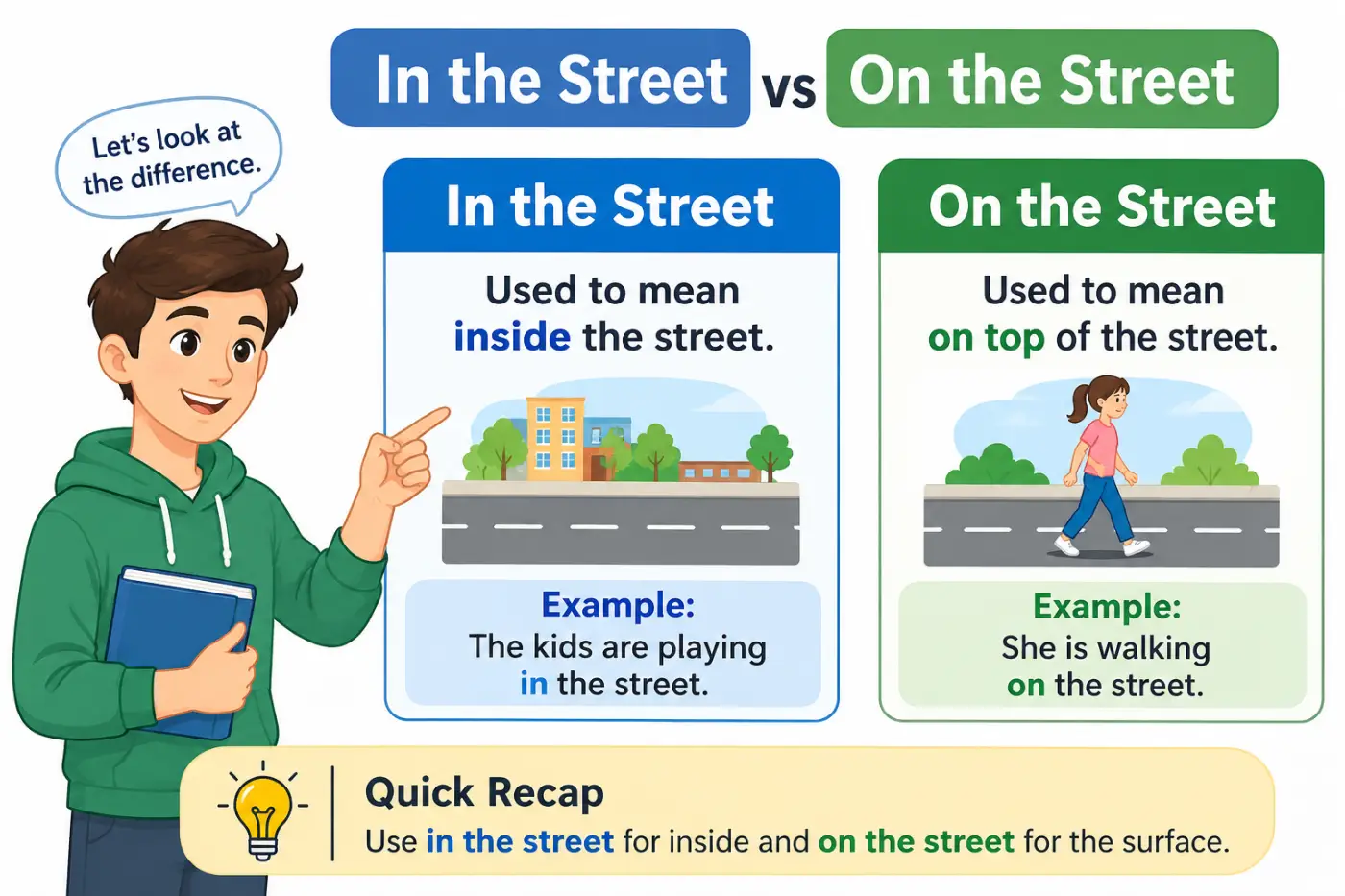
Imagine you’re writing In the Street vs On the Street an email about a traffic accident, describing where someone is standing, or explaining that a new store has opened nearby. You might wonder which expression sounds right: in the street or on the street. Both are common in English, but they don’t always communicate the same idea.
The difference between these two expressions comes down to how you understand the location. One often describes something happening within the street area or roadway, while the other commonly refers to being physically outside on a street or being located along a particular road.
The simple answer is that “in the street” usually emphasizes being within the street or roadway, while “on the street” generally describes being on a street, outside, or located along it. Both expressions are grammatically correct, but the surrounding sentence determines which one works best.
Learning this difference can make your everyday conversations, emails, school assignments, and professional writing clearer. This guide explains their meanings, origins, common alternatives, regional differences, and practical examples so you can choose the right expression with confidence.
What Does In the Street Mean in Simple English?
The expression “in the street” describes someone or something situated within the street area. It often suggests that a person, vehicle, or object is in the roadway or occupying space that people and vehicles normally use.
For example:
- The children were playing in the street.
- A large tree had fallen in the street.
- There was a broken bottle in the street.
How Is In Used in This Expression?
The preposition “in” commonly describes a position inside an area, space, or enclosed place.
For example:
- In the room.
- In the garden.
- In the park.
- In the street.
A street isn’t enclosed like a room, but English speakers also use “in” for certain open areas and spaces.
When someone says that a person is in the street, the listener usually understands that the person is within the street area.
This doesn’t always mean the person is standing directly in the middle of the road. They could be anywhere within the space being described, depending on the situation.
When Should You Use It?
Use this expression when you want to emphasize the street as an area or the physical space where an activity is happening.
Examples:
- The workers repaired a damaged pipe in the street.
- A group of children was playing in the street.
- The police found an abandoned bicycle in the street.
- People gathered in the street after the celebration.
- Heavy rain left several branches in the street.
What Does On the Street Mean in Simple English?
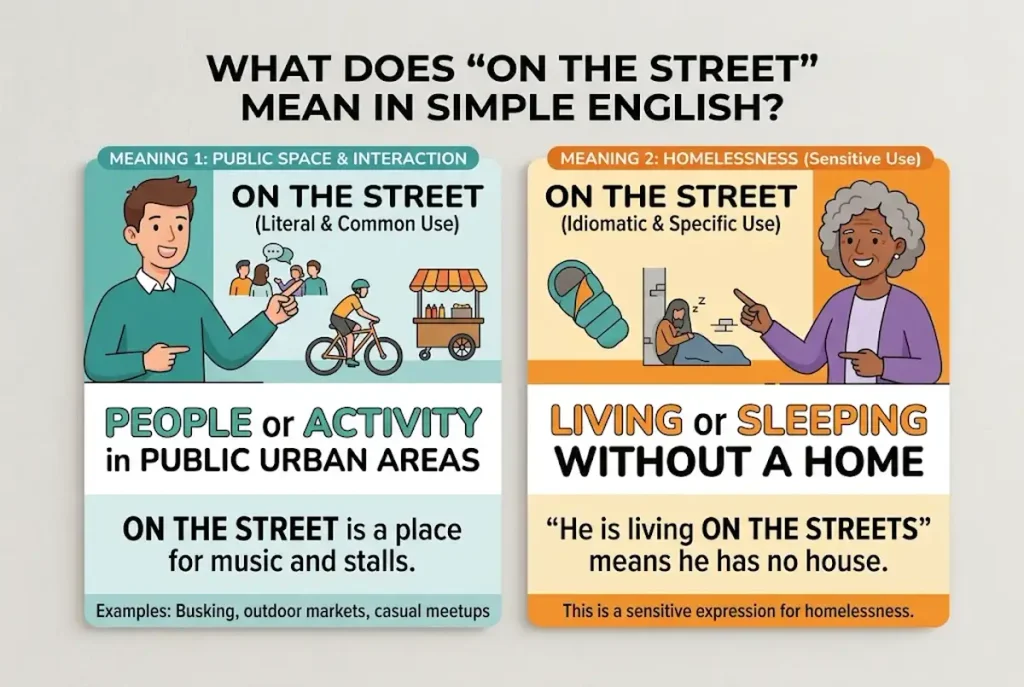
The expression “on the street” usually describes someone or something located on a street, outside, or along a particular road.
It is extremely common in American English. People use it when talking about walking, living, working, shopping, meeting someone, or finding a particular place.
For example:
- She lives on the street.
- He was walking on the street.
- I met my friend on the street.
How Is On Used in This Expression?
The preposition “on” often describes a position on a surface, route, or line.
For example:
- On the floor.
- On the road.
- On the sidewalk.
- On the street.
Consider these examples:
- My office is on Main Street.
- There are many small shops on this street.
- I saw my neighbor walking on the street.
- The new restaurant is on the next street.
- Several cars were parked on the street.
What Are the Special Meanings?
This expression has meanings beyond its literal location.
Homelessness
The phrase “living on the street” can describe someone who has no permanent home and sleeps outdoors or in public places.
Example: Many people are struggling because they have been living on the street.
Public availability
The expression “on the street” can describe something that has become available to the public.
Example: The new phone will be on the street next Monday.
Everyday public life
It can also describe activities, conversations, or events happening in public spaces.
Example: The campaign received strong support from people on the street.
What Is the Origin of These Street Expressions?
The difference between these expressions comes from the long history of English prepositions.
The word “street” comes through Old English “strǣt,” which developed from Latin “strata,” meaning a paved road or way. The Latin term was connected to “via strata,” referring to a prepared or paved road.
Over time, the word became the familiar English noun used for a public road, especially one in a town or city with buildings along its sides.
The prepositions “in” and “on” developed different spatial uses.
“In” has roots in Old English forms connected with being inside or within a place. It commonly describes location inside an area, space, or boundary.
“On” comes from Old English “on” and has long been used to describe position, contact, and location along a surface or route.
These meanings help explain why English speakers use both expressions.
Why Does English Use Two Different Prepositions?
English prepositions don’t always follow one simple physical rule.
For example, people say:
- In the garden.
- On the road.
- In the park.
- On the sidewalk.
- In the field.
- On the street.
What Are the Best Alternatives to These Street Expressions?
Sometimes you may want to avoid repeating the same expression. You can use other words and phrases to describe a person’s location, movement, or surroundings.
However, these alternatives are not all direct synonyms. Some describe a physical location, while others describe movement, direction, or a specific situation.
The following list groups useful alternatives by tone and everyday use.
Simple Alternatives
| Word or Phrase | Meaning | Tone | Example |
|---|---|---|---|
| Outside | Not inside a building | Simple | The children are outside. |
| Outdoors | In an open-air place | Simple | We spent the afternoon outdoors. |
| Nearby | Not far away | Simple | There is a shop nearby. |
| Along the road | Following the length of a road | Simple | Trees grow along the road. |
| By the road | Close to a road | Simple | A house stands by the road. |
| Roadside | The area beside a road | Simple | We stopped at a roadside cafe. |
| On the pavement | On the paved walking area | Simple | He left his bag on the pavement. |
Everyday Alternatives
| Word or Phrase | Meaning | Tone | Example |
|---|---|---|---|
| Along the street | Following the street | Everyday | Shops are located along the street. |
| Around the corner | A short distance away | Everyday | The pharmacy is around the corner. |
| Down the road | Further along a road | Everyday | There is a school down the road. |
| Across the street | On the opposite side | Everyday | The bank is across the street. |
| Near the sidewalk | Close to the pedestrian path | Everyday | A bicycle was near the sidewalk. |
| By the curb | Next to the edge of the road | Everyday | A car was parked by the curb. |
| At street level | At ground level near a street | Everyday | The store has an entrance at street level. |
Formal Alternatives
| Word or Phrase | Meaning | Tone | Example |
|---|---|---|---|
| Within the roadway | Inside the area used by vehicles | Formal | Debris remained within the roadway. |
| Along the thoroughfare | Following a main public road | Formal | Shops operate along the thoroughfare. |
| In the public right of way | Within publicly designated road space | Formal | The equipment was placed in the public right of way. |
| On the carriageway | On the part of a road used by vehicles | Formal, especially British | A vehicle stopped on the carriageway. |
| Adjacent to the road | Next to a road | Formal | The building is adjacent to the road. |
| On the public highway | Located on or using a public road | Formal | The vehicle was stopped on the public highway. |
| Along the roadway | Following the length of the road | Formal | Safety barriers were installed along the roadway. |
How Do These Expressions Differ by Intensity?
These phrases don’t have a natural mild-to-strong scale in the way that emotional or descriptive words do. However, you can group related expressions by how specifically they describe a person’s position.
This helps you choose a more precise phrase.
General Location
These expressions provide a broad idea of where something is happening.
- Outside.
- Outdoors.
- Nearby.
- Around the neighborhood.
- Around town.
Example: The children were playing outdoors.
More Specific Location
These expressions give the reader a clearer idea of the person’s position.
- Along the street.
- By the roadside.
- Near the curb.
- On the sidewalk.
- Across the street.
Example: The children were playing on the sidewalk.
Exact or Technical Location
These expressions identify a particular part of the road or street area.
- Within the roadway.
- On the carriageway.
- At the curb.
- In the traffic lane.
- Along the public right of way.
Example: The damaged sign was lying within the roadway.
Which Parts of Speech Are Used in These Expressions?
Both expressions contain a preposition, an article, and a noun.
Understanding their grammatical structure makes it easier to use them correctly.
Prepositions
“In” and “on” are prepositions. They show relationships between people, objects, and places.
Examples:
- The dog is in the street.
- The dog is on the street.
- The store is on the street.
Articles
“The” is a definite article. It identifies a particular street or a street understood from the surrounding context.
Example: The children were playing in the street.
Nouns
“Street” is a common noun. It names a type of public road.
Examples of related nouns include:
- Road.
- Avenue.
- Boulevard.
- Lane.
- Sidewalk.
- Highway.
- Roadway.
Are These Expressions Different in American and British English?
Both expressions are grammatically correct in American and British English. However, everyday usage and the words surrounding them can vary by region.
American English
In the United States, “on the street” is extremely common when describing a location along a road or someone’s presence in a public street area.
Examples:
- My parents live on Oak Street.
- There is a grocery store on this street.
- I saw a man walking on the street.
Americans also use “in the street” when emphasizing that someone or something is within the roadway.
Example: The children were playing in the street.
British English
British speakers also use both expressions.
However, British English often uses “in the street” when describing someone or something within the street area.
Examples:
- There were people dancing in the street.
- A car was parked in the street.
Which Version Should You Use?
If you’re writing for an American audience, use “on the street” when describing a general location along a street and “in the street” when emphasizing the roadway or street space.
For a British audience, both are acceptable. Pay attention to the local context and the meaning you want to communicate.
Neither expression is automatically wrong in either variety of English.

Which Expression Works Best in Different Writing Situations?
The best choice depends on your purpose, audience, and the information you want to communicate.
Which Expression Is Better for a Resume?
In a resume, it’s usually better to use specific language instead of a general street expression.
For example:
- Managed a retail store on Main Street.
- Coordinated outdoor promotional activities across the local area.
- Supported customers at a street-level retail location.
Which Expression Is Better for an Essay?
Both expressions work in essays, but the choice depends on the scene or situation.
Use “in the street” when describing activities taking place within the street area.
Example: The residents gathered in the street to celebrate the national holiday.
Use “on the street” when discussing a location along a road.
Example: Several historic buildings on the street still have their original designs.
For academic writing, avoid vague descriptions when a more exact location is available.
Which Expression Is Better for Texting?
In casual messages, both expressions are natural.
Examples:
- I’m waiting on the street.
- The kids are playing in the street.
- Meet me on the street near the cafe.
Which Expression Is Better for an Email?
For professional emails, clarity should come first.
Use “on the street” when giving a business location or meeting point.
Example: Our new office is located on Park Avenue.
Use “in the street” when describing a problem or activity happening within the roadway.
Example: Please be careful because construction materials are currently in the street.
If the location is important for safety, provide a more exact description.
Which Expression Is Better in Everyday Speaking?
Both are natural in everyday conversation.
You might say:
- I left my keys in the street.
- My friend lives on this street.
- There are too many cars in the street.
What Are 15 Correct Example Sentences?
Real examples are one of the easiest ways to understand how these expressions work.
The following sentences show their use in different situations.
Examples Using In the Street
- The children were playing in the street while their parents watched from the porch.
- A large branch fell in the street during last night’s storm.
- The police found a damaged motorcycle in the street after the accident.
- Several people were dancing in the street during the neighborhood festival.
- The construction workers left some tools in the street.
- A small dog was sitting in the street when the driver stopped his car.
- The residents gathered in the street to discuss the parking problem.
- Water was flowing in the street after the heavy rainfall.
Examples Using On the Street
- My grandparents have lived on this street for more than twenty years.
- There is a new bakery on the street near my school.
- I met an old friend while walking on the street yesterday.
- Several small businesses operate on the street.
- The police found a wallet on the street outside the shopping center.
- We stopped at a restaurant on the street before going home.
- The new apartment building is on the street across from the library.
What Is the Difference Between In the Street and On the Road?
Both expressions describe locations connected with public travel spaces, but they aren’t always interchangeable.
“In the street” commonly emphasizes the street area, especially the part where vehicles travel.
“On the road” often describes being on a road or traveling along it. It can also have an extended meaning related to traveling or working away from home.
| In the Street | On the Road |
|---|---|
| Focuses on a street area or roadway | Focuses on a road or route |
| Often describes an urban street | Can describe roads in cities or rural areas |
| Common in location descriptions | Common in travel descriptions |
| The children were playing in the street. | We spent six hours on the road. |
What Is the Difference Between On the Street and On the Sidewalk?
These expressions describe different physical locations.
“On the street” can refer broadly to being on or along a street. It doesn’t always identify the exact part of the street.
“On the sidewalk” specifically describes the pedestrian walking area beside the road.
| On the Street | On the Sidewalk |
|---|---|
| General street location | Specific pedestrian area |
| May describe different street activities | Usually describes walking or standing beside the road |
| Can refer to a street as a whole | Refers to the paved walking path |
| He was walking on the street. | He was walking on the sidewalk. |
Example:
The children were playing on the sidewalk.
This sentence identifies a pedestrian area rather than the vehicle roadway.
If you’re giving safety instructions, this difference is especially important.
What Common Mistakes Should You Avoid?
Although both expressions are correct, people sometimes use them without considering the intended meaning.
Here are common mistakes and ways to avoid them.
Using In When You Mean a Street Address
Incorrect: My office is in Main Street.
Correct: My office is on Main Street.
When giving the location of a building or business along a named street in standard American English, “on” is generally the natural choice.
Using On When You Mean Inside a Street Area
Consider this sentence:
The children were playing on the street.
This is not necessarily grammatically wrong, but it may sound less natural if you’re emphasizing that the children are occupying the roadway.
A clearer alternative is:
The children were playing in the street.
The second sentence focuses more directly on the street as a physical area.
Assuming Both Expressions Always Mean the Same Thing
Incorrect understanding: Both expressions can replace each other in every situation.
Better understanding: Their meanings overlap, but their emphasis can differ.
For example:
The shop is on the street.
This describes the shop’s location.
The shop’s delivery boxes were left in the street.
This describes where the boxes were placed.
Confusing Street and Sidewalk
The street and sidewalk are connected, but they aren’t the same thing.
Incorrect: The pedestrian was walking in the sidewalk.
Correct: The pedestrian was walking on the sidewalk.
Use “on” when describing the surface of a sidewalk.
Ignoring Special Expressions
Some phrases have meanings that go beyond physical location.
For example:
He has been on the street for months.
This may describe someone experiencing homelessness.
It doesn’t necessarily mean that the person has spent every moment standing on a road.
Always consider the complete sentence before choosing an interpretation.
When Should You Avoid These Expressions?
Sometimes a more precise phrase communicates your meaning better.
Avoid using a general street expression when the reader needs to know the exact position of a person or object.
For example:
Vague: The car was on the street.
More specific: The car was parked beside the curb.
Vague: There was a box in the street.
More specific: A cardboard box was lying in the middle traffic lane.
Also, avoid using these expressions repeatedly in formal writing when a clear alternative is available.
For example, instead of writing:
The workers were on the street. They worked on the street all day. Their equipment was also on the street.
You could write:
The workers spent the day repairing the roadway. Their equipment was placed near the construction area.
The revised version is clearer and avoids unnecessary repetition.
What Are the Antonyms of These Street Expressions?
Neither expression has one exact opposite because both describe location rather than a single quality.
However, several phrases can communicate an opposite or contrasting position.
| Expression | Opposite or Contrast | Example |
|---|---|---|
| In the street | Inside a building | The children moved inside the building. |
| On the street | Indoors | We stayed indoors because of the rain. |
| Outdoors | Indoors | The meeting was moved indoors. |
| Outside | Inside | The customers went inside. |
| On the road | Off the road | The vehicle was safely off the road. |
| In public | In private | They discussed the issue in private. |
Conclusion
Choosing between these two expressions becomes much easier when you understand how English uses prepositions to describe location. In the Street vs On the Street is mainly a question of emphasis, not a simple rule about one expression being correct and the other being wrong.
The first commonly highlights a street as a physical area, while the second often identifies a location along a road or describes someone’s presence there. Both are accepted in American and British English, although their everyday use can vary.
Pay attention to the situation, the exact position, and the message you want to communicate. With regular reading and practice, you’ll become more comfortable choosing the right preposition in conversations and writing.
Frequently Asked Questions
Is it correct to say in the street or on the street?
Both expressions are grammatically correct. The best choice depends on the location and meaning you want to describe.
Should I say I live in the street or on the street?
In American English, say “I live on the street” when identifying your home address along a particular street. “Living on the street” can also mean experiencing homelessness.
Why do Americans say on the street?
Americans commonly use “on” to describe a person’s or building’s location along a street. It is a standard expression in everyday conversations and written English.
Do British people say in the street?
Yes, British speakers commonly use “in the street” to describe people or activities within a street area. They also use “on the street” in many situations.
Can I use on the street when talking about walking?
Yes, you can use it when describing someone walking along a street. However, “on the sidewalk” is more precise when you specifically mean the pedestrian walkway.
What’s another way to say someone is in the street?
You can say someone is outside, in the roadway, on the road, or near the sidewalk. The best alternative depends on the person’s exact location.
Is on the street a formal or informal expression?
It is a standard expression used in both formal and informal English. It works in emails, essays, conversations, news reports, and professional descriptions.
What does it mean when someone says they are on the street?
It can mean that someone is physically outside on a street. In certain contexts, it also means that the person is homeless or has no permanent place to live.

Daniel Grammarfield — The Language Learner
Age: 28Occupation: ESL Learner & Digital Professional
Bio:Daniel is a non-native English speaker who wants to communicate more confidently at work and online. He uses Synotrench to improve grammar, understand confusing words, learn correct sentence structures, and build everyday English skills. He prefers simple explanations with practical examples.
Goals:
Master English grammar rules
Avoid common language mistakes
Improve professional communication
Learn English through real-life examples
Quote:“Learning English is not about memorizing rules — it’s about expressing ideas clearly.”
2 thoughts on “In the Street vs On the Street: Best Usage Guide (2026)”