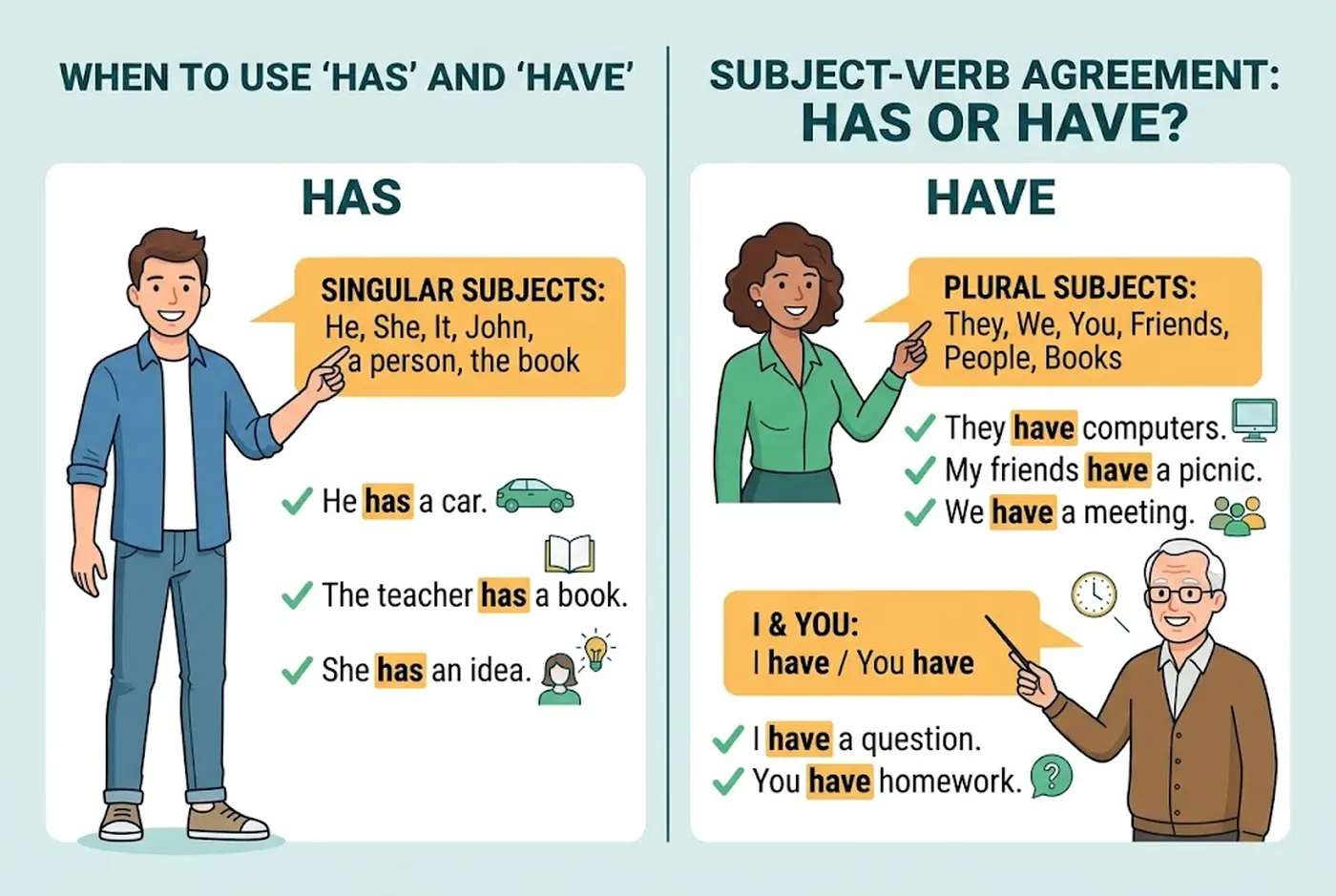
When you’re writing an email, finishing an essay, or sending a quick text, you may stop at a sentence like, “Does anyone have a question?” Then another sentence can make you wonder: should it be “anyone has” instead? The answer depends on the role of the phrase in the sentence.
The basic rule is simple: “anyone” is treated as singular in standard English. So, you use “has” when “anyone” is the subject of a statement, but you usually use “have” after the auxiliary verb “does” in a question.
Answer: “Anyone has” is grammatically correct in certain statements, while “does anyone have” is correct in questions. The helping verb “does” changes the main verb to its base form “have.”
This guide explains the grammar behind the choice, where the word anyone comes from, common alternatives, examples, regional differences, common mistakes, and the best wording for emails, essays, texts, resumes, and everyday speech.
What is the basic rule for anyone has or anyone have?
The easiest way to remember the rule is to look at the verb before you choose has or have.
Anyone is an indefinite pronoun. Although it refers to one person at a time, it can represent any person in a group. In standard English, anyone takes a singular verb.
That means these statements are correct:
- Anyone has the right to ask a question.
- Anyone has access to the public information.
- Anyone who has a valid ticket can enter.
- If anyone has a problem, please contact me.
However, questions often use “does,” and that changes the form of the main verb:
- Does anyone have a question?
- Does anyone have a pen?
- Does anyone have an answer?
- Does anyone have experience with this software?
The key point is that “does” already carries the singular present tense. The following verb stays in its base form.
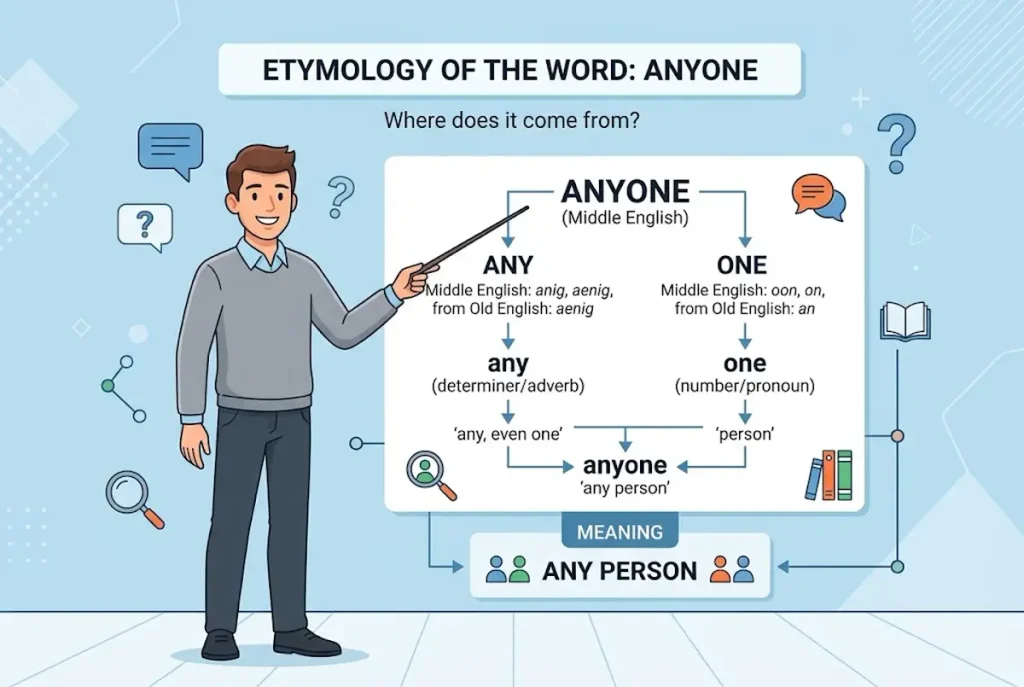
Where does the word anyone come from?
Anyone is made from two familiar parts: any and one.
The word “any” has long been used to refer to one or more members of an unspecified group. “One” refers to a single person or thing. Together, anyone developed as a pronoun meaning any person at all or any person from a particular group.
The word has been part of English for centuries and belongs to a larger family of indefinite pronouns. Other members include someone, somebody, everyone, everybody, no one, nobody, anything, and nothing.
Even though the meaning can cover many people, anyone is grammatically singular.
Think about this example:
“Anyone is welcome.”
The meaning is that every person is welcome as an individual possibility. English grammar treats anyone as one person grammatically, so the verb is singular.
This is similar to:
- Everyone is ready.
- Someone has called.
- Nobody knows the answer.
- Anybody can participate.
This grammatical pattern explains why “anyone has” can be correct in a statement.
What does anyone mean in plain English?
Anyone means any person or any individual, without naming a specific person.
For example:
“Anyone can learn this skill.”
This means any person can learn the skill.
“Can anyone help me?”
This asks if there is at least one person who can help.
“Anyone who wants to join may sign up.”
This means any person who wants to join is allowed to sign up.
Anyone often appears in questions, negative sentences, conditional sentences, and statements about general possibilities.
It can also have slightly different meanings depending on context.
Anyone as any person
“Anyone can apply.”
Here, anyone means any person.
Anyone as an unspecified person
“Did anyone call?”
Here, the speaker does not know which person, if any, called.
What are the best synonyms for anyone?
The closest alternatives to anyone include anybody, any person, any individual, whoever, and every person in certain contexts. They are not always interchangeable, so the sentence matters.
The table below gives a wider range of related expressions. Some are direct substitutes, while others work only in specific situations.
Not every item in this table can replace anyone in every sentence. For example, “everyone” means all people, while “anyone” generally means any person or any possible person.
Which synonyms are mild and which are stronger?
Different alternatives can change the strength or scope of a sentence.
A useful way to think about these expressions is from limited or specific to broad or emphatic.
| Intensity or scope | Expression | Example |
|---|---|---|
| Limited | A person | A person may request help. |
| Specific group | Any member | Any member can vote. |
| General | Anyone | Anyone can participate. |
| Broad | Anybody | Anybody can learn this. |
| Very broad | Anyone at all | Anyone at all can submit an entry. |
| Almost universal | Just about anyone | Just about anyone can understand the basic rule. |
| Universal | Everyone | Everyone must follow the rule. |
| Total group | Every person | Every person received a notice. |
Be careful with “everyone.” It is not simply a stronger version of anyone.
“Anyone can enter” means there is no restriction on who may enter.
“Everyone can enter” usually means all people in the relevant group can enter.
That difference can matter in formal writing.
Which synonyms work as different parts of speech?
Anyone is a pronoun. It stands for a person rather than directly naming one.
Most close alternatives also function as pronouns, but related expressions can work differently.
| Form | Example | Function |
|---|---|---|
| Anyone | Anyone can apply. | Pronoun |
| Anybody | Anybody can ask. | Pronoun |
| Whoever | Whoever calls can leave a message. | Pronoun |
| Everyone | Everyone agreed. | Pronoun |
| Someone | Someone called. | Pronoun |
| Nobody | Nobody answered. | Pronoun |
| Any person | Any person can apply. | Noun phrase |
| Any individual | Any individual may appeal. | Noun phrase |
| Any member | Any member can participate. | Noun phrase |
| A customer | A customer can request help. | Noun phrase |
This matters because changing the expression can change the grammar around it.
For example:
“Anyone has a chance.”
“Any person has a chance.”
Both can work, although the second sounds more formal and can be less natural in casual conversation.
Is anyone singular in American English?
Yes. In standard American English, anyone is normally treated as singular.
You would say:
- Anyone is welcome.
- Anyone has the right to ask.
- Anyone knows that rule.
However, the third example may sound unnatural because the intended meaning usually calls for “everyone” or another expression.
The important grammar point is that anyone takes singular agreement.
This is also why the following sentence is correct:
“Anyone who has completed the form can leave.”
The relative clause “who has completed” uses has because who refers back to anyone, which is grammatically singular.
You would not normally write:
“Anyone who have completed the form can leave.”
That is incorrect in standard English.
Is anyone different in British English?
The basic rule is the same in British English. Anyone is normally singular.
You can see the same pattern:
- Anyone is welcome.
- Anyone has the right to complain.
- Does anyone have a question?
There can be differences between American and British English in vocabulary, spelling, pronunciation, and some collective noun patterns, but the basic subject agreement for anyone does not change.
The question “Does anyone have…?” is standard in both varieties.
Regional and informal speech can sometimes contain nonstandard agreement, especially in fast conversation. That does not change the standard written rule.
For school assignments, professional documents, applications, and formal communication, use the standard singular agreement.
What should you write in an essay?
In an essay, use anyone when you mean any person or any individual within the relevant group.
Example:
“Anyone who has access to reliable information can make a more informed decision.”
Here, has is correct because anyone is the subject of the relative clause.
Another example:
“Anyone can develop a useful writing habit with regular practice.”
For academic writing, you can sometimes replace anyone with “any individual,” “a person,” or “people,” depending on the meaning.
For example:
“Any individual who has completed the course may apply.”
This sounds more formal than:
“Anyone who has completed the course may apply.”
Both can be grammatically correct.
What should you write in a text message?
Text messages usually favor simple, natural wording.
If you are asking someone:
“Does anyone have a charger?”
That is the normal form.
You could also say:
“Anyone have a charger?”
This shortened version is common in casual speech and texting. It leaves out “does,” but the meaning is clear from context.
For formal writing, keep the auxiliary verb:
“Does anyone have a charger?”
The shorter version is best treated as informal conversation rather than a model for formal grammar.
What should you write on a resume?
A resume usually does not need the word anyone very often.
Instead, use specific nouns when possible.
For example:
“Anyone with strong communication skills can succeed in this role.”
This is grammatically fine, but a resume might be clearer with:
“Candidates with strong communication skills can succeed in this role.”
If you are describing your own experience, avoid vague wording and use precise subjects.
Instead of:
“Anyone can manage customer complaints.”
Use:
“I managed customer complaints for more than two years.”
Clear writing is usually more effective on a resume than broad statements.
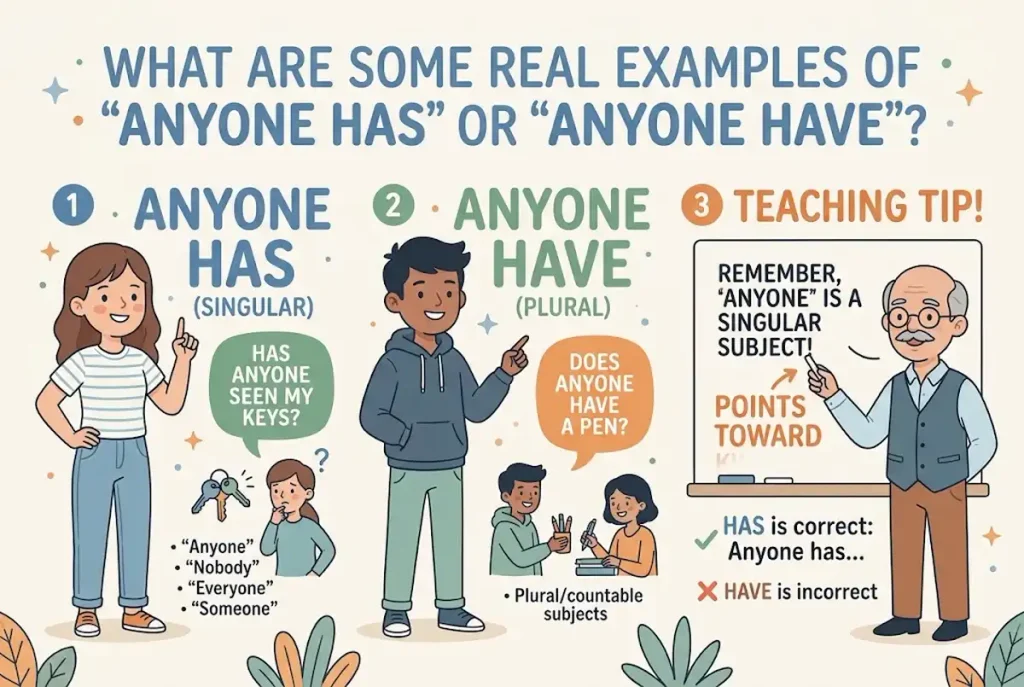
What are some real examples of anyone has or anyone have?
Here are examples from different situations.
- “Does anyone have a spare laptop charger?”
- “If anyone has questions, please send me an email.”
- “Does anyone have experience with this software?”
- “Anyone who has a valid ticket may enter the building.”
- “If anyone has seen my keys, please let me know.”
- “Does anyone have the notes from yesterday’s class?”
- “Anyone has the right to express an opinion.”
- “Does anyone have a better suggestion?”
- “Anyone who has completed the training can use the equipment.”
- “If anyone has information about the missing document, contact the office.”
- “Does anyone have time to review my essay?”
- “Anyone can make a mistake.”
- “If anyone has a concern, please raise it during the meeting.”
- “Does anyone have an extra seat?”
- “Anyone who has worked in customer service will recognize this situation.”
Notice how the structure changes depending on the sentence.
Anyone has vs anyone have: what is the difference?
The main difference is grammatical structure.
| Form | Correct use | Example |
|---|---|---|
| Anyone has | Statement or clause where anyone is the subject | Anyone has the right to ask. |
| Anyone have | Usually not correct as a complete standard statement | Anyone have a question? |
| Does anyone have | Standard question | Does anyone have a question? |
| Anyone who has | Relative clause | Anyone who has a ticket can enter. |
| If anyone has | Conditional clause | If anyone has concerns, speak up. |
The common mistake is seeing “anyone” and assuming the verb must always be “have.”
That is not how English subject agreement works.
The sentence structure matters.
Which is correct?
“Does anyone have” is correct.
“Does anyone has” is incorrect in standard English.
The reason is simple. “Does” is the third person singular present form of “do.” Once “does” is used as the helping verb, the main verb returns to its base form.
Correct:
“Does anyone have a question?”
Incorrect:
“Does anyone has a question?”
This rule also applies to other verbs:
- Does she have a car?
- Does he know the answer?
- Does anyone want coffee?
- Does anyone need help?
You would not write “Does she has,” “Does he knows,” or “Does anyone wants.”
Anyone has vs anyone who has: what changes?
“Anyone who has” adds a relative clause that identifies the people being discussed.
Compare:
“Anyone has the right to apply.”
“Anyone who has the required qualification can apply.”
The second sentence is more specific. It limits the meaning to people who meet the condition.
This pattern is extremely common:
- Anyone who has experience can apply.
- Anyone who has a ticket can enter.
- Anyone who has questions can contact us.
- Anyone who has completed the form may continue.
In all these examples, “has” agrees with anyone.
When should you not use anyone?
Anyone is useful, but it is not always the clearest choice.
Avoid it when you actually mean a specific group.
Instead of:
“Anyone on the marketing team should attend.”
Write:
“Everyone on the marketing team should attend.”
If you mean all members of a group, everyone is usually more precise.
Avoid anyone when the person is already known.
Instead of:
“Anyone should contact the manager.”
Write:
“Employees should contact the manager.”
Avoid it in places where a specific noun would make the sentence clearer.
Instead of:
“Anyone responsible for the project should sign this.”
Write:
“The project manager should sign this.”
The best grammar is not only about correctness. Clear meaning matters too.
What are the most common mistakes with anyone?
Mistake one: using have after anyone in a statement
Incorrect:
“Anyone have the answer.”
In formal standard English, this needs an auxiliary verb if it is intended as a question.
Correct:
“Does anyone have the answer?”
In casual speech, “Anyone have the answer?” is common, but it is an informal shortened question.
Mistake two: using has after does
Incorrect:
“Does anyone has a question?”
Correct:
“Does anyone have a question?”
Remember that does already carries the singular verb marking.
Mistake three: treating anyone as plural
Incorrect:
“Anyone who have a ticket can enter.”
Correct:
“Anyone who has a ticket can enter.”
Anyone takes singular agreement.
Mistake four: confusing anyone and everyone
“Anyone can attend” means any person can attend.
“Everyone can attend” means all people in the relevant group can attend.
These meanings are related but not identical.
Mistake five: using anybody and anyone as completely different grammar forms
Anyone and anybody usually have the same grammatical function and meaning.
For example:
“Does anyone have a pen?”
“Does anybody have a pen?”
Both are standard.
Anyone can sound slightly more neutral, while anybody can sound a little more conversational in some contexts.
What are the antonyms of anyone?
The closest opposite depends on the intended meaning.
If anyone means any person, possible opposites include:
- no one
- nobody
- no person
- a specific person
- a particular individual
Compare:
“Anyone can apply.”
“No one can apply.”
These sentences have opposite meanings.
But “everyone” is not an antonym of anyone. In many contexts, anyone and everyone overlap, but they are not exact opposites.
For example:
“Anyone can ask a question.”
“Everyone can ask a question.”
The first emphasizes open possibility. The second emphasizes the whole group.
What is the easiest memory trick?
Remember this formula:
Anyone + has.
Does + anyone + have.
Anyone who + has.
If anyone + has.
You can use these four patterns in most everyday situations.
| Pattern | Example |
|---|---|
| Anyone has | Anyone has the right to ask. |
| Does anyone have | Does anyone have a question? |
| Anyone who has | Anyone who has a ticket can enter. |
| If anyone has | If anyone has concerns, let me know. |
The biggest trap is “does anyone has.” Avoid it.
After does, use the base verb.
After anyone by itself in a statement, use the singular form when the verb requires it.
Why does English use singular verbs with anyone?
English treats indefinite pronouns such as anyone, someone, everyone, and nobody as grammatically singular.
This may feel strange because anyone can refer to many different people.
The difference is between meaning and grammatical form.
Imagine a teacher says:
“Anyone is welcome to join.”
The teacher is not saying that only one person may join. The sentence means that any individual person is welcome.
The pronoun is singular because the grammar considers each possible person individually.
The same pattern appears with everyone:
“Everyone has a chance.”
Although everyone refers to many people, the verb is singular: has.
This is why:
“Everyone have a chance” is incorrect in standard English.
And:
“Anyone have a chance” is not the normal complete statement either.
How does anyone work with has and have in questions?
The presence of an auxiliary verb is one of the most important parts of the rule.
In a normal present tense statement:
“Anyone has access.”
In a question, English often moves the auxiliary verb before the subject:
“Does anyone have access?”
The main verb changes back to its base form.
The same pattern appears in other sentences:
“She has a car.”
“Does she have a car?”
“He has enough time.”
“Does he have enough time?”
“Anyone has the opportunity.”
“Does anyone have the opportunity?”
The grammar is consistent.
How does anyone work in negative sentences?
Anyone is also common in negative sentences.
For example:
“I don’t know anyone here.”
“She doesn’t know anyone at the office.”
“We didn’t see anyone outside.”
Here, anyone means any person, but the negative verb supplies the structure.
Be careful not to force “has” or “have” into these sentences.
For example:
“I don’t think anyone has the answer.”
This is correct.
The phrase “anyone has” appears inside the clause, while “don’t” is the main auxiliary for the larger sentence.
Another example:
“She doesn’t think anyone has seen the document.”
The structure is:
She doesn’t think + anyone has seen the document.
The singular form has is correct because anyone is the subject of “has seen.”
How does anyone work with relative clauses?
Relative clauses are another common place where people make mistakes.
Correct:
“Anyone who has a ticket can enter.”
Incorrect:
“Anyone who have a ticket can enter.”
The verb in “who has” agrees with the antecedent anyone.
More examples:
- Anyone who has experience may apply.
- Anyone who has questions can stay after class.
- Anyone who has completed the assignment may leave.
- Anyone who has a valid ID can enter.
- Anyone who has seen the document should report it.
If you see “anyone who,” “has” will often be the form you need when the clause is in the present tense.
Final grammar check for anyone has or anyone have
Before submitting an email, essay, message, or assignment, use this quick checklist.
- Is anyone the subject of a statement?
Use has when the sentence calls for the singular present form.
- Is the sentence a question beginning with does?
Use have.
- Does anyone appear before who?
Check the following clause carefully. “Anyone who has” is standard.
- Is anyone part of an if clause?
“ If anyone has…” is standard.
- Are you writing casually?
“Anyone have…?” can work as an informal shortened question, but “Does anyone have…?” is safer for formal writing.
Use a specific noun when it makes the sentence clearer.
What should you remember about anyone has or anyone have?
The main rule is easier than it first appears.
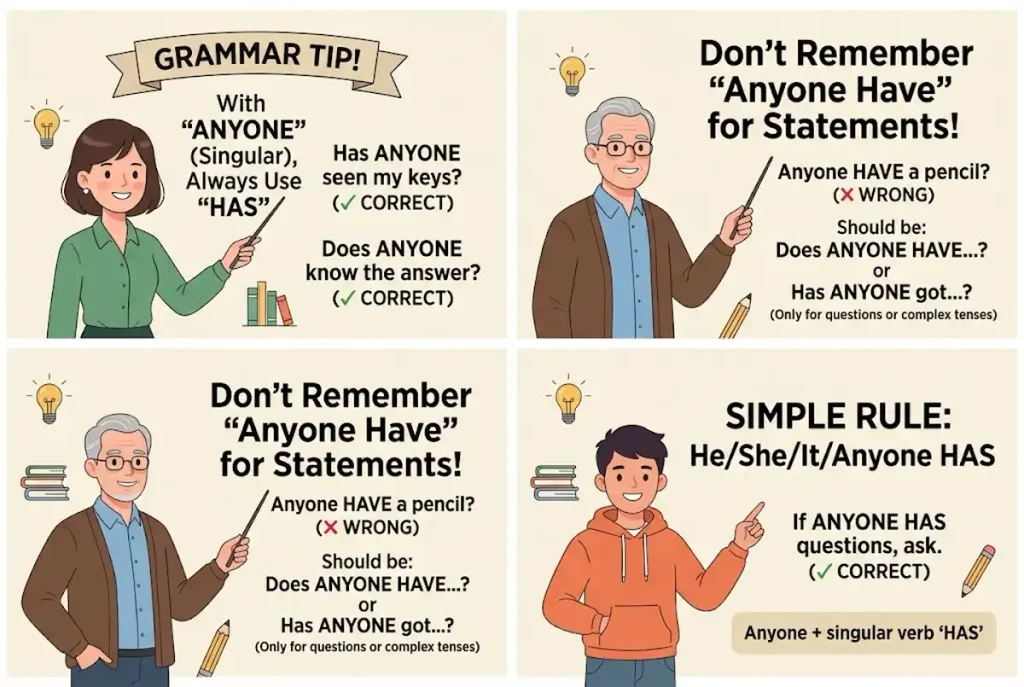
Anyone is grammatically singular, so it can take has in a normal statement or clause. When you form a question with the auxiliary does, the main verb returns to its base form, so you say “does anyone have,” not “does anyone has.” The same rule applies to sentences such as “anyone who has” and “if anyone has.”
The choice becomes much easier once you stop treating anyone and have as a fixed pair. Look at the whole sentence instead. Check for helping verbs, relative clauses, and the meaning you want to express. With a little practice, these patterns will become automatic.
Conclusion
Choosing between “anyone has” and “anyone have” becomes much easier when you look at the full sentence. Anyone is grammatically singular, so use has in statements such as “If anyone has questions, please ask.” However, when you use does to form a question, the main verb stays in its base form: “Does anyone have a question?”
Remembering this simple pattern will help you avoid common grammar mistakes in emails, essays, texts, and everyday conversations. When in doubt, check for the helping verb does and the structure around anyone. With a little practice, the correct form will start to feel natural.
Frequently Asked Questions
Is anyone has grammatically correct?
Yes, “anyone has” can be grammatically correct when anyone is the subject of a statement or clause that requires has. For example, “If anyone has questions, please ask.”
Is it does anyone have or does anyone has?
The correct form is “does anyone have.” After the helping verb does, use the base form have.
Why do we say anyone has but does anyone have?
Anyone is grammatically singular, so it can take has in a statement. In a question with does, the auxiliary verb carries the singular marking, so the main verb stays as have.
Can I say anyone have in a text?
Yes, “Anyone have a pen?” is common as a shortened informal question. In formal writing, “Does anyone have a pen?” is the safer choice.
Is anyone singular or plural?
Anyone is grammatically singular in standard English. It normally takes singular verb agreement, such as “Anyone is welcome” or “Anyone who has a ticket can enter.”

Daniel Grammarfield — The Language Learner
Age: 28Occupation: ESL Learner & Digital Professional
Bio:Daniel is a non-native English speaker who wants to communicate more confidently at work and online. He uses Synotrench to improve grammar, understand confusing words, learn correct sentence structures, and build everyday English skills. He prefers simple explanations with practical examples.
Goals:
Master English grammar rules
Avoid common language mistakes
Improve professional communication
Learn English through real-life examples
Quote:“Learning English is not about memorizing rules — it’s about expressing ideas clearly.”
3 thoughts on “Anyone Has or Anyone Have: Simple Grammar Guide”