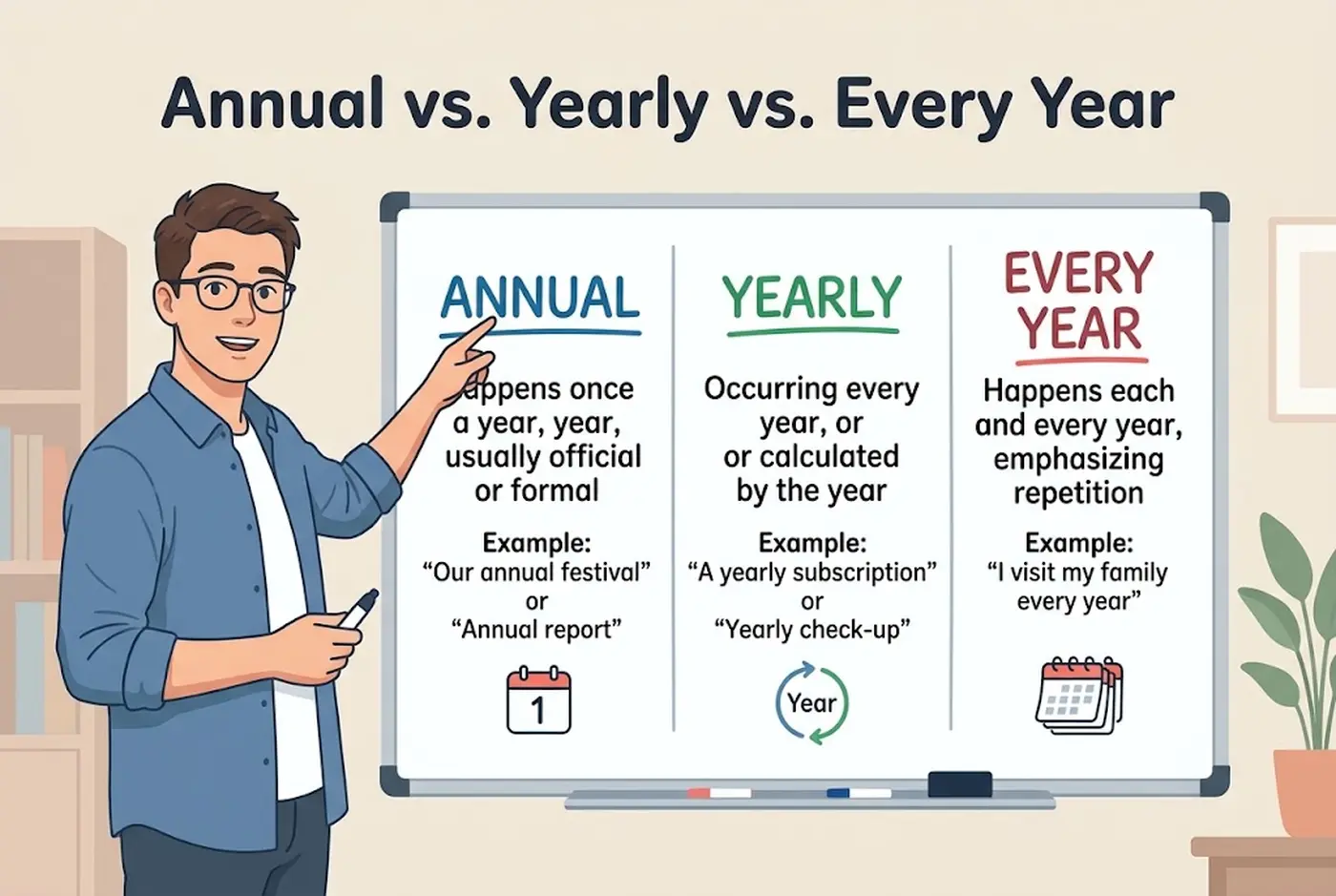
When you’re writing an email, resume, school essay, report, or even a quick text, you may stop and wonder about Annual vs Yearly vs Every Year. All three expressions relate to a period of one year, so they can seem interchangeable. In many sentences, they are. But they don’t always sound equally natural, and their grammar and tone can be different.
The simple answer is that annual and yearly are usually adjectives, while every year is an adverbial phrase that tells us how often something happens. Annual often sounds more formal and is common in business, education, finance, and official writing. Yearly is more conversational. Every year is especially natural when you are describing a repeated action or event.
This guide explains the meaning, origin, grammar, tone, regional use, common mistakes, and practical differences among these expressions. You’ll also see examples for resumes, essays, emails, texting, and everyday speech.
What do annual yearly and every year mean
In Annual vs Yearly vs Every Year, the basic idea is the same: something happens, is done, or is connected to one year.
Annual means happening once each year or relating to a year.
Yearly can mean happening once each year or relating to a year.
Every year means once in each year or during each year in a repeated pattern.
For example:
- The company holds an annual meeting.
- The company holds a yearly meeting.
- The company holds a meeting every year.
All three sentences can communicate a similar idea. The difference is mainly grammatical structure and tone.
Annual usually works directly before a noun:
- annual report
- annual meeting
- annual salary
- annual review
- annual event
Yearly can also work before a noun:
- yearly report
- yearly meeting
- yearly payment
- yearly review
But yearly is also commonly used after a verb:
- We meet yearly.
- The fee is paid yearly.
- The event happens yearly.
Every year is especially useful when the sentence focuses on the repeated action:
- We meet every year.
- She visits her parents every year.
- The school hosts a science fair every year.
Is annual the same as yearly
Annual and yearly have almost the same basic meaning, but annual is generally more formal and is especially common before nouns.
For example, annual report sounds more formal than yearly report. Both can be grammatically correct, but the first is more common in professional and institutional writing.
Is every year the same as annual
Not exactly in grammar, although the meaning can overlap.
Annual is an adjective:
- an annual celebration
Every year is an adverbial phrase:
- We celebrate it every year.
You cannot simply replace one with the other in every sentence.

Where did annual and yearly come from
The history of these words helps explain why they behave differently today.
Annual comes from the Latin word annus, meaning year. English developed the word through Old French and later Middle English forms. Because of its history, annual became strongly associated with formal language, especially writing connected with organizations, government, education, finance, and records.
Yearly is much more direct. It comes from the English word year with the suffix ly. The basic idea is simply “in a way related to a year” or “once each year.”
Every year is even more transparent. It combines every, meaning each individual one in a group or sequence, with year. It clearly expresses repetition across individual years.
This difference in history does not create a major difference in meaning. Instead, it helps explain the different styles we hear today.
Annual often feels institutional:
- annual budget
- annual conference
- annual inspection
Yearly often feels ordinary and conversational:
- yearly expenses
- yearly checkup
- yearly payment
Every year sounds natural when talking about personal routines or repeated events:
- I visit my grandparents every year.
- We go there every year.
- The festival returns every year.
Which words are mild and which sound stronger
Frequency words do not usually have a strong emotional scale, but they can show different degrees of repetition or emphasis.
Mild or simple frequency
These are easy choices for ordinary communication:
- yearly
- every year
- each year
- once a year
- once each year
- per year
Examples:
- We go camping every year.
- The fee is paid yearly.
- I take the course once a year.
More formal frequency
These choices work well in professional and academic writing:
- annual
- annually
- once annually
- per annum
- on an annual basis
- on a yearly basis
Examples:
- The company publishes an annual report.
- The records are reviewed annually.
- The interest rate is stated per annum.
Strong repetition
These expressions emphasize that something keeps happening across multiple years:
- year after year
- year by year
- from year to year
- repeatedly each year
- on a recurring annual basis
Examples:
- The tradition has continued year after year.
- The company has grown year by year.
- Prices may change from year to year.
The strongest choice depends on what you want to emphasize. If you simply want to state frequency, every year is usually enough.
How do annual yearly and every year work in grammar
Grammar is one of the biggest differences in Annual vs Yearly vs Every Year.
Annual is normally an adjective. It describes a noun.
Examples:
- annual meeting
- annual payment
- annual income
- annual examination
- annual celebration
Yearly can function as an adjective or adverb.
As an adjective:
- yearly payment
- yearly report
- yearly subscription
As an adverb:
- The payment is made yearly.
- We review the policy yearly.
Every year normally functions as an adverbial phrase.
Examples:
- We meet every year.
- She travels every year.
- The school holds the event every year.
This means you should not automatically replace one form with another.
Incorrect structure:
- We annual visit our relatives.
Better:
- We visit our relatives every year.
Also incorrect:
- We every year report our results.
Better:
- We report our results every year.
You can place every year in several positions depending on the sentence:
- We visit every year.
- We visit them every year.
- Every year, we visit them.
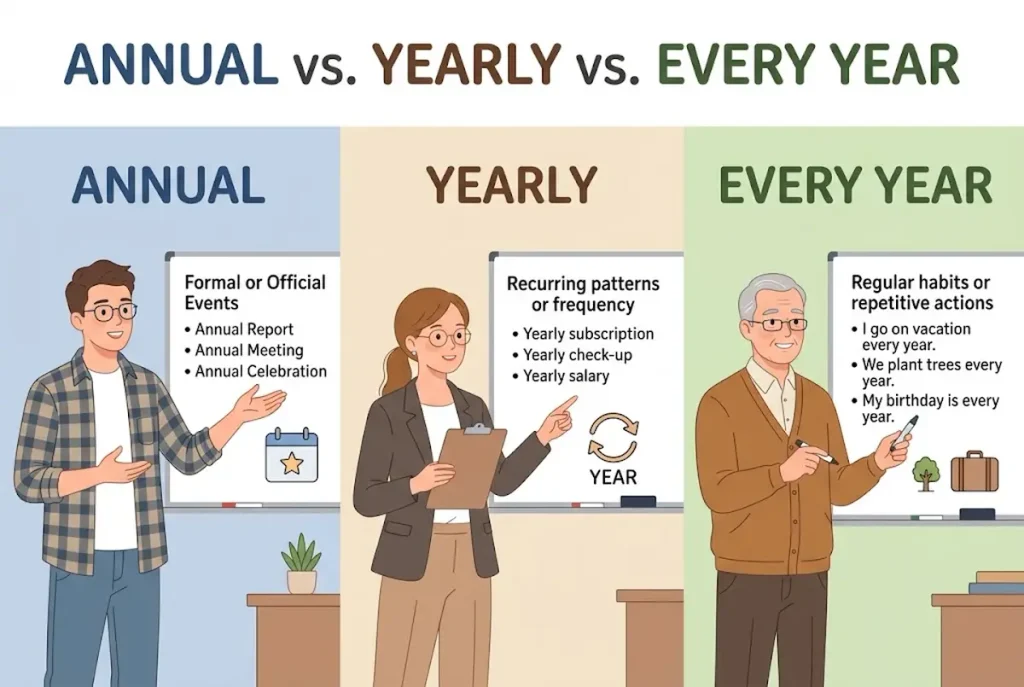
Annual vs yearly vs every year by context
The best choice often depends on where you are writing.
What should you use in a resume
Annual usually works well on a resume because resumes often use professional and compact language.
Examples:
- Managed an annual budget of $250,000.
- Prepared annual financial reports.
- Conducted annual employee reviews.
- Increased annual sales by 15 percent.
Yearly can also be correct, but annual often fits professional terminology more naturally.
For example:
- annual salary
- annual revenue
- annual budget
- annual performance review
These are familiar phrases in workplace English.
What should you use in a text message
For texting, every year and yearly are usually more natural.
Examples:
- We go there every year.
- Do you still do that yearly?
- Our family trip is every year in July.
You do not need formal vocabulary in a casual message.
What should you use in an email
The best choice depends on the email’s purpose.
For a professional email:
- The annual review is scheduled for June.
- We conduct this process annually.
For a casual email:
- We visit the beach every year.
- We have a family dinner every year.
Both styles are correct. The level of formality should match the audience.
What should you use when speaking
Every year is extremely natural in everyday speech.
Examples:
- I go there every year.
- We have a reunion every year.
- She visits her family every year.
Yearly is also common:
- We have a yearly meeting.
Annual is common in established phrases:
- annual event
- annual meeting
- annual fee
In casual conversation, annual can sound more formal if a simpler expression would work.
What is the difference between annual and annually
Annual and annually are closely related, but they have different grammatical jobs.
Annual is an adjective:
- annual report
- annual income
- annual meeting
Annually is an adverb:
- We meet annually.
- The report is published annually.
- Fees are reviewed annually.
A useful trick is to ask what the word is describing.
If it describes a noun, use annual.
If it describes an action, annually may work better.
Compare:
| Annual | Annually |
|---|---|
| annual review | reviewed annually |
| annual payment | paid annually |
| annual meeting | meet annually |
| annual inspection | inspected annually |
This distinction is especially useful in formal writing.
What is the difference between yearly and every year
Yearly and every year are often interchangeable, but they do not always sound equally natural.
Yearly can describe a noun:
- yearly payment
- yearly report
Every year usually describes when something happens:
- We make a payment every year.
- We publish the report every year.
Compare these sentences:
- The company sends a yearly report.
- The company sends a report every year.
Both are clear.
The second sentence puts more attention on the repeated action. The first treats the report as a type of report.
In conversation, every year often sounds more natural.
What is the difference between every year and each year
Every year and each year have nearly the same meaning.
Every year is more common in everyday American English:
- We visit them every year.
Each year can sound slightly more deliberate or formal:
- The number of visitors increases each year.
There is no major difference in frequency. The choice is mostly about style and sentence rhythm.
Compare:
- Every year, the company hires new employees.
- Each year, the company hires new employees.
Both are correct.
Each year can also draw attention to the individual years as separate periods.
What is the difference between annual and per year
Annual usually describes something connected with a full year.
Per year expresses a rate or amount for each year.
Compare:
- My annual salary is $60,000.
- I earn $60,000 per year.
The first uses annual as an adjective before salary. The second uses per year to express the rate of income.
Other examples:
- annual membership fee
- membership costs $100 per year
- annual interest rate
- interest is charged at 5 percent per year
These forms can communicate similar information, but their grammar is different.
Does American English prefer annual or yearly
American English uses both annual and yearly.
Annual is especially common in professional, financial, academic, legal, and organizational language.
Examples include:
- annual income
- annual report
- annual meeting
- annual fee
- annual review
Yearly is also standard American English and is common in everyday language.
Examples include:
- yearly expenses
- yearly payment
- yearly visit
Every year is extremely common in ordinary conversation and general writing.
There is no rule saying American English must use one expression. Context determines the natural choice.
Are there UK English differences
British English also uses annual, yearly, and every year.
The basic meanings remain the same. The larger difference is often related to style, vocabulary preferences, and the surrounding sentence rather than grammar.
For example, both American and British writers can say:
- annual report
- yearly payment
- every year
- once a year
Some related vocabulary can vary by region, but these three expressions are widely understood in both forms of English.
For an international audience, annual and every year are especially clear.
What are the best choices for formal and casual writing
A simple guide can help:
| Situation | Natural choice | Example |
|---|---|---|
| Business report | annual | The annual report was released. |
| Financial writing | annual | The annual rate is 5 percent. |
| Academic writing | annual or annually | The survey is conducted annually. |
| Resume | annual | Managed the annual budget. |
| Professional email | annual or annually | The annual review is scheduled. |
| Casual email | every year | We meet every year. |
| Text message | every year | We go there every year. |
| Everyday speech | every year | I visit every year. |
| General writing | yearly or every year | The event happens every year. |
| Legal or official document | annual | The annual fee is due in June. |
These are style preferences, not absolute grammar rules.
What are some real examples of annual yearly and every year
Here are practical examples from different situations.
- The company publishes its annual report in March.
- I visit my hometown every year during the summer.
- The membership requires a yearly payment.
- Our school holds an annual sports festival.
- She renews her professional license every year.
- The software receives a yearly update.
- The board conducts an annual review of the policy.
- We have dinner together every year on New Year’s Eve.
- The organization meets annually to discuss its goals.
- My yearly expenses have increased over the past few years.
- The insurance policy has an annual premium.
- They return to the same hotel every year.
- The company offers an annual performance review.
- The subscription costs $120 per year.
- The family takes a yearly vacation near the coast.
- The festival has attracted more visitors year after year.
- The equipment must be inspected annually.
- We renew the membership every year.
- The report compares annual sales across five regions.
- The students complete a yearly assessment.
These examples show why grammar and context matter. The meaning may overlap, but the natural wording changes with the sentence.
What mistakes should you avoid
One common mistake is treating annual as an adverb.
Incorrect:
- We annual check the equipment.
Correct:
- We check the equipment annually.
- We check the equipment every year.
Another mistake is using yearly when the phrase has a more established formal form.
For example:
- annual report
is generally more natural in professional writing than:
- yearly report
The second is not necessarily wrong. It simply sounds less conventional in that context.
Another mistake is confusing annual with yearlong.
Annual means something happens once each year or is connected with a year.
Yearlong means something continues for an entire year.
Compare:
- an annual course
This may mean a course offered once a year.
- a yearlong course
This means the course lasts for one year.
They describe different ideas.
A further mistake is using every year when you actually mean every twelve months from a specific date.
For example:
- The license renews every twelve months.
This can be more precise than:
- The license renews every year.
The difference can matter in technical, legal, or scheduling contexts.
When should you not use annual
Do not use annual when the event happens more than once a year.
For example, if a company holds meetings every three months, calling them annual meetings would be incorrect.
Use:
- quarterly meetings
- monthly meetings
- weekly meetings
Annual means once each year in the usual sense.
Also avoid annual when you mean something lasts for a whole year.
Use yearlong instead.
Incorrect meaning:
- We joined an annual program that lasted twelve months.
If the important idea is duration, a better phrase may be:
- We joined a yearlong program.
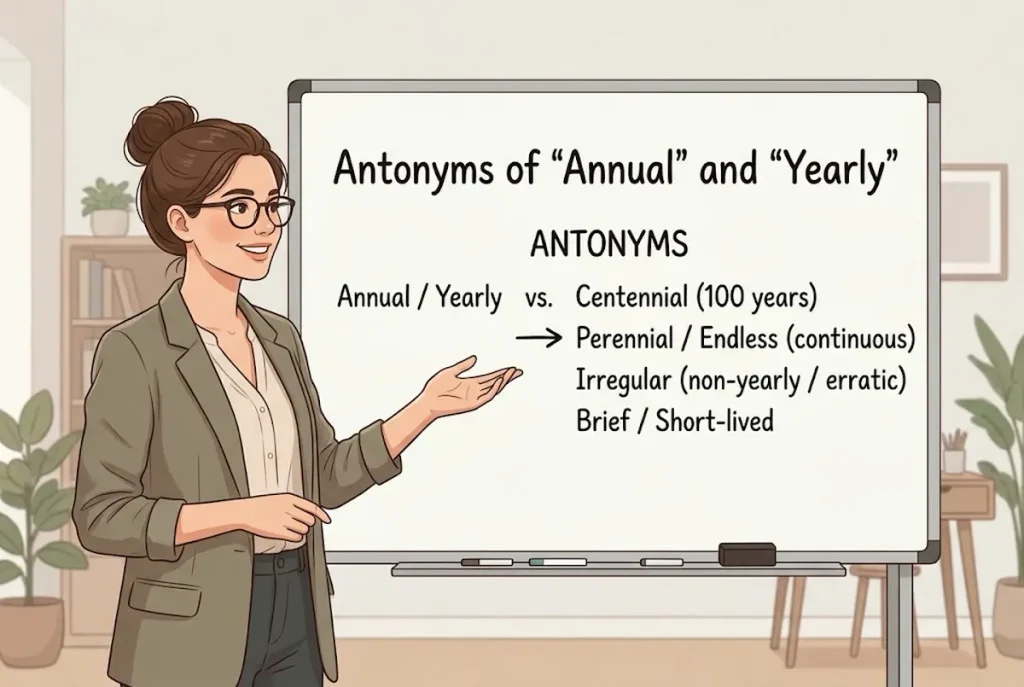
What are the antonyms of annual and yearly
There is no single perfect opposite for annual.
The opposite depends on what you mean.
If you mean more frequent:
- monthly
- weekly
- daily
- quarterly
If you mean less frequent:
- occasional
- irregular
- infrequent
- sporadic
For example:
- annual event
- monthly event
or:
- annual payment
- one time payment
The correct opposite depends on the frequency being discussed.
How can you choose the right word quickly
When deciding among these expressions, ask four simple questions.
Is a noun coming after the word
If yes, annual or yearly may work.
Examples:
- annual meeting
- yearly meeting
For formal writing, annual is often the more conventional choice.
Are you describing an action
If you are explaining how often an action happens, every year is usually very natural.
Example:
- We visit the museum every year.
You can also use annually:
- We visit the museum annually.
Is the writing formal
For reports, resumes, business documents, and official writing, annual and annually often fit well.
For casual messages, every year is usually simple and natural.
Do you mean duration instead of frequency
If something continues for a whole year, annual may not be the right word.
Use yearlong when duration is the main idea.
Compare:
- annual event = happens once each year
- yearlong event = continues for a year
This quick distinction prevents many mistakes.
What is the easiest way to remember the difference
Think of the three expressions this way:
Annual = related to one year or happening once a year.
Yearly = happening once a year, usually in a neutral or conversational style.
Every year = a repeated action happening in each year.
A simple pattern is:
- annual + noun
- yearly + noun
- verb + every year
- verb + annually
Examples:
- annual meeting
- yearly meeting
- meet every year
- meet annually
This pattern will help you choose naturally without memorizing complicated grammar rules.
Conclusion
The choice among Annual vs Yearly vs Every Year usually comes down to grammar, tone, and context rather than a major difference in meaning. Annual is a strong choice for formal phrases such as annual report, annual fee, and annual meeting. Yearly is flexible and often sounds more relaxed. Every year is especially natural when you are describing a repeated action.
Remember the basic pattern: use annual or yearly before a noun, and use every year when you want to clearly show repeated timing. Use annually when an adverb is needed in formal writing. Once you notice these patterns, choosing the right expression becomes much easier. The goal is not to use the most formal word every time. The goal is to choose the expression that fits your sentence, audience, and meaning.
Frequently Asked Questions
Is annual the same as yearly
Yes, annual and yearly usually mean something happens once each year or relates to a year. Annual is generally more formal, while yearly is often more conversational.
Is every year grammatically correct
Yes, every year is completely correct and very common. It normally works as an adverbial phrase that tells when something happens.
Which is more formal annual or yearly
Annual is generally more formal than yearly. It is especially common in business, academic, financial, legal, and organizational writing.
Can I say yearly report
Yes, yearly report is grammatically possible, but annual report is more common in professional and official writing.
What’s another way to say every year
You can say annually, yearly, each year, once a year, or once annually. The best choice depends on the grammar and tone of your sentence.
Is annual better for a resume
Annual often fits naturally on a resume because resumes commonly use professional phrases such as annual salary, annual revenue, and annual budget. Yearly can also be correct.
What is the difference between annual and every year
Annual is normally an adjective used with a noun, while every year is an adverbial phrase that describes how often something happens. For example, annual meeting and we meet every year are both correct structures.
Which should I use in everyday conversation
Every year is usually the simplest and most natural choice in everyday conversation. Yearly is also common, while annual can sound more formal depending on the sentence.

Daniel Grammarfield — The Language Learner
Age: 28Occupation: ESL Learner & Digital Professional
Bio:Daniel is a non-native English speaker who wants to communicate more confidently at work and online. He uses Synotrench to improve grammar, understand confusing words, learn correct sentence structures, and build everyday English skills. He prefers simple explanations with practical examples.
Goals:
Master English grammar rules
Avoid common language mistakes
Improve professional communication
Learn English through real-life examples
Quote:“Learning English is not about memorizing rules — it’s about expressing ideas clearly.”
2 thoughts on “Annual vs Yearly vs Every Year: Best Usage Guide”