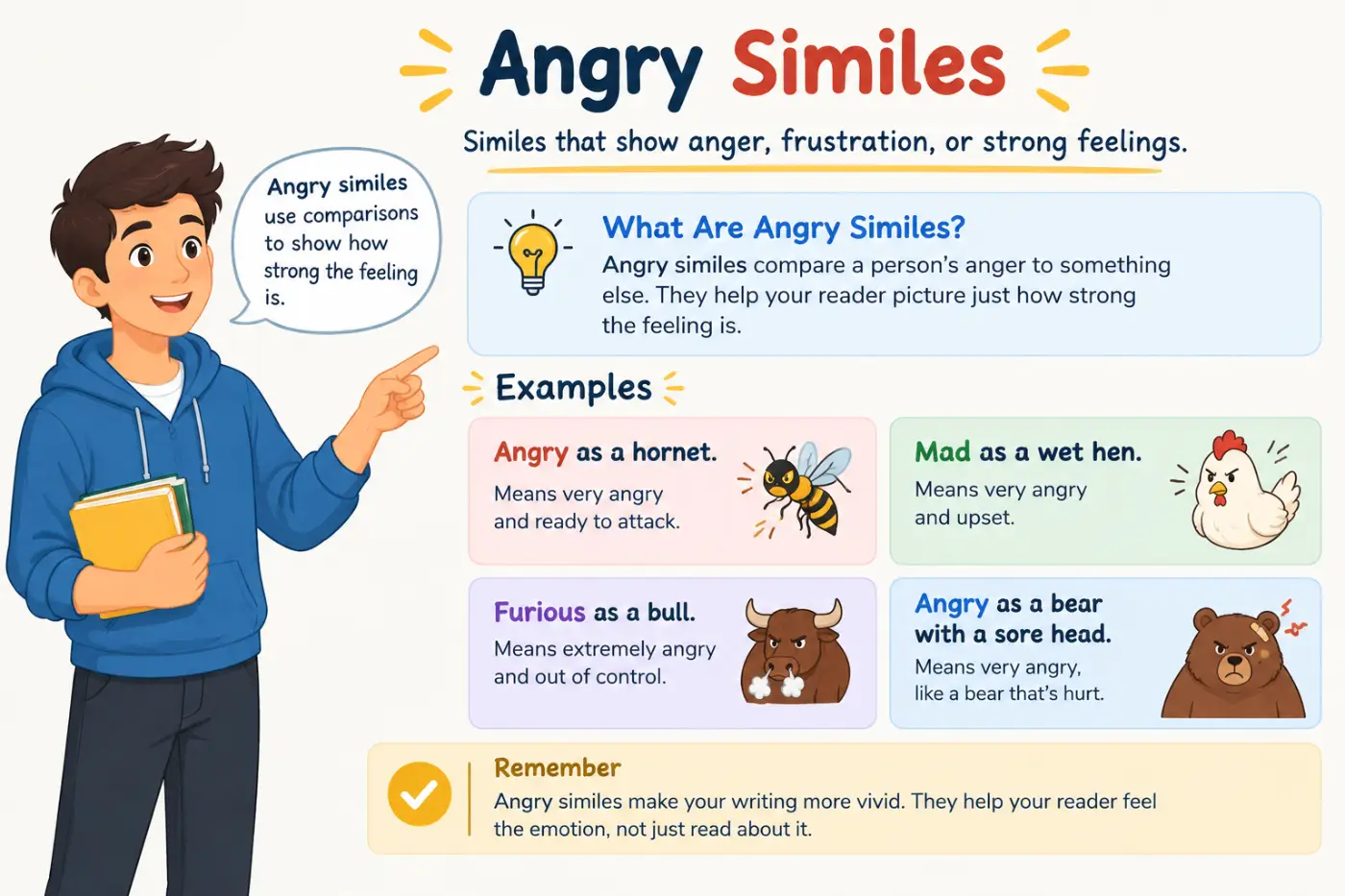
Have you ever written an email, essay, text, or story and wanted to show that someone was angry without simply writing, “She was angry”? A strong comparison can make that emotion much clearer. Angry similes can help readers picture a person’s face, voice, body language, or behavior.
Anger can be quiet and controlled, or it can be loud and explosive. The right comparison helps show the exact level of emotion. Saying someone was “as mad as a hornet” creates a different picture from saying someone was “as cold as ice.” One suggests active irritation, while the other can suggest a person who has become emotionally distant.
This guide explains where these comparisons come from, how strong they are, which words work best in different situations, and how to avoid phrases that sound unnatural. You’ll also find a large synonym list, examples, close comparisons, common mistakes, and answers to frequently searched questions.
What are angry similes?
These are comparisons that describe anger by connecting it to a person, animal, object, force of nature, or familiar situation. They often use “like” or “as” to make the comparison clear.
For example:
- He was as angry as a bull.
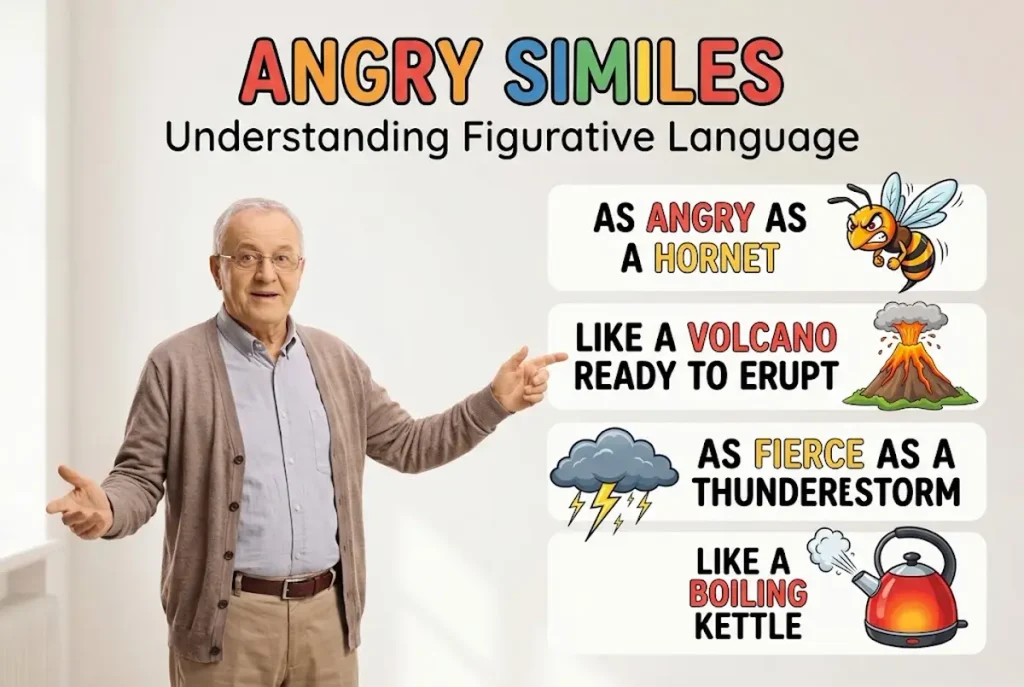
- She looked like a volcano ready to erupt.
- His face was as red as a tomato.
- The customer was mad as a hornet.
- She stormed out like a thundercloud.
The purpose isn’t just to say that someone feels anger. The purpose is to help the reader see or feel that anger.
Compare these two sentences:
He was angry.
He was as angry as a bull charging at a fence.
The first sentence tells us the emotion. The second gives us an image. It suggests force, movement, danger, and a lack of patience.
A good simile should add meaning rather than simply make a sentence longer.
Where does the idea of angry similes come from?
The use of comparison is very old. People have always explained unfamiliar or difficult emotions by comparing them with things they already understand.
Anger is especially easy to describe through physical images. A person may become red in the face, raise their voice, clench their fists, breathe heavily, or move suddenly. These visible signs naturally lead to comparisons with fire, storms, wild animals, and other powerful forces.
Words such as “anger” and “angry” have much older roots in English and related Germanic languages. The English word “anger” developed from Old Norse and related Germanic forms connected with distress, grief, or trouble. Over time, its meaning became strongly associated with the emotion we now call anger.
The comparisons themselves don’t come from one single historical source. Many have developed naturally through everyday speech, literature, storytelling, and popular culture.
For example, comparing anger with fire makes sense because fire is hot, powerful, and difficult to control. Comparing an angry person with a hornet also works because a disturbed hornet may react quickly and aggressively.
This is why many emotional comparisons feel natural even when they are not literal.
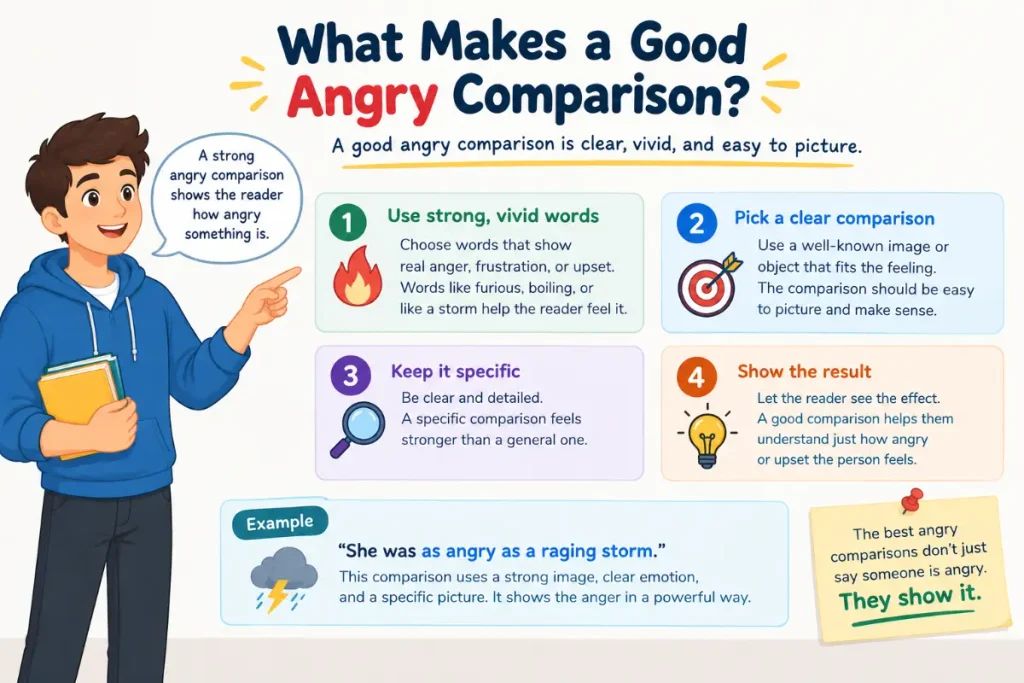
What makes a good angry comparison?
A useful comparison usually has three qualities.
It creates a clear picture
The reader should be able to imagine the situation quickly.
“She was like a volcano” is more visual than “She was very angry.”
It matches the level of anger
A person who is mildly annoyed shouldn’t always be compared with an exploding volcano. Strong language can make a sentence feel exaggerated.
It fits the situation
A funny comparison may work well in a text message but feel strange in a serious business email.
For example:
“I was as mad as a hornet when they canceled my order.”
This works in casual writing.
For a formal complaint, this is more suitable:
“I was extremely frustrated by the repeated cancellation.”
The emotion stays clear, but the language fits the context.
Which words describe mild to extreme anger?
Not every angry person is furious. Choosing the right intensity makes your writing more believable.
Mild anger
Use these when someone is slightly bothered:
- Annoyed.
- Irritated.
- Bothered.
- Vexed.
- Miffed.
Examples:
She was as irritated as a bee trapped in a window.
He looked as bothered as a child who had lost his favorite toy.
Moderate anger
These work when irritation has become stronger:
- Angry.
- Mad.
- Frustrated.
- Agitated.
- Exasperated.
Examples:
He was as frustrated as a driver stuck in traffic for hours.
She looked as mad as someone who had just discovered a broken promise.
Strong anger
Use these when the emotion is intense:
- Furious.
- Enraged.
- Livid.
- Seething.
- Outraged.
- Incensed.
Examples:
He was as furious as a storm tearing through the countryside.
She stood there, as livid as a fire burning through dry grass.
Strong words should have a reason behind them. Calling every small inconvenience “enraging” can make your writing lose its impact.
Which angry words work as nouns adjectives and verbs?
Most emotional vocabulary in this area consists of adjectives, but related forms can appear as nouns and verbs.
| Part of speech | Word | Example |
|---|---|---|
| Adjective | Angry | He was angry with me. |
| Adjective | Furious | She was furious about the mistake. |
| Adjective | Irritated | I felt irritated by the noise. |
| Adjective | Frustrated | He was frustrated with the process. |
| Noun | Anger | Her anger was obvious. |
| Noun | Rage | His rage frightened everyone. |
| Noun | Fury | The decision filled her with fury. |
| Verb | Anger | The unfair rule angered him. |
| Verb | Irritate | The constant noise irritated her. |
| Verb | Infuriate | The accusation infuriated the coach. |
| Verb | Enrage | The news enraged the community. |
This distinction matters when you’re building a sentence. You can’t use every related word in the same grammatical position.
For example:
“Her anger was obvious.”
works because “anger” is a noun.
“Her angry face was obvious.”
works because “angry” is an adjective.
“The decision angered her.”
works because “angered” is a verb.
How do you describe anger with a simile?
The strongest descriptions often connect anger to something powerful or visually familiar.
Common images include:
- Fire.
- Volcanoes.
- Thunderstorms.
- Bulls.
- Hornets.
- Boiling water.
- Wild animals.
- Red-hot metal.
- Explosions.
- Dark clouds.
Each image creates a slightly different effect.
A volcano suggests anger that has been building and may suddenly explode.
A storm suggests loud, powerful, uncontrolled emotion.
A bull suggests physical strength and aggression.
A hornet suggests quick irritation and an aggressive reaction.
Fire suggests heat, danger, and growing intensity.
Boiling water suggests anger that has reached a breaking point.
The best choice depends on what the character is doing.
What are the best smile for different situations?
What works in a resume?
A resume usually isn’t the place for colorful emotional comparisons. Professional documents should use direct language.
Instead of:
“I was as angry as a raging bull after the project failed.”
write:
“I remained focused while addressing a difficult project setback.”
If you’re describing a skill such as conflict management, use professional language:
“I handled tense customer situations calmly and professionally.”
A resume should show control rather than dramatic emotion.
What works in an essay?
An essay can use a comparison when you’re writing a personal narrative, literary analysis, or creative piece.
Example:
“After hearing the accusation, my father stood as still as a statue, but his face showed an anger that felt like a gathering storm.”
This works because the comparison adds atmosphere.
For academic writing, avoid using too many casual idioms. A clear phrase such as “intense anger” may be better.
What works in a text message?
Text messages allow more casual and playful language.
Examples:
- “I’m as mad as a hornet right now.”
- “She was literally seeing red.”
- “He’s fuming over that game.”
- “I’m so annoyed I could scream.”
The tone can be exaggerated because casual texting often uses humor and emotional shorthand.
What works in an email?
The right choice depends on the person you’re emailing.
For a friend:
“I was as mad as a hornet when I saw the bill.”
For a coworker:
“I was extremely frustrated by the repeated issue.”
For a formal complaint:
“I was very dissatisfied with the way the matter was handled.”
The more formal the audience, the less useful slang becomes.
What are some original examples?
Good examples should cover different settings rather than repeating the same animal or fire image.
- After reading the unfair email, Maya was as mad as a hornet.
- His face turned as red as a tomato when the waiter accused him of lying.
- The coach was like a thundercloud after the team ignored his instructions.
- She stood as stiff as a board, her eyes burning like hot coals.
- By the third phone call, he was as frustrated as a driver trapped in endless traffic.
- Her anger rose like boiling water inside a covered pot.
- The customer stormed toward the counter like a bull charging through a gate.
- He was as furious as a volcano about to erupt.
- She looked like a storm had gathered behind her eyes.
- His voice was as sharp as a knife when he answered the accusation.
- After discovering the missing money, the manager was fuming like a kettle left too long on the stove.
- The child looked as angry as a cat disturbed from its favorite sleeping place.
- His patience disappeared like ice under a summer sun.
- She entered the room like a thunderstorm, and everyone stopped talking.
- The normally quiet teacher looked as fierce as a lion protecting its cubs.
Notice that these comparisons do more than repeat the word “angry.” They describe facial expression, movement, voice, body language, or emotional pressure.
Angry like a volcano vs angry like a storm
Both comparisons suggest powerful emotion, but they create different pictures.
| Comparison | Main idea | Best use |
|---|---|---|
| Like a volcano | Anger has built up and may explode | Suppressed or explosive anger |
| Like a storm | Anger is powerful and spreads through the situation | Loud or overwhelming anger |
Example:
“She was like a volcano waiting to erupt.”
This suggests that she has been holding anger inside.
“He was like a storm when he entered the office.”
This suggests immediate, noticeable energy.
Choose a volcano when you want buildup. Choose a storm when you want movement and atmosphere.
Angry like a bull vs mad as a hornet
These two familiar comparisons also have different shades.
| Comparison | Feeling | Image |
|---|---|---|
| Like a bull | Strong, aggressive, forceful | Physical power |
| Mad as a hornet | Irritated, reactive, ready to attack | Quick agitation |
A bull comparison works well when someone is charging, shouting, or acting aggressively.
A hornet comparison works well when someone is irritated and ready to react.
For example:
“The customer came toward the desk like a bull.”
This sounds physically aggressive.
“The customer was mad as a hornet after waiting an hour.”
This focuses more on irritation.
What are the most useful?
The most useful choices depend on the feeling you want to create.
| If you want to show… | Try comparing anger to… |
|---|---|
| Mild irritation | A buzzing fly |
| Quick annoyance | A hornet |
| Building anger | A volcano |
| Loud anger | A thunderstorm |
| Physical aggression | A charging bull |
| Dangerous anger | A wildfire |
| Controlled anger | A pressure cooker |
| Quiet anger | Dark clouds |
| Extreme anger | Fire |
| Sudden anger | An explosion |
These comparisons aren’t interchangeable. A pressure cooker suggests emotion being held inside. A wildfire suggests anger spreading quickly. An explosion suggests a sudden release.
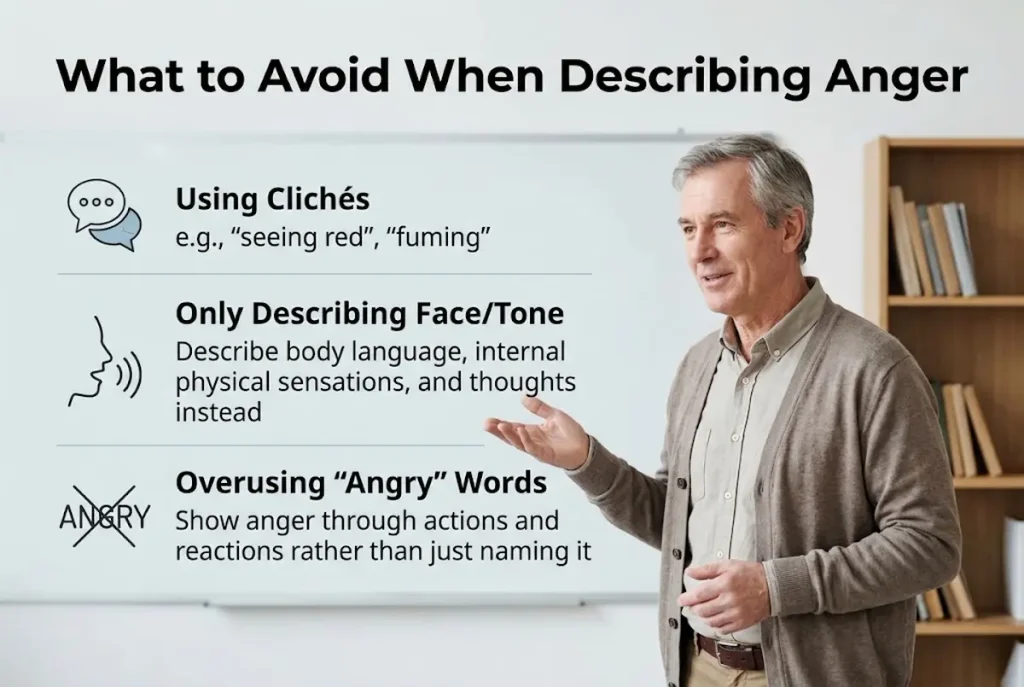
What should you avoid when describing anger?
A common mistake is using an extreme comparison for a small problem.
For example:
“I was as furious as a volcano because my pen stopped working.”
The sentence may sound humorous, but it doesn’t sound realistic unless exaggeration is intentional.
Another mistake is mixing comparisons.
“He was as angry as a volcano charging like a bull.”
This combines two unrelated images and makes the sentence awkward.
Choose one clear image:
“He was like a volcano ready to erupt.”
Another mistake is using a cliché too often. Familiar expressions can be useful, but original comparisons usually make creative writing more memorable.
Instead of:
“She was seeing red.”
you could write:
“Her face tightened, and every word came out like a spark from a fire.”
The second version gives the reader more detail.
What are the antonyms of angry?
Anger has several useful opposites and related contrasts.
| Antonym | Meaning |
|---|---|
| Calm | Not emotionally disturbed |
| Peaceful | Free from conflict or agitation |
| Relaxed | Free from tension |
| Patient | Able to tolerate problems without becoming angry |
| Pleased | Feeling satisfied or happy |
| Content | Satisfied with a situation |
| Happy | Feeling positive or joyful |
| Friendly | Kind and pleasant toward others |
| Forgiving | Willing to stop blaming someone |
| Gentle | Calm and nonaggressive |
These words can help create contrast in a story.
For example:
“At first, he was as calm as still water. Then the accusation changed everything.”
The contrast makes the later anger stronger.
What are the best tips for choosing the right comparison?
Match the intensity
Don’t use “furious” when “annoyed” is enough.
Think about behavior
Ask what the person is actually doing. Are they shouting, glaring, pacing, shaking, or staying silent?
Choose a familiar image
Readers understand fire, storms, animals, and boiling water quickly.
Consider your audience
Slang may work in texting but not in a formal report.
Don’t force a comparison
If a direct word is clearer, use it.
How can you make an angry simile more creative?
Start with the emotion and then ask what physical experience matches it.
If the character is holding anger inside, think about pressure.
“His anger sat inside him like steam trapped in a sealed pipe.”
If the character suddenly explodes, think about force.
“Her words burst out like sparks from a struck match.”
If the character is silently angry, think about cold or darkness.
“She was as cold as winter glass, but her silence carried more anger than shouting could.”
You can also focus on body language rather than naming the emotion.
“His hands tightened like ropes being pulled.”
“Her eyes burned like coals beneath ash.”
“His voice shook like a window in a hard storm.”
These examples show anger without repeatedly using the word “angry.”
What are common mistakes with angry similes?
Using a metaphor instead of a simile
A simile normally makes a comparison using “like” or “as.”
Simile:
“He was like a volcano.”
Metaphor:
“He was a volcano.”
Both are useful, but they are different literary devices.
Using “as” incorrectly
A standard simile often follows an “as…as” structure:
“She was as angry as a hornet.”
However, “like” comparisons are also common:
“She looked like a hornet ready to attack.”
Don’t force the “as…as” pattern when a natural “like” sentence sounds better.
Confusing anger with frustration
Frustration often comes from obstacles, delays, or repeated failure.
Anger is broader and can come from insults, injustice, betrayal, or conflict.
Someone can be frustrated without being furious.
Repeating the same comparison
Using “like a volcano” several times in one story makes the image lose its power.
Use different details when the emotion changes.
How do US and UK expressions differ?
American and British English share many expressions for anger, but some vocabulary differs in frequency.
In the United States, “mad” commonly means angry:
“I’m mad at him.”
In British English, “mad” can also mean angry, but “cross” is a familiar word for mild anger:
“She’s cross with him.”
“Fuming” is understood in both varieties.
“Pissed” needs special care. In American English, “pissed” commonly means very angry. In British English, “pissed” can mean drunk, while “pissed off” means angry.
This difference can matter if you’re writing for an international audience.
If your audience is unclear, “angry,” “annoyed,” “frustrated,” and “furious” are safer choices because their meanings are widely understood.
What is the difference between angry and furious?
Angry is the general word for feeling strong displeasure.
Furious means extremely angry.
For example:
“I was angry when the meeting was canceled.”
“I was furious when the meeting was canceled after I had traveled three hours to attend it.”
The second sentence gives a stronger emotional reaction.
Use “furious” when the situation genuinely calls for intense anger.
What is the difference between frustrated and angry?
Frustration usually comes from being unable to achieve something or solve a problem.
Anger can come from many sources, including unfairness, disrespect, betrayal, or conflict.
For example:
“I was frustrated because the computer wouldn’t start.”
“I was angry because my coworker blamed me for the problem.”
A person can experience both emotions at the same time.
What is the difference between rage and anger?
Anger is the broad emotional state. Rage is much more intense and often suggests loss of control.
Compare:
“His anger was obvious.”
“His rage shook the room.”
Rage should be used carefully because it creates a much stronger image.
How do you choose between a synonym and a simile?
Use a synonym when you want to state the emotion clearly.
Use a simile when you want to create an image.
Compare:
“She was furious.”
“She was like a wildfire spreading through dry grass.”
The first is direct and efficient. The second is more descriptive and creative.
Strong writing often uses both.
“She was furious. Her words came out like sparks from a fire.”
The first sentence tells the reader the emotion. The second shows it.
Quick guide to choosing the right word
| Situation | Useful choice |
|---|---|
| Small annoyance | Annoyed |
| Repeated irritation | Irritated |
| Problem causing stress | Frustrated |
| General anger | Angry |
| Casual US conversation | Mad |
| Very strong anger | Furious |
| Extreme anger | Enraged |
| Quiet intense anger | Seething |
| Anger about injustice | Outraged |
| Formal description | Indignant |
| Casual slang | Steamed |
| Strong informal anger | Fuming |
| Professional communication | Frustrated or dissatisfied |
| Creative writing | A vivid simile |
When you’re unsure, start with the simplest accurate word. Then add a comparison only if it improves the sentence.
Final answer about angry similes
It make emotional writing easier to picture. They turn an abstract feeling into something concrete, such as a storm, volcano, fire, bull, hornet, or pressure cooker. The strongest choice depends on the kind of anger you’re describing.
Use a mild comparison for irritation and a powerful image for intense emotion. Think about the character’s actions, setting, audience, and purpose before choosing your words. A formal email usually needs direct language, while a story can benefit from vivid imagery.
The best comparison isn’t always the most dramatic one. It is the one that fits the moment. If you choose an image that matches the emotion, your writing will sound clearer, more natural, and more memorable.
Conclusion
Angry similes can make your writing more vivid by turning a strong emotion into a clear picture. A person can be as mad as a hornet, like a storm ready to break, or as furious as a volcano about to erupt. The best comparison depends on the level of anger, the situation, and the tone of your writing. For casual conversations, familiar expressions can sound natural and fun.
For essays, stories, and other creative writing, a fresh comparison can make your description more memorable. Keep the image simple and make sure it fits the emotion. When you choose the right words, help readers understand not only that someone is angry, but also how that anger feels and looks.
Frequently Asked Questions
What is an angry simile?
An angry simile is a comparison that describes anger by connecting it to something familiar, often with “like” or “as.” For example, “He was as angry as a bull” compares a person’s anger with the force of a bull.
What’s another way to say someone is very angry?
You can say someone is furious, enraged, livid, outraged, incensed, or fuming. In creative writing, a comparison such as “like a volcano ready to erupt” can make the description more vivid.
What are some good similes for anger?
Common choices include “as mad as a hornet,” “like a volcano ready to erupt,” “like a thunderstorm,” and “like a charging bull.” The best one depends on the intensity and behavior you want to show.
What is a simile for extreme anger?
A strong option is “like a volcano about to erupt.” It suggests that anger has built up and may suddenly become explosive.
Is “mad as a hornet” a simile?
Yes. “Mad as a hornet” is a familiar simile because it compares a person’s anger with the aggressive reaction associated with a disturbed hornet.
What is the difference between angry and furious?
Furious describes a much stronger level of anger than the general word angry. Someone can be angry about a small insult, while furious usually suggests an extreme emotional reaction.
What is a funny simile for being angry?
A playful option is “as mad as a cat whose nap was interrupted.” Funny comparisons work best in casual writing, conversations, texts, and humorous stories.

Daniel Grammarfield — The Language Learner
Age: 28Occupation: ESL Learner & Digital Professional
Bio:Daniel is a non-native English speaker who wants to communicate more confidently at work and online. He uses Synotrench to improve grammar, understand confusing words, learn correct sentence structures, and build everyday English skills. He prefers simple explanations with practical examples.
Goals:
Master English grammar rules
Avoid common language mistakes
Improve professional communication
Learn English through real-life examples
Quote:“Learning English is not about memorizing rules — it’s about expressing ideas clearly.”
2 thoughts on “Angry Similes: The Ultimate Guide to Strong Comparisons”