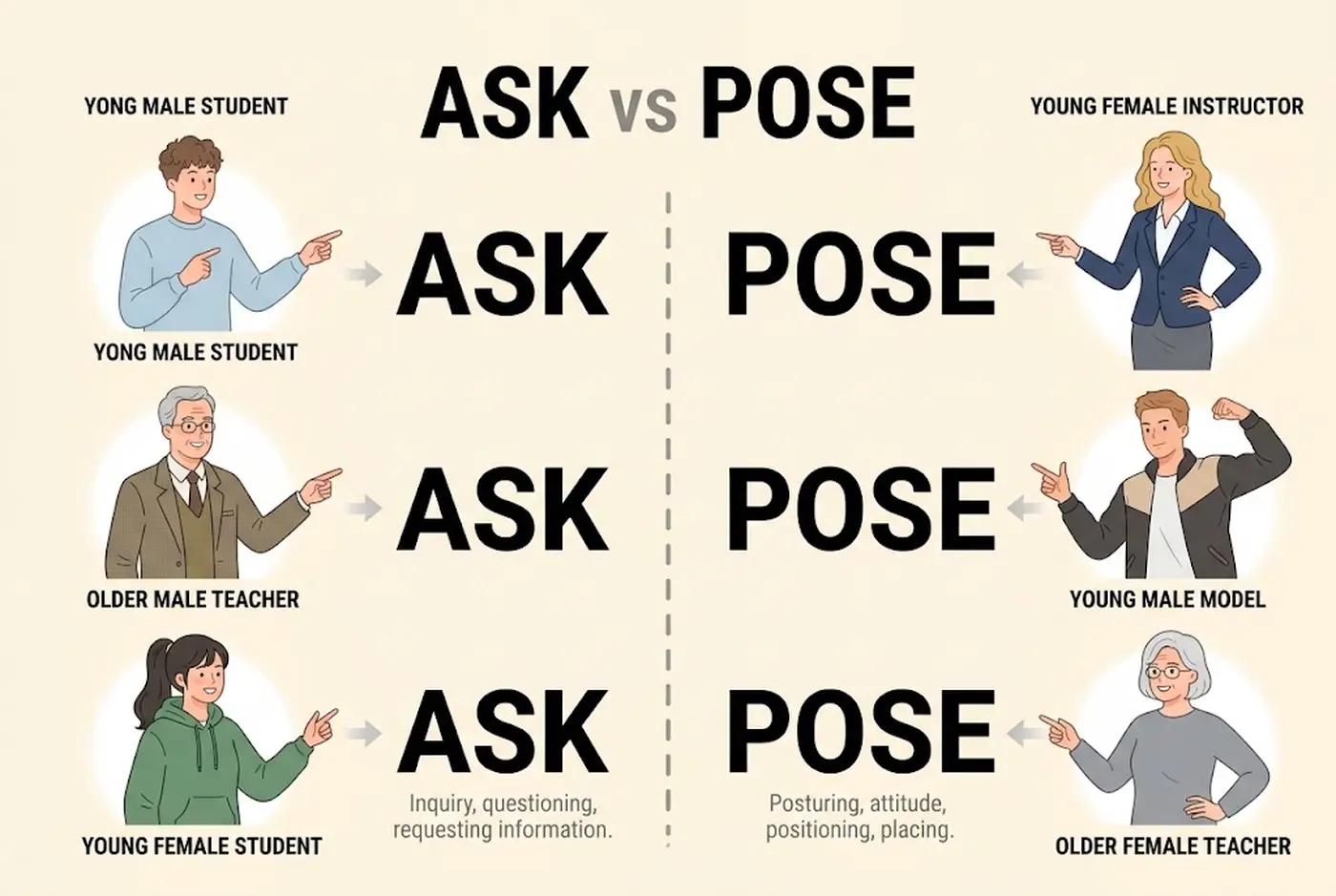
When you’re writing an email, answering an essay question, or sending a quick text, you may wonder if you should use “ask” or “pose.” The two words can sometimes appear in similar sentences, but they don’t have the same meaning or style. Ask vs Pose becomes especially useful when you want your writing to sound natural, clear, and appropriate for the situation.
The main difference is simple. Ask is the everyday word for requesting information, help, permission, or an answer. Pose is more formal and is usually used when someone presents a question, problem, challenge, or idea for consideration.
This guide explains the meanings, origins, synonyms, levels of formality, common mistakes, regional usage, and best choices for emails, resumes, essays, texts, and conversations. You’ll also see plenty of examples that show exactly how these words work.
What do ask and pose mean?
The word ask is broad and extremely common. You can ask a person a question, ask for help, ask for permission, ask someone to do something, or ask about a topic.
Examples:
- I asked my teacher a question.
- She asked for directions.
- They asked me to wait.
- He asked whether the meeting was canceled.
- Can I ask you something?
Pose has a narrower use. When pose means “ask,” it usually means to present a question for someone to consider or answer.
Examples:
- The teacher posed an interesting question.
- The journalist posed several questions to the mayor.
- The problem poses a serious challenge.
- She posed a difficult question during the discussion.
Notice the difference in tone. Ask sounds natural in ordinary conversation. Pose sounds more deliberate, formal, or academic.
Where did ask come from?
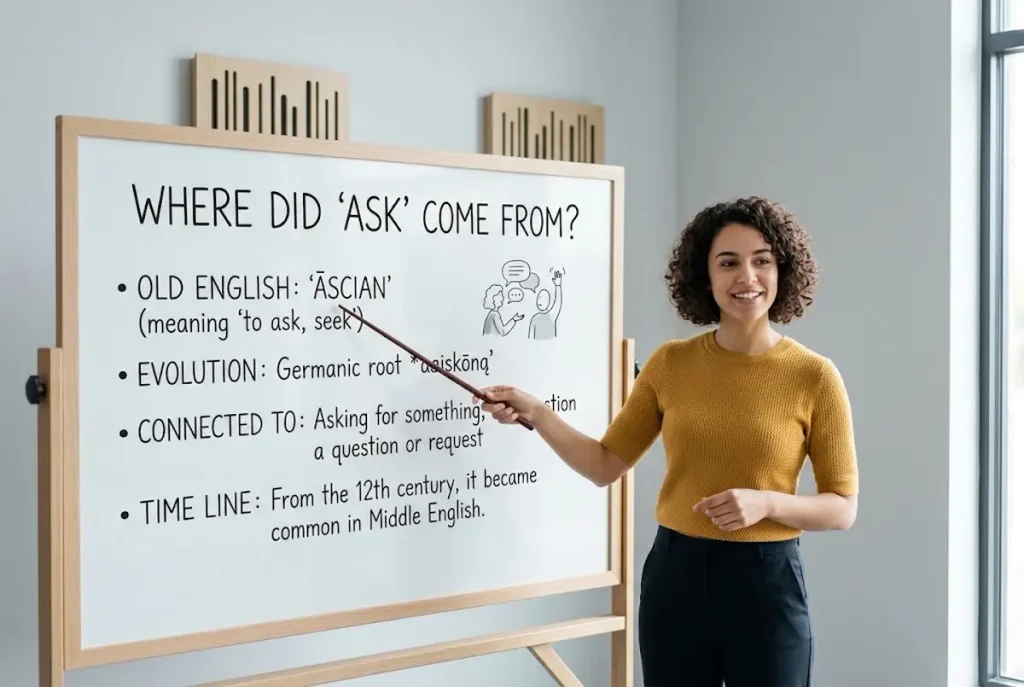
Ask is an old English word. It comes from Old English terms related to seeking information or making a request. The word has been part of English for many centuries.
Its meaning has remained fairly stable. People use it when they want information, assistance, permission, or action.
The word is also extremely flexible. It can work as both a verb and, in the form “ask,” as a noun in some expressions.
For example:
- I need to ask a question.
- She asked for help.
- He asked me to call later.
- That’s a fair ask.
The noun use of ask is especially common in modern business and workplace English. It refers to something someone wants, requests, or expects from another person.
Where did pose come from?
Pose entered English through French and ultimately has roots connected to Latin. Its history is related to ideas such as placing or putting something forward.
That basic idea helps explain its modern meaning.
When you pose a question, you put the question in front of someone for consideration. When you pose a problem, you present that problem as something that needs attention or thought.
Pose has several other meanings, too. A person can pose for a photograph, for example. Something can also pose a danger or threat.
Compare these:
- The teacher asked a question.
- The teacher posed a question.
- The storm poses a danger.
In the second sentence, the question is being presented for consideration. In the third sentence, pose does not mean “ask” at all. It means “present or create” a particular situation or risk.
What is the difference between ask and pose?
The easiest way to understand the difference is to focus on purpose and tone.
| Word | Basic meaning | Usual tone | Common use |
|---|---|---|---|
| Ask | Request information or action | Neutral | Conversation, texts, emails |
| Pose | Present something for consideration | Formal | Essays, journalism, academic writing |
| Question | Ask for information | Neutral | Formal and everyday writing |
| Inquire | Request information | Formal | Business and official communication |
| Raise | Bring a question or issue forward | Neutral to formal | Meetings and discussions |
| Present | Put an idea or issue forward | Formal | Academic and professional writing |
What are the best synonyms for ask and pose?
English gives you many ways to express the idea of asking, requesting, presenting, or raising an issue. The best choice depends on the situation.
Simple synonyms
| Word | Meaning | Tone | Example |
|---|---|---|---|
| Ask | Request information or help | Simple | I asked him for help. |
| Question | Ask for information | Neutral | She questioned the decision. |
| Request | Ask for something | Neutral | I requested a copy. |
| Say | Speak or express something | Simple | He said he had a question. |
| Seek | Try to get information | Neutral | We seek more information. |
| Need | Express a requirement | Simple | I need some advice. |
Everyday synonyms
| Word | Meaning | Tone | Example |
|---|---|---|---|
| Check | Ask to confirm something | Casual | I wanted to check the time. |
| Bring up | Introduce a topic | Casual | She brought up an important issue. |
| Raise | Introduce a question or concern | Neutral | He raised a good question. |
| Wonder | Express uncertainty or curiosity | Everyday | I was wondering about the schedule. |
| Find out | Get information | Everyday | I called to find out the price. |
| Talk about | Discuss a subject | Everyday | We talked about the problem. |
| Get clarification | Ask for a clearer explanation | Neutral | I need to get clarification. |
Formal synonyms
| Word | Meaning | Tone | Example |
|---|---|---|---|
| Inquire | Request information | Formal | I am writing to inquire about the position. |
| Enquire | British form of inquire | Formal | She enquired about the course. |
| Pose | Present a question | Formal | The researcher posed a difficult question. |
| Raise | Present an issue for discussion | Formal | The report raises several concerns. |
| Submit | Formally present a question or request | Formal | Students may submit questions online. |
| Solicit | Seek something formally | Formal | The company solicited feedback. |
| Request | Formally ask for something | Formal | We request additional information. |
| Propose | Put forward an idea | Formal | She proposed a new solution. |
| Present | Put an idea or issue forward | Formal | He presented a challenging question. |
Which synonyms are mild and which are strong?
Not every word related to ask has the same level of force.
A useful scale is:
Mild → Neutral → Direct → Formal → Strong
Mild
Words such as wonder, check, and inquire can make a request sound less direct.
Example:
I was wondering if you could send the file.
This can sound polite because the speaker does not give a blunt command.
Neutral
Ask and request are useful in most ordinary situations.
I asked for a copy of the report.
I requested a copy of the report.
The second sentence sounds slightly more formal.
Direct
Question and demand can sound stronger, depending on context.
The reporter questioned the witness.
The manager demanded an explanation.
Demand is much stronger than ask. It suggests that the speaker expects compliance.
Formal
Pose, inquire, raise, submit, and solicit can sound more formal depending on the sentence.
The researcher posed an important question.
The committee raised several concerns.
Strong
Words such as demand, challenge, confront, and insist can express pressure or disagreement.
The customer demanded a refund.
That is very different from:
The customer asked for a refund.
How do ask and pose work as different parts of speech?
Ask is mainly used as a verb, although it can also function as a noun in modern English.
As a verb:
I asked a question.
As a noun:
The manager made a difficult ask.
Pose is also mainly used as a verb, but it has several meanings.
As a verb meaning present:
She posed an interesting question.
As a verb meaning create a risk:
The leak poses a safety risk.
As a verb meaning position yourself:
The model posed for a photograph.
Pose can also be a noun when referring to a particular body position.
Hold that pose for a few seconds.
This difference matters because replacing ask with pose in every sentence will create errors. The words overlap in one meaning, but they are not interchangeable everywhere.
Is ask or pose more common in American English?
Ask is much more common in everyday American English. People use it constantly in conversations, texts, emails, classrooms, and workplaces.
Pose is also normal American English, but it appears more often in formal, academic, journalistic, or professional contexts.
For example:
I want to ask you a question.
This sounds completely natural.
I want to pose a question to you.
This sounds more formal and deliberate.
American speakers understand both sentences, but the first is the ordinary choice.
British English uses both words as well. There is no major US versus UK difference in the basic distinction.
One regional difference appears with inquire and enquire. American English generally prefers inquire, while British English commonly uses enquire in many everyday contexts.
What is the best word for a resume?
For a resume, ask is usually not the strongest word unless you are describing a specific action.
Resume writing often benefits from precise action verbs.
Instead of:
Asked customers about their needs.
You could write:
Assessed customer needs through targeted questions.
Instead of:
Asked team members for feedback.
You could write:
Gathered feedback from team members.
For a professional document, the best word depends on what actually happened. Do not use pose simply because it sounds more advanced.
If your role involved presenting questions during research, pose can work:
Posed research questions to participants during interviews.
That sentence is more specific and professional than simply saying “asked questions.”
What is the best word for an essay?
Pose is often useful in essays because academic writing frequently discusses questions, problems, and ideas.
Example:
The novel poses an important question about personal freedom.
You could write:
The novel asks an important question about personal freedom.
Both are grammatically correct. Pose gives the sentence a more analytical tone.
Ask is still useful when describing what a person actually did:
The teacher asked students to explain their answers.
Pose works well when you are discussing a question as an intellectual issue:
The experiment poses a difficult question for modern scientists.
What is the best word for texting?
Ask is the clear choice for most texts.
Examples:
Can I ask you something?
Ask Sarah if she’s coming.
I wanted to ask about tomorrow.
Using pose in a casual text can sound unnecessarily formal:
Can I pose a question?
This is grammatically possible, but it may sound stiff between friends.
A playful or intentionally formal message might use it, but ordinary texting usually favors ask.
What is the best word for email?
The answer depends on the type of email.
For a friendly or ordinary workplace email, ask is natural:
I wanted to ask if the meeting could be moved to Friday.
For a formal business email, inquire or request may work better:
I am writing to inquire about the application process.
For an academic or analytical email, pose can be appropriate:
I would like to pose a question about the research findings.
The goal is not to choose the most formal word. The goal is to choose the word that matches your purpose and audience.
What is the best word for speaking?
Ask is almost always the natural choice in everyday speech.
Examples:
Can I ask you something?
Did you ask your brother?
I asked her where she lived.
Pose is more likely to appear in a presentation, lecture, interview, or formal discussion.
For example:
Let me pose a question for the group.
That sounds natural because the speaker is deliberately presenting a question to an audience.
What are some real examples of ask?
Here are examples from different situations.
- I asked my teacher to explain the rule again.
- She asked me where I bought the book.
- Can I ask you a quick question?
- He asked for permission before leaving.
- We asked the hotel for a later checkout.
- The customer asked about the return policy.
- I asked my friend for advice.
- They asked whether the event had been canceled.
- The student asked a thoughtful question.
- She asked her manager for another day to finish the project.
- I called to ask about my application.
- He asked me to send the document again.
- The child asked why the sky looked orange.
- We asked the guide for directions.
- She asked everyone to remain quiet.
These examples show why ask is so flexible. It can describe questions, requests, permission, instructions, and information seeking.
What are some real examples of pose?
Pose is more limited but very useful in the right setting.
- The professor posed a challenging question.
- The article poses an interesting problem.
- The reporter posed several questions during the interview.
- The situation poses a serious risk.
- The scientist posed a new theory for discussion.
- The documentary poses difficult questions about technology.
- The speaker posed a question to the audience.
- The lack of funding poses a major challenge.
- The study poses an important question for future research.
- The journalist posed a difficult question to the candidate.
- The new evidence poses a problem for the original theory.
- The teacher posed a question that made the class think.
- The proposal poses several practical concerns.
- The issue poses a challenge for local communities.
- The book poses questions about identity and memory.
Notice how many of these examples involve an idea, issue, challenge, or question being placed before someone for consideration.
Ask vs inquire — what is the difference?
| Ask | Inquire |
|---|---|
| Common in everyday English | More formal |
| Works in speech and writing | Common in formal writing |
| Natural with people | Often used with information |
| Very flexible | More specific |
Ask vs request — what is the difference?
You can ask someone a question:
I asked her why she was late.
You can request something:
I requested a refund.
But request usually focuses on obtaining something or asking for an action. Ask can involve information, permission, action, or a simple question.
Compare:
I asked him what happened.
I requested that he leave.
The first seeks information. The second seeks an action.
Ask vs raise — what is the difference?
Raise is commonly used when someone introduces a question, concern, issue, or topic.
She raised an important question.
She asked an important question.
These sentences are close, but raise emphasizes bringing the issue into a discussion.
For example:
The employee raised concerns about the new policy.
This does not simply mean the employee wanted information. It means the employee brought concerns forward for attention.
Ask vs pose — what is the practical difference?
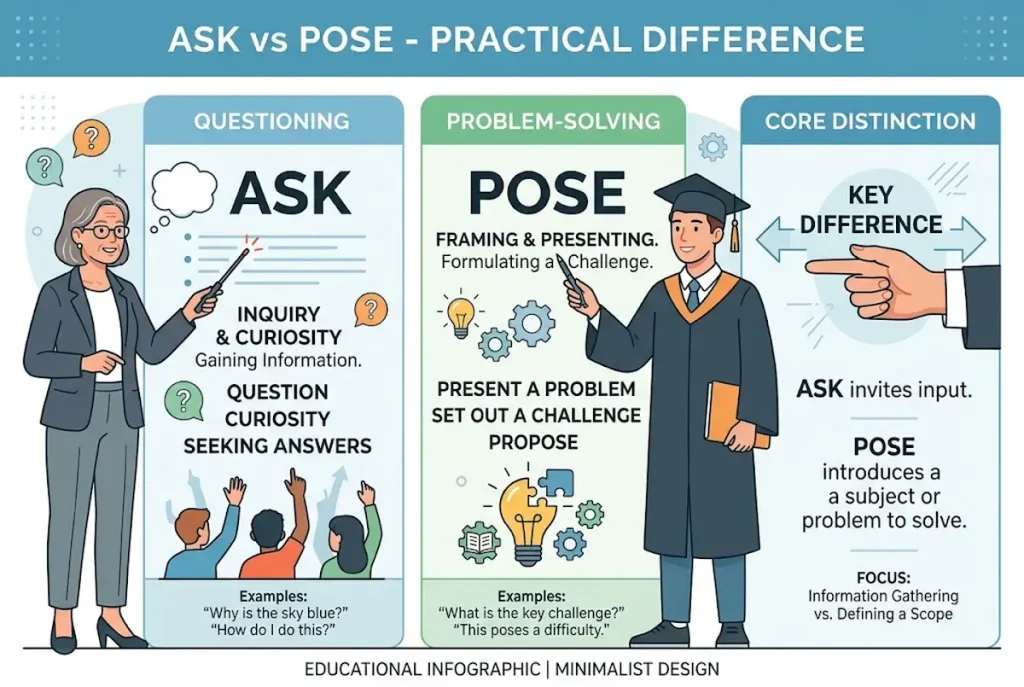
The main difference is context.
| Ask | Pose |
|---|---|
| Everyday | More formal |
| Questions | Questions and problems |
| Requests | Issues and challenges |
| Information seeking | Presentation for consideration |
| Conversation | Academic and professional writing |
| Very flexible | More limited |
Use ask when someone wants an answer, piece of information, favor, or action.
Use pose when you want to emphasize that a question, problem, risk, or challenge has been presented for consideration.
For example:
The student asked a question.
This simply tells us that the student wanted information.
The question posed a challenge for the students.
What are the common mistakes with ask and pose?
Using pose with a person incorrectly
A common mistake is:
I posed him a question.
This construction is not standard in ordinary American English.
Better:
I asked him a question.
Or:
I posed a question to him.
Using pose in every formal sentence
Some writers think pose always sounds better because it is more sophisticated.
That can make writing unnatural.
Instead of:
I would like to pose a request for additional information.
Write:
I would like to request additional information.
Pose is best connected to questions, problems, challenges, risks, and similar ideas.
Confusing pose with posture
Pose can refer to a physical position.
She posed for a picture.
Posture refers more generally to the way someone holds their body.
Good posture can reduce back strain.
They are related but not identical.
Assuming pose always means ask
Pose has several meanings.
The chemical poses a danger.
Here, pose does not mean ask.
He posed for the camera.
Here, pose does not mean ask.
Context determines the meaning.
Making casual writing too formal
A text such as:
May I pose an inquiry concerning your arrival time?
sounds much more formal than necessary.
A natural version is:
What time are you arriving?
Clear writing does not need complicated vocabulary.
When should you not use pose?
Avoid pose when you simply want to describe an ordinary request.
Instead of:
I posed my mother for permission.
Say:
I asked my mother for permission.
Do not use pose when the sentence requires a direct object referring to a person in the same way ask does.
Incorrect or unnatural:
She posed me to help her.
Better:
She asked me to help her.
Also avoid pose when a simpler word communicates the idea more accurately.
Instead of:
I posed for information about the train.
Say:
I asked for information about the train.
What are the antonyms of ask and pose?
The exact opposite depends on the meaning.
For ask meaning seek information, possible opposites include:
- Answer
- Respond
- Explain
- Tell
- Provide
- Inform
Example:
I asked a question.
She answered the question.
For ask meaning request, possible opposites include:
- Give
- Provide
- Grant
- Refuse
- Deny
For pose meaning present a problem or challenge, possible opposites might include:
- Solve
- Remove
- Resolve
- Prevent
- Avoid
Example:
The problem poses a challenge.
The new system resolves the problem.
There is no single antonym that works in every situation.
How can you choose the right word quickly?
Use these simple questions.
Are you simply requesting information?
Use ask.
I asked where the station was.
Are you requesting help or permission?
Use ask.
I asked my manager for permission.
Are you presenting a question for thought?
Pose may be better.
The author poses an important question.
Are you writing an academic essay?
Ask and pose can both work. Use pose when discussing an intellectual question or problem, and ask when describing an actual person’s action.
Are you texting a friend?
Use ask.
Can I ask you something?
What should you remember about ask vs pose?
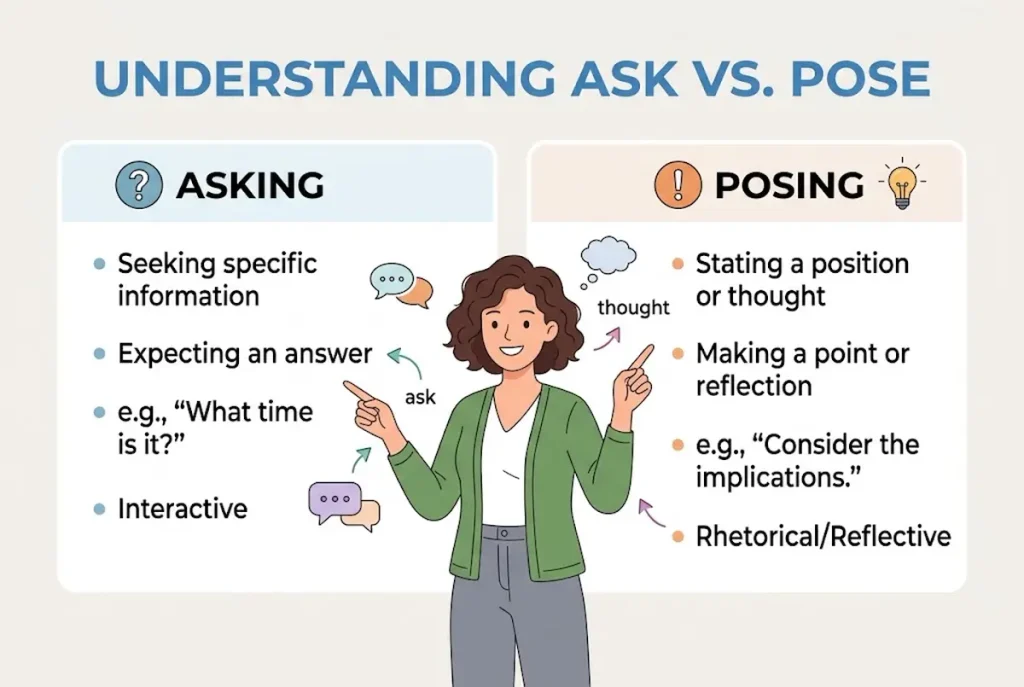
The simplest rule is this: use ask for ordinary questions and requests. Use pose when you want to present a question, problem, challenge, or idea for consideration.
Ask is flexible, common, and natural. It belongs almost everywhere.
Pose is more specialized. It adds a formal or analytical tone when it means presenting something for consideration. It also has separate meanings related to physical positioning and creating a risk or challenge.
You don’t need to replace a simple word with a complicated one just to make your writing sound smarter. Good word choice means choosing the word that fits the meaning, audience, and situation.
Conclusion
Choosing between ask vs pose becomes much easier when you focus on the purpose of the sentence. Use ask for everyday questions, requests, permission, help, and information. It is the natural choice for conversations, texts, and most ordinary emails. Use pose when you are presenting a question, problem, challenge, or idea for someone to consider, especially in academic, professional, or analytical writing.
Remember that pose has other meanings too. A person can pose for a picture, and a situation can pose a risk. That means context matters.
When you’re unsure, ask is usually the simpler and safer choice. If your sentence focuses on presenting a serious question or problem for consideration, pose may be the more precise word.
Frequently Asked Questions
Is ask more common than pose?
Yes, ask is much more common in everyday English. Pose is used more often in formal, academic, professional, and analytical contexts.
Can I use pose instead of ask?
Sometimes, but not always. You can say “pose a question,” but you generally cannot replace every use of ask with pose.
What is the difference between ask and pose?
Ask usually means to request information, help, permission, or action. Pose usually means to present a question, problem, challenge, or idea for consideration.
Is pose more formal than ask?
Yes, when pose means present a question, it usually sounds more formal or deliberate than ask. This is one of the main reasons it appears frequently in academic and professional writing.
Can you say pose a question to someone?
Yes. “Pose a question to someone” is grammatically correct and means to present a question for that person to answer or consider.
What’s another way to say ask a question?
You can say raise a question, pose a question, inquire, seek information, or request clarification. The best alternative depends on the level of formality and the exact meaning.
Is ask vs pose important in academic writing?
Yes. Both can be correct, but they create different tones. Ask is natural when describing what a person did, while pose works well when discussing a question as an issue for thought or analysis.
Is pose the same as request?
No. Pose usually means present something for consideration, while request means formally or directly ask for something. They can overlap in some contexts but are not interchangeable.

Daniel Grammarfield — The Language Learner
Age: 28Occupation: ESL Learner & Digital Professional
Bio:Daniel is a non-native English speaker who wants to communicate more confidently at work and online. He uses Synotrench to improve grammar, understand confusing words, learn correct sentence structures, and build everyday English skills. He prefers simple explanations with practical examples.
Goals:
Master English grammar rules
Avoid common language mistakes
Improve professional communication
Learn English through real-life examples
Quote:“Learning English is not about memorizing rules — it’s about expressing ideas clearly.”
1 thought on “Ask vs Pose: The Best Simple Guide (2026)”