Imagine you’re writing an email to your coworkers and want to say that everyone must attend an important meeting. You type, “Every people must attend the meeting.” But something doesn’t sound quite right. Should you write every person or every people?
This small grammar mistake is common among English learners. Both person and people refer to human beings, but they follow different grammar rules. Choosing the correct expression can make your writing clearer and more natural.
In this guide, you’ll learn the difference between these expressions, their meanings, grammar rules, useful alternatives, and common mistakes. You’ll also find practical examples for emails, essays, resumes, texting, and everyday conversations.
What Does Every Person or Every People Mean?
The difference becomes easier to understand when you look at how English treats singular and plural nouns.
What Does Every Person Mean?
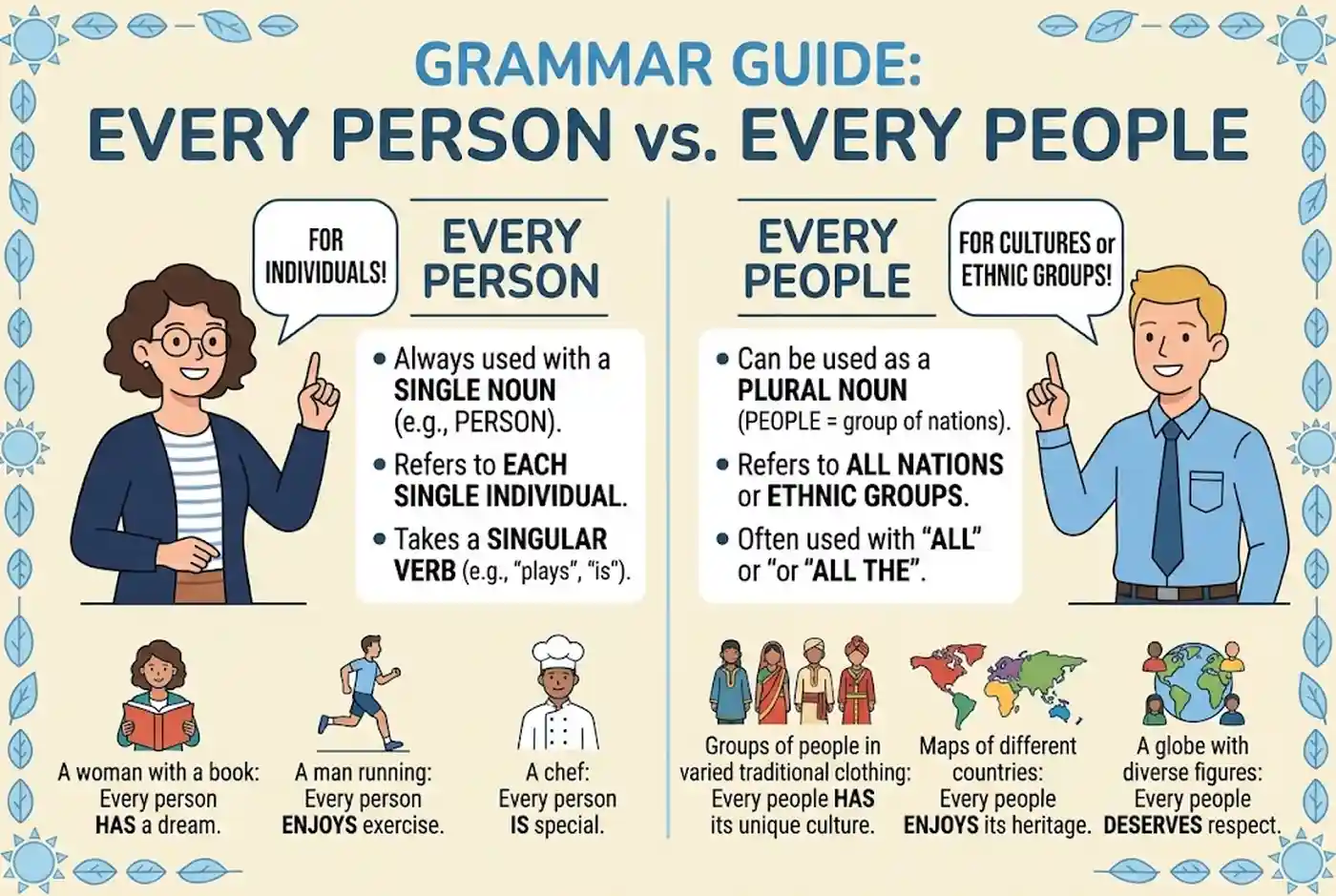
Every person means each individual in a particular group. It includes all members without leaving anyone out.
The expression focuses on people individually, even when discussing a large group.
Examples:
- Every person deserves respect.
- Every person must follow the safety rules.
- Every person has a different opinion.
- Every person in the classroom received a notebook.
- Every person should have access to clean drinking water.
Notice that the sentences use singular verbs such as has, deserves, and receives.
This happens because every person is grammatically singular.
Why Is Every People Usually Incorrect?
People is normally the plural form of person.
Compare these examples:
| Incorrect | Correct |
|---|---|
| Every people is important. | Every person is important. |
| Every people have rights. | Every person has rights. |
| Every people need food. | Every person needs food. |
| Every people are different. | Every person is different. |
| Every people should vote. | Every person should vote. |
Can Every People Ever Be Correct?
Yes, but only in a special context.
People can also be a singular collective noun meaning a nation, ethnic group, or distinct community. Its plural form in this sense is peoples.
For example:
- Every people has its own cultural traditions.
This usage is uncommon in everyday conversation. It appears more often in historical, cultural, political, and academic writing.
For ordinary sentences about individual human beings, every person is the natural choice.
Where Do Person and People Come From?
Understanding the history of these words helps explain why English uses two different forms.
The Origin of Person
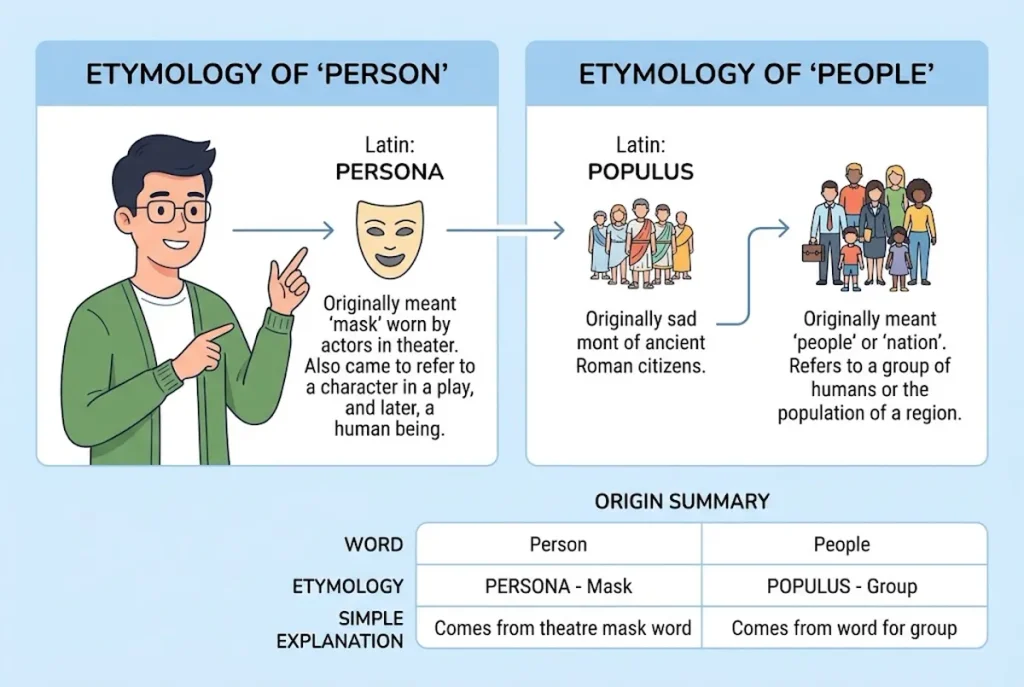
Person entered English through Old French from the Latin word persona.
In Latin, persona originally referred to a theatrical mask or character. Its meaning later expanded to describe an individual human being.
Today, person is a singular countable noun.
Examples:
- One person entered the room.
- A person called yesterday.
- Every person needs encouragement.
The Origin of People
Everyone comes from the Latin word populus, meaning a population or community.
It entered English through Old French and developed into the common plural form used for person.
Examples:
- Three people entered the room.
Persons appears mainly in legal, official, and administrative language.
For example:
“Only authorized persons may enter.”
In normal conversation, most speakers would say:
“Only authorized people may enter.”
Why Does Every Require a Singular Noun?
Every developed from an Old English expression meaning each of a whole group.
Modern English uses it to refer to all members of a group while considering them individually.
That’s why we write:
- Every student.
- Every teacher.
- Every child.
- Every person.
We don’t normally write every students, every teachers, or every children.
What Is the Grammar Rule for Every Person?
The basic rule is simple:
Every + singular countable noun + singular verb.
Consider this structure:
| Grammar element | Example |
|---|---|
| Determiner | Every |
| Singular noun | Person |
| Singular verb | Has |
| Remaining sentence | A responsibility |
Should You Use Has or Have After Every Person?
Use has because person is singular.
Examples:
- Every person has a unique personality.
- Every person has the right to speak.
- Every person has something valuable to offer.
Use have when the subject is plural.
Examples:
- All people have different experiences.
- Many person have similar concerns.
- These have important responsibilities.
Should You Use Is or Are?
The same rule applies to is and are.
| Subject | Correct verb | Example |
|---|---|---|
| Every person | Is | Every person is welcome. |
| Each person | Is | Each person is responsible. |
| Everyone | Is | Everyone is ready. |
| All people | Are | All people are welcome. |
| Many people | Are | Many people are interested. |
| Both people | Are | Both people are available. |
What Are the Best Alternatives to Every Person?
Repeating the same expression can make your writing sound unnatural.
English offers several alternatives, including everyone, everybody, each individual.
However, these words don’t always carry exactly the same meaning or tone.
The following table includes 30 useful expressions grouped by writing style.
Some are close replacements, while others work only in particular contexts.
Simple Alternatives
These expressions are easy to understand and work well in everyday writing.
| Word or Phrase | Meaning | Tone | Example |
|---|---|---|---|
| Everyone | All individuals in a group | Simple | Everyone deserves kindness. |
| Everybody | All people being discussed | Friendly | Everybody enjoyed the event. |
| Each person | Individuals considered separately | Neutral | Each person received a ticket. |
| All people | People considered collectively | Simple | All people need clean water. |
| Every individual | Each separate human being | Neutral | Every individual matters. |
| Each one | Every member separately | Simple | Each one received a gift. |
| All of us | Everyone including the speaker | Friendly | All of us make mistakes. |
| Each of us | Every member including the speaker | Personal | Each of us has a role. |
Everyday Alternatives
These choices sound natural in conversations, emails, and informal writing.
| Word or Phrase | Meaning | Tone | Example |
|---|---|---|---|
| All of them | Every member of a mentioned group | Casual | All of them arrived early. |
| The whole group | Everyone in one group | Neutral | The whole group agreed. |
| Every single person | All individuals without exception | Emphatic | Every single person helped. |
| One and all | Everyone collectively | Warm | We welcome one and all. |
| Each member | Every individual belonging to a group | Neutral | Each member received an invitation. |
| All concerned | Everyone involved in a matter | Professional | All concerned were informed. |
| Every participant | Each person taking part | Neutral | Every participant completed the survey. |
| Each attendee | Every person attending an event | Neutral | Each attendee received a badge. |
Formal Alternatives
Formal alternatives are useful in academic writing, professional documents, policies, and official communication.
| Word or Phrase | Meaning | Tone | Example |
|---|---|---|---|
| Each individual | Every separate person | Formal | Each individual has legal rights. |
| Every member | Each person within a defined group | Professional | Every member must register. |
| All individuals | Every person in a group | Formal | All individuals must provide identification. |
| Each citizen | Every member of a country’s citizenry | Formal | Each citizen has civic responsibilities. |
| Every employee | Each worker in an organization | Professional | Every employee must complete training. |
| Each applicant | Every person applying | Formal | Each applicant will receive a response. |
| All personnel | Everyone employed in an organization | Official | All personnel must follow the policy. |
| Every resident | Each person living in a particular area | Formal | Every resident received a notice. |
Which Alternative Sounds Stronger?
Some expressions communicate a simple fact. Others add emotional weight or emphasize that nobody is excluded.
You can organize them by intensity.
| Intensity | Expression | Example |
|---|---|---|
| Mild | Some people | Some people prefer working alone. |
| Neutral | Each person | Each person received instructions. |
| Neutral | Everyone | Everyone attended the meeting. |
| Clear emphasis | All people | All people deserve equal treatment. |
| Strong | Every single person | Every single person contributed. |
| Very strong | Every last one | Every last one finished the assignment. |
| Strong collective emphasis | One and all | We extend our thanks to one and all. |
When Should You Use Every Single Person?
Use every single person when you want to emphasize that nobody was excluded.
Compare:
Every person attended the meeting.
Every single person attended the meeting.
The second sentence sounds more emphatic. It suggests that attendance was complete and perhaps surprising.
Avoid using strong expressions repeatedly in formal writing because they can make ordinary statements sound exaggerated.
How Do These Alternatives Work as Different Parts of Speech?
A determiner comes before a noun and helps identify its meaning or quantity.
Other expressions can communicate a similar idea using different grammatical structures.
| Part of Speech | Expression | Example |
|---|---|---|
| Determiner + noun | Every person | Every person deserves respect. |
| Determiner + noun | Each individual | Each individual received a form. |
| Indefinite pronoun | Everyone | Everyone deserves respect. |
| Indefinite pronoun | Everybody | Everybody enjoyed the presentation. |
| Determiner + plural noun | All people | All people deserve respect. |
| Pronoun phrase | Each of us | Each of us has responsibilities. |
| Collective noun phrase | The entire team | The entire team participated. |
Is Everyone Singular or Plural?
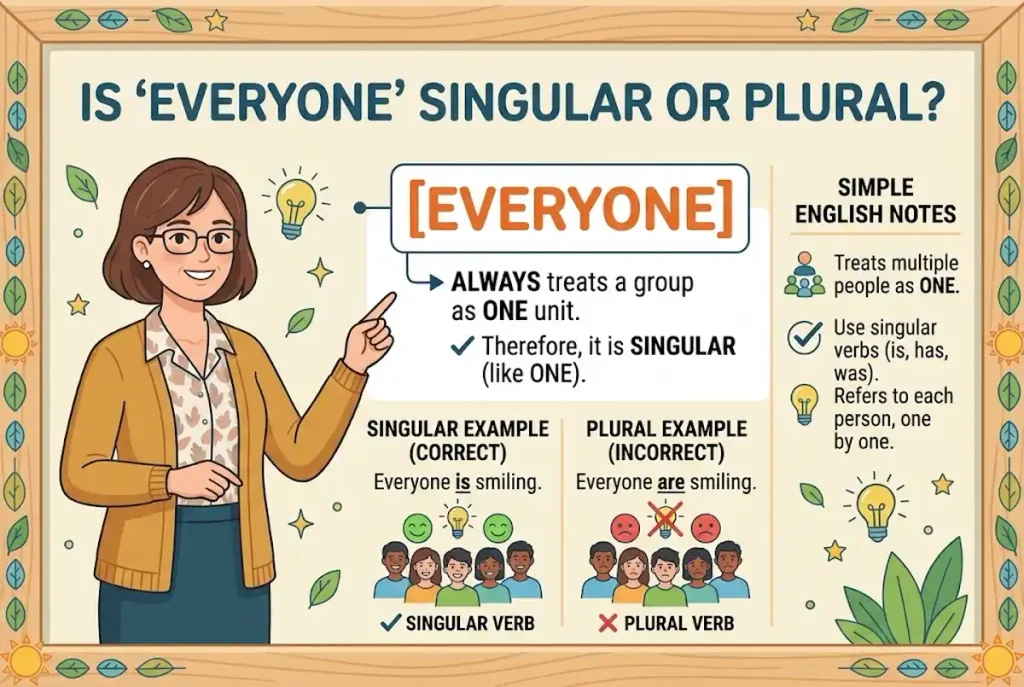
Everyone is grammatically singular.
This surprises some learners because the word refers to multiple individuals.
Correct:
Everyone is happy.
Incorrect:
Everyone are happy.
The same rule applies to everybody.
Correct:
Everybody has a chance.
Incorrect:
Everybody have a chance.
You can still use singular they when referring back to everyone.
Example:
Everyone should bring their notebook.
This is natural and widely accepted in modern English.
Is There a Difference Between American and British English?
The main grammar rule is the same in American and British English.
Both varieties normally use every person when referring to individuals.
However, a few related expressions differ in usage.
American English
American English commonly uses everyone, everybody, each person.
Examples:
- Everyone is invited.
- Each person must register.
The plural noun persons also appears in American legal and administrative writing.
For example:
“This elevator has a maximum capacity of eight persons.”
British English
British English follows the same singular noun rule.
However, British speakers may use collective nouns with plural verbs more often than American speakers.
For example:
British English: The team are ready.
American English: The team is ready.
This difference doesn’t change the grammar of every person.
Both varieties use:
Every person is ready.
When Should You Use Every Person in Different Situations?
The best expression depends on what you’re writing and whom you’re addressing.
An academic essay may need formal language, while a friendly text message should sound relaxed.
How Should You Use It in a Resume?
Resumes should focus on clear actions and measurable results.
Example:
“Provided personalized support to every person visiting the customer service desk.”
A stronger resume version might be:
“Delivered personalized support to more than 40 customers daily.”
The second version provides a measurable achievement.
You can also use each customer, every client, or all team members when those expressions describe your responsibilities accurately.
Which Expression Works Best in an Essay?
Academic essays benefit from precise and neutral language.
Use each individual when discussing personal responsibilities. Use all people when discussing society collectively.
Example:
“Every person should have access to quality education.”
Alternative:
“All individuals should have equal access to educational opportunities.”
The second sentence sounds slightly more formal.
However, don’t replace simple words with complicated ones just to make an essay appear academic.
Clarity matters more than vocabulary size.
What Should You Write in a Text Message?
Text messages usually sound better with everyone or everybody.
Example:
“Hey everyone, the movie starts at 7!”
You could also write:
“Everybody needs to bring their own snacks.”
Using every person in casual texting isn’t wrong, but it can sound unnecessarily formal.
Compare:
“Every person must arrive before 6.”
“Everyone, please get here before 6!”
The second sentence feels friendlier.
Every Person vs Everyone
These expressions have almost the same meaning, but their grammatical structures differ.
Every person contains a determiner and a singular noun.
Everyone is an indefinite pronoun that stands alone.
| Every person | Everyone |
|---|---|
| Contains two words | Contains one word |
| Uses a singular noun | Functions as a singular pronoun |
| Can emphasize individuals | Usually sounds more conversational |
| Every person is welcome. | Everyone is welcome. |
| Every person received a form. | Everyone received a form. |
Every Person vs Each Person
Both expressions refer to individuals within a group.
The difference is mainly one of emphasis.
Every considers all members of a group without excluding anyone.
Each places slightly more attention on individuals separately.
| Every person | Each person |
|---|---|
| Emphasizes complete inclusion | Emphasizes separate individuals |
| Often used for general rules | Often used for individual tasks |
| Every person must attend. | Each person must sign the form. |
| Every person deserves respect. | Each person received a personal letter. |
Every Person vs All People
This comparison is especially useful because both expressions describe complete groups.
The main difference is grammatical.
| Every person | All people |
|---|---|
| Singular construction | Plural construction |
| Focuses on individuals | Focuses on people collectively |
| Takes singular verbs | Takes plural verbs |
| Every person has rights. | All people have rights. |
| Every person is different. | All people are different. |
Every Person vs Every One
Every person refers specifically to human beings.
It can refer to people or things.
Every one is a two-word expression that emphasizes each member of a particular group.
Examples:
- Every person received a certificate.
- Every one of the students received a certificate.
- Every one of the books was damaged.
Don’t confuse every one with everyone.
Everyone refers to people and is written as one word.
Every one emphasizes individual members and is written as two words.
Compare:
Everyone arrived early.
Every one of the participants arrived early.
Both sentences are correct.
What Are 15 Real-Life Examples of Every Person?
Looking at complete sentences can help you recognize the correct grammar more quickly.
The following examples cover school, work, family, public communication, and everyday situations.
School and Education
- Every person in our class has a different learning style.
- Every person deserves an opportunity to ask questions.
- Every person attending the seminar must register online.
Workplace Situations
- Every person on the team is responsible for meeting deadlines.
- Every person must wear an identification badge inside the building.
- Every person who applied for the position received a response.
Family and Social Life
- Every person in our family enjoys spending time together.
- Every person brought something delicious to the dinner.
- Every person at the birthday party received a small gift.
Public Communication
- Every person has the right to express an opinion.
- Every person should follow local traffic laws.
- Every person entering the hospital must follow its safety procedures.
Everyday Conversations
- Every person I met during the trip was friendly.
- Every person in the waiting room looked tired.
- Every person needs a little encouragement sometimes.
What Are the Most Common Grammar Mistakes?
Small errors involving singular and plural nouns can make otherwise clear sentences sound unnatural.
These are the mistakes worth checking before publishing or sending your writing.
Mistake 1 Using Every With a Plural Noun
Incorrect: Every people need help.
Correct: Every person needs help.
Alternative: All people need help.
Remember that every normally requires a singular countable noun.
Mistake 2 Using a Plural Verb
Incorrect: Every person have a choice.
Correct: Every person has a choice.
The verb must agree with the singular subject.
Mistake 3 Confusing Everyone and Every One
Incorrect: Every one deserves happiness.
Correct: Everyone deserves happiness.
The two-word form is possible when emphasizing individual members of a defined group, but everyone is the natural choice for this general statement.
Mistake 4 Writing Every Persons
Incorrect: Every persons should participate.
Correct: Every person should participate.
Persons is a valid plural noun, but it cannot normally follow every directly.
Mistake 5 Writing All Person
Incorrect: All person are welcome.
Correct: All people are welcome.
When Should You Avoid Using Every Person?
Although the expression is grammatically correct, it isn’t always the best choice.
Avoid it when a more specific noun would make your meaning clearer.
For example:
Less specific: Every person must submit the assignment.
More specific: Every student must submit the assignment.
The second sentence immediately identifies the intended audience.
You should also avoid using it when you mean only some members of a group.
Compare:
“Every person attended the event.”
“Most people attended the event.”
These sentences communicate different facts.
Every person means complete attendance. Most people means a majority attended, but some may have been absent.
In formal writing, be careful with universal claims.
For example, saying every person enjoys music is too broad because individual preferences vary.
A more accurate sentence might be:
“Many people enjoy listening to music.”
Choose expressions that reflect what you can actually support.
What Is the Opposite of Every Person?
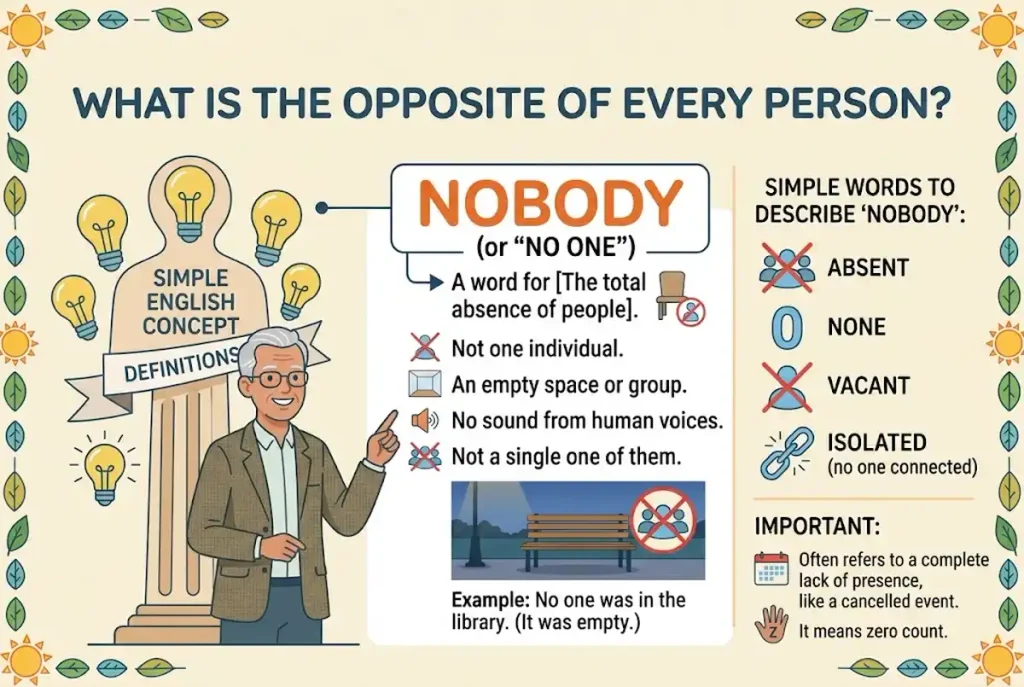
There isn’t one perfect antonym for this expression. The best opposite depends on the sentence.
| Expression | Opposite or Contrast | Example |
|---|---|---|
| Every person | No person | No person entered the room. |
| Everyone | No one | No one answered the question. |
| Everybody | Nobody | Nobody attended the event. |
| All people | Some people | Some people disagreed. |
| Each person | Not every person | Not every person received a ticket. |
| Every member | Only certain members | Only certain members participated. |
Pay attention to the difference between no one and not everyone.
No one means zero people.
Not everyone means at least one person is excluded, but others may still be included.
For example:
“No one passed the test.”
This means every student failed.
“Not everyone passed the test.”
This means at least one student failed, but some may have passed.
Quick Tips for Choosing the Right Expression
You don’t need to memorize complicated grammar terminology to make the correct choice.
Use these practical rules:
- Use every person when discussing all individuals separately.
- Use everyone or everybody for natural everyday conversation.
- Use each person when emphasizing individual tasks or responsibilities.
- Use a singular verb after every person, everyone, and everybody
- Choose specific nouns such as employee, student, customer, or participant when possible.
A Simple Grammar Test
Try replacing person with another singular noun.
For example:
Every student has a notebook.
Every teacher has a notebook.
All three sentences follow the same structure.
Now compare:
All students have notebooks.
All teachers have notebooks.
This simple substitution makes the singular and plural difference easier to remember.
Conclusion
The choice between every person or every people becomes simple once you understand how singular and plural nouns work in English. Use every person when referring to all individuals in a group. It follows the normal rule that every takes a singular countable noun and a singular verb.
If you want a more conversational expression, everyone and everybody are excellent alternatives. For collective statements, all people works naturally. Each person is particularly useful when discussing individual responsibilities or separate actions.
Remember that good grammar isn’t about choosing the most complicated expression. It’s about communicating your meaning clearly.
Before finishing an email, essay, or important document, check your subject and verb agreement. A quick grammar check can make your writing sound more confident, accurate, and natural.
Frequently Asked Questions
What’s Another Way to Say Every Person?
You can say everyone, everybody, each person, each individual, or all people. Choose the expression that best matches your sentence and writing style.
Is Every Person Singular or Plural?
Every person is grammatically singular. It takes singular verbs such as is, has, needs, and deserves.
Should I Say Every Person Has or Have?
Use every person has. For example, “Every person has the right to express an opinion.”
What Is the Difference Between Everyone and Every Person?
Both expressions refer to all individuals in a group. Everyone is a singular pronoun, while every person combines a determiner with a singular noun.
Can I Use Every Person in Formal Writing?
Yes. It’s suitable for essays, workplace communication, policies, and official documents. However, a more specific expression such as each employee or every participant may provide greater clarity.

Daniel Grammarfield — The Language Learner
Age: 28Occupation: ESL Learner & Digital Professional
Bio:Daniel is a non-native English speaker who wants to communicate more confidently at work and online. He uses Synotrench to improve grammar, understand confusing words, learn correct sentence structures, and build everyday English skills. He prefers simple explanations with practical examples.
Goals:
Master English grammar rules
Avoid common language mistakes
Improve professional communication
Learn English through real-life examples
Quote:“Learning English is not about memorizing rules — it’s about expressing ideas clearly.”
3 thoughts on “Every Person or Every People: Simple Grammar Guide”