Have you ever written an email and stopped to wonder if you should use every day vs everyday? Maybe you’re writing about your daily routine, describing your favorite shoes, or sending a quick text to a friend. Both expressions look almost identical, but that little space makes a big difference.
The confusion around every day vs everyday is common, even among people who speak English fluently. Both forms are correct, but they serve different purposes in a sentence. Using the wrong one can make an otherwise clear sentence sound awkward.
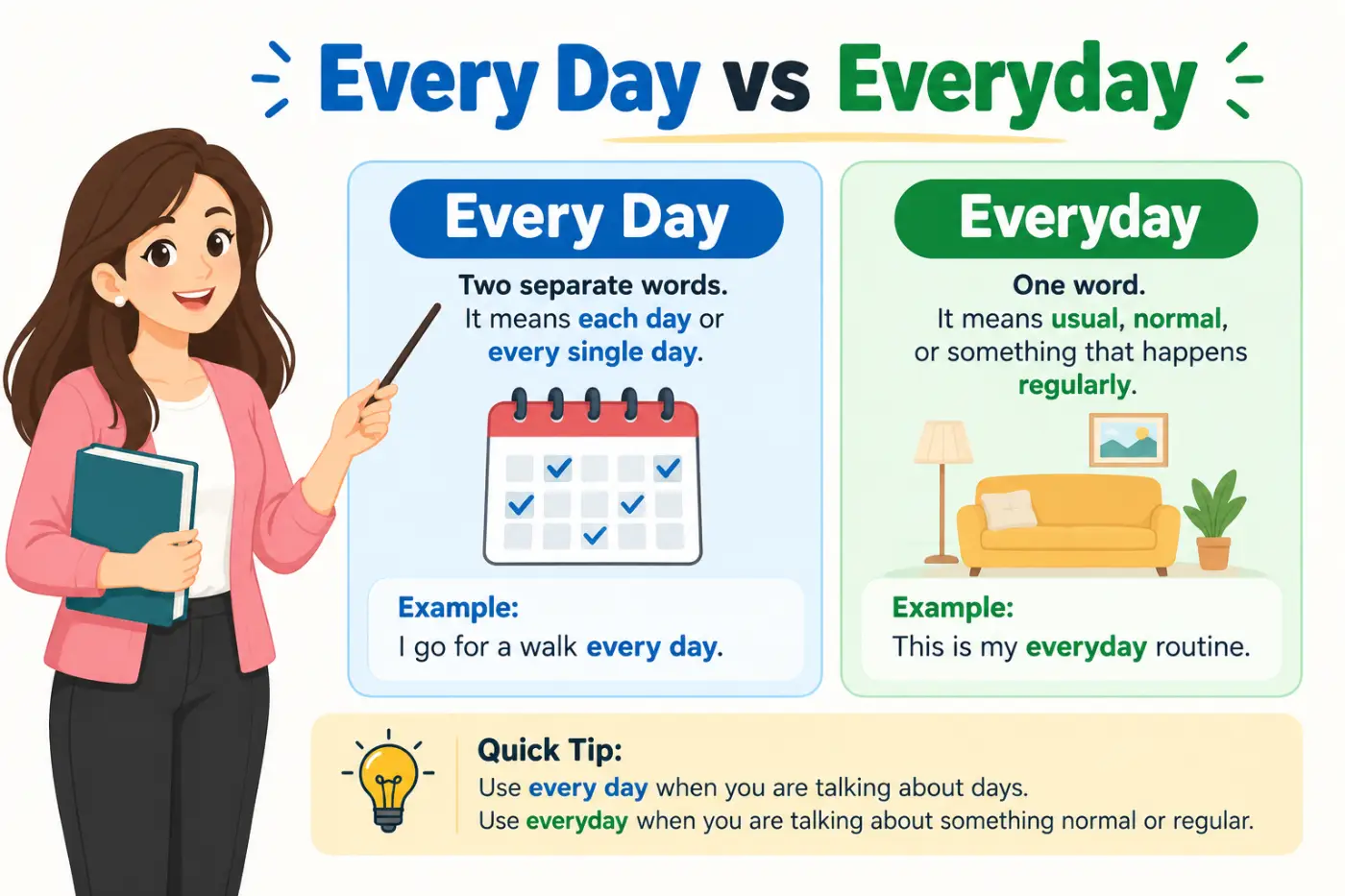
Every day means each day and tells us how often something happens. Everyday is an adjective that describes something ordinary, common, or used regularly.
Once you understand this simple difference, choosing the correct form becomes much easier. This guide explains their meanings, origins, grammar rules, alternatives, and real-life examples. You’ll also learn a quick test that helps you avoid mistakes in emails, essays, resumes, and everyday conversations.
What Is the Difference Between Every Day and Everyday?
The main difference is grammatical. One expression tells us about time, while the other describes a person, thing, or situation.
| Expression | Meaning | Grammar | Example |
|---|---|---|---|
| Every day | Each day | Determiner + noun | I exercise every day. |
| Everyday | Ordinary or common | Adjective | These are my everyday shoes. |
The easiest way to remember the difference is to look at what you’re trying to say.
If you’re explaining how frequently something happens, write two words.
If you’re describing something as ordinary, usual, or suitable for regular use, write one word.
Compare these sentences:
- I wear these shoes every day.
- These are my everyday shoes.
The first sentence explains how often you wear the shoes. The second describes the type of shoes.
Both sentences are grammatically correct, but they communicate slightly different ideas.
What Does Every Day Mean in Simple English?
Every day means each day or daily. It describes an action, habit, or event that happens on each individual day.
For example:
- I drink coffee every day.
- She walks her dog every day.
- We practice English every day.
- My father reads the newspaper every day.
- They call their grandparents every day.
In these examples, the expression answers the question, “How often?”
Although the two words often work together as a time expression, they have separate grammatical roles.
Every is a determiner, and day is a singular noun.
You can also replace the entire expression with each day without changing the basic meaning.
Example:
I study English every day.
I study English each day.
Both sentences describe a daily activity.
What Does Everyday Mean in Simple English?
Everyday is an adjective meaning ordinary, common, usual, or suitable for regular use.
It normally appears before a noun and describes that noun.
Examples include:
- Everyday clothes
- Everyday problems
- Everyday activities
- Everyday conversations
- Everyday responsibilities
Consider this sentence:
These are my everyday clothes.
Here, everyday describes the clothes. It suggests that they are suitable for normal activities rather than special occasions.
Another example:
Technology has become part of everyday life.
The sentence means technology is now part of ordinary life.
Remember that everyday doesn’t directly tell us how frequently an action happens.
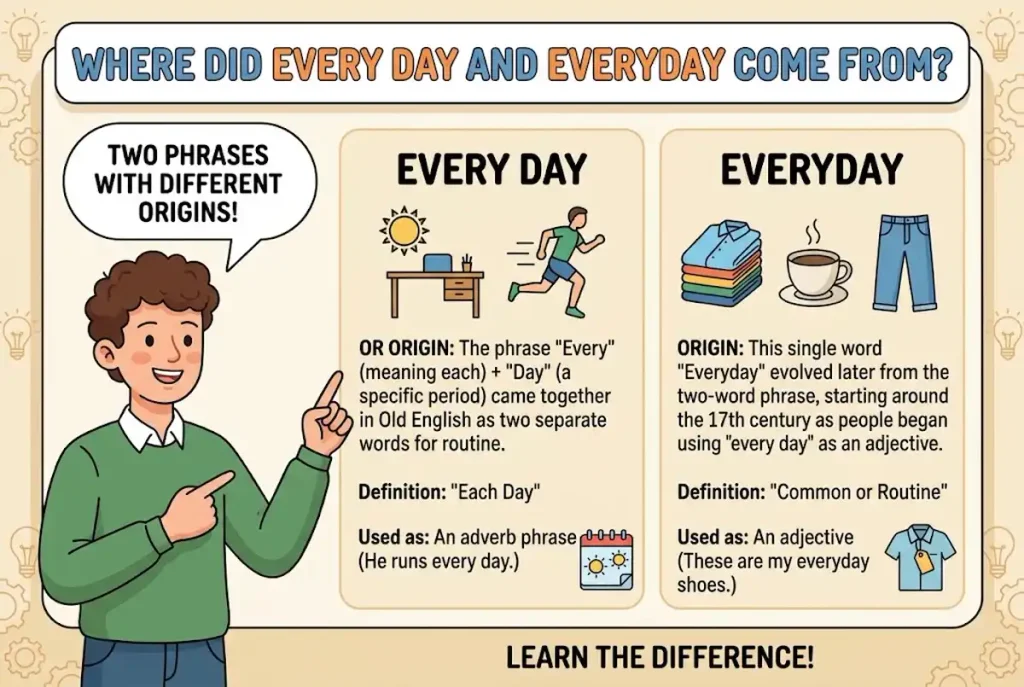
Where Did Every Day and Everyday Come From?
Understanding their history can make the spelling difference easier to remember.
The word day comes from Old English dæg, which referred to a day or a period of daylight.
The word every developed from the Old English expression æfre ælc, meaning each one or every one.
Over time, English speakers began using every day to describe something happening on each individual day.
The combined spelling everyday developed as a compound adjective.
English has many compound words formed when separate words develop a closely connected meaning.
For example:
| Separate words | Combined word |
|---|---|
| Every day | Everyday |
| Any one | Anyone |
| Some time | Sometime |
| Any time | Anytime |
These pairs don’t all follow identical grammar rules, but they show how spacing can affect meaning.
In modern English, everyday has its own established adjective meaning. It often refers to things that are ordinary or part of normal life.
That is why the two spellings aren’t interchangeable.
How Can You Remember Every Day vs Everyday?
One simple replacement test can solve most of the confusion.
Try replacing the expression with each day.
If the sentence still makes sense, use every day as two separate words.
If the replacement sounds strange or changes the intended meaning, you probably need everyday.
| Sentence | Replace with Each Day | Correct Form |
|---|---|---|
| I run every day. | I run each day. | Every day |
| These are everyday tasks. | These are each day tasks. | Everyday |
| She studies every day. | She studies each day. | Every day |
| We face everyday challenges. | We face each day challenges. | Everyday |
| He cooks every day. | He cooks each day. | Every day |
Another helpful trick is to look at the noun.
If the expression describes a noun such as clothes, life, activities, or problems, the one-word adjective is usually correct.
If it answers how often an action happens, choose the two-word form.
What Are the Best Synonyms for Every Day and Everyday?
Both expressions have useful alternatives, but their synonyms belong to different groups.
For the two-word expression, choose alternatives that describe frequency.
For the one-word adjective, choose alternatives that describe ordinary life, regular use, or something common.
Not every synonym works in every sentence. Some are more formal, while others are better suited to casual conversations.
Simple Synonyms
These alternatives are easy to understand and work well in normal English.
| Word or Phrase | Meaning | Tone | Example |
|---|---|---|---|
| Each day | On every individual day | Simple | I practice reading each day. |
| Daily | Happening each day | Neutral | She takes a daily walk. |
| Regular | Happening or used normally | Simple | Exercise is part of my regular routine. |
| Normal | Not unusual | Simple | It’s a normal school day. |
| Usual | Expected or familiar | Simple | He followed his usual schedule. |
| Common | Frequently seen or experienced | Neutral | This is a common problem. |
| Ordinary | Not special or unusual | Neutral | It was an ordinary afternoon. |
| Routine | Part of a repeated pattern | Neutral | Cleaning is a routine task. |
Daily is particularly useful because it can describe both frequency and something associated with each day.
Compare:
I exercise daily.
Exercise is part of my daily routine.
The first uses daily as an adverb. The second uses it as an adjective.
Everyday English Synonyms
These alternatives sound natural in conversations, emails, and general writing.
| Word or Phrase | Meaning | Tone | Example |
|---|---|---|---|
| Day to day | Related to normal daily activities | Conversational | She manages day-to-day operations. |
| On a daily basis | Each day | Neutral | We communicate on a daily basis. |
| All the time | Very frequently | Casual | He talks about football all the time. |
| Usually | In most situations | Neutral | I usually leave at eight. |
| Typically | In a normal situation | Neutral | We typically eat dinner together. |
| Normally | Under usual conditions | Neutral | She normally works from home. |
| Regularly | Repeatedly at consistent intervals | Neutral | They regularly visit their relatives. |
| Familiar | Well known through experience | Neutral | It was a familiar situation. |
Notice that usually, typically, and regularly don’t necessarily mean something happens without missing a day.
Use them when you’re describing a general habit rather than an exact daily frequency.
Formal Synonyms
Formal alternatives are useful in academic writing, reports, business communication, and professional documents.
| Word or Phrase | Meaning | Tone | Example |
|---|---|---|---|
| On a daily basis | Each day | Professional | The team reviews reports on a daily basis. |
| Routinely | As part of a normal procedure | Formal | Staff routinely inspect equipment. |
| Customarily | According to an established practice | Formal | Employees customarily attend weekly meetings. |
| Habitually | As a repeated habit | Formal | He habitually checks the records. |
| Ordinarily | Under normal circumstances | Formal | The office ordinarily closes at six. |
| Conventional | Following accepted practices | Formal | They used conventional methods. |
| Standard | Commonly accepted or used | Professional | This is standard office equipment. |
| Commonplace | Frequently encountered | Formal | Remote meetings are now commonplace. |
Casual and Slang Alternatives
These expressions can sound natural in friendly conversations, social media posts, and informal messages.
| Word or Phrase | Meaning | Tone | Example |
|---|---|---|---|
| Day in, day out | Repeatedly over many days | Informal | He works hard day in, day out. |
| 24/7 | Constantly or almost constantly | Slang | She’s online 24/7. |
| Like clockwork | Very regularly | Informal | He arrives at nine like clockwork. |
| The usual | Something normally done | Casual | I’ll have the usual breakfast. |
| Same old | Familiar and repetitive | Casual | It’s the same old routine. |
| Nonstop | Without stopping | Informal | The phone has been ringing nonstop. |
| Round the clock | Throughout the day and night | Conversational | The hospital provides round-the-clock care. |
| On repeat | Happening repeatedly | Casual | That song has been playing on repeat. |
These expressions are not exact replacements.
For instance, 24/7 suggests continuous activity, while the two-word expression only indicates something happens each day.
Which Synonyms Are Stronger or Weaker?
Frequency expressions can communicate different levels of regularity.
Some describe occasional habits. Others suggest repeated or continuous activity.
| Intensity | Expression | Meaning |
|---|---|---|
| Mild | Sometimes | On certain occasions |
| Mild | Occasionally | Not very frequently |
| Moderate | Often | Many times |
| Moderate | Usually | Most of the time |
| Moderate | Regularly | At repeated intervals |
| Strong | Daily | Each day |
| Strong | Each and every day | Emphasizes every single day |
| Very strong | Constantly | Almost without stopping |
| Very strong | Nonstop | Without a break |
| Very strong | 24/7 | All day and night |
These expressions describe different patterns, not just different levels of emphasis.
For example:
I check my messages regularly.
This suggests a repeated habit but doesn’t promise that it happens daily.
I check my messages each and every day.
This strongly emphasizes daily frequency.
I check my messages constantly.
This suggests checking messages repeatedly throughout the day.
For accurate writing, choose the expression that matches the actual situation.
How Do These Expressions Work as Different Parts of Speech?
Understanding their grammatical roles helps you choose the correct spelling without memorizing dozens of rules.
Every Day as a Time Expression
Every is a determiner, while day is a noun.
Together, they form a noun phrase that often functions as an adverbial expression of time.
Example:
She practices piano every day.
The phrase explains when or how often she practices.
You can also place it at the beginning of a sentence.
Every day, she practices piano.
The meaning stays the same.
Everyday as an Adjective
The combined word is an adjective. Its job is to describe a noun.
Example:
She wears everyday jewelry.
Here, the adjective describes the jewelry as suitable for regular use.
Other examples include everyday language, everyday objects, and everyday situations.
Daily as an Adjective and Adverb
Daily is especially flexible because it can perform both roles.
| Part of Speech | Example |
|---|---|
| Adjective | Reading is part of my daily routine. |
| Adverb | I read daily. |
This makes daily a useful alternative when you want a shorter sentence.
However, it doesn’t always carry the same meaning as ordinary or commonplace.
Is There a Difference Between American and British English?
The spelling distinction is the same in American and British English.
Both varieties use every day for daily frequency and everyday as an adjective meaning ordinary or associated with normal life.
For example:
American English: I walk to work every day.
British English: I walk to work every day.
The rule doesn’t change.
Some related vocabulary differs between regions, but the grammar remains consistent.
| American English | British English |
|---|---|
| Everyday sneakers | Everyday trainers |
| Everyday pants | Everyday trousers |
| Daily schedule | Daily timetable |
| Regular vacation activities | Regular holiday activities |
In both regions, everyday life and everyday activities are standard expressions.
There is no special UK spelling that changes the one-word adjective into two words.
Which Form Should You Use in Different Writing Situations?
Your writing context can help you decide which expression sounds most natural.
The basic grammar rule stays the same, but professional writing, academic essays, and casual messages may call for different sentence styles.
How Should You Use Them in a Resume?
Resumes should describe responsibilities clearly and professionally.
Use every day when you want to explain the frequency of a task. Use everyday when you’re describing ordinary workplace duties or situations.
Examples:
- I monitored customer requests every day.
- Managed everyday administrative responsibilities.
- Reviewed daily performance reports.
- Coordinated routine office activities.
For most resumes, daily and routine are often more concise alternatives.
Instead of writing:
I checked inventory every day.
You could write:
Monitored daily inventory levels.
The revised sentence sounds more direct and action-oriented.
Which Form Is Better for an Academic Essay?
Academic writing benefits from accurate word choices and clear explanations.
Use the two-word expression when discussing events that happen each day.
Example:
Students who read every day may develop stronger reading habits.
Use the adjective when describing ordinary experiences.
Example:
Digital technology influences everyday communication.
Avoid replacing precise frequency expressions with vague alternatives.
For instance, regularly doesn’t necessarily mean each day.
If your essay discusses a daily activity, keep that meaning clear.
How Do You Use Them in Text Messages?
Texting allows a more relaxed writing style, but the spelling distinction still matters.
Examples:
- I miss you every day.
- These are my everyday sneakers.
- We talk every day.
- Just dealing with everyday problems.
You can also use casual alternatives.
Example:
Same routine, day in, day out.
However, casual expressions sometimes change the meaning or add emotion. Use the original forms when you want to be precise.
Which Form Works Best in Professional Emails?
Professional emails should sound natural and easy to understand.
Use every day when describing repeated actions.
Example:
Our team checks incoming requests every day.
Use everyday when referring to common workplace matters.
Example:
This guide will help employees handle everyday technical issues.
You can also use daily to make a sentence shorter.
Example:
We provide daily updates to all department managers.
Avoid using longer phrases simply to sound professional. Clear writing is usually more effective.
How Should You Use Them in Everyday Speaking?
In spoken English, the two forms sound the same.
Listeners understand the intended meaning through sentence structure and context.
For example:
I wear this jacket every day.
This is my everyday jacket.
The first sentence describes frequency. The second describes the jacket’s usual purpose.
You don’t need to change your pronunciation to communicate the difference.
The distinction becomes visible when you write the sentence.
What Are Some Real-Life Examples of Every Day and Everyday?
The following examples show how both expressions work in familiar situations.
| Situation | Example Sentence | Explanation |
|---|---|---|
| Morning routine | I wake up at six every day. | Describes frequency |
| Clothing | These are my everyday jeans. | Describes ordinary clothing |
| Education | My sister studies mathematics every day. | Describes a repeated activity |
| Technology | Smartphones are part of everyday life. | Describes normal life |
| Health | My doctor recommends walking every day. | Describes frequency |
| Shopping | This bag is perfect for everyday use. | Describes regular use |
| Family | We eat dinner together every day. | Describes a daily habit |
| Work | Everyday responsibilities can become stressful. | Describes common duties |
| Friendship | My best friend calls me every day. | Describes frequency |
| Travel | Comfortable shoes are useful for everyday travel. | Describes ordinary travel |
| Reading | He reads at least ten pages every day. | Describes frequency |
| Communication | Clear language improves everyday conversations. | Describes common conversations |
Can Both Forms Appear in the Same Sentence?
Yes. You can use both expressions in one sentence because they perform different grammatical jobs.
Consider these examples:
- I wear my everyday shoes every day.
- She practices everyday English every day.
- We discuss everyday problems every day.
- He uses his everyday backpack every day.
- Everyday exercise equipment should be cleaned every day.
These sentences may sound repetitive, but they are grammatically correct.
The first expression describes a noun, while the second explains frequency.
For smoother writing, you can sometimes replace one form with an alternative.
Example:
She practices everyday English daily.
This version communicates the same basic idea without repeating similar-looking words.
What’s the Difference: Everyday vs Daily?
Everyday and daily are close in meaning, but they aren’t always interchangeable.
Everyday generally describes something ordinary, common, or suitable for normal use.
Daily describes something that happens, appears, or is intended for use each day.
| Everyday | Daily |
|---|---|
| Focuses on ordinary life or regular use | Focuses on each-day frequency |
| Used as an adjective | Used as an adjective or adverb |
| Everyday clothes | Daily exercise |
| Everyday challenges | Daily updates |
| Everyday conversations | Daily meetings |
Every Day vs Each Day: Are They Interchangeable?
Every day and each day are usually interchangeable when describing daily frequency.
However, each day can place slightly more emphasis on individual days.
| Every day | Each day |
|---|---|
| I exercise every day. | I exercise each day. |
| She learns something every day. | She learns something each day. |
| We communicate every day. | We communicate each day. |
What Are the Most Common Spelling Mistakes?
Most errors happen when writers confuse an adjective with a time expression.
Here are several common mistakes and their corrections.
| Incorrect Sentence | Correct Sentence | Reason |
|---|---|---|
| I go to school everyday. | I go to school every day. | Describes frequency |
| These are my every day shoes. | These are my everyday shoes. | Describes shoes |
| She exercises everyday. | She exercises every day. | Describes frequency |
| This is an every day problem. | This is an everyday problem. | Describes a problem |
| We talk everyday. | We talk every day. | Describes frequency |
| Everyday I learn something new. | Every day I learn something new. | Describes frequency |
Why Is I Work Everyday Incorrect?
The sentence is incorrect in standard written English because everyday is an adjective.
It cannot normally stand alone to describe how often you work.
Correct:
I work every day.
You could also write:
I work daily.
Both versions express frequency correctly.
Why Is Everyday Life Correct?
Everyday life is correct because everyday describes the noun life.
The expression refers to normal activities, experiences, and responsibilities.
For example:
Small decisions can make a big difference in everyday life.
Writing every day life would be incorrect because the sentence needs an adjective, not a time expression.
Can You Write Everyday at the Beginning of a Sentence?
Yes, but only when it describes a noun or forms part of a larger noun phrase.
Correct:
Everyday challenges can teach us valuable lessons.
Incorrect:
Everyday, I walk to school.
Correct:
Every day, I walk to school.
The position of a word doesn’t change its grammatical function.
When Should You Not Use Everyday?
Avoid the one-word adjective when you’re describing the frequency of an action.
It doesn’t mean each day when used by itself.
For example:
Incorrect: I drink water everyday.
Correct: I drink water every day.
Also, don’t assume that everyday always means something happens daily.
An everyday jacket may be suitable for normal activities, even if its owner doesn’t wear it on every single day.
Similarly, everyday problems are common or ordinary problems. They don’t necessarily happen daily.
You should also avoid using everyday as a noun when the sentence requires everyday life, everyday activities, or another complete noun phrase.
Correct:
Technology affects everyday life.
Less natural:
Technology affects everyday.
The complete expression makes the intended meaning clearer.
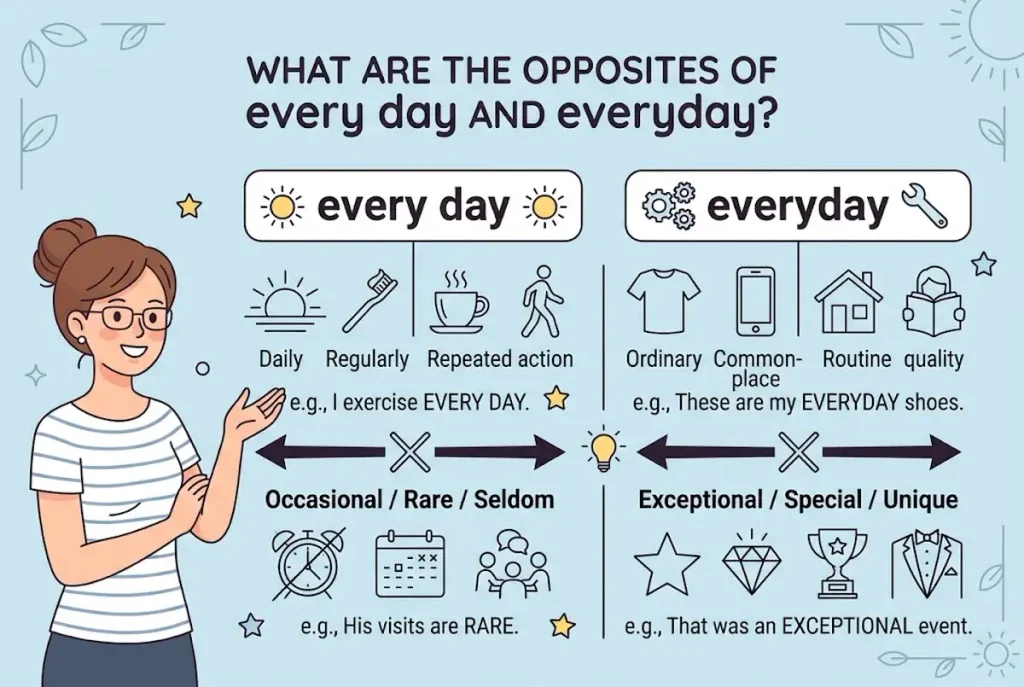
What Are the Opposites of Every Day and Everyday?
Because the two forms have different meanings, their opposites are also different.
Antonyms for Every Day
These expressions describe activities that don’t happen each day.
| Opposite | Meaning | Example |
|---|---|---|
| Occasionally | Sometimes | We occasionally visit the beach. |
| Rarely | Not often | He rarely eats fast food. |
| Infrequently | At long intervals | They meet infrequently. |
| Once in a while | Sometimes | I watch movies once in a while. |
| Sporadically | Irregularly | She exercises sporadically. |
Antonyms for Everyday
These words describe something unusual, special, or outside normal experience.
| Opposite | Meaning | Example |
|---|---|---|
| Extraordinary | Very unusual | It was an extraordinary achievement. |
| Exceptional | Unusually good or rare | She showed exceptional talent. |
| Unusual | Not common | That was an unusual experience. |
| Special | Different from ordinary things | He wore a special outfit. |
| Rare | Not frequently encountered | It was a rare opportunity. |
| Remarkable | Worth noticing | They made remarkable progress. |
What Are the Best Tips for Choosing the Correct Form?
You don’t need to memorize complicated grammar rules to make the right choice.
A few practical checks can help you write confidently.
- Replace the expression with each day. If the sentence still makes sense, use two words.
- Look for a noun being described. If the meaning is ordinary or suitable for regular use, choose the one-word adjective.
- Ask how often. If the expression answers that question, use every day.
- Try daily as an alternative. It often works when you’re describing frequency.
- Read the complete sentence. The surrounding words usually reveal the intended meaning.
Conclusion
The difference between every day vs everyday comes down to meaning and grammar. Use the two-word expression when describing something that happens each day. Use the one-word adjective when describing something ordinary, common, or suitable for regular use.
You can remember the distinction with one simple question: Can I replace this expression with each day? If the answer is yes, write it as two words. If you’re describing a noun, the combined adjective is probably what you need.
This small spelling difference matters in everything from casual messages to professional documents. With a little practice, you’ll start recognizing the correct form naturally. Focus on the meaning of your sentence, and choosing the right spelling will become much easier.
Frequently Asked Questions
Is it correct to say every day or everyday?
Both forms are correct, but they have different meanings. Every day means each day, while everyday describes something ordinary, common, or used regularly.
Is it I love you everyday or every day?
The correct sentence is “I love you every day.” The two-word expression describes how frequently the feeling exists.
What’s another way to say every day?
You can use each day or daily. Both expressions communicate daily frequency and work naturally in most sentences.
Why is everyday one word sometimes?
Everyday is written as one word when it functions as an adjective. For example, everyday clothes means clothing suitable for ordinary activities.
Is everyday life grammatically correct?
Yes. Everyday life is grammatically correct because everyday describes the noun life and means ordinary or normal life.
What is the easiest way to remember every day vs everyday?
Replace the expression with each day. If the sentence still makes sense, use two words. If you’re describing something as ordinary or common, use the one-word adjective.
Can I use everyday at the end of a sentence?
Not normally as a standalone adjective. Write “I exercise every day,” not “I exercise everyday.”
Is every day the same as daily?
Yes, when both describe an action happening each day. However, daily can also function as an adjective, as in daily exercise or daily routine.

Daniel Grammarfield — The Language Learner
Age: 28Occupation: ESL Learner & Digital Professional
Bio:Daniel is a non-native English speaker who wants to communicate more confidently at work and online. He uses Synotrench to improve grammar, understand confusing words, learn correct sentence structures, and build everyday English skills. He prefers simple explanations with practical examples.
Goals:
Master English grammar rules
Avoid common language mistakes
Improve professional communication
Learn English through real-life examples
Quote:“Learning English is not about memorizing rules — it’s about expressing ideas clearly.”
3 thoughts on “Every Day vs Everyday: Simple Guide With Examples (2026)”