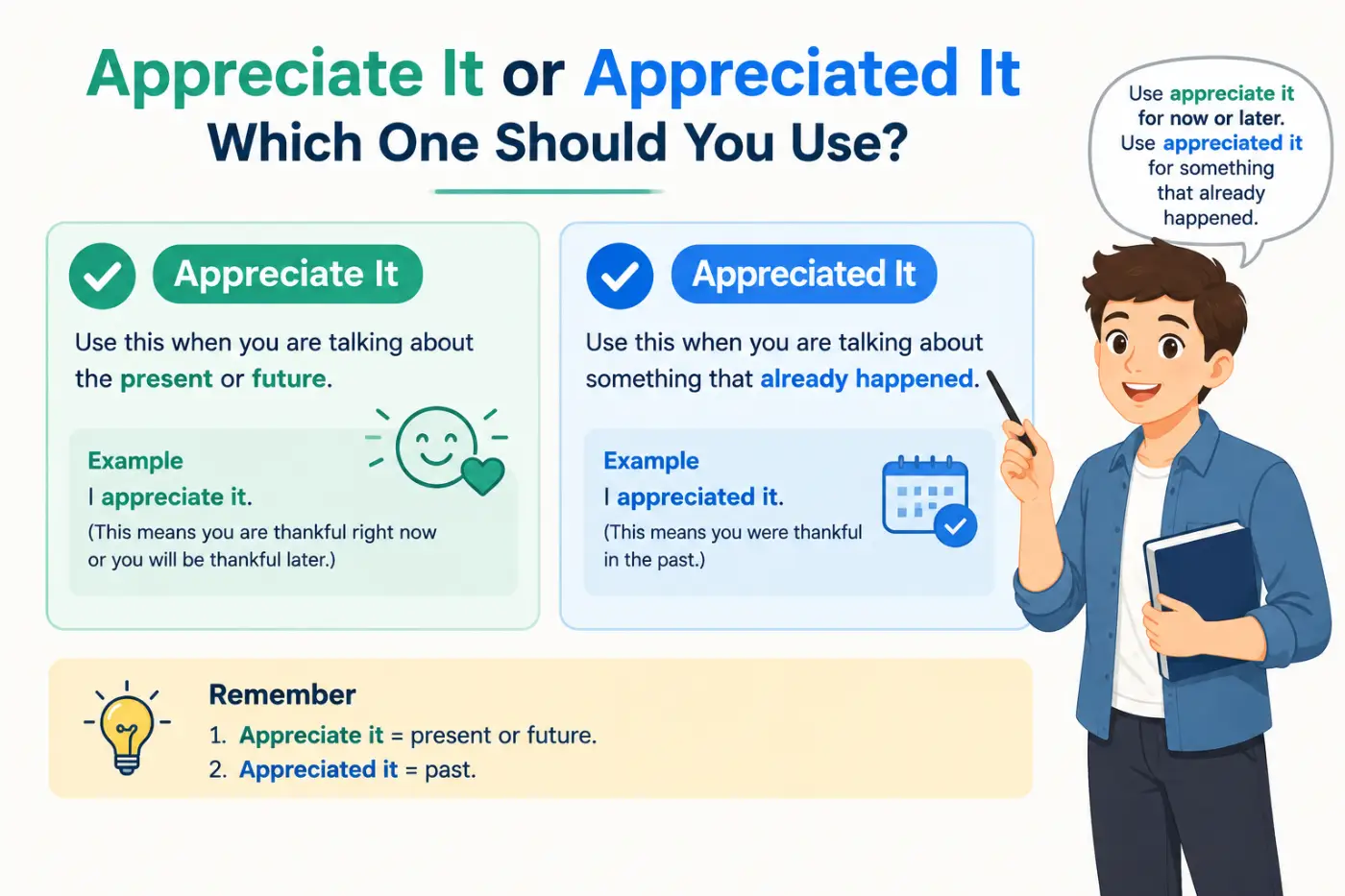
When you’re writing an email, replying to a coworker, or sending a quick text, you may pause over the phrase “Appreciate It or Appreciated It.” Both forms look natural, but they don’t always fit the same situation. The difference mainly comes from tense and the timing of the action you’re talking about.
In most everyday situations, “appreciate it” is used when you are thanking someone for something they have just done or are doing for you. “Appreciated it” is past tense, so it normally refers to something you appreciated at an earlier time.
Answer: Use “appreciate it” for a present or current thank you, and use “appreciated it” when talking about gratitude for something that happened in the past.
This guide explains the meaning, grammar, origin, synonyms, intensity, regional use, common mistakes, and best choices for emails, resumes, essays, texts, and conversations. You’ll also see plenty of real examples so you can choose the natural expression without second guessing yourself.
What does appreciate it mean?
“Appreciate it” is a common way to express thanks. In this expression, appreciate means to recognize the value or kindness of something someone has done.
For example:
- I appreciate it.
- I really appreciate your help.
- I appreciate you taking the time to explain this.
- I appreciate it when people are honest with me.
The word “it” usually refers to an action, favor, kindness, effort, or helpful thing.
If someone sends you the file you needed, you can say:
I appreciate it.
You aren’t simply saying that you understand the file. You’re saying that you value the person’s effort or help.
The expression is especially common in American English. It works well in conversations, text messages, workplace communication, and friendly emails.
What does appreciated it mean?
It tells the reader or listener that the appreciation happened in the past.
For example:
I appreciated it when you stayed late to help me.
The speaker is talking about a past event. The help happened, and the speaker felt grateful for it.
You can also use the phrase with a specific past time:
I appreciated it when you called me last night.
I really appreciated your help yesterday.
We appreciated it when you gave us extra time.
The main idea is simple. If the appreciation is connected to something happening now or a current situation, use the present form. If you’re looking back at an earlier event, the past form is usually more natural.
Where do these expressions come from?
The verb appreciate comes from the Latin word appretiare, which was connected with putting a value or price on something. The word later developed through French and entered English with the sense of valuing or understanding the worth of something.
Over time, appreciate developed several related meanings.
You can appreciate the value of an object.
You can appreciate a piece of art.
The meaning of gratitude became especially common in expressions such as “I appreciate it” and “I appreciate your help.”
The basic idea remains connected to recognizing value. When you tell someone that you appreciate their help, you’re saying that their help matters to you.
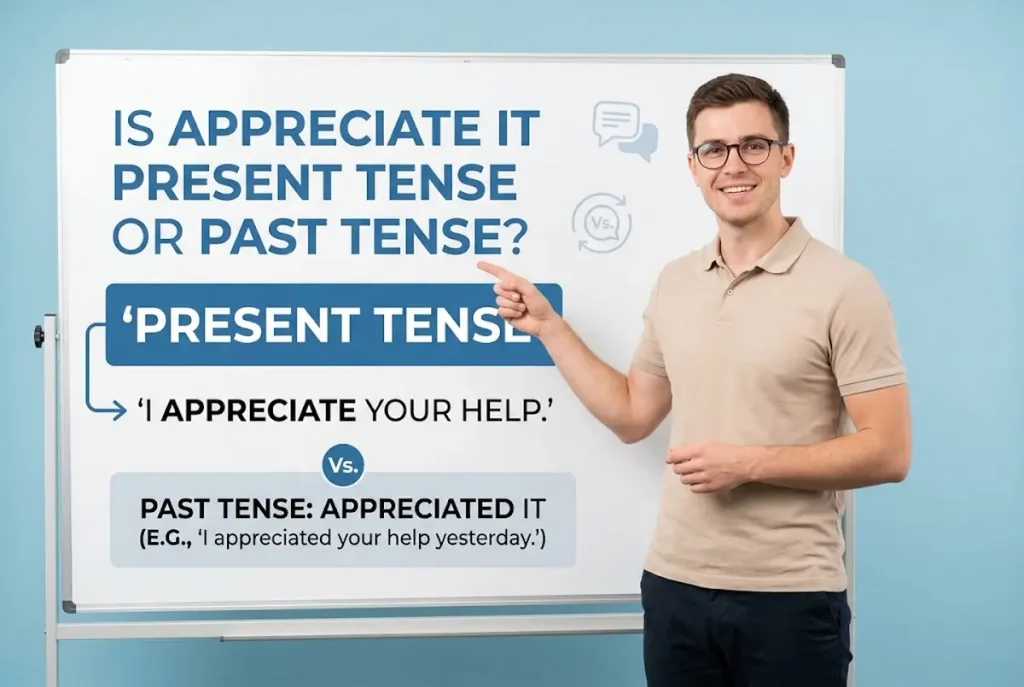
Is appreciate it present tense or past tense?
“Appreciate it” is present tense, while “appreciated it” is past tense.
| Expression | Tense | Main idea |
|---|---|---|
| Appreciate it | Present | I value your help now |
| Appreciated it | Past | I valued your help earlier |
| Appreciate | Present | Value or recognize |
| Appreciated | Past | Valued or recognized |
I appreciate it when you help me.
I appreciated it when you helped me yesterday.
The first sentence describes a current feeling or a general situation. The second looks back at something that happened.
When should you say appreciate it?
Use “appreciate it” when you’re thanking someone for something current, recent, or still relevant.
It is especially natural after someone does you a favor.
Examples:
Thanks for sending that file. I appreciate it.
I appreciate it. That really helped.
Thanks for picking me up. I appreciate it.
I appreciate you checking on this.
The expression can also describe an ongoing feeling.
I appreciate your honesty.
I appreciate your patience.
In these cases, the speaker is expressing gratitude in the present.
When should you say appreciated it?
Use “appreciated it” when you’re referring to an earlier event or completed situation.
Examples:
I appreciated it when you helped me last week.
She appreciated it when her manager gave her extra time.
We appreciated it when you came to the meeting.
He said he appreciated it when his friends supported him.
The past form doesn’t mean the person is no longer grateful. It simply places the appreciation in a past situation.
For example:
I appreciated your help yesterday.
You may still feel grateful today. The sentence simply focuses on yesterday’s help.
Which synonym should you use for different levels of gratitude?
Not every thank you carries the same emotional weight.
A short thank you can be enough for a small favor. A stronger expression works better when someone made a major effort.
Mild gratitude
Use these for small favors or everyday kindness.
- Thanks.
- Thank you.
- I appreciate it.
- I appreciate your help.
- That’s kind of you.
Example:
Thanks for holding the door.
Moderate gratitude
Use these when someone’s effort mattered to you.
- I really appreciate it.
- I’m grateful for your help.
- I truly value your support.
- Thank you so much.
- I can’t thank you enough.
Example:
I really appreciate you staying late to help me finish the report.
Strong gratitude
Use stronger expressions when someone made a major sacrifice or gave important support.
- I’m deeply grateful.
- I’m extremely thankful.
- Your support means a lot to me.
- I’m very grateful for everything you’ve done.
- I can’t express how grateful I am.
Example:
I’m deeply grateful for everything you did for my family.
The strongest expression isn’t always the best one. If someone simply holds a door open, “I’m deeply grateful” may sound overly dramatic.
Which synonyms work by part of speech?
Understanding the grammatical role of each word can help you avoid awkward sentences.
Verbs
These words can work as verbs:
- appreciate
- thank
- value
- admire
- respect
- recognize
- acknowledge
- treasure
- cherish
- praise
- commend
- honor
Examples:
I appreciate your help.
I value your opinion.
She respects her teacher.
Adjectives
These words describe a grateful feeling or attitude:
- grateful
- thankful
- appreciative
- obliged
Examples:
I’m grateful for your support.
We are thankful for the opportunity.
She was appreciative of the extra time.
Nouns
These can describe gratitude or recognition:
- thanks
- gratitude
- appreciation
- respect
- praise
- recognition
Examples:
My thanks go to everyone who helped.
We expressed our appreciation for the volunteers.
The employee received recognition for her work.
Is appreciate it common in American English?
Yes. “I appreciate it” is very common in American English, especially in casual and professional conversations.
It can sound polite without being overly formal.
For example:
Thanks for covering my shift. I appreciate it.
I appreciate you getting back to me so quickly.
Thanks for your advice. I really appreciate it.
The expression is also common in workplace messages because it can sound warmer and more personal than a simple “thanks.”
British English speakers use appreciate in the same basic way. The difference is not a major grammar rule between American and British English.
Some expressions vary by region, though. “Cheers” is especially common as an informal thank you in British English and several other English speaking regions. In the United States, “thanks” and “I appreciate it” are often more natural in everyday situations.
What’s the best choice for a resume?
A resume usually shouldn’t rely on conversational phrases such as “I appreciate it.”
A resume focuses on actions, achievements, and professional value. Stronger verbs such as “recognized,” “valued,” “supported,” or “contributed” may fit better.
For example, instead of:
I appreciate the opportunity to lead the team.
A resume could say:
Recognized for leading a five member project team.
Or:
Valued for strong communication and team leadership.
A resume isn’t normally the place for a direct thank you. Save personal gratitude for a cover letter, email, or interview.
What’s the best choice for an essay?
Formal essays usually benefit from words such as “value,” “recognize,” “acknowledge,” and “appreciate,” depending on the meaning.
For example:
Researchers increasingly recognize the value of early education.
The author acknowledges the importance of community support.
The audience can appreciate the historical significance of the event.
“I appreciate it” sounds conversational, so it usually doesn’t fit an academic essay unless you’re writing dialogue.
What’s the best choice for texting?
Texting is where “appreciate it” works especially well.
It is short, friendly, and clear.
Examples:
Thanks! Appreciate it.
Really appreciate it!
I appreciate you helping me out.
Thanks for grabbing that for me. Appreciate it.
In casual texting, you can even leave out the subject “I”:
Appreciate it!
This is an informal sentence fragment, but it’s completely normal in everyday messages.
What’s the best choice for email?
The best expression depends on the person you’re emailing.
For a coworker:
Thanks for sending the report. I appreciate it.
For a manager:
Thank you for taking the time to review my work. I really appreciate your feedback.
For a customer or client:
Thank you for your patience. We appreciate your understanding.
For a formal business message:
We greatly appreciate your time and consideration.
A short “Appreciate it” can work in a casual workplace, but a complete sentence is safer when you’re communicating with someone you don’t know well.
What’s the best choice for speaking?
In conversation, “I appreciate it” is natural and flexible.
You can use it after a favor, compliment, explanation, or offer of help.
For example:
Thanks for explaining that. I appreciate it.
You brought me coffee? I appreciate it.
I appreciate you being honest with me.
Thanks for waiting. I really appreciate it.
Your tone matters. A warm voice can make a simple expression of thanks sound sincere.
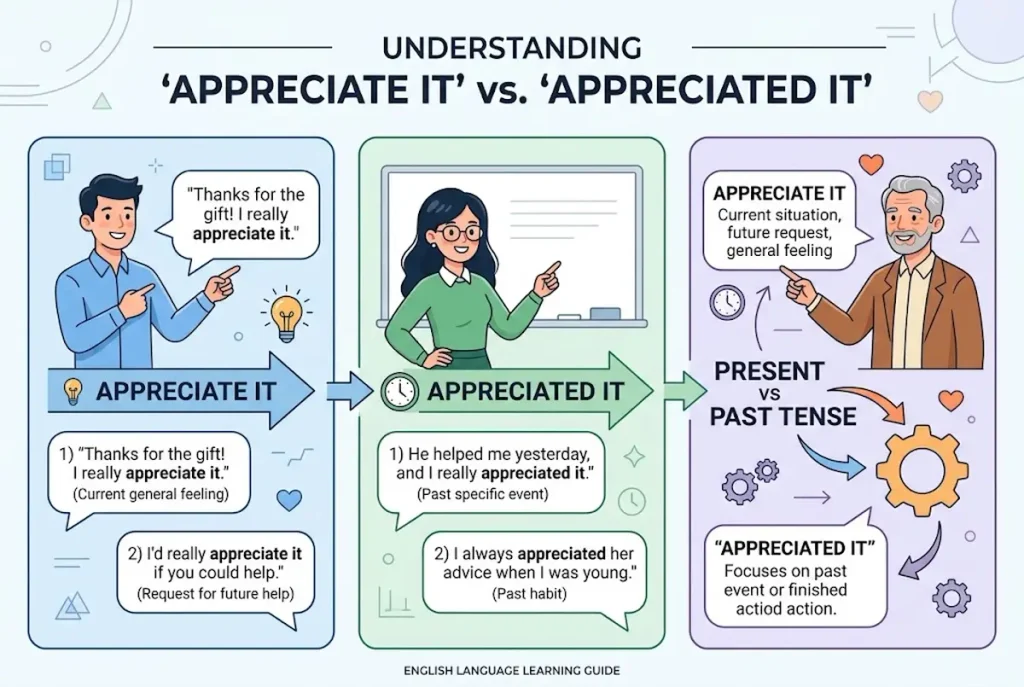
What are some real examples of appreciate it and appreciated it?
The following examples show how the two forms work in different situations.
Example 1
Thanks for helping me move. I really appreciate it.
The help is recent, and the speaker is expressing gratitude now.
Example 2
I appreciated it when you checked on me after the accident.
The speaker is looking back at a past event.
Example 3
I appreciate your honesty.
This describes a current attitude toward someone’s honesty.
Example 4
She appreciated the extra time her teacher gave her.
The sentence describes her reaction to a past event.
Example 5
Thanks for picking up dinner. Appreciate it!
This is casual and natural in a text message.
Example 6
We appreciated your support during the event.
The sentence looks back at support connected to a completed event.
Example 7
I appreciate everything you’ve done for me.
The feeling is current and may refer to many past actions that still matter.
Example 8
He said he appreciated our help.
The reporting verb “said” places the statement in the past, so “appreciated” fits naturally.
Example 9
I appreciate you taking the time to meet with me.
This is a common professional expression.
Example 10
I really appreciated you staying late yesterday.
“Yesterday” clearly points to a past situation.
Appreciate it vs thank you: what’s the difference?
“Thank you” is the most direct expression of gratitude. “I appreciate it” focuses more on the value of the person’s action.
| Expression | Main focus | Example |
|---|---|---|
| Thank you | Direct gratitude | Thank you for helping me. |
| I appreciate it | Value of the help | I appreciate it. |
| I appreciate your help | Value of a specific action | I appreciate your help. |
| I’m grateful | Feeling of gratitude | I’m grateful for your support. |
In many situations, they can be used together:
Thank you for helping me. I really appreciate it.
This sounds natural because the two expressions reinforce the same message without changing the meaning.
Appreciate it vs I’m grateful: what’s different?
These expressions are close, but their style is slightly different.
“I appreciate it” often sounds conversational and practical.
“I’m grateful” can sound more personal or emotionally meaningful.
Compare:
Thanks for fixing my computer. I appreciate it.
I’m grateful that you were there for me during such a difficult time.
The first sentence fits a simple favor. The second suggests deeper personal gratitude.
“Grateful” also requires a different grammatical structure in many sentences.
I appreciate your help.
I’m grateful for your help.
Don’t write:
I’m grateful your help.
Use “for” before the noun phrase.
Appreciate it vs appreciated it: what changes?
The main difference is time.
| Present | Past |
|---|---|
| I appreciate it. | I appreciated it. |
| I appreciate your help. | I appreciated your help. |
| I appreciate what you do. | I appreciated what you did. |
Consider the context:
Thanks for helping me today. I appreciate it.
Thanks for helping me yesterday. I appreciated it.
However, time words aren’t the only factor. The speaker’s viewpoint matters too.
You can say:
I appreciate what you did yesterday.
Here, the action happened yesterday, but the speaker’s gratitude is current.
You can also say:
I appreciated what you did yesterday.
This places the appreciation in the past.
Both can be grammatically correct. The intended time of the feeling determines the better choice.
Common mistakes with appreciate it
A few errors appear often because English learners try to translate gratitude expressions directly from another language.
Mistake 1: Using appreciate as a noun
Incorrect:
I have a lot of appreciate for your help.
Correct:
I have a lot of appreciation for your help.
Or:
I really appreciate your help.
“Appreciate” is a verb. “Appreciation” is the noun.
Mistake 2: Adding “to” before the person
Incorrect:
I appreciate to you for helping me.
Correct:
I appreciate your help.
Or:
I appreciate you helping me.
The normal structure is “appreciate + noun” or “appreciate + person + verb ing.”
Mistake 3: Using “appreciated” for a current thank you
Suppose someone has just helped you.
You say:
Thanks. I appreciated it.
This isn’t always grammatically wrong, but it can sound like you’re describing your reaction as a completed past event. In a normal immediate response, “I appreciate it” is more natural.
Mistake 4: Saying “I am appreciate”
Incorrect:
I am appreciate your help.
Correct:
I appreciate your help.
Or:
I am appreciative of your help.
The verb appreciate does not need “am.”
Mistake 5: Confusing appreciation with approval
Appreciating something doesn’t always mean you agree with it.
For example:
I appreciate your concern, but I disagree with your conclusion.
Here, appreciate means “I recognize and value the fact that you care.” It doesn’t mean “I agree with you.”
When should you not use appreciate it?
There are situations where another expression is clearer.
When you need a formal statement
Instead of:
We appreciate it.
You might write:
We appreciate your consideration.
This identifies exactly what you’re thankful for.
When you need to apologize
“Appreciate it” isn’t an apology.
Use:
I’m sorry.
I apologize.
Please accept my apologies.
When you need to show agreement
“Appreciate it” doesn’t mean “I agree.”
Use:
I agree.
That makes sense.
I understand your point.
When you need to show strong emotional gratitude
For a serious personal situation, “I’m grateful” may express the feeling more clearly.
For example:
I’m grateful that you stayed with me during that difficult time.
This can sound more personal than:
I appreciate it.
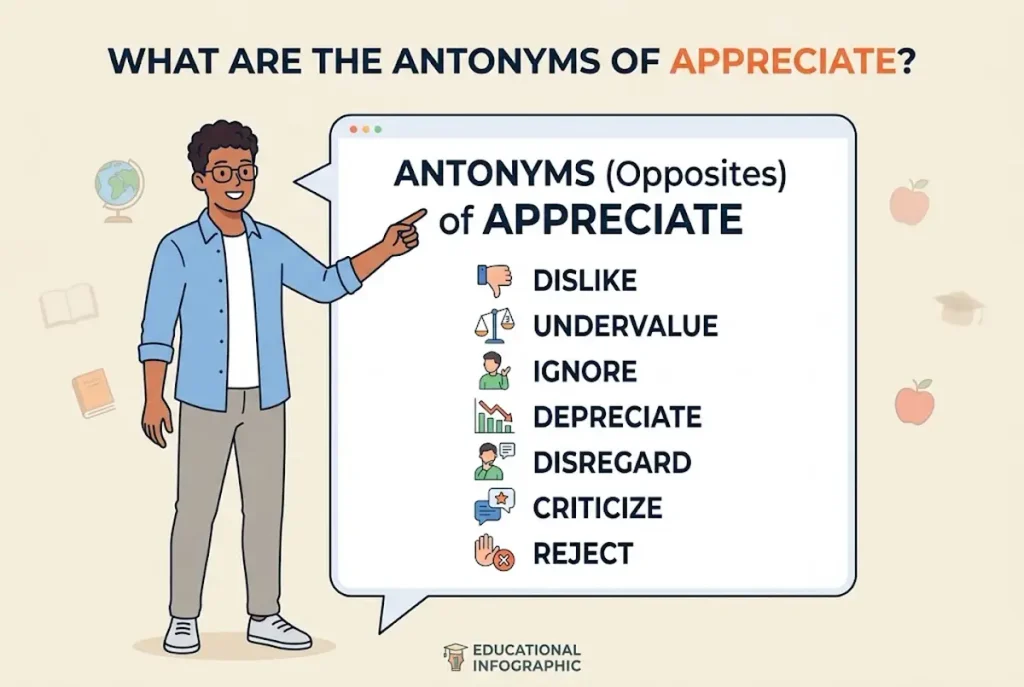
What are the antonyms of appreciate?
The opposite of appreciate depends on the meaning.
If appreciate means “be grateful,” possible opposites include:
- Ignore.
- Disregard.
- Reject.
- Undervalue.
- Take for granted.
- Dismiss.
If appreciate means “recognize the value of something,” the opposite could be “undervalue.”
Example:
She appreciated his effort.
Opposite:
She undervalued his effort.
“Take for granted” is especially useful when someone receives help or kindness but fails to recognize its value.
Example:
Don’t take your family’s support for granted.
How can you choose the right expression quickly?
You don’t need to memorize dozens of grammar rules.
Ask yourself three simple questions.
Is the gratitude happening now?
If yes, use “appreciate.”
Example:
I appreciate your help.
Are you looking back at a past feeling?
If yes, “appreciated” may be the better choice.
Example:
I appreciated your help yesterday.
Is this formal writing?
If yes, name the thing you value when possible.
Example:
We appreciate your time and consideration.
This is clearer than simply writing:
We appreciate it.
Quick comparison table
| Situation | Natural choice | Example |
|---|---|---|
| Someone just helped you | Appreciate it | Thanks, I appreciate it. |
| Talking about yesterday | Appreciated it | I appreciated it yesterday. |
| Formal email | Appreciate your help | We appreciate your assistance. |
| Casual text | Appreciate it | Thanks! Appreciate it! |
| Academic writing | Recognize or acknowledge | The study acknowledges this limitation. |
| Resume | Recognized or valued | Recognized for strong leadership. |
| Deep personal gratitude | Grateful | I’m grateful for your support. |
| Strong praise | Commend | We commend her dedication. |
| Casual British style | Cheers | Cheers for your help. |
A simple rule to remember
Think about the time of the feeling, not just the time of the action.
If you’re grateful now, use “appreciate.”
If you’re describing how you felt in the past, use “appreciated.”
That distinction solves most cases.
For example:
You helped me today, and I appreciate it.
You helped me yesterday, and I appreciated it.
But this is also possible:
You helped me yesterday, and I appreciate it.
Why? Because the help happened yesterday, but the speaker’s gratitude is still present.
This is one reason tense choices can depend on meaning rather than a single time word.
Conclusion
The difference between appreciate it and appreciated it mainly comes down to the time and viewpoint of the gratitude. Use the present form when you’re expressing thanks now or describing an attitude that still exists. Use the past form when you’re talking about appreciation that belonged to an earlier situation.
Remember that the action itself can happen in the past while your appreciation remains current. That’s why “I appreciate what you did yesterday” can be perfectly natural.
For everyday conversations, texts, and workplace messages, “I appreciate it” is a friendly and flexible choice. For more formal writing, naming the specific action or using a word such as “recognize,” “value,” or “acknowledge” can make your meaning clearer. Once you focus on the timing of the feeling, choosing the right form becomes much easier.
Frequently Asked Questions
Is appreciate it correct English?
Yes, “appreciate it” is correct and very common English. It is often used as a short way to thank someone for a favor, effort, or kindness.
Is appreciated it correct English?
Yes, “appreciated it” is correct when you’re describing gratitude connected to a past situation. The surrounding sentence should make the past meaning clear.
What’s another way to say I appreciate it?
You can say “Thank you,” “I’m grateful,” “I value your help,” “Thanks a lot,” or “I really appreciate your help.” The best option depends on how formal or personal you want to sound.
Can I say appreciate it in a professional email?
Yes, but a complete and specific expression is often more polished. For example, “I appreciate your help with this project” clearly identifies what you’re thanking the person for.
Is appreciate it formal or informal?
“Appreciate it” is neutral and conversational. It works in many professional situations, but a more specific phrase such as “I appreciate your assistance” can sound more formal.
Can I say I appreciate what you did yesterday?
Yes. The action happened yesterday, but your appreciation can still be a current feeling. That’s why the present form can work even when the action occurred in the past.
What is the difference between appreciate and appreciated?
“Appreciate” is the present form and normally expresses current gratitude or value. “Appreciated” is the past form and normally describes gratitude or recognition in an earlier situation.

Daniel Grammarfield — The Language Learner
Age: 28Occupation: ESL Learner & Digital Professional
Bio:Daniel is a non-native English speaker who wants to communicate more confidently at work and online. He uses Synotrench to improve grammar, understand confusing words, learn correct sentence structures, and build everyday English skills. He prefers simple explanations with practical examples.
Goals:
Master English grammar rules
Avoid common language mistakes
Improve professional communication
Learn English through real-life examples
Quote:“Learning English is not about memorizing rules — it’s about expressing ideas clearly.”
1 thought on “Appreciate It or Appreciated It: Best Simple Guide (2026)”