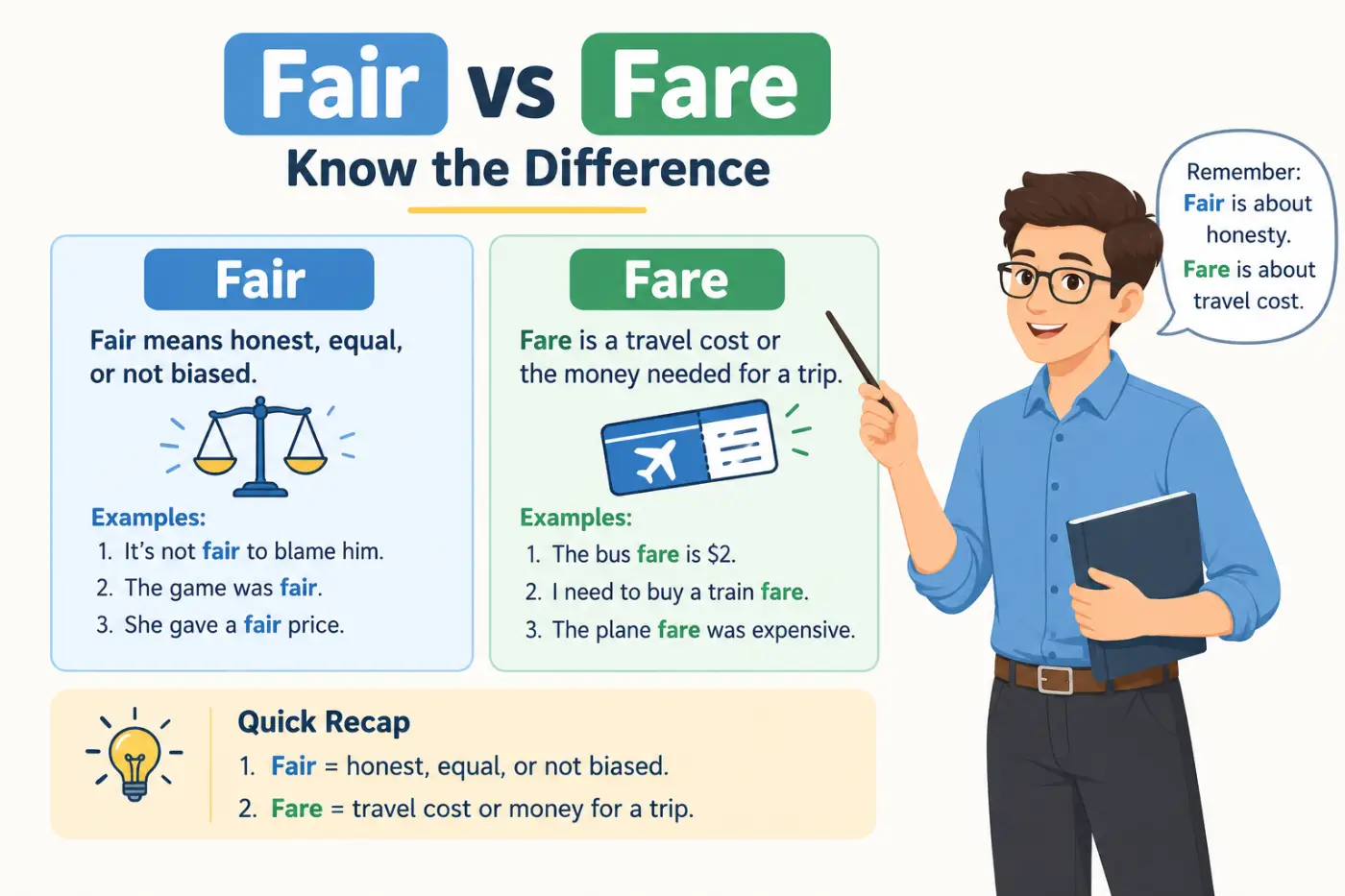
The confusion around Fair vs Fare is common because English has many words that share a pronunciation but have different spellings and meanings. You might see fair in a sentence about equal treatment, while fare often appears when discussing transportation costs.
Fair means reasonable, equal, just, or acceptable. It can also refer to an exhibition or public event. Fare means the price of transportation, food, or how someone performs in a particular situation.
This guide explains their meanings, origins, grammar rules, synonyms, and everyday uses. You’ll also find practical examples, common mistakes, and simple tips to help you choose the correct spelling every time.
What Is the Difference Between Fair and Fare?
The main difference between these two words is their meaning and grammatical use. Fair usually describes something that is reasonable, equal, or acceptable. It can also describe pleasant weather, light coloring, or an event where people gather to enjoy activities or sell products.
Fare commonly refers to the money someone pays for transportation. It can also describe food or how well someone performs in a situation.
Here’s a simple comparison:
| Feature | Fair | Fare |
|---|---|---|
| Pronunciation | Fair | Fair |
| Main meaning | Just, reasonable, or equal | Transportation cost |
| Part of speech | Adjective, noun, adverb, verb | Noun, verb |
| Common use | Fair treatment | Bus fare |
| Other meaning | Festival or exhibition | Food or performance |
| Example | That’s a fair decision. | The taxi fare was $15. |
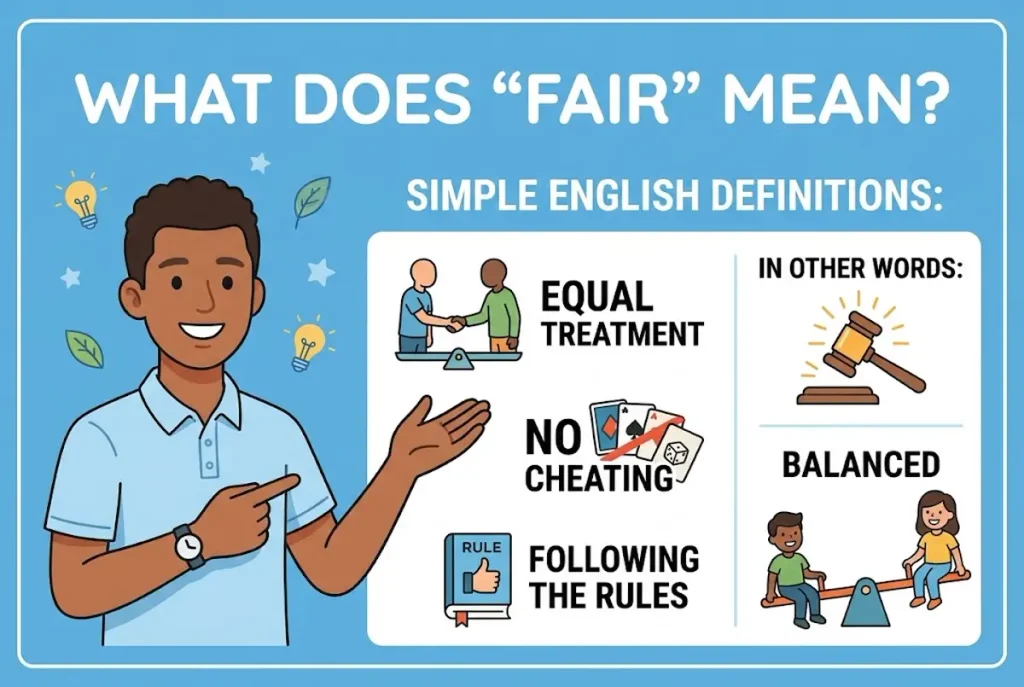
What Does Fair Mean in Simple English?
Fair describes something that is reasonable, honest, equal, or acceptable. When someone makes a fair decision, they consider the facts and treat people properly. The word often appears in conversations about justice, rules, competition, and personal behavior.
Examples:
- Every student deserves a fair chance.
- The teacher made a fair decision.
- We should treat everyone fairly.
- That’s a fair price for this laptop.
- Both teams agreed to follow fair rules.
However, fair has several other meanings.
| Meaning | Explanation | Example |
|---|---|---|
| Just | Treating people properly | The judge reached a fair decision. |
| Reasonable | Acceptable in a situation | That’s a fair offer. |
| Light-colored | Describing pale skin or light hair | She has fair hair. |
| Pleasant weather | Clear or generally good conditions | The forecast predicts fair weather. |
| Exhibition | An organized public event | We visited the science fair. |
| Moderately good | Acceptable but not excellent | His performance was fair. |
Where Does the Word Fair Come From?
Fair has a long history in English.
Its adjective form comes from the Old English word fæger, which referred to something beautiful, pleasant, or attractive.
Over time, its meaning expanded to include ideas such as honesty, justice, and reasonable treatment.
The noun fair, meaning a public market or exhibition, has a different origin. It comes through Old French from the Latin word feria, associated with holidays and festive occasions.
This explains why the same spelling can describe both equal treatment and a public event.
What Does Fare Mean in Simple English?
Fare most commonly means the money someone pays to travel by bus, train, taxi, airplane, or another form of transportation.
For example, if you pay $20 for a taxi ride, that amount is your taxi fare.
Common examples include:
- The bus fare increased this month.
- How much is the train fare?
- She paid her taxi fare in cash.
- We found a cheap airfare online.
- Children receive discounted fares on some routes.
Fare also works as a verb.
When used as a verb, it describes how someone performs, progresses, or manages in a particular situation.
Examples:
- How did you fare in the interview?
- The team fared well during the tournament.
- Small businesses may fare differently during difficult economic conditions.
Another meaning relates to food.
You might hear someone describe traditional fare, local fare, or simple fare when discussing meals and cuisine.
For example:
The restaurant serves traditional American fare.
Here, fare means food rather than transportation.
Where Does the Word Fare Come From?
Fare comes from the Old English word faran, meaning to travel, go, or journey.
This historical connection helps explain its modern meanings.
The word gradually developed several uses connected with traveling, living, and getting along in life.
Its transportation meaning eventually became associated with the money paid for a journey.
The verb meaning, as in how someone fared, still reflects the older idea of progressing through an experience.
Fair vs Fare Synonyms With Meanings and Examples
Synonyms can help you understand these words more clearly. However, the best replacement depends on the meaning you want to express.
For example, just can replace fair when discussing justice, but it cannot replace fair when referring to a festival.
Similarly, ticket price may replace fare in a transportation sentence, but it cannot replace fare when discussing someone’s performance.
The following tables group useful alternatives by tone and everyday usage.
Simple Synonyms
| Word | Meaning | Tone | Example |
|---|---|---|---|
| Just | Morally right | Simple | The judge made a just decision. |
| Equal | The same in amount or treatment | Simple | Everyone received an equal share. |
| Honest | Truthful and sincere | Simple | Give me your honest opinion. |
| Right | Correct or acceptable | Simple | Making that choice felt right. |
| Good | Positive or acceptable | Simple | We received a good offer. |
| Price | Money paid for something | Simple | The ticket price increased. |
| Cost | Amount required to pay | Simple | The cost of traveling has risen. |
| Food | Something people eat | Simple | They served delicious food. |
Everyday Synonyms
| Word | Meaning | Tone | Example |
|---|---|---|---|
| Reasonable | Sensible and acceptable | Everyday | The landlord offered reasonable terms. |
| Balanced | Considering different sides | Everyday | She gave a balanced opinion. |
| Impartial | Not favoring one side | Everyday | We need an impartial referee. |
| Acceptable | Good enough for a situation | Everyday | The final result was acceptable. |
| Festival | Organized public celebration | Everyday | Our town hosts a summer festival. |
| Exhibition | Public display or event | Everyday | Students attended the art exhibition. |
| Ticket price | Amount paid for a ticket | Everyday | The ticket price includes admission. |
| Performance | How well someone does | Everyday | Her performance improved this year. |
| Cuisine | A particular style of food | Everyday | The restaurant specializes in Italian cuisine. |
Formal Synonyms
| Word | Meaning | Tone | Example |
|---|---|---|---|
| Equitable | Fair according to circumstances | Formal | The company adopted an equitable policy. |
| Unbiased | Free from unfair preference | Formal | The report presented an unbiased assessment. |
| Objective | Based on facts | Formal | The manager provided objective feedback. |
| Legitimate | Lawful or justified | Formal | Employees raised legitimate concerns. |
| Proportionate | Appropriate in size or degree | Formal | The punishment should be proportionate. |
| Remuneration | Payment for work | Formal | The contract outlines employee remuneration. |
| Transportation charge | Amount paid for travel | Formal | The transportation charge appears on the receipt. |
| Culinary offerings | Food provided or available | Formal | The hotel offers diverse culinary offerings. |
| Progress | Development or advancement | Formal | The students made steady progress. |
How Do Fair and Fare Synonyms Change by Intensity?
Some synonyms communicate stronger meanings than others.
For example, acceptable suggests that something meets a basic standard. Equitable communicates a more specific idea of justice.
Fair Synonyms From Mild to Strong
| Intensity | Word | Meaning |
|---|---|---|
| Mild | Okay | Good enough |
| Mild | Acceptable | Meets basic expectations |
| Moderate | Reasonable | Sensible and appropriate |
| Moderate | Balanced | Considers different sides |
| Strong | Just | Morally right |
| Strong | Impartial | Free from favoritism |
| Strong | Equitable | Fair according to people’s circumstances |
Fare Synonyms by Meaning
Fare does not have one natural intensity scale because it describes several unrelated ideas.
Instead, choose alternatives based on the situation.
| Situation | Basic expression | More specific expression |
|---|---|---|
| Transportation | Cost | Transportation charge |
| Food | Food | Cuisine |
| Performance | Do | Perform |
| Progress | Get along | Make progress |
| Managing difficulties | Manage | Persevere |
How Do Fair and Fare Work as Different Parts of Speech?
Grammar plays a major role in choosing the correct word.
Fair has more grammatical uses than fare, although both can function as nouns and verbs.
Fair as an Adjective
An adjective describes a noun.
Fair commonly appears before nouns such as decision, treatment, price, and chance.
Examples:
- The company offers fair wages.
- Every child deserves a fair opportunity.
- We reached a fair agreement.
Fair as a Noun
As a noun, fair usually refers to an organized event, exhibition, or market.
Examples:
- Our school organized a book fair.
- Thousands attended the county fair.
- She displayed her artwork at the local fair.
Fair as an Adverb or Verb
Fair can also function as an adverb in certain expressions, such as play fair.
Example:
Both teams promised to play fair.
Its verb form is less common in everyday conversation. It can describe making something smooth or streamlined, particularly in technical contexts.
Fare as a Noun
Fare commonly names a transportation payment or a type of food.
Examples:
- The train fare was affordable.
- The restaurant serves vegetarian fare.
Fare as a Verb
Fare describes how someone performs or manages.
Examples:
- How did you fare during the exam?
- The company fared better than expected.
Its common verb forms are:
| Form | Example |
|---|---|
| Base | I hope you fare well. |
| Present | She fares well under pressure. |
| Past | He fared poorly in the competition. |
| Present participle | The business is faring better. |
Notice that the past tense is fared, not faired.
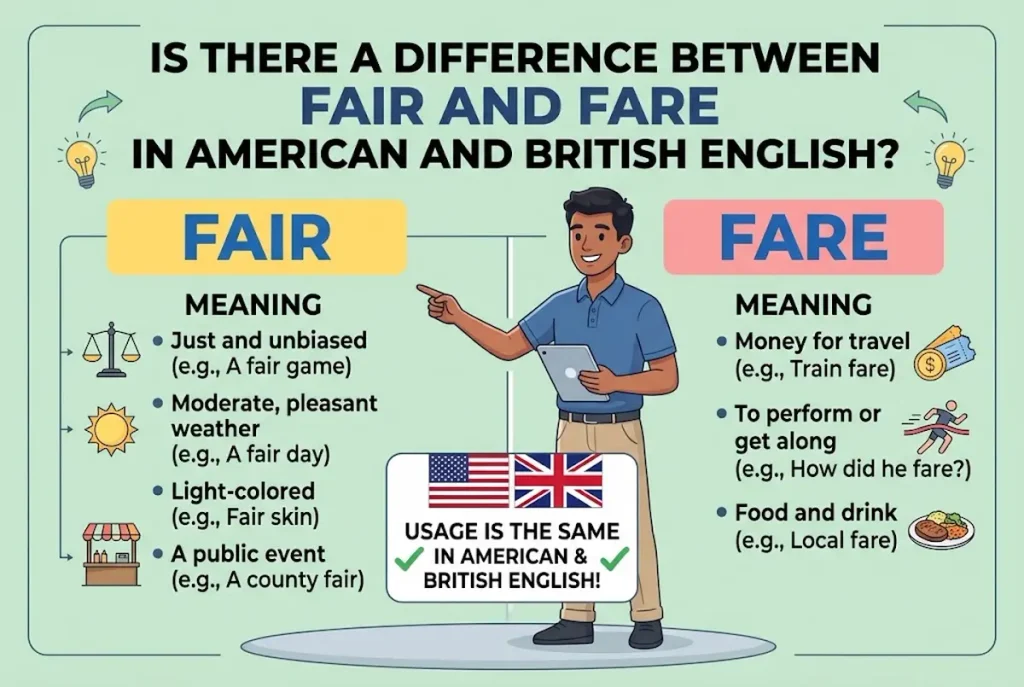
Is There a Difference Between Fair and Fare in American and British English?
Both words have the same main meanings in American and British English.
Their spellings do not change between the two varieties.
However, some expressions and everyday contexts differ slightly.
| Expression | American English | British English |
|---|---|---|
| Fair treatment | Common | Common |
| Bus fare | Common | Common |
| County fair | Common | Less typical as an event name |
| Funfair | Understood but less common | Common |
| Airfare | Common | Common |
| Fair play | Common | Common |
When Should You Use Fair or Fare in Different Situations?
Choosing the correct word becomes easier when you consider what your sentence is trying to communicate.
Professional writing, academic essays, casual texts, and everyday conversations often require different expressions.
How Should You Use Fair and Fare on a Resume?
On a resume, fair may appear when describing ethical practices, workplace policies, or employee treatment.
However, stronger action-based wording often communicates your achievements more clearly.
Example:
Developed fair scheduling procedures to improve employee satisfaction.
You could also write:
Introduced equitable scheduling practices across multiple departments.
Fare is less common on resumes unless your job involves transportation, ticketing, or travel expenses.
Example:
Managed passenger fare collection and daily transaction records.
Avoid using fair as a vague description of your skills. Saying you have fair communication skills may suggest that your abilities are only average.
Which Word Should You Use in an Essay?
Academic essays often use fair when discussing justice, equality, or reasonable decisions.
Example:
A fair education system should provide equal learning opportunities for all students.
Fare is useful when writing about transportation, economics, or performance.
Example:
Rising transportation fares can place additional pressure on low-income families.
When writing a formal essay, explain the specific meaning instead of relying on vague statements.
For instance, equitable treatment may be more precise than fair treatment when discussing different needs and circumstances.
How Do You Use Fair and Fare in Text Messages?
Casual messages often use fair to express agreement or acceptance.
Examples:
- Fair enough. I understand.
- That’s not fair!
- Sounds like a fair deal.
Fare usually appears when discussing travel costs or asking about someone’s experience.
Examples:
- What’s the Uber fare?
- How did you fare in your interview?
- The bus fare is getting expensive.
Fair enough is especially common in informal communication. It means you accept someone’s point or explanation.
Which Word Is Better in a Professional Email?
Professional emails require clear and accurate wording.
Use fair when discussing reasonable expectations, agreements, or workplace decisions.
Example:
We believe this proposal offers a fair solution for both parties.
Use fare when discussing transportation expenses or travel arrangements.
Example:
Please include your taxi fare in the reimbursement request.
If you’re writing about a person’s performance, fare can also be appropriate.
Example:
We hope your team fares well during the upcoming evaluation.
How Do You Use Fair and Fare in Everyday Speaking?
In ordinary conversation, both words appear naturally.
Fair is especially common when people discuss decisions, prices, or personal opinions.
Example:
I don’t think that’s a fair way to treat your friends.
Fare frequently appears in conversations about transportation.
Example:
Do you know how much the subway fare costs?
You may also hear:
How did you fare at your new job?
This asks how someone’s experience went, not how much money they earned.
Fair vs Fare Examples in Everyday Sentences
The following examples show how context changes the meaning of each word.
| Situation | Correct sentence | Explanation |
|---|---|---|
| School | The teacher gave everyone a fair chance. | Equal treatment |
| Shopping | That’s a fair price for a used phone. | Reasonable cost |
| Transportation | The bus fare increased by $2. | Travel payment |
| Job interview | How did you fare during the interview? | Performance |
| Community event | We attended the annual county fair. | Public event |
| Restaurant | The café serves traditional American fare. | Food |
| Workplace | Employees expect fair treatment. | Justice |
| Travel | She booked a discounted airfare. | Flight cost |
| Sports | Both teams agreed to play fair. | Following rules |
| Weather | We’re expecting fair weather tomorrow. | Pleasant conditions |
| Business | The company fared well last year. | Successful performance |
| Education | Students deserve fair grading practices. | Unbiased assessment |
| Train journey | The return fare was cheaper than expected. | Ticket cost |
| Family | Parents should establish fair household rules. | Reasonable expectations |
| Festival | Local artists displayed their work at the fair. | Organized exhibition |
| Competition | Our team fared better in the final round. | Improved results |
Examples Using Both Words Together
Sometimes both words appear naturally in the same sentence.
- The bus fare seemed fair for such a long journey.
- We paid a reasonable fare to attend the fair.
- The taxi driver charged a fair fare.
- The company introduced fair transportation fare policies.
- I hope you fare well and receive fair treatment.
These examples demonstrate why spelling matters even when pronunciation stays the same.
Fair vs Just and Reasonable
Fair, just, and reasonable share similar meanings, but they communicate different ideas.
| Fair | Just | Reasonable |
|---|---|---|
| Focuses on proper treatment | Focuses on moral correctness | Focuses on sensible judgment |
| Common in everyday speech | Common in ethical discussions | Common in negotiations |
| Can describe prices | Rarely describes ordinary prices | Commonly describes prices |
Consider these sentences:
- The manager made a fair decision.
- The judge reached a just verdict.
- The seller offered a reasonable price.
Fare vs Fee and Price
Fare, fee, and price all relate to money, but their uses are different.
| Fare | Fee | Price |
|---|---|---|
| Usually relates to transportation | Usually relates to a service or permission | General cost of a product or service |
| Bus fare | Registration fee | Laptop price |
| Train fare | Membership fee | Ticket price |
| Taxi fare | Processing fee | House price |
Examples:
- The train fare is $12.
- The registration fee is $25.
- The laptop price is $600.
Fare vs Perform and Manage
When fare functions as a verb, it often overlaps with perform and manage.
However, these words are not always interchangeable.
| Word | Main focus | Example |
|---|---|---|
| Fare | Overall outcome or experience | She fared well in the interview. |
| Perform | Quality of someone’s actions | She performed well during the interview. |
| Manage | Ability to handle a situation | She managed the difficult interview confidently. |
What Are the Most Common Fair and Fare Mistakes?
Because these words sound identical, spelling errors are easy to make.
Most mistakes happen when writers focus on pronunciation instead of meaning.
Mistake 1 Using Fair for Transportation Costs
Incorrect: The taxi fair was expensive.
Correct: The taxi fare was expensive.
Use fare when referring to the money paid for transportation.
Mistake 2 Using Fare for Equal Treatment
Incorrect: Everyone deserves a fare chance.
Correct: Everyone deserves a fair chance.
Fair describes proper or reasonable treatment.
Mistake 3 Confusing Fair Well With Farewell
Incorrect: I said fair well to my classmates.
Correct: I said farewell to my classmates.
Farewell is a single word used when saying goodbye.
Although it is historically connected with fare well, the modern noun and expression are normally written as one word.
Mistake 4 Writing Faired Instead of Fared
Incorrect: The company faired well last year.
Correct: The company fared well last year.
Fared is the correct past tense when describing how someone or something performed.
Mistake 5 Using Fair for Food
Incorrect: The restaurant offers traditional Italian fair.
Correct: The restaurant offers traditional Italian fare.
Fare can describe food or cuisine.
When Should You Avoid Using Fair or Fare?
Even when a word is grammatically correct, it may not communicate your intended meaning clearly.
Avoid using fair when you need a more precise description of someone’s abilities.
For example:
His writing skills are fair.
This usually means his writing is acceptable or average, not excellent.
If you want to praise someone’s ability, good, strong, or excellent may work better.
Also, avoid using fare as a general replacement for every type of payment.
For example:
Incorrect: I paid my hospital fare.
Better: I paid my hospital bill.
Fare usually relates to transportation or food, not ordinary service charges.
Finally, avoid overly formal uses of fare in casual conversations when a simpler expression sounds more natural.
Instead of asking:
How did you fare at the grocery store?
You would normally ask:
How did your shopping trip go?
Both can be understood, but the second sounds more natural in everyday American English.
What Are the Opposites of Fair and Fare?
Fair has several antonyms because it carries different meanings.
| Meaning of Fair | Opposite | Example |
|---|---|---|
| Just | Unjust | The ruling was unjust. |
| Equal | Unequal | Workers received unequal treatment. |
| Honest | Dishonest | His behavior was dishonest. |
| Reasonable | Unreasonable | The request was unreasonable. |
| Impartial | Biased | The referee appeared biased. |
| Pleasant weather | Stormy | Stormy weather delayed the event. |
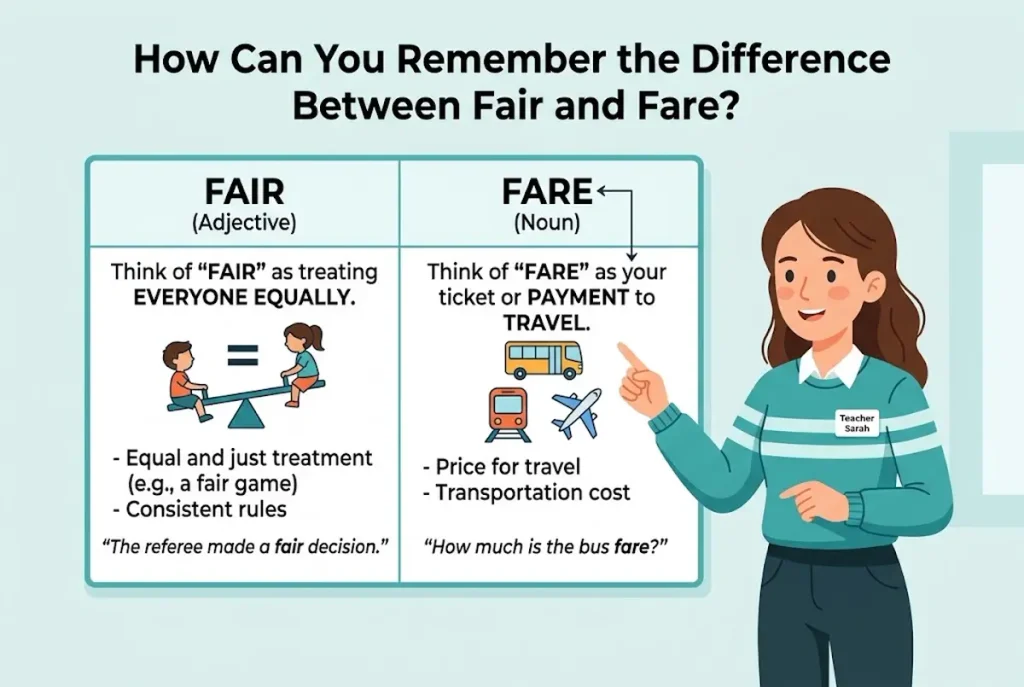
How Can You Remember the Difference Between Fair and Fare?
A few simple memory tricks can help you avoid confusing these homophones.
Remember Fair for Fairness
Fair and fairness share the same spelling pattern.
If your sentence discusses justice, equality, or reasonable treatment, choose fair.
Example:
Everyone deserves a fair opportunity.
Remember Fare for Transportation
Connect fare with the money required for a journey.
Think of familiar expressions such as:
- Bus fare
- Train fare
- Taxi fare
- Airfare
These expressions all refer to transportation costs.
Remember Fare for Performance
When asking how an experience went, use fare.
Example:
How did you fare during your first week at work?
A simple way to remember this meaning is to connect fare with how someone gets along through an experience.
Use This Quick Decision Table
| If your sentence is about… | Choose |
|---|---|
| Justice | Fair |
| Equal treatment | Fair |
| Reasonable prices | Fair |
| Festivals or exhibitions | Fair |
| Pleasant weather | Fair |
| Bus or taxi costs | Fare |
| Airline ticket costs | Fare |
| Food or cuisine | Fare |
| Someone’s performance | Fare |
| How an experience went | Fare |
Conclusion
Understanding Fair vs Fare becomes much easier once you connect each spelling with its meaning. Use fair when discussing justice, equal treatment, reasonable decisions, pleasant weather, or public exhibitions. Choose fare when referring to transportation costs, food, or how someone performs in a particular situation.
Remember that these words sound identical, so pronunciation alone cannot help you select the correct spelling. The surrounding sentence provides the answer.
A fair price is reasonable, while a fare is the amount you pay for transportation. Similarly, someone can receive fair treatment and fare well during an interview.
With a little practice, these differences become natural. Before choosing either word, consider the message you want to communicate. That simple habit will help you write more accurately and confidently.
Frequently Asked Questions
What is the main difference between fair and fare?
The main difference in Fair vs Fare is meaning. Fair describes something just, equal, or reasonable, while fare commonly refers to transportation costs, food, or someone’s performance.
Is it fair price or fare price?
Fair price is correct when describing a reasonable amount of money. Fare refers specifically to a transportation charge, so you can also describe a transportation fare as fair.
Is it bus fair or bus fare?
Bus fare is correct. Fare means the money passengers pay to travel by bus or another form of transportation.
What does it mean to fare well?
To fare well means to perform successfully or have a positive experience in a particular situation. For example, someone who fared well in an interview likely had a successful experience.
Is it school fair or school fare?
School fair is correct when referring to an organized school event featuring games, activities, exhibitions, or stalls. Fare would refer to food or transportation costs.
What’s an easy way to remember fair vs fare?
Remember that fair connects with fairness, while fare commonly connects with travel expenses. If you’re discussing someone’s performance, fare is also the correct choice.
Can fair and fare be used in the same sentence?
Yes. For example, “The taxi fare was fair.” The first word refers to transportation cost, while the second describes the price as reasonable.
Is it fare better or fair better?
Fare better is correct when describing improved performance or results. For example, “She hopes to fare better in her next examination.”

Daniel Grammarfield — The Language Learner
Age: 28Occupation: ESL Learner & Digital Professional
Bio:Daniel is a non-native English speaker who wants to communicate more confidently at work and online. He uses Synotrench to improve grammar, understand confusing words, learn correct sentence structures, and build everyday English skills. He prefers simple explanations with practical examples.
Goals:
Master English grammar rules
Avoid common language mistakes
Improve professional communication
Learn English through real-life examples
Quote:“Learning English is not about memorizing rules — it’s about expressing ideas clearly.”
1 thought on “Fair vs Fare Guide With Meanings and Examples”