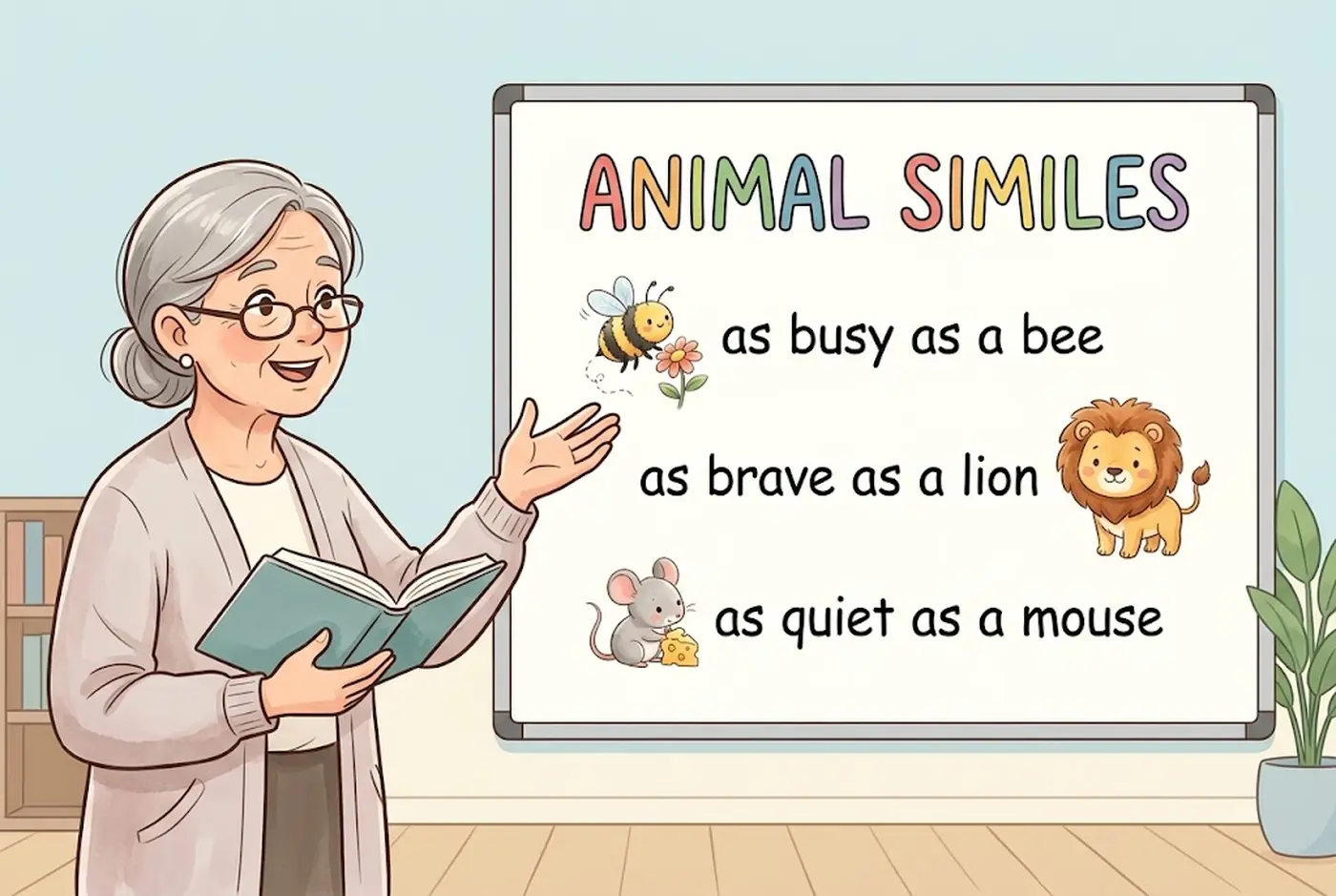
When you’re writing an essay, email, story, text, or even a social media post, you may want your description to feel more vivid. Saying someone is very fast works, but saying someone is as fast as a cheetah creates a much clearer picture. That is where animal similes become useful.
It compare a person, thing, action, or feeling to an animal by using words such as like or as. They make ordinary descriptions easier to picture and more interesting to read.
An animal simile is a comparison that connects something to an animal to describe a quality such as speed, strength, size, fear, cleverness, or quietness.
In this guide, you’ll learn what these comparisons mean, where the idea comes from, how different expressions vary in strength and tone, and which ones work best in essays, emails, texts, resumes, stories, and everyday speech. You’ll also find more than 30 examples, common mistakes, close comparisons, and practical tips for choosing the right expression.
Why do writers use animal comparisons?
Writers use these expressions because they can communicate an idea quickly.
Compare these two sentences:
He was very brave.
He fought like a lion.
The first sentence gives the reader a fact. The second gives the reader an image.
That difference matters in creative writing. A strong comparison can make a character, scene, or action easier to imagine.
These expressions are also useful in everyday conversation. You might tell a friend, You eat like a bird, or say, She sleeps like a baby. Most people understand the intended meaning immediately.
Where did animal similes come from?
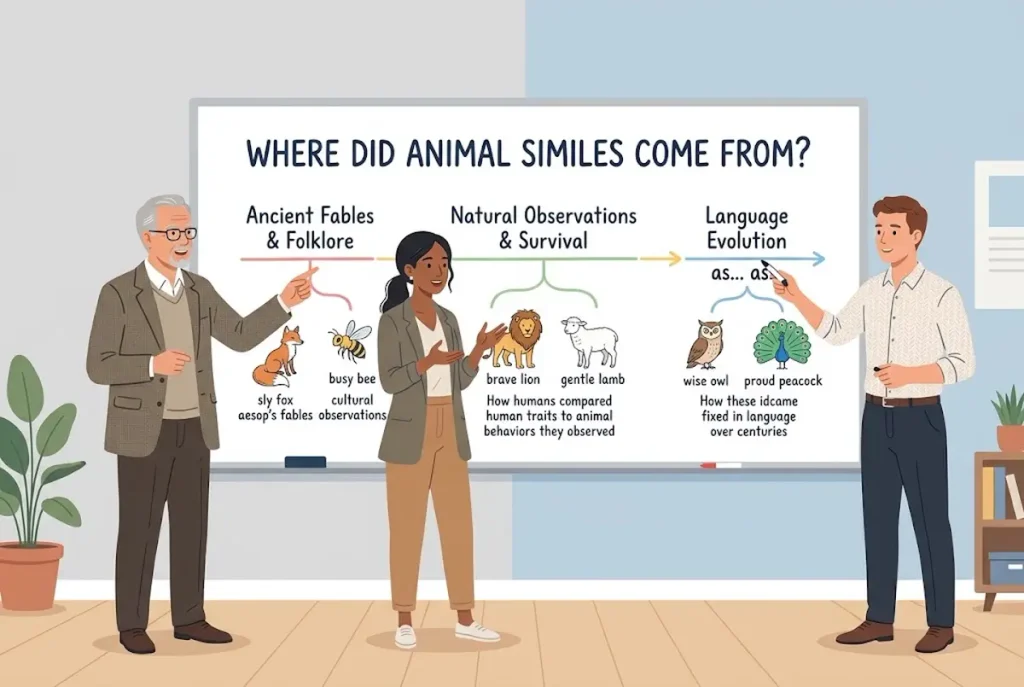
Animal comparisons have been part of human language for centuries. People have always watched animals closely and used their behavior as a way to describe human qualities.
Many traditional expressions developed from common observations. Bees were associated with constant work. Lions were associated with courage and power. Foxes were associated with cleverness. Mules were associated with stubbornness.
Some comparisons also come from literature, folklore, fables, religious writing, and everyday speech. Stories often give animals human qualities so readers can understand lessons about human behavior.
English has inherited many of these expressions over time. Some are very old and familiar, while others are newer and more creative.
There is no single historical moment when animal comparisons were invented. They developed naturally as speakers looked for vivid ways to describe people, actions, and experiences.
The important point is that these expressions are based on shared cultural associations. Those associations can also change. A particular animal may symbolize one quality in one culture and something different in another.
What is the difference between a simile and a metaphor?
A simile usually makes a comparison using like or as. A metaphor directly says that one thing is another.
For example:
Simile: He is as strong as an ox.
Metaphor: He is an ox.
The first sentence openly compares the person with an ox. The second treats the person as an ox in a figurative sense.
Both forms create imagery, but they work differently.
A simile often makes the comparison easier to recognize. A metaphor can sound stronger, shorter, or more dramatic.
Which words are simple and everyday?
Simple expressions are useful when you want your writing to sound natural.
Some common choices include:
- As busy as a bee.
- As strong as an ox.
- As quiet as a mouse.
- As fast as a cheetah.
- As gentle as a lamb.
- As proud as a peacock.
- As wise as an owl.
- As free as a bird.
- As light as a feather.
- As stubborn as a mule.
These are easy for most English speakers to understand. They work well in conversations, school writing, stories, and informal messages.
Which expressions sound more formal?
Most animal comparisons are informal or neutral rather than highly formal. In a professional document, you should usually choose a direct description instead of a colorful expression.
For example, instead of writing:
She works like a horse.
A resume could say:
She consistently handles a heavy workload and meets deadlines.
Instead of:
He is as sly as a fox.
A formal report might say:
He uses careful and strategic methods to achieve his goals.
Animal comparisons can still appear in essays, especially literature or creative writing. They should fit the purpose and audience.
Which expressions are slang or very informal?
Some expressions have a strong conversational flavor.
Examples include:
- Eat like a horse.
- Drink like a fish.
- Mad as a hornet.
- Fight like cats and dogs.
- Blind as a bat.
- Stubborn as a mule.
These can sound funny or colorful, but they are not always appropriate in professional writing.
The phrase drink like a fish can also be sensitive because it refers to heavy alcohol consumption. Use it carefully and only when the context makes the meaning clear.
How do change from mild to strong?
Not every comparison has the same intensity.
Consider ways to describe speed.
Mild:
He is quick.
Moderate:
He is as fast as a horse.
Strong:
He runs like a cheetah.
Very strong:
He moves like lightning.
The animal comparison can make the quality feel stronger because it gives the reader a concrete image.
The same idea works for other qualities.
For anger:
- Annoyed.
- Angry.
- Mad as a hornet.
- Furious.
For hunger:
- A little hungry.
- Hungry.
- Hungry as a wolf.
- Starving.
The strongest expression is not always the best one. Choose the level that matches the situation.
Which animal similes work best for resumes?
A resume usually needs clear and professional language. Most colorful animal comparisons are better replaced with direct descriptions.
For example, instead of:
I worked like a horse to finish the project.
Write:
I worked consistently to complete the project ahead of schedule.
Instead of:
She is as busy as a bee.
Write:
She efficiently manages multiple priorities and deadlines.
A resume should show skills with specific evidence. A direct statement is usually stronger than a figurative comparison.
Which work best for texting?
Texting is one of the easiest places to use casual comparisons.
You could write:
I was hungry as a wolf after work.
She was quiet as a mouse during the meeting.
My dog sleeps like a log.
You two fight like cats and dogs.
These expressions feel natural because texting often uses conversational English.
The best choice depends on the relationship between the people texting. A playful expression may sound friendly among friends but inappropriate in a serious conversation.
Which animal similes work best in emails?
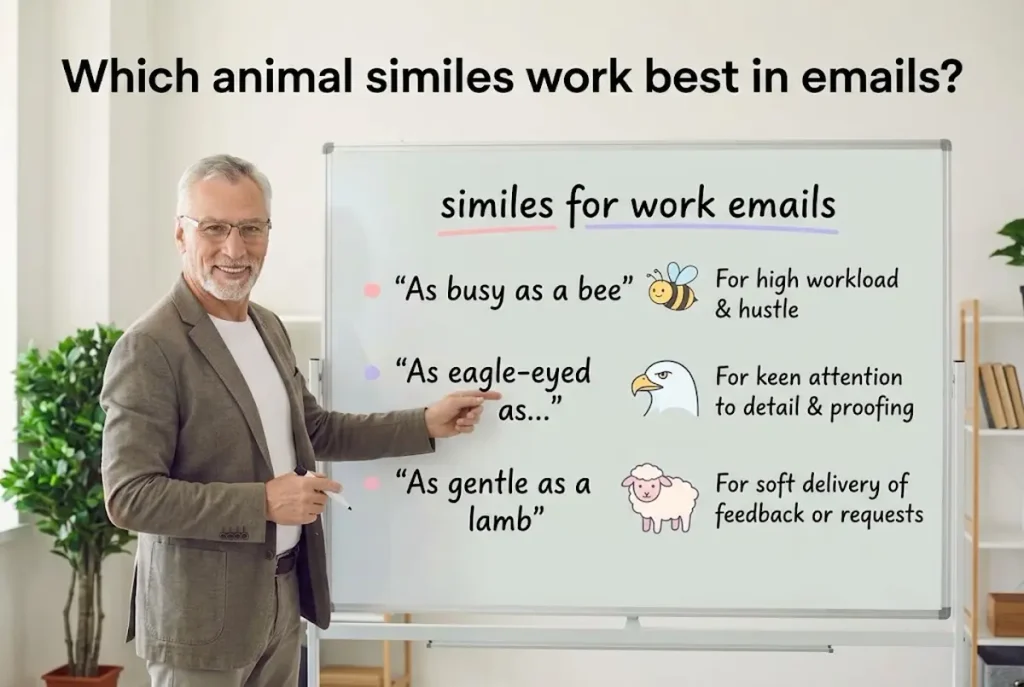
The answer depends on the email.
In a casual email to a friend, expressions such as busy as a bee or hungry as a wolf can sound natural.
In a workplace email, direct language is usually safer.
Casual:
I’ve been as busy as a bee this week.
Professional:
I’ve had a very busy week and am working through the remaining tasks.
The second version is clearer for professional communication.
Which work best in speaking?
Everyday speech is where many familiar expressions feel most natural.
You might say:
I’m hungry as a wolf.
He sleeps like a log.
She swims like a fish.
The kids are busy as bees.
That car is fast as a cheetah.
Because listeners already know many of these expressions, they can understand the meaning quickly without extra explanation.
What are some original animal simile examples?
Good examples should cover different people, actions, emotions, and situations. Here are more than 10 you can study.
- The little boy ran like a rabbit when he heard the bell.
- After working all day, Maria was hungry as a wolf.
- The new employee was busy as a bee during her first week.
- The swimmer moved through the water like a fish.
- The old teacher was wise as an owl when she gave us advice.
- The puppy was gentle as a lamb around the baby.
- The goalkeeper moved as fast as a cheetah to stop the ball.
- The two sisters argued like cats and dogs over the remote control.
- After the long trip, everyone slept like logs.
- The little girl sat as quiet as a mouse during the presentation.
- The athlete was strong as an ox after years of training.
- My uncle is stubborn as a mule when he has made up his mind.
- The child looked proud as a peacock after receiving the award.
- The detective was clever as a fox when he found the missing clue.
- After finishing the final exam, the students felt free as birds.
Notice that the animal does not describe every part of the sentence. It highlights one specific quality.
What is the difference between fast as a cheetah and fast as a horse?
Both expressions describe speed, but they create different levels of intensity.
| Expression | Main idea | Strength | Typical feeling |
|---|---|---|---|
| Fast as a horse | Very fast | Moderate | Natural and familiar |
| Fast as a cheetah | Extremely fast | Strong | More dramatic |
A horse can run very quickly, but the cheetah is widely known for exceptional speed. Because of that association, fast as a cheetah usually creates a stronger image.
For a dramatic story, the cheetah comparison may work better. For a simple everyday statement, a horse comparison may be enough.
What is the difference between clever as a fox and wise as an owl?
These expressions both describe intelligence, but they focus on different qualities.
Clever as a fox usually suggests quick thinking, strategy, or the ability to solve a problem. It can be positive, but it can also suggest someone is crafty.
Wise as an owl usually suggests knowledge, experience, good judgment, or thoughtful decision making.
Compare:
She was clever as a fox and found a way around the difficult rule.
Her grandmother was wise as an owl and gave her thoughtful advice.
The first person is strategic. The second person is experienced and sensible.
What is the difference between quiet as a mouse and silent as a ghost?
Both describe a lack of noise, but they create different images.
Quiet as a mouse is a familiar expression for someone who makes very little noise. It can also suggest shyness or a timid personality.
Silent as a ghost is a more creative comparison. It emphasizes an eerie or complete silence.
For a classroom:
The students were quiet as mice.
For a suspense story:
The hallway was silent as a ghost town.
The second expression is more literary and dramatic.
Are these different in American and British English?
Most common English expressions are understood in both American and British English. The main difference is often how frequently a particular expression is used.
American English commonly uses expressions such as busy as a bee, stubborn as a mule, and proud as a peacock.
British English also recognizes these expressions, although some phrases may sound more natural in one region or social group than another.
Some animal related expressions can also reflect cultural differences. An animal that carries a positive meaning in one culture may not carry exactly the same association elsewhere.
If your audience is American, choose expressions that sound natural in everyday US English. Avoid forcing an unfamiliar expression simply because it appears in a dictionary.
Why does culture matter in animal comparisons?
Animal symbolism is not universal.
For example, an owl is often connected with wisdom in English speaking cultures. Foxes are commonly associated with cleverness. Lions can symbolize courage or strength.
But these associations are shaped by stories, traditions, media, religion, history, and local culture.
That means an expression can lose some of its meaning when translated directly into another language.
For international readers, a short explanation may help if the comparison depends heavily on a cultural association.
What are common mistakes?
One common mistake is using an expression without understanding its meaning.
For example, saying someone is sly as a fox is not always a compliment. Sly often suggests cleverness combined with dishonesty or deception.
Another mistake is using an expression in a formal situation where it sounds too casual.
For example:
The company manager is stubborn as a mule.
That may sound humorous in a conversation, but a formal report could say:
The manager has been resistant to changing the current process.
A third mistake is mixing two expressions.
Incorrect:
She is as busy like a bee.
Correct:
She is as busy as a bee.
Or:
She works like a bee.
The pattern as + adjective + as is different from the pattern verb + like + noun.
When should you not use?
Avoid them when precision matters more than imagery.
Legal documents, technical instructions, medical records, scientific reports, and many business documents usually need direct language.
For example:
Figurative:
The computer was as slow as a turtle.
Technical:
The computer required several minutes to load the application.
The first sentence is colorful. The second gives clearer information.
You should also avoid comparisons that could sound insulting.
Calling someone a pig, rat, snake, or donkey can carry negative meanings. The intended joke may not be understood by every reader.
Think about the audience before using a figurative expression.
What are the antonyms of common animal comparisons?
Animal comparisons often describe qualities, so their opposite can be expressed with a direct word.
| Comparison | Main meaning | Possible opposite |
|---|---|---|
| Busy as a bee | Very busy | Idle |
| Fast as a cheetah | Very fast | Slow |
| Strong as an ox | Very strong | Weak |
| Brave as a lion | Very brave | Cowardly |
| Quiet as a mouse | Very quiet | Loud |
| Clever as a fox | Clever | Naive |
| Gentle as a lamb | Gentle | Rough |
| Stubborn as a mule | Stubborn | Flexible |
| Hungry as a wolf | Very hungry | Full |
| Proud as a peacock | Very proud | Humble |
| Free as a bird | Free | Restricted |
| Wise as an owl | Wise | Foolish |
The best antonym depends on the exact meaning and sentence.
How do you choose the right animal comparison?
Start with the quality you want to describe.
If the person is very fast, think about animals known for speed.
If the person is hardworking, think about animals commonly associated with constant activity.
Then consider tone.
Ask yourself:
- Is this for school, work, texting, or conversation?
- Does the expression sound positive, negative, or playful?
- Is the comparison easy for my audience to understand?
- Does it match the strength of the quality?
- Could the animal association accidentally sound insulting?
- Would a direct word be clearer?
These questions help prevent awkward choices.
What makes a good animal simile?
A good comparison has a clear connection between the subject and the animal.
For example:
The runner was as fast as a cheetah.
The connection is easy to understand.
A confusing comparison can make the reader stop and ask why that animal was chosen.
Good figurative language should help the reader rather than create extra work.
The best expressions also fit the tone. A funny expression can work well in a casual story but sound out of place in a formal report.
How can you create your own?
You do not have to use only traditional expressions. Writers can create new comparisons as long as the connection is clear.
Start by choosing a quality.
Suppose you want to describe someone who watches everything carefully.
You could write:
He watched the room like an owl at night.
For someone who moves quietly:
She slipped through the hallway like a cat.
For someone who is extremely energetic:
The children raced around the playground like puppies.
Creative comparisons work especially well in stories, poems, personal essays, and descriptive writing.
The key is to make the image easy to understand.
How do animal comparisons improve creative writing?
They can make a scene more visual.
Instead of:
The dog ran quickly.
You could write:
The dog raced across the yard like a cheetah.
Instead of:
The girl was scared.
You could write:
The girl stood as still as a rabbit hiding from a fox.
The second versions give readers something to picture.
Still, don’t fill every sentence with figurative language. If every line contains a comparison, the writing can feel crowded.
Use strong comparisons at moments where you want the reader to notice a person, action, or emotion.
What should students know about animal similes?
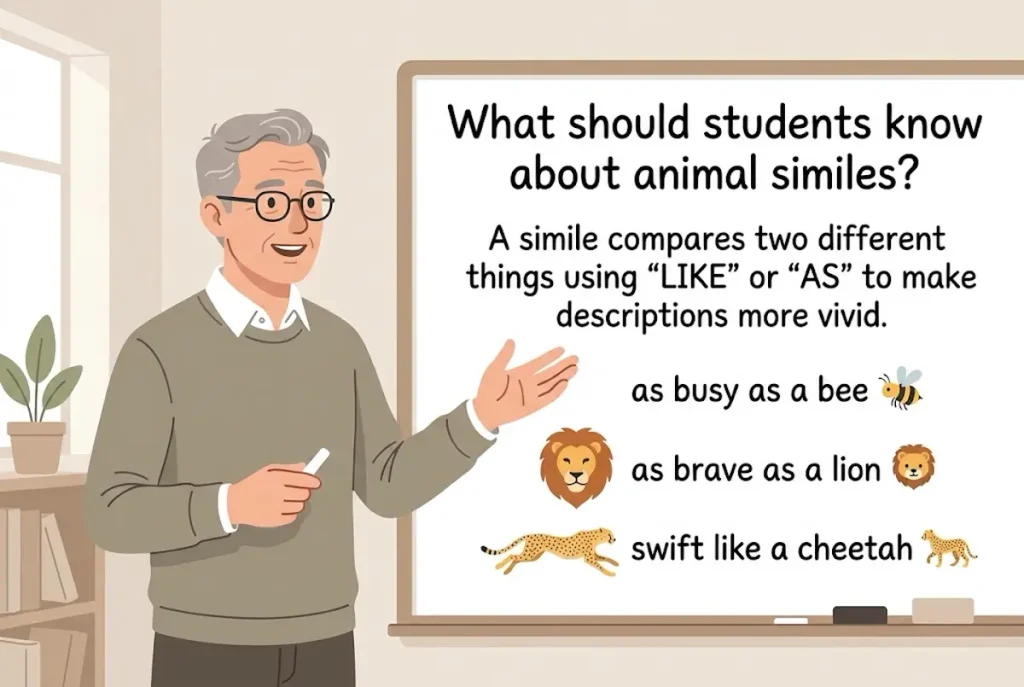
Students should first understand the basic pattern.
A simile compares two different things.
Common structures include:
- as + adjective + as + noun.
Example: He is as strong as an ox.
- verb + like + noun.
Example: She runs like a cheetah.
The comparison should make sense in context.
Students should also understand that similes are not literal statements. If a sentence says someone sleeps like a log, it does not mean the person is actually a piece of wood.
The purpose is to create a clearer mental picture.
Why are some animal funny?
Humor often comes from exaggeration.
If someone says:
I was hungry as a wolf.
The speaker is usually not claiming to have the appetite of an actual wolf. The exaggeration makes the sentence lively.
Other expressions sound funny because animals create unexpected images.
For example:
He eats like a horse.
The phrase is informal and exaggerated, so it can add a playful tone.
Humor depends on context. An expression that sounds funny among friends may not belong in a serious professional message.
What should you remember about word?
Animal comparisons are most effective when they do a specific job.
Use one to show speed, strength, courage, quietness, intelligence, hunger, fear, stubbornness, or another clear quality.
Do not choose an expression simply because it sounds interesting.
Think about meaning first. Then consider tone, audience, and intensity.
That approach will help you write descriptions that feel natural instead of forced.
Conclusion
Animal similes give ordinary descriptions more life by connecting people, actions, and feelings. A well chosen comparison can show speed, strength, courage, intelligence, fear, hunger, or personality without needing a long explanation.
The key is to match the expression with your purpose. Busy as a bee may work perfectly in a casual conversation, while a resume usually needs a direct statement about productivity. Clever as a fox and wise as an owl may both describe intelligence, but they suggest different kinds of intelligence.
Use these comparisons when they make your writing clearer or more memorable. Keep your audience and tone in mind, and don’t force a figurative expression where simple wording would be stronger. With the right choice, a short comparison can make a sentence much easier to picture and remember.
Frequently Asked Questions
What are animal similes?
The comparisons that use animals to describe people, objects, actions, or feelings. They commonly use like or as to create a clear mental image.
What is an example of an animal simile?
A common example is, She is as busy as a bee. The comparison means she is very busy or hardworking.
What are the most common?
Common examples include busy as a bee, strong as an ox, quiet as a mouse, stubborn as a mule, wise as an owl, and proud as a peacock. These expressions are widely understood in everyday English.
What’s another way to say someone is very fast?
You can say someone is as fast as a cheetah, quick as lightning, or runs like the wind. The best choice depends on how informal or dramatic you want the sentence to sound.
Are these used in formal writing?
They can be used in some essays and creative writing, but direct language is usually better for technical, legal, scientific, and highly professional documents. Always match the expression to your audience.
What is the difference between a simile and a metaphor?
A simile makes a comparison using words such as like or as, while a metaphor directly describes one thing as another. For example, He is as strong as an ox is a simile, while He is an ox is a metaphor.

Daniel Grammarfield — The Language Learner
Age: 28Occupation: ESL Learner & Digital Professional
Bio:Daniel is a non-native English speaker who wants to communicate more confidently at work and online. He uses Synotrench to improve grammar, understand confusing words, learn correct sentence structures, and build everyday English skills. He prefers simple explanations with practical examples.
Goals:
Master English grammar rules
Avoid common language mistakes
Improve professional communication
Learn English through real-life examples
Quote:“Learning English is not about memorizing rules — it’s about expressing ideas clearly.”
3 thoughts on “Animal Similes: Ultimate Guide With 30+ Examples (2026)”