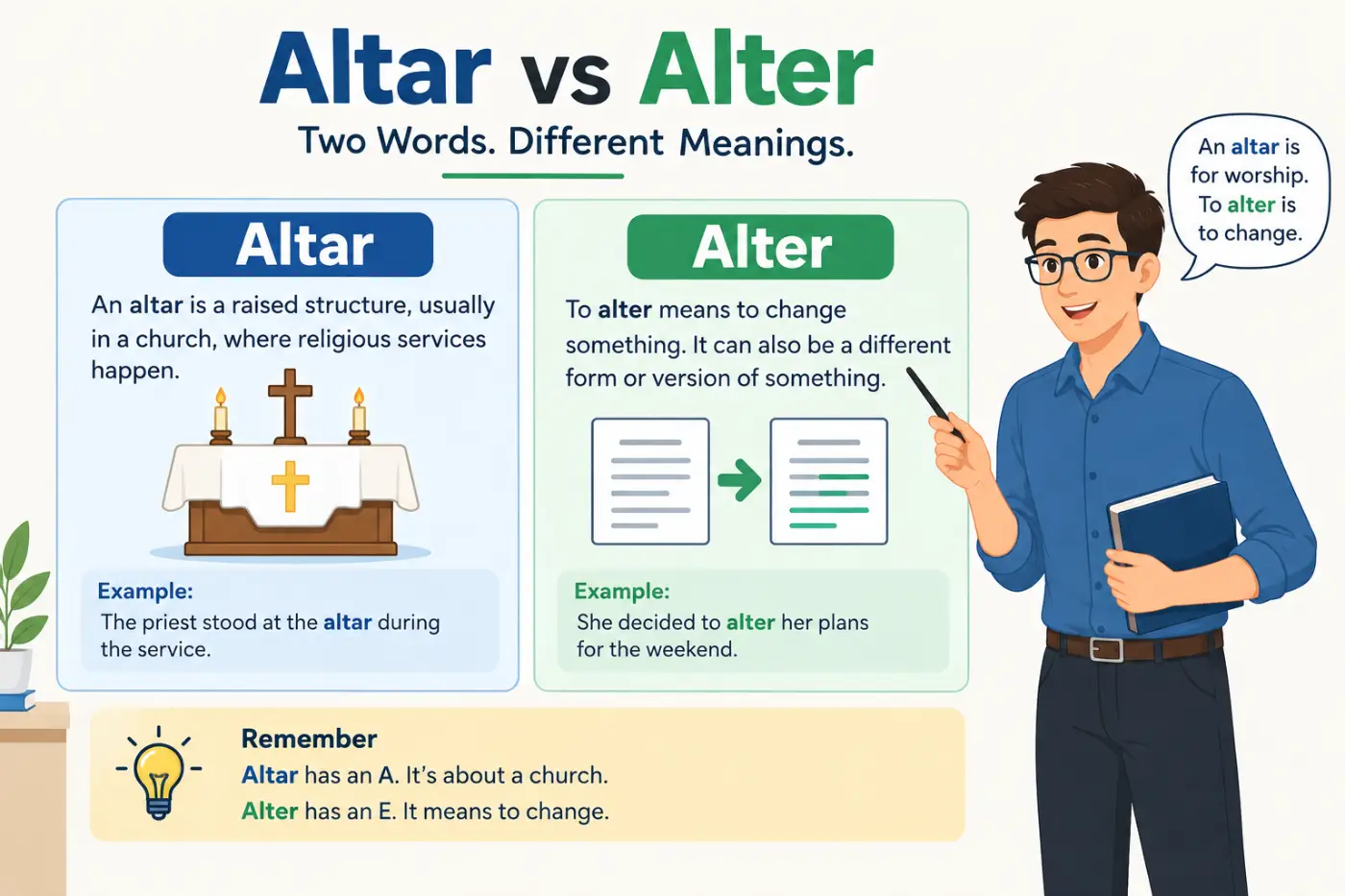
If you’re writing an email, essay, text, or even a resume, confusing altar vs alter can lead to a very different meaning. The two words sound exactly the same in standard American English, but they have completely different meanings and uses.
Altar is a noun that usually means a raised place or structure used for religious ceremonies. Alter is a verb that means to change, modify, or make something different.
That one letter makes a big difference. You might write about a wedding at an altar, but you would alter your plans if something unexpected happened.
This guide explains the meanings, origins, synonyms, examples, common mistakes, regional details, and practical ways to remember the difference. By the end, you’ll know exactly which word to choose in an essay, email, text, conversation, or formal document.
What is the difference between altar and alter?
The basic difference is simple: altar is a thing, while alter describes an action.
An altar is a physical or symbolic place connected with worship or religious ceremony. It can be found in churches, temples, shrines, and other sacred settings. In a wedding ceremony, for example, a couple may stand near the altar.
Alter is a verb. It means to change something, usually by making it different from its original form, condition, appearance, or arrangement.
Consider these examples:
- The couple stood near the altar during the ceremony.
- We need to alter the design before printing it.
- The priest placed flowers on the altar.
- She decided to alter her travel plans.
- The church has a beautiful marble altar.
- You can alter the dress to make it fit better.
The easiest rule is this:
Altar = a place or structure.
Alter = to change something.
If you can replace the word with “change,” you probably need alter. If you’re talking about a sacred table, platform, or ceremonial place, you probably need altar.
Where do altar and alter come from?
Understanding their origins can make the difference easier to remember.
What is the origin of altar?
The word altar has a long religious history. It comes into English through Old French and Latin. The Latin word altare referred to an altar or place where offerings were made.
The idea of an altar appears across many religious and cultural traditions. An altar may be used for prayer, offerings, sacrifice, worship, remembrance, or important ceremonies.
The meaning has also expanded in modern English. People sometimes use the word in historical, literary, or figurative contexts.
For example:
- The ancient altar stood at the center of the temple.
- Flowers covered the family altar.
- The story describes a sacrifice made at the altar.
The central idea remains connected to a sacred or ceremonial place.
What is the origin of alter?
Alter has a different history. It comes from Latin alter, meaning “other” or “another.” It eventually developed into the English verb meaning to make something different.
That history fits its modern meaning. When you alter something, you make it other than it was before.
For example:
- The tailor altered the jacket.
- We altered the schedule.
- The company altered its policy.
- He altered the image before publishing it.
The word has nothing to do with religious altars.
Why do altar and alter sound the same?
The two words are homophones. Homophones are words that have the same pronunciation but different meanings, spellings, and often different origins.
This is why altar vs alter causes so many spelling mistakes. When someone hears the word, sound alone doesn’t tell them which spelling to use.
Context provides the answer.
If someone says, “They walked toward the altar,” the religious or ceremonial meaning makes the spelling clear.
If someone says, “We need to alter the plan,” the meaning of “change” tells you to use alter.
What are the meanings of altar and alter?
A quick comparison makes the difference easier to see.
| Word | Part of speech | Basic meaning | Example |
|---|---|---|---|
| Altar | Noun | A sacred or ceremonial structure or place | The candles were placed on the altar. |
| Alter | Verb | To change or modify something | We need to alter the schedule. |
There is also a useful grammar test.
A noun names a person, place, thing, or idea. Altar names a thing or place.
A verb describes an action or state. Alter describes the action of changing something.
So:
The altar was decorated.
Here, altar is the thing being decorated.
They altered the decorations.
Here, altered describes the action of changing them.
What are the main synonyms and related words?
Because altar and alter have different meanings and parts of speech, they don’t share one synonym list. The most useful approach is to separate words related to alter from words connected with altar.
The following list gives more than 20 useful alternatives and related terms. Some are direct synonyms, while others are closely related words that work in specific contexts.
The important point is that words such as change, modify, adjust, revise, amend, and adapt can often replace alter, depending on the context.
Words such as shrine, sanctuary, chapel, and temple are related to altar, but they aren’t exact synonyms. A shrine is not necessarily an altar, and a temple is not an altar.
Which synonyms for alter are mild or strong?
Not every synonym communicates the same amount of change.
Choosing the right word can make your writing more precise.
What words mean a small change?
For a small change, use words such as:
- Adjust.
- Tweak.
- Refine.
- Edit.
- Modify.
Examples:
- I need to adjust the chair.
- She tweaked the sentence.
- The editor refined the introduction.
- He edited the paragraph.
- We modified the schedule slightly.
These words suggest that the original thing remains mostly intact.
What words mean a moderate change?
For a noticeable but controlled change, consider:
- Revise.
- Adapt.
- Rework.
- Reorganize.
- Redesign.
- Reshape.
Examples:
- The teacher revised the lesson.
- We adapted the plan.
- The designer reworked the layout.
- The manager reorganized the department.
- The company redesigned the website.
What words mean a major change?
For a large or dramatic change, words such as these may work better:
- Transform.
- Convert.
- Rebuild.
- Overhaul.
- Restructure.
Examples:
- The renovation transformed the building.
- They converted the warehouse into apartments.
- The city rebuilt the damaged bridge.
- The company overhauled its system.
- The organization restructured its departments.
This distinction matters because alter itself is fairly neutral. It doesn’t automatically tell the reader how large the change was.
What part of speech are altar and alter?
The difference in grammar is one of the fastest ways to remember these words.
Is altar a noun?
Yes. Altar is a noun.
It names a structure or place associated with religious or ceremonial activity.
Examples:
- The altar was covered with flowers.
- The church has a wooden altar.
- They placed candles beside the altar.
- The bride walked toward the altar.
You can put articles such as “a” or “the” before it.
- an altar.
- the altar.
- a beautiful altar.
- the old altar.
Is alter a verb?
Yes. Alter is a verb.
It describes the act of changing something.
Examples:
- We need to alter the design.
- She altered her dress.
- They altered the schedule.
- The experience altered his opinion.
It can appear in different verb forms:
- alter.
- alters.
- altered.
- altering.
For example:
The tailor altered the suit.
The word “altered” tells us what the tailor did.
How should you use altar in a resume?
You usually won’t need altar in a resume unless your work, education, volunteer activity, research, or experience directly involves religion, history, architecture, art, or cultural studies.
For example:
- Assisted with the restoration of a historic church altar.
- Studied medieval altar design as part of an art history project.
- Helped organize ceremonial objects for a museum exhibit.
In most professional resumes, altar is not a general business word.
Don’t use it when you mean “change.”
Incorrect:
I altar my work methods when needed.
Correct:
I alter my work methods when needed.
The second sentence means that you change your methods when necessary.

How should you use alter in a resume?
Alter can work in a resume when you’re describing how you changed a process, document, design, plan, or approach.
For example:
I altered the reporting process to reduce unnecessary steps.
You can also use more specific verbs when they better describe your achievement.
Instead of:
I altered the company website.
You might write:
I redesigned the company website.
Instead of:
I altered the training program.
You might write:
I revised the training program for new employees.
Specific verbs can make resume writing clearer because they tell the reader exactly what kind of change you made.
How should you use altar in an essay?
Altar can appear naturally in essays about religion, history, culture, literature, art, architecture, or ceremonies.
Examples:
The ancient altar was used for ceremonial offerings.
The novel describes a family gathering around a small altar.
The church’s stone altar became an important part of the building’s history.
In a historical essay, make sure the word refers to an actual ceremonial structure or place.
Don’t use altar as a substitute for alter just because the two words sound the same.
How should you use alter in an essay?
Alter is common in academic writing because writers often need to describe change.
Examples:
Climate conditions can alter the behavior of certain animals.
The invention altered the way people communicated.
New evidence may alter the interpretation of the historical event.
The researchers altered the procedure to improve the results.
In academic writing, you may sometimes choose a more precise synonym.
For example:
The researchers modified the procedure.
This sounds more specific than:
The researchers altered the procedure.
Both can be correct.
How should you use altar in a text message?
In ordinary texting, altar is uncommon unless you’re talking about a wedding, church, religion, or ceremony.
For example:
The flowers at the altar looked beautiful.
If you’re talking about changing something, use alter:
I might have to alter my plans.
A useful texting trick is to replace the word mentally with “change.”
If the sentence still makes sense, alter is probably correct.
I need to change my plans.
Therefore:
I need to alter my plans.
But:
They stood near the change.
That doesn’t make sense if you mean a religious structure. You need altar.
How should you use altar in an email?
Use altar only when the email discusses a religious or ceremonial subject.
For example:
The flowers for the altar will arrive tomorrow morning.
If you’re discussing changes to a schedule, document, project, or plan, use alter.
For example:
We may need to alter the meeting schedule.
Another example:
Please let me know if you want me to alter the document before Friday.
The choice depends entirely on meaning.
How should you use alter when speaking?
In conversation, alter is useful when you mean “change.”
You might say:
Can we alter the schedule?
I had to alter my plans.
That experience altered my opinion.
The tailor altered my jacket.
Because altar and alter sound alike, the listener usually understands the intended word from context.
That means pronunciation won’t help you decide which spelling to use when writing. Meaning will.
What are some real examples of altar and alter?
Here are examples from different situations.
Religious ceremony
The priest stood beside the altar during the service.
Here, altar is a noun referring to a religious structure.
Wedding
The couple exchanged vows near the altar.
Again, altar refers to the ceremonial place.
Clothing
The tailor altered the jacket to fit better.
Here, altered means changed.
Travel
A delayed flight forced us to alter our plans.
The plans were changed.
School
The teacher altered the assignment after receiving student feedback.
The teacher changed the assignment.
Business
The company altered its pricing strategy after reviewing the results.
The company changed its strategy.
Architecture
The historic altar was carefully restored.
The word refers to a physical religious structure.
Technology
The developer altered the code to fix the problem.
The developer changed the code.
Writing
The author altered the final paragraph before publication.
The author changed the paragraph.
History
The ancient altar was discovered during the excavation.
The word refers to a ceremonial structure.
Personal plans
I had to alter my plans because of the weather.
The plans changed.
Fashion
She altered the dress before the wedding.
The dress was changed to improve its fit or appearance.
Altar vs alter: what is the difference in a sentence?
The easiest way to see the contrast is to put both words in the same sentence.
The couple stood near the altar after they altered the ceremony schedule.
The first word names the ceremonial structure.
The second word describes an action.
Another example:
The designer altered the decoration around the altar.
Here, altered means changed, while altar identifies the religious structure.
One sentence can contain both words because they perform completely different jobs.
Alter vs modify: what’s the difference?
These words are close in meaning, but they aren’t always interchangeable in tone.
Alter means to make something different.
Modify usually suggests making a specific adjustment while keeping the basic identity or purpose of the original thing.
Compare:
| Alter | Modify |
|---|---|
| General change | Specific adjustment |
| Broad everyday use | Often more technical or precise |
| Can describe major or minor changes | Often suggests controlled changes |
| We altered the plan. | We modified the plan slightly. |
For example:
The experience altered his career path.
This suggests a meaningful change.
The engineer modified the machine.
This suggests a specific technical adjustment.
The two words overlap, but context determines which sounds more natural.
Alter vs adapt: what’s the difference?
Alter means to change something.
Adapt usually means to change something so that it works in a new situation or for a new purpose.
Compare:
We altered the schedule.
This simply means we changed it.
We adapted the schedule for remote workers.
This suggests that the schedule was changed to suit a particular situation.
Adaptation has a purpose built into its meaning. Alteration does not necessarily have one.
For example:
The teacher altered the lesson.
We know the lesson changed.
The teacher adapted the lesson for younger students.
We know why the lesson changed.
Altar vs alter: what are the common mistakes?
The biggest mistake is using altar when you mean alter.
Incorrect:
I need to altar my plans.
Correct:
I need to alter my plans.
The second common mistake is using alter when you mean altar.
Incorrect:
The flowers were placed on the alter.
Correct:
The flowers were placed on the altar.
Another mistake happens when writers rely only on sound.
Because both words are pronounced alike, listening isn’t enough to determine the spelling.
Instead, identify the meaning first.
Ask:
Am I talking about a sacred place or structure?
If yes, use altar.
Ask:
Am I talking about changing something?
If yes, use alter.
When should you not use altar?
Don’t use altar when you simply mean:
- Change.
- Modify.
- Adjust.
- Revise.
- Edit.
- Improve.
- Adapt.
For example:
Incorrect:
We need to altar the schedule.
Correct:
We need to alter the schedule.
The schedule isn’t a religious structure. You’re talking about changing it.
When should you not use alter?
Don’t use alter when you mean a religious or ceremonial structure.
Incorrect:
The priest walked toward the alter.
Correct:
The priest walked toward the altar.
If you’re talking about candles, offerings, ceremonies, worship, or a sacred structure, altar is likely the word you need.
What are the antonyms of alter?
Since alter means to change, its opposites generally involve keeping something the same.
Useful antonyms include:
- Keep.
- Preserve.
- Maintain.
- Retain.
- Leave unchanged.
- Keep intact.
- Continue.
- Sustain.
Examples:
We decided to keep the original design.
The museum preserved the historic structure.
She maintained the same schedule.
They retained the original wording.
There isn’t a single direct antonym that works in every sentence. The best choice depends on the type of change you’re talking about.
Altar doesn’t have a simple direct antonym because it is a noun naming a specific type of structure.
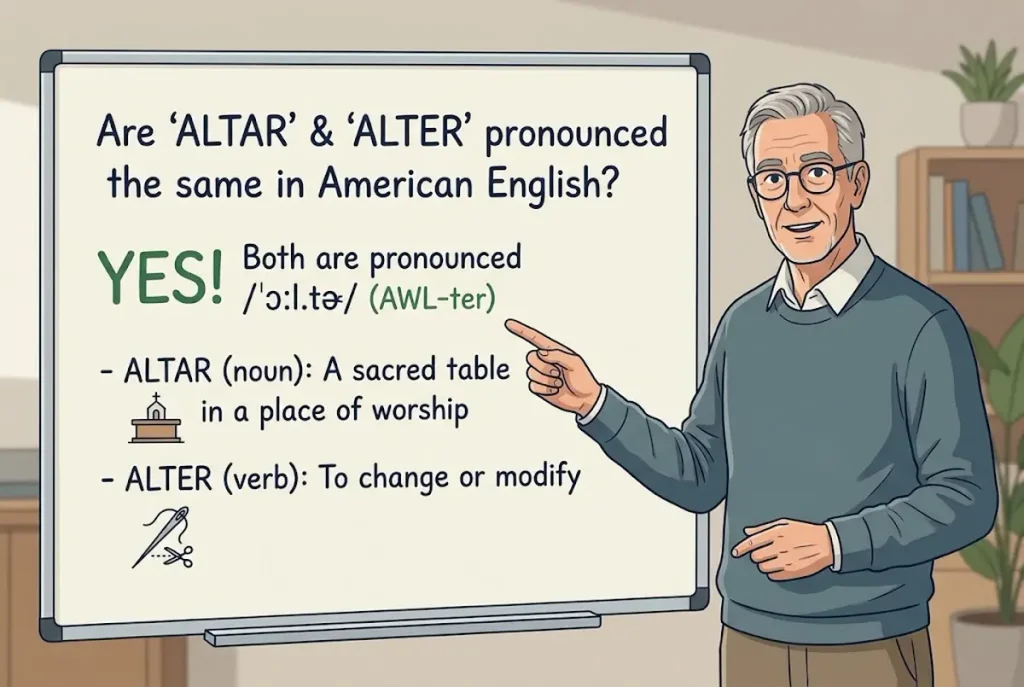
Are altar and alter pronounced the same in American English?
Yes. In standard American English, altar and alter are normally pronounced the same.
This makes them homophones.
That shared pronunciation explains why people sometimes spell the wrong word after hearing it.
The same problem occurs with many other English word pairs, such as:
- Their and there.
- To and too.
- Right and write.
- Hear and here.
- Brake and break.
The solution is the same: focus on meaning and grammar, not sound alone.
Are altar and alter different in British English?
The spelling and basic meanings are also different in British English.
Altar refers to a religious or ceremonial structure.
Alter means to change something.
The distinction is not a special American English rule. English speakers in both the United States and the United Kingdom generally use the two words with these meanings.
Pronunciation can vary slightly across regional accents, but the words remain a common homophone pair.
What is the best way to remember altar vs alter?
A simple memory trick can help.
Think of the extra a in altar as standing for altar and worship.
Then remember:
Alter = change.
You can also connect alter with words such as:
- Altered.
- Alteration.
- Alternatively.
For example:
The dress was altered.
The dress needed an alteration.
Both words clearly connect to changing something.
For altar, picture a church, temple, candles, flowers, or a wedding ceremony.
Another quick test is:
Can I replace the word with “change”?
If yes, use alter.
Can I replace it with “religious ceremonial structure”?
If yes, use altar.
How can you choose the right word quickly?
Use this five second method.
- Look at the sentence.
- Decide what the word means.
- Check if it names a thing or describes an action.
- Replace it mentally with a simpler word.
- Choose the spelling.
For example:
We need to ___ the schedule.
Replace the blank with “change.”
We need to change the schedule.
That works.
So:
We need to alter the schedule.
Now consider:
The flowers were placed on the ___.
Replace the blank with “change.”
The flowers were placed on the change.
That doesn’t work.
Think about a religious ceremony instead.
So:
The flowers were placed on the altar.
This method is much more reliable than trying to remember the spelling by sound.
What related words should you know?
Learning related forms can make the difference easier to recognize.
For alter, useful forms include:
- Alter.
- Alters.
- Altered.
- Altering.
- Alteration.
- Alterable.
Examples:
The designer altered the layout.
The designer is altering the layout.
The alteration improved the design.
For altar, the word itself is the main form you will encounter.
You may also see related expressions involving religious or ceremonial settings, such as:
- Altar cloth.
- Altar rail.
- Altar table.
- Altar stone.
- Family altar.
- High altar.
These expressions all retain the basic religious meaning.
What should you remember about altar vs alter?
The most useful rule is short:
Altar is a noun connected with worship or ceremony. Alter is a verb meaning to change.
If you remember only one example, remember these:
The couple stood near the altar.
They altered their plans.
The first word names a place or structure.
The second word describes an action.
Because they sound alike, spelling mistakes are easy to make. But once you connect each word with its meaning, the difference becomes much easier to recognize.
Conclusion
The difference between altar vs alter comes down to meaning and grammar. Altar is a noun connected with worship, ceremonies, and sacred spaces. Alter is a verb that means to change or modify something.
When you’re writing, don’t depend on pronunciation because the two words sound alike. Instead, ask what the sentence is saying. If you’re talking about changing a plan, design, schedule, document, or idea, choose alter. If you’re talking about a religious or ceremonial structure, choose altar.
A simple memory trick can help: alter means change, while altar is a place or structure used for worship or ceremony. Keep that distinction in mind, and this common homophone pair becomes much easier to use correctly.
Frequently Asked Questions
What is the difference between altar and alter?
Altar is a noun for a sacred or ceremonial structure, while alter is a verb meaning to change or modify something.
Is altar a place or an action?
Altar is a noun that names a place or structure used for religious or ceremonial purposes.
Does alter mean change?
Yes. Alter means to make something different, usually by changing its form, condition, appearance, arrangement, or nature.
What’s another way to say alter?
Another way to say alter is change, modify, adjust, revise, adapt, edit, amend, or rework, depending on the context.
Why do altar and alter sound the same?
They are homophones, meaning they have the same pronunciation but different meanings and spellings.
Which is correct: altar or alter my plans?
The correct phrase is “alter my plans” because the verb means to change something.
Which is correct for a wedding: altar or alter?
The correct word is “altar” when referring to the ceremonial place or structure associated with the wedding.

Daniel Grammarfield — The Language Learner
Age: 28Occupation: ESL Learner & Digital Professional
Bio:Daniel is a non-native English speaker who wants to communicate more confidently at work and online. He uses Synotrench to improve grammar, understand confusing words, learn correct sentence structures, and build everyday English skills. He prefers simple explanations with practical examples.
Goals:
Master English grammar rules
Avoid common language mistakes
Improve professional communication
Learn English through real-life examples
Quote:“Learning English is not about memorizing rules — it’s about expressing ideas clearly.”
2 thoughts on “Altar vs Alter: The Ultimate Simple Guide (2026)”