When you’re writing Analogy vs Allegory an essay, email, story, or even a text, you may want to explain a difficult idea by connecting it to something familiar. That’s where an analogy can help. But if you’re reading a novel, poem, speech, or fable, you may run into a related idea called an allegory. The terms sound similar, but they do different jobs.
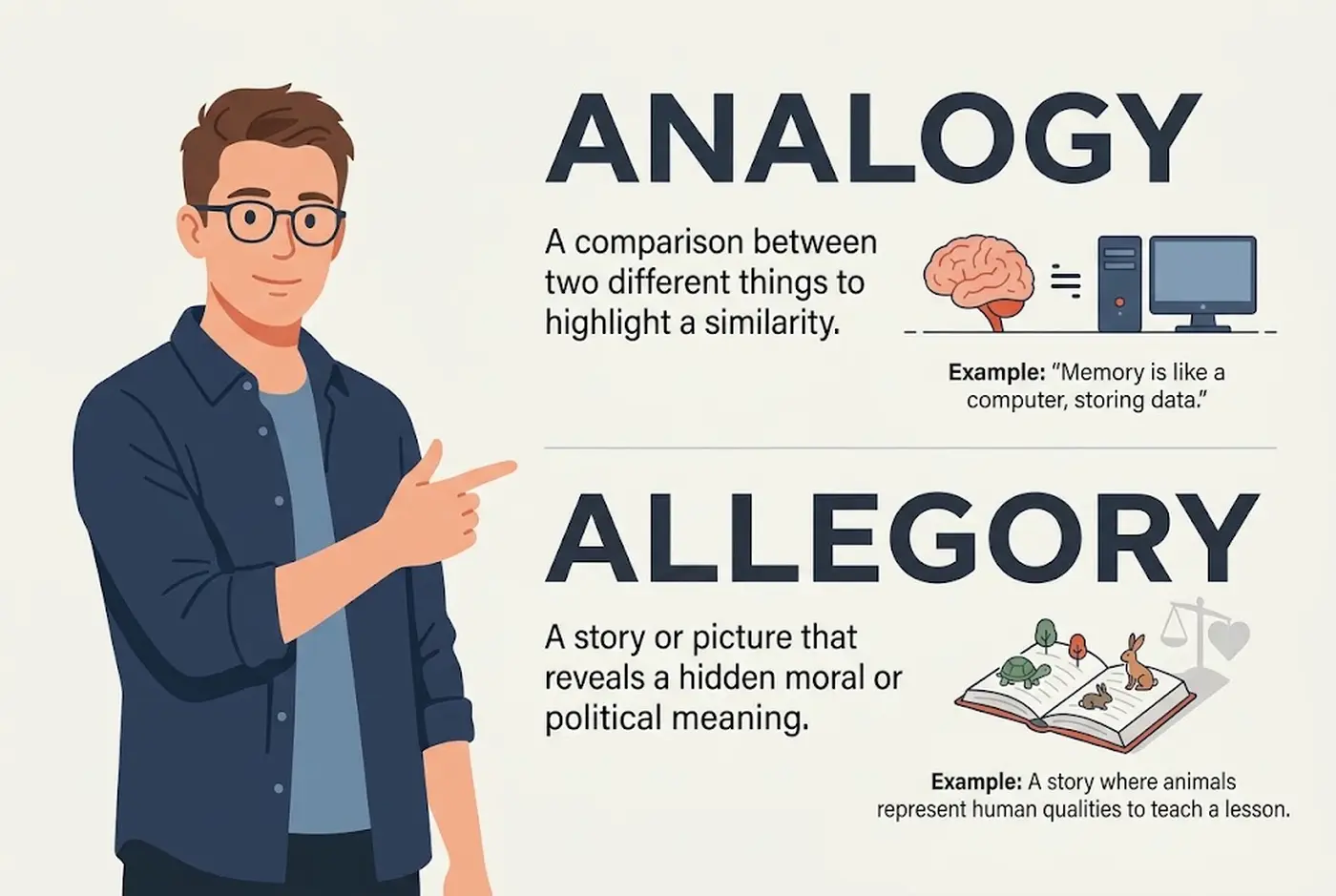
Analogy vs Allegory can be confusing because both connect one idea to another. An analogy usually explains or clarifies something by showing how two different things are alike in a useful way. An allegory is a story, image, or extended description that represents another idea, often a moral, political, social, or philosophical one.
Answer: An analogy compares two things to explain an idea, while an allegory uses a larger story or symbolic system to represent another meaning.
Understanding Analogy vs Allegory will make it easier to read literature, write stronger essays, and explain complicated ideas clearly. Below, you’ll learn where these words came from, how they work, how they differ, which related words fit different situations, and how to avoid common mistakes.
What does analogy mean in simple English?
An analogy is a comparison between two things that are different but share a useful similarity.
The purpose is usually to make an unfamiliar idea easier to understand. You don’t need the two things to be exactly alike. You only need a similarity that helps explain the point.
For example:
“Learning a new language is like building a house. You start with a strong foundation, then add more pieces over time.”
Learning a language isn’t literally building a house. The comparison simply helps explain that basic knowledge provides a foundation for more advanced skills.
An analogy can be short or detailed. It can appear in conversation, teaching, essays, speeches, advertisements, and everyday explanations.
Where did the word analogy come from?
The word analogy comes from the Greek word “analogía,” which referred to proportion, correspondence, or a relationship between things.
The basic idea has remained similar. An analogy points to a relationship between two things and uses that relationship to help someone understand an idea.
In modern English, analogy is especially common when someone is explaining a difficult concept.
A teacher might say:
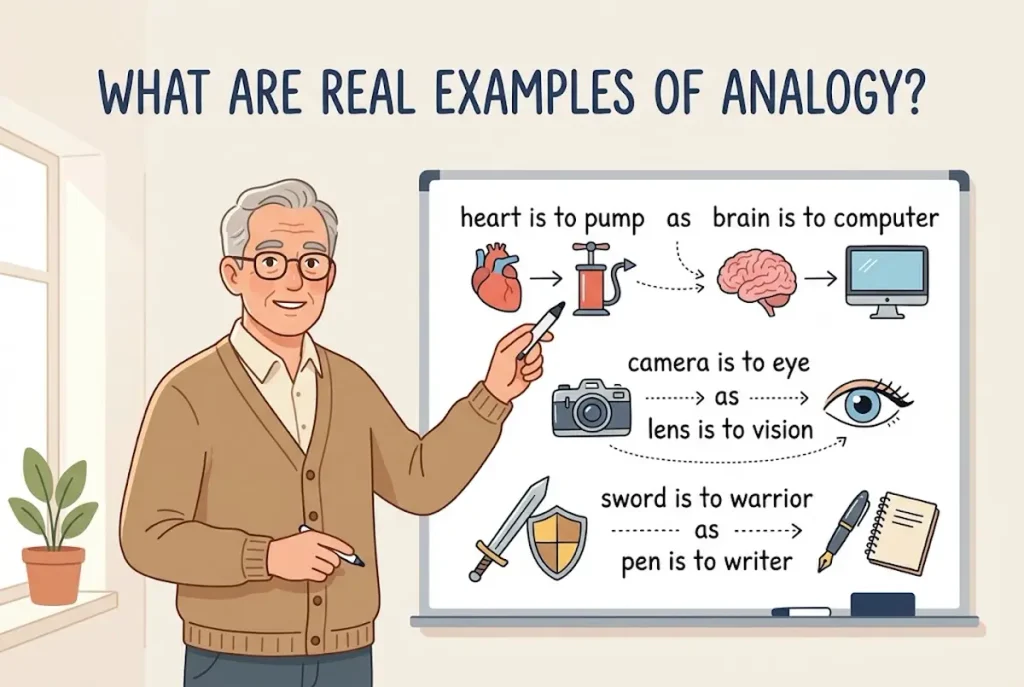
“The heart works like a pump.”
The heart and a mechanical pump aren’t identical. However, both move fluid through a system. That shared function makes the comparison useful.
Where did the word allegory come from?
Allegory comes from the Greek word “allēgoría,” meaning something like speaking about something through another form.
The word is connected to the idea of saying one thing while communicating another meaning through symbols, characters, or events.
Allegory has a long history in literature. Writers have used it to discuss morality, religion, politics, human behavior, and social problems without stating every idea directly.
Analogy vs Allegory: What is the main difference?
The easiest way to remember the difference is purpose.
An analogy explains.
An allegory represents.
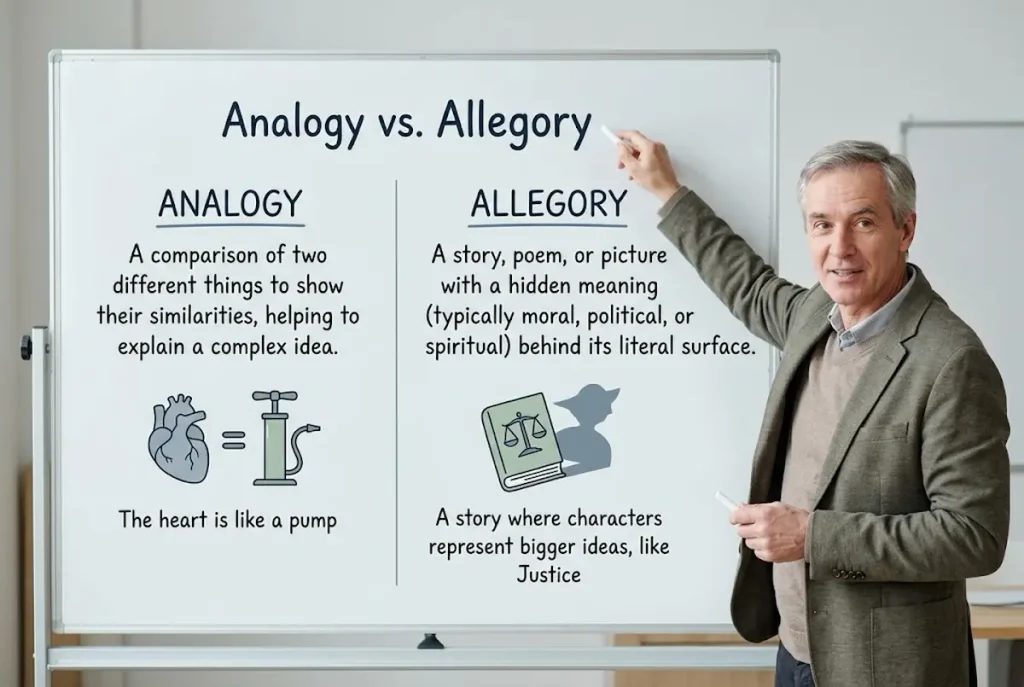
An analogy usually takes two things and points out a meaningful similarity. An allegory builds a broader symbolic meaning into a story, image, or work.
| Feature | Analogy | Allegory |
|---|---|---|
| Main purpose | Explain or clarify | Represent a deeper meaning |
| Basic structure | Comparison | Extended symbolic representation |
| Typical length | Often short | Often extended |
| Common use | Teaching and explanation | Literature, art, stories, moral lessons |
| Meaning | Based on similarity | Based on symbols and representation |
| Example | “The brain is like a computer.” | A story where characters represent ideas or groups |
| Reader’s task | Understand the comparison | Interpret the deeper meaning |
This distinction is central to Analogy vs Allegory.
An analogy doesn’t normally require an entire story. An allegory often depends on a collection of related symbols, characters, or events.
How are analogy and allegory similar?
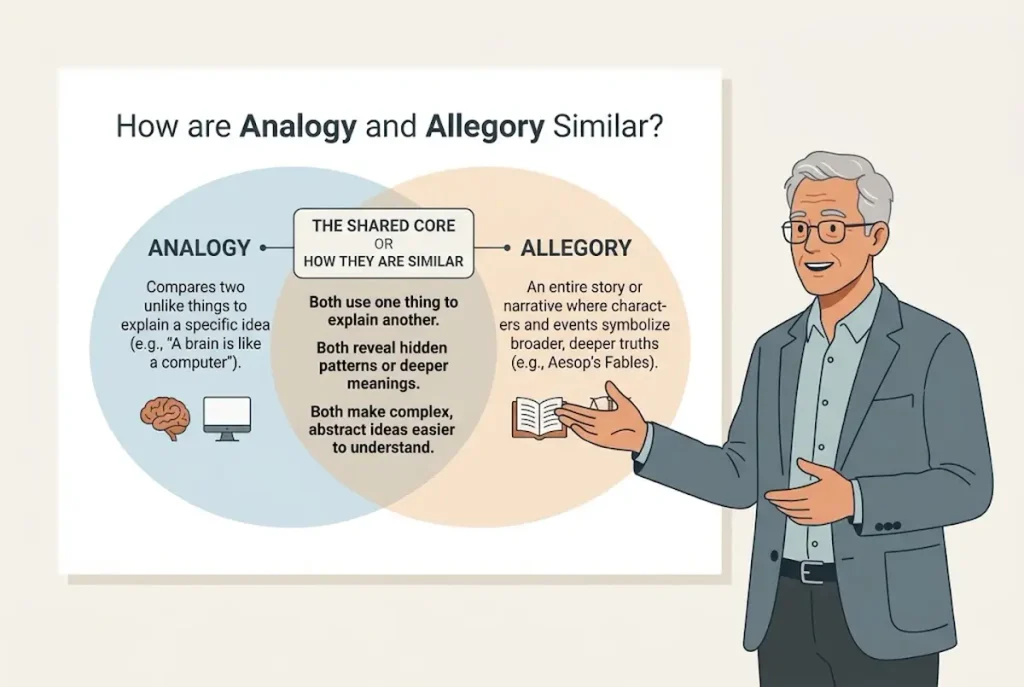
The two terms have several things in common.
First, both can help communicate ideas indirectly. Instead of giving a plain definition, a writer can use something familiar or symbolic.
Second, both can make abstract ideas easier to understand.
Third, both are common in literature, education, speeches, and everyday communication.
Fourth, both require the reader or listener to notice a relationship between two levels of meaning.
The key difference is the scale and purpose of that relationship.
An analogy may take one sentence.
An allegory may take an entire book.
For example:
“Managing money is like managing water. If you let small leaks continue, you may lose a lot over time.”
That’s an analogy.
Now imagine a story about a village where a water supply slowly disappears because of careless leaders, selfish citizens, and broken systems. If the water shortage represents a larger social problem, the story may work as an allegory.
What are the main types of analogy?
Analogies can take several forms. You don’t always need to memorize the names, but knowing the common patterns can help you recognize them.
Function based analogy
This type compares things because they perform similar functions.
Example:
“A thermostat is like the body’s temperature control system.”
Both systems help maintain a desired temperature.
Relationship based analogy
This type focuses on a relationship between two things.
Example:
“Teacher is to student as coach is to athlete.”
The important point is the relationship, not physical similarity.
Cause and effect analogy
This compares situations that have similar results.
Example:
“Ignoring a small writing error is like ignoring a loose screw on a machine. A small problem can become a larger one.”
Structural analogy
This compares how two systems are organized.
Example:
“A company’s departments are like sections of an orchestra. Each has a different role, but they must work together.”
These forms show why analogy is useful in teaching and communication.
What are the main types of allegory?
Allegories can also appear in different forms.
Moral allegory
A moral allegory uses characters and events to explore ideas about right and wrong.
A character who repeatedly chooses honesty despite personal costs might represent the value of integrity.
Political allegory
A political allegory uses a story or symbolic setting to discuss political systems, leaders, power, or conflict.
The writer may use fictional characters instead of directly naming real political figures or institutions.
Religious allegory
Religious allegories use stories and symbols to communicate spiritual or religious ideas.
Social allegory
A social allegory may represent problems such as inequality, prejudice, class conflict, or social pressure.
Philosophical allegory
This type uses symbolic situations to explore questions about knowledge, reality, freedom, justice, or human nature.
Because allegories can operate on several levels, readers sometimes disagree about exactly what a work represents. That doesn’t automatically make an interpretation wrong. Context and the author’s broader work can matter.
Which words are mild and which are stronger?
Choosing the right related word also depends on how strong the connection is.
Mild comparison
Use these when you only want to point out a basic similarity.
- Similarity.
- Resemblance.
- Likeness.
- Comparison.
- Connection.
Example:
“There is a clear similarity between the two approaches.”
Moderate comparison
Use these when the relationship is meaningful and useful.
- Parallel.
- Correspondence.
- Illustration.
- Representation.
- Reflection.
Example:
“The novel creates a strong parallel between personal freedom and political freedom.”
Strong symbolic connection
Use these when one thing consistently represents another idea.
- Symbolism.
- Allegory.
- Motif.
- Emblem.
- Representation.
Example:
“The repeated use of darkness creates a strong symbol of fear.”
The stronger words shouldn’t be used just to make your writing sound sophisticated. Choose the word that accurately describes the relationship.
Analogy vs Allegory in American and British English
There is no major US versus UK difference in the basic meanings of analogy and allegory.
American and British writers use both terms in largely the same ways. The spelling is also the same.
The bigger differences usually come from context, education, literary tradition, or personal style rather than geography.
For example, an American teacher might say:
“Think of the cell as a tiny factory.”
A British teacher could use the same analogy.
Likewise, a British literature class and an American literature class can both discuss a novel as an allegory.
Regional vocabulary can still affect the surrounding examples, but the core distinction remains stable.
What is the best word for a resume?
For a resume, analogy and allegory are rarely the words you need.
Professional resumes usually benefit from direct language such as comparison, example, result, achievement, experience, or evidence.
For example:
Weak:
“I use many analogies to explain business problems.”
Better:
“I simplify complex business problems for clients and team members.”
If you are specifically describing a communication skill, analogy can still be appropriate.
Example:
“I use clear analogies to explain technical concepts to nontechnical audiences.”
That sentence works because analogy describes a real communication method.
What is the best word for an essay?
For an essay, analogy can be useful when you’re explaining a difficult idea.
Example:
“An analogy between a computer network and a city’s road system helps explain how information moves between devices.”
For literary analysis, allegory may be the better term if a story consistently represents another set of ideas.
Example:
“The novel can be read as an allegory about the effects of unchecked power.”
Use the word that matches the evidence in the text. Don’t call a work an allegory simply because it contains one symbol.
What is the best word for email?
Email writing usually benefits from clarity.
If you’re explaining a complicated subject to a coworker, analogy may be useful.
Example:
“Think of the first stage like a foundation. If we skip it, the later steps become harder.”
If you’re discussing literature or symbolism, use allegory when it accurately describes the work.
Example:
“The story works as an allegory for the conflict between freedom and control.”
What is the best word for speaking?
In conversation, comparison and analogy are often the easiest choices.
Example:
“It’s kind of like driving. You need to learn the basic controls before you can drive confidently.”
That is an analogy, but most people don’t need to label it during casual conversation.
Allegory is more common when discussing books, films, religious stories, myths, art, or other works with deeper symbolic meaning.
What are some real examples of analogy?
Here are original examples from everyday situations.
Example about studying
“Studying for an exam is like training for a race. Small amounts of practice over time can prepare you better than one huge effort at the end.”
The comparison explains the value of consistent preparation.
Example about teamwork
“A good team is like a relay race. Each person has a different part to complete, and the final result depends on the handoff.”
The two situations are not identical, but their relationship is useful.
Example about cooking
“Learning to cook is like learning a language. You begin with basic words and rules, then gradually become more comfortable creating your own combinations.”
Example about saving money
“Small expenses are like drops of water filling a bucket. One drop doesn’t seem like much, but hundreds can add up.”
Example about technology
“A password is like a key. It helps keep something protected, but it only works well when you keep it private.”
What are some real examples of allegory?
Allegory becomes clearer when you look at stories in which characters or events carry a second level of meaning.
George Orwell’s “Animal Farm” is often discussed as a political allegory because its fictional farm and animal characters can be read as representations of political events and systems.
John Bunyan’s “The Pilgrim’s Progress” is a well known example of religious allegory. Its journey can be understood on a symbolic level as a spiritual journey.
Plato’s “Allegory of the Cave” uses a fictional situation involving prisoners, shadows, and a journey toward greater understanding to explore philosophical ideas about knowledge and reality.
These works are more than simple comparisons. Their characters, settings, actions, and events work together to communicate broader meanings.
Analogy vs Allegory in literature
Literature can contain both forms.
A novelist may use an analogy in one paragraph to explain a character’s emotions. The same novel could contain a larger allegorical structure.
For example, a writer might compare grief to a storm. That’s an analogy.
If the entire story follows a journey through a storm where every major event represents a stage of emotional recovery, the work may move toward allegorical structure.
The important point is that one analogy does not automatically make a work an allegory.
This is one of the most common areas of confusion in Analogy vs Allegory.
Analogy vs Metaphor: What’s different?
Analogy and metaphor are closely related, but they are not exactly the same.
A metaphor usually makes a direct figurative statement.
Example:
“Her voice was music.”
The speaker isn’t saying her voice is literally music. The metaphor creates a figurative connection.
An analogy usually explains the relationship more clearly.
Example:
“Her voice worked like music because its rhythm made difficult information easier to remember.”
A metaphor can be part of an analogy, but the terms should not be treated as exact synonyms.
Analogy vs Simile: What’s different?
A simile usually compares two things using words such as “like” or “as.”
Example:
“His mind was like a crowded library.”
An analogy may also use “like,” but it normally develops the comparison to explain something.
Example:
“His mind was like a crowded library. Every memory was a different book, and finding one quickly required knowing where it belonged.”
The second example provides more explanation. That’s what makes it function more strongly as an analogy.
Allegory vs Symbolism: What’s different?
Symbolism is the use of an object, action, character, color, place, or image to suggest another meaning.
An allegory is usually broader.
A story can contain symbolism without being a full allegory.
For example, a storm might symbolize fear in one scene. That doesn’t automatically make the entire novel an allegory.
An allegorical work usually creates a larger network of meanings.
| Symbolism | Allegory |
|---|---|
| Can involve one symbol | Often involves many connected symbols |
| Can appear briefly | Often extends across a work |
| Adds meaning to an element | Can shape the meaning of the whole story |
| Common in poems and novels | Common in stories, fables, and philosophical works |
This distinction is especially helpful in literary essays.
What are common mistakes with analogy and allegory?
Several mistakes appear often.
Mistake 1: Calling every comparison an allegory
Not every comparison is an allegory.
A sentence such as “Life is like a journey” is a comparison. By itself, it isn’t a complete allegorical story.
Mistake 2: Treating analogy as an exact synonym for metaphor
Analogy and metaphor overlap, but they serve different purposes.
A metaphor can create an image. An analogy often explains a relationship.
Mistake 3: Assuming an allegory must have only one meaning
Some allegorical works support several interpretations.
A story may explore political, moral, social, and personal ideas at the same time.
Mistake 4: Calling something allegorical without evidence
If you’re writing a literary essay, don’t label a story an allegory just because it contains symbols.
Look for repeated relationships between characters, events, settings, and larger ideas.
When should you not call something an allegory?
Don’t call a story an allegory simply because it has a hidden message.
Stories can contain themes, symbols, metaphors, motifs, or moral lessons without being full allegories.
If you are unsure, describe the specific feature instead.
For example:
“The river symbolizes change.”
This is more precise than saying:
“The entire story is an allegory.”
Use the stronger term only when the evidence supports it.
Quick tips for choosing the right word
- Use analogy when the goal is explanation.
- Use allegory when the goal is symbolic representation.
- Use comparison when you simply mean two things are being compared.
- Use metaphor for a direct figurative comparison.
- Use simile when a comparison uses like or as.
- Use symbolism when an object or image represents another idea.
- Use parable for a short story that teaches a lesson.
- Use fable for a moral story, often involving animals.
- Use representation when one thing stands for another.
- Use motif for a repeated image, idea, or element in a work.
- Don’t call every symbol an allegory.
- Don’t use analogy when you simply mean an example.
- Choose the simplest accurate word for your audience.
- In academic writing, support claims about allegory with evidence from the text.
- In everyday writing, explain the comparison instead of forcing a technical label.
Why does the difference matter?
Knowing this distinction improves both reading and writing.
When you understand analogy, you can recognize how writers and speakers make difficult ideas easier to understand.
When you understand allegory, you can look beneath the surface of a story and notice how characters, events, and settings may represent larger ideas.
This also helps with literary analysis.
Instead of writing:
“The author uses an allegory.”
You can write something more useful:
“The journey represents the character’s movement from ignorance to understanding, while the repeated darkness represents uncertainty.”
The second sentence gives evidence and explains the meaning.
That is what strong analysis should do.
Analogy vs Allegory: A quick comparison
| Question | Analogy | Allegory |
|---|---|---|
| What is it? | A comparison | A symbolic story or representation |
| Why use it? | To explain | To communicate a deeper meaning |
| Does it need a story? | No | Often yes |
| Can it be one sentence? | Yes | Sometimes, but usually broader |
| Is it figurative? | Often | Usually |
| Is symbolism required? | No | Usually central |
| Common in teaching? | Very common | Less common |
| Common in literature? | Yes | Very common |
| Main question to ask | “How are these alike?” | “What does this represent?” |
The simplest memory trick is this:
Analogy explains by comparison.
Allegory communicates through extended representation.
Conclusion
Analogy vs Allegory becomes much easier once you focus on purpose. An analogy compares two things because their relationship helps explain an idea. An allegory uses characters, events, objects, or an entire story to represent a deeper meaning.
Think of an analogy as a bridge between a familiar idea and an unfamiliar one. Think of an allegory as a story that carries another message beneath its surface.
When you’re writing, don’t choose the more complicated term just because it sounds academic. Choose the word that accurately describes what the writer is doing. If you’re explaining a difficult concept, analogy may be the right choice. If you’re analyzing a work filled with connected symbolic meanings, allegory may fit better.
Once you learn that basic difference, these two terms become much easier to recognize in essays, books, conversations, and everyday explanations.
Frequently Asked Questions
What is the difference between analogy and allegory?
An analogy compares two things to explain an idea, while an allegory uses a story or symbolic system to represent a deeper idea. An analogy is usually focused on a specific relationship, while an allegory can continue throughout an entire work.
Is an analogy the same as a metaphor?
No. A metaphor makes a figurative comparison, while an analogy usually explains a relationship between two different things. A metaphor can be part of an analogy, but the terms aren’t exact synonyms.
Is a story always an allegory if it has a hidden meaning?
No. A story can have themes or symbols without being an allegory. An allegory usually has a broader and more consistent relationship between its fictional elements and another set of ideas.
Can an analogy be used in an essay?
Yes. Analogy can be very useful in essays when you need to explain a difficult or abstract idea. A good analogy should clarify your argument rather than replace evidence.
Can a short sentence be an allegory?
Yes, in some contexts, but allegory usually involves a broader symbolic structure. A single symbolic image is more often described as symbolism or metaphor than as a complete allegory.
What’s another way to say analogy?
Other choices include comparison, parallel, similarity, likeness, illustration, or correspondence. The best choice depends on how strong and specific the relationship is.
How can I remember the difference between analogy and allegory?
Remember this simple rule: analogy explains through comparison, while allegory represents a deeper idea through a story, image, or connected set of symbols.
Why do writers use allegory instead of saying an idea directly?
Writers may use allegory to make an idea more memorable, encourage interpretation, explore sensitive subjects indirectly, or show a complex idea through characters and events. The symbolic form can give readers more than one level of meaning.

Daniel Grammarfield — The Language Learner
Age: 28Occupation: ESL Learner & Digital Professional
Bio:Daniel is a non-native English speaker who wants to communicate more confidently at work and online. He uses Synotrench to improve grammar, understand confusing words, learn correct sentence structures, and build everyday English skills. He prefers simple explanations with practical examples.
Goals:
Master English grammar rules
Avoid common language mistakes
Improve professional communication
Learn English through real-life examples
Quote:“Learning English is not about memorizing rules — it’s about expressing ideas clearly.”