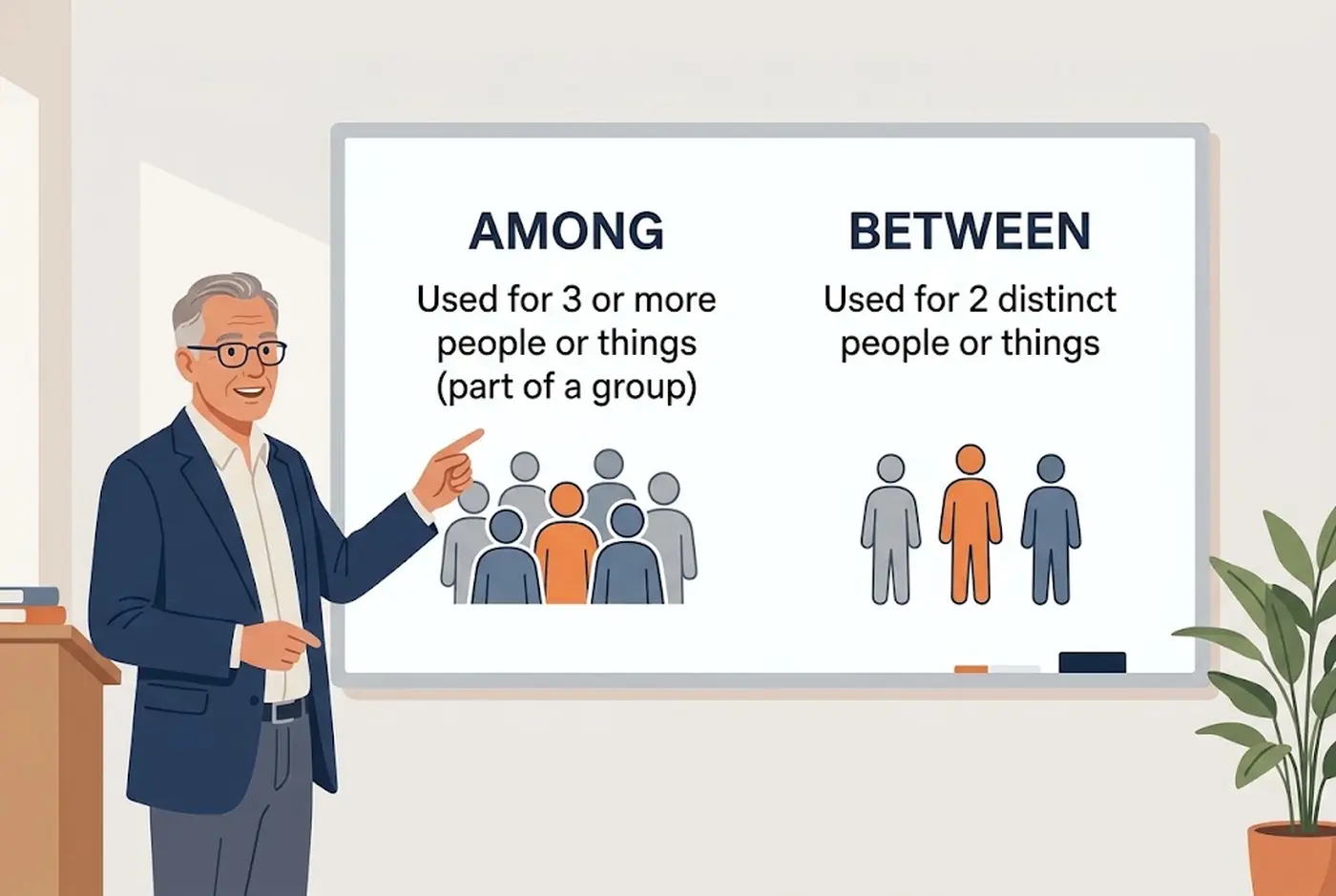
When you’re writing an email, essay, resume, or even a quick text, choosing between two similar words can be surprisingly difficult. Among vs Between is one of those grammar questions that often causes confusion because both words describe relationships involving people or things. The old rule says use one word for two things and the other for three or more. That rule is useful, but it doesn’t tell the whole story.
Among usually means surrounded by or included in a group. Between usually describes a relationship involving separate people or things, especially when the individual connections are clear.
The key is to look at the relationship, not just count the number of items. Between can be used with more than two people or things when the relationship involves distinct individuals, choices, places, or points.
In this guide, you’ll learn the meanings and origins of these words, see a large list of related alternatives, compare common contexts, study real examples, and learn the mistakes that can make a sentence sound unnatural.
What do among and between mean?
Among and between are both prepositions. They help show how a person, object, idea, or action relates to other people or things.
The simplest distinction is this:
Among means within a group or surrounded by several people or things.
Between means in the space, relationship, or choice separating two or more clearly identified people or things.
Consider these two sentences:
She was sitting among her classmates.
The agreement was made between the two companies.
In the first sentence, she is part of a larger group. The individual classmates aren’t the main focus.
In the second sentence, the two companies have a specific relationship. The connection between them is clear.
But English gets more interesting when more than two people or things are involved.
For example:
The money was divided between Alice, Ben, and Carlos.
This sentence is correct if the money was divided into distinct shares for the three named people. The relationship is specific and individual.
Now compare:
She felt comfortable among her new classmates.
Here, the classmates are treated as a group rather than as separate individuals.
That difference is much more useful than simply memorizing a number.
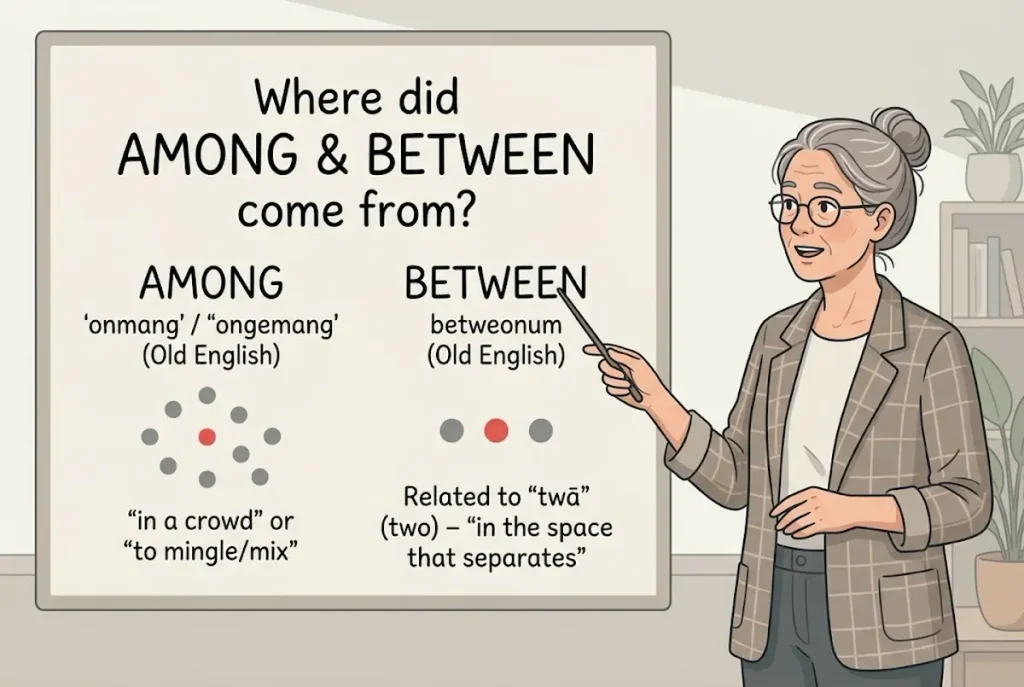
Where did among and between come from?
Understanding the history of a word can make its modern meaning easier to remember.
Among comes from older forms of English that developed from expressions meaning in the midst of or in the company of. Its meaning has long been connected with being surrounded by or included within a group.
The word often gives the idea of being inside a larger collection.
For example:
He found himself among strangers.
The word among places him within the group of strangers.
Between has a different history. It developed from Old English forms related to the idea of two or more separate points with something located in the middle or connecting them.
That central idea is still visible today.
For example:
The store is between the bank and the library.
The word between shows the location of the store in relation to two specific places.
Over time, English speakers began using between with more than two things when the relationship between the individual items was important.
That’s why this sentence is perfectly natural:
The negotiations continued between the three countries.
The countries are treated as separate participants in a specific relationship.
The historical meanings help explain why the modern distinction isn’t simply about counting.
Is between only used for two things?
No. Between can be used for three or more people or things.
This is one of the most common grammar myths.
You can use between when three or more separate people, groups, places, or things have an identifiable relationship.
For example:
The responsibility was shared between the four managers.
The discussion between the five team leaders lasted two hours.
There was an agreement between the three organizations.
The prize was divided between the six winners.
In each sentence, the people or groups are considered separate participants.
Among would also be possible in some situations, but it would change the focus.
Compare:
The prize was divided between the six winners.
The winner was standing among six other contestants.
The first sentence focuses on the relationship between separate recipients. The second focuses on someone’s position inside a group.
So don’t automatically replace between with among just because you see three or more nouns.
Is among used only for three or more things?
Usually, among describes a group of three or more, but the important idea is that the person or thing is within a group.
For example:
She was walking among the trees.
He felt relaxed among friends.
The letter was hidden among the papers.
The new product became popular among teenagers.
In these sentences, the surrounding group matters more than the individual relationships.
You normally wouldn’t say:
She was walking among the two trees.
You would usually say:
She was walking between the two trees.
With two clearly identified objects, between is normally the natural choice.
What is the difference between among and between?
The clearest difference is focus.
Among focuses on membership, surroundings, or a group.
Between focuses on separation, connection, comparison, choice, or a specific relationship.
| Word | Main idea | Example |
|---|---|---|
| Among | Within a group | He was among friends. |
| Between | Connecting separate points | The house is between two stores. |
| Among | Surrounded by several things | She searched among the books. |
| Between | A relationship involving distinct parties | The deal was between three companies. |
Think of among as looking at the group as a whole.
Think of between as looking at separate points and the relationship connecting them.
What words are related to among and between?
There isn’t a single perfect synonym for either preposition in every sentence. The best replacement depends on the meaning.
Still, many words and phrases can express similar ideas.
Simple alternatives
| Word or phrase | Meaning | Tone | Example |
|---|---|---|---|
| In | Inside or within | Simple | He was in the crowd. |
| With | Together with others | Simple | She was with her friends. |
| Near | Close to something | Simple | He stood near the group. |
| By | Beside or close to | Simple | She sat by her friends. |
| Inside | Within an area or group | Simple | The note was inside the papers. |
| Around | Surrounded by | Simple | Children gathered around her. |
| Within | Inside a group or limit | Simple | He worked within the team. |
How do you choose between among and between by intensity?
Unlike adjectives such as good, bad, happy, or angry, among and between don’t have a true intensity scale.
Still, you can group their related expressions by how strongly they show separation or group inclusion.
Mild group connection
These expressions simply show that someone or something is part of a group.
- In.
- With.
- Among.
- Within.
- Around.
Examples:
She was with friends.
She was in the group.
Clear physical separation
These expressions make the separation between objects or locations more obvious.
- Near.
- Beside.
- Next to.
- Between.
- Across from.
Examples:
The pharmacy is near the bank.
The pharmacy is next to the bank.
Stronger relationship language
For people, organizations, or ideas, some phrases show a more specific connection.
- In relation to.
- In connection with.
- In partnership with.
- In coordination with.
- In cooperation with.
These are especially useful in professional or academic writing.
What part of speech are among and between?
Among and between are normally used as prepositions.
A preposition connects a noun or pronoun to another part of a sentence.
Examples:
She sat among the students.
The decision was made between the two departments.
The words students and departments are objects of the prepositions.
Neither among nor between normally works as a noun or adjective in standard English.
This matters when you’re trying to replace them.
For example, you can use within as another preposition:
The rule applies within the organization.
But you can’t simply use a related word in any grammatical position.
English depends on both meaning and sentence structure.
Are among and between different in US and UK English?
There is no major US versus UK difference in the basic use of among and between.
Both varieties use among for group inclusion and between for relationships involving distinct points or parties.
British English sometimes uses amid or amongst more frequently than American English, especially in formal or literary writing.
For example:
She stood amongst the crowd.
This is grammatical, but among is more common in everyday American English.
American English generally favors simple, direct wording.
For most US writing, among is a safe and natural choice when you mean within a group.
Between remains standard when you’re describing a relationship between separate people, places, choices, or things.
The bigger difference isn’t regional. It’s contextual.
Which word is best for a resume?
On a resume, choose the word that clearly shows your role within a group or your relationship with specific people or organizations.
Among works well when describing recognition or standing within a larger group.
Example:
Recognized among the top-performing employees in the department.
Between works well when describing coordination involving specific teams or organizations.
Example:
Coordinated communication between three departments.
Avoid forcing either word into a sentence just to sound formal. Resume writing works best when the relationship is specific.
For example:
Worked among several departments.
This sounds vague.
A stronger sentence would be:
Coordinated projects between the marketing, sales, and design departments.
The second sentence tells the reader exactly what the relationship involved.
Which word is best in texting?
Text messages usually favor short and familiar wording.
Among is natural:
I was among a bunch of people from school.
But everyday speakers may choose in, with, or around instead.
Between is also common:
It’s between you and me.
The decision is between these two.
If you’re texting casually, you don’t need to replace these words. Both are normal everyday English.
Which word works best in an email?
Professional emails often use between for specific responsibilities, communication, or agreements.
Example:
I’ll coordinate communication between the two teams.
Among is useful when referring to a larger group.
Example:
I’ll share the update among the team members.
However, within may sometimes sound more natural in formal business writing.
Example:
I’ll share the update within the team.
Don’t choose the more formal sounding word automatically. Choose the one that accurately describes the situation.
Which word sounds natural in conversation?
Both words are common in spoken English.
You might hear:
She was sitting among her friends.
There’s a big difference between the two.
We need to choose between these options.
He was popular among his classmates.
Notice that spoken English often uses between with expressions involving choices.
For example:
I can’t decide between pizza and burgers.
That’s one of the most common uses of between in everyday speech.
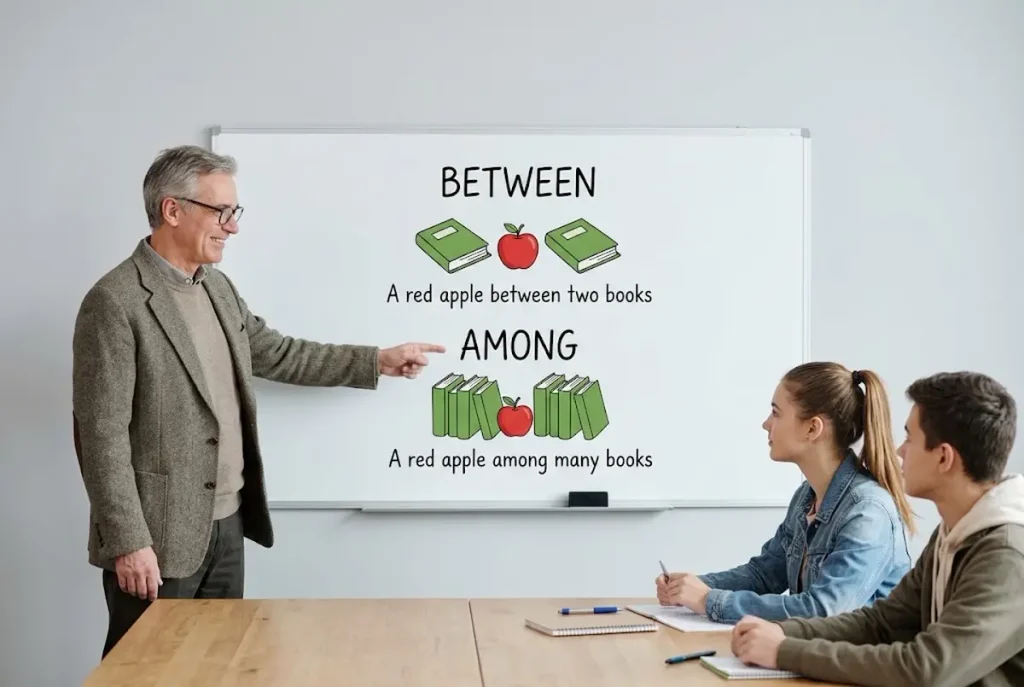
What are the most useful examples of among and between?
Here are original examples from different real-life situations.
School
- Maya found her notebook among the books on the desk.
- The teacher divided the project between four students.
- He felt comfortable among his classmates.
- The difference between the two answers was easy to see.
- The award was shared between three students.
Work
- Communication between the sales and marketing teams improved.
- She was well respected among her coworkers.
- The manager divided the tasks between five employees.
- The company built strong relationships among its regional offices.
- The meeting created better cooperation between the departments.
Family
- The secret stayed among the family members.
- The inheritance was divided between the three siblings.
- She felt safe among her relatives.
- There was a disagreement between the two brothers.
Travel
- The hotel is located between the airport and downtown.
- We walked among the old buildings.
- The guide moved among the tourists.
- The road runs between two mountains.
Technology
- The file was hidden among hundreds of documents.
- The update created compatibility problems between the two systems.
Between vs beside what’s the difference?
Between identifies a position relative to two or more distinct points.
Beside usually means next to one person or thing.
Compare:
The café is between the bank and the library.
The café is beside the library.
The first sentence identifies the café’s position relative to two locations.
The second identifies its position next to one location.
This distinction becomes useful when describing physical locations.
You can also use between for relationships that aren’t physical:
There is a difference between the two plans.
Beside doesn’t work in that sentence.
Between vs from what’s the difference?
Between can describe a relationship or position connecting separate points.
From usually identifies the starting point of movement, origin, or source.
Compare:
The train runs between Boston and New York.
The train leaves from Boston.
Between tells you the relationship between two locations.
From tells you where the journey begins.
This difference is important because replacing between with from can change the meaning of a sentence.
What are the most common mistakes with among and between?
Mistake 1: Thinking between always means two
This is the most common mistake.
Incorrect idea:
Between can only be used with two things.
Correct understanding:
Between can be used with more than two distinct people, groups, places, or things.
Example:
The agreement was reached between the four organizations.
Mistake 2: Using among for every group of three or more
The number rule works as a basic shortcut, but it isn’t absolute.
For example:
The competition was between three companies.
This can be completely correct because the companies are separate participants.
Mistake 3: Using between when you mean inside a group
Consider:
He felt comfortable between his classmates.
This may sound unnatural if you mean that he felt comfortable as part of the group.
A better sentence is:
He felt comfortable among his classmates.
When should you not use among?
Don’t use among when you’re clearly describing a relationship between separate points, especially when the relationship itself matters.
For example:
The agreement was made among the two companies.
This sounds unnatural because there are only two clearly identified companies.
Use:
The agreement was made between the two companies.
Also avoid among when describing a physical location between two specific objects.
Instead of:
The chair is among the two tables.
Say:
The chair is between the two tables.
Among works best when the idea of a group or surrounding collection is central.
When should you not use between?
Don’t use between when you simply mean that someone or something is part of a larger group.
For example:
She was between her classmates.
If you mean that she was surrounded by classmates, use:
She was among her classmates.
Between is also not the best choice when there is no meaningful relationship between distinct points.
For example:
He was popular between students.
A more natural sentence is:
He was popular among students.
The second sentence means that students as a group liked him.
What is the best way to remember the difference?
Use a simple mental picture.
Imagine a group of people standing together.
If you’re inside that group, think among.
She stood among the crowd.
Now imagine two houses with a road running through them.
If something sits in the space separating the houses, think between.
The road runs between the houses.
Now add three separate companies negotiating with each other.
You can still use between if the companies have individual relationships.
The agreement was negotiated between the three companies.
The picture matters more than the number.
Quick tips for choosing the right word
- Use among when you mean within a group.
- Use between when you mean a relationship involving distinct people or things.
- Don’t assume between is limited to two.
- Use between for clearly separated choices.
- Use among for general group membership.
- Ask yourself if the individuals are important to the sentence.
- If the group is treated as one collection, among may fit better.
- If the sentence focuses on separate parties or connections, between may fit better.
- In everyday American English, choose the simpler natural word.
- Read the entire sentence instead of deciding from the number of nouns alone.
A useful test is to ask:
Am I talking about being inside a group?
If yes, among may be the right choice.
Am I describing a connection, separation, comparison, or choice involving distinct points?
If yes, between may be the better choice.
Why does the two versus three rule still exist?
The traditional rule developed because between was strongly associated with relationships involving two separate points, while among was associated with groups.
That makes the rule useful for beginners.
For example:
between you and me
between the chair and table
among friends
among the trees
These examples reinforce the basic pattern.
The problem appears when learners turn the shortcut into an absolute rule.
Modern English allows between to describe relationships involving more than two distinct entities.
That use is common in formal and everyday writing.
So the two versus three rule is best treated as a starting point, not a complete grammar law.
Can you use among with ideas?
Yes.
Among can describe ideas, opinions, beliefs, or choices when they are treated as a group.
Examples:
There was disagreement among the researchers.
The idea was popular among economists.
The topic caused confusion among students.
The word doesn’t have to describe a physical group of people.
It can describe an abstract group as well.
Can you use between with ideas?
Yes.
Between is very common when comparing or distinguishing ideas.
Examples:
There is an important difference between fact and opinion.
She couldn’t decide between two explanations.
The debate between the two theories continued.
You can also use between with more than two ideas when each one is distinct.
For example:
The researcher compared differences between three competing theories.
The sentence treats the theories as separate items being compared.
Which word should you choose for formal writing?
For formal writing, accuracy matters more than sounding sophisticated.
Use among for group membership or a general group relationship.
Use between for specific relationships, comparisons, choices, or distinctions.
Consider these examples:
The survey examined attitudes among young adults.
The study compared differences between three age groups.
Both sentences are appropriate for formal writing.
Avoid replacing simple words with formal alternatives just to make your writing sound academic.
Clear English is usually stronger English.
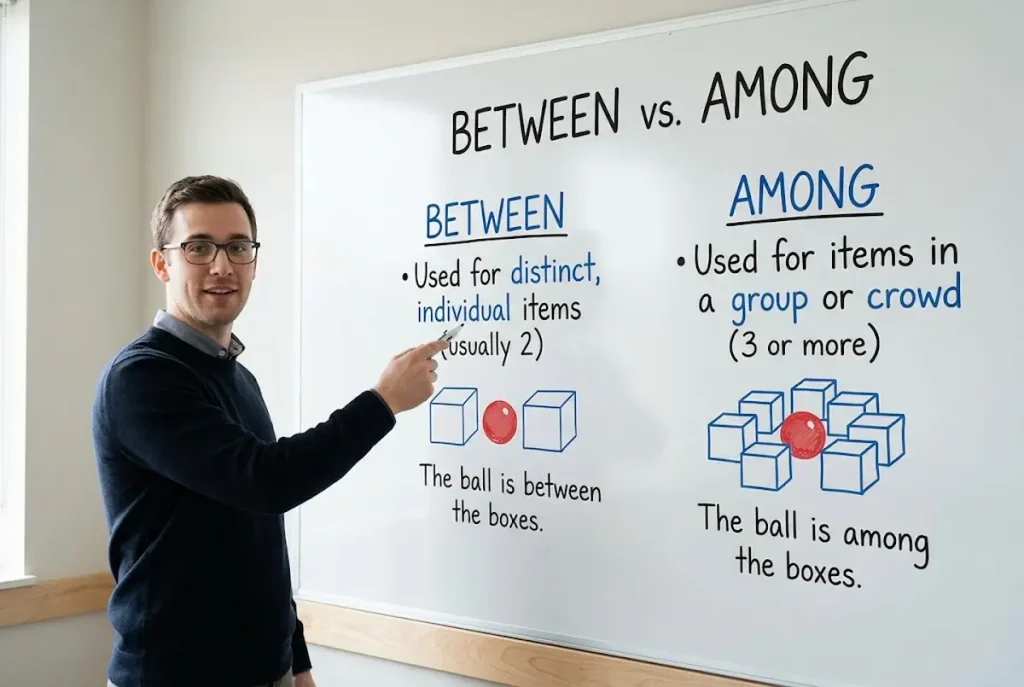
Final answer about among and between
Among and between are both useful prepositions, but they highlight different relationships. Among usually places someone or something within a group, while between focuses on separate people, things, points, choices, or relationships. The traditional idea that between is only for two and among is only for three or more is too simple. Between can correctly describe relationships involving three or more distinct entities.
When you’re unsure, don’t just count the nouns. Ask what the sentence is actually showing. If you’re describing group membership or being surrounded by a collection, among will often fit. If you’re describing a clear connection, comparison, separation, or choice involving distinct items, between is often the better choice. With that distinction in mind, Among vs Between becomes much easier to handle in emails, essays, conversations, and professional writing.
Conclusion
Understanding Among vs Between becomes much easier when you focus on the relationship instead of simply counting the number of people or things. Use among when someone or something is part of a group or surrounded by others. Use between when you’re showing a connection, comparison, choice, or separation between distinct people or things.
Remember that between can also be correct with three or more people or groups when each one is treated as a separate participant. When you’re unsure, ask yourself whether you mean within a group or a specific relationship. This simple question can help you choose the right word in emails, essays, conversations, and professional writing.
Frequently Asked Questions
Is between only used for two things?
No, between can be used for more than two distinct people or things when their individual relationships are important.
Is among used for three or more people?
Usually, yes, when the people are treated as a group. For example, She was popular among her classmates.
Can I use between with three people?
Yes. For example, The money was divided between three students is correct when the students are treated as separate recipients.
What is the easiest way to remember among and between?
Remember that among usually means within a group, while between usually shows a relationship, separation, comparison, or choice involving distinct points.
What’s another way to say among?
Depending on the sentence, you can use in, within, amid, amidst, around, with, or surrounded by.
What’s another way to say between?
Depending on the meaning, alternatives can include in the space separating, between the two, among distinct parties, alongside, or in relation to.
Is among more formal than between?
No. Both are normal English words. Among is common in everyday speech, and between is also extremely common in casual and formal writing.

Daniel Grammarfield — The Language Learner
Age: 28Occupation: ESL Learner & Digital Professional
Bio:Daniel is a non-native English speaker who wants to communicate more confidently at work and online. He uses Synotrench to improve grammar, understand confusing words, learn correct sentence structures, and build everyday English skills. He prefers simple explanations with practical examples.
Goals:
Master English grammar rules
Avoid common language mistakes
Improve professional communication
Learn English through real-life examples
Quote:“Learning English is not about memorizing rules — it’s about expressing ideas clearly.”
1 thought on “Among vs Between: The Best Simple Guide (2026)”