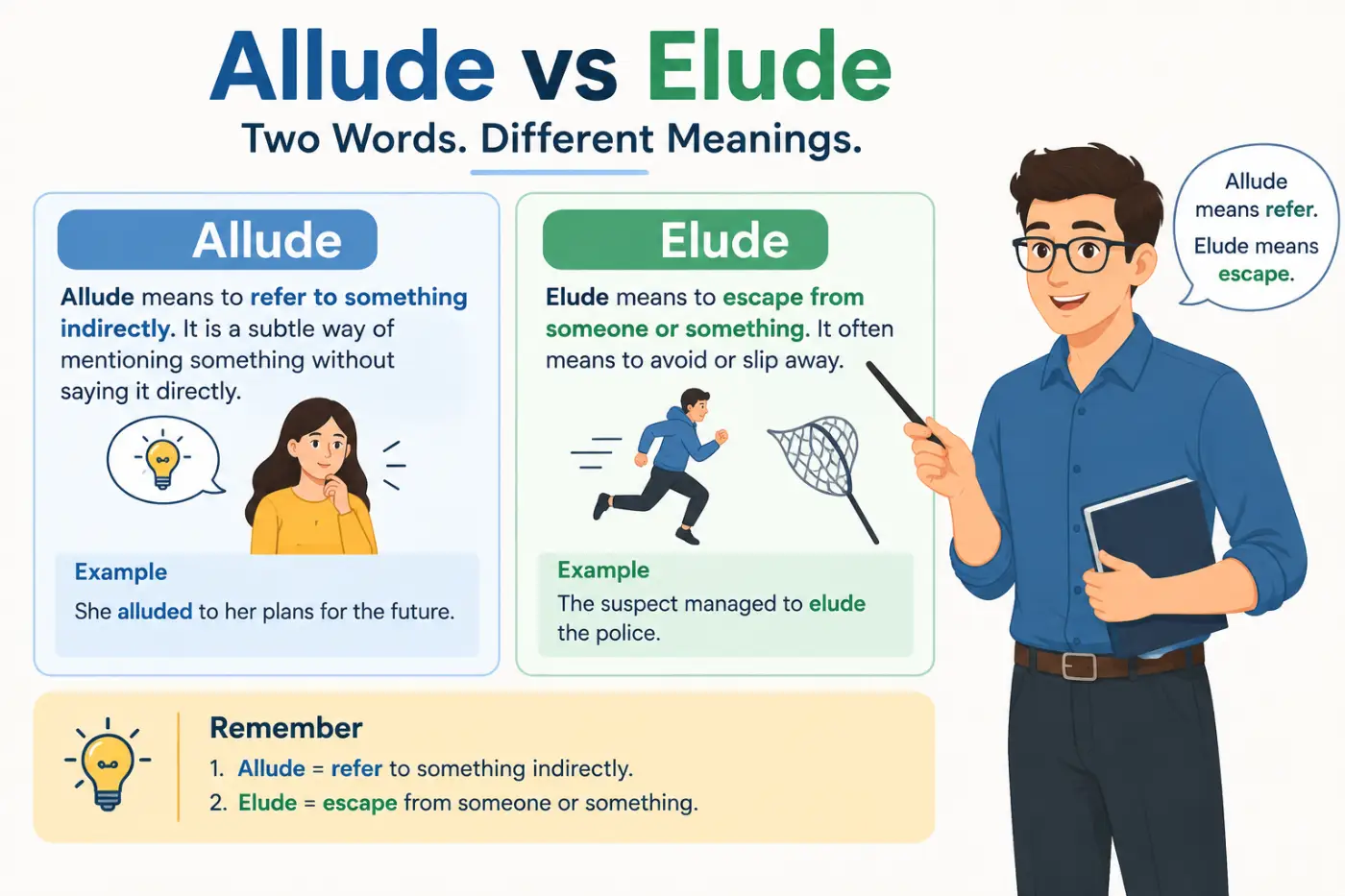
When you’re writing an email, essay, resume, or text, choosing between Allude vs Elude can be surprisingly confusing. The words look almost identical, but they have very different meanings. One is about making an indirect reference. The other is about escaping, avoiding, or being difficult to understand.
Allude means to mention or refer to something indirectly, while elude means to escape from something or remain difficult to understand or achieve.
That difference becomes much easier once you connect each word to a simple idea. Think of allude as pointing toward an idea without saying it directly. Think of elude as something slipping away from you.
This guide explains the meanings, origins, synonyms, examples, common mistakes, regional usage, and context based choices that can help you use these words naturally. By the end, you’ll know exactly when to use each one.
What do allude and elude mean?
The simplest way to separate these words is to focus on the action involved.
Allude means to refer to something indirectly. You don’t state the subject clearly. Instead, you give a hint that allows the reader or listener to understand what you’re talking about.
Example:
The speaker alluded to the recent disagreement.
This means the speaker referred to the disagreement without discussing it directly.
Elude has two closely related meanings. It can mean to escape from someone or something, or it can mean to remain difficult to understand, remember, find, or achieve.
Example:
The suspect eluded the police.
Here, the suspect escaped.
Another example:
The answer continued to elude me.
Here, the answer was difficult for me to find or understand.
So when comparing Allude vs Elude, remember:
| Word | Basic meaning | Simple memory |
|---|---|---|
| Allude | Refer to something indirectly | Hint |
| Elude | Escape or remain difficult to grasp | Slip away |
Where do allude and elude come from?
The similar appearance of these words isn’t an accident. Both come from Latin roots connected with the idea of playing or referring to something.
Allude comes from the Latin alludere, meaning to play with or refer to indirectly. The word developed into its modern English sense of making an indirect reference.
Elude comes from the Latin eludere, meaning to escape, avoid, or evade. It carries the idea of getting away from something that is trying to catch, hold, or understand you.
Their Latin origins help explain why the words look so similar while having different meanings.
A useful way to remember the difference is to focus on what happens after the word is used.
With allude, a person gives a clue.
With elude, something gets away.
For example:
The author alluded to a difficult childhood.
The meaning of the poem eluded me.
In the first sentence, the author gives an indirect reference. In the second, the meaning remains out of reach.
What is the easiest way to remember the difference?
Use this memory trick:
Allude = allude to an idea.
You normally use allude with to when referring indirectly to something.
Example:
She alluded to her previous job.
Elude = escape.
Something or someone avoids being caught, found, remembered, understood, or achieved.
Example:
The criminal eluded capture.
Another helpful trick is to connect the first letters with simple ideas:
A = Allude = Address indirectly.
E = Elude = Escape.
This isn’t a formal grammar rule. It’s simply a memory tool.
If you’re unsure which word belongs in your sentence, ask yourself one question:
Am I talking about an indirect reference, or am I talking about something getting away?
If it’s an indirect reference, use allude.
If it’s an escape or something that remains out of reach, use elude.
What are the best synonyms for allude and elude?
The best synonym depends on the exact meaning and tone you need. Some alternatives are casual, some are formal, and others are stronger or more expressive.
Because allude and elude have different meanings, their synonyms should be treated separately.
Synonyms for allude
| Word | Meaning | Tone | Example |
|---|---|---|---|
| Hint | Suggest something without saying it directly | Simple | She hinted at a problem. |
| Mention | Bring something up briefly | Everyday | He mentioned the meeting. |
| Refer | Point to something or someone | Everyday | She referred to the report. |
| Suggest | Give an idea without stating it fully | Everyday | His words suggested trouble. |
| Imply | Communicate an idea indirectly | Formal | Her response implied disagreement. |
| Indicate | Show or point toward something | Neutral | The results indicated a problem. |
| Touch on | Discuss something briefly | Everyday | The article touched on the issue. |
| Point to | Direct attention toward something | Everyday | The evidence points to a mistake. |
| Invoke | Bring an idea or concept to mind | Formal | The speech invoked national history. |
| Evoke | Cause a feeling, memory, or idea to arise | Formal | The song evoked childhood memories. |
| Mention indirectly | Refer without explaining fully | Neutral | He mentioned the event indirectly. |
| Suggest indirectly | Communicate without saying directly | Neutral | She suggested the reason indirectly. |
| Make reference to | Refer to something | Formal | The report made reference to the earlier study. |
| Call attention to | Direct focus toward something | Neutral | The writer called attention to the problem. |
| Bring up | Start talking about something | Casual | He brought up the issue. |
Which synonyms are mild and which are strong?
Synonyms can have different levels of force. Choosing the right intensity can make your writing more accurate.
Mild words for escape or difficulty
For ordinary situations, use:
- Avoid.
- Escape.
- Get away.
- Slip away.
- Dodge.
For more formal or stronger situations, use:
- Evade.
- Flee.
- Defy.
- Remain elusive.
- Escape capture.
Compare these:
The dog escaped from the yard.
The suspect evaded arrest.
The second sentence sounds more formal and serious.
For ideas, memories, or answers, use words such as:
- Puzzle.
- Baffle.
- Escape notice.
- Remain elusive.
- Defy explanation.
Example:
The reason for the error continued to elude the researchers.
This suggests that the answer remained difficult to discover.
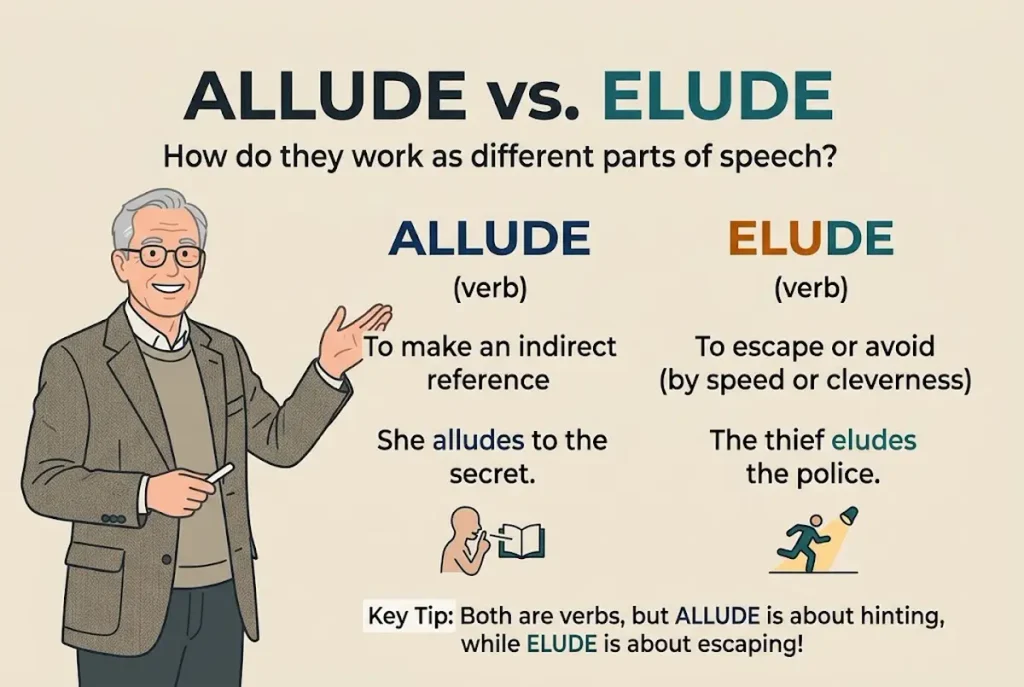
How do allude and elude work as different parts of speech?
Both allude and elude are verbs.
That means they describe actions or states.
Allude as a verb
The basic form is allude.
Example:
The writer alludes to the earlier chapter.
Common forms include:
| Form | Example |
|---|---|
| Allude | Writers often allude to history. |
| Alludes | The poem alludes to war. |
| Alluded | She alluded to the problem. |
| Alluding | He was alluding to an old argument. |
The noun allusion comes from allude.
Example:
The poem contains an allusion to Greek mythology.
An allusion is an indirect reference.
Elude as a verb
The basic form is elude.
Example:
The suspect eluded the officers.
Common forms include:
| Form | Example |
|---|---|
| Elude | The answer may elude us. |
| Eludes | The solution eludes him. |
| Eluded | The runner eluded the guards. |
| Eluding | The suspect was eluding capture. |
The adjective elusive is closely related.
Example:
The solution remained elusive.
The noun elusion exists but is much less common in everyday English. In most ordinary writing, words such as escape, avoidance, or evasion may sound more natural depending on the meaning.
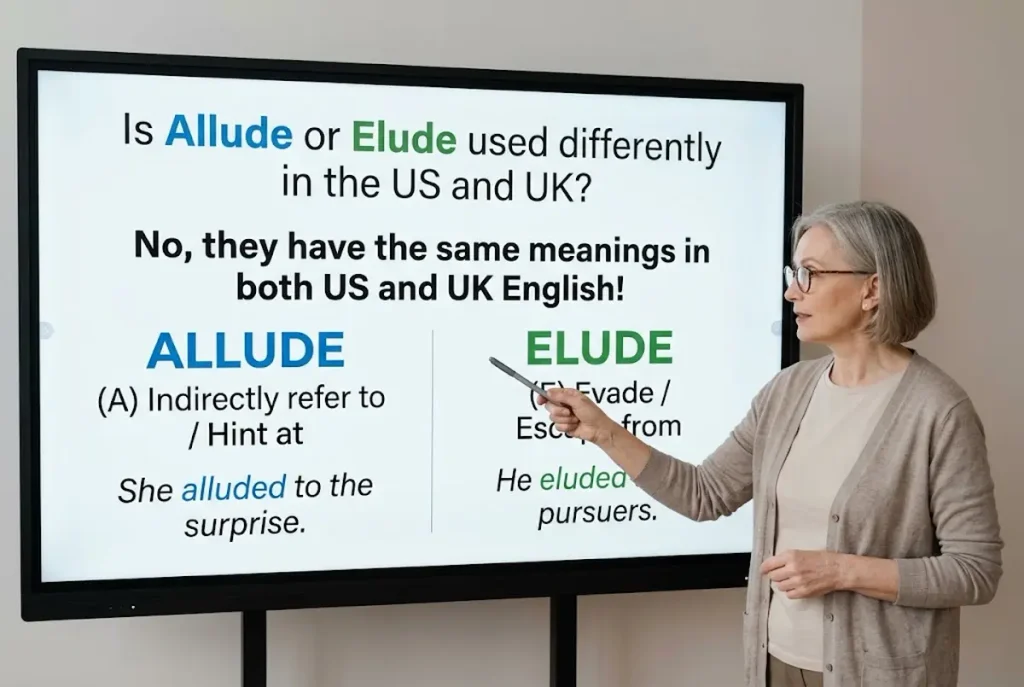
Is allude or elude used differently in the US and UK?
There is no major US versus UK meaning difference between these two words.
American and British English use allude to mean making an indirect reference. Both varieties also use elude for escaping or for something that remains difficult to find, understand, remember, or achieve.
For example, these sentences work naturally in both varieties:
The author alluded to the earlier incident.
The answer continued to elude him.
The main difference is usually style and frequency rather than meaning.
In casual American conversation, people may choose simpler expressions such as hint, mention, escape, or avoid. British speakers can do the same.
The words are common enough to be understood across English speaking regions, but allude and elude can sound slightly more formal than everyday alternatives.
Which word is best for a resume?
For a resume, allude can be useful when describing writing, communication, or references, but it isn’t a word you need often.
For example:
The report alludes to several industry challenges.
That sentence works if you’re describing an actual report.
However, resume writing usually benefits from direct language. Instead of saying:
I alluded to my leadership experience.
You could say:
I highlighted my leadership experience.
Or:
I described my leadership experience.
If you’re using elude, make sure the sentence describes something genuinely escaping notice, detection, or understanding.
Example:
The cause of the recurring issue initially eluded the engineering team.
That’s appropriate in a technical or professional description.
For most resumes, though, direct verbs are stronger.
Use allude when an indirect reference is actually important.
Use elude when something could not be found, solved, detected, or achieved.
Which word is best for an essay?
Essays often use allude because writers discuss literature, history, culture, and ideas.
Example:
The author alludes to the American Civil War throughout the novel.
Another example:
The poem alludes to the writer’s childhood.
In literary analysis, the noun allusion is also common.
Example:
The biblical allusion adds another layer of meaning to the poem.
Elude is useful when discussing difficult ideas, unanswered questions, or characters who escape.
Example:
The true meaning of the final scene eludes the reader.
Another example:
The prisoner eludes the guards in the final chapter.
When writing an academic essay, choose the word based on the action you’re describing, not simply because it sounds formal.
Which word is best for texting?
Texting usually favors simple language.
Instead of:
She alluded to a problem.
You might write:
She hinted at a problem.
Instead of:
The answer is eluding me.
You could write:
I can’t figure out the answer.
Still, allude and elude are perfectly correct in texts when they fit your meaning.
Example:
He alluded to something weird happening at work.
Example:
That name keeps eluding me.
The second example sounds natural because people often use elude when they can’t remember a name, word, or detail.
Which word is best for email?
Professional emails often use allude when a reference is indirect.
Example:
As I alluded to in my previous email, the deadline has changed.
This sentence tells the reader that the subject was mentioned earlier without repeating the entire explanation.
You can also use elude in professional communication.
Example:
The source of the error has continued to elude our team.
This means the team has not been able to identify the source.
For simple emails, however, direct alternatives may be clearer.
Instead of:
As I alluded to earlier…
You could write:
As I mentioned earlier…
Instead of:
The reason continues to elude us.
You could write:
We still haven’t found the reason.
Choose based on the level of formality and the needs of your reader.
What are some real examples of allude and elude?
Seeing these words in different situations makes the distinction much easier.
Example 1
The manager alluded to changes in the company’s schedule.
The manager hinted that changes were coming but didn’t explain them fully.
Example 2
The suspect eluded the officers for several hours.
The suspect escaped and avoided being caught.
Example 3
The author alludes to a famous historical event.
The author refers to the event indirectly.
Example 4
The correct answer continued to elude the student.
The student couldn’t find or understand the answer.
Example 5
During the interview, she alluded to problems at her previous job.
She referred to those problems without giving every detail.
Example 6
The runner eluded the defenders and reached the goal.
The runner successfully avoided the defenders.
Example 7
The professor alluded to an important study during the lecture.
The professor referred to the study without explaining it in detail.
Example 8
The meaning of the painting eluded me at first.
I couldn’t understand the meaning at first.
Example 9
The politician alluded to the controversy without naming anyone.
The speaker referred indirectly to the controversy.
Example 10
The escaped animal eluded search teams for two days.
The animal remained free and avoided being found.
what’s the difference?
Allude and imply are close, but they don’t mean exactly the same thing.
To allude means to refer to something indirectly.
To imply means to communicate an idea without stating it directly.
Compare these sentences:
She alluded to her financial problems.
She implied that she was having financial problems.
The first focuses on the indirect reference. The second focuses on the hidden meaning communicated by her words.
Another example:
The speaker alluded to an old disagreement.
The speaker implied that the disagreement was still important.
A person can allude to something without strongly implying a particular conclusion.
That’s why the words shouldn’t always be treated as exact synonyms.
what’s the difference?
Elude emphasizes successfully escaping or remaining out of reach.
Evade often emphasizes deliberately avoiding something.
Compare:
The suspect eluded the police.
The suspect evaded the police.
Both sentences can mean that the suspect avoided capture, but evade can place more emphasis on the act of avoiding.
Evade can also be used for questions, responsibilities, taxes, or difficult subjects.
Examples:
He evaded the question.
The company was accused of evading taxes.
You generally wouldn’t replace evade with elude in every situation.
For example:
He evaded the question.
This is natural.
He eluded the question.
This can sound unusual because elude is not normally the best choice for simply refusing to answer a question.
when should you choose each one?
Hint is usually simpler and more conversational.
Allude is often more formal and can suggest a reference to a particular person, event, text, idea, or subject.
Compare:
She hinted that she was upset.
She alluded to the disagreement.
The first sentence sounds natural in everyday conversation.
The second sounds more suitable for formal writing or analysis.
If you’re writing a text message, hint will often sound more natural.
If you’re writing a literary analysis, allude may be the better choice.
Neither word is automatically better. The situation determines the best choice.
Allude vs refer: are they interchangeable?
Not completely.
Refer can mean to mention or direct someone to something.
Allude specifically suggests an indirect reference.
Compare:
The teacher referred to the textbook.
The teacher alluded to a difficult chapter.
The first sentence can mean the teacher directly mentioned or discussed the textbook.
The second suggests a less direct reference.
This is an important distinction for precise writing.
If the subject is openly named or clearly discussed, refer may be the better word.
If the subject is hinted at without being directly explained, allude is more precise.
What are the common mistakes with allude and elude?
The most common problem is switching the words because they look and sound similar.
Mistake 1: Using elude for an indirect reference
Incorrect:
The author eluded to the historical event.
Correct:
The author alluded to the historical event.
The author is making an indirect reference, so alluded is correct.
Mistake 2: Using allude for escape
Incorrect:
The suspect alluded the police.
Correct:
The suspect eluded the police.
The suspect escaped or avoided capture, so eluded is correct.
Mistake 3: Confusing allude with allusion
Incorrect:
The author made an allude to the Bible.
Correct:
The author made an allusion to the Bible.
Allude is a verb.
Allusion is a noun.
Mistake 4: Forgetting to use to after allude
A common construction is:
She alluded to the problem.
Not:
She alluded the problem.
The verb allude is normally followed by to when you identify the subject being referenced.
Mistake 5: Using elude when evade is more natural
Incorrect or awkward:
The student eluded the teacher’s question.
Better:
The student evaded the teacher’s question.
When someone avoids answering a question, evade is generally more natural.
Mistake 6: Assuming elude always means physical escape
Elude isn’t limited to people running away.
A memory can elude you.
An answer can elude you.
A solution can elude researchers.
An understanding of a difficult idea can elude a reader.
This broader meaning is one reason the word appears frequently in formal writing.
When should you not use elude?
Don’t use elude when you mean simply refer to something.
Incorrect:
The writer eluded to the main theme.
Correct:
The writer alluded to the main theme.
Also avoid elude when someone deliberately refuses to answer a question unless the context genuinely involves escaping or avoiding something.
For example:
She evaded my question.
This is usually better than:
She eluded my question.
Use elude when something stays out of reach, escapes capture, or remains difficult to understand, remember, discover, or achieve.
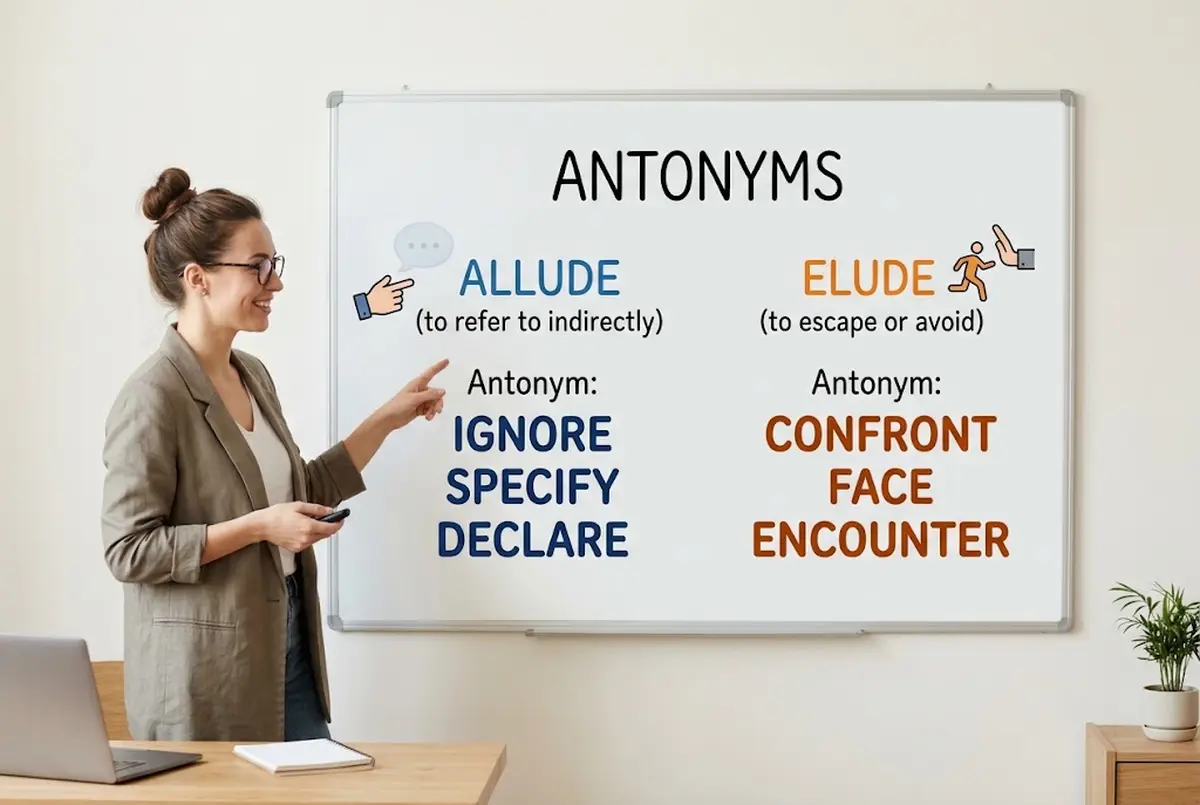
What are the antonyms of allude and elude?
The opposite of allude depends on the intended meaning.
Possible opposites include:
- State.
- Explain.
- Specify.
- Identify.
- Clarify.
- Declare.
- Describe directly.
Example:
Instead of alluding to the problem, she explained it clearly.
For elude, possible opposites include:
- Capture.
- Find.
- Discover.
- Understand.
- Remember.
- Solve.
- Achieve.
Example:
The detective finally found the missing evidence.
The answer no longer eluded the researcher.
Antonyms can help reinforce the difference because they show the direction of the action.
Allude moves toward an indirect reference.
Elude describes something moving out of reach or staying beyond reach.
How can you choose the right word quickly?
When you’re writing and don’t have time to think about the difference, use this quick test.
Ask what the person is doing
If the person is giving a hint or indirect reference, choose allude.
If someone or something is escaping or staying out of reach, choose elude.
Look for the word to
If you see a structure like:
She ___ to the problem.
The answer is probably alluded.
Example:
She alluded to the problem.
Look for escape or capture
Words such as police, capture, pursuit, escape, search, and catch often point toward elude.
Example:
The suspect eluded capture.
Look for ideas that are difficult to grasp
Words such as answer, solution, memory, meaning, and understanding can also work with elude.
Examples:
The answer eluded me.
The meaning eluded the reader.
The solution eluded the researchers.
Check if the reference is direct
If you directly name or discuss something, refer, mention, or explain may be more appropriate.
If you hint at it without saying it clearly, allude is a better fit.
What should you remember about allude and elude?
The key difference in Allude vs Elude comes down to reference versus escape.
Use allude when someone refers to something indirectly.
Example:
The writer alluded to her childhood.
Use elude when someone or something escapes or remains difficult to grasp.
Example:
The answer eluded me.
The words may look almost the same, but their jobs are different.
Think of allude as a hint.
Think of elude as something slipping away.
Once you connect each word with that simple idea, the distinction becomes much easier to remember.
Conclusion
The easiest way to understand Allude vs Elude is to separate reference from escape. Allude means to refer to something indirectly, often by giving a hint instead of stating the subject directly. Elude means to escape, avoid capture, or remain difficult to find, remember, understand, or achieve.
Use allude to when you’re pointing toward an idea. Use elude when something stays beyond reach. The difference is small in spelling but important in meaning.
When you’re unsure, stop and ask what your sentence describes. Is someone giving an indirect reference? Choose allude. Is a person, answer, memory, or solution slipping away? Choose elude. With that simple test, you’ll be able to choose the right word with confidence.
Frequently Asked Questions
What is the difference between allude and elude?
Allude means to refer to something indirectly, while elude means to escape or remain difficult to find, remember, understand, or achieve.
Is it allude to or elude to?
The correct phrase is allude to when you mean make an indirect reference. Elude normally does not take to in that same construction.
What’s another way to say allude?
Another way to say allude is hint, refer to, mention indirectly, or imply, depending on the exact context.
Is elude the same as evade?
They can be similar when describing avoidance or escape, but elude often emphasizes successfully escaping or remaining out of reach, while evade can emphasize deliberately avoiding something.
Can you use elude for a memory?
Yes. You can say that a memory eludes you when you cannot remember or recall it.
Is allude formal English?
Allude is standard English and is somewhat more formal than everyday words such as hint or mention. It’s especially common in essays, literary discussions, professional writing, and formal speech.
How can I remember allude vs elude?
Think of allude as giving a hint and elude as escaping. If you’re referring indirectly, use allude. If something is getting away or staying out of reach, use elude.

Daniel Grammarfield — The Language Learner
Age: 28Occupation: ESL Learner & Digital Professional
Bio:Daniel is a non-native English speaker who wants to communicate more confidently at work and online. He uses Synotrench to improve grammar, understand confusing words, learn correct sentence structures, and build everyday English skills. He prefers simple explanations with practical examples.
Goals:
Master English grammar rules
Avoid common language mistakes
Improve professional communication
Learn English through real-life examples
Quote:“Learning English is not about memorizing rules — it’s about expressing ideas clearly.”
1 thought on “Allude vs Elude: The Best Simple Guide”