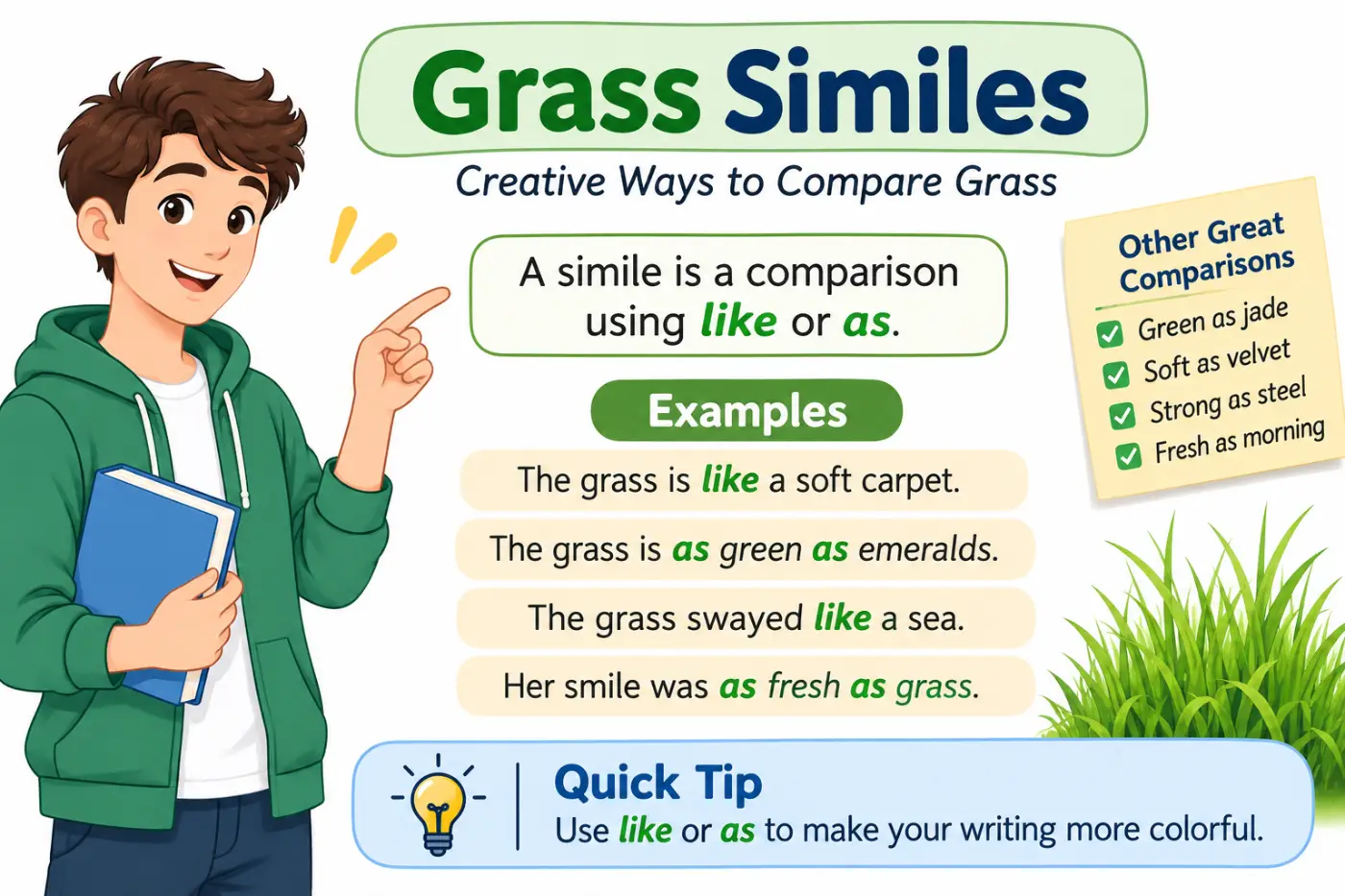
Grass similes help writers describe the color, texture, movement, and appearance of grass by comparing it to familiar things. For example, you might say the grass is as green as emeralds, as soft as velvet, or as fresh as spring leaves. Each comparison creates a different picture in the reader’s mind.
A grass simile is a figure of speech that compares grass to another person, object, color, or natural element using the words like or as. It makes descriptions more colorful by helping readers imagine how grass looks, feels, or moves.
These comparisons are useful in creative writing, poetry, school essays, nature descriptions, and everyday conversations. Some create peaceful images, while others describe thick, wet, dry, or freshly cut grass.
In this guide, you’ll discover more than 30 creative examples, their simple meanings, different levels of description, and practical ways to use them in sentences. You’ll also learn how to choose the right comparison for your writing.
What Does a Grass Simile Mean?
A grass simile is a comparison that describes grass by showing how it resembles something else. It uses like or as to connect two different things and create a clear mental picture.
For example:
- The grass was as soft as a velvet blanket.
- The green field stretched like an emerald carpet.
- The grass moved like waves in the ocean.
Why Do Writers Use Comparisons for Grass?
Grass is a common part of nature, but describing it in an interesting way can be challenging. Similes give writers more choices than simply using words like green, soft, or fresh.
Here are five reasons to use them.
- Better descriptions: They help readers imagine the appearance of grass.
- Stronger emotions: They can create feelings of peace, happiness, comfort, or sadness.
- Creative writing: They make stories and poems more interesting.
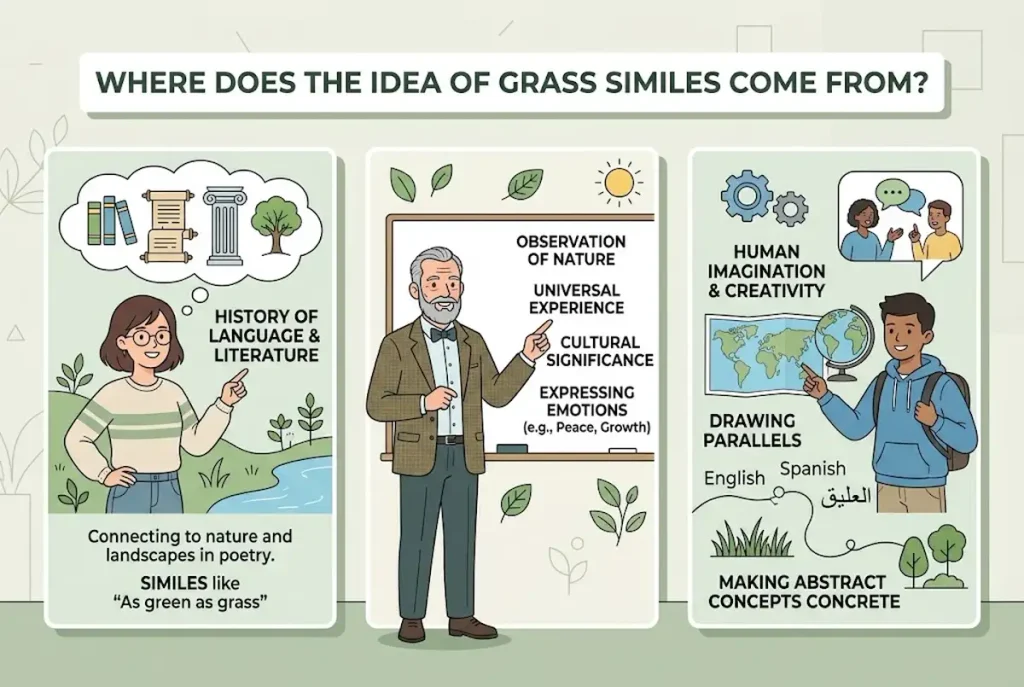
Where Does the Idea of Grass Similes Come From?
The word simile comes from the Latin word similis, which means similar or like. It describes a comparison between two different things that share a particular quality.
The word grass comes from Old English græs, which referred to green plants with narrow leaves that grow close to the ground.
People have used comparisons to describe nature for centuries. Writers, poets, and storytellers often compare plants, trees, flowers, and fields to familiar objects to help readers imagine the natural world.
Grass is especially useful in descriptive language because it has several noticeable qualities.
- Color: Grass can be bright green, dark green, yellow, or brown.
- Texture: It can feel soft, rough, thick, or dry.
- Movement: Wind can make grass bend, sway, or ripple.
What Are the Best Grass Similes?
The best comparisons depend on the quality you want to describe. Some focus on color, while others describe softness, movement, freshness, or size.
Here are 30 useful examples grouped by tone and writing style.
Simple Grass Similes
These comparisons use familiar words and are easy for children, students, and beginner writers to understand.
| Simile | Meaning | Tone | Example |
|---|---|---|---|
| As green as leaves | Very green | Simple | The grass was as green as leaves. |
| As soft as a blanket | Gentle and comfortable | Simple | The grass felt as soft as a blanket. |
| Like a green carpet | A smooth green surface | Simple | The lawn looked like a green carpet. |
| As fresh as morning air | Fresh and pleasant | Simple | The grass looked as fresh as morning air. |
| Like a field of green paint | Bright and colorful | Simple | The garden looked like a field of green paint. |
| As thick as a cushion | Dense and full | Simple | The grass grew as thick as a cushion. |
| Like a soft green bed | Comfortable and inviting | Simple | The meadow looked like a soft green bed. |
| As bright as spring | Full of fresh green color | Simple | The new grass was as bright as spring. |
Everyday Word
These examples work well in conversations, school assignments, short stories, and general descriptions.
| Simile | Meaning | Tone | Example |
|---|---|---|---|
| As soft as velvet | Very smooth and soft | Everyday | The grass felt as soft as velvet. |
| Like waves in the ocean | Moving gently in the wind | Everyday | The grass rolled like waves in the ocean. |
| As green as emeralds | Deep and rich green | Everyday | The hillside was as green as emeralds. |
| Like a green blanket | Covering a large area | Everyday | Grass spread like a green blanket across the park. |
| As fresh as spring rain | Clean and refreshed | Everyday | The lawn looked as fresh as spring rain. |
| Like a field of feathers | Light and gentle in appearance | Everyday | The tall grass moved like a field of feathers. |
| As smooth as silk | Very smooth to the touch | Everyday | The freshly trimmed lawn felt as smooth as silk. |
| Like a dancing crowd | Moving together in the wind | Everyday | The grass swayed like a dancing crowd. |
Formal and Literary
These comparisons are more descriptive and work especially well in poetry, novels, essays, and detailed nature writing.
| Simile | Meaning | Tone | Example |
|---|---|---|---|
| Like an endless emerald sea | A vast green landscape | Literary | The meadow stretched like an endless emerald sea. |
| As delicate as silk threads | Thin and fragile | Formal | The young grass was as delicate as silk threads. |
| Like a shimmering green tapestry | A beautiful, detailed green surface | Literary | The hillside appeared like a shimmering green tapestry. |
| As golden as autumn sunlight | Dry grass with a golden color | Literary | The field was as golden as autumn sunlight. |
| Like a thousand tiny dancers | Grass moving in the breeze | Literary | The blades moved like a thousand tiny dancers. |
| As fragile as glass | Easily damaged or broken | Formal | The young grass seemed as fragile as glass. |
| Like a living green ocean | A wide field moving in waves | Literary | The prairie rolled like a living green ocean. |
| As peaceful as a sleeping garden | Quiet and calm | Literary | The grass rested as peacefully as a sleeping garden. |
Which Word Describe Different Intensities?
Not every comparison creates the same feeling. Some describe a gentle green lawn, while others suggest a thick, powerful, or wild landscape.
Choosing the right intensity helps your description sound natural.
Mild Comparisons
Mild comparisons are suitable when you want to describe grass in a simple and gentle way.
- As green as fresh leaves: Describes a natural green color.
- Like a soft blanket: Suggests comfort and softness.
- As light as feathers: Describes thin grass moving in the wind.
Moderate Comparisons
Moderate comparisons create a stronger image without making the description overly dramatic.
- As soft as velvet: Highlights a smooth texture.
- Like waves in the ocean: Describes noticeable movement.
- As green as emeralds: Suggests a rich green color.
Strong Comparisons
Strong comparisons are useful when describing large fields, dramatic landscapes, or thick vegetation.
- Like an endless emerald sea: Describes a huge green landscape.
- As wild as a jungle: Suggests uncontrolled growth.
- Like a thousand dancing flames: Describes energetic movement.
What Are the Different Types of Grass Comparisons?
Grass comparisons can describe several qualities. Understanding these categories makes it easier to choose a suitable expression.
About Green Grass
Green grass often represents freshness, growth, nature, and new beginnings.
- As green as emeralds.
- Like a carpet of fresh leaves.
- As bright as a spring garden.
About Soft Grass
Softness is one of the most common qualities people associate with healthy lawns and fresh grass.
- As soft as velvet.
- Like a feather pillow.
- As smooth as silk.
About Tall Grass
Tall grass can create interesting images because it bends, moves, and sometimes hides things beneath its leaves.
- Like a wall of green.
- As tall as a field of spears.
- As wild as a jungle.
About Dry Grass
Dry grass often appears yellow, brown, rough, or lifeless. These comparisons are useful for describing summer fields and drought conditions.
- As dry as straw.
- As brittle as old paper.
- Like a field of dried hay.
About Wet Grass
Rain and morning dew change the appearance and texture of grass. Wet grass can look shiny, fresh, and bright.
- As shiny as polished glass.
- Like a field covered in silver drops.
- As fresh as a morning shower.
Are Word Nouns, Verbs, or Adjectives?
A simile is a figure of speech, not a separate part of speech. However, it can function in different ways within a sentence.
Understanding these uses helps you write grammatically correct descriptions.
Similes Used as Adjective Phrases
Many grass comparisons describe a noun by explaining its appearance or quality.
Examples:
- The grass was as green as emeralds.
- The lawn looked like a soft green carpet.
- The field was as dry as straw.
Similes Used With Verbs
Some comparisons explain how grass moves or behaves.
Examples:
- The grass danced like children at a festival.
- The tall blades swayed like ocean waves.
- The leaves moved like ribbons in the breeze.
Similes Used in Noun Descriptions
A comparison can also appear after a linking verb to describe a subject.
Examples:
- The meadow was like a green ocean.
- The backyard looked like a velvet blanket.
- The field seemed like a golden sea.
Are Word Different in American and British English?
Most grass comparisons have the same meaning in American and British English. The words like and as work in the same way in both varieties.
However, some vocabulary choices differ by region.
| American English | British English | Meaning |
|---|---|---|
| Lawn | Lawn | Grass growing in a garden or yard |
| Yard | Garden | Outdoor area around a home |
| Grass field | Grass field | An open area covered with grass |
| Soccer field | Football pitch | An area used for playing football |
| Mowed grass | Mown grass | Grass that has been cut |
| Fall grass | Autumn grass | Grass during the fall season |
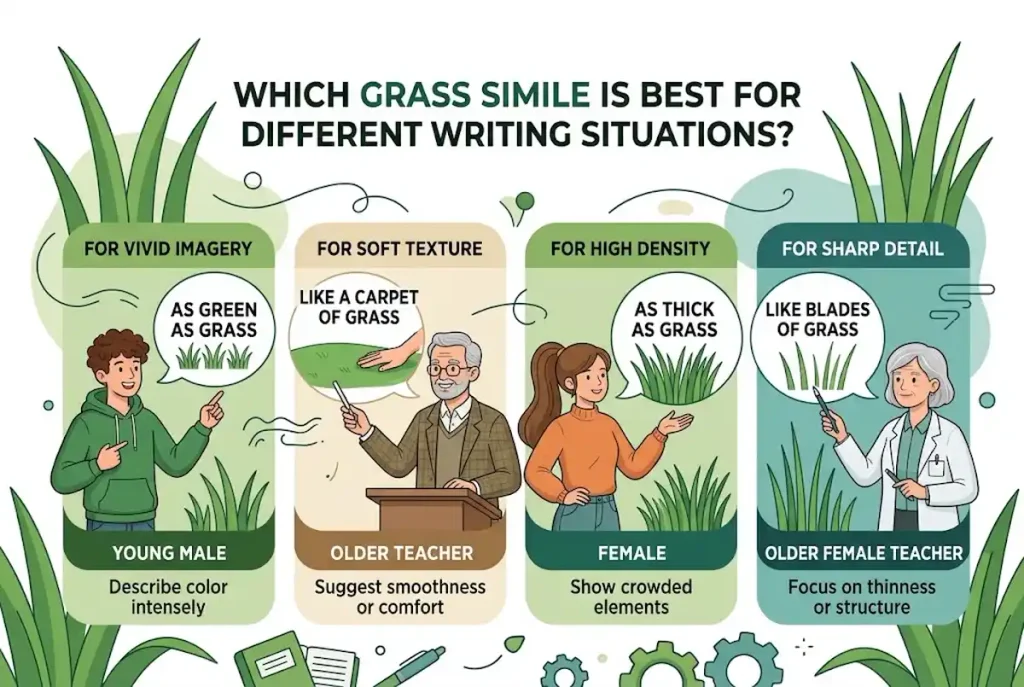
Which Grass Simile Is Best for Different Writing Situations?
The best comparison depends on your audience and purpose. A sentence for a school essay may need simple language, while a nature poem may benefit from more creative imagery.
What Is the Best Grass Simile for a Resume?
A resume usually needs professional and direct language. Similes are rarely necessary in work experience or skills sections because employers prefer clear information.
However, if you’re writing a creative portfolio, personal statement, or nature related professional profile, a simple comparison may fit.
Example:
My photography captures landscapes that look like living paintings.
What Is the Best Grass Simile for an Essay?
An essay about nature, gardening, seasons, or the environment can benefit from a clear comparison.
Good choices include:
- The green grass spread like a carpet across the school playground.
- The morning dew made the lawn sparkle like tiny diamonds.
- The tall grass moved like waves beneath the afternoon breeze.
What Is the Best Grass Simile for Texting?
Text messages usually sound more natural when they use short and familiar comparisons.
Try these examples:
- This grass is as soft as a blanket!
- The lawn is as fresh as spring.
- The grass is waving like ocean water.
What Is the Best Grass Simile for Email?
In an email, the comparison should match the subject and tone.
For example, if you’re describing a garden project, you could write:
The newly planted grass has created a soft green carpet around the building.
For a professional landscaping update, this sentence is clear and appropriate. Avoid overly dramatic comparisons when communicating with clients or colleagues.
What Is the Best Grass Simile for Speaking?
Everyday conversations benefit from comparisons that are easy to understand immediately.
Here are some natural examples:
- The grass feels as soft as velvet.
- That field looks like a green ocean.
- The lawn is as fresh as a spring morning.
What Are Some Original Grass Simile Sentences?
Seeing comparisons in complete sentences helps you understand how to use them in real situations. The following examples cover different places, seasons, weather conditions, and activities.
Everyday Nature Examples
1. The grass outside our house was as soft as a velvet blanket after the gardener finished mowing it.
2. The wide green meadow stretched like an emerald carpet beneath the morning sunlight.
3. The grass along the river moved like gentle waves whenever the cool breeze passed through.
4. The freshly watered lawn sparkled like a thousand tiny diamonds in the afternoon sun.
5. The young grass looked as bright as spring leaves after several days of heavy rain.
School and Childhood Examples
6. The playground was covered with grass as soft as a giant pillow.
7. The children ran across the field like little birds flying over a green meadow.
8. The school garden looked like a green painting after the students finished planting new grass.
9. The tall grass around the playground swayed like dancers during the morning breeze.
10. The grass beneath the trees felt as cool as a shaded blanket on a hot summer day.
Weather and Seasonal Examples
11. After the storm, the grass looked as fresh as a newly washed green cloth.
12. The summer field turned as golden as dried wheat beneath the blazing sun.
13. The wet grass shone like polished glass when the first rays of sunlight appeared.
14. During autumn, the dry grass looked like golden threads spread across the earth.
15. The winter grass stood like thin brown needles against the cold morning sky.
What Is the Difference Between Similar Words?
Some comparisons appear similar but create different images. Understanding their differences helps you select the most accurate expression.
Grass Like Velvet vs Grass Like Silk
Both comparisons describe softness, but they suggest slightly different textures.
| Grass Like Velvet | Grass Like Silk |
|---|---|
| Suggests a soft and rich texture | Suggests a smooth and delicate texture |
| Creates an image of comfort | Creates an image of elegance |
| Works well for thick lawns | Works well for smooth, fine grass |
Grass Like a Carpet vs Grass Like an Ocean
These comparisons describe different appearances.
| Grass Like a Carpet | Grass Like an Ocean |
|---|---|
| Suggests a smooth covering | Suggests a wide moving landscape |
| Focuses on appearance | Focuses on movement and size |
| Works well for lawns | Works well for large fields |
Grass as Green as Emeralds vs Grass as Green as Fresh Leaves
Both comparisons describe green color, but their intensity differs.
| Green as Emeralds | Green as Fresh Leaves |
|---|---|
| Suggests a deep, rich green | Suggests a natural, lighter green |
| Creates a vivid image | Creates a fresh and gentle image |
| Works well for lush fields | Works well for young grass |
What Mistakes Should You Avoid When Using Word?
Similes can improve writing, but using them incorrectly can make sentences confusing or unnatural.
Here are some common mistakes to avoid.
Confusing Similes With Metaphors
A simile compares two things using like or as. A metaphor describes one thing as another without making the comparison explicit.
Simile: The grass was like a green carpet.
Metaphor: The grass was a green carpet.
Both sentences describe grass creatively, but they use different figures of speech.
Using Comparisons That Do Not Make Sense
A comparison should connect two things through a recognizable quality.
Unclear: The grass was as loud as a mountain.
This comparison doesn’t create a clear image because grass and mountains don’t share an obvious quality related to sound.
Better: The grass was as quiet as a sleeping garden.
Repeating the Same Comparison
Using the same expression repeatedly can make a story sound boring.
For example:
The grass looked like a green carpet. The next field also looked like a green carpet. The garden looked like a green carpet, too.
A better version uses different comparisons:
The first lawn looked like a green carpet. The nearby meadow moved like ocean waves, while the garden grass felt as soft as velvet.
Using Too Many Similes
A sentence doesn’t need several comparisons to become descriptive.
Overloaded: The grass was like velvet, silk, feathers, emeralds, and a green ocean.
Better: The grass felt as soft as velvet beneath our feet.
Choose one strong comparison that communicates your intended meaning.
Using the Wrong Comparison for the Situation
A comparison should match the actual appearance or condition of the grass.
For example, describing dry, brown grass as green as emeralds creates a misleading image.
Instead, use a comparison such as:
The dry grass looked as golden as old straw.
The description should help readers picture the scene accurately.
What Are the Antonyms of Grass Similes?
Similes themselves don’t have direct antonyms because they are figures of speech. However, the descriptive qualities used in grass comparisons have opposite meanings.
| Positive Description | Opposite Description |
|---|---|
| Green | Brown or yellow |
| Soft | Rough or hard |
| Fresh | Stale or withered |
| Thick | Thin or sparse |
| Wet | Dry |
| Smooth | Uneven |
| Healthy | Dead or damaged |
| Bright | Dull |
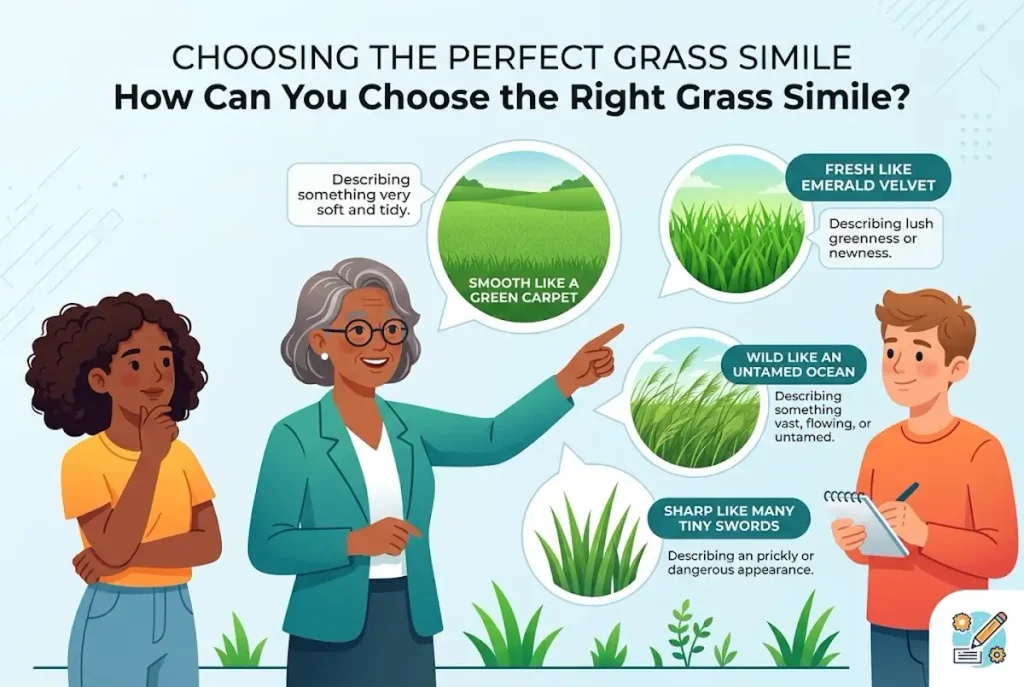
How Can You Choose the Right Grass Simile?
Choosing a good comparison doesn’t have to be difficult. Start by deciding what you want your reader to imagine.
Use these practical tips.
1. Focus on one quality. Decide if you’re describing color, softness, movement, freshness, or size.
2. Choose a familiar object. Compare grass to something readers already understand, such as velvet, silk, a blanket, or ocean waves.
3. Match the mood. Use gentle comparisons for peaceful scenes and stronger descriptions for dramatic landscapes.
4. Consider your audience. Children and beginner writers usually benefit from simple comparisons. Poetry and fiction can use more imaginative expressions.
5. Avoid exaggeration. A comparison should make the description clearer, not more confusing.
How to Create Your Own Grass Simile
You can make an original comparison by following three simple steps.
Step 1: Identify a quality.
For example, grass is soft.
Step 2: Think of something with a similar quality.
A velvet blanket also feels soft.
Step 3: Connect the two using like or as.
The grass felt as soft as a velvet blanket.
You can use the same method for other qualities.
| Grass Quality | Possible Comparison | New Simile |
|---|---|---|
| Green | Emerald | As green as an emerald |
| Wet | Glass | Like polished glass |
| Tall | Wall | Like a wall of green |
| Moving | Ocean waves | Like ocean waves |
| Dry | Straw | As dry as straw |
| Fresh | Spring leaves | As fresh as spring leaves |
| Thick | Cushion | As thick as a cushion |
| Golden | Sunshine | Like a field of sunshine |
Conclusion
Grass can be described in many creative ways, depending on its color, texture, movement, and condition. The best word make ordinary descriptions more interesting while helping readers imagine a clear picture. Comparisons such as as soft as velvet, as green as emeralds, and like waves in the ocean are useful choices for essays, poems, stories, and everyday conversations.
Remember that a good comparison should match the quality you’re describing. You don’t need complicated words or several comparisons in one sentence. Choose an expression that feels natural, communicates your idea clearly, and suits your writing style. With a little practice and observation, you can create original comparisons that bring every outdoor scene to life.
Frequently Asked Questions
What is a good simile for grass?
A good simile for grass is as soft as velvet. It describes the gentle texture of healthy grass and creates an easy image for readers to understand.
What is a simile for green grass?
A common simile for green grass is as green as emeralds. It compares the rich green color of grass to the bright green color of the gemstone.
What is a simile for grass blowing in the wind?
Grass blowing in the wind can be described as moving like waves in the ocean. This comparison shows how grass bends and moves together in a gentle breeze.
What’s another way to say the grass was soft?
You can say the grass felt like velvet or was as soft as a blanket. Both comparisons describe a comfortable and gentle texture.
Can you give me a simile for dry grass?
Dry grass can be described as dry as straw or as brittle as old paper. These comparisons help readers imagine its rough and fragile condition.
What is the difference between a grass simile and a metaphor?
A grass simile compares grass to something else using like or as, while a metaphor describes grass as something else directly. For example, the grass was like a carpet is a simile, while the grass was a carpet is a metaphor.
How do I write my own simile about grass?
Start by choosing a quality of grass, such as its color, texture, or movement. Then think of something with a similar quality and connect the two using like or as.

Daniel Grammarfield — The Language Learner
Age: 28Occupation: ESL Learner & Digital Professional
Bio:Daniel is a non-native English speaker who wants to communicate more confidently at work and online. He uses Synotrench to improve grammar, understand confusing words, learn correct sentence structures, and build everyday English skills. He prefers simple explanations with practical examples.
Goals:
Master English grammar rules
Avoid common language mistakes
Improve professional communication
Learn English through real-life examples
Quote:“Learning English is not about memorizing rules — it’s about expressing ideas clearly.”
4 thoughts on “Grass Similes: Best Examples and Comparisons (2026)”