
Imagine you’re writing a science essay about the air around us. You type a sentence about oxygen, nitrogen, and other substances in the atmosphere. Suddenly, your spell checker makes you question something simple. Should you write gases or gasses?
This spelling difference can be confusing because both words exist in English. However, they don’t always serve the same purpose. One is the standard plural form of a common science term, while the other has a more specific use.
The correct plural of gas is gases. Gasses is mainly used as a verb meaning to expose someone or something to gas, although it is also an accepted but less common plural spelling.
Understanding of both words becomes easier once you know how each word works in a sentence. This guide explains their meanings, word origins, grammar rules, related vocabulary, regional differences, and common mistakes. You’ll also find practical examples to help you choose the correct spelling confidently.
What Is the Difference Between Gases and Gasses?
The main difference is how the two words are used.
Gases is the standard plural noun form of gas. It refers to two or more gaseous substances, such as oxygen, hydrogen, nitrogen, or carbon dioxide.
Gasses is commonly the third-person singular form of the verb gas. It describes someone or something releasing gas, exposing something to gas, or supplying gas.
However, gasses can also function as an alternative plural of gas. This spelling is much less common in modern scientific and professional writing.
Consider these examples:
- Different gases make up Earth’s atmosphere.
- The machine gasses the chamber during its operating cycle.
- Some gases become liquids when cooled sufficiently.
- The technician gasses the container as part of a controlled industrial process.
In the first and third sentences, gases refers to substances. In the second and fourth sentences, gasses describes an action.
Quick Comparison Table
| Feature | Gases | Gasses |
|---|---|---|
| Main function | Plural noun | Verb or alternative plural noun |
| Base word | Gas | Gas |
| Common meaning | Multiple gaseous substances | Exposes to gas or supplies gas |
| Grammar | Plural noun | Third-person singular verb or plural noun |
| Scientific writing | Standard spelling | Usually avoided as a plural |
| Example | Oxygen and nitrogen are gases. | The equipment gasses the chamber. |
| Recommendation | Use for the plural of gas | Use when the verb requires it |
What Does Gas Mean in Simple English?
Gas is a state of matter that has no fixed shape or volume. It spreads out to fill the space available inside a container.
For example, oxygen is a gas that humans need to breathe. Carbon dioxide is another gas found naturally in the atmosphere.
Unlike a solid, a gas doesn’t keep its own shape. Unlike a liquid, it expands to fill its container rather than keeping a fixed volume.
The word gas can also refer to fuel.
In American English, people often use gas as a shorter name for gasoline, especially when discussing cars.
Examples include:
- The balloon contains helium gas.
- Natural gas is used to heat many homes.
- We need to stop for gas before leaving town.
- Scientists measured the amount of gas inside the container.
The intended meaning depends on the situation.
Where Did the Word Gas Come From?
The word gas entered scientific language through the work of Belgian scientist Jan Baptist van Helmont in the 17th century.
He introduced the term while studying substances that behaved differently from solids and liquids.
The word is commonly linked to the Greek word chaos, which refers to disorder or an unformed state.
Over time, gas became a standard scientific term used to describe one of the main states of matter.
Its plural form developed according to ordinary English spelling patterns.
Because gas ends in s, adding es produces gases.
The verb form follows a different spelling pattern. Its final consonant is doubled before adding es, producing gasses.
This explains why both spellings exist.
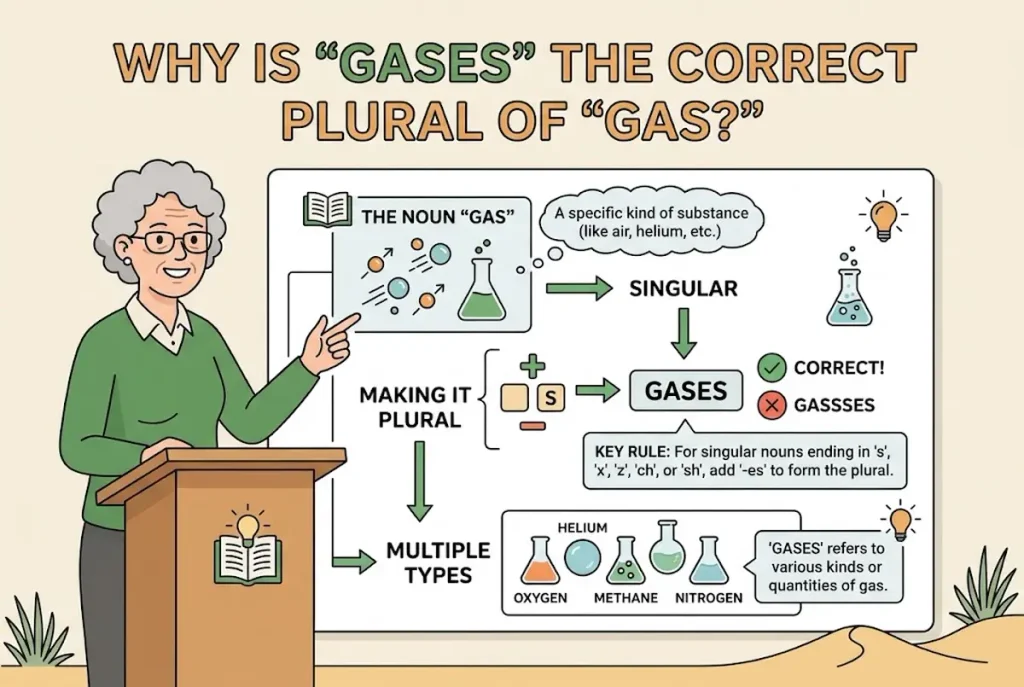
Why Is Gases the Correct Plural of Gas?
Gases is the preferred plural because it follows the established spelling convention for this particular noun.
Many English nouns ending in s form their plurals by adding es.
For example:
| Singular | Plural |
|---|---|
| Bus | Buses |
| Lens | Lenses |
| Gas | Gases |
| Class | Classes |
| Glass | Glasses |
| Kiss | Kisses |
| Loss | Losses |
Can Gasses Be a Plural Noun?
Yes. Some dictionaries recognize gasses as an alternative plural of gas.
However, gases is far more conventional in scientific, academic, technical, and general writing.
For example:
Correct and preferred: The laboratory stores several gases.
Accepted but less common: The laboratory stores several gasses.
Both can communicate the same idea, but the first sentence follows the spelling readers are more likely to expect.
For professional writing, consistency also matters. Avoid switching between the two plural spellings within the same document.
What Does Gasses Mean as a Verb?
Gasses is a form of the verb gas.
It is used with a third-person singular subject in the simple present tense.
In everyday grammar, this means it can follow subjects such as he, she, it, the machine, or the technician.
Depending on context, the verb can mean:
- To supply something with gas.
- To expose someone or something to gas.
- To affect someone through gas exposure.
- Informally, to talk excessively, particularly in British English.
Examples:
- The machine gasses the sealed chamber.
- The technician gasses the container during the process.
- The faulty appliance gasses the room when it leaks.
- He gasses about football for hours.
The meaning changes according to the surrounding words.
How Does the Verb Gas Change?
The verb has several forms worth remembering.
| Verb form | Spelling | Example |
|---|---|---|
| Base form | Gas | They gas the chamber. |
| Third-person singular | Gasses | The machine gasses the chamber. |
| Past tense | Gassed | The container was gassed. |
| Present participle | Gassing | The machine is gassing the chamber. |
| Past participle | Gassed | The chamber has been gassed. |
What Are 30 Related Words and Alternatives for Gas?
The words don’t have one perfect synonym that works in every situation.
A science teacher discussing atmospheric substances needs different vocabulary from a driver talking about gasoline.
Similarly, a writer describing gas exposure may need a verb rather than a noun.
The following table includes 32 related words and context-specific alternatives. Some are close synonyms, while others name particular gases, forms of fuel, or actions.
They should not all be treated as interchangeable.
Simple and Everyday Words
| Word | Meaning | Tone | Example |
|---|---|---|---|
| Air | Mixture of gases around Earth | Simple | Fresh air entered the room. |
| Vapor | Substance in gaseous form | Everyday | Water vapor collected near the window. |
| Fumes | Gas or vapor, often harmful or unpleasant | Everyday | Paint fumes filled the workshop. |
| Steam | Water in gaseous form, often seen with condensed droplets | Everyday | Steam rose from the kettle. |
| Smoke | Airborne particles and gases from burning | Everyday | Smoke drifted above the fire. |
| Fuel | Material used to produce energy | Everyday | The heater needs fuel. |
| Gasoline | Liquid fuel used in many vehicles | Everyday | She purchased gasoline. |
| Natural gas | Gaseous fossil fuel mixture | Everyday | Natural gas powers the stove. |
| Exhaust | Waste gases and particles released by an engine | Everyday | Exhaust escaped through the pipe. |
| Emissions | Substances released into the environment | Everyday | The company reduced its emissions. |
| Oxygen | Gas needed for human respiration | Simple | Oxygen enters our lungs. |
| Carbon dioxide | Gas released during respiration | Simple | Plants absorb carbon dioxide. |
Formal and Scientific Words
| Word | Meaning | Tone | Example |
|---|---|---|---|
| Gaseous substances | Materials existing in gas form | Scientific | The experiment examined gaseous substances. |
| Atmosphere | Layer or mixture of gases surrounding a planet | Scientific | Earth’s atmosphere contains nitrogen. |
| Effluent | Material discharged from a process | Formal | The facility monitored its gaseous effluent. |
| Volatiles | Substances that evaporate readily | Scientific | Heating released several volatiles. |
| Propellant | Material used to produce movement or thrust | Technical | The system uses compressed gas as a propellant. |
| Aerosol | Fine solid or liquid particles suspended in gas | Scientific | The aerosol remained suspended in the air. |
| Hydrocarbons | Compounds containing hydrogen and carbon | Scientific | Methane belongs to the hydrocarbon family. |
| Nitrogen | Common atmospheric gas | Scientific | Nitrogen makes up most of Earth’s atmosphere. |
| Helium | Lightweight chemical element that is a gas under ordinary conditions | Scientific | Helium filled the balloon. |
| Methane | Flammable gas found in natural gas | Scientific | Methane escaped from the damaged pipe. |
| Refrigerant | Substance used in cooling systems | Technical | The refrigerant circulates through the system. |
| Greenhouse gas | Gas that absorbs and emits infrared radiation | Scientific | Methane is a greenhouse gas. |
Informal and Slang Expressions
| Word | Meaning | Tone | Example |
|---|---|---|---|
| Gas | Short form of gasoline in the US | Informal | I need gas for my car. |
| Petrol | Common British term for gasoline | Everyday UK | We stopped to buy petrol. |
| Gas up | Fill a vehicle with fuel | Informal US | We should gas up before the trip. |
| Gas guzzler | Vehicle that consumes a lot of fuel | Informal | That old truck is a gas guzzler. |
| Pass gas | Release intestinal gas | Everyday | Some foods can make people pass gas. |
| Break wind | Release intestinal gas | Informal | He politely described it as breaking wind. |
| Gasbag | Person who talks excessively | Informal | Everyone knew he was a gasbag. |
| Gas away | Talk for a long time | Informal UK | They gassed away all afternoon. |
How Do Related Gas Words Change in Intensity?
Some related expressions describe increasing levels of release, exposure, or danger.
However, gases themselves don’t have a built-in intensity level. Oxygen, helium, and methane are different substances, not stronger versions of the same word.
When discussing gas exposure, choose vocabulary that reflects what actually happened.
From Mild to Strong
| Level | Expression | Meaning | Example |
|---|---|---|---|
| Mild | Release gas | Allow gas to escape | The container releases gas slowly. |
| Mild | Emit fumes | Give off gas or vapor | The material emits fumes when heated. |
| Moderate | Leak gas | Allow gas to escape unintentionally | The damaged pipe leaks gas. |
| Moderate | Expose to gas | Bring someone or something into contact with gas | The process exposes the sample to gas. |
| Strong | Fill with gas | Introduce enough gas to occupy a space | The system fills the chamber with gas. |
| Strong | Overexpose | Subject someone to excessive exposure | The worker was overexposed to harmful fumes. |
| Severe | Poison | Cause injury through a toxic substance | The fumes poisoned the animals. |
| Severe | Asphyxiate | Deprive someone of adequate oxygen | The atmosphere could asphyxiate an unprotected person. |
Is Gases a Noun or a Verb?
Gases is primarily a plural noun. Gasses is most commonly a verb form, although dictionaries also recognize its less common plural use.
Understanding parts of speech makes the spelling difference easier to remember.
Noun Forms
| Form | Function | Example |
|---|---|---|
| Gas | Singular noun | This gas has no color. |
| Gases | Standard plural noun | These gases have different properties. |
| Gasses | Alternative plural noun | Several gasses were examined. |
Verb Forms
| Form | Function | Example |
|---|---|---|
| Gas | Base verb | They gas the chamber. |
| Gasses | Third-person singular | The system gasses the chamber. |
| Gassed | Past tense | The technician gassed the container. |
| Gassing | Present participle | The system is gassing the container. |
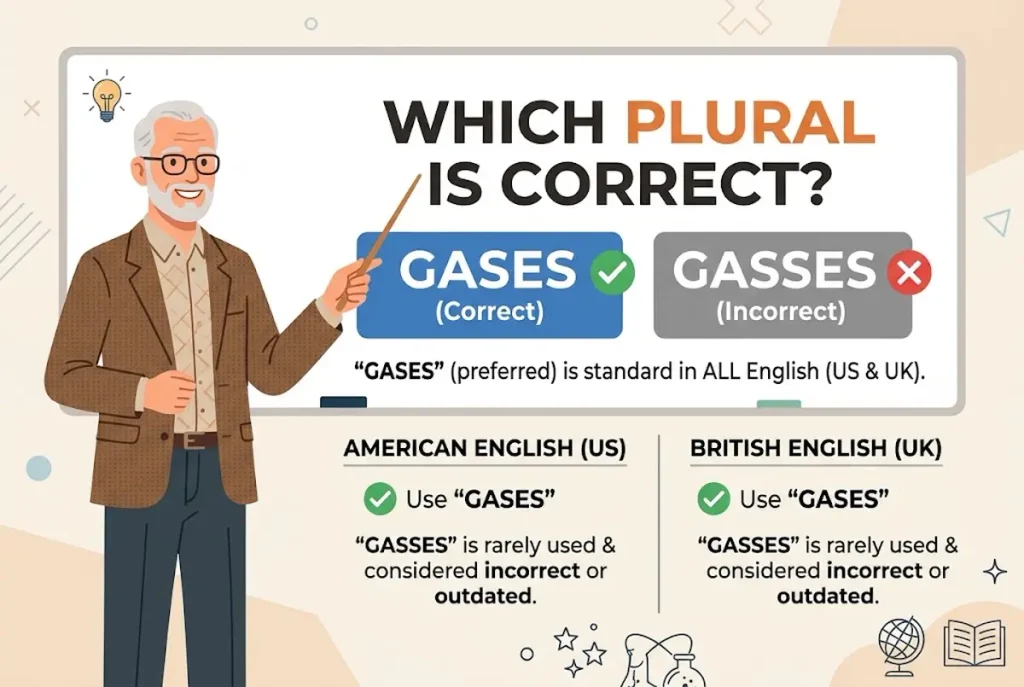
Is Gases or Gasses Correct in American and British English?
Both American and British English generally prefer gases as the plural noun.
There is no major regional rule requiring Americans to use one spelling and British writers to use the other.
The difference is mainly grammatical and conventional.
| Situation | American English | British English |
|---|---|---|
| Standard plural of gas | Gases | Gases |
| Alternative plural | Gasses | Gasses |
| Third-person singular verb | Gasses | Gasses |
| Common vehicle fuel term | Gas or gasoline | Petrol |
| Informal excessive talking | Less common use of gas | Gas or gassing |
Which Spelling Should You Use in Different Situations?
Choosing between words depends on your sentence’s purpose.
Academic writing usually needs the plural noun. Technical instructions may require the verb. Everyday communication can involve either form.
Which Spelling Is Better for a Resume?
Use gases when describing work involving multiple gaseous substances.
This is especially relevant for laboratory technicians, chemical engineers, environmental specialists, and industrial workers.
Example:
Monitored industrial gases and maintained accurate laboratory records.
Another example:
Conducted quality checks on compressed gases used in manufacturing.
These sentences sound natural and professional.
Avoid using gasses as the plural in a resume unless a specific organization’s style guide requires it.
Which Spelling Should You Use in an Essay?
Gases is the safest choice when discussing science, environmental studies, chemistry, or climate change.
Example:
Greenhouse gases absorb and emit infrared radiation, influencing Earth’s temperature.
Another example:
Different gases respond differently when pressure and temperature change.
Using the standard plural helps maintain consistency with educational and scientific terminology.
Which Word Works Better in Text Messages?
In casual texting, your intended meaning determines the spelling.
Example:
Do you know which gases are inside that balloon?
If you’re talking about filling a vehicle with gasoline, you would normally use gas rather than gases.
Example:
I need to get gas before picking you up.
The second sentence uses gas as a mass noun referring to fuel.
What Are Some Real Examples of Words?
Seeing these words in different situations helps you understand their practical uses.
Science and Education
- Oxygen and nitrogen are two important gases in Earth’s atmosphere.
- Noble gases include helium, neon, and argon.
- Some gases dissolve in water more easily than others.
- The teacher explained how gases expand when heated under constant pressure.
- Scientists studied how different gases behave at extremely low temperatures.
Workplace and Industry
- The factory stores several compressed gases in approved containers.
- The technician checks the equipment before the system gasses the chamber.
- Industrial gases are used in welding, manufacturing, and food processing.
- The company monitors gases released during production.
- The automated equipment gasses the enclosed space during its operating cycle.
Environment and Nature
- Greenhouse gases influence the planet’s energy balance.
- Volcanoes release gases such as water vapor and carbon dioxide.
- Certain gases contribute to air pollution.
- Researchers collected samples of gases near the volcanic opening.
- Different atmospheric gases absorb different wavelengths of radiation.
Everyday Communication
- The balloon contains a mixture of gases.
- My brother gasses about his favorite video games for hours.
- The science museum displayed information about gases found on other planets.
- We learned that some gases have no noticeable smell.
- The faulty appliance gasses the room when its exhaust system fails.
Notice how the noun examples refer to substances, while the verb examples describe actions.
Gases vs Fumes: What’s the Difference?
Gases and fumes are related words, but they don’t mean exactly the same thing.
Gas describes a physical state of matter. Fumes generally refers to airborne gas or vapor, often with an unpleasant, irritating, or harmful quality.
In technical settings, fume can have a narrower meaning involving very fine airborne particles formed through processes such as condensation.
| Gases | Fumes |
|---|---|
| Refers to substances in a gaseous state | Often refers to airborne emissions |
| Neutral scientific term | Often suggests irritation or danger |
| Includes oxygen and nitrogen | Commonly associated with paint, fuel, or industrial processes |
| Suitable for general chemistry | Suitable for certain exposure descriptions |
Gases vs Vapors: What’s the Difference?
These words are also closely connected.
A gas is a state of matter. Vapor commonly describes the gaseous form of a substance that is normally liquid or solid under the conditions being discussed.
| Gases | Vapors |
|---|---|
| General term for the gaseous state | Often refers to evaporated substances |
| Includes oxygen and nitrogen | Includes water vapor and gasoline vapor |
| Common in general science | Common in discussions of evaporation and condensation |
| Broad physical classification | Often identifies a substance’s gaseous form |
Gas vs Gasoline: Are They the Same Thing?
Not always.
In science, gas refers to a state of matter. In everyday American English, gas can also mean gasoline.
Gasoline is a liquid fuel, not a gas under ordinary conditions.
This difference can confuse English learners because the same word appears in two unrelated everyday situations.
Compare:
The scientist studied a gas inside the container.
The driver bought gas at the station.
The first sentence uses the scientific meaning. The second uses the American fuel-related meaning.
When precision matters, write gasoline instead of gas.
What Are the Most Common Spelling Mistakes?
The biggest mistake is assuming that words can always replace each other.
Although the alternative plural exists, the two spellings have different preferred uses.
Mistake 1: Using Gasses in a Science Essay
Less preferred:
The atmosphere contains several different gasses.
Preferred:
The atmosphere contains several different gases.
The first spelling is recognized as an alternative plural, but the second is the standard choice for academic writing.
Mistake 2: Using Gases Instead of the Verb Gasses
Incorrect:
The machine gases the chamber.
Correct:
The machine gasses the chamber.
When gas functions as a regular verb in the third-person singular, the conventional spelling is gasses.
Mistake 3: Writing Gas’s as a Plural
Incorrect:
The laboratory tested three gas’s.
Correct:
The laboratory tested three gases.
An apostrophe doesn’t make a regular noun plural.
Gas’s is generally a possessive form or a contraction of gas is, depending on the sentence.
For example:
The gas’s temperature increased.
In formal scientific writing, the temperature of the gas may sound more natural.
Mistake 4: Confusing Gas and Gases
Incorrect:
Several gas were released.
Correct:
Several gases were released.
The word several requires a plural count noun.
However, gas can also function as an uncountable noun.
Example:
Gas escaped from the damaged pipe.
Mistake 5: Using Gases for Gasoline in Every Situation
Unnatural:
I need to buy some gases for my car.
Natural:
I need to buy some gas for my car.
In ordinary American English, gasoline is usually treated as an uncountable substance.
When Should You Avoid Using Gasses?
Avoid gasses as a plural noun when writing for readers who expect standard scientific or professional terminology.
This includes:
- Chemistry textbooks and assignments.
- Environmental research papers.
- Laboratory reports.
- Technical manuals.
- Educational websites.
There is nothing inherently wrong with the alternative plural, but gases is more familiar and consistent with standard usage.
Also, avoid using gasses as an informal verb meaning excessive talking in formal writing.
For example:
Informal: He gasses about work all day.
Formal: He talks extensively about his work.
The second version communicates the meaning without relying on regional slang.
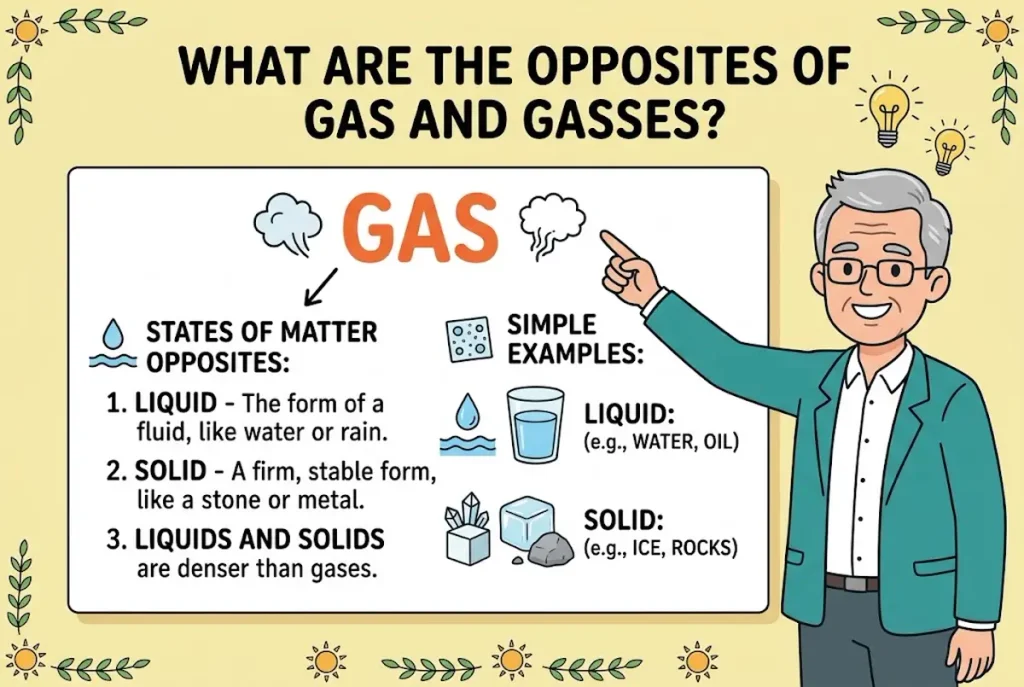
What Are the Opposites of Gas and Gasses?
Gases doesn’t have one direct antonym that works in every context.
However, related terms can express contrasting physical states or actions.
| Word | Related opposite | Explanation |
|---|---|---|
| Gas | Solid | Different state of matter |
| Gas | Liquid | Different state of matter |
| Release gas | Contain gas | Prevent gas from escaping |
| Supply gas | Remove gas | Take gas away from a system |
| Fill with gas | Evacuate | Remove gas from an enclosed space |
| Gas exposure | Protection from exposure | Prevent or reduce contact |
How Can You Remember the Correct Spelling?
A few simple checks can prevent most mistakes.
Use These Five Quick Tips
- If you’re discussing two or more gaseous substances, choose gases.
- If one person or machine performs the verb gas, use gasses.
- Remember that the verb forms include gassed and gassing.
- Use gases in science essays, reports, and professional documents.
- Read the complete sentence before trusting an automatic spelling suggestion.
Conclusion
The difference between Gases or Gasses comes down to standard usage and grammar. Gases is the preferred plural of gas and should be your default choice when discussing multiple gaseous substances. Gasses is the regular third-person singular verb form, although it is also recognized as a less common plural spelling.
For science assignments, workplace documents, and professional communication, using gases as the plural keeps your writing clear and consistent. Reserve gasses for sentences that require the verb form, such as describing what a machine does.
Remember that English spelling doesn’t always follow one universal pattern. Learning how a word functions in a sentence is often more useful than memorizing spelling rules alone. With a little practice, choosing between these two forms becomes straightforward.
Frequently Asked Questions
What is the plural of gas in American English?
The preferred plural of gas in American English is gases. Gasses is also recognized as an alternative plural, but it is less common.
Why does gases have only one s in the middle?
Gases follows the established plural spelling of the noun gas. The verb follows a different pattern, producing forms such as gasses, gassed, and gassing.
Is gasses grammatically incorrect?
No. Gasses is a valid English word. It can function as a third-person singular verb or a less common plural noun.
What’s another way to say gases?
Possible alternatives include gaseous substances, fumes, vapors, or emissions, depending on context. These terms have different meanings, so they aren’t always interchangeable.
Is gasses used in British English?
Yes. British English recognizes gasses as a verb form and alternative plural. However, gases remains the standard plural noun.
How do you spell the past tense of gas?
The standard past tense is gassed, with a doubled s. For example, the technician gassed the chamber during the controlled procedure.

Daniel Grammarfield — The Language Learner
Age: 28Occupation: ESL Learner & Digital Professional
Bio:Daniel is a non-native English speaker who wants to communicate more confidently at work and online. He uses Synotrench to improve grammar, understand confusing words, learn correct sentence structures, and build everyday English skills. He prefers simple explanations with practical examples.
Goals:
Master English grammar rules
Avoid common language mistakes
Improve professional communication
Learn English through real-life examples
Quote:“Learning English is not about memorizing rules — it’s about expressing ideas clearly.”
2 thoughts on “Gases or Gasses: Simple Guide to Correct Spelling (2026)”