You are writing a friendly email, finishing a text message, or preparing an essay when you reach the final sentence. You want to say farewell, but suddenly you wonder: should you write goodbye or good bye? Both forms look understandable, so choosing the correct spelling can be confusing.
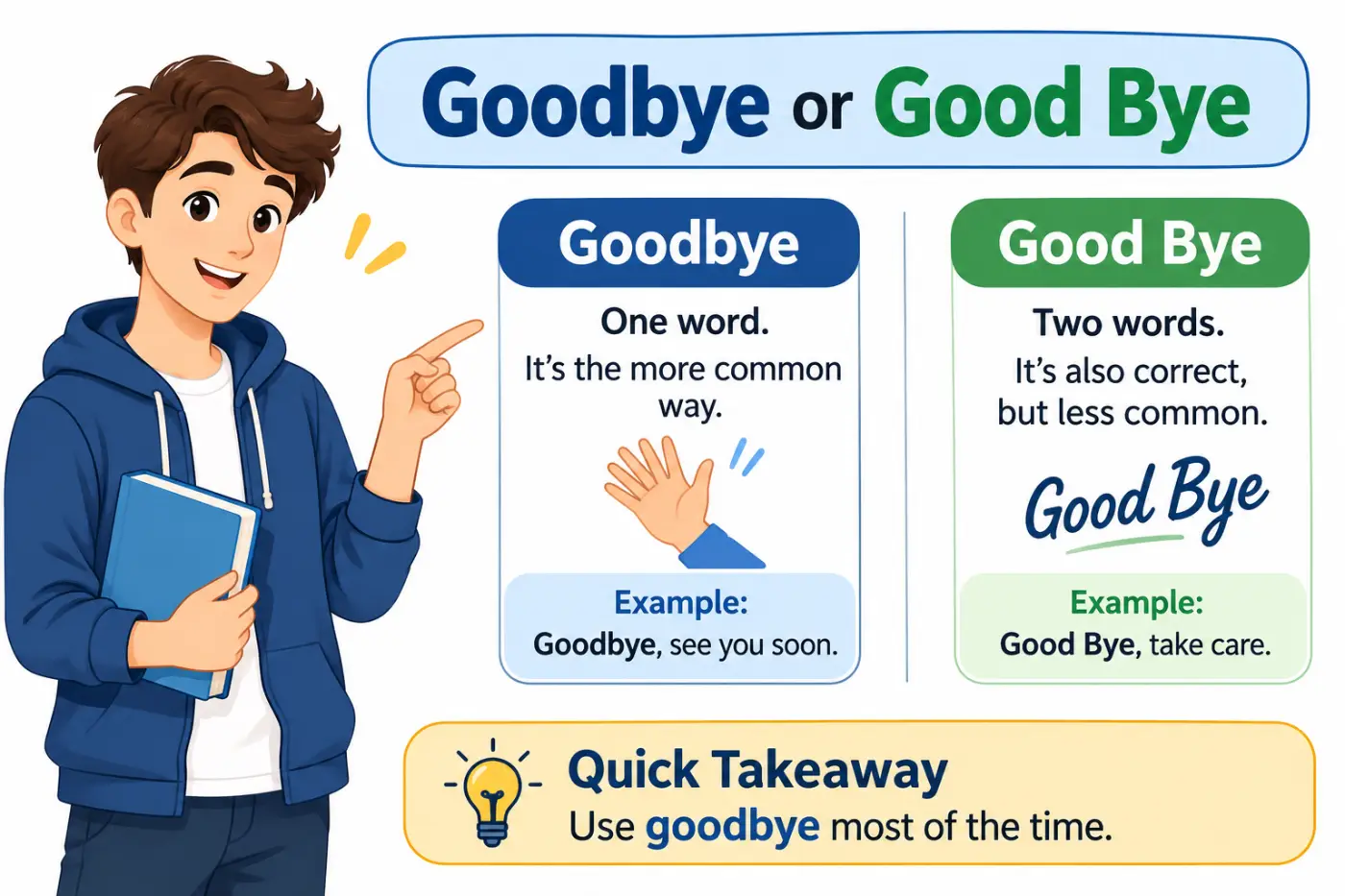
The correct spelling in modern American English is goodbye. It is written as one word when you want to say farewell to someone. The two word form good bye is generally considered incorrect in standard modern writing.
Goodbye is the standard spelling for saying farewell. Use it as one word in emails, essays, text messages, letters, and everyday conversations.
Although both forms look similar, they do not have the same standing in modern English. Knowing the correct spelling will help you avoid mistakes and make your writing look more polished.
In this guide, you will learn where the word came from, how to use it in different situations, which alternatives you can choose, and what common spelling mistakes to avoid. You will also find practical examples and answers to frequently asked questions.
What Is the Correct Spelling of Goodbye or Good Bye?
The correct spelling is goodbye, written as a single word. It is the standard form used in American English and other major varieties of modern English.
People use this word when they leave someone, end a conversation, finish a message, or express that they will not see someone for a while.
Here are the correct and incorrect forms:
| Spelling | Correct or Incorrect | Explanation |
|---|---|---|
| Goodbye | Correct | Standard modern spelling |
| Good bye | Generally incorrect | Not the standard spelling |
| Good-bye | Accepted variant | Older hyphenated spelling |
| Goodby | Incorrect | Missing the final e |
| Good-bye! | Accepted | Hyphenated form of the farewell |
Why Do People Write Good Bye as Two Words?
Many people separate the word because they recognize good and bye as two familiar English words.
Good usually describes something positive, while bye is a casual way to say farewell. When people see them together, it may seem natural to write them separately.
However, spelling does not always follow the original meaning of individual words. Some expressions become established as single words over time.
Goodbye is one of those expressions. Modern dictionaries recognize it as a single word, so writing it separately is not recommended in standard English.
Where Did the Word Goodbye Come From?
The history of goodbye is interesting because its original form was quite different from the word we use today.
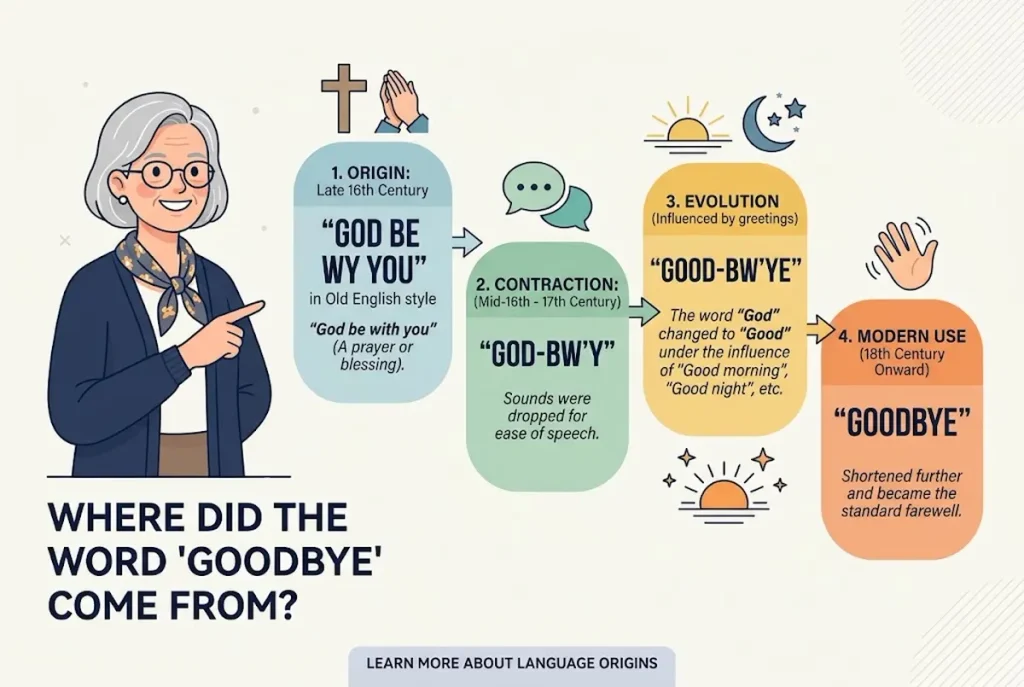
The expression developed from the phrase God be with ye. People used this expression as a way of wishing someone well when they parted.
Over time, the phrase became shorter and changed in pronunciation and spelling.
How Did God Be With Ye Become Goodbye?
In earlier English, people commonly used religious expressions when saying farewell. God be with ye was one such expression.
The phrase carried a thoughtful meaning. It expressed a wish that God would protect or guide someone after they left.
As people used it in everyday speech, the expression gradually became shorter.
The development is commonly explained through these stages:
- God be with ye was the original expression.
What Did Goodbye Originally Mean?
Originally, goodbye expressed a wish for God’s protection when someone departed.
Today, it has a much simpler everyday meaning: farewell.
The religious meaning is no longer necessary when people use the word. Someone can say goodbye to a friend, coworker, stranger, or family member without making a religious statement.
For example:
- My grandmother said goodbye and wished me a safe journey.
What Does Goodbye Mean in Simple English?
Goodbye means farewell or the act of leaving someone at the end of a meeting or conversation.
It is commonly used when someone is going home, ending a phone call, leaving a workplace, or finishing a visit.
The word can express different feelings depending on the situation.
| Situation | Meaning | Example |
|---|---|---|
| Leaving a friend | Ending a meeting | Goodbye, see you tomorrow! |
| Ending a phone call | Finishing a conversation | Goodbye, thanks for calling. |
| Leaving a workplace | Saying farewell to coworkers | I said goodbye to my team. |
| Permanent separation | Parting for a long time | It was difficult to say goodbye. |
| Ending a message | Closing a written conversation | Goodbye, and take care. |
Is Goodbye a Noun or an Interjection?
Goodbye can function as both a noun and an interjection.
As an interjection, it is used directly when someone leaves or ends a conversation.
Example:
Goodbye! Have a safe trip.
As a noun, it refers to the act or moment of saying farewell.
Example:
Her goodbye made everyone emotional.
What Are the Best Synonyms for Goodbye?
Several English words and expressions can replace goodbye. However, the best choice depends on your relationship with the other person, the situation, and the tone you want to express.
Some alternatives are casual and friendly, while others sound formal, emotional, or professional.
The following table includes 32 useful alternatives grouped by tone.
Simple Words for Goodbye
These alternatives are easy to understand and work well in everyday conversations.
| Word | Meaning | Tone | Example |
|---|---|---|---|
| Bye | A short farewell | Casual | Bye, see you tomorrow. |
| Farewell | A formal or meaningful goodbye | Neutral | Farewell, my old friend. |
| See you | Expecting to meet again | Casual | See you after school. |
| Later | See you at another time | Casual | Catch you later. |
| Goodbye | A general farewell | Neutral | Goodbye, everyone. |
| So long | A way to say farewell | Casual | So long, take care. |
| Take care | A wish for someone’s well-being | Friendly | Take care on your journey. |
| See you soon | Expecting to meet again shortly | Friendly | See you soon, Sarah. |
Everyday Alternatives for Goodbye
These expressions are useful in daily conversations, messages, and informal writing.
| Word | Meaning | Tone | Example |
|---|---|---|---|
| Bye-bye | A friendly farewell | Informal | Bye-bye, Mom! |
| See you later | Meet again at another time | Casual | See you later at work. |
| Catch you later | Meet or talk again soon | Friendly | Catch you later, buddy. |
| Until next time | Farewell until another meeting | Friendly | Until next time, everyone. |
| Have a good one | Wish someone a good day | Casual | Have a good one! |
| All the best | Wish someone success | Warm | All the best with your new job. |
| Take it easy | A relaxed farewell | Casual | Take it easy, my friend. |
| Keep in touch | Stay connected | Friendly | Keep in touch after graduation. |
Formal Alternatives for Goodbye
Use these expressions in professional emails, business communication, formal letters, and respectful conversations.
| Word | Meaning | Tone | Example |
|---|---|---|---|
| Farewell | A respectful parting | Formal | We wish you a pleasant farewell. |
| Adieu | A traditional farewell | Formal | Adieu, until we meet again. |
| Parting | The act of separating | Formal | Their parting was emotional. |
| Until we meet again | Hope to meet in the future | Formal | Until we meet again, take care. |
| Best wishes | A positive closing expression | Professional | Best wishes for your future. |
| Goodbye for now | A temporary farewell | Polite | Goodbye for now, everyone. |
| Safe travels | A wish for a safe journey | Polite | Safe travels, and enjoy your trip. |
| Sincerely | A formal letter closing | Professional | Sincerely, David. |
Which Goodbye Synonyms Are Best From Mild to Strong?
Not every farewell carries the same emotional meaning. Some expressions sound light and friendly, while others suggest a serious or permanent separation.Choosing the right expression helps you communicate your feelings more clearly.
Mild Farewell Expressions
Mild expressions are suitable when you expect to see or speak to someone again soon.
- Bye: A short and simple farewell.
- See you: A friendly way to end a conversation.
- Later: A casual expression for another meeting.
Moderate Farewell Expressions
These expressions are slightly more thoughtful and can work in personal and professional situations.
- Take care of yourself: Shows concern for another person.
- Until next time: Suggests another meeting in the future.
- All the best: Expresses good wishes.
Strong or Emotional Farewell Expressions
These expressions carry deeper feelings and may suggest a long or permanent separation.
- A final goodbye: A farewell that may be permanent.
- Last farewell: A final parting.
- Parting words: The words spoken before separation.
Are There Different Forms of Goodbye by Part of Speech?
Yes. Goodbye can function as a noun or an interjection. Related expressions can also work as verbs, depending on how you construct a sentence.
Understanding these differences will help you avoid grammatical mistakes.
Goodbye as a Noun
A noun names a person, place, thing, or idea. When used as a noun, goodbye refers to a farewell or the act of parting.
Examples:
- His goodbye was short but meaningful.
- We exchanged a final goodbye at the airport.
- Her goodbye brought tears to my eyes.
Goodbye as an Interjection
An interjection expresses a feeling or reaction. Goodbye works this way when you use it directly to address someone who is leaving.
Examples:
- Goodbye! I hope you enjoy your vacation.
- Goodbye, everyone. Thank you for coming.
- Well, goodbye! It was nice meeting you.
Related Verbs and Expressions
Goodbye itself is not normally used as a verb. However, several verbs describe the action of leaving or expressing a farewell.
| Word or Phrase | Part of Speech | Meaning | Example |
|---|---|---|---|
| Leave | Verb | Go away from a place | I need to leave now. |
| Depart | Verb | Go away or begin a journey | The passengers will depart soon. |
| Part | Verb | Separate from someone | We parted after lunch. |
| Farewell | Noun or interjection | An expression of parting | They shared a farewell. |
| Wave goodbye | Verb phrase | Move your hand when leaving | She waved goodbye to us. |
| Say goodbye | Verb phrase | Express a farewell | I said goodbye to my teacher. |
Is Goodbye Different in American and British English?
No major spelling difference exists between American and British English. Both varieties generally use goodbye as one word.
The spelling is also standard in other major English-speaking regions, including Canada and Australia.
However, some farewell expressions are more common in certain regions or social settings.
| Expression | Common Usage | Meaning |
|---|---|---|
| Goodbye | American and British English | General farewell |
| Bye | American and British English | Short, everyday farewell |
| Cheerio | More associated with British English | Friendly farewell |
| Ta-ta | British informal usage | Casual goodbye |
| See ya | Common in American and British speech | See you again |
| Catch you later | Common in American and other English varieties | Meet or talk again |
| Cheers | Common in British informal communication | Can express thanks or farewell |
Which Spelling Should You Use in American English?
Use goodbye as one word in American English.
It is the safest spelling for school assignments, workplace communication, personal messages, and online writing.
Although good-bye appears in older publications and some traditional writing, goodbye is the more common modern form.
You do not need to change the spelling based on the country where your reader lives.
What Is the Best Goodbye for Different Situations?
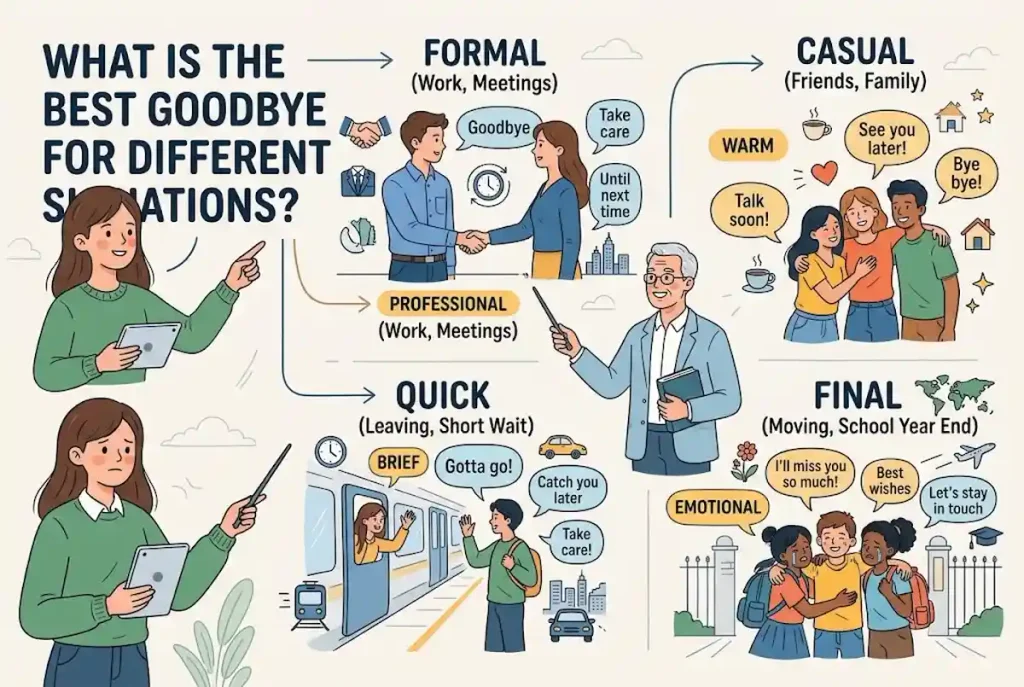
The right farewell depends on the person you are speaking to and the reason you are leaving.
A message to your best friend does not need the same language as a professional email to your manager. Similarly, an academic essay requires more careful wording than a casual text.
What Should You Write Instead of Goodbye on a Resume?
A resume usually does not need a farewell expression. It should end with professional information or a clear statement about your qualifications and interest in a position.
However, if you are writing a cover letter or an accompanying message, choose a professional closing.
Good options include:
- Sincerely.
- Best regards.
- Kind regards.
What Is the Best Alternative to Goodbye in an Essay?
In an academic essay, goodbye is usually unnecessary unless the topic involves a farewell, separation, or personal experience.
If you are discussing the end of a relationship or a historical departure, use words that fit the meaning.
Useful alternatives include:
- Farewell.
- Departure.
- Separation.
What Should You Say Instead of Goodbye in Texting?
Text messages are usually informal, so you can use short and friendly expressions.
Good choices include:
- Bye!
- See ya!
- Talk soon!
What Is the Best Goodbye for an Email?
Email closings should match the purpose of your message.
A professional email needs a polite and respectful closing. A message to a friend can be much more relaxed.
| Email Type | Best Closing | Example |
|---|---|---|
| Business email | Best regards | Best regards, Michael |
| Formal request | Sincerely | Sincerely, James |
| Friendly email | Take care | Take care, Anna |
| Work follow-up | Thanks | Thanks, David |
| Personal email | Talk soon | Talk soon, Emily |
| Job application | Kind regards | Kind regards, Sarah |
What Should You Say When Speaking to Someone?
Spoken farewells can be simple, friendly, emotional, or formal.
Choose a phrase that feels natural in the conversation.
Examples:
- See you tomorrow.
- Have a nice day.
- Take care of yourself.
What Are Some Original Examples of Goodbye in Sentences?
Seeing the word in different situations makes its meaning and grammar easier to understand.
Here are original examples from everyday life, school, work, travel, and personal relationships.
Everyday Conversation Examples
- I said goodbye to my neighbor before walking home.
- My brother waved goodbye as the school bus drove away.
- We said goodbye after spending the afternoon together.
School and Academic Examples
- The students said goodbye to their classmates before summer vacation.
- Our teacher gave us a warm goodbye on the final day of school.
- I wrote a short goodbye message in my friend’s yearbook.
Workplace and Professional Examples
- Daniel said goodbye to his coworkers on his last day at the company.
- The manager thanked the team before saying goodbye.
- We exchanged goodbyes after finishing the business meeting.
What Is the Difference Between Goodbye and Bye?
Goodbye and bye have almost the same basic meaning, but they differ slightly in tone and formality.
Goodbye is the complete, standard farewell expression. Bye is a shorter and more casual version.
| Feature | Goodbye | Bye |
|---|---|---|
| Meaning | Farewell | Farewell |
| Tone | Neutral | Casual |
| Length | Longer | Shorter |
| Formality | Suitable for most situations | More informal |
| Common use | Speech and writing | Everyday conversation |
| Example | Goodbye, everyone. | Bye, everyone! |
When Should You Use Goodbye?
Use goodbye when you want a neutral farewell that works in many situations.
Examples:
- Goodbye, and thank you for your help.
- It was nice meeting you. Goodbye.
- We said goodbye before leaving the office.
When Should You Use Bye?
Use bye when speaking casually with friends, family members, and people you know well.
Examples:
- Bye! See you tomorrow.
- Bye, Mom. I’ll be home soon.
- Okay, bye! Talk to you later.
What Is the Difference Between Goodbye and Farewell?
Goodbye and farewell both express separation, but they do not always create the same feeling.
Goodbye is a general expression used in ordinary situations. Farewell often sounds more formal, emotional, or serious.
| Feature | Goodbye | Farewell |
|---|---|---|
| Meaning | Saying goodbye to someone | Expressing a parting |
| Tone | Neutral | Formal or emotional |
| Everyday use | Very common | Less common |
| Professional use | Acceptable | Often suitable |
| Emotional feeling | Depends on context | Can sound more meaningful |
| Example | Goodbye, see you soon. | Farewell, old friend. |
Examples of Goodbye and Farewell
Goodbye:
It was nice working with you. Goodbye, and have a wonderful weekend.
Farewell:
The entire team gathered to give their retiring manager a heartfelt farewell.
The first example describes an ordinary departure. The second suggests a more meaningful occasion.
What Is the Difference Between Goodbye and See You Later?
Goodbye and see you later are both common ways to end a conversation. However, they communicate slightly different expectations.
Goodbye simply expresses a farewell. See you later suggests that you expect to meet or communicate with the person again.
| Feature | Goodbye | See You Later |
|---|---|---|
| Meaning | Farewell | Meet again later |
| Tone | Neutral | Friendly |
| Future meeting | Not required | Usually expected |
| Formality | Neutral | Casual |
| Example | Goodbye, everyone. | See you later, everyone. |
Examples of Both Expressions
Goodbye:
I said goodbye to my old neighbors before moving to another city.
See you later:
I’ll finish my homework now. See you later at the library.
The important difference is the expectation of meeting again. You can use goodbye even when you do not know when you will see someone next.
What Are the Common Mistakes People Make When Writing Goodbye?
English spelling can be confusing, especially when two familiar words appear together. Goodbye is a common example because its spelling may look like two separate words.
Here are some mistakes worth avoiding.
Mistake 1: Writing Good Bye Instead of Goodbye
Incorrect: Good bye, my friend. Have a safe trip.
Correct: Goodbye, my friend. Have a safe trip.
The standard spelling is one word. Do not separate good and bye when writing the modern farewell expression.
Mistake 2: Forgetting the Final E
Incorrect: I waved goodby to my family.
Correct: I waved goodbye to my family.
The word ends with the letter e. Remember to include it every time you write the standard spelling.
Mistake 3: Confusing Goodbye With Good Night
Goodbye and good night are not interchangeable in every situation.
Goodbye means farewell. Good night is generally used when leaving someone at night or when someone is going to sleep.
Incorrect: I am going to bed now. Goodbye!
More natural: I am going to bed now. Good night!
You can use goodbye at night, but good night is usually more natural when ending a conversation before sleep.
Mistake 4: Using Bye in Formal Writing
Bye is correct English, but it can sound too casual in certain professional situations.
Less suitable: Bye, Mr. Anderson. Thank you for the interview.
Better: Thank you for your time, Mr. Anderson. Best regards.
The right expression depends on the setting. A friendly message and a professional letter have different expectations.
Mistake 5: Using Farewell for Every Situation
Farewell is correct, but it can sound overly formal or dramatic in everyday conversation.
Unnatural: Farewell! I will see you in five minutes.
More natural: See you in five minutes!
Choose language that matches the situation instead of using formal expressions everywhere.
When Should You Not Use Goodbye?
Although goodbye is a useful expression, it is not always the best choice.
There are situations where another word or phrase communicates your meaning more clearly.
When You Are Only Pausing a Conversation
If you are temporarily stopping a conversation but plan to continue soon, use a phrase such as talk later or be right back.
Example:
Instead of: Goodbye, I’ll return in two minutes.
Better: I’ll be right back.
When You Are Ending a Formal Business Letter
A formal letter usually needs a professional closing rather than a conversational farewell.
Example:
Instead of: Goodbye, John.
Better: Sincerely, John.
When You Are Welcoming Someone
Goodbye expresses departure, not arrival.
Incorrect: Goodbye! Welcome to our school.
Better: Hello! Welcome to our school.
Use greetings such as hello, welcome, or good morning when someone arrives.
What Are the Antonyms of Goodbye?
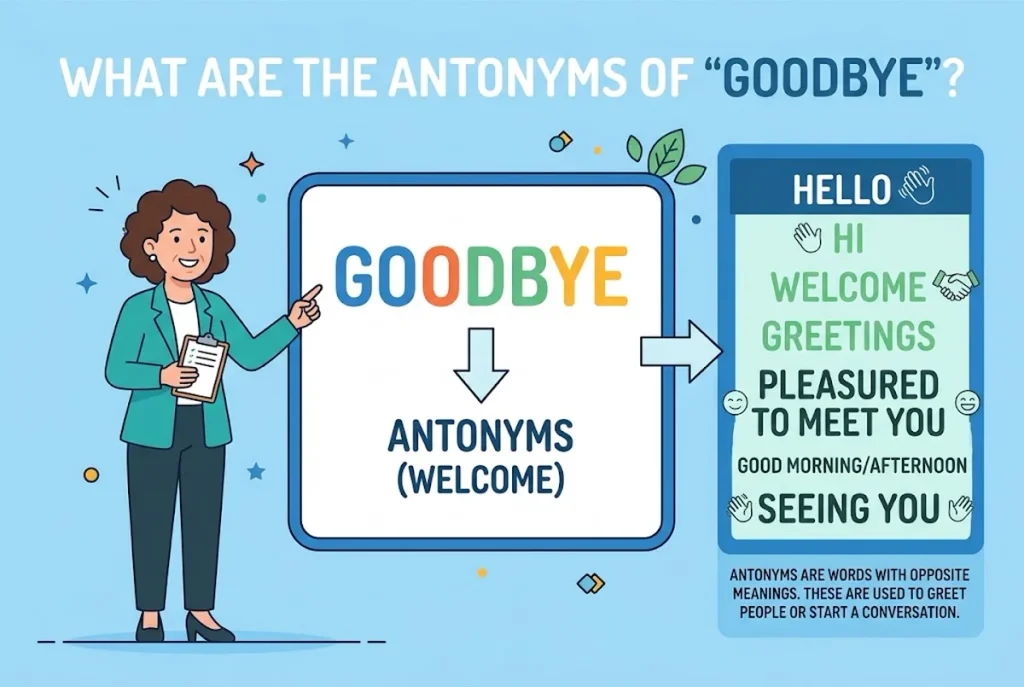
An antonym is a word or expression with an opposite meaning.
Since goodbye expresses departure or separation, its opposite usually communicates greeting, arrival, or meeting again.
| Antonym or Opposite Expression | Meaning | Example |
|---|---|---|
| Hello | A greeting | Hello, nice to meet you. |
| Welcome | A friendly greeting | Welcome to our home. |
| Hi | An informal greeting | Hi, how are you? |
| Greetings | An expression of welcome | Greetings, everyone. |
| Arrival | The act of reaching a place | Their arrival made us happy. |
| Reunion | Meeting again after separation | We celebrated our reunion. |
| Meet again | See someone another time | I hope we meet again. |
Conclusion
Choosing the correct farewell spelling does not have to be difficult. The standard form is goodbye, written as one word. Although good bye may look reasonable, it is not the accepted spelling in modern standard English.
You can use goodbye in conversations, emails, school assignments, personal messages, and professional communication. If you want a more casual expression, choose bye or see you later. For formal or emotional situations, farewell may be a better option.
Remember the simple rule: keep goodbye together and include the final e. With this small spelling rule in mind, you can write confidently and choose the right farewell for every situation.
Frequently Asked Questions
Is Goodbye One Word or Two Words?
Goodbye is one word in standard modern English. Writing good bye as two separate words is generally considered incorrect.
Is Good Bye Ever Correct?
Good bye is not the standard modern spelling of the farewell expression. Use goodbye in schoolwork, professional documents, emails, and everyday writing.
Why Is Goodbye Spelled as One Word?
Goodbye developed from the older expression God be with ye. Over time, the expression became shorter and eventually developed into the single word used today.
Is Goodbye or Good Bye Correct in American English?
Goodbye is the correct standard spelling in American English. It is also the usual spelling in British English and other major English varieties.
What’s Another Way to Say Goodbye?
You can say bye, farewell, see you later, take care, until next time, or talk soon. Choose an expression that matches your relationship with the person.
What Is the Plural of Goodbye?
The plural form is goodbyes. For example: We exchanged our goodbyes before leaving the restaurant.

Daniel Grammarfield — The Language Learner
Age: 28Occupation: ESL Learner & Digital Professional
Bio:Daniel is a non-native English speaker who wants to communicate more confidently at work and online. He uses Synotrench to improve grammar, understand confusing words, learn correct sentence structures, and build everyday English skills. He prefers simple explanations with practical examples.
Goals:
Master English grammar rules
Avoid common language mistakes
Improve professional communication
Learn English through real-life examples
Quote:“Learning English is not about memorizing rules — it’s about expressing ideas clearly.”
2 thoughts on “Goodbye or Good Bye: The Best Spelling Guide (2026)”