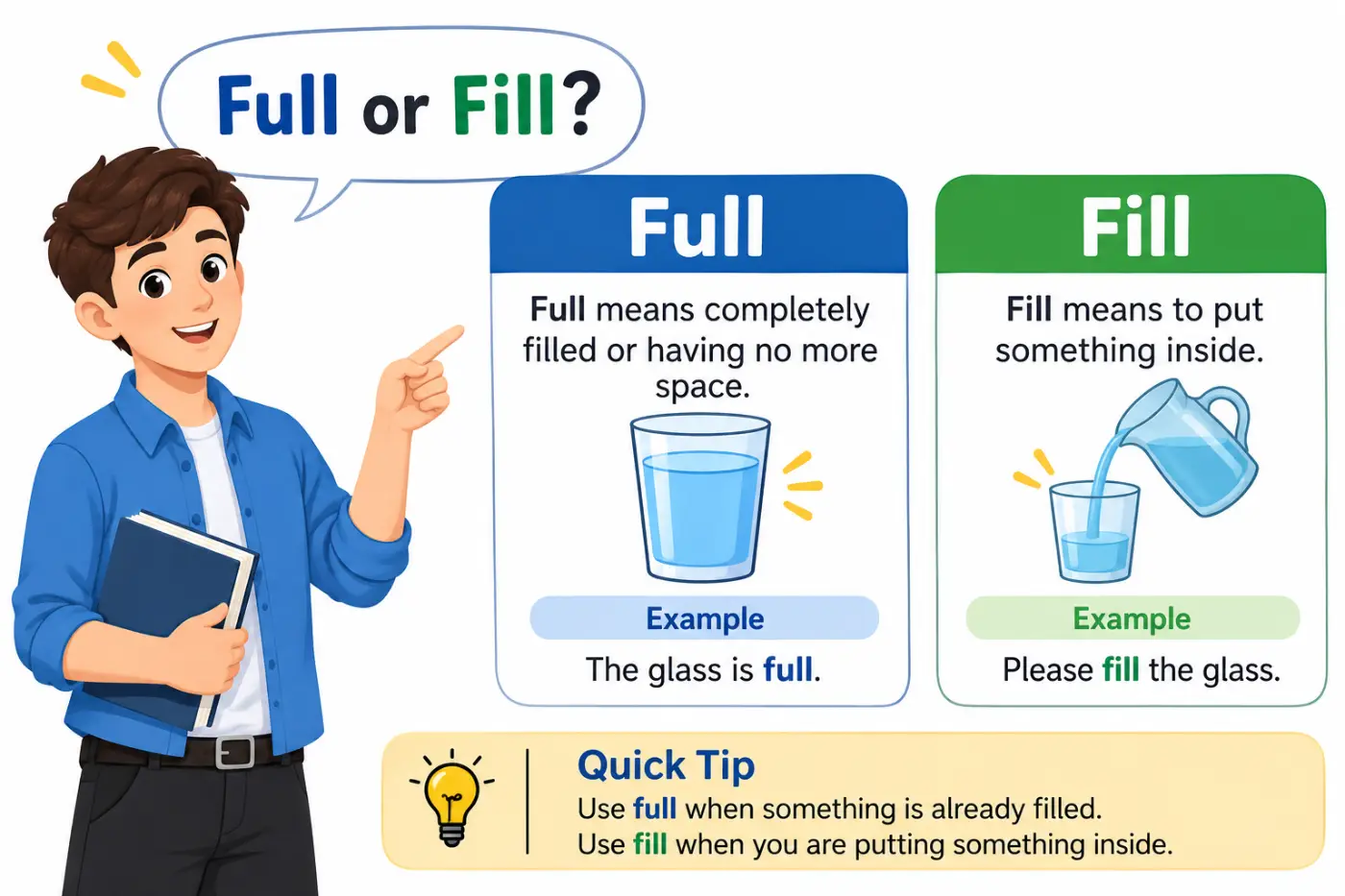
Understanding Full vs Fill helps you write clearer sentences, especially when describing containers, completing forms, talking about food, or explaining how much space something takes up.
Full is usually an adjective that describes something containing as much as it can hold. Fill is usually a verb that means to put something into a space or container until it reaches a certain level.
The difference becomes easier once you understand how each word works in a sentence. This guide explains their meanings, origins, grammar rules, synonyms, everyday examples, common mistakes, and practical tips for choosing the correct word.
What Is the Difference Between Full and Fill?
The main difference is that full describes a condition, while fill describes an action.
You use full when something already contains a large amount or has no more available space. You use fill when someone adds something to a container, space, or area.
Consider these examples:
- The bottle is full of water.
- Please fill the bottle with water.
- The parking lot is full.
- More cars will fill the parking lot.
- My schedule is full today.
The first word describes the current situation. The second explains an action that creates or changes that situation.
Full vs Fill Quick Comparison Table
| Feature | Full | Fill |
|---|---|---|
| Main meaning | Having little or no space left | Putting something into a space |
| Main part of speech | Adjective | Verb |
| Describes | A condition or state | An action or process |
| Example | The cup is full. | Fill the cup. |
| Past form | Not applicable as an adjective | Filled |
| Common phrase | Full of | Fill with |
| Opposite | Empty | Empty or drain |
| Related noun | Fullness | Filling |

Where Do Full and Fill Come From?
Although these words have different grammatical functions, they share an interesting history.
Both developed from related Old English words and have roots in the Germanic language family.
Origin and Meaning of Full
Full comes from the Old English word “full,” which meant complete, filled, or containing everything possible.
Its meaning has remained remarkably similar over time.
Today, full can describe physical objects, feelings, schedules, events, and abstract ideas.
Examples:
- A full suitcase.
- A full stomach.
- A full explanation.
- A full calendar.
- A heart full of happiness.
Notice that full doesn’t always mean a container has reached its physical limit. It can also describe completeness.
For example, a full explanation means an explanation that includes all the necessary details.
Origin and Meaning of Fill
Fill comes from the Old English verb “fyllan,” meaning to make full or complete.
The word developed into modern English as a verb describing the action of adding something to a space.
Examples:
- Fill the bucket with water.
- Fill the application form.
- Fill the room with music.
The historical connection explains why the words have related meanings despite performing different grammatical jobs.
Is Full an Adjective or a Verb?
Full is mainly an adjective. It describes the condition of a noun or pronoun.
An adjective provides information about a person, place, object, or situation.
Examples:
- The restaurant is full tonight.
- She carried a full basket.
- My phone’s storage is full.
In each sentence, full describes something rather than showing an action.
Can Full Be Used as a Noun or Adverb?
Yes, although these uses are less common.
As a noun, full appears in expressions such as:
- The moon is at its full.
- We enjoyed the celebration to the full.
As an adverb, it appears in expressions such as:
- He knew full well what would happen.
- The light shone full in her face.
These uses are worth recognizing, but beginners should focus on its main role as an adjective.
What Are the Comparative Forms of Full?
The comparative and superlative forms are:
| Form | Example |
|---|---|
| Full | The first glass is full. |
| Fuller | The second glass is fuller. |
| Fullest | The third glass is the fullest. |
Is Fill a Verb or a Noun?
Fill is mainly a verb. It describes the action of putting something into a container, area, or space.
Examples:
- Please fill this bottle.
- Music filled the entire room.
- She filled the basket with apples.
Unlike full, fill changes its form according to tense.
What Are the Verb Forms of Fill?
| Verb form | Word | Example |
|---|---|---|
| Base form | Fill | Please fill the glass. |
| Third person singular | Fills | She fills the bottles. |
| Present participle | Filling | He is filling the tank. |
| Simple past | Filled | They filled the boxes. |
| Past participle | Filled | The workers have filled the containers. |
Can Fill Be Used as a Noun?
Yes. As a noun, fill can mean an amount sufficient to satisfy a need or reach a desired level.
For example:
- Everyone ate their fill.
- The children had their fill of chocolate.
- After hours of sightseeing, we had our fill of excitement.
The related noun filling refers to material placed inside something.
Examples include sandwich filling, dental filling, and pie filling.
What Are the Best Synonyms for Full and Fill?
Choosing another word depends on the meaning you want to express.
Full has synonyms that describe completeness, quantity, or a lack of available space. Fill has alternatives that describe adding, loading, covering, or supplying something.
The following master list includes more than 30 useful alternatives grouped by tone and everyday usage.
Simple Synonyms
These words are easy to understand and suitable for everyday conversations.
| Word | Meaning | Tone | Example |
|---|---|---|---|
| Complete | Having everything necessary | Simple | The report is complete. |
| Packed | Containing many things | Simple | The bus was packed. |
| Loaded | Carrying a large amount | Simple | The truck was loaded. |
| Stuffed | Filled tightly | Simple | The bag was stuffed with clothes. |
| Add | Put something extra inside | Simple | Add water to the bowl. |
| Pour | Make liquid flow into something | Simple | Pour milk into the glass. |
| Put in | Place something inside | Simple | Put the books in the box. |
| Cover | Spread something over a surface | Simple | Cover the cake with cream. |
Everyday Synonyms
These alternatives sound natural in conversations, emails, and general writing.
| Word | Meaning | Tone | Example |
|---|---|---|---|
| Crowded | Containing many people | Everyday | The hallway was crowded. |
| Occupied | Currently being used | Everyday | Every seat was occupied. |
| Overflowing | Exceeding normal capacity | Everyday | The basket was overflowing. |
| Satisfied | Having enough | Everyday | Everyone felt satisfied after dinner. |
| Stocked | Supplied with necessary items | Everyday | The pantry was fully stocked. |
| Load | Put items into something | Everyday | Load the bags into the car. |
| Supply | Provide what is needed | Everyday | The company supplies clean water. |
| Refill | Fill something again | Everyday | Can you refill my cup? |
| Top up | Add more to reach a desired level | Everyday | Top up the water bottle. |
Formal Synonyms
These words work well in professional documents, reports, academic writing, and business communication.
| Word | Meaning | Tone | Example |
|---|---|---|---|
| Comprehensive | Including all major details | Formal | She prepared a comprehensive report. |
| Entire | Including every part | Formal | The entire building was inspected. |
| Exhaustive | Extremely thorough | Formal | They conducted an exhaustive review. |
| Saturated | Unable to absorb much more | Formal | The soil became saturated. |
| Replete | Abundantly supplied | Formal | The article was replete with examples. |
| Populate | Add data or entries | Formal | Populate the database with records. |
| Replenish | Restore a supply | Formal | Workers replenished the inventory. |
| Occupy | Take up available space | Formal | Equipment occupied the storage area. |
| Complete | Supply missing required information | Formal | Complete the application before Friday. |
Which Synonyms Show Different Levels of Intensity?
Some alternatives express a mild degree of fullness, while others describe a much stronger condition.
Choosing the correct intensity helps readers understand the exact situation.
Synonyms for Full From Mild to Strong
| Intensity | Word | Example |
|---|---|---|
| Mild | Occupied | Several seats were occupied. |
| Moderate | Well-stocked | The store was well-stocked. |
| High | Full | The container was full. |
| Strong | Packed | The train was packed. |
| Very strong | Jam-packed | The hall was jam-packed. |
| Extreme | Overflowing | The trash can was overflowing. |
Synonyms for Fill From Mild to Strong
| Intensity | Word | Example |
|---|---|---|
| Mild | Add | Add a little water. |
| Moderate | Supply | Supply the kitchen with ingredients. |
| Moderate | Refill | Refill the empty container. |
| Strong | Load | Load the truck with supplies. |
| Very strong | Stuff | Stuff the bag with clothing. |
| Extreme | Cram | Cram the remaining books into the box. |
How Do Full and Fill Change by Part of Speech?
The easiest way to choose between these words is to identify the grammatical job your sentence needs.
| Part of speech | Correct word | Example |
|---|---|---|
| Adjective | Full | The room is full. |
| Verb | Fill | Fill the room with chairs. |
| Noun | Fullness | She felt a sense of fullness. |
| Noun | Filling | The sandwich has a cheese filling. |
| Noun | Fill | We ate our fill. |
| Comparative adjective | Fuller | This container is fuller. |
| Superlative adjective | Fullest | That glass is the fullest. |
What Does Filled Mean?
Filled is the past tense and past participle of fill.
It can also function as an adjective.
Compare:
- The workers filled the boxes yesterday.
- The boxes are filled with supplies.
The first sentence describes a completed action. The second describes the boxes’ condition.
What Does Filling Mean?
Filling can describe an ongoing action or something placed inside another object.
Examples:
- She is filling the bottle.
- The filling inside the pie tastes delicious.
- This meal is surprisingly filling.
In the third example, filling is an adjective meaning that the meal makes someone feel satisfied after eating.
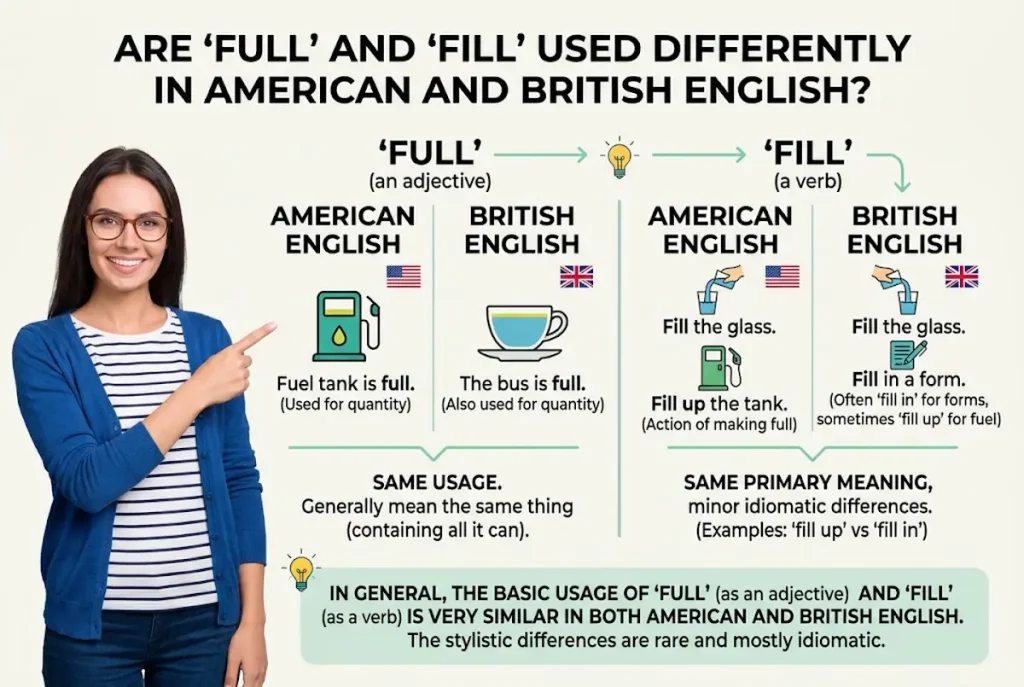
Are Full and Fill Used Differently in American and British English?
The basic meanings and spellings are the same in American and British English.
However, a few related expressions differ by region.
| American English | British English | Meaning |
|---|---|---|
| Fill out a form | Fill in a form | Enter required information |
| Fill up the gas tank | Fill up the petrol tank | Add fuel |
| Fill out an application | Fill in an application | Complete required fields |
| The parking lot is full | The car park is full | No parking spaces remain |
How Should You Use Full and Fill in Different Writing Situations?
Understanding the dictionary meanings is helpful, but real communication requires choosing words that match the situation.
The following examples show how to use them naturally in professional and everyday settings.
How Do You Use Full and Fill on a Resume?
On a resume, full often describes complete responsibility, availability, or professional experience.
Fill is useful when discussing vacancies, staffing needs, or positions.
Examples:
- Managed full responsibility for daily inventory operations.
- Helped fill vacant positions during seasonal recruitment.
- Maintained full compliance with company safety procedures.
For stronger resume writing, describe measurable achievements rather than relying on vague expressions.
Instead of writing “Filled many positions,” write “Filled 12 open positions within three months.”
How Do You Use Full and Fill in an Essay?
Academic writing often uses full when discussing completeness, capacity, or detailed explanations.
Fill is useful when explaining processes.
Examples:
- The study provides a full explanation of the results.
- Researchers filled each container with an equal amount of water.
- The experiment required a full examination of the collected data.
In formal essays, complete or comprehensive may sometimes communicate your intended meaning more precisely than full.
How Do You Use Full and Fill in Text Messages?
Texting usually allows short, direct sentences.
Examples:
- My phone storage is full.
- Can you fill my water bottle?
- The restaurant is already full.
The phrase fill you in means to give someone information they missed.
For example, “I’ll fill you in after the meeting” means you’ll explain what happened.
How Do You Use Full and Fill in Emails?
Professional emails benefit from clear instructions.
Use full to describe a condition and fill to request an action.
Examples:
- Please fill out the attached application.
- The training session is currently full.
- Kindly provide your full name and contact information.
Avoid writing “Please full the form.” The correct verb is fill.
What Are Some Everyday Examples of Full and Fill?
The following sentences show how these words work across different situations.
| Situation | Example with Full | Example with Fill |
|---|---|---|
| Kitchen | The jar is full of sugar. | Fill the jar with sugar. |
| School | The classroom is full. | Fill the empty spaces on the worksheet. |
| Office | My schedule is full. | Fill the vacant position. |
| Travel | The hotel is full tonight. | Fill the suitcase with clothes. |
| Technology | My phone’s storage is full. | Fill in the required login details. |
| Shopping | The cart is full. | Fill the cart with groceries. |
| Gardening | The watering can is full. | Fill the watering can. |
| Restaurant | The dining area is full. | Fill the glasses with water. |
| Healthcare | The waiting room is full. | Fill out the patient information form. |
| Sports | The stadium is full. | Fans quickly fill the stadium. |
What’s the Difference: Full vs Filled ?
Full and filled can both describe something containing material, but they don’t always emphasize the same information.
Full focuses on the amount or condition. Filled often draws attention to the presence of something inside or the result of an action.
| Full | Filled |
|---|---|
| The glass is full. | The glass is filled with juice. |
| The room is full. | The room is filled with furniture. |
| The box is full. | The box is filled with toys. |
| The hall is full. | The hall is filled with music. |
Fill vs Refill What’s the Difference?
Fill means to put something into a container or space.
Refill means to add something again, usually after some or all of the original contents have been used or removed.
| Fill | Refill |
|---|---|
| Fill the new bottle. | Refill the empty bottle. |
| Fill the swimming pool. | Refill the pool after cleaning. |
| Fill the printer tray. | Refill the tray when the paper runs low. |
| Fill the coffee cup. | Refill the cup after drinking. |
What’s the Difference: Full vs Complete?
Full and complete sometimes share similar meanings, but they aren’t perfect substitutes.
Full often describes capacity, quantity, or extent. Complete usually means that nothing necessary is missing.
| Full | Complete |
|---|---|
| The glass is full. | The assignment is complete. |
| The theater is full. | The project is complete. |
| She gave a full explanation. | She gave a complete explanation. |
| My calendar is full. | The application is complete. |
What Are the Most Common Mistakes With Full and Fill?
Because these words share related meanings, learners sometimes use one where the other belongs.
Here are common mistakes and their corrections.
| Incorrect sentence | Correct sentence | Explanation |
|---|---|---|
| Please full the bottle. | Please fill the bottle. | An action requires a verb. |
| The glass is fill. | The glass is full. | A condition requires an adjective. |
| My stomach is fill. | My stomach is full. | Full describes the condition. |
| Fill the form with your full name. | Fill in the form with your full name. | Fill in is natural for entering information. |
| The room is fill of people. | The room is full of people. | Use full of. |
| She full the basket yesterday. | She filled the basket yesterday. | Filled is the past tense. |
| The box is full with books. | The box is full of books. | Full of is the standard expression. |
| I am filling after lunch. | I am full after lunch. | Full describes feeling satisfied after eating. |
Should You Say Full Of or Fill With?
Use full of when describing a condition.
Use fill with when describing an action.
Examples:
- The room is full of people.
- People fill the room.
- The worker fills the container with sand.
- The container is full of sand.
You can also use filled with to describe the result.
For example, “The container is filled with sand.”
Is Fill Up Always Necessary?
No. Fill and fill up often communicate similar meanings when discussing containers.
Examples:
- Fill the bottle with water.
- Fill up the bottle with water.
Both are correct.
Fill up can place slightly more emphasis on reaching the desired capacity, but the difference is often small in everyday conversation.
Can You Say Full Up?
Yes. Full up is a common informal expression, especially in British English.
For example:
- I’m full up after dinner.
- The restaurant is completely full up.
In American English, speakers generally prefer “I’m full” when talking about food.
When Should You Avoid Using Full or Fill?
Even grammatically correct words can sound unnatural when used in the wrong context.
Avoid full when you mean that someone has completed a task.
Incorrect: I am full with my homework.
Correct: I have finished my homework.
Avoid fill when you mean that something contains all its required parts.
Incorrect: The report is fill.
Correct: The report is complete.
You should also avoid full when the intended meaning is simply that something contains a small amount.
For example, a cup containing a little coffee isn’t necessarily full.
Similarly, don’t use fill when you mean to replace something entirely.
“Replace the old battery” and “Fill the old battery” communicate very different actions.
The surrounding meaning should always guide your word choice.
What Are the Opposites of Full and Fill?
It help you understand the difference between a condition and an action.
Antonyms of Full
| Antonym | Meaning | Example |
|---|---|---|
| Empty | Containing nothing | The bottle is empty. |
| Vacant | Not occupied | The room is vacant. |
| Incomplete | Missing necessary parts | The report is incomplete. |
| Sparse | Containing relatively little | The audience was sparse. |
| Unoccupied | Not currently being used | The seat is unoccupied. |
Antonyms of Fill
| Antonym | Meaning | Example |
|---|---|---|
| Empty | Remove the contents | Empty the container. |
| Drain | Remove liquid | Drain the water from the tank. |
| Remove | Take something away | Remove the books from the shelf. |
| Unload | Take cargo out | Unload the truck. |
| Deplete | Reduce or use up a supply | Heavy use depleted the reserves. |

What Are Common Expressions With Full and Fill?
English includes several everyday expressions that use these words beyond their basic meanings.
| Expression | Meaning | Example |
|---|---|---|
| Full of life | Energetic and lively | The puppy is full of life. |
| Full of yourself | Excessively proud | He sounds full of himself. |
| Full attention | Complete concentration | Please give me your full attention. |
| Full time | Working standard full working hours | She has a full-time job. |
| Fill in | Enter missing information | Fill in your address. |
| Fill out | Complete a document | Fill out the application. |
| Fill someone in | Give someone information | I’ll fill you in tomorrow. |
| Fill up | Add enough to reach a desired level | Fill up the tank. |
| Fill someone’s shoes | Replace someone in a role | It’s difficult to fill her shoes. |
| Have your fill | Have as much as you want or need | We had our fill of dessert. |
Conclusion
The difference between Full vs Fill becomes simple when you understand the grammatical role of each word. Full mainly describes a condition, while fill describes an action. They share related meanings, but choosing the wrong one can make an otherwise clear sentence sound unnatural.
Remember that you fill a container, and the container becomes full. You can also fill out a form, describe a full schedule, or say that a room is filled with people.
Pay attention to related expressions such as full of, fill with, fill in, and fill up. Each has a useful place in everyday English.
With regular practice, choosing between these two words will become much easier. Focus on the meaning of your sentence, and the correct choice will usually follow naturally.
Frequently Asked Questions
What is the main difference between Full vs Fill?
Full is mainly an adjective describing a condition, while fill is mainly a verb describing an action. For example, you fill a bottle until it becomes full.
Is it correct to say fill the form or full the form?
Fill the form is grammatically possible, but fill out the form and fill in the form are more natural expressions. Full the form is incorrect in standard everyday English.
Can I use full and filled interchangeably?
Not always. Full emphasizes a condition or capacity, while filled often emphasizes the presence of something inside or the result of an action.
What’s another way to say full?
Common alternatives include packed, crowded, complete, occupied, stuffed, and overflowing. The best choice depends on the context.
What is the past tense of fill?
The past tense of fill is filled. For example, “She filled the glass with water yesterday.”
Is my stomach is fill grammatically correct?
No. The correct sentence is “My stomach is full” or simply “I’m full.” Full describes the feeling of having eaten enough.
How can I remember Full vs Fill easily?
Remember that fill describes putting something inside, while full describes the resulting condition. You fill a glass with water, and then the glass is full.
Should I write fill in or fill out an application?
Both expressions are correct. Fill out is especially common in American English when referring to completing an entire application, while fill in often refers to entering information into specific fields.

Daniel Grammarfield — The Language Learner
Age: 28Occupation: ESL Learner & Digital Professional
Bio:Daniel is a non-native English speaker who wants to communicate more confidently at work and online. He uses Synotrench to improve grammar, understand confusing words, learn correct sentence structures, and build everyday English skills. He prefers simple explanations with practical examples.
Goals:
Master English grammar rules
Avoid common language mistakes
Improve professional communication
Learn English through real-life examples
Quote:“Learning English is not about memorizing rules — it’s about expressing ideas clearly.”
2 thoughts on “Full vs Fill Simple Guide to Meaning and Usage (2026)”