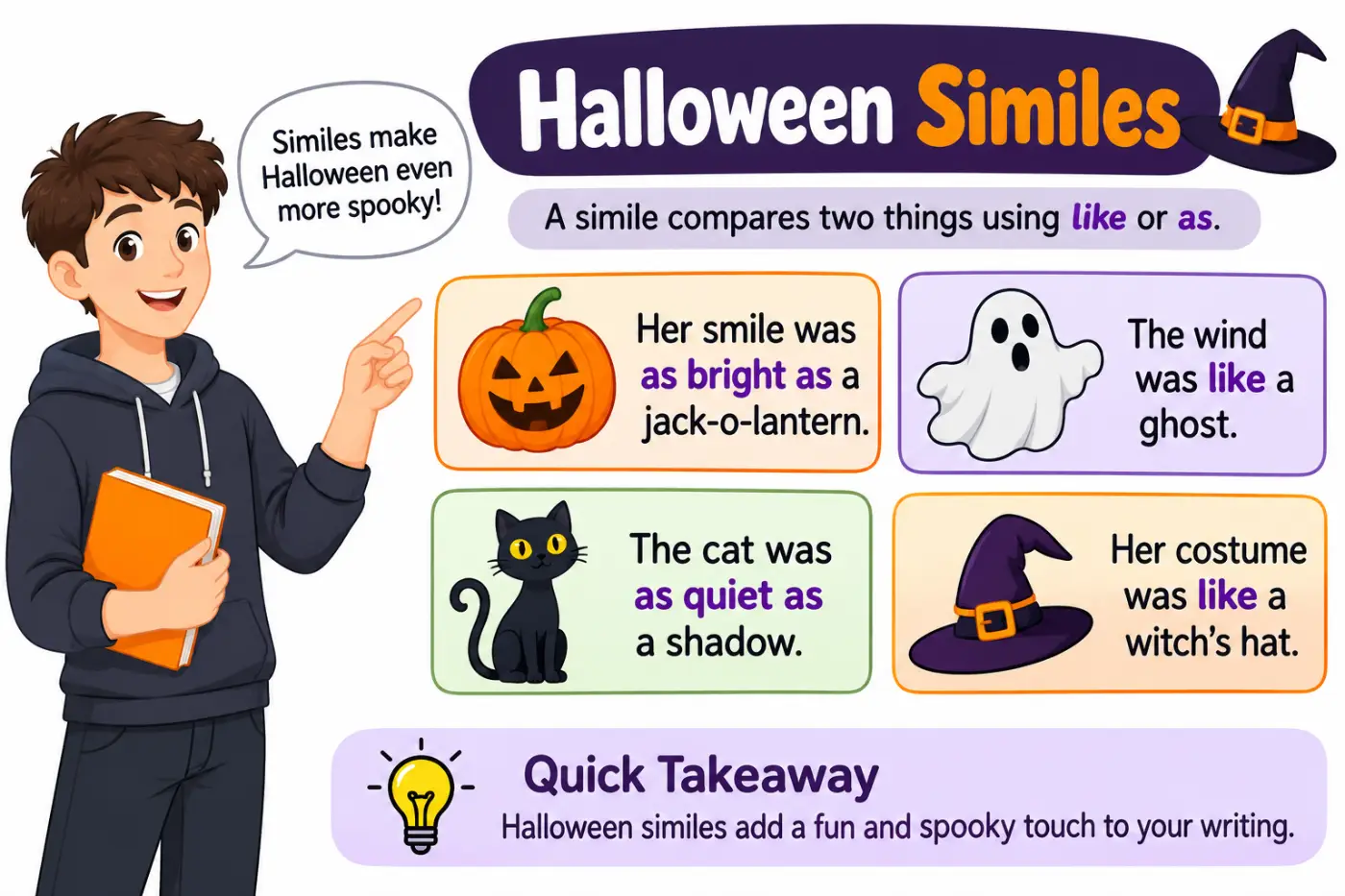
Halloween is a wonderful time to make writing more creative. Imagine describing a dark street, a spooky house, or a scary night in a school essay. Instead of saying the street was very dark, you could say it was as dark as a moonless night. That simple comparison helps readers picture the scene.
Halloween similes make descriptions more interesting by comparing people, places, objects, and experiences to familiar things. They can make a haunted house sound terrifying, a ghost seem mysterious, or a pumpkin look as bright as a golden lantern.
A Halloween simile is a comparison that uses words such as like or as to describe something spooky, mysterious, funny, or exciting. It helps readers imagine Halloween scenes through clear and creative comparisons.
In this guide, you’ll discover the meaning and origin of similes, 35 creative examples, useful descriptive alternatives, comparisons with similar literary devices, common mistakes, and practical tips for using them naturally.
What Are Halloween Similes in Simple English?
Halloween similes are creative comparisons that describe Halloween-related things by connecting them to something familiar. They usually use like or as to help readers imagine a particular feeling, appearance, sound, or experience.
For example:
- The haunted house was as silent as a graveyard.
- Her costume looked like a walking shadow.
- The wind howled like a hungry wolf.
- His face was as pale as a ghost.
Each sentence compares one thing with another to create a stronger picture in the reader’s mind.
Similes don’t always have to describe something frightening. They can also express excitement, humor, surprise, and mystery.
For instance, a child’s Halloween costume might be as colorful as a rainbow, while a bowl of candy might disappear like magic.
Why Are Similes Used in Halloween Writing?
Similes help writers create atmosphere without using long or complicated descriptions.
Consider these two sentences:
- The old house was scary.
- The old house stood like a forgotten monster beneath the dark sky.
The second sentence gives readers a clearer picture. It creates a stronger mood and makes the description more memorable.
Writers use these comparisons to:
- Create spooky scenes in Halloween stories.
- Describe costumes, decorations, and pumpkins.
- Make poems more interesting.
- Explain emotions such as fear and excitement.
- Add humor to Halloween jokes and conversations.
- Help young readers imagine unfamiliar scenes.
Where Did Similes Come From?
The word simile comes from the Latin word similis, meaning similar or alike. It describes a literary technique that compares two different things because they share a particular quality.
People have used comparisons in storytelling, poetry, speeches, and everyday conversations for centuries.
Writers use similes to explain difficult ideas through familiar images. For example, saying someone is as brave as a lion connects courage with an animal commonly associated with strength.
Halloween itself has a long cultural history. Its traditions are connected to ancient Celtic celebrations, especially Samhain, which marked the end of the harvest season and the beginning of winter.
Over time, Halloween developed into a celebration associated with costumes, ghosts, witches, pumpkins, haunted houses, and trick-or-treating.
These familiar traditions provide plenty of inspiration for creative comparisons.
For example:
- A ghost can represent something mysterious.
- A black cat can create a sense of superstition.
- A pumpkin can represent autumn and Halloween decorations.
- A haunted house can suggest fear and uncertainty.
- A full moon can create a mysterious atmosphere.
Combining these familiar images with comparisons creates memorable Halloween descriptions.
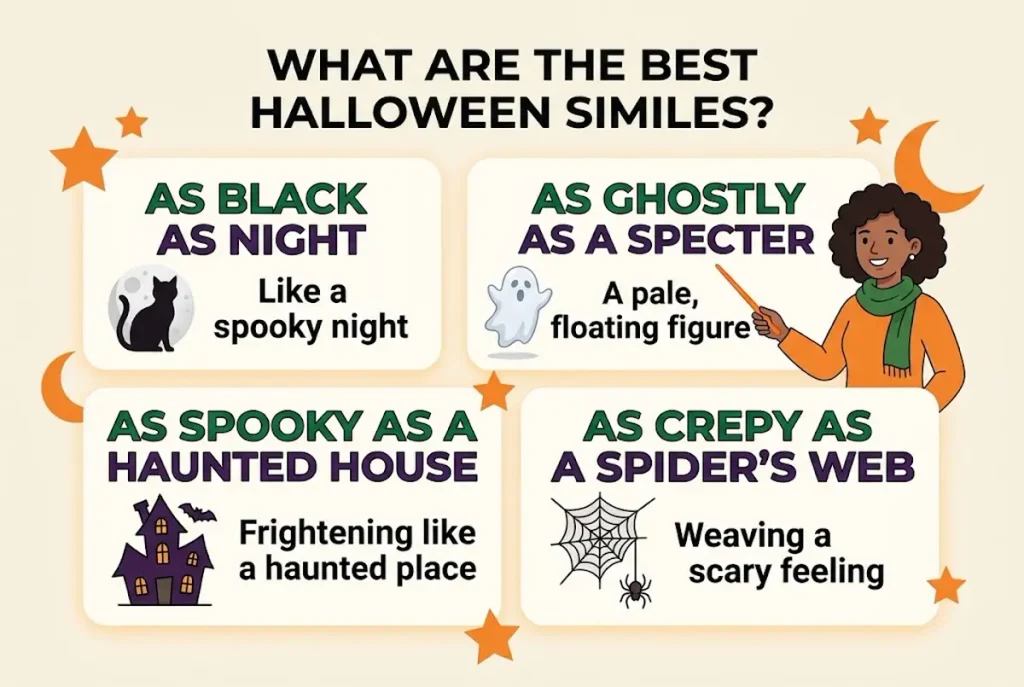
What Are the Best Halloween Similes?
The best examples are easy to understand, creative, and connected to familiar Halloween images. Some describe frightening situations, while others create funny or playful scenes.
Here are 35 original examples with their meanings.
| No. | Simile | Meaning |
|---|---|---|
| 1 | As dark as a moonless night | Extremely dark |
| 2 | As pale as a ghost | Very pale or frightened |
| 3 | As silent as a graveyard | Completely quiet |
| 4 | As scary as a nightmare | Extremely frightening |
| 5 | As cold as a tombstone | Very cold |
| 6 | As mysterious as a midnight shadow | Difficult to understand |
| 7 | Like a ghost in the darkness | Hard to see or notice |
| 8 | Like a witch flying across the moon | Moving mysteriously through the sky |
| 9 | As orange as a Halloween pumpkin | Bright orange in color |
| 10 | As sharp as a vampire’s teeth | Very sharp |
| 11 | Like bats dancing in the night sky | Moving quickly and unpredictably |
| 12 | As quiet as a sleeping monster | Extremely quiet |
| 13 | As creepy as an abandoned house | Unpleasant and frightening |
| 14 | Like a skeleton rattling in a closet | Making strange, rattling sounds |
| 15 | As black as a witch’s cloak | Completely black |
| 16 | As bright as a jack-o’-lantern | Giving off a strong, warm light |
| 17 | Like a spider crawling across the ceiling | Moving slowly and carefully |
| 18 | As frightening as a haunted forest | Creating a strong feeling of fear |
| 19 | Like a shadow following every step | Staying close behind someone |
| 20 | As strange as a talking pumpkin | Unusual or surprising |
What Are Halloween Similes From Mild to Strong?
Not every Halloween scene needs a frightening comparison. The right expression depends on how much emotion you want to create.
A playful story for children may need gentle comparisons, while a horror story may require stronger descriptions.
Mild Similes
Mild comparisons create a light Halloween atmosphere without making readers feel frightened.
| Simile | Meaning | Example |
|---|---|---|
| As sweet as candy | Very pleasant | The little ghost was as sweet as candy. |
| As bright as a pumpkin | Full of warm light | The porch was as bright as a pumpkin. |
| Like autumn leaves in the wind | Moving gently | The decorations moved like autumn leaves in the wind. |
| As colorful as a costume parade | Very colorful | The children looked as colorful as a costume parade. |
| As cheerful as a trick-or-treater | Very happy | Mia was as cheerful as a trick-or-treater. |
Moderate Similes
These comparisons create mystery, suspense, or a slightly uncomfortable feeling.
| Simile | Meaning | Example |
|---|---|---|
| As quiet as an empty street | Very silent | The road was as quiet as an empty street. |
| Like a shadow in the hallway | Hard to notice | Someone moved like a shadow in the hallway. |
| As strange as a witch’s spell | Unusual | The sound was as strange as a witch’s spell. |
| Like a spider in the corner | Moving secretly | He watched like a spider in the corner. |
| As cold as a winter graveyard | Extremely cold | The room felt as cold as a winter graveyard. |
Strong Similes
Strong comparisons create fear, suspense, and a darker atmosphere.
| Simile | Meaning | Example |
|---|---|---|
| As terrifying as a living nightmare | Extremely frightening | The creature was as terrifying as a living nightmare. |
| Like a monster chasing its prey | Moving aggressively | The shadow followed him like a monster chasing its prey. |
| As dark as the deepest cave | Completely dark | The tunnel was as dark as the deepest cave. |
| Like a scream echoing through a tomb | Producing a frightening sound | Her voice traveled like a scream echoing through a tomb. |
| As chilling as a ghost’s touch | Extremely unsettling | The sudden breeze felt as chilling as a ghost’s touch. |
What Words Can You Use Instead of Halloween Similes?
The word simile describes a type of comparison, but writers also need descriptive words to make those comparisons effective.
The following alternatives can help you describe Halloween scenes in different ways.
Simple Descriptive Words
These words are easy to understand and work well in elementary and middle school writing.
| Word | Meaning | Tone | Example |
|---|---|---|---|
| Dark | Without much light | Simple | The dark hallway looked like a cave. |
| Scary | Causing fear | Simple | The mask was like a scary monster. |
| Cold | Having a low temperature | Simple | The wind felt like ice. |
| Pale | Light in color | Simple | His face was as pale as snow. |
| Quiet | Making little noise | Simple | The house was as quiet as a tomb. |
| Bright | Giving off light | Simple | The pumpkin glowed like a little sun. |
Everyday Descriptive Words
These expressions sound natural in stories, conversations, and school assignments.
| Word | Meaning | Tone | Example |
|---|---|---|---|
| Creepy | Strange and unsettling | Everyday | The room felt like a creepy cave. |
| Spooky | Mysterious or frightening | Everyday | The garden looked like a spooky forest. |
| Chilly | Slightly cold | Everyday | The air was as chilly as a winter morning. |
| Mysterious | Difficult to explain | Everyday | The figure appeared like a mysterious shadow. |
| Eerie | Strange and frightening | Everyday | The music sounded like an eerie whisper. |
| Haunted | Associated with ghosts | Everyday | The house looked like a haunted castle. |
| Frightening | Causing strong fear | Everyday | The noise was like a frightening scream. |
Formal Descriptive Words
These words are useful for essays, detailed storytelling, and more advanced creative writing.
| Word | Meaning | Tone | Example |
|---|---|---|---|
| Ominous | Suggesting something bad may happen | Formal | The sky looked as ominous as a storm over a cemetery. |
| Sinister | Giving an impression of evil | Formal | The smile was like a sinister warning. |
| Macabre | Related to death or frightening subjects | Formal | The decoration looked like a macabre sculpture. |
| Gloomy | Dark or depressing | Formal | The garden was as gloomy as a forgotten graveyard. |
| Spectral | Ghostlike or supernatural | Formal | The figure moved like a spectral visitor. |
| Foreboding | Creating a feeling of approaching danger | Formal | The silence was like a warning before a storm. |
| Eerie | Unnaturally strange | Formal | The sound was like an eerie call from another world. |
What Are the Different Types of Halloween Similes?
Similes can describe several qualities, including appearance, sound, movement, temperature, and emotion.
Understanding these categories helps you choose a comparison that fits the scene.
Similes About Darkness
Darkness is one of the most common features of Halloween stories. These comparisons help create mysterious surroundings.
- As dark as a sealed tomb.
- Like a black curtain covering the sky.
- As shadowy as an abandoned tunnel.
- Like midnight hiding behind the trees.
- As black as a raven’s feathers.
Similes About Fear
These comparisons describe frightening emotions and situations.
- As frightened as a rabbit facing a wolf.
- Like a mouse trapped in a room with a cat.
- As nervous as a child entering a haunted house.
- Like a heartbeat racing during a nightmare.
- As terrified as someone hearing footsteps behind them.
Similes About Ghosts and Monsters
Ghosts and monsters are popular Halloween characters. Comparisons involving them can make stories more imaginative.
- Like a ghost drifting through the mist.
- As pale as a moonlit spirit.
- Like a monster hiding under the bed.
- As frightening as a creature from another world.
- Like a zombie walking through an empty street.
Similes About Halloween Decorations
These comparisons are useful for describing homes, gardens, parties, and outdoor displays.
- As bright as a glowing jack-o’-lantern.
- Like a spider’s web stretched across the doorway.
- As colorful as a box of Halloween candy.
- Like tiny stars shining inside carved pumpkins.
- As crooked as a scarecrow’s hat.
Similes About Halloween Sounds
Sounds can make a scene more realistic and suspenseful.
- Like a wolf howling at the full moon.
- As loud as thunder over a cemetery.
- Like dry leaves whispering in the wind.
- As sharp as a scream in an empty house.
- Like chains dragging across a stone floor.
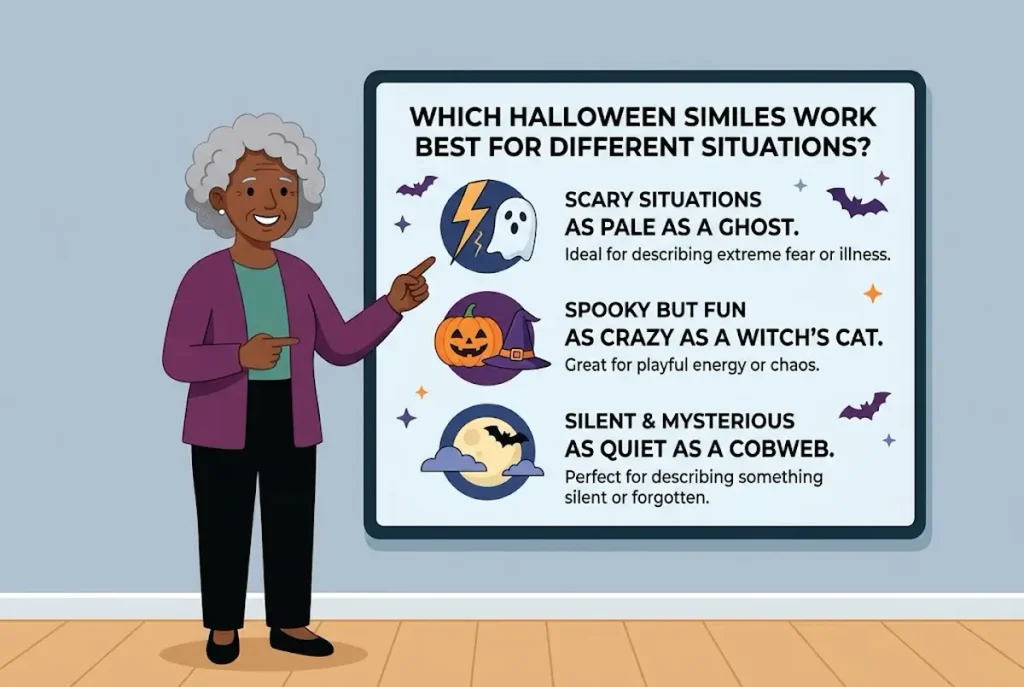
Which Halloween Similes Work Best for Different Situations?
The best comparison depends on where you’re using it. A school essay needs clear language, while a spooky story may benefit from more imaginative descriptions.
For a Halloween Resume or Creative Portfolio
A professional resume usually doesn’t need Halloween expressions. However, if you’re preparing a seasonal writing portfolio, costume design project, or Halloween event proposal, descriptive comparisons can help explain your creative work.
Example:
The event entrance was designed like a mysterious castle, creating an exciting atmosphere for visitors.
For a Halloween Essay
School essays benefit from simple comparisons that communicate a clear picture.
Example:
The neighborhood looked like a magical Halloween village, with glowing pumpkins and colorful costumes on every street.
For Halloween Texting
Short, playful comparisons work best in messages because people usually prefer quick and natural language.
Examples:
- That haunted house was as scary as a nightmare!
- Your costume looks like it came from a horror movie.
- The candy disappeared like magic.
For Halloween Emails
When writing an email about a Halloween party, school activity, or community event, choose comparisons that create excitement without making the message difficult to understand.
Example:
Our classroom will look as colorful as a Halloween candy shop, with creative costumes, pumpkin decorations, and fun activities.
For Halloween Speaking
In everyday conversations, natural comparisons are easier to understand than complicated literary expressions.
Examples:
- The movie was as scary as a nightmare.
- The costume was as funny as a cartoon character.
- The wind sounded like a monster outside.
What Are Some Original Halloween Simile Sentences?
Learning examples in complete sentences makes it easier to understand how comparisons work in real situations.
Here are 10 original sentences for different Halloween scenes.
Halloween Night Examples
- The moon looked like a silver coin hanging above the quiet neighborhood.
- The street was as dark as a forgotten tunnel.
- The wind moved through the trees like a ghost searching for a home.
- The children ran as fast as frightened rabbits when the thunder started.
- The old gate creaked like a monster waking from a long sleep.
Haunted House Examples
- The staircase was as narrow as a secret passage.
- The curtains moved like invisible hands were pulling them.
- The hallway was as silent as a sleeping cemetery.
- A strange shadow appeared like a giant standing behind the door.
- The wooden floor sounded like bones cracking beneath our feet.
What Is the Difference Between Similar Halloween Comparisons?
Some comparisons look alike but create different feelings. Choosing the right one can make your writing more accurate.
As Pale as a Ghost vs. As White as Snow
| As Pale as a Ghost | As White as Snow |
|---|---|
| Suggests a pale appearance connected with fear or illness | Describes a very white color |
| Often creates a spooky feeling | Usually creates a clean or peaceful image |
| His face was as pale as a ghost after hearing the noise. | Her costume was as white as snow. |
As Quiet as a Graveyard vs. As Silent as the Night
| As Quiet as a Graveyard | As Silent as the Night |
|---|---|
| Creates a spooky or unsettling atmosphere | Creates a peaceful or mysterious atmosphere |
| The house was as quiet as a graveyard. | The forest was as silent as the night. |
| Often connects with Halloween imagery | Can describe many settings |
Like a Ghost in the Darkness vs. Like a Shadow in the Darkness
| Like a Ghost in the Darkness | Like a Shadow in the Darkness |
|---|---|
| Suggests something mysterious or supernatural | Suggests something difficult to see |
| Creates a supernatural feeling | Creates a visual impression |
| A figure moved like a ghost in the darkness. | The cat slipped like a shadow in the darkness. |
What Are Common Mistakes When Using Halloween Similes?
Similes can improve creative writing, but poorly chosen comparisons may confuse readers or make sentences sound unnatural.
Here are some mistakes to avoid.
Confusing Similes With Metaphors
A simile uses like or as to compare two different things.
Example:
The haunted house was like a monster.
A metaphor describes one thing as another without using those comparison words.
Example:
The haunted house was a monster.
Both expressions create imagery, but they use different structures.
Using Comparisons That Don’t Make Sense
A comparison should connect two things through a quality that readers can understand.
Unclear example:
The ghost was as sweet as a broken clock.
The comparison doesn’t communicate a clear quality.
Better example:
The ghost was as pale as winter snow.
This comparison clearly describes appearance.
Adding Too Many Similes
Using several comparisons in one sentence can make writing confusing.
Overloaded example:
The house was as dark as a cave, as scary as a nightmare, like a monster, and as cold as ice.
Better example:
The house was as dark as a cave, and its cold hallway felt like an underground tomb.
Use one or two strong comparisons instead of filling every sentence with them.
Using the Wrong Comparison Words
Similes commonly use like or as, but the sentence must still be grammatically correct.
Incorrect: The pumpkin was as a golden sun.
Correct: The pumpkin was like a golden sun.
Also correct: The pumpkin was as bright as a golden sun.
Choosing Unfamiliar Images
A comparison should help readers understand your description.
If your audience is young children, avoid obscure references that require historical or literary knowledge.
Instead of using a complicated mythological creature, compare something to a ghost, monster, pumpkin, or black cat.
Using Scary Comparisons in Happy Scenes
Not every Halloween activity is frightening. Trick-or-treating, costume parties, and pumpkin carving are often joyful.
For example:
The children were as happy as puppies playing outside.
This comparison fits a cheerful Halloween scene better than a frightening description.
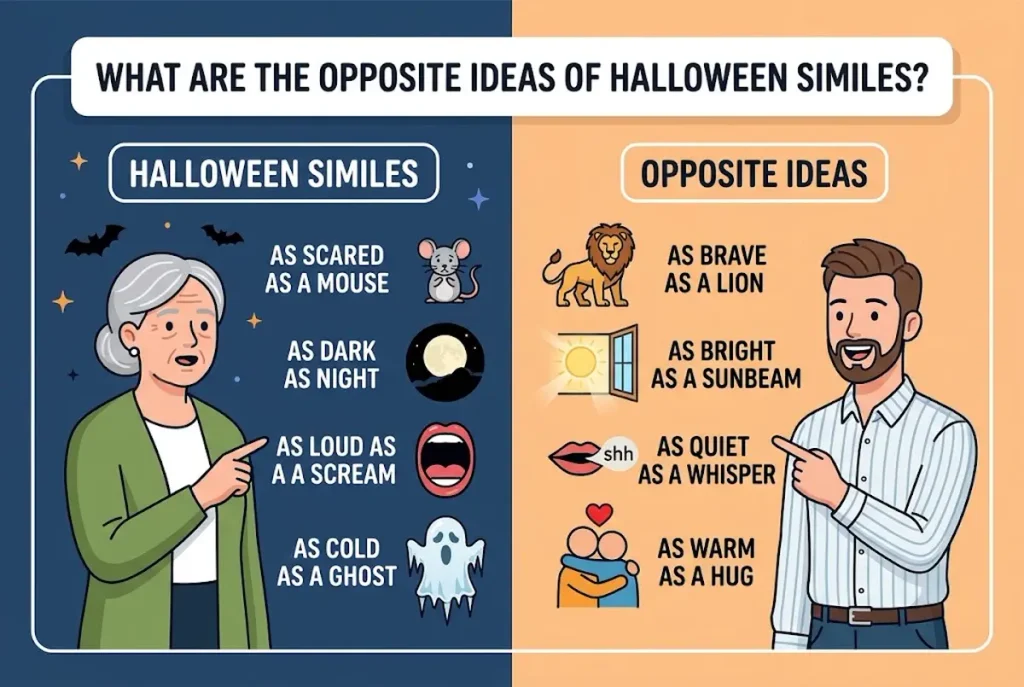
What Are the Opposite Ideas of Halloween Similes?
Similes don’t have direct antonyms because they are literary comparisons rather than descriptive adjectives.
However, you can use opposite descriptive words to change the mood of a Halloween scene.
| Spooky Description | Opposite Description |
|---|---|
| Dark | Bright |
| Frightening | Comforting |
| Creepy | Pleasant |
| Silent | Noisy |
| Cold | Warm |
| Gloomy | Cheerful |
| Sinister | Friendly |
| Ominous | Reassuring |
| Mysterious | Clear |
| Terrifying | Enjoyable |
For example:
- As dark as a moonless night becomes as bright as a summer morning.
- As cold as a tombstone becomes as warm as a cozy blanket.
- As scary as a nightmare becomes as comforting as a familiar song.
How Can You Choose the Right Halloween Simile?
Choosing a good comparison doesn’t have to be difficult. Follow these practical tips to make your writing clear and memorable.
1. Think about the scene. Decide if you’re describing something scary, funny, mysterious, or cheerful.
2. Choose one clear quality. Focus on color, sound, movement, temperature, or emotion.
3. Use familiar objects. Ghosts, pumpkins, bats, candles, and haunted houses are easy for readers to imagine.
4. Match the audience. Use simple comparisons for young students and more detailed descriptions for older readers.
5. Avoid unnecessary comparisons. One strong simile can be more effective than several weak ones.
6. Read the sentence aloud. If it sounds awkward, replace the comparison with a more natural expression.
7. Check the meaning. Make sure the two things share a recognizable quality.
8. Use different types. Mix comparisons about sound, appearance, movement, and emotion to keep your writing interesting.
9. Don’t force the word like or as. A comparison should fit naturally into the sentence.
10. Create your own examples. Think about familiar Halloween objects and find something else that shares their qualities.
Conclusion
Halloween similes make ordinary descriptions more imaginative by connecting familiar Halloween images with recognizable feelings, sounds, colors, and experiences. They can turn a dark hallway into a mysterious tunnel, a glowing pumpkin into a golden lantern, or a quiet house into a forgotten graveyard.
The best comparisons aren’t always the scariest or most complicated. They are the ones that help readers picture a scene without struggling to understand it. When writing Halloween stories, poems, school assignments, or party invitations, choose expressions that match your audience and the mood you want to create.
Use these examples as inspiration, experiment with your own comparisons, and remember that a simple, well-chosen image can make your writing much more memorable.
Frequently Asked Questions
What is a simple Halloween simile?
A simple Halloween simile compares something to a familiar spooky object or experience using like or as. For example, the house was as dark as a cave.
What are 5 examples of Halloween similes?
Five examples include as pale as a ghost, as dark as a moonless night, as quiet as a graveyard, like a shadow in the darkness, and as bright as a jack-o’-lantern.
What is a simile for a haunted house?
A good simile for a haunted house is as creepy as an abandoned graveyard. It creates a frightening image that readers can easily imagine.
What is a simile for a ghost?
A useful simile for a ghost is as pale as winter snow. Another creative example is like a shadow floating through the hallway.
What’s another way to say something is as scary as Halloween?
You can say it’s as frightening as a nightmare, as creepy as an abandoned house, or like a monster hiding in the darkness.
Are Halloween similes suitable for school essays?
Yes, Halloween similes are useful in school essays, poems, and creative writing assignments. They help students describe characters, settings, and emotions in more interesting ways.
What is the difference between a Halloween simile and a metaphor?
A Halloween simile compares two things using like or as, while a metaphor describes one thing as another. For example, the ghost was like a shadow is a simile, while the ghost was a shadow is a metaphor.
Can Halloween similes be funny instead of scary?
Yes, similes can create humor as well as fear. For example, his costume was as silly as a dancing pumpkin creates a playful Halloween image.

Daniel Grammarfield — The Language Learner
Age: 28Occupation: ESL Learner & Digital Professional
Bio:Daniel is a non-native English speaker who wants to communicate more confidently at work and online. He uses Synotrench to improve grammar, understand confusing words, learn correct sentence structures, and build everyday English skills. He prefers simple explanations with practical examples.
Goals:
Master English grammar rules
Avoid common language mistakes
Improve professional communication
Learn English through real-life examples
Quote:“Learning English is not about memorizing rules — it’s about expressing ideas clearly.”
3 thoughts on “Halloween Similes: 35 Best Examples and Meanings”