Imagine you’re buying a new laptop, washing machine, or smartphone. The seller tells you that the product comes with a warranty. Another seller promises a money back guarantee if you’re unhappy with your purchase.
Both promises sound reassuring, but do they mean the same thing? Not exactly. Although people sometimes use these words interchangeably, they have different meanings in everyday English and consumer protection.
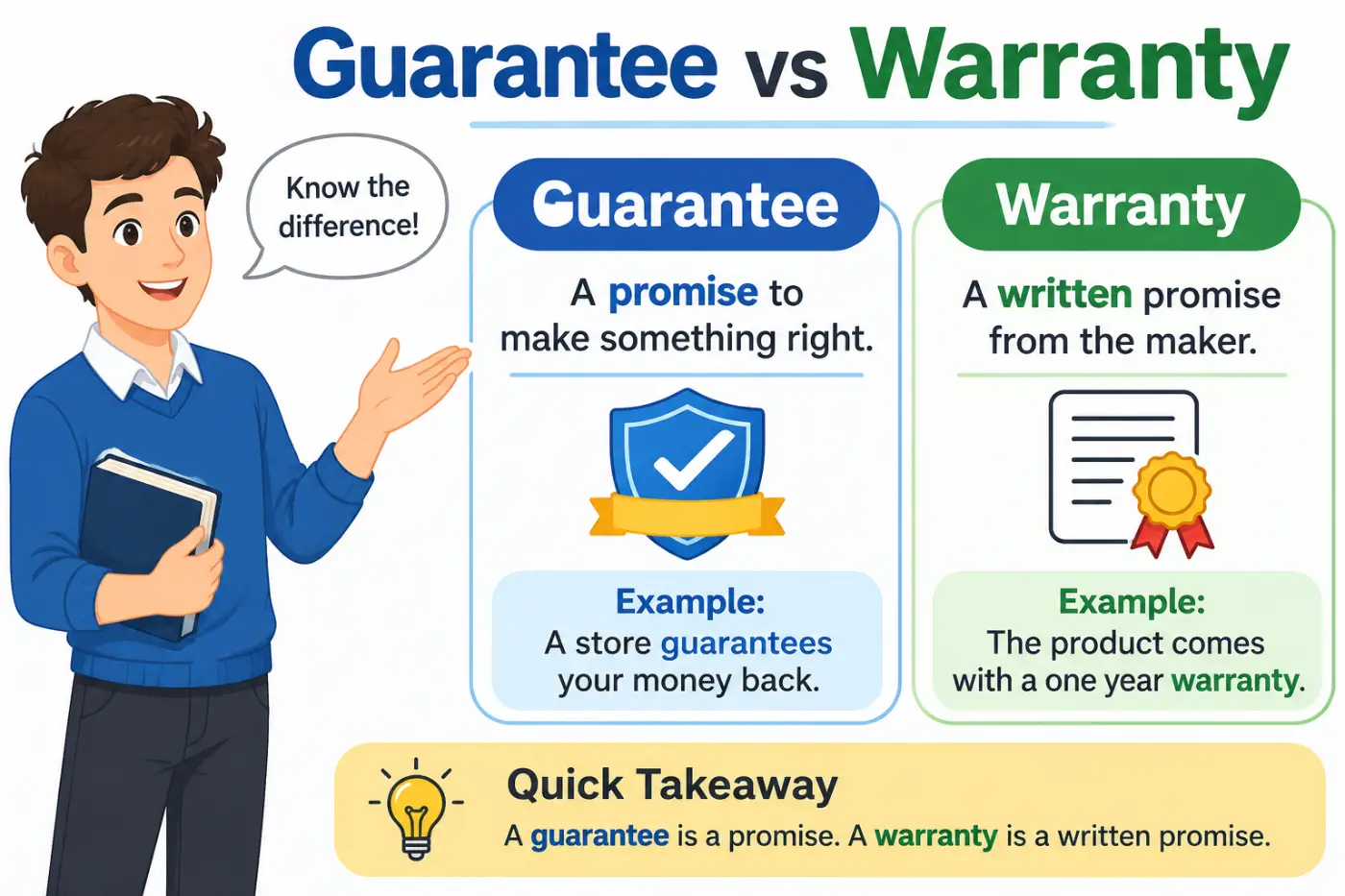
The main difference is that a guarantee is a promise that something will meet certain expectations or that a customer will receive a particular solution if it doesn’t. A warranty is usually a written promise from a manufacturer or seller to repair, replace, or otherwise cover a product if specific problems occur within a stated period.
This guide explains the meanings, origins, related words, practical examples, and common mistakes so you can choose the correct term in any situation.
What Is the Difference Between Guarantee and Warranty?
The biggest difference is the type of promise being made.
A guarantee is a general assurance that a product, service, or result will meet certain standards. It may offer a refund, replacement, repair, or another solution if the promise isn’t fulfilled.
A warranty is generally a specific commitment about a product’s condition, quality, or performance. It often explains what defects are covered, how long the coverage lasts, and what the manufacturer or seller must do if something goes wrong.
| Point of difference | Guarantee | Warranty |
|---|---|---|
| Basic meaning | A promise or assurance | A commitment covering a product or service |
| Main purpose | Provides confidence or satisfaction | Provides protection against specified problems |
| Common use | Products, services, results, and promises | Electronics, appliances, vehicles, and equipment |
| Coverage | Depends on the promise | Usually defined by written terms |
| Duration | May or may not have a time limit | Usually has a stated coverage period |
| Remedy | Refund, replacement, repair, or another solution | Usually repair, replacement, or another specified remedy |
| Provider | Seller, company, manufacturer, or service provider | Usually manufacturer or seller |
| Example | A 30-day money back guarantee | A two-year product warranty |
A Simple Way to Remember the Difference
Think of a guarantee as an assurance and a warranty as a defined form of protection.
For example:
- A store offers a 30-day money back guarantee if customers aren’t satisfied.
- A laptop manufacturer provides a two-year warranty covering certain hardware defects.
Where Did the Words Guarantee and Warranty Come From?
Understanding the history of these words makes their meanings easier to remember. Both are connected to promises, trust, and responsibility, but they developed from different language roots.
What Is the Origin of Guarantee?
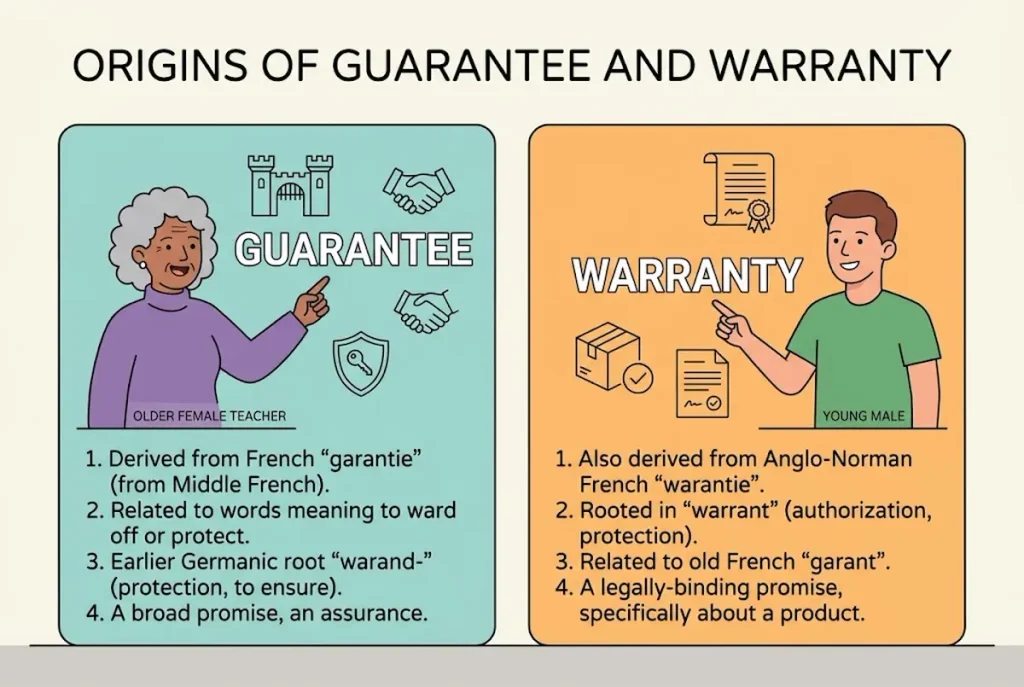
The word guarantee entered English through French, particularly the French word garantie, which referred to protection or a promise. It is also connected to older Germanic language roots associated with protecting or securing something.
Over time, the word developed into a common English term for a promise that something will happen, work properly, or meet an expected standard.
Today, guarantee can be used in several ways:
- A company can guarantee the quality of its products.
- A seller can guarantee a full refund.
- A business can guarantee customer satisfaction.
What Is the Origin of Warranty?
The word warranty comes through Anglo-French and Old North French forms related to warrant. The older word traces back to Germanic roots connected with protecting, defending, or authorizing something.
In English, warranty gradually became associated with a formal assurance that a product or service meets certain conditions.
Today, it is commonly used in business, sales, manufacturing, and consumer protection.
For example:
- A car may come with a three-year warranty.
- A refrigerator may include a manufacturer’s warranty.
- A contractor may provide a warranty on installation work.
Why Do These Words Have Similar Meanings?
Both words involve trust and responsibility. They tell customers that a seller or company is willing to stand behind a promise.
The difference comes from how the promise is presented and what it covers.
A guarantee often communicates confidence or assurance. A warranty usually describes specific coverage, conditions, and remedies.
Remember that these are common usage patterns, not strict rules that apply to every contract. A guarantee can be legally detailed, and a warranty can make a broad promise about product quality.
What Are the Best Synonyms for Guarantee and Warranty?
There are several related words you can use when discussing promises, protection, and product coverage. However, not every synonym works in every sentence.
For example, assurance may replace guarantee in a general statement, but it doesn’t always work when discussing a formal product warranty.
The following tables group useful alternatives by tone and explain how to use them naturally.
What Are Simple Synonyms for Guarantee?
These words are easy to understand and work well in everyday conversations.
| Word | Meaning | Tone | Example |
|---|---|---|---|
| Promise | A statement that something will happen | Simple | The seller made a promise to replace the item. |
| Assurance | A statement that gives confidence | Simple | The company gave us assurance about the product. |
| Pledge | A serious promise | Simple | The store made a pledge to help customers. |
| Protection | Safety against possible problems | Simple | The plan offers protection against defects. |
| Security | Freedom from worry or risk | Simple | The guarantee gives buyers extra security. |
| Commitment | A firm promise to do something | Simple | The business showed its commitment to quality. |
| Coverage | Protection against certain problems | Simple | The phone includes basic coverage. |
What Are Everyday Synonyms for Guarantee and Warranty?
These words are useful in normal conversations, customer service, shopping, and business writing.
| Word | Meaning | Tone | Example |
|---|---|---|---|
| Assurance | Confidence that something is reliable | Everyday | The seller gave assurance that the product would work. |
| Backing | Support provided by a person or company | Everyday | The product has strong company backing. |
| Protection plan | An agreement covering certain problems | Everyday | I purchased a protection plan for my laptop. |
| Promise | A commitment to deliver something | Everyday | The shop promised to repair the damaged item. |
| Refund policy | Rules explaining when money is returned | Everyday | Check the refund policy before ordering. |
| Return policy | Rules for returning purchased items | Everyday | The store has a 30-day return policy. |
| Service agreement | An agreement describing service responsibilities | Everyday | The equipment comes with a service agreement. |
What Are Formal Synonyms for Guarantee and Warranty?
Formal alternatives are useful in contracts, legal documents, reports, professional emails, and business communication.
| Word | Meaning | Tone | Example |
|---|---|---|---|
| Undertaking | A formal promise to do something | Formal | The supplier gave a written undertaking. |
| Covenant | A binding agreement or promise | Formal | Both parties accepted the contractual covenant. |
| Assurance | A formal statement of confidence | Formal | The company provided written assurance of quality. |
| Indemnity | Protection against certain losses or liabilities | Formal | The agreement includes an indemnity clause. |
| Representation | A statement presented as fact | Formal | The seller made a representation about the product. |
| Obligation | A duty that must be fulfilled | Formal | The manufacturer has an obligation to repair covered defects. |
| Stipulation | A specific condition in an agreement | Formal | The contract includes a repair stipulation. |
| Commitment | A formal promise or responsibility | Formal | The supplier confirmed its commitment in writing. |
Which Synonyms Are Stronger or Weaker Than Guarantee?
Words related to promises can express different levels of confidence and responsibility. Choosing the right one depends on how certain or formal the statement needs to sound.
Mild Expressions
These words communicate confidence without making a particularly strong commitment.
- Suggestion: Indicates that something may be suitable or reliable.
- Expectation: Describes what someone believes will happen.
- Indication: Provides a sign that something is likely.
- Assurance: Gives someone confidence.
- Support: Shows that help is available.
Moderate Expressions
These words communicate a clearer level of responsibility.
- Promise: A statement of intention.
- Commitment: A firm agreement to take responsibility.
- Pledge: A serious declaration.
- Protection: An arrangement that helps prevent or reduce harm.
- Coverage: Protection against specified risks or problems.
Strong Expressions
These words suggest a more formal or clearly defined responsibility.
- Obligation: A duty that must be fulfilled.
- Undertaking: A formal commitment.
- Contractual commitment: A responsibility established by an agreement.
- Warranty: A promise concerning specified product conditions or remedies.
- Binding guarantee: A guarantee that creates an enforceable commitment under applicable terms and law.
Are Guarantee and Warranty Different Parts of Speech?
Both words can function as nouns and verbs, although warranty is mainly used as a noun.
Understanding their grammatical forms helps you avoid mistakes in emails, essays, and professional writing.
Guarantee as a Noun
As a noun, guarantee means a promise or assurance.
Examples:
- The product comes with a lifetime guarantee.
- The store offers a money back guarantee.
- Customer satisfaction is not always a guarantee of future success.
Guarantee as a Verb
As a verb, guarantee means to promise or confirm that something will happen.
Examples:
- We guarantee excellent customer service.
- The manufacturer guarantees the quality of its materials.
- I can guarantee that the package will arrive tomorrow.
Warranty as a Noun
As a noun, warranty refers to an agreement or promise covering specific conditions.
Examples:
- The television has a one-year warranty.
- Please read the warranty before buying the device.
- The extended warranty covers certain repairs.
Can Warranty Be Used as a Verb?
In ordinary modern English, warranty is not normally used as a verb.
For example:
Incorrect: The company warranties every product for two years.
Better: The company provides a two-year warranty for every product.
Also correct: The company guarantees every product for two years.
For natural writing, use warranty as a noun and guarantee as either a noun or a verb.
Is There a Difference Between Guarantee and Warranty in American and British English?
The words are used in both American and British English, and their basic meanings are similar. However, their everyday use and legal treatment can vary by region.
American English
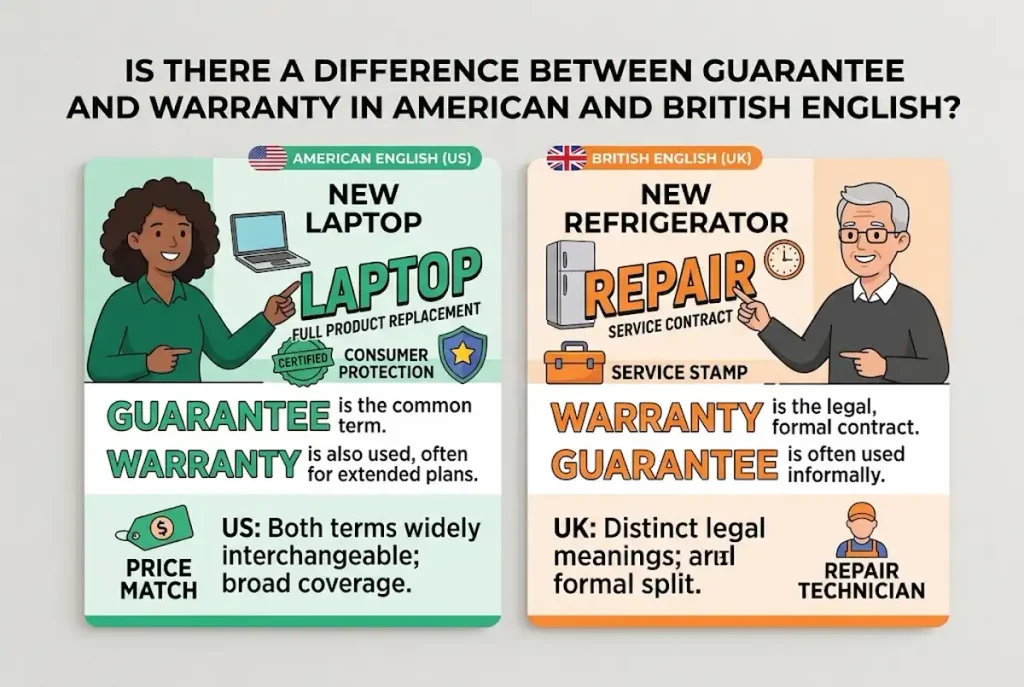
In the United States, warranty is especially common when discussing electronics, vehicles, appliances, and other manufactured products.
Guarantee is often used in advertising, customer satisfaction promises, and refund policies.
Examples:
- The computer includes a one-year limited warranty.
- The store offers a 30-day money back guarantee.
- The manufacturer guarantees the quality of its materials.
British English
In British English, both guarantee and warranty are widely used.
A manufacturer may offer a guarantee covering the quality of a product, while a warranty may describe repair or replacement coverage.
However, British consumer protection laws give customers rights that exist separately from a manufacturer’s guarantee or warranty.
For example, a customer may have legal rights when an item is faulty even after its written coverage expires. The exact rights depend on the circumstances and applicable consumer law. Citizens Advice+1
Which Spelling Should You Use?
There is no major spelling difference between American and British English for these two words.
Both countries use:
- Guarantee
- Warranty
- Guaranteed
- Warranted
- Guaranteeing
Which Word Should You Use in Different Situations?
The best choice depends on your audience and purpose. A word that sounds natural in a conversation may not be the best choice for a business contract.
Which Word Is Better for a Resume?
Use guarantee when describing a result or promise you can confidently support. Use warranty only if you’re discussing an actual product coverage responsibility.
Example:
I guarantee accurate data entry and careful handling of customer records.
This sentence works because the speaker is making a professional promise.
Another example:
Managed warranty claims and customer support requests for electronic products.
This is appropriate for a resume describing experience in product service and customer care.
Avoid using guarantee to make claims about results you cannot control.
Which Word Is Better for an Essay?
Both words work in academic writing, but the context determines the choice.
Use guarantee when discussing promises, certainty, or expected outcomes.
Example:
A strong educational background does not guarantee success in every career.
Use warranty when discussing consumer protection, business agreements, or product responsibilities.
Example:
The manufacturer’s warranty protects eligible buyers against certain product defects.
In formal essays, explain the type of promise rather than assuming both terms mean the same thing.
Which Word Is Better for Texting?
Guarantee is more natural in everyday text messages when someone wants to express confidence.
Examples:
- I guarantee you’ll enjoy this movie.
- The store gives a one-year warranty on the phone.
- Don’t worry, I guarantee everything will be fine.
Which Word Is Better for an Email?
Use warranty when asking about product coverage, repairs, or replacement conditions.
Example:
Subject: Question About Product Warranty
Hello,
I recently purchased a laptop from your store. Could you please confirm how long the manufacturer’s warranty lasts and which repairs are included?
Thank you for your assistance.
Use guarantee when asking about a company’s promise or satisfaction policy.
Example:
Subject: Question About Your Money Back Guarantee
Hello,
I would like to know more about your money back guarantee. Could you please explain the return period and the conditions for receiving a refund?
Thank you.
Which Word Is Better When Speaking?
Both words sound natural in conversation.
Use guarantee when talking about confidence or a promise.
Example: I guarantee this restaurant serves some of the best food in town.
Use warranty when talking about product protection.
Example: Does this refrigerator still have a valid warranty?
The easiest approach is to think about what you’re discussing. If it’s a general promise, guarantee often works. If it’s product coverage, warranty is usually more suitable.
What Are Some Real Life Examples of Guarantee and Warranty?
The easiest way to understand these words is to see how people use them in everyday situations. Here are original examples from shopping, business, customer service, and personal communication.
Examples of Guarantee in Everyday English
- The company guarantees that every order will be delivered safely.
- Our store offers a 30-day money back guarantee.
- I guarantee that this new phone will make your work easier.
- The restaurant guarantees fresh ingredients in every meal.
- The seller guaranteed that the furniture was made from solid wood.
Examples of Warranty in Everyday English
- My new laptop comes with a two-year warranty.
- The refrigerator stopped working while it was still under warranty.
- Please check the warranty before purchasing the washing machine.
- The manufacturer rejected the claim because the damage wasn’t covered.
- I purchased an extended warranty for my television.
What Is the Difference Between Guarantee and Assurance?
Guarantee and assurance are closely related because both words communicate confidence. However, they don’t always have the same meaning.
| Guarantee | Assurance |
|---|---|
| Often involves a promise about an outcome | Mainly provides confidence or reassurance |
| Can include a specific remedy | Doesn’t automatically include a remedy |
| Can create a responsibility | May simply communicate confidence |
| Common in sales and advertising | Common in personal and professional communication |
Examples:
Guarantee: The company guarantees a replacement if the product has a manufacturing defect.
Assurance: The salesperson gave me assurance that the product was reliable.
The first example describes a promise with a possible remedy. The second describes an attempt to build confidence.
What Is the Difference Between Warranty and Protection Plan?
Warranty and protection plan are also related, especially when buying electronic devices and household appliances.
| Warranty | Protection plan |
|---|---|
| Usually covers specific product defects or problems | May cover additional risks depending on the agreement |
| Often comes with the product | May require an additional payment |
| Commonly provided by a manufacturer or seller | Often provided by a retailer or third-party company |
| Has defined coverage conditions | May offer broader or different coverage |
Example:
The laptop includes a one-year manufacturer’s warranty, but I purchased an additional protection plan against accidental damage.
A protection plan may cover things that a standard warranty excludes. However, coverage varies by provider, so read the agreement carefully.
What Common Mistakes Should You Avoid?
People often confuse these words because both describe promises. However, using them incorrectly can make your writing unclear.
Here are some common mistakes and how to correct them.
Mistake 1: Thinking Both Words Mean Exactly the Same Thing
Incorrect understanding: A guarantee and a warranty always provide identical protection.
Correct understanding: Both involve promises, but their coverage, conditions, and purposes may differ.
A guarantee might promise a refund if a customer isn’t satisfied. A warranty might cover specific repairs for a limited period.
Mistake 2: Assuming Every Warranty Covers All Damage
A warranty doesn’t automatically cover every problem.
For example, a standard laptop warranty may cover certain manufacturing defects but exclude accidental damage, liquid spills, or unauthorized repairs.
Always check the coverage details before making a claim.
Mistake 3: Assuming Every Guarantee Offers a Refund
Not every guarantee promises money back.
Some guarantees offer repairs, replacements, additional services, or another solution.
Example:
The company guarantees free repairs for covered defects during the first year.
This is a guarantee, even though it doesn’t promise a refund.
Mistake 4: Using Warranty as a Verb
Warranty is generally a noun in everyday English.
Incorrect: The company warranties all its products.
Correct: The company provides a warranty for all its products.
Another correct sentence is:
The company guarantees all its products.
Mistake 5: Believing a Verbal Promise Always Provides Clear Protection
A salesperson might promise free repairs or a replacement. However, customers can face problems if they cannot prove what was promised.
For important purchases, ask for the promise and its conditions in writing.
The FTC also recommends getting spoken promises about free repairs in writing to avoid confusion later. Consumer Advice.
What Are the Opposite Words of Guarantee and Warranty?
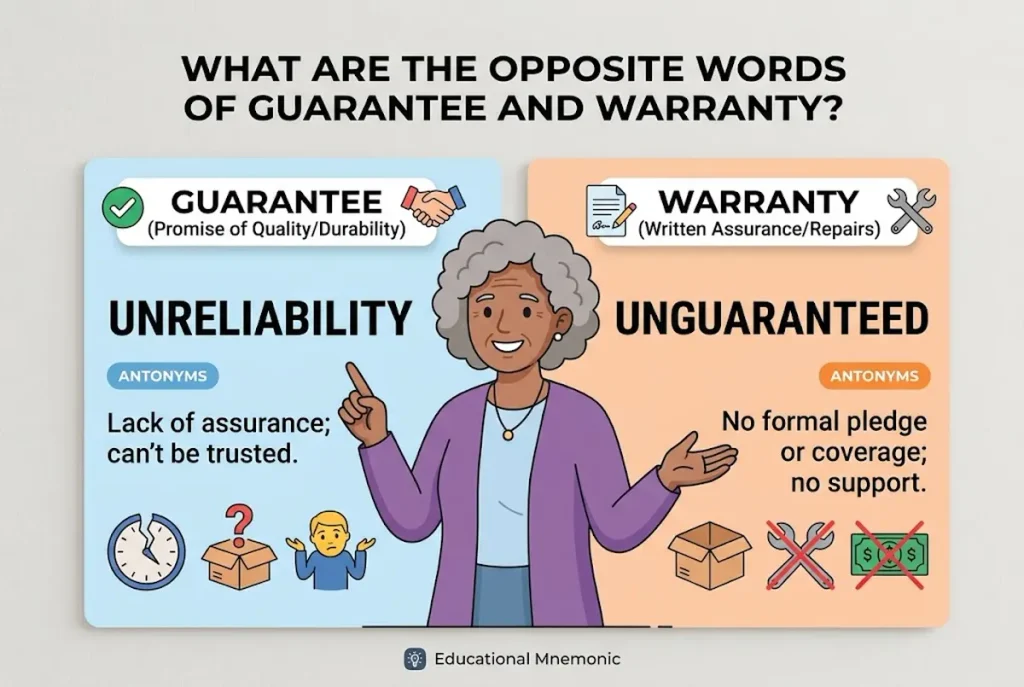
Guarantee and warranty don’t have exact one-word antonyms in every situation. However, several words express the opposite ideas of certainty, protection, and responsibility.
| Word | Opposite idea | Example |
|---|---|---|
| Uncertainty | Lack of confidence about an outcome | There is uncertainty about the product’s performance. |
| Risk | Possibility of loss or damage | Buying without protection creates additional risk. |
| Doubt | Lack of confidence | Customers have doubts about the seller’s promise. |
| Insecurity | Lack of safety or confidence | The missing coverage creates insecurity. |
| Disclaimer | A statement limiting or denying responsibility | The agreement contains a disclaimer about accidental damage. |
| Exclusion | Something that isn’t included in coverage | Water damage is listed as an exclusion. |
| Liability limitation | A restriction on responsibility | The contract contains a liability limitation. |
Remember that these are opposites in meaning or context, not direct grammatical antonyms.
What Are the Quickest Tips for Choosing the Right Word?
If you still find these words confusing, use the following tips to make the correct choice.
- Use guarantee when discussing a general promise or assurance.
- Use warranty when discussing specific product coverage.
- Use guarantee as a noun when describing a promise.
- Use guarantee as a verb when promising a result.
- Use warranty as a noun in ordinary writing.
- Use money back guarantee when discussing a refund promise.
- Use manufacturer’s warranty when discussing product defects and repairs.
- Read the written conditions before assuming a promise covers something.
- Use assurance when you want to communicate confidence without describing a specific remedy.
- Don’t assume a warranty replaces your legal consumer rights.
Conclusion
Understanding the difference between guarantee and warranty makes everyday communication easier. A guarantee generally refers to a promise or assurance that something will meet certain expectations. A warranty usually describes specific protection or coverage for a product or service under stated conditions.
In the Guarantee vs Warranty comparison, neither word is automatically better. The right choice depends on the promise being discussed. Use guarantee when talking about confidence, satisfaction, or a promised result. Use warranty when referring to product coverage, repairs, or replacement conditions.
Remember to check the actual terms before relying on either promise. Once you understand how these words work, you’ll find them much easier to use in conversations, emails, essays, and professional writing.
Frequently Asked Questions
Is a guarantee the same as a warranty?
No, a guarantee and a warranty are not always the same. A guarantee generally describes a promise, while a warranty usually provides specific coverage for certain product problems.
Which is better a guarantee or a warranty?
Neither is always better. A guarantee may offer a refund or satisfaction promise, while a warranty may provide useful repair or replacement coverage. Compare the actual terms before choosing.
Does a warranty mean you can get your money back?
Not necessarily. Most warranties focus on repairs or replacements, although some may offer refunds under specific conditions.
Can a product have both a guarantee and a warranty?
Yes, a product can have both. For example, a company might offer a 30-day money back guarantee alongside a two-year manufacturer’s warranty.
What is another word for guarantee?
Promise, assurance, pledge, and commitment are common alternatives. The best choice depends on the sentence and the type of promise being described.
Does a lifetime guarantee really last forever?
Not always. A lifetime guarantee may refer to the expected lifetime of a product or another period defined by the company. Always read the written conditions to understand what lifetime means.
Can a company refuse a warranty claim?
Yes, a company may refuse a claim if the problem falls outside the warranty’s coverage or the customer hasn’t met its conditions. However, the company must also follow applicable consumer protection laws.
What should I check before buying a product with a warranty?
Check the coverage period, included repairs, exclusions, claim process, and any extra costs. Also, keep your receipt and a copy of the warranty document.

Daniel Grammarfield — The Language Learner
Age: 28Occupation: ESL Learner & Digital Professional
Bio:Daniel is a non-native English speaker who wants to communicate more confidently at work and online. He uses Synotrench to improve grammar, understand confusing words, learn correct sentence structures, and build everyday English skills. He prefers simple explanations with practical examples.
Goals:
Master English grammar rules
Avoid common language mistakes
Improve professional communication
Learn English through real-life examples
Quote:“Learning English is not about memorizing rules — it’s about expressing ideas clearly.”
4 thoughts on “Guarantee vs Warranty: Best Guide to the Differences (2026)”