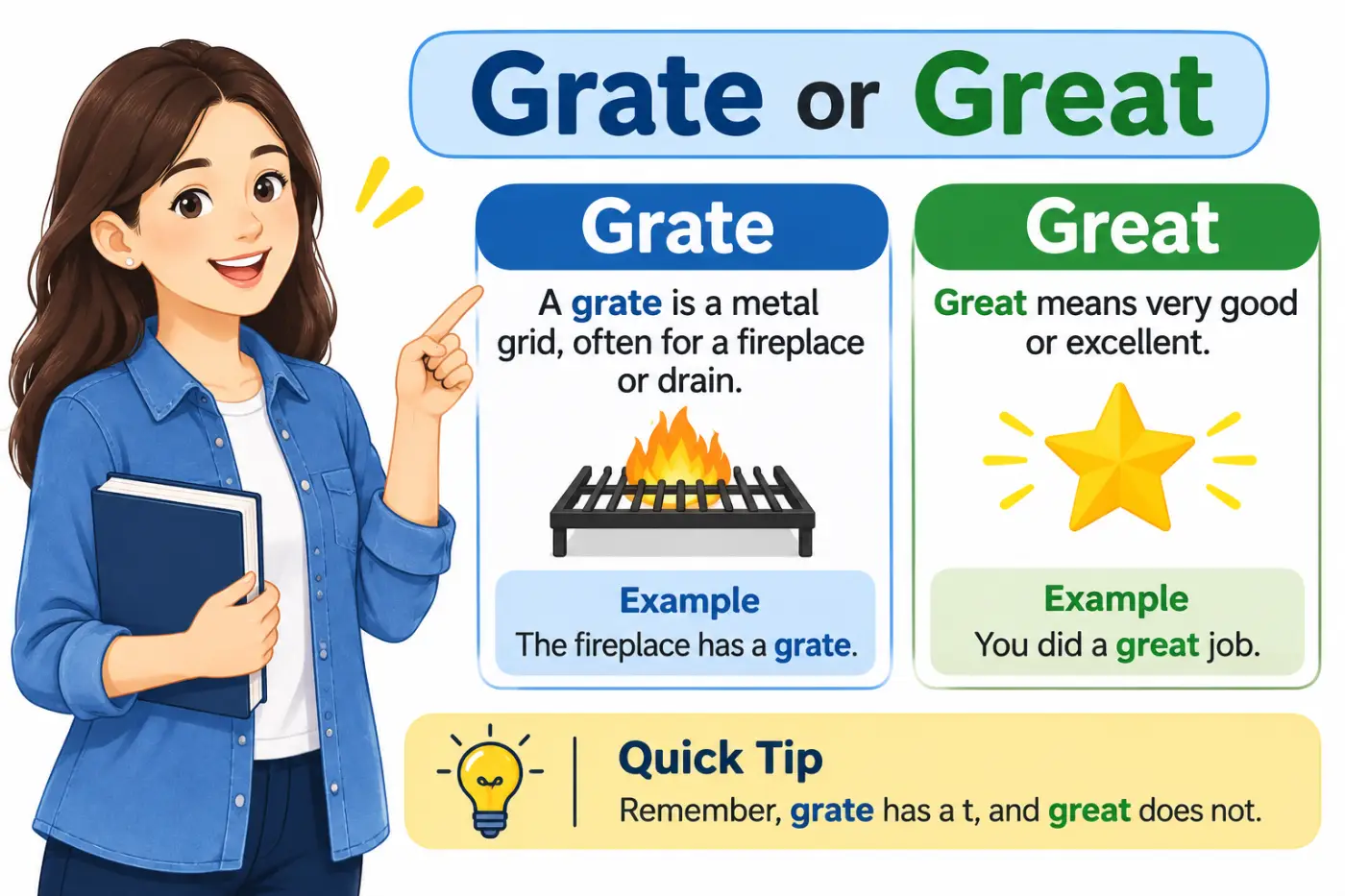
Have you ever stopped while writing an email, school assignment, or social media post because you weren’t sure which word to use? Grate and great sound exactly alike, but their meanings and uses are completely different. Choosing the wrong one can change the meaning of your sentence.
The confusion between these words is common because they are homophones. Homophones are words that have the same pronunciation but different spellings and meanings. Although grate and great sound identical, one usually relates to scraping, shredding, or a metal structure, while the other describes something excellent or impressive.
The simple answer is that great means excellent, wonderful, or very good. Grate means to shred something into small pieces, scrape a surface, or refer to a framework made of metal bars. The correct choice depends on what you want to communicate.
In this guide, you’ll learn their meanings, origins, synonyms, grammatical uses, and differences. You’ll also find practical examples, common mistakes, and helpful tips to remember the correct spelling in everyday English.
What Is the Difference Between Grate and Great?
The main difference is their meaning and grammatical use. Both words sound alike, but they serve different purposes in English.
| Word | Meaning | Part of Speech | Example |
|---|---|---|---|
| Grate | To shred food into small pieces | Verb | Please grate the cheese. |
| Grate | A metal framework or covering | Noun | Leaves covered the drain grate. |
| Grate | To produce an irritating sound or feeling | Verb | His loud voice began to grate on me. |
| Great | Excellent, wonderful, or very good | Adjective | We had a great weekend. |
| Great | Large or important in degree | Adjective | She has great patience. |
What Does Grate Mean?
Grate has several meanings, depending on how it appears in a sentence.
As a verb, it commonly means to break food into small pieces by rubbing it against a rough or sharp surface. This action is often performed with a kitchen grater.
For example:
- Grate the carrots before adding them to the salad.
- She likes to grate fresh cheese over her pasta.
- I need to grate some chocolate for the cake.
Grate can also describe something that produces an unpleasant sound or feeling.
For example:
- The constant noise began to grate on my nerves.
- His rude comments grated on everyone in the room.
As a noun, a grate is a structure made from metal bars. It may cover a drain, fireplace, or opening.
For example:
The metal grate covered the drainage opening.
What Does Great Mean?
Great is an adjective that describes something excellent, impressive, enjoyable, or important.
People commonly use it to express happiness, approval, or admiration. It can describe experiences, people, ideas, achievements, and objects.
For example:
- You did a great job on your presentation.
- We had a great time at the beach.
- She is a great teacher.
- That is a great idea.
Great can also describe something that has a high degree or considerable amount.
For example:
He showed great courage during the difficult situation.
In this sentence, great describes the level of courage.
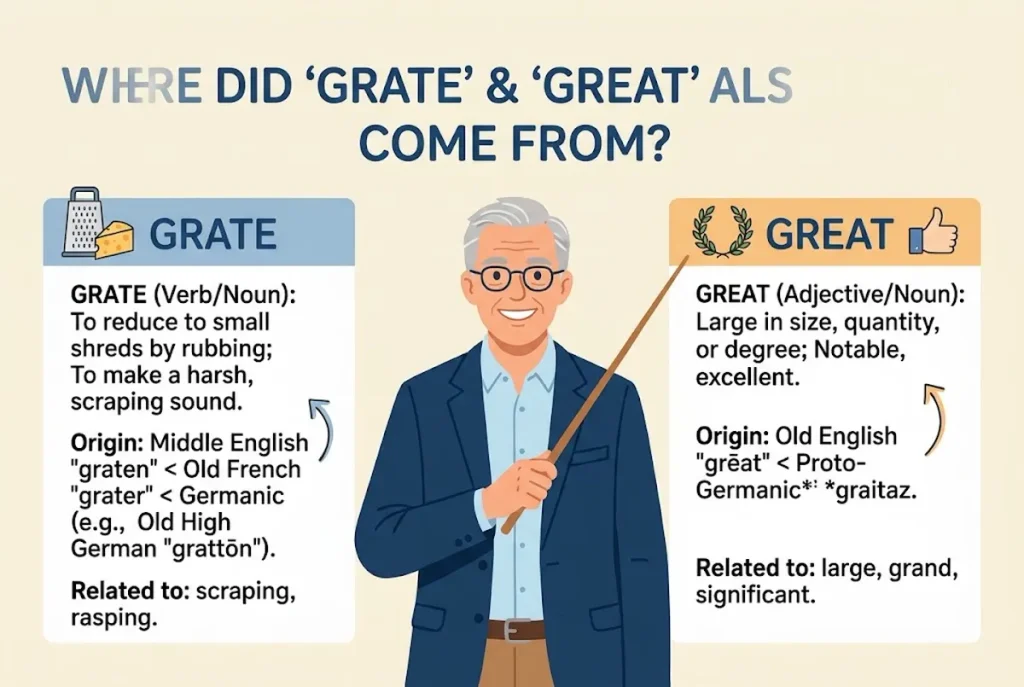
Where Did Grate and Great Come From?
Understanding the history of words can make their meanings easier to remember. Although these two words sound alike today, they have different historical backgrounds.
The Origin of Grate
The word grate comes through Middle English from Old French and Latin roots associated with scratching, rubbing, or scraping.
Its history connects with the idea of creating friction against a surface.
Over time, the word developed several related meanings. It became associated with rubbing food into smaller pieces, scraping surfaces, and making unpleasant sounds.
This explains why we use grate when talking about preparing cheese, carrots, or other ingredients.
It also explains expressions such as something grating on your nerves. The expression compares an irritating experience to an unpleasant scraping sound or sensation.
The noun grate developed from the idea of a framework or structure made of bars, especially one used to cover an opening.
The Origin of Great
Great comes from Old English grēat, which meant large, thick, or coarse.
Its meaning gradually expanded. Instead of describing only physical size, it began to describe importance, power, ability, and excellence.
Today, great is commonly used as a positive adjective.
For example:
- A great leader inspires others.
- That was a great achievement.
- We enjoyed a great performance.
The historical meaning helps explain why great can describe both physical size and personal excellence.
What Are the Best Synonyms for Grate and Great?
Synonyms are words with similar meanings. However, not every synonym works in every situation.
Grate and great have different meanings, so their related words must be considered separately. The following lists include alternatives for both words, grouped by tone and everyday use.
Simple Synonyms
These words are easy to understand and useful in everyday conversations.
| Word | Meaning | Tone | Example |
|---|---|---|---|
| Good | Pleasant or satisfactory | Simple | We had a good day. |
| Nice | Pleasant or enjoyable | Friendly | That was a nice meal. |
| Fine | Acceptable or satisfactory | Neutral | Your work looks fine. |
| Excellent | Extremely good | Positive | She gave an excellent answer. |
| Shred | Cut into small pieces | Practical | Shred the cabbage. |
| Scrape | Remove something by rubbing | Practical | Scrape the paint away. |
Everyday Synonyms
These alternatives are useful in conversations, emails, and general writing.
| Word | Meaning | Tone | Example |
|---|---|---|---|
| Wonderful | Extremely enjoyable | Warm | We had a wonderful evening. |
| Amazing | Very impressive | Enthusiastic | You have an amazing voice. |
| Fantastic | Extremely good | Informal | The concert was fantastic. |
| Terrific | Very enjoyable or impressive | Friendly | You did a terrific job. |
| Outstanding | Much better than usual | Positive | Her performance was outstanding. |
| Rub | Move something against a surface | Neutral | Rub the surface gently. |
| Grate | Break food into small pieces | Practical | Grate the fresh ginger. |
Formal Synonyms
These words work well in professional writing, essays, reports, and academic discussions.
| Word | Meaning | Tone | Example |
|---|---|---|---|
| Exceptional | Far above average | Formal | She demonstrated exceptional skill. |
| Remarkable | Worthy of attention | Formal | The project achieved remarkable results. |
| Superb | Excellent in quality | Formal | The restaurant provided superb service. |
| Impressive | Deserving admiration | Professional | His results were impressive. |
| Magnificent | Extremely beautiful or impressive | Formal | The building has a magnificent design. |
| Pulverize | Reduce something to very small particles | Technical | The machine can pulverize dry material. |
| Abrade | Wear away a surface through friction | Technical | The rough material can abrade the surface. |
How Do Synonyms Change from Mild to Strong?
The strength of a word affects how much emotion or importance it communicates.
Some alternatives describe something that is simply good, while others express a much stronger reaction.
Mild Words
Mild words express ordinary approval without showing extreme excitement.
- Good: The presentation was good.
- Nice: We had a nice lunch.
- Fine: Your suggestion sounds fine.
- Pleasant: It was a pleasant experience.
Use these words when you want to sound natural and balanced.
Medium Strength Words
These words communicate stronger approval and are useful in everyday writing.
- Great: You gave a great presentation.
- Wonderful: We had a wonderful holiday.
- Fantastic: The service was fantastic.
They work well when you genuinely want to praise someone or describe a positive experience.
Strong Words
Strong words express exceptional quality, excitement, or admiration.
- Outstanding: Her performance was outstanding.
- Exceptional: He has exceptional leadership skills.
- Magnificent: The view was magnificent.
- Extraordinary: She achieved extraordinary results.
- Phenomenal: The team delivered a phenomenal performance.
Choose strong words when the situation deserves extra emphasis. Using them for ordinary situations can make your writing sound exaggerated.
Can Grate and Great Be Used as Different Parts of Speech?
Yes. Their grammatical roles are different, which makes understanding their parts of speech especially useful.
Grate as a Verb
Grate is commonly used as a verb.
It describes an action involving rubbing, scraping, or shredding.
Examples:
- Grate the cheese into a small bowl.
- The rough surface may grate against the metal.
- His constant complaints grate on my nerves.
The verb can also appear in different grammatical forms.
| Form | Example |
|---|---|
| Base form | Grate the carrots. |
| Third person | She grates the cheese. |
| Past tense | He grated the ginger. |
| Present participle | She is grating the chocolate. |
| Past participle | The cheese was grated earlier. |
Grate as a Noun
Grate can also function as a noun.
It refers to a metal framework that covers or protects an opening.
Examples:
- The fireplace grate holds the burning wood.
- Water flowed through the drain grate.
- The worker removed the damaged metal grate.
Great as an Adjective
Great is mainly used as an adjective.
It describes a person, object, experience, quality, or achievement.
Examples:
- He is a great writer.
- That was a great opportunity.
- She has great confidence.
Great can appear before a noun or after a linking verb.
For example:
The movie was great.
In this sentence, great describes the movie after the linking verb was.
Is Great Ever a Noun?
Great is not normally used as a standalone noun in everyday English.
However, it appears in certain expressions and historical contexts. For example, the phrase the great refers to an important or famous person when used as part of a title or description.
Examples include Alexander the Great and Catherine the Great.
In ordinary writing, use great as an adjective.
Is There an American or British Difference Between Grate and Great?
No major spelling difference exists between American and British English for these two words.
Both varieties use grate and great with the same standard spellings and meanings.
However, their pronunciation and everyday expressions may vary slightly across English speaking regions.
| Feature | American English | British English |
|---|---|---|
| Spelling | Grate / Great | Grate / Great |
| Meaning of great | Excellent or impressive | Excellent or impressive |
| Meaning of grate | Shred or scrape | Shred or scrape |
| Pronunciation | Usually the same for both words | Usually the same for both words |
| Common use | Great job! | Great job! |
Which Word Should You Use in an Email, Essay, or Conversation?
The best choice depends on the message you want to communicate. Great is usually appropriate when describing something positive, while grate is appropriate when discussing scraping, shredding, or irritation.
Which Word Is Best for a Resume?
Great can describe professional qualities, achievements, or experiences, but stronger and more specific words often make a resume sound more professional.
Instead of writing:
I am a great team member.
You could write:
I am an effective team member with strong communication skills.
Other useful alternatives include:
- Excellent: I have excellent organizational skills.
- Exceptional: I have exceptional problem solving abilities.
- Outstanding: I have an outstanding record of customer service.
Grate is generally unrelated to resume writing unless the job involves food preparation, manufacturing, or another activity where grating is part of the work.
Which Word Is Best for an Essay?
Great is suitable for essays when you want to describe something important, valuable, or impressive.
Example:
Education plays a great role in developing a person’s future.
For more formal writing, consider using important, significant, valuable, or essential when they express your intended meaning more precisely.
Grate may appear in an essay about cooking, mechanical processes, materials, or unpleasant sounds.
Example:
The researcher used a metal tool to grate the surface of the sample.
Which Word Is Best for Texting?
Great is the natural choice when responding positively to a message.
Examples:
- That sounds great!
- Great job on your exam!
- I had a great time yesterday.
Grate is appropriate only when you are discussing its actual meaning.
For example:
Can you grate some cheese for dinner?
Which Word Is Best for Professional Emails?
Great works well in professional emails when expressing approval or appreciation.
Examples:
- Great work on completing the report.
- That is a great suggestion.
- We had a great discussion during the meeting.
If you want a more formal tone, consider excellent, valuable, or impressive.
Grate is only appropriate when discussing a relevant action or object.
Example:
Please grate the cheese before adding it to the mixture.
Which Word Is Best for Speaking?
Both words are natural in spoken English, but their meanings determine how you use them.
Use great when praising someone or describing a positive experience.
Example:
That was a great performance!
Use grate when explaining a cooking action or describing something irritating.
Example:
Please grate the carrots before putting them in the bowl.
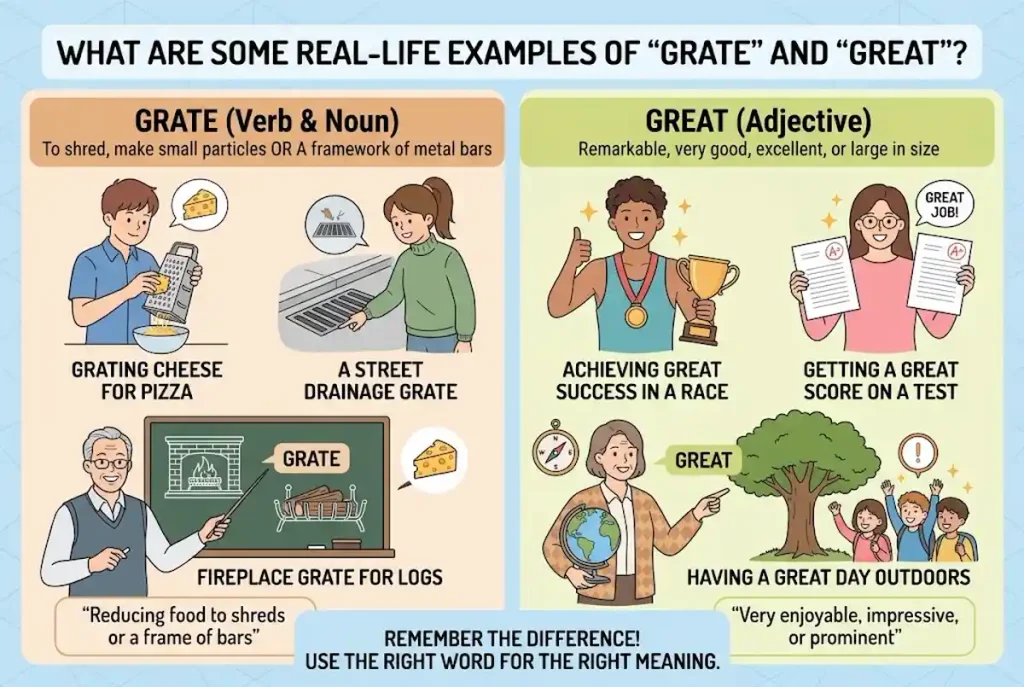
What Are Some Real Life Examples of Grate and Great?
Seeing both words in different situations makes their meanings easier to understand.
Here are original examples from everyday life.
Examples of Grate in Everyday Sentences
- My mother asked me to grate the cheese before preparing dinner.
- The chef used a small tool to grate fresh ginger.
- Please grate two carrots for the vegetable salad.
- The old metal grate covered the opening in the floor.
- The fireplace grate was covered with ash.
Examples of Great in Everyday Sentences
- We had a great time visiting our grandparents.
- She gave a great answer during the class discussion.
- My brother is a great football player.
- That restaurant serves great food.
- You have done a great job organizing the event.
Grate vs. Great: What Is the Difference Between Similar Words?
Some words have related meanings but are not suitable replacements in every situation. Understanding these differences can help you write more clearly.
Great vs. Excellent
Both great and excellent describe something positive, but excellent usually communicates a higher level of quality.
| Great | Excellent |
|---|---|
| Common in everyday conversations | Common in formal and everyday writing |
| Flexible and natural | Stronger and more specific praise |
| We had a great meal. | We had an excellent meal. |
| She is a great teacher. | She is an excellent teacher. |
Grate vs. Shred
Grate and shred can both describe breaking food into smaller pieces, but their methods and results are slightly different.
| Grate | Shred |
|---|---|
| Usually involves rubbing food against a grater | Usually involves cutting or tearing food into narrow pieces |
| Often produces fine or small pieces | Often produces longer strips |
| Grate the cheese. | Shred the chicken. |
| Grate the carrots finely. | Shred the cabbage. |
Great vs. Wonderful
Great and wonderful are close in meaning, but wonderful often sounds warmer and more enthusiastic.
| Great | Wonderful |
|---|---|
| General positive description | Strong positive feeling |
| That is a great idea. | That is a wonderful idea. |
| We had a great day. | We had a wonderful day. |
Grate vs. Scrape
These words describe actions involving contact with a surface, but they do not mean exactly the same thing.
Grate usually means rubbing something against a rough surface to break it into small pieces or create friction.
Scrape generally means removing something from a surface or moving an object across it.
Examples:
- Grate the cheese into a bowl.
- Scrape the dried paint from the wall.
- Grate the carrots for the salad.
- Scrape the mud from your shoes.
What Are the Common Mistakes When Using Grate and Great?
Many writers confuse these words because they sound identical. However, a few simple spelling mistakes can change the entire meaning of a sentence.
Using Grate Instead of Great
Incorrect: You did a grate job on your assignment.
Correct: You did a great job on your assignment.
Explanation: The sentence expresses praise. Therefore, great is the correct adjective.
Using Great Instead of Grate
Incorrect: Please great the cheese before dinner.
Correct: Please grate the cheese before dinner.
Explanation: The sentence describes shredding cheese into small pieces. Therefore, grate is the correct verb.
Confusing Grate With a Kitchen Grater
A grate is the action of shredding or a metal framework. A grater is the tool used to shred food.
Incorrect: Please bring the grate from the kitchen.
Correct: Please bring the grater from the kitchen.
Explanation: When referring to the kitchen tool, use grater.
Using Great for an Irritating Sound
Incorrect: His constant shouting began to great on my nerves.
Correct: His constant shouting began to grate on my nerves.
Explanation: The expression grate on someone’s nerves describes something irritating or annoying.
Choosing a Word Only by Its Pronunciation
Never depend entirely on sound when deciding between these words.
For example:
That was a great meal.
Please grate the cheese.
Both words sound alike, but their grammatical roles and meanings are different.
Always read the entire sentence before choosing the spelling.
When Should You Not Use Grate or Great?
There are situations where one of these words may be grammatically correct but still not the best choice.
When Great Sounds Too General
Great is useful in casual English, but repeating it too often can make writing less descriptive.
For example:
The book was great. The story was great. The characters were great.
A more detailed version would be:
The book was engaging. The story was exciting, and the characters were believable.
Specific descriptions help readers understand exactly what you liked.
When Grate Does Not Describe the Action
Do not use grate when you simply mean to cut something into large pieces, chop vegetables, or slice bread.
For example:
Incorrect: Grate the onions into large chunks.
Better: Chop the onions into large chunks.
Grating generally produces smaller pieces than chopping.
When a More Specific Word Is Better
Great can describe many positive things, but sometimes another adjective communicates your meaning more clearly.
For example:
- Use successful when describing an achievement.
- Use talented when describing someone’s ability.
- Use enjoyable when describing an experience.
- Use significant when describing importance.
- Use beautiful when describing appearance.
The best word is the one that communicates your exact meaning.
What Are the Antonyms of Grate and Great?
Antonyms are words with opposite or contrasting meanings.
The antonyms of great depend on the meaning you intend to express.
| Word | Opposite or Contrasting Word | Example |
|---|---|---|
| Great | Terrible | It was a terrible experience. |
| Great | Poor | The service was poor. |
| Great | Awful | The weather was awful. |
| Great | Ordinary | It was an ordinary performance. |
| Great | Small | They lived in a small house. |
| Great | Insignificant | The difference was insignificant. |
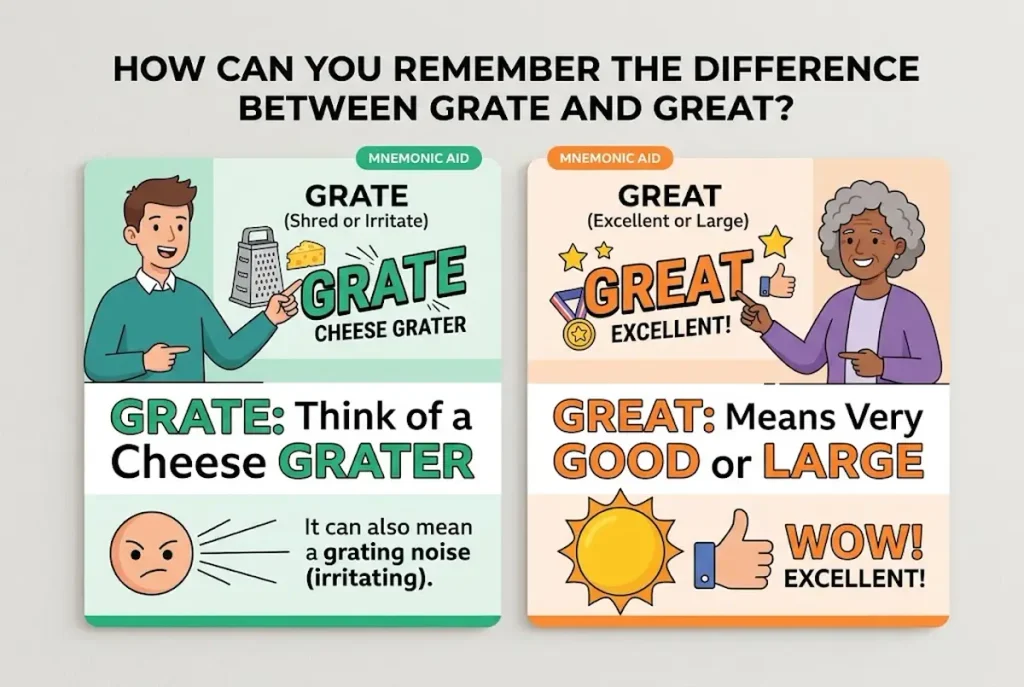
How Can You Remember the Difference Between Grate and Great?
Remembering the spelling becomes easier when you connect each word with a familiar image or situation.
Here are some practical memory tips.
1. Great means good: Both words are associated with positive ideas. Think of a great day, a great friend, or a great achievement.
2. Grate means shred: Think of a kitchen grater. You use it to grate cheese, carrots, or chocolate.
3. Look at the sentence: If you are praising something, great is usually the correct choice. If you are describing scraping, shredding, or irritation, grate may be correct.
4. Remember the noun grater: The extra letters in grater help remind you of the kitchen tool.
5. Check the meaning before spelling: Read the sentence and identify the action or description you want to express.
Conclusion
Choosing the correct spelling becomes much easier when you understand what each word means. Great is an adjective used to describe something excellent, impressive, or important. Grate is mainly a verb that means to shred or scrape something, although it can also refer to a metal framework or an irritating sound.
The easiest way to remember the difference is to connect great with praise and grate with a kitchen grater. When writing an email, completing an essay, or sending a text message, think about the meaning before selecting the spelling.
Both words are useful in everyday English, and neither is incorrect on its own. With a little practice and attention to context, you’ll be able to use the right word confidently and avoid common spelling mistakes.
Frequently Asked Questions
Is it grate or great when saying something is good?
Great is correct when describing something good, excellent, or impressive. For example, you can say, That was a great movie.
What does grate mean in simple English?
It means to shred something into small pieces by rubbing it against a rough surface. It can also refer to a metal framework or something that produces an irritating sound.
Are grate and great pronounced the same?
Yes, grate and great are homophones in standard American English. They have the same pronunciation but different spellings and meanings.
What’s another way to say great?
Other ways to say great include excellent, wonderful, fantastic, amazing, outstanding, and impressive. The best alternative depends on the situation and the level of praise you want to express.
Can great be used to describe a person?
Yes, great can describe a person’s qualities, abilities, or character. For example, She is a great friend.
Why do people confuse grate and great?
People confuse these words because they sound exactly alike in standard English pronunciation. Their different spellings and meanings make it necessary to understand the sentence before choosing the correct word.

Daniel Grammarfield — The Language Learner
Age: 28Occupation: ESL Learner & Digital Professional
Bio:Daniel is a non-native English speaker who wants to communicate more confidently at work and online. He uses Synotrench to improve grammar, understand confusing words, learn correct sentence structures, and build everyday English skills. He prefers simple explanations with practical examples.
Goals:
Master English grammar rules
Avoid common language mistakes
Improve professional communication
Learn English through real-life examples
Quote:“Learning English is not about memorizing rules — it’s about expressing ideas clearly.”
2 thoughts on “Grate or Great: The Best Way to Choose (2026)”