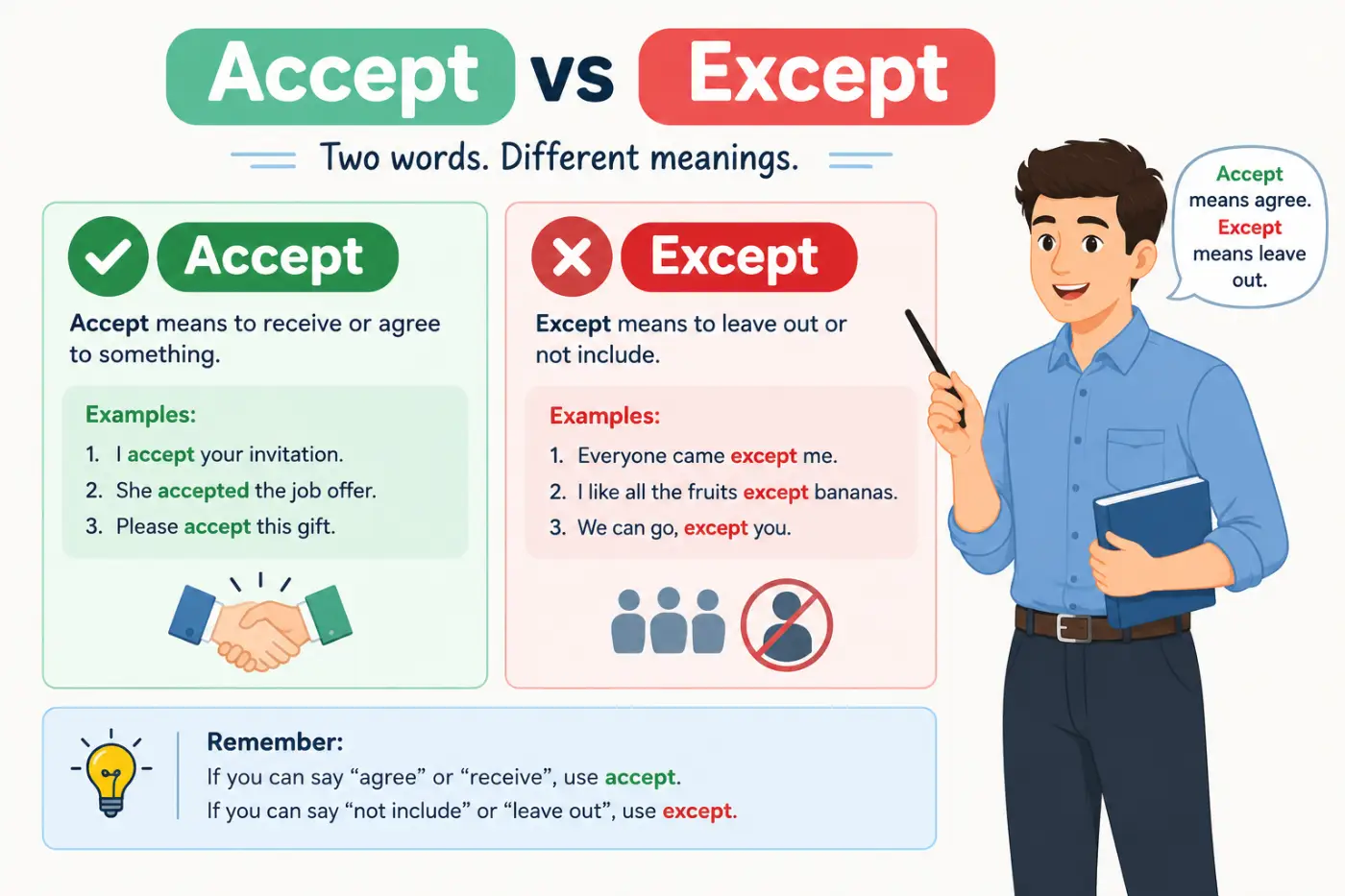
When you write an email, finish an essay, or send a quick text, two small words can cause a big mistake: Accept vs Except. They look and sound similar, but they do completely different jobs. One is mainly a verb about receiving or agreeing. The other usually means leaving someone or something out.
Accept means to receive, agree to, or approve something. Except means to leave out or exclude someone or something. The easiest way to remember the difference is this: accept = say yes, while except = leave out. Once you connect each word with its main idea, choosing the right one becomes much easier.
This guide explains the meanings, origins, synonyms, intensity levels, grammar, regional use, common mistakes, and real examples. You will also see which word fits better in emails, resumes, essays, texts, and everyday speech.
What Do Accept and Except Mean?
The basic difference between Accept vs Except is simple.
| Word | Main meaning | Part of speech | Example |
|---|---|---|---|
| Accept | To receive, agree to, or approve | Verb | I accept your invitation. |
| Except | To leave out or exclude | Preposition, conjunction, verb | Everyone came except Tom. |
Accept usually describes an action of receiving something or agreeing to something.
You can accept:
- An invitation.
- A gift.
- An apology.
- A job offer.
- A payment.
- A decision.
- A proposal.
- A responsibility.
- A fact.
- An idea.
For example:
She accepted the job offer.
This means she agreed to take the job.
Except usually creates an exception. It tells the reader that one person or thing is not included in a group.
For example:
She accepted the challenge.
Everyone passed the test except Mark.
This means everyone passed, but Mark did not.
The two words can appear close together in spelling and pronunciation, but their meanings are clearly different.
Where Did Accept Come From?
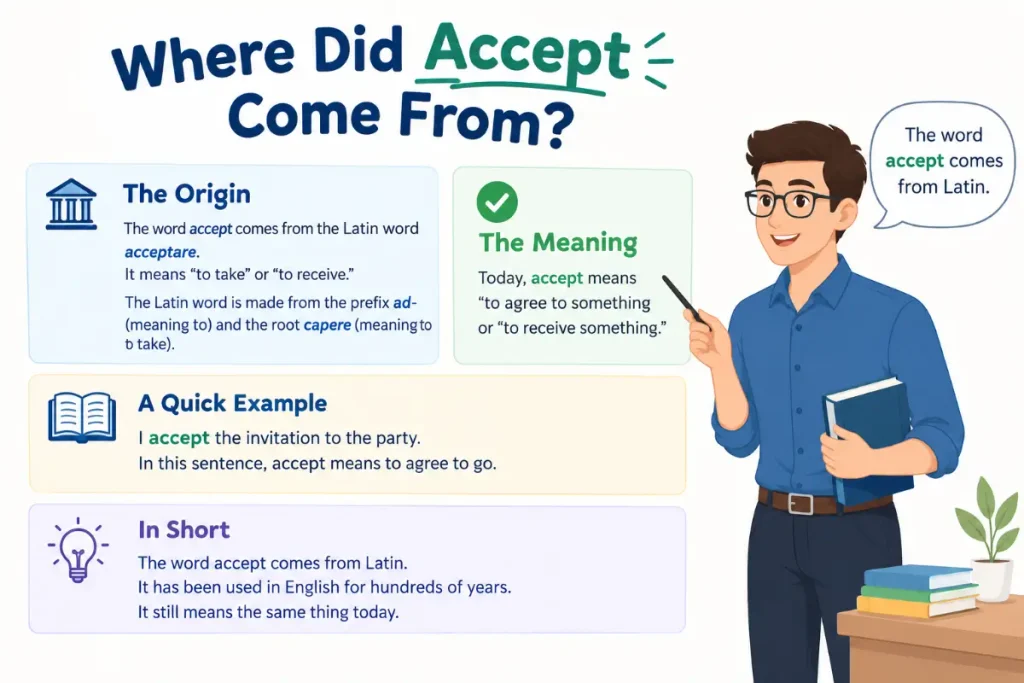
The word accept comes from Latin roots connected with receiving something willingly or taking something as acceptable. It entered English through Old French and developed into the modern English verb accept. The central idea has stayed fairly stable. When you accept something, you take it, agree to it, recognize it, or consider it suitable. That gives us several related meanings.
You can accept an object.
He accepted the package.
You can accept an offer.
She accepted the scholarship.
You can accept an idea.
I accept your explanation.
You can accept a situation.
He finally accepted the changes.
You can also accept responsibility.
The manager accepted responsibility for the mistake.
So, although the situations are different, the basic idea is still connected to receiving or agreeing.
Where Did Except Come From?
Except also has Latin roots. It comes from a Latin expression meaning to take out or exclude. That origin fits its modern meaning very well. When you use except, you create an exception.
Consider this sentence:
All the students attended except Sara.
The group is the students who attended. Sara is removed from that group.
The word can also introduce an exception to a statement.
I would go with you except I have work to finish.
Here, the speaker would normally go, but one condition prevents it.
This gives except two common uses.
- It can identify someone or something that is excluded.
- It can introduce a condition that prevents something from happening.
How Can You Remember Accept and Except?
A quick memory trick can make the difference easier.
Think of accept as agree.
I accept your offer.
Think of except as exclude.
Everyone came except John.
Another useful clue is the letter x in except. You can imagine the x as crossing something out or removing it from a group. This is only a memory trick, not a rule of grammar. Still, it can help when you need to choose quickly.
What Are the Main Synonyms for Accept?
The best synonym depends on the situation. Accept can mean receive, agree, approve, recognize, tolerate, or take responsibility. Here is a larger synonym list grouped by tone and use.
Simple Synonyms for Accept
| Word | Meaning | Tone | Example |
|---|---|---|---|
| Receive | Take something given to you | Simple | She received the gift. |
| Take | Get or receive something | Simple | I will take the offer. |
| Agree | Say yes to an idea or plan | Simple | I agree to the plan. |
| Admit | Allow something to be true | Simple | He admitted his mistake. |
| Allow | Give permission | Simple | They allowed him to join. |
| Welcome | Receive gladly | Simple | We welcome new members. |
| Approve | Say that something is acceptable | Simple | The board approved the plan. |
Everyday Synonyms for Accept
| Word | Meaning | Tone | Example |
|---|---|---|---|
| Take on | Agree to a task or responsibility | Everyday | She took on the new project. |
| Go along with | Agree with an idea or plan | Everyday | I can go along with that idea. |
| Say yes to | Agree to something | Casual | He said yes to the invitation. |
| Get | Receive something | Casual | I got the package today. |
| Embrace | Accept an idea or change willingly | Everyday | The team embraced the new system. |
| Recognize | Accept something as true or real | Everyday | She recognized the problem. |
| Put up with | Tolerate something | Casual | He puts up with the noise. |
Slang and Casual Alternatives for Accept
Some of these words are not perfect replacements in every sentence. Context matters. Accept is often the safest general choice when you mean receive or agree.
What Are Synonyms for Except?
Except has fewer direct replacements because its meaning depends strongly on grammar.
Common alternatives include:
- Excluding.
- Apart from.
- Other than.
- But.
- With the exception of.
- Leaving out.
- Not including.
- Outside of.
- Save.
- Barring.
Examples:
Everyone attended except Maria.
You could say:
Everyone attended apart from Maria.
Or:
Everyone attended with the exception of Maria.
Which Synonyms Sound Mild or Strong?
Not all synonyms carry the same strength.
Mild Choices
These usually sound neutral.
- Accept.
- Receive.
- Agree.
- Allow.
- Acknowledge.
- Recognize.
Example:
She accepted the explanation.
This does not necessarily mean she loved the explanation. It simply says she accepted it.
Stronger Choices
Some words show stronger approval or willingness.
- Embrace.
- Endorse.
- Welcome.
- Support.
For example:
The company accepted the new policy.
Strong Choices for Exclusion
Words such as exclude, bar, and reject can sound stronger than except.
For example:
The list excludes children.
This directly describes an exclusion.
Everyone can enter except children.
This states an exception without necessarily suggesting a strong negative attitude.
That difference matters in formal writing.
What Part of Speech Is Accept?
Accept is a verb.
It describes an action.
Common forms include:
| Form | Example |
|---|---|
| Accept | I accept the offer. |
| Accepts | She accepts the decision. |
| Accepted | They accepted the invitation. |
| Accepting | He is accepting the award. |
You can use it with a direct object.
I accepted the gift.
They accepted our proposal.
You can also use it with clauses.
I accept that mistakes happen.
He accepted that he was wrong.
The noun form is acceptance.
Her acceptance of the offer surprised us.
The adjective acceptable means good enough or suitable.
Your explanation is acceptable.
The adverb acceptably is less common but is also related to the same word family.
What Part of Speech Is Except?
Except can work in several grammatical roles.
Most commonly, it works as a preposition.
Everyone was invited except Jake.
It can also work as a conjunction.
I would help you except I have an appointment.
In some contexts, it can work as a verb, although this use is less common in everyday American English.
The rule excepts certain cases.
That sentence means the rule leaves out certain cases.
The most useful forms for everyday writing are the preposition and conjunction.
Is Accept Different From Except in American and British English?
The basic distinction is the same in American and British English.
Both varieties use accept for receiving or agreeing.
Both use except for exclusion and exceptions.
For example, the following sentence works naturally in both:
Everyone was ready except David.
Likewise:
She accepted the invitation.
There can be differences in vocabulary, spelling, punctuation, and style between US and UK English, but these two words do not normally change meaning based on the region.
One related point is pronunciation. In many accents, the words sound similar enough to cause confusion, especially when spoken quickly. That is one reason the mistake appears in informal writing.
What Word Should You Use in a Resume?
Use accept when your resume describes receiving, approving, or taking responsibility.
For example:
Accepted a leadership role within the department.
Accepted and processed customer applications.
However, resume writing often benefits from more specific action verbs.
Instead of:
Accepted responsibility for the project.
You could write:
Managed the project.
Or:
Led the project team.
The better choice depends on what you actually did.
Do not use except when you mean that you agreed to something.
Incorrect:
I except the position.
Correct:
I accept the position.
A single letter changes the meaning completely.
What Word Should You Use in an Essay?
Use accept when discussing agreement, recognition, or receiving something.
For example:
Many people accept the idea that education can change lives.
You can also use it when discussing a character or historical event.
The character eventually accepted the consequences of his decision.
Use except when you need to identify an exception.
Most of the characters survive except the main villain.
Academic writing often uses alternatives such as apart from, other than, and with the exception of, but except remains perfectly normal.
What Word Should You Use in a Text Message?
In texting, accept is common when you are agreeing to something.
I accept your apology.
I accept the invitation.
Except is useful when you are leaving something or someone out.
Everyone is coming except Mike.
I like all of them except the blue one.
A casual text can also use phrases such as say yes to, leave out, or apart from, depending on the sentence.
What Word Should You Use in an Email?
Use accept for offers, invitations, requests, responsibilities, and agreements.
Thank you for the offer. I am happy to accept it.
Use except when explaining an exception.
The office is open every day except Sunday.
In professional emails, accuracy matters because the two words can change the meaning of a sentence.
Compare:
We accept all applications.
This means the organization receives or agrees to all applications.
We accept all applications except international applications.
This creates an exception.
What Word Should You Use When Speaking?
In everyday speech, both words are common.
You might say:
I accept your apology.
Or:
Everyone is here except James.
The challenge is pronunciation. Because the words can sound close, listeners may depend on context to understand which word you mean.
If you are speaking carefully, focus on the meaning rather than trying to force a dramatic pronunciation difference.
Remember:
Accept = receive or agree.
Except = leave out.
What Are Real Examples of Accept and Except?
Real situations make the difference easier to understand.
Invitations
I accepted the invitation to the wedding.
You agreed to attend.
Everyone accepted the invitation except Daniel.
Daniel did not accept it.
Job Offers
Maria accepted the job offer.
She agreed to take the job.
The company considered every applicant except one.
One applicant was left out of the consideration.
Gifts
He accepted the birthday gift.
He received it willingly.
She liked every gift except the sweater.
The sweater was the one item she did not like.
School
She liked every gift except the sweater.
The teacher agreed to receive it.
Everyone completed the assignment except two students.
Two students did not complete it.
Travel
We accepted the hotel upgrade.
We agreed to take it.
Every passenger boarded except one.
One passenger did not board.
Work
The manager accepted responsibility for the error.
The manager acknowledged responsibility.
Everyone attended the meeting except the new intern.
The intern was not included.
Food
I will accept your offer of coffee.
You are agreeing to the coffee.
I like every fruit except grapefruit.
Grapefruit is the exception.
Rules
The school accepted the new safety rules.
The school approved or agreed to them.
All students must wear uniforms except students in the final-year program.
Final-year students are excluded from that rule.
Technology
The app accepts credit cards.
The app allows credit card payments.
Checks are not included.
Personal Decisions
She accepted that she needed more time.
She recognized the situation.
Everyone agreed to the plan except Ben.
Ben did not agree.
What Is the Difference Between Accept and Approve?
Accept and approve can be close, but they are not always interchangeable.
Accept often means receiving something or agreeing to it.
She accepted the invitation.
Approve usually means officially agreeing that something is good, suitable, or allowed.
The manager approved the vacation request.
You can accept a gift without officially approving it.
You can also approve a plan without physically receiving anything.
Compare them this way:
| Accept | Approve |
|---|---|
| Receive something | Officially agree to something |
| Agree to an offer | Decide something is acceptable |
| Recognize something | Give permission |
| Take responsibility | Authorize an action |
This distinction is useful in workplace writing.
What Is the Difference Between Accept and Receive?
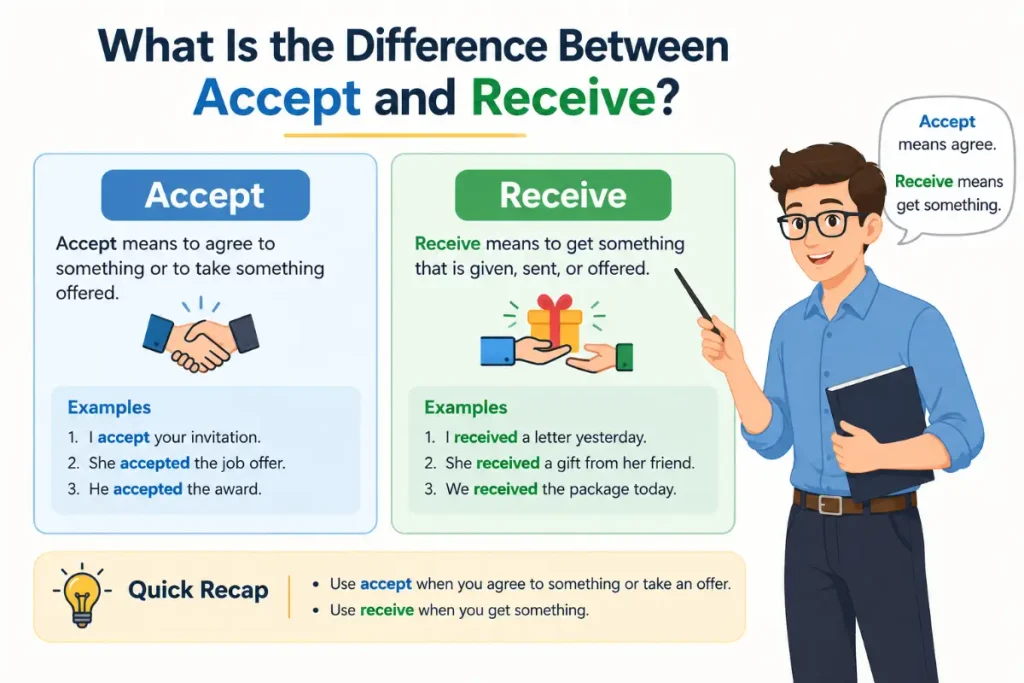
Receive focuses on getting something. Accept often adds the idea of willingness or agreement.
For example:
I received the package.
This tells us that the package came to me.
I accepted the package.
This suggests that I took it or agreed to take it.
The words can overlap, but they are not always equal.
You can receive an unwanted email. You did not necessarily accept it in the sense of agreeing with it.
Likewise, you can accept an offer before you physically receive anything.
She accepted the job offer.
She may not have received her first paycheck yet.
What Is the Difference Between Accept and Agree?
Agree focuses on having the same opinion or saying yes to a proposal.
Accept has a wider range of meanings.
You can agree with someone.
I agree with you.
You can accept someone’s explanation.
I accept your explanation.
You can accept a gift.
I accepted the gift.
But you would not normally say:
I agreed the gift.
The grammar and meaning do not work in the same way.
This is why replacing one word with a synonym without checking the sentence can create a mistake.
What Is the Difference Between Except and Exclude?
Except usually introduces the person or thing that is not included.
Everyone came except Sarah.
Exclude is a verb that describes the act of leaving someone or something out.
The organizer excluded Sarah from the list.
The meanings are closely related, but their grammar is different.
Compare:
Everyone was invited except Sarah.
The organizer excluded Sarah from the invitation list.
The first sentence identifies an exception. The second describes an action.
What Is the Difference Between Except and Apart From?
Except and apart from can often express the same idea.
Everyone came except John.
Everyone came apart from John.
Both mean John was not included.
However, apart from can sometimes be ambiguous because it may also mean in addition to.
For example:
Apart from English, she speaks Spanish.
Here, English is not being excluded. The phrase means besides English.
Because except is more direct, it can be clearer when you specifically mean exclusion.
What Are the Most Common Accept and Except Mistakes?
Several mistakes appear again and again.
Mistake One: Writing Except Instead of Accept
Incorrect:
I except your apology.
Correct:
I accept your apology.
The person is saying yes to the apology, so accept is needed.
Mistake Two: Writing Accept Instead of Except
Incorrect:
Everyone came accept Tom.
Correct:
Everyone came except Tom.
Tom is the exception, so except is correct.
Mistake Three: Confusing Them in Job Applications
Incorrect:
I am pleased to except the position.
Correct:
I am pleased to accept the position.
This is especially important in professional writing.
Mistake Four: Confusing Them in Invitations
Incorrect:
I accept everyone from the class except Maria.
This sentence may be grammatically possible in a special context, but if you mean Maria did not agree to attend, the clearer sentence is:
Everyone accepted the invitation except Maria.
The sentence structure should make it clear who accepted and who did not.
Mistake Five: Using Accept for Exclusion
Incorrect:
Everyone is accept John.
Correct:
Everyone is here except John.
Remember that accept does not mean apart from.
When Should You NOT Use Accept?
Do not use accept when your main meaning is exclusion.
If you mean leave out, choose except, exclude, apart from, or another suitable phrase.
Do not write:
Everyone came accept Tom.
Write:
Everyone came except Tom.
Also, do not use accept simply because it sounds close to except. Check the meaning first.
Ask:
Am I receiving or agreeing to something?
If yes, accept may be correct.
Ask:
Am I leaving someone or something out?
If yes, except may be correct.
When Should You NOT Use Except?
Do not use except when you mean receive or agree.
Incorrect:
She excepted the award.
If you mean she received or agreed to take the award, the correct word is usually:
She accepted the award.
Also, do not use except for approval.
Incorrect:
The manager excepted the proposal.
Correct:
The manager accepted the proposal.
If you mean the manager officially approved it, approved may be even more precise.
What Are the Antonyms of Accept and Except?
The opposite of accept depends on the meaning.
If accept means agree, an opposite can be:
- Reject.
- Refuse.
- Decline.
- Disagree.
Example:
She accepted the offer.
If accept means receive, an opposite can be:
- Refuse.
- Decline.
- Return.
For except, the opposite idea is inclusion.
Useful words include:
- Include.
- Add.
- Admit.
- Contain.
- Cover.
Example:
Everyone was included.
This contrasts with:
Everyone was included except James.
How Do You Choose Between Accept and Except Quickly?
Use these quick checks when writing.
Ask What Action You Mean
If you mean receive, use accept.
I accepted the package.
If you mean agree, use accept.
I accepted the offer.
If you mean leave out, use except.
Everyone came except Sam.
Replace the Word With Say Yes
Try replacing the word mentally with say yes.
I ___ the invitation.
I say yes to the invitation.
That points to accept.
Now try:
Everyone came ___ Sam.
You cannot say:
Everyone came say yes to Sam.
The sentence needs an exception.
So except is correct.
Replace the Word With Leave Out
Try leave out.
Everyone came ___ Sam.
Everyone came, leaving Sam out.
That points to except.
This simple test works in many everyday sentences.
What Are the Most Useful Quick Tips?
- Accept means receive or agree.
- Except means leave out or exclude.
- Accept is normally a verb.
- Except is often a preposition or conjunction.
- Think accept = yes.
- Think except = exclude.
- If you can replace the word with receive, try accept.
- If you can replace it with leave out, try except.
- In a professional email, check the word carefully because the meanings are very different.
- Do not choose based only on pronunciation.
- Read the complete sentence before deciding.
- If the sentence names an exception, except is often the right choice.
- If someone agrees to an offer, invitation, or responsibility, accept is usually correct.
- If you need a stronger word, consider approve, reject, exclude, or another precise synonym.
- When in doubt, replace the word with its basic meaning and see which sentence still makes sense.
Can Accept and Except Ever Appear in the Same Sentence?
Yes. They can appear together when a sentence talks about both agreement and exclusion.
For example:
Everyone accepted the invitation except David.
This sentence is especially useful because it shows both meanings at once.
Accepted tells us that people agreed to the invitation.
Except David tells us that David was the one person who did not belong to that group.
Another example is:
We accept all applications except those submitted after the deadline.
Here, accept describes what the organization does with applications. Except identifies the applications that are not included.
This is one of the clearest ways to see why the two words should not be treated as interchangeable.
How Does Context Change the Meaning?
Context can make accept more specific.
Consider:
She accepted the answer.
This could mean she agreed that the answer was satisfactory.
Now:
She accepted the gift.
This means she received it willingly.
Now:
She accepted the criticism.
This means she recognized or tolerated the criticism.
The basic word stays the same, but the surrounding words provide the exact meaning.
The same thing happens with except.
Everyone came except John.
Here, John is excluded from a group.
I would call you except my phone is dead.
Here, except introduces a condition that prevents an action.
So, always look at the complete sentence rather than trying to memorize one meaning for every situation.
How Can You Use These Words More Naturally?
Strong writing is not only about choosing the correct word. It is also about choosing the clearest word.
If accept is correct, use it when it gives the exact meaning you need.
We accepted the proposal.
If approve is more precise, use approve.
The director approved the proposal.
If receive is more precise, use receive.
We received the proposal yesterday.
Likewise, if except sounds unclear, you can use apart from, excluding, or with the exception of, depending on the sentence.
For example:
Everyone attended except Nina.
This is short and natural.
Everyone attended with the exception of Nina.
This is more formal.
Everyone attended, excluding Nina.
This is more direct and formal.
Good word choice depends on your purpose, audience, and sentence structure.
What Is the Easiest Final Rule for Accept vs Except?
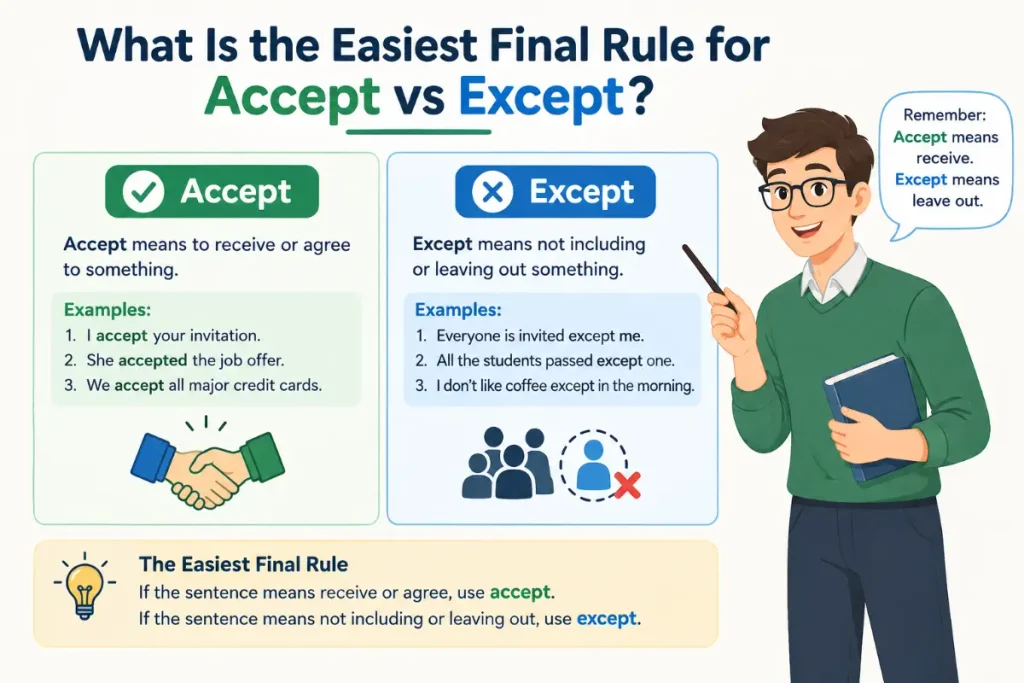
The simplest rule is:
Accept = receive or agree.
Except = leave out or identify an exception.
If someone gives you something and you take it, you accept it.
If someone offers you a job and you say yes, you accept it.
For example:
I accept the invitation.
But:
Everyone accepted the invitation except Mark.
Once you connect accept with agreement and except with exclusion, the difference becomes much easier to remember.
Conclusion
The key difference in Accept vs Except comes down to two simple ideas. Accept is mainly about receiving something, agreeing to something, or recognizing something as valid. Except is mainly about leaving someone or something out or showing an exception.
Use accept for offers, invitations, gifts, responsibilities, ideas, and agreements. Use except when one person or thing is not part of a group or when a condition creates an exception.
When you are unsure, pause and ask what the sentence means. If the idea is receive or say yes, choose accept. If the idea is leave out, choose except. That quick check can prevent one of the most common spelling and word choice mistakes in everyday English.
Frequently Asked Questions
What is the difference between accept and except?
Accept means to receive, agree to, or approve something, while except means to leave someone or something out.
Is it accept the offer or except the offer?
The correct phrase is accept the offer because you agree to or receive the offer.
Is it everyone accept John or everyone except John?
The correct phrase is everyone except John when John is the person left out.
Can accept and except be used in the same sentence?
Yes. For example, Everyone accepted the invitation except Maria uses both words correctly.
What’s another way to say accept?
Depending on the context, you can say receive, agree, approve, welcome, acknowledge, consent, endorse, or take.
What’s another way to say except?
Common alternatives include excluding, apart from, other than, with the exception of, and not including.
How can I remember accept and except?
Remember accept = agree or receive and except = exclude or leave out. The letter x in except can remind you to cross something out.

Daniel Grammarfield — The Language Learner
Age: 28Occupation: ESL Learner & Digital Professional
Bio:Daniel is a non-native English speaker who wants to communicate more confidently at work and online. He uses Synotrench to improve grammar, understand confusing words, learn correct sentence structures, and build everyday English skills. He prefers simple explanations with practical examples.
Goals:
Master English grammar rules
Avoid common language mistakes
Improve professional communication
Learn English through real-life examples
Quote:“Learning English is not about memorizing rules — it’s about expressing ideas clearly.”
2 thoughts on “Accept vs Except: The Ultimate Simple Guide (2026).”