Imagine writing an email to a hospital receptionist or describing someone who cannot wait for an important appointment. You type a sentence, but suddenly you wonder: Should you write impatient or inpatient? Both words look almost identical, and a small spelling difference changes the entire meaning.
The confusion is understandable. One word describes a person’s behavior, while the other relates to medical care. Using the wrong one can make a simple email, school assignment, or professional message sound confusing.
In this guide, you’ll learn their meanings, origins, synonyms, pronunciation differences, and correct usage. You’ll also find practical examples, comparisons, common mistakes, and tips for choosing the right word in everyday American English.
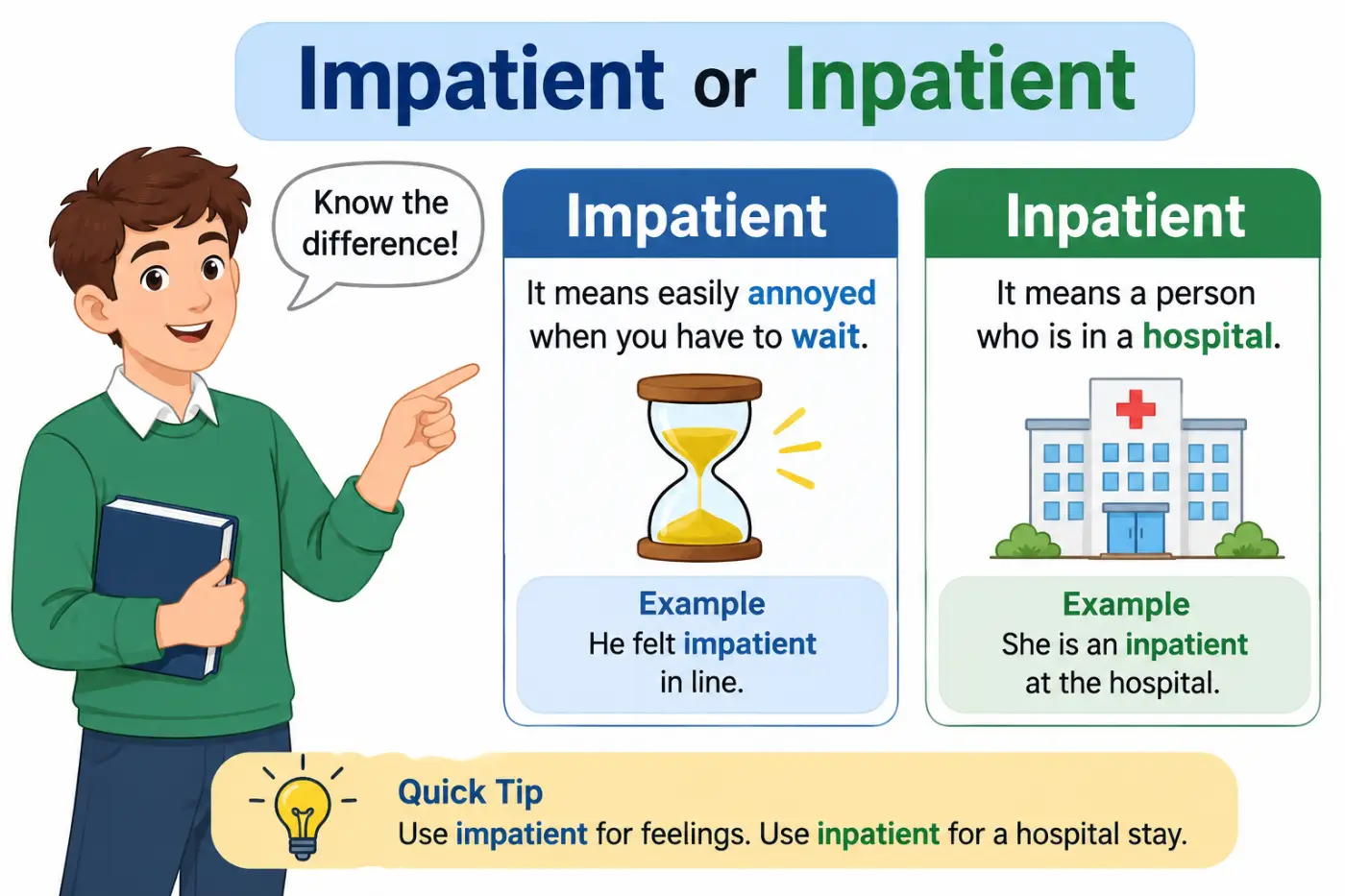
What Is the Difference Between Impatient and Inpatient?
The main difference is their meaning and purpose. Although they share several letters, they belong to different word families and describe completely different situations.
| Word | Part of Speech | Meaning | Example |
|---|---|---|---|
| Impatient | Adjective | Unable or unwilling to wait calmly | The impatient customer complained about the delay. |
| Inpatient | Noun | Someone admitted to a hospital for treatment | The inpatient received care throughout the night. |
| Inpatient | Adjective | Related to hospital treatment that requires an overnight or longer stay | The doctor recommended inpatient care. |
What Does Impatient Mean?
Impatient is an adjective that describes someone who becomes annoyed, restless, or frustrated when waiting for something.
An impatient person may dislike delays, struggle to wait for results, or want something to happen immediately.
For example:
- She became impatient after waiting for an hour.
- The children were impatient to open their birthday presents.
- My manager seemed impatient during the long meeting.
What Does Inpatient Mean?
Inpatient is a medical term used for someone who is admitted to a hospital or another healthcare facility for treatment and care.
An inpatient usually needs medical attention that requires staying at the facility rather than returning home immediately after an appointment.
For example:
- My grandfather became an inpatient after his surgery.
- The hospital has 150 inpatient beds.
- She received inpatient treatment for several days.
Where Did Impatient and Inpatient Come From?
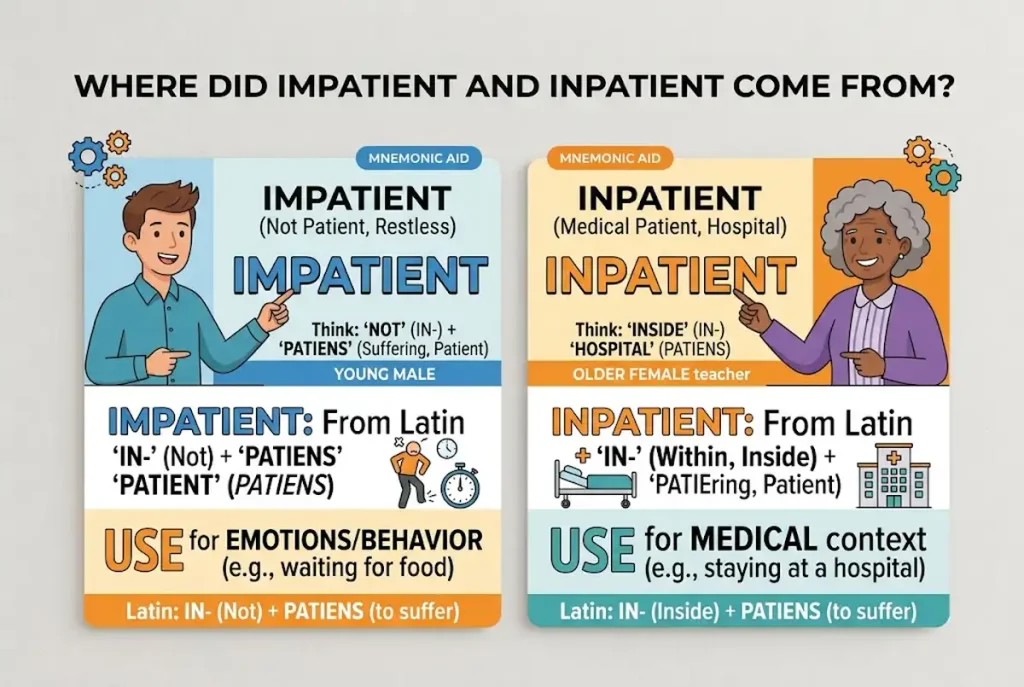
Understanding word origins makes spelling differences easier to remember. These two words developed from different combinations and uses of older English and Latin words.
The Origin of Impatient
Impatient comes from the Latin word impatiens, which describes someone who cannot endure or tolerate something.
It developed from the Latin prefix in-, meaning not, and patiens, meaning suffering, enduring, or tolerating.
The word entered English through French and Latin influences. Over time, its meaning became closely connected with having little patience or becoming annoyed while waiting.
This history explains why impatient describes a person’s attitude toward delays, difficulties, or situations that require tolerance.
Related words include:
- Patient.
- Patience.
- Impatience.
The Origin of Inpatient
Inpatient developed from the combination of in and patient.
In this medical expression, in refers to being inside or admitted to a healthcare facility. Patient refers to someone receiving medical attention.
The word became established in healthcare language to distinguish people who stay in a hospital from those who receive treatment without being admitted.
Related medical expressions include:
- Inpatient care.
- Inpatient services.
- Inpatient treatment.
- Inpatient admission.
- Inpatient rehabilitation.
What Are the Best Synonyms for Words?
These words do not share the same synonyms because their meanings are different. Impatient describes an attitude, while inpatient describes a person receiving admitted medical care.
Therefore, choose synonyms according to the meaning you want to communicate.
What Are Synonyms for Impatient?
The following words can replace impatient in suitable situations. Some describe mild restlessness, while others suggest stronger frustration or anger.
| Word | Meaning | Tone | Example |
|---|---|---|---|
| Restless | Unable to relax or stay still | Simple | The restless child walked around the room. |
| Eager | Excited to do or receive something | Simple | She was eager to hear the results. |
| Anxious | Worried or nervous about something | Everyday | He felt anxious while waiting. |
| Edgy | Nervous or easily annoyed | Everyday | The passengers became edgy after the delay. |
| Fidgety | Unable to sit still comfortably | Everyday | The fidgety student kept moving. |
| Hasty | Acting too quickly | Everyday | His hasty decision caused problems. |
| Rushed | Done with too much speed | Everyday | She sounded rushed during the call. |
| Frustrated | Upset because something is not going as expected | Everyday | The customer was frustrated by the delay. |
| Irritated | Slightly angry or annoyed | Everyday | He became irritated by the noise. |
| Agitated | Nervous, upset, or disturbed | Everyday | The waiting passenger looked agitated. |
| Tense | Unable to relax because of worry | Everyday | Everyone felt tense before the announcement. |
| Intolerant | Unwilling to accept delays or difficulties | Formal | He was intolerant of slow progress. |
| Snappy | Speaking in a sharp or rude way | Slang | She gave a snappy reply. |
| Cranky | Easily annoyed or bad-tempered | Slang | The tired child became cranky. |
| Antsy | Restless because of waiting | Slang | We were getting antsy before the show. |
What Words Are Related to Inpatient?
Inpatient has a narrower medical meaning, so its alternatives depend on the healthcare situation.
| Word or Phrase | Meaning | Tone | Example |
|---|---|---|---|
| Hospitalized patient | Someone admitted to a hospital | Everyday | The hospitalized patient needs additional monitoring. |
| Admitted patient | Someone formally accepted for hospital treatment | Formal | The admitted patient is waiting for surgery. |
| Hospital patient | Someone receiving hospital care | Simple | The hospital patient is recovering. |
| Resident patient | A patient staying at a medical facility | Formal | The resident patient receives daily care. |
| Hospital resident | Someone staying in a hospital | Everyday | The hospital resident is receiving treatment. |
| Medical patient | Someone receiving medical attention | Simple | The medical patient needs regular checkups. |
| Ward patient | Someone receiving care in a hospital ward | Everyday | The ward patient is recovering well. |
| Long-term care patient | Someone receiving extended medical care | Formal | The long-term care patient needs rehabilitation. |
Can You Use keyword Interchangeably?
No. Their meanings are different, so replacing one with the other can change the entire message.
Consider these sentences:
- The impatient patient asked when the doctor would arrive.
- The inpatient patient received treatment overnight.
How Do Word Differ in Intensity?
The word impatient describes a range of feelings. Someone may simply feel restless, or they may become extremely angry because of a delay.
Choosing a more precise word helps readers understand the strength of the emotion.
Mild Impatience
These words describe a small amount of restlessness or difficulty waiting.
- Eager: Excited about something that is going to happen.
- Restless: Unable to relax or remain still.
- Antsy: Slightly uncomfortable because of waiting.
- Fidgety: Moving around because of nervousness or boredom.
- Expectant: Waiting with interest or hope.
Moderate Impatience
These words describe noticeable frustration or annoyance.
- Annoyed: Slightly angry about something.
- Irritated: Feeling bothered by a situation.
- Frustrated: Upset because something is taking too long.
- Agitated: Emotionally disturbed or nervous.
- Edgy: Easily annoyed or uncomfortable.
Strong Impatience
These words communicate serious frustration, anger, or an unwillingness to tolerate delays.
- Furious: Extremely angry.
- Enraged: Filled with intense anger.
- Exasperated: Extremely annoyed after repeated problems.
- Irate: Very angry, especially because of something unfair.
- Outraged: Extremely angry about something considered wrong.
How Do Impatient and Inpatient Work as Different Parts of Speech?
Understanding parts of speech helps you use each word correctly in sentences.
How Is Impatient Used as an Adjective?
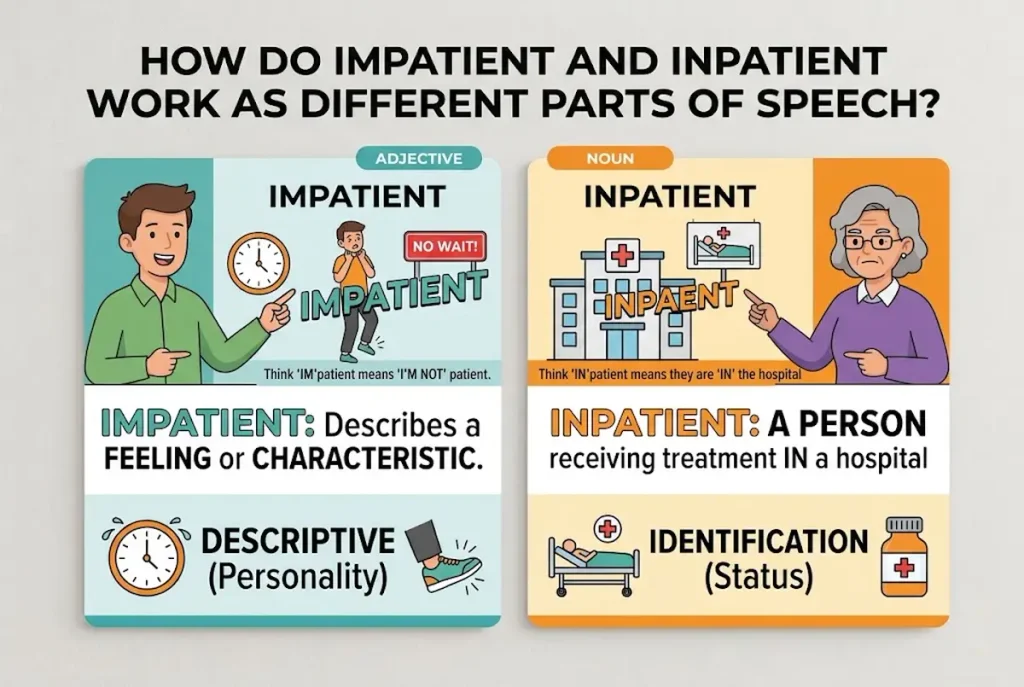
Impatient is an adjective. It describes a noun or pronoun by explaining someone’s attitude toward waiting, delays, or difficult situations.
Examples:
- The impatient customer asked for the manager.
- My brother is impatient when plans change.
- An impatient driver passed several slow vehicles.
How Is Inpatient Used as a Noun?
Inpatient can function as a countable noun referring to someone admitted to a hospital or medical facility.
Examples:
- The inpatient needs additional medical attention.
- Every inpatient received a hospital identification band.
- The nurse checked on the inpatient before midnight.
How Is Inpatient Used as an Adjective?
Inpatient also describes medical services, facilities, programs, or treatment that involve hospital admission.
Examples:
- Inpatient care is available at the medical center.
- The doctor recommended inpatient rehabilitation.
- The hospital expanded its inpatient department.
What Are the Related Word Forms?
| Word | Part of Speech | Meaning |
|---|---|---|
| Impatient | Adjective | Unable to wait calmly |
| Impatience | Noun | The state of being impatient |
| Impatiently | Adverb | In an impatient manner |
| Patient | Noun | Someone receiving medical care |
| Patient | Adjective | Able to wait calmly |
| Patience | Noun | The ability to tolerate delays |
| Inpatient | Noun | Someone admitted for medical care |
| Inpatient | Adjective | Related to admitted medical car. |
Is There a Difference Between American and British English?
The meanings of these two words are generally the same in American and British English. Both varieties use impatient to describe someone who has difficulty waiting and inpatient in medical contexts.
However, some healthcare expressions and related terms may differ by region.
American English Usage
In the United States, inpatient is widely used in hospitals, insurance policies, medical records, and healthcare administration.
Common American expressions include:
- Inpatient care.
- Inpatient hospital services.
- Inpatient admission.
- Inpatient rehabilitation.
- Inpatient treatment program.
British English Usage
British English also uses inpatient and impatient with the same basic meanings.
However, British healthcare writing may use expressions such as hospital admission, hospital patient, or hospital inpatient depending on the context.
Example:
The hospital admitted the patient for further treatment.
Which Word Should You Use in an Email, Essay, Resume, or Conversation?
The correct choice depends on what you want to communicate. Consider the subject of your sentence before selecting either spelling.
Which Word Is Best for a Resume?
Use impatient when describing a personal weakness, but consider a more professional and constructive expression.
For example:
I sometimes become impatient when projects move more slowly than expected.
A more positive resume or interview version would be:
I value efficient work and continue improving my ability to manage changing deadlines.
Inpatient is appropriate only when discussing relevant healthcare experience.
For example:
Provided administrative support to inpatient departments and medical staff.
If you work in healthcare, the word can help explain your professional responsibilities.
Which Word Is Best for an Essay?
Use impatient when writing about a person’s emotions, behavior, or reaction to waiting.
Example:
The main character became impatient as the journey continued.
Use inpatient when discussing hospitals, healthcare systems, or medical treatment.
Example:
The research examines the cost of inpatient care for older adults.
Always match the word to the subject of your essay.
Which Word Is Best for Texting?
In casual messages, impatient is useful when explaining that you do not want to wait.
Examples:
- I’m getting impatient waiting for you.
- Don’t be impatient. We’ll arrive soon.
- I’m impatient to see the new movie.
Inpatient is useful when talking about someone receiving hospital treatment.
Examples:
- My uncle is an inpatient at the city hospital.
- The doctor recommended inpatient treatment.
Even in informal texting, the spelling matters because the meanings are different.
What Are 12 Examples of Words in Real Situations?
Examples make the difference easier to understand because they show how each word works in natural sentences.
Examples of Impatient
1. The impatient customer asked the cashier to open another checkout counter.
2. My younger brother becomes impatient when his favorite television show is delayed.
3. The students grew impatient while waiting for their teacher to return.
4. She was too impatient to listen to the complete explanation.
5. The manager sounded impatient during the conference call.
6. Drivers became impatient after the road was closed for repairs.
7. I felt impatient because the website took several minutes to load.
8. The children were impatient to open their holiday gifts.
9. He gave an impatient sigh when the meeting continued longer than expected.
10. The audience became impatient when the speaker repeated the same information.
Examples of Inpatient
11. The inpatient received specialized care after undergoing surgery.
12. The hospital opened a new inpatient unit for patients who needed continuous medical supervision.
These examples show why the two spellings cannot be substituted for one another. One describes a feeling, while the other identifies a medical status or service.
What Is the Difference Between Impatient and Impatience?
Impatient and impatience belong to the same word family, but they have different grammatical functions.
Impatient is an adjective that describes a person or behavior.
Impatience is a noun that identifies the feeling or condition of being unable to wait calmly.
| Impatient | Impatience |
|---|---|
| Adjective | Noun |
| Describes a person or attitude | Names a feeling |
| The impatient boy left the line. | His impatience caused him to leave the line. |
| She seems impatient. | She showed impatience. |
More examples:
- The impatient passenger complained about the delay.
- The passenger’s impatience made the situation worse.
Use impatient when describing someone. Use impatience when naming the emotion.
What Is the Difference Between Inpatient and Outpatient?
Inpatient and outpatient are two important healthcare terms. They describe different types of medical care.
An inpatient is someone admitted to a healthcare facility for treatment that requires an overnight or longer stay.
An outpatient receives medical care without being admitted for an overnight hospital stay.
| Inpatient | Outpatient |
|---|---|
| Usually requires hospital admission | Does not require overnight admission |
| May stay overnight | Usually returns home after treatment |
| May need continuous monitoring | Often receives scheduled medical services |
| Common for major surgery or serious illness | Common for consultations and minor procedures |
Examples:
Inpatient:
The patient stayed in the hospital for three nights after surgery.
Outpatient:
The patient visited the clinic for a routine examination and returned home.
One important detail is that not every hospital visit makes someone an inpatient. A person may spend several hours in an emergency department or receive a procedure and still be classified as an outpatient.
The classification depends on formal admission and the type of care provided.
What Are the Common Mistakes When Using These Words?
Many spelling mistakes happen because the two words look almost identical. However, understanding their meanings can prevent confusion.
Using Inpatient When You Mean Impatient
Incorrect:
The impatient customer was admitted to the hospital.
Correct:
The inpatient received medical attention.
Correct:
The impatient customer complained about the long waiting time.
Using Impatient When You Mean Inpatient
Incorrect:
My father is an impatient at the hospital.
Correct:
My father is an inpatient at the hospital.
The first sentence incorrectly uses an adjective as a noun. The second correctly identifies someone receiving admitted medical care.
Assuming Both Words Have the Same Meaning
Their similar spelling does not make them synonyms.
Impatient describes behavior, while inpatient belongs to medical vocabulary.
Before writing either word, ask yourself whether the sentence is about someone’s attitude or hospital admission.
Forgetting the Noun and Adjective Difference
Impatient is an adjective, so it describes a person or thing.
Inpatient can be a noun or adjective.
For example:
- She is impatient.
- She is an inpatient.
- She receives inpatient treatment.
These sentences use the words in different grammatical ways.
Confusing Patient With Impatient
Patient can describe someone who receives medical care. It can also describe someone who can wait calmly.
Impatient adds the negative prefix im- to patient in its patience-related sense.
Examples:
- The patient waited patiently for the doctor.
- The impatient patient complained about the delay.
The second sentence uses both meanings of patient-related vocabulary correctly.
When Should You Avoid Using Word?
Although both words are useful, they are not suitable for every situation.
Avoid impatient when you want to describe someone who is simply excited or looking forward to something without frustration.
For example:
Less precise: She was impatient to attend the concert.
More precise: She was eager to attend the concert.
Eager communicates excitement without suggesting annoyance.
Avoid inpatient when referring to someone who visits a hospital for a routine appointment without being formally admitted.
For example:
Less precise: My mother is an inpatient because she visited the hospital for a checkup.
More precise: My mother is an outpatient because she visited the hospital for a checkup without being admitted.
Inpatient should be used when the medical admission context supports it.
What Are the Antonyms of Impatient and Inpatient?
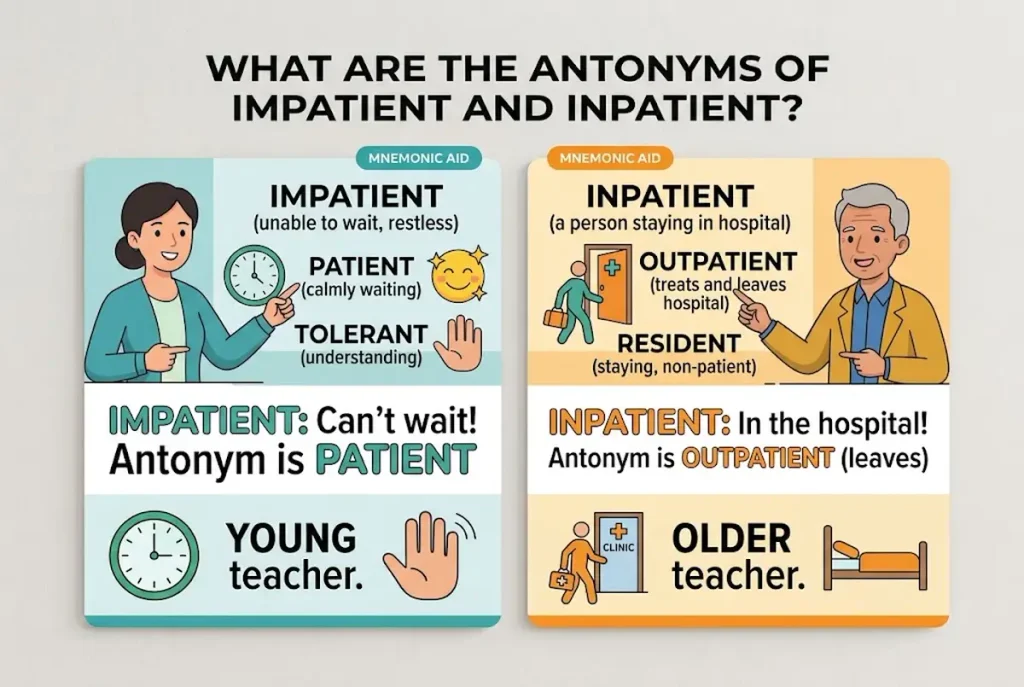
Antonyms are words with opposite meanings. They can help you understand how a word is used.
Antonyms of Impatient
| Antonym | Meaning | Example |
|---|---|---|
| Patient | Able to wait calmly | She is patient with children. |
| Calm | Peaceful and relaxed | He remained calm during the delay. |
| Tolerant | Able to accept difficulties | The teacher was tolerant of mistakes. |
| Relaxed | Free from tension | Everyone felt relaxed after the meeting. |
| Composed | Calm and in control | She remained composed while waiting. |
| Understanding | Willing to accept another person’s situation | The manager was understanding about the delay. |
Is There an Antonym of Inpatient?
There is no exact opposite of inpatient in every medical situation. However, outpatient is the closest commonly used contrasting term in healthcare.
- Inpatient: A person admitted for hospital treatment.
- Outpatient: A person receiving medical services without an overnight hospital admission.
These terms describe different healthcare arrangements rather than opposite personality traits.
How Can You Remember the Correct Spelling?
A simple memory trick can help you avoid mixing up these words.
Remember Impatient With Patience
Impatient contains the word patient with the negative prefix im-.
Think about the relationship between patient, patience, and impatient.
- Patient: Able to wait calmly.
- Patience: The ability to wait calmly.
- Impatient: Not willing or able to wait calmly.
Example:
I am impatient because I have no patience for unnecessary delays.
Remember Inpatient With Hospital Admission
Inpatient begins with in, which can remind you of someone staying inside a hospital for medical care.
Think about these related expressions:
- Inpatient room.
- Inpatient department.
- Inpatient treatment.
- Inpatient admission.
The word is connected to medical services rather than someone’s attitude.
Check the Meaning Before Sending Your Message
Before sending an email, submitting an essay, or publishing an article, read the complete sentence.
Ask yourself:
- Am I describing someone who dislikes waiting?
- Am I talking about a person admitted to a medical facility?
- Does the word fit the grammar of my sentence?
These three questions can help you select the correct spelling without relying on guesswork.
Conclusion
The best way to remember the difference is to connect each spelling with its meaning. Impatient describes someone who struggles to wait calmly, while inpatient refers to someone admitted to a hospital for medical care.
Although the words look similar, they serve different purposes in English. Use impatient when discussing frustration, restlessness, or a lack of patience. Choose inpatient when writing about hospital admission, medical services, or treatment that requires a stay in a healthcare facility.
Pay attention to the context and grammatical role of the word before using it. With regular practice, you’ll find it easy to recognize the correct spelling and use both words naturally in your writing.
Frequently Asked Questions
Is inpatient a medical term?
Yes, inpatient is a medical term for someone admitted to a hospital or healthcare facility for treatment. It can also describe services and treatment provided during a hospital stay.
Is impatient a positive or negative word?
Impatient usually has a negative meaning because it describes frustration or difficulty waiting. However, it can sometimes describe excitement or eagerness in informal situations.
What’s another way to say impatient?
You can use restless, frustrated, irritated, annoyed, edgy, or eager, depending on the situation. Each alternative has a slightly different meaning and emotional strength.
What is the opposite of inpatient?
Outpatient is the closest contrasting medical term. An outpatient receives medical services without being admitted for an overnight hospital stay.
Can a person be both impatient and an inpatient?
Yes, a person can be both at the same time. For example, someone admitted to a hospital may become impatient while waiting for medical test results.
How do you use inpatient in a sentence?
You can write: The inpatient received special medical attention after surgery. In this sentence, inpatient identifies someone admitted to a healthcare facility.

Daniel Grammarfield — The Language Learner
Age: 28Occupation: ESL Learner & Digital Professional
Bio:Daniel is a non-native English speaker who wants to communicate more confidently at work and online. He uses Synotrench to improve grammar, understand confusing words, learn correct sentence structures, and build everyday English skills. He prefers simple explanations with practical examples.
Goals:
Master English grammar rules
Avoid common language mistakes
Improve professional communication
Learn English through real-life examples
Quote:“Learning English is not about memorizing rules — it’s about expressing ideas clearly.”
3 thoughts on “Impatient or Inpatient: Best Way to Use Each Word”