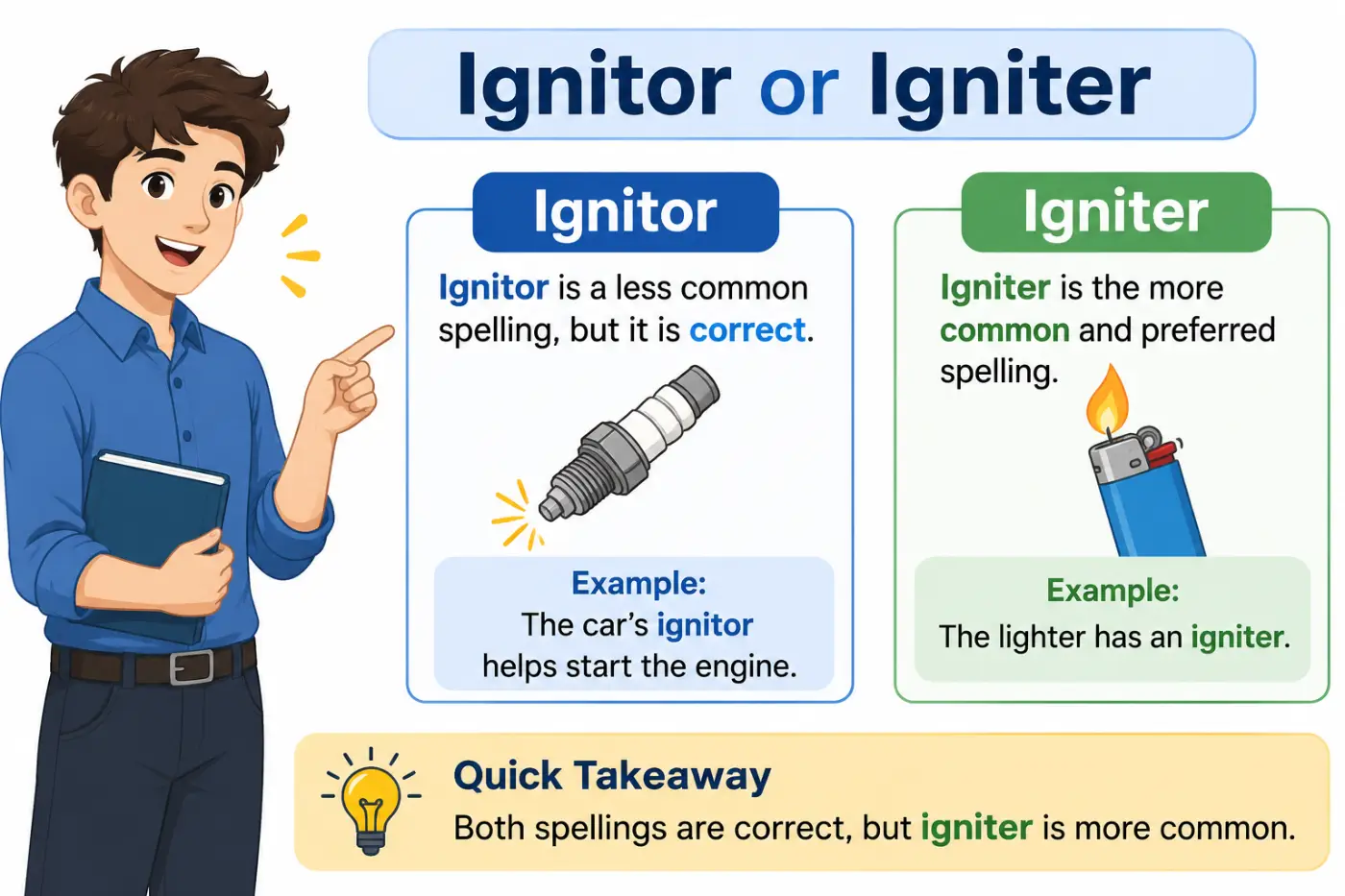
Have you ever written a sentence about a car engine, gas stove, furnace, or heating system and stopped to wonder which spelling is correct? You might have seen both ignitor and igniter in product descriptions, repair manuals, and online stores. That can make a simple spelling choice confusing, especially when you’re writing an email, an essay, or a technical report.
The good news is that both spellings are correct. They refer to a device or component that starts combustion by producing a spark, heat, or another source of ignition. The main difference is spelling preference and usage, not meaning.
Choosing the right spelling depends on your audience, writing style, and the type of equipment you’re discussing. In this guide, you’ll learn where the words come from, how they differ in usage, which spelling works best in different situations, and how to use them correctly in real sentences.
What Is the Difference Between Both words?
The difference between these two words is mainly their spelling. Both are nouns that describe a device or component used to start combustion.
| Word | Meaning | Usage |
|---|---|---|
| Igniter | A device that starts ignition or combustion | Common in general American English |
| Ignitor | A device that starts ignition or combustion | Also correct, often found in technical and product terminology |
For example:
- The gas stove has an electric igniter.
- The technician replaced the furnace ignitor.
- The fireplace igniter produces a spark when you press the button.
Where Do Igniter or Ignitor Come From?
Understanding a word’s origin can make its spelling easier to remember. Both forms are connected to the verb ignite.
The verb ignite comes from the Latin word ignis, meaning fire. It entered English through French and Latin influences and developed the meaning to set something on fire or cause it to burn.
The noun igniter comes from this verb. It follows a common English word formation pattern in which the suffix er identifies a person or thing that performs an action.
For example:
| Verb | Noun | Meaning |
|---|---|---|
| Teach | Teacher | Someone who teaches |
| Write | Writer | Someone who writes |
| Light | Lighter | Something that produces a flame |
| Ignite | Igniter | Something that starts combustion |
For example:
| Verb | Noun |
|---|---|
| Act | Actor |
| Invent | Inventor |
| Operate | Operator |
| Ignite | Ignitor |
What Does the Word Igniter Mean in Simple English?
An igniter is a device or component that starts a fire or causes fuel to burn. It may work by creating an electric spark, producing heat, or using another ignition method.
Think about a gas stove. When you turn the control knob, the igniter creates a spark near the burner. That spark lights the gas and produces a flame.
You can find similar components in:
- Gas stoves and ovens.
- Home heating furnaces.
- Gas fireplaces.
- Outdoor grills.
- Gas water heaters.
The word can also refer to a person or thing that starts an event or process in a figurative sense, although the technical meaning is much more common.
What Does the Word Ignitor Mean in Simple English?
Ignitor has the same basic meaning as igniter. It refers to a device or component that starts combustion.
For example, a furnace manufacturer might use the term hot surface ignitor for a heating component. Another manufacturer might write hot surface igniter.
The spelling may change, but the basic function remains the same.
This is why you should pay attention to the terminology used in equipment manuals and product labels. If a manufacturer consistently uses one spelling, follow that spelling when discussing its specific product.
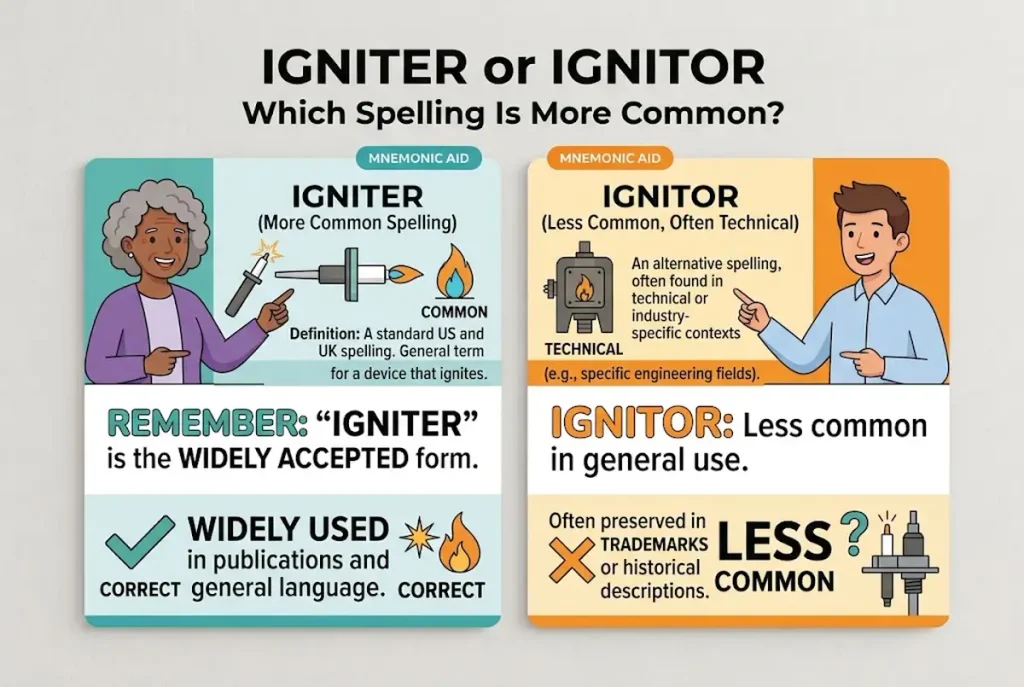
Igniter or Ignitor Which Spelling Is More Common?
For everyday American English, igniter is generally the safer spelling choice.
It follows the familiar er pattern found in words such as writer, driver, and lighter. Readers can recognize it easily, and it works naturally in general writing.
However, ignitor is not a spelling mistake. It appears in technical descriptions, equipment names, product listings, and other specialized contexts.
Consider these examples:
| Situation | Suggested spelling |
|---|---|
| General American writing | Igniter |
| School assignments | Igniter |
| Everyday emails | Igniter |
| Technical manuals | Follow the manufacturer’s spelling |
| Product replacement parts | Follow the product listing |
| Engineering documents | Follow the established technical terminology |
| British English | Check the relevant style guide or product terminology |
What Are the Best Synonyms?
The words have several related terms. However, not every synonym can replace them in every sentence.
For example, a spark plug and an ignition device both help start combustion, but they don’t always describe the same component. A lighter can start a flame, but it may not be the correct name for a part inside a furnace.
The following table includes 28 useful related words, grouped by tone and writing style.
Simple Words
| Word | Meaning | Tone | Example |
|---|---|---|---|
| Starter | Something that begins a process | Simple | The starter helped light the burner. |
| Lighter | A device that produces a flame | Simple | He used a lighter to start the fire. |
| Spark | A small flash of electricity or fire | Simple | A spark started the gas flame. |
| Fire starter | Something used to begin a fire | Simple | The fire starter worked quickly. |
| Light source | Something that produces light or flame | Simple | The system needs a reliable light source. |
| Flame starter | A device that begins a flame | Simple | The flame starter activated the burner. |
| Ignition tool | A tool used to start combustion | Simple | The ignition tool was stored nearby. |
| Lighting device | Equipment used to produce a flame or light | Simple | The lighting device needs replacement. |
Everyday Words
| Word | Meaning | Tone | Example |
|---|---|---|---|
| Ignition device | Equipment that starts combustion | Everyday | The ignition device stopped working. |
| Spark generator | A component that creates an electrical spark | Everyday | The spark generator needs inspection. |
| Gas lighter | A device used to light gas | Everyday | The gas lighter failed to produce a spark. |
| Burner starter | A component that starts a burner | Everyday | The burner starter was replaced. |
| Firelighting device | Equipment used to start a fire | Everyday | The firelighting device was easy to operate. |
| Electronic starter | A device that starts a process electronically | Everyday | The electronic starter controls ignition. |
| Starting mechanism | A system that begins an operation | Everyday | The starting mechanism needs repair. |
| Flame generator | A device that produces or helps establish a flame | Everyday | The flame generator is part of the heating system. |
Formal and Technical Words
| Word | Meaning | Tone | Example |
|---|---|---|---|
| Ignition source | A source of energy that starts combustion | Formal | The engineer identified the ignition source. |
| Combustion initiator | A component that begins combustion | Formal | The combustion initiator was inspected. |
| Ignition element | A part that helps initiate ignition | Formal | The ignition element needs testing. |
| Thermal igniter | A heat producing component used for ignition | Formal | The thermal igniter reached the required temperature. |
| Electrical igniter | A device that uses electricity to start ignition | Formal | The electrical igniter created a spark. |
| Ignition assembly | A group of components responsible for ignition | Formal | The ignition assembly was replaced. |
| Initiator | Something that begins an action or process | Formal | The initiator activated the system. |
| Activator | Something that causes a system to operate | Formal | The activator started the equipment. |
Which Words Can Replace Igniter Based on Intensity?
Words related to ignition can describe different levels of action. Some refer to a small spark, while others describe the complete process of starting combustion.
Although intensity isn’t a strict grammar category for technical nouns, this comparison can help you choose more precise vocabulary.
Mild or Basic Terms
These words describe the beginning of a fire or ignition process without emphasizing its strength.
| Word | Meaning | Example |
|---|---|---|
| Spark | A small flash of electricity or fire | The spark started the flame. |
| Lighter | A small device that produces a flame | She used a lighter to light the burner. |
| Starter | Something that begins an operation | The starter activated the system. |
| Match | A small object used to produce a flame | He struck a match. |
| Lighting device | Equipment used to create light or flame | The lighting device was replaced. |
Medium or Technical Terms
These words describe equipment or mechanisms that actively help start combustion.
| Word | Meaning | Example |
|---|---|---|
| Ignition device | Equipment that starts combustion | The ignition device worked correctly. |
| Spark generator | A component that produces sparks | The spark generator needs cleaning. |
| Ignition element | A part responsible for initiating ignition | The ignition element became damaged. |
| Burner starter | A component that starts a burner | The burner starter was tested. |
| Flame generator | Equipment that helps produce a flame | The flame generator was inspected. |
Strong or Specialized Terms
These words are more suitable for scientific, engineering, or technical descriptions.
| Word | Meaning | Example |
|---|---|---|
| Combustion initiator | A component that begins combustion | The combustion initiator was tested. |
| Ignition source | The source that starts combustion | The ignition source was identified. |
| Thermal ignition element | A heat producing component that starts ignition | The thermal ignition element reached its operating temperature. |
| Ignition assembly | A complete group of ignition components | The ignition assembly required maintenance. |
| Pyrotechnic initiator | A specialized device used to start a pyrotechnic reaction | The pyrotechnic initiator was examined by qualified personnel. |
How Does Igniter Change Based on Part of Speech?
The word igniter is mainly used as a noun. It names a person or thing that performs the action of igniting something.
However, related words can appear in different grammatical forms.
| Word | Part of speech | Meaning | Example |
|---|---|---|---|
| Ignite | Verb | To start burning | The spark can ignite the gas. |
| Igniter | Noun | Something that starts combustion | The igniter needs replacement. |
| Ignitor | Noun | Another spelling for an ignition device | The ignitor stopped working. |
| Ignition | Noun | The process of starting combustion | The ignition happened quickly. |
| Igniting | Verb form | Starting a fire or combustion | The device is igniting the fuel. |
| Ignited | Past tense or past participle | Started burning | The fuel ignited immediately. |
| Ignitable | Adjective | Capable of being ignited | Keep ignitable materials away from heat. |
| Ignitable substance | Noun phrase | A material that can catch fire | The substance was marked as ignitable. |
Is Igniter a Noun or a Verb?
Igniter is a noun, not a verb.
It names the device or component that starts combustion. The verb is ignite.
Correct: The igniter started the furnace.
Correct: The spark can ignite the fuel.
Incorrect: The technician will igniter the burner.
Correct: The technician will ignite the burner.
This distinction is useful when writing technical instructions, school assignments, and equipment descriptions.
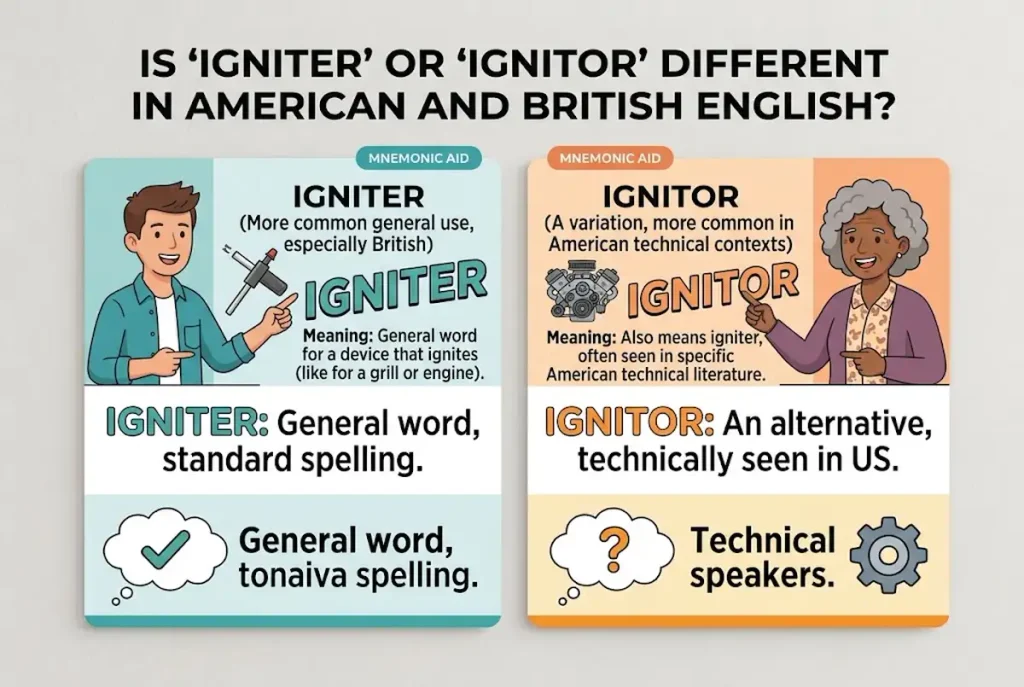
Is Igniter or Ignitor Different in American and British English?
Both spellings are recognized in English, including British English. However, their frequency and use can vary across publications, manufacturers, and technical fields.
In American English, igniter is a sensible default for general writing. It is also a well established dictionary form. Dictionary.com and Collins list the word as a noun meaning a person or thing that ignites. Dictionary.com+1
In British English, igniter is also used. The spelling ignitor can appear in product descriptions and specialized terminology, but you shouldn’t assume that it is the standard British spelling.
The same principle applies to Australian and other English speaking regions. A company may use one spelling in its product catalog while another company chooses the alternative.
| Region or situation | Recommended approach |
|---|---|
| United States | Use igniter for general writing. |
| United Kingdom | Use the spelling preferred by the relevant publication or manufacturer. |
| Australia | Follow local style guidance and product terminology. |
| Canada | Use igniter as a clear general choice, while respecting established terminology. |
| International technical writing | Follow the terminology used in the equipment documentation. |
Should You Change the Spelling for a British Audience?
You don’t need to change word just because your readers are British.
Both forms are understandable. What matters most is following the spelling used by the organization, publisher, or technical documentation you’re working with.
For example, if you’re describing a replacement part from a British equipment manufacturer, copy the spelling printed in its official manual. This makes it easier for readers to find the exact product.
Which Spelling Should You Use in Different Writing Situations?
The best spelling depends on the purpose of your writing. A school essay, professional resume, repair report, and casual message may have different requirements.
Which Spelling Is Best for a Resume?
Use igniter when describing equipment, maintenance experience, or technical skills in an American resume.
A resume should be clear and easy to understand. Use the spelling that matches the terminology in your industry.
Example:
Experienced in inspecting and replacing gas furnace igniters and electrical ignition components.
Which Spelling Is Best for an Essay?
Use igniter in a general English essay unless your teacher or reference material specifies another form.
Avoid switching between the two spellings in the same essay. Consistency makes your writing look more professional.
Example:
An electric igniter helps start the combustion process in many modern gas appliances.
If your essay discusses a specific product, use the spelling found in its official documentation.
Which Spelling Is Best for Texting?
Either spelling is understandable in casual messages. However, igniter is a simple choice for American English.
Example:
The grill’s igniter isn’t working, so we need to check it before cooking.
You don’t need to explain the difference in a casual conversation unless someone asks.
What Are Some Real Examples of keyword in Sentences?
Examples make it easier to understand how these words work in everyday and professional situations. Both spellings can be used in similar sentences because they share the same basic meaning.
Here are 15 original examples from different situations.
Everyday Examples
- The igniter on our kitchen stove stopped producing sparks.
- My father called a repair technician to replace the faulty igniter.
- The gas grill has an automatic igniter that starts the burner.
- She pressed the ignition button, but the igniter didn’t respond.
- The fireplace needs a new igniter before winter begins.
Technical and Workplace Examples
- The engineer inspected the ignitor before testing the heating system.
- A damaged igniter can prevent a gas furnace from starting properly.
- The technician ordered a replacement ignitor from the manufacturer.
- The maintenance team checked the electrical connections in the ignition assembly.
- The new igniter was tested after the repair was completed.
School and Professional Writing Examples
- An igniter is an important component in many gas powered appliances.
- The report explains how an electrical igniter helps start combustion.
- The manufacturer recommends regular inspection of the ignition system.
- The laboratory team recorded the performance of the ignition device.
- The replacement ignitor matched the specifications listed in the equipment manual.
Igniter vs Starter What’s the Difference?
Igniter and starter are related words, but they don’t always describe the same thing.
An igniter specifically helps start combustion. A starter has a broader meaning and can describe anything that begins a process or activates equipment.
| Igniter | Starter |
|---|---|
| Usually refers to a device that starts combustion | Refers to something that begins an operation |
| Common in gas appliances and heating systems | Common in vehicles, machines, and everyday activities |
| Has a specific connection to ignition | Can describe many different functions |
| Example: The furnace igniter failed. | Example: The car starter failed. |
Consider these sentences:
- The gas furnace needs a new igniter.
- The car needs a new starter.
Igniter vs Spark Plug What’s the Difference?
A spark plug and an igniter both relate to starting combustion, but they are not interchangeable in every situation.
A spark plug is a specific component used in spark ignition engines. It produces an electrical spark that ignites the air and fuel mixture inside the engine cylinder.
An igniter is a broader term for a device or component that initiates combustion. It may use electricity, heat, or another ignition method.
| Igniter | Spark plug |
|---|---|
| General term for an ignition component | Specific engine component |
| Used in various ignition systems | Used in spark ignition engines |
| May create a spark or produce heat | Produces an electrical spark |
| Found in furnaces, stoves, grills, and other equipment | Found in many gasoline engines |
Examples:
- The furnace igniter glowed during the startup process.
- The mechanic replaced the damaged spark plug.
What Common Mistakes Should You Avoid?
Even though both spellings are correct, writers sometimes make mistakes when using these words.
Treating Ignitor as an Incorrect Spelling
One common mistake is assuming that ignitor is always wrong.
This isn’t correct. Ignitor is an accepted alternative spelling of igniter.
Incorrect explanation: Ignitor is a spelling mistake.
Using the Words as Verbs
Another mistake is using word as an action word.
Incorrect: The machine will ignitor the fuel.
Correct: The machine will ignite the fuel.
Assuming Every Igniter Creates a Spark
Not all ignition devices work in the same way.
Some create an electrical spark, while others produce enough heat to start combustion. For example, a hot surface igniter uses heat rather than a conventional spark.
Incorrect: Every igniter works by producing an electrical spark.
Better: An igniter can start combustion through a spark, heat, or another suitable ignition method.
Switching Between Spellings Without a Reason
Using both forms in one article can make your writing look inconsistent.
For example:
Incorrect: The igniter stopped working. The technician replaced the ignitor.
Better: The igniter stopped working. The technician replaced it.
Choose one spelling and use it consistently unless you’re directly discussing the spelling difference or quoting a product name.
Replacing a Technical Name With an Unrelated Synonym
A spark plug, match, lighter, and ignition device are related to starting a fire or combustion. However, they have different functions.
Don’t replace a specific equipment name with a general synonym just to avoid repetition.
For example, if you’re discussing a furnace component, calling it a match would be inaccurate.
Ignoring the Manufacturer’s Terminology
Technical products often have specific part names and model descriptions.
If the official manual calls a component an ignitor, don’t automatically change the spelling when discussing that product.
Keeping the original terminology helps readers identify the correct replacement part.
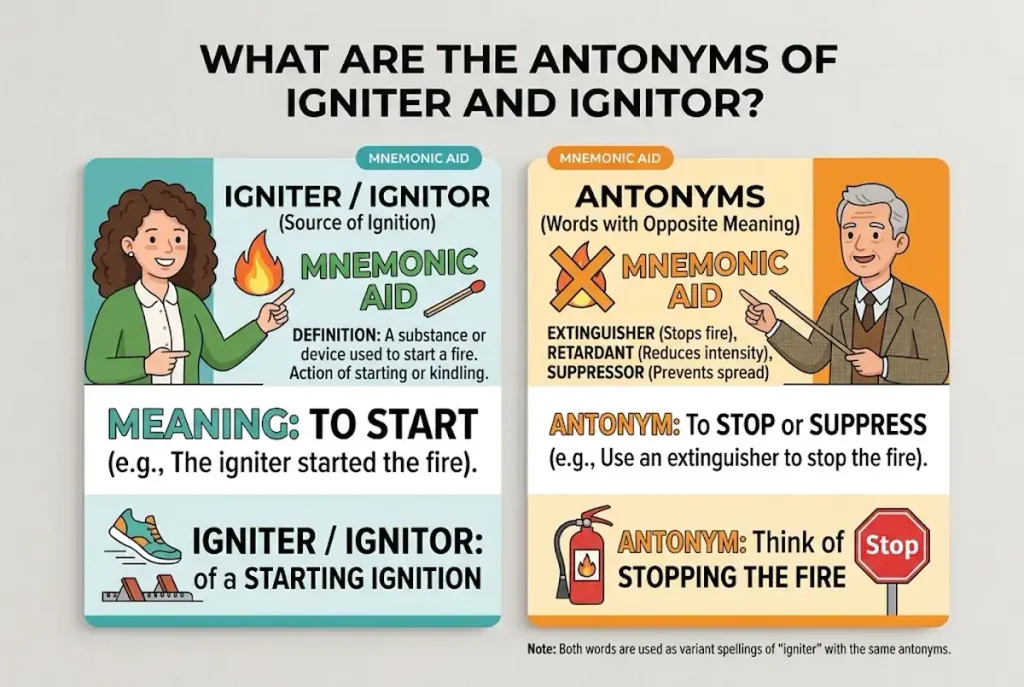
What Are the Antonyms of Igniter and Ignitor?
There isn’t one exact opposite for igniter because it describes a device that starts combustion. However, several words describe the opposite action or a different function.
| Word | Meaning | Example |
|---|---|---|
| Extinguisher | A device used to put out a fire | The extinguisher stopped the flames. |
| Fire suppressor | Something that reduces or controls fire | The fire suppressor activated automatically. |
| Cooler | Something that lowers temperature | The cooler reduced the equipment’s temperature. |
| Quencher | Something that puts out or reduces a flame | Water acted as a flame quencher. |
| Inhibitor | Something that slows or prevents a process | The inhibitor prevented the reaction from starting. |
| Fire suppressant | A substance used to control or extinguish fire | The fire suppressant stopped the burning material. |
What Are the Best Tips for Choosing the Correct Spelling?
If you still find the two forms confusing, use these practical tips.
- Choose igniter for general American English. It’s a straightforward choice for everyday writing.
- Remember that both spellings are correct. Don’t automatically mark ignitor as an error.
- Check the manufacturer’s documentation. Product terminology should match the original source.
Conclusion
The spelling choice between igniter and ignitor is easier once you understand that both words have the same basic meaning. They describe a person, device, or component that starts ignition. For general American English, igniter is the best everyday choice because it is a familiar and widely recognized form.
However, ignitor is also correct and may appear in product descriptions, equipment manuals, and specialized terminology. If you’re writing about a particular machine, follow the manufacturer’s spelling.
Remember that ignite is the verb, while both noun forms identify something that starts combustion. With these simple rules, you can choose the right spelling confidently and keep your writing clear and consistent.
Frequently Asked Questions
Is igniter more common in American English?
Yes, igniter is a familiar and widely recognized spelling in American English. It’s a good default for everyday writing and general educational content.
What does an igniter do?
An igniter starts combustion by producing a spark, heat, or another source of ignition. It’s commonly found in gas stoves, furnaces, fireplaces, and grills.
Can I use ignitor in a formal document?
Yes, you can use ignitor in formal writing. Just make sure it follows your organization’s spelling preferences and the terminology used in the relevant technical documentation.
What’s another word for igniter?
Other related terms include ignition device, starter, spark generator, fire starter, and ignition source. The best alternative depends on the equipment and its function.
Are igniter and spark plug the same thing?
No, they aren’t exactly the same. A spark plug is a specific engine component that creates an electrical spark, while igniter is a broader term for something that initiates combustion.
Is igniter a noun or a verb?
Igniter is a noun because it names a person or thing that starts combustion. Ignite is the related verb that describes the action.

Daniel Grammarfield — The Language Learner
Age: 28Occupation: ESL Learner & Digital Professional
Bio:Daniel is a non-native English speaker who wants to communicate more confidently at work and online. He uses Synotrench to improve grammar, understand confusing words, learn correct sentence structures, and build everyday English skills. He prefers simple explanations with practical examples.
Goals:
Master English grammar rules
Avoid common language mistakes
Improve professional communication
Learn English through real-life examples
Quote:“Learning English is not about memorizing rules — it’s about expressing ideas clearly.”
4 thoughts on “Ignitor or Igniter: Best Spelling Guide (2026)”