Imagine you’re writing an email to your teacher, preparing a school essay, or sending an important message. You want to add information that makes your point stronger. You type the words in fact, but then you wonder if infact might also be correct. Both forms look similar, so it’s easy to get confused.
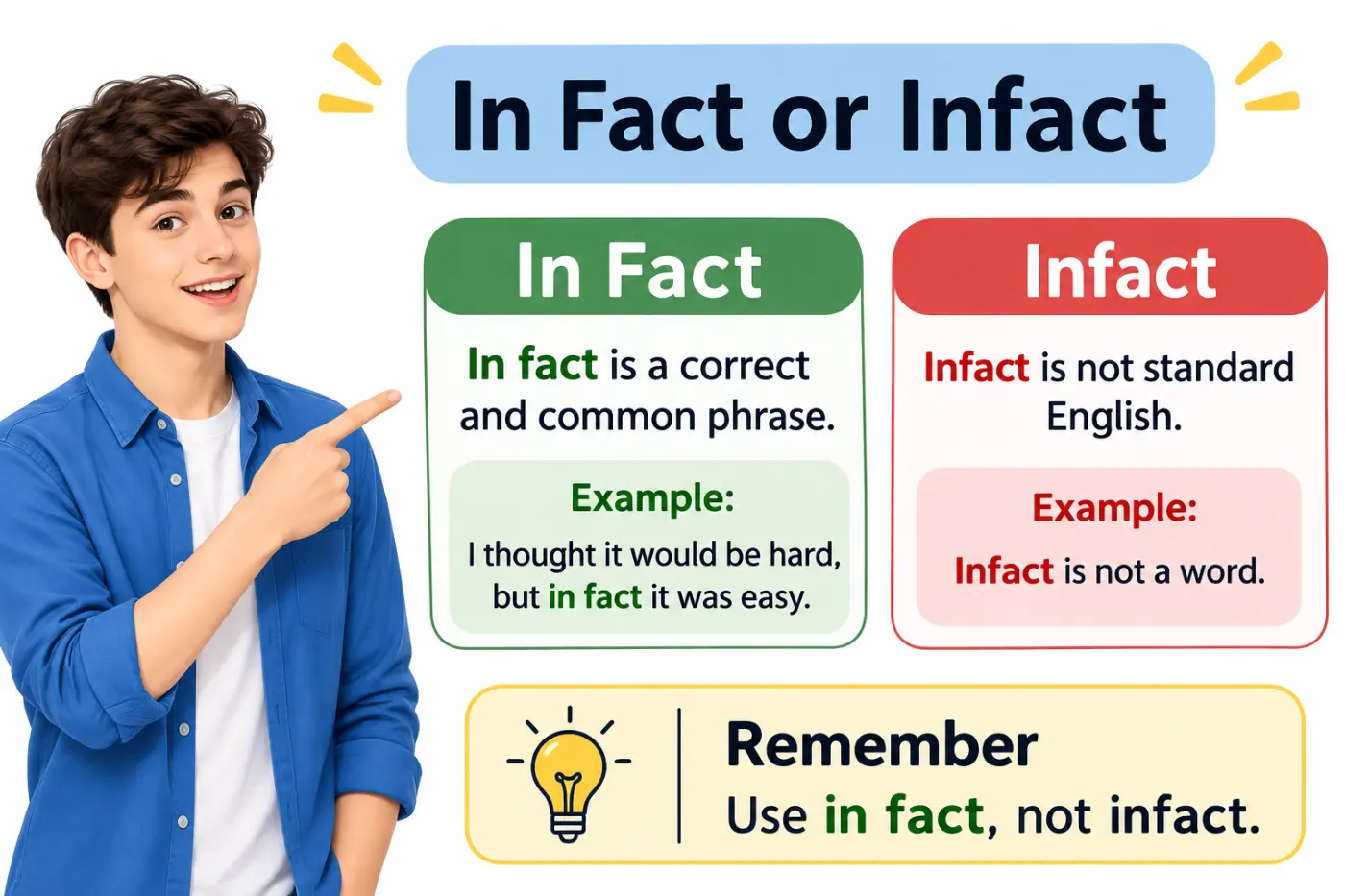
The correct spelling is in fact. It is a two word phrase used to introduce information that is true, clarify a previous statement, or emphasize a point. Infact, written as one word, is an incorrect spelling in standard English.
In fact, is commonly used in everyday conversations, professional emails, academic writing, and online messages. It helps connect ideas and gives readers a clearer understanding of what you’re trying to say.
In this guide, you’ll learn the difference between these spellings, their meanings, word origins, useful synonyms, and practical examples. You’ll also discover how to use the expression naturally in different writing situations.
What Is the Correct Spelling Between In Fact or Infact?
The correct spelling is in fact, written as two separate words. It is an established English expression that means actually, truly, or as a matter of fact.
Infact is not a standard English word. It is a common typing and spelling mistake that happens when people combine the two words.
Here is a simple comparison:
| Spelling | Correct or Incorrect | Explanation |
|---|---|---|
| In fact | Correct | Standard English expression |
| Infact | Incorrect | Words are incorrectly combined |
| In Fact | Correct in a title | Capitalization depends on title style |
| IN FACT | Correct in uppercase | Used for emphasis or headings |
Remember that the two words work together to express one idea, but they must remain separate in writing.
What Does In Fact Mean in Simple English?
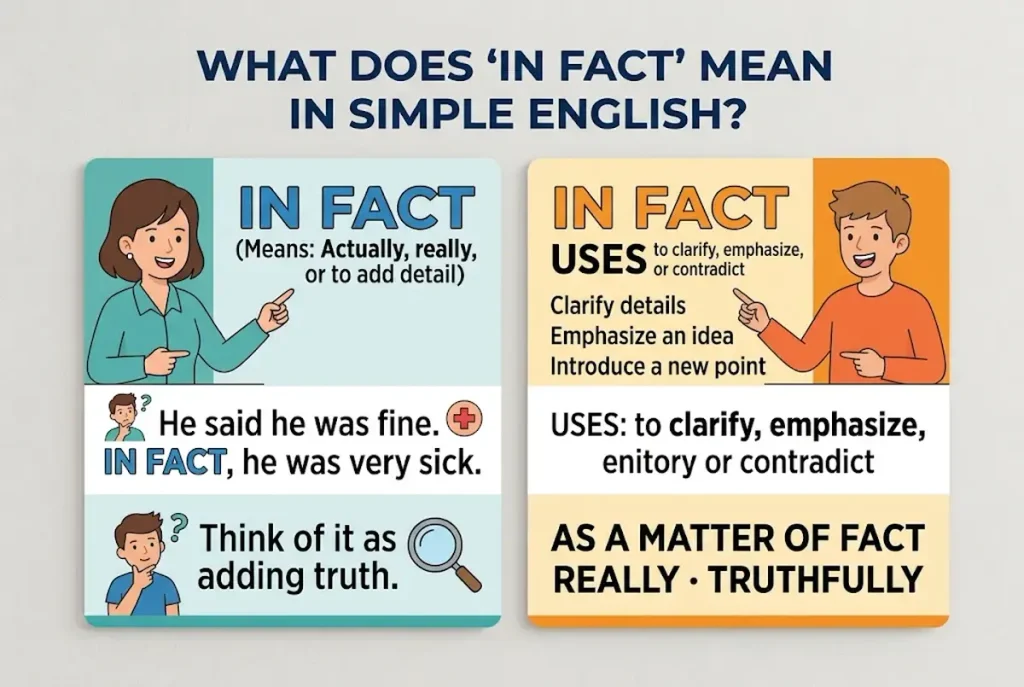
In fact means actually or truly. People use it when they want to explain something accurately, add an important detail, or correct an idea that may not be completely true.
It can also introduce information that supports an earlier statement.
For example:
- She is not angry. In fact, she is quite happy.
- I thought the test would be difficult. In fact, it was easy.
- He knows several languages. In fact, he speaks five.
The Three Main Meanings
The phrase can serve several purposes depending on the sentence.
1. To introduce a true statement
It can emphasize that something is real or accurate.
Example: In fact, the library opens at eight every morning.
2. To correct an incorrect impression
It can introduce information that changes what someone previously believed.
Example: I thought Mark was a new employee. In fact, he has worked here for ten years.
3. To add supporting information
It can introduce an additional detail that makes an earlier statement stronger.
Example: Sarah is an excellent student. In fact, she received the highest grade in her class.
These uses make the expression helpful in both spoken and written English.
Where Did the Phrase In Fact Come From?
Understanding the origin of an expression can make its meaning easier to remember.
The phrase in fact comes from two separate English words: in and fact.
The word fact has roots in the Latin word factum, which means something done or an action. It is connected to the Latin verb facere, meaning to do or make.
Over time, the meaning of fact developed to describe something that is real, true, or supported by evidence.
The word in is a common English preposition. It can express position, condition, or relationship.
When these two words are combined, they form the expression in fact. Its meaning is closely related to something being true or existing in reality.
The phrase has become a common way to introduce accurate information, provide clarification, and emphasize a statement.
Why Is It Written as Two Words?
The expression contains two separate grammatical words.
- In is a preposition.
- Fact is a noun.
They work together as a phrase, but they do not form a single compound word.
This is why adding a space is necessary. Writing them together changes the spelling into an unrecognized form in standard English.
A useful way to remember this is to think of the phrase as meaning in reality. Both words contribute to the complete expression.
What Are the Best Synonyms for In Fact?
There are several alternatives you can use when you want to express the same general idea.
However, not every synonym works in every sentence. Some are suitable for formal writing, while others sound more natural in everyday conversations.
The following table includes 28 useful alternatives, their meanings, tones, and examples.
Simple Synonyms
These words are easy to understand and work well in everyday English.
| Word | Meaning | Tone | Example |
|---|---|---|---|
| Actually | Really or truly | Simple | Actually, I already knew the answer. |
| Really | In a real or true way | Casual | She really enjoys reading. |
| Truly | Honestly or genuinely | Simple | He is truly talented. |
| Indeed | Certainly or really | Neutral | Indeed, the results were impressive. |
| Certainly | Without doubt | Neutral | She certainly deserves the award. |
| Honestly | In an honest way | Conversational | Honestly, I expected something different. |
| Definitely | Without uncertainty | Casual | They definitely finished the project. |
Everyday Synonyms
These expressions are useful in conversations, emails, and general writing.
| Word | Meaning | Tone | Example |
|---|---|---|---|
| As a matter of fact | To emphasize a true detail | Everyday | As a matter of fact, I met him yesterday. |
| To be honest | To express an honest opinion | Conversational | To be honest, I don’t like that idea. |
| In reality | According to the actual situation | Neutral | In reality, the process takes less time. |
| As it happens | Introducing a relevant fact | Conversational | As it happens, I know her brother. |
| The truth is | Introducing an honest explanation | Everyday | The truth is, we need more time. |
| In truth | According to what is true | Neutral | In truth, the decision was difficult. |
| For real | Genuinely or actually | Casual | He was excited for real. |
Formal Synonyms
These alternatives are useful in professional documents, reports, essays, and academic writing.
| Word | Meaning | Tone | Example |
|---|---|---|---|
| In reality | According to actual conditions | Formal | In reality, the figures were much lower. |
| In actuality | In the actual situation | Formal | In actuality, the company made a profit. |
| As a matter of fact | Introducing factual information | Formal | As a matter of fact, the report confirms this result. |
| Indeed | Emphasizing a statement | Formal | Indeed, the findings support the conclusion. |
| In essence | Expressing the basic truth | Formal | In essence, the proposal addresses two major problems. |
| Factually | Based on facts | Formal | The claim was factually incorrect. |
| To be precise | Introducing exact information | Formal | To be precise, the meeting begins at 9:30 a.m. |
Which Synonyms Are Best From Mild to Strong?
Not all alternatives express the same level of emphasis. Some simply introduce information, while others make a statement sound more certain or powerful.
Choosing the right strength helps your writing sound natural.
Mild Expressions
Mild alternatives introduce information without adding much emphasis.
- Actually: She actually lives nearby.
- In reality: In reality, the situation is quite simple.
- In truth: In truth, the answer is not complicated.
Moderate Expressions
Moderate alternatives add more confidence to a statement.
- Indeed: Indeed, the new plan is better.
- Certainly: She certainly understands the problem.
- To be honest: To be honest, I prefer the first option.
Strong Expressions
Strong alternatives communicate certainty, seriousness, or emphasis.
- Definitely: This is definitely the right decision.
- Undoubtedly: Undoubtedly, the discovery changed the field.
- Beyond doubt: His experience is beyond doubt.
Can In Fact Be Used as Different Parts of Speech?
The expression in fact is not a noun, verb, or adjective. It generally functions as an adverbial phrase.
An adverbial phrase provides additional information about a statement, action, or idea.
For example:
- She is, in fact, the manager.
- In fact, the results were better than expected.
- The situation is not improving. In fact, it is getting worse.
In Fact as a Sentence Opener
It can appear at the beginning of a sentence to introduce an important point.
Example: In fact, the school has already announced the results.
This position is common in essays, articles, reports, and conversations.
In Fact in the Middle of a Sentence
It can also appear within a sentence to add emphasis.
Example: The new employee is, in fact, more experienced than the previous manager.
When used as an interrupting expression, it is usually separated by commas.
In Fact at the End of a Sentence
The expression can occasionally appear at the end of a sentence, although this structure is less common.
Example: I was right about the result, in fact.
A more natural version would usually be:
I was right about the result. In fact, I predicted it correctly.
For clear writing, placing the expression at the beginning or middle of a sentence is often the better choice.
Is In Fact Different in American and British English?
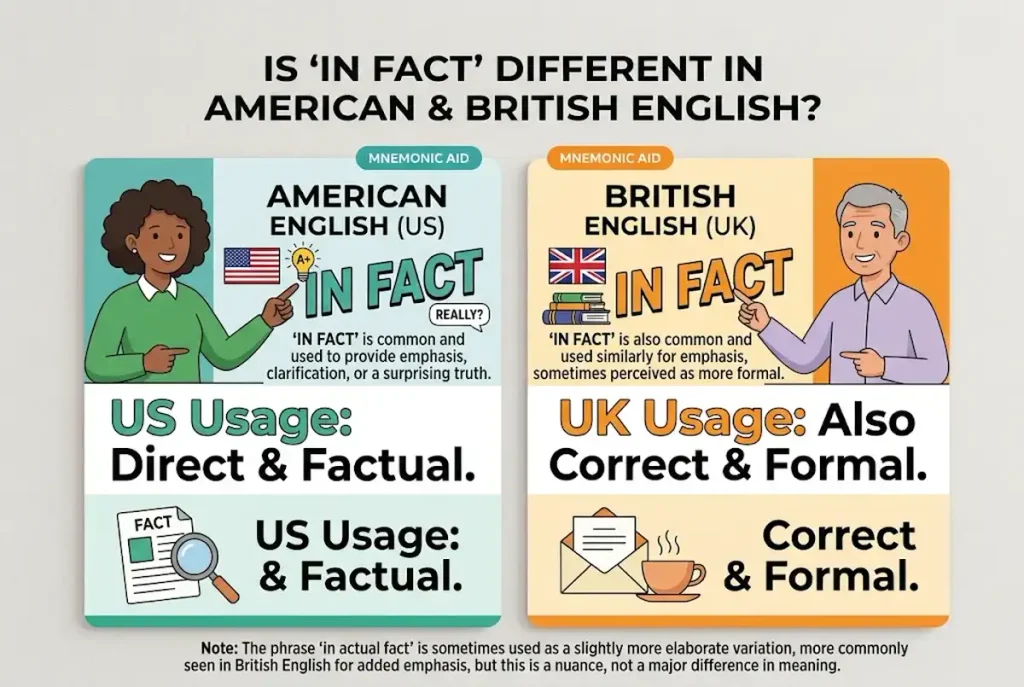
No. The spelling and basic meaning are the same in American and British English.
Both varieties use in fact as a two word expression.
| Feature | American English | British English |
|---|---|---|
| Correct spelling | In fact | In fact |
| Incorrect spelling | Infact | Infact |
| Meaning | Actually or truly | Actually or truly |
| Everyday use | Common | Common |
| Formal writing | Accepted | Accepted |
| Pronunciation | Similar | Similar |
There is no regional spelling difference that changes the correct form.
American and British writers may have different preferences for punctuation or sentence structure, but the expression itself remains unchanged.
For example:
- American English: In fact, the store is open until nine.
- British English: In fact, the shop is open until nine.
Which Expression Should You Use in Different Writing Situations?
The best alternative depends on your audience, purpose, and writing style.
Although in fact works in many situations, using the same expression repeatedly can make your writing sound less natural.
Here are some useful choices for common writing situations.
What Should You Use in a Resume?
A resume should be clear, professional, and focused on achievements.
The expression in fact is grammatically correct, but it is rarely the strongest choice in a resume. Instead, use direct statements supported by measurable information.
Example:
Weak: In fact, I have five years of experience in customer service.
Better: I have five years of experience in customer service and a strong record of solving customer problems.
A resume usually benefits from confident statements rather than extra introductory expressions.
What Should You Use in an Academic Essay?
In academic writing, you may use in fact to introduce evidence, clarify a point, or strengthen an argument.
However, alternatives such as indeed, actually, and the evidence shows can sometimes create a more suitable academic tone.
Example:
In fact, the research suggests that regular reading can improve vocabulary development.
Another option:
Indeed, the research suggests that regular reading can improve vocabulary development.
For academic work, make sure that factual claims are supported by reliable sources.
What Should You Use in Text Messages?
Text messages are usually informal, so simple expressions work best.
You can use actually, honestly, really, or for real, depending on your meaning.
Examples:
- Actually, I’m already on my way.
- Honestly, that movie was amazing.
- For real, I didn’t know about the event.
- In fact, I have an extra ticket.
There is no need to make a casual message sound overly formal.
What Are Some Real Examples of In Fact in Sentences?
Seeing an expression in different situations helps you understand how to use it correctly.
Below are 15 original examples from everyday life, education, work, and social situations.
Everyday Life Examples
- I thought the grocery store was closed, but in fact, it was open until midnight.
- My brother looks quiet, but in fact, he enjoys talking to new people.
- The weather seemed cold in the morning. In fact, it became quite warm by noon.
- I expected the journey to take three hours. In fact, we arrived in less than two.
- She said she didn’t need help. In fact, she appreciated our support.
School and Education Examples
- The mathematics test looked difficult. In fact, most students completed it easily.
- Our teacher explained that the assignment was optional. In fact, completing it could improve our grades.
- Many students think grammar is difficult. In fact, regular practice makes it easier to understand.
- I believed the answer was incorrect. In fact, it was completely right.
- The book contains useful information. In fact, it explains several important grammar rules.
Workplace Examples
- The manager expected the project to take a month. In fact, the team finished it in three weeks.
- Our new employee has limited experience. In fact, she has excellent technical skills.
- The company planned to hire five people. In fact, it hired eight.
- The meeting was supposed to last thirty minutes. In fact, it continued for almost an hour.
- The report looked complicated. In fact, its main findings were quite simple.
What Is the Difference Between In Fact and Actually?
In fact and actually are closely related, but they are not always interchangeable.
Both can introduce true information. However, they have slightly different uses and tones.
| In Fact | Actually |
|---|---|
| Often introduces supporting information | Often corrects or clarifies information |
| Common in formal and informal writing | Common in everyday conversation |
| Can emphasize an entire statement | Can modify a word, phrase, or statement |
| Often connects two ideas | Often responds to an assumption |
When Should You Choose In Fact?
Use it when you want to introduce additional information, strengthen a point, or explain what is really happening.
Example: He is a talented musician. In fact, he has won several national awards.
When Should You Choose Actually?
Use it when correcting a misunderstanding or giving information that may surprise someone.
Example: Actually, I don’t work on Fridays.
Both expressions are useful, but understanding their purpose will help you avoid awkward sentences.
What Is the Difference Between In Fact and Indeed?
Indeed is another common alternative, especially in formal writing.
Both expressions can emphasize a statement, but they have slightly different tones.
| In Fact | Indeed |
|---|---|
| Introduces true or additional information | Emphasizes or confirms a statement |
| Often clarifies a situation | Often expresses agreement or certainty |
| Natural in everyday and formal writing | Often sounds more formal |
| Can introduce a correction | Can reinforce an existing point |
Which One Is Better?
Choose in fact when you want to explain or add information.
Choose indeed when you want to confirm or emphasize something.
Both are correct, but the sentence should determine which expression sounds more natural.
What Are the Common Mistakes When Using In Fact?
Even though this expression is simple, writers sometimes make mistakes with its spelling, punctuation, and placement.
Understanding these errors can help improve your English writing.
Writing It as One Word
This is the most common mistake.
Incorrect: Infact, the answer is correct.
Correct: In fact, the answer is correct.
Always keep a space between the two words.
Forgetting the Comma
When the expression introduces a complete sentence, a comma usually follows it.
Less clear: In fact the answer was correct.
Better: In fact, the answer was correct.
The comma helps readers recognize the introductory expression.
Using It Too Many Times
Repeating the same expression throughout a paragraph can make writing sound unnatural.
Repetitive:
In fact, the school is large. In fact, it has many classrooms. In fact, it also has a library.
Improved:
The school is large. It has many classrooms and, in addition, a well-equipped library.
Use different sentence structures to keep your writing interesting.
Using It Without Adding Useful Information
The expression should have a purpose. It should introduce a fact, clarification, or meaningful detail.
Weak: I like reading. In fact, reading is something I like.
Better: I like reading. In fact, I finish at least two books every month.
The second example provides meaningful information.
Confusing It With Infact
Some writers assume that because the expression has one meaning, it should also have one spelling unit.
However, many English expressions contain multiple words.
The correct form remains in fact, regardless of the sentence or writing style.
When Should You Avoid Using In Fact?
Although the expression is useful, there are situations where another sentence structure may work better.
When a Sentence Is Already Clear
You don’t need an introductory expression if the statement communicates its meaning perfectly.
Wordy: In fact, the meeting starts at 10 a.m.
Direct: The meeting starts at 10 a.m.
The shorter version is often better when no extra emphasis is needed.
When You Need a Stronger Transition
Sometimes, another transition word communicates the relationship between ideas more clearly.
For example:
- However introduces contrast.
- Therefore introduces a result.
- For example introduces an illustration.
- Additionally introduces extra information.
- In conclusion introduces a final point.
When You Are Writing Short Instructions
Instructions should be direct and easy to follow.
Wordy: In fact, you should click the blue button to continue.
Better: Click the blue button to continue.
Removing unnecessary words makes instructions easier to understand.
When You Are Making an Unsupported Claim
Using in fact doesn’t automatically make a statement true.
For example:
In fact, everyone agrees with this decision.
Unless you have evidence that everyone agrees, the statement may be misleading.
Use accurate information and reliable evidence when making factual claims.
What Are the Antonyms of In Fact?
An antonym is a word or expression with an opposite or contrasting meaning.
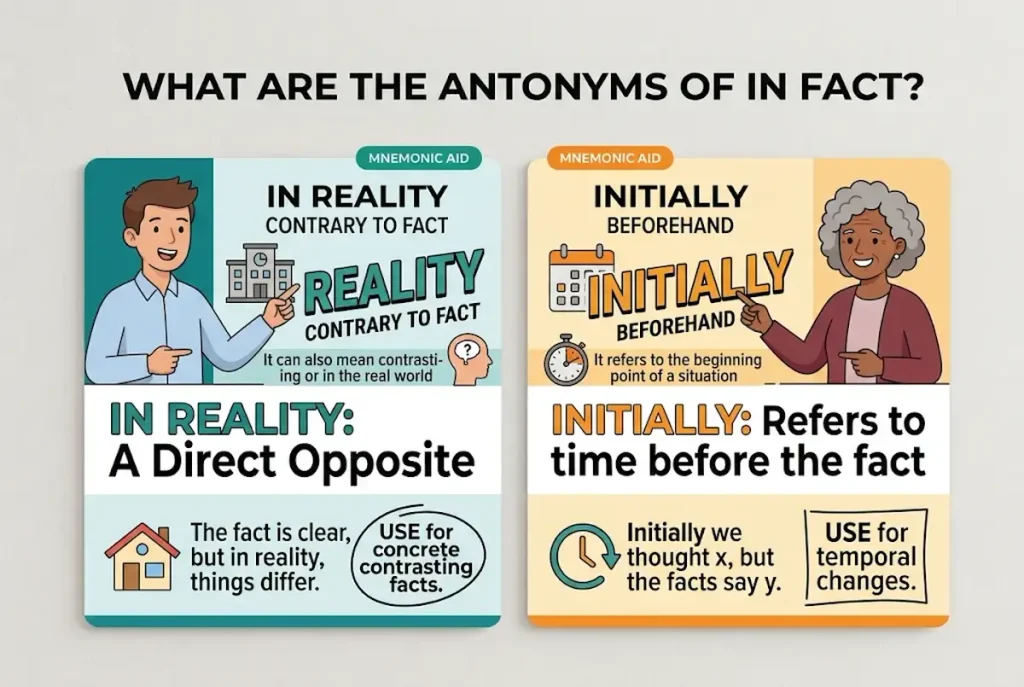
Because in fact is an adverbial phrase, it doesn’t have one exact opposite in every situation. However, several expressions can communicate contrasting ideas.
| Opposite or Contrasting Expression | Meaning | Example |
|---|---|---|
| In theory | According to an idea rather than actual practice | In theory, the plan should work. |
| Apparently | Based on what seems to be true | Apparently, the office is closed. |
| Supposedly | According to what people claim | Supposedly, the product is free. |
| Allegedly | According to an unproven claim | The company allegedly changed its policy. |
| Hypothetically | Based on an imagined situation | Hypothetically, we could finish tomorrow. |
| Perhaps | Possibly or maybe | Perhaps the answer is different. |
How Can You Choose the Right Alternative?
Choosing the right expression becomes easier when you understand your purpose and audience.
Here are some practical tips.
- Understand your meaning first. Decide if you want to introduce a fact, correct an assumption, or emphasize an idea.
- Consider your audience. Use professional expressions in reports and simpler alternatives in casual conversations.
- Avoid unnecessary emphasis. If your sentence is already clear, you may not need an introductory phrase.
- Check the sentence flow. Read the complete sentence to see if the alternative sounds natural.
- Use evidence for factual claims. An introductory expression cannot replace reliable information.
Conclusion
The correct spelling is in fact, written as two separate words. Infact is a spelling mistake and should not be used in standard English writing. The expression helps introduce true information, clarify an earlier statement, and emphasize an important detail.
You can use alternatives such as actually, indeed, in reality, and as a matter of fact to make your writing more natural and varied. The best choice depends on your sentence, audience, and purpose.
Remembering the space between the two words is a simple way to avoid a common spelling error. With regular practice, you’ll find it easier to use this expression correctly in emails, essays, conversations, and professional documents.
Frequently Asked Questions
Is in fact one word or two words?
In fact is always written as two words in standard English. Infact is an incorrect spelling.
Is infact a real English word?
No, infact is not recognized as a standard English word. The correct expression is in fact.
Why do people write infact instead of in fact?
People often combine the words because they sound like one expression when spoken. However, the correct written form always includes a space.
Can I start a sentence with in fact?
Yes, you can start a sentence with in fact. Place a comma after it when it introduces a complete sentence.
What is another way to say in fact?
Actually, indeed, in reality, truly, and as a matter of fact are common alternatives. Choose one based on the meaning and tone of your sentence.
Is in fact formal or informal?
In fact is suitable for both formal and informal situations. It works in academic essays, professional emails, everyday conversations, and general writing.
Do American and British English spell in fact differently?
No, American and British English use the same two word spelling. Neither variety accepts infact as the standard form.
Can I use in fact and actually in the same sentence?
Yes, but using both is usually unnecessary because their meanings overlap. Choose the expression that communicates your point most clearly.

Daniel Grammarfield — The Language Learner
Age: 28Occupation: ESL Learner & Digital Professional
Bio:Daniel is a non-native English speaker who wants to communicate more confidently at work and online. He uses Synotrench to improve grammar, understand confusing words, learn correct sentence structures, and build everyday English skills. He prefers simple explanations with practical examples.
Goals:
Master English grammar rules
Avoid common language mistakes
Improve professional communication
Learn English through real-life examples
Quote:“Learning English is not about memorizing rules — it’s about expressing ideas clearly.”
2 thoughts on “In Fact or Infact: Best Spelling and Usage Guide”