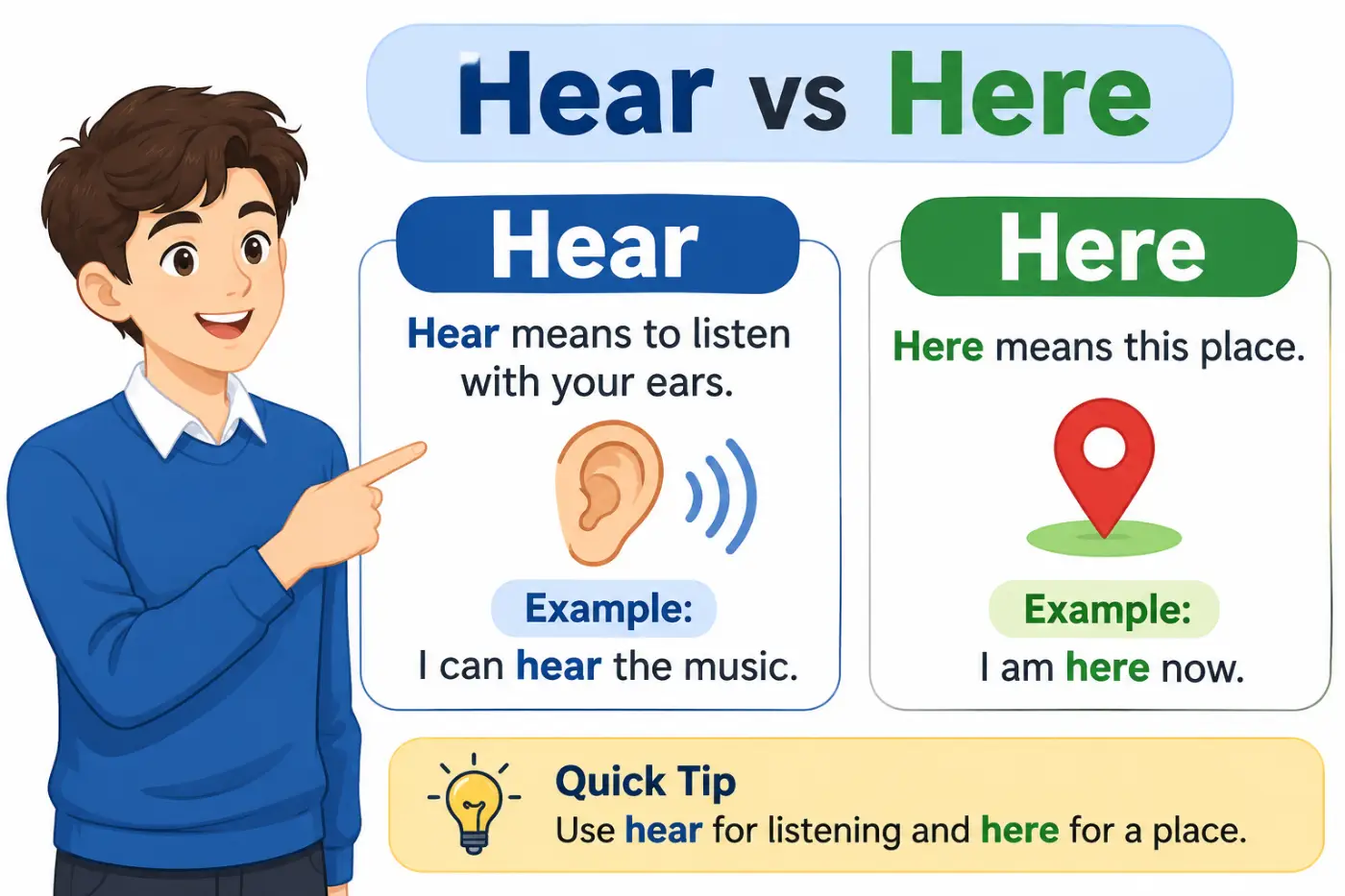
The difference between hear vs here is simple once you understand what each word does. One relates to listening and sound, while the other refers to a place, position, or location. They are homophones, which means they have the same pronunciation but different spellings and meanings.
When writing an email, sending a text, or completing an English assignment, you might pause and wonder if you should use hear or here. These two words sound exactly alike, but their meanings and uses are completely different. Choosing the wrong one can change the meaning of your sentence.
Hear means to notice or receive a sound through your ears. Here means in this place or at this location. For example, you can hear music, but you can come here to listen to it.
Although both words sound the same, they cannot replace each other. In this guide, you’ll learn their meanings, origins, grammar rules, examples, common mistakes, and practical tips for choosing the correct word in everyday writing.
What Is the Difference Between Hear and Here?
The main difference is that hear is a verb connected to sound, while here is an adverb that identifies a place or location.
| Word | Part of Speech | Meaning | Example |
|---|---|---|---|
| Hear | Verb | To notice sound with your ears | I can hear the birds singing. |
| Here | Adverb | In this place or location | Please come here. |
What Does Hear Mean?
Hear is a verb that means to notice, receive, or become aware of a sound through your ears. You don’t always need to pay attention to a sound to hear it. Sometimes, your ears notice sounds automatically.
For example, you might hear a car passing outside while reading a book. You weren’t listening for the car, but you still noticed its sound.
Hear can also describe receiving information, listening to someone’s opinion, or learning about something.
Examples:
- I can hear someone knocking on the door.
- Did you hear the announcement?
- She likes to hear stories about her grandparents.
- We heard the news this morning.
- I want to hear your opinion.
What Does Here Mean?
Here is an adverb that means in this place, at this location, or in the current position. It helps identify where someone or something is.
For example, when you tell a friend to sit here, you’re asking them to sit in the place where you are.
Here can also refer to a particular point in a conversation, document, or situation.
Examples:
- Please wait here for a few minutes.
- I live here with my family.
- Put your bag here.
- We are happy to have you here.
- Here is the document you requested.
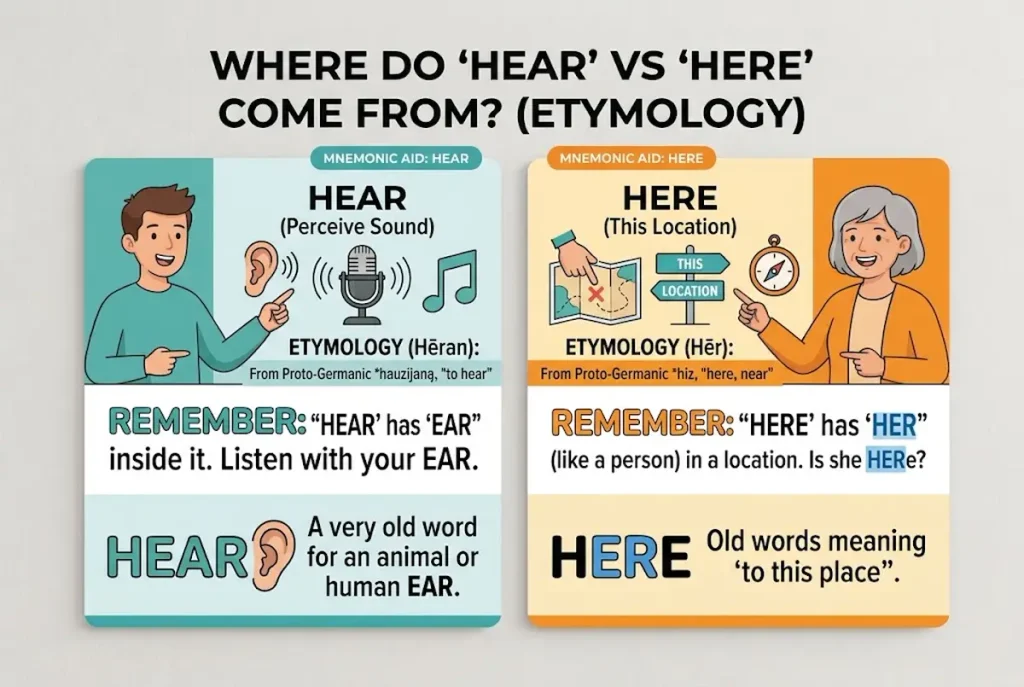
Where Do Hear vs Here Come From?
Understanding the origins of words can make their meanings easier to remember. Although these words sound alike today, they developed from different Old English words.
What Is the Origin of Hear?
The word hear comes from the Old English word hieran or hīeran, which meant to hear, listen, or pay attention to sound.
It is connected to the Germanic language family. Related forms appear in other languages, including German hören, which means to hear or listen.
Over time, the spelling and pronunciation changed, but the central meaning remained connected to receiving sound.
Today, hear has several uses:
- Physical hearing: I can hear the rain.
- Receiving information: I heard about your promotion.
- Listening to someone: The manager wants to hear your ideas.
What Is the Origin of Here?
Here comes from the Old English word hēr, which meant in this place or at this location.
It also has roots in the Germanic language family. Similar words appear in German hier and Dutch hier, both meaning here.
The meaning has remained remarkably consistent over time. It still identifies a place or position.
Today, here can be used in different ways:
- Physical location: Come here and sit beside me.
- Present situation: Here we are again.
- Introducing something: Here is your coffee.
Why Do These Words Sound the Same?
Hear and here are homophones. Homophones are words that have the same pronunciation but different meanings and spellings.
In standard American English, both words are pronounced /hɪr/. Their identical sounds can make spelling confusing, especially when writing quickly.
However, their meanings provide a simple way to tell them apart.
Remember:
- Hear relates to your ears.
- Here relates to your location.
What Are the Synonyms of Hear and Here?
Synonyms are words with similar meanings. However, not every synonym can replace the original word in every sentence.
Hear has synonyms connected to listening, receiving sounds, and gaining information. Here has alternatives connected to location and position.
The following tables organize useful alternatives by tone and everyday use.
What Are the Simple Synonyms of Hear?
These words are easy to understand and work well in everyday conversations.
| Word | Meaning | Tone | Example |
|---|---|---|---|
| Listen | Pay attention to sound | Simple | Listen to the teacher. |
| Notice | Become aware of something | Simple | I noticed a strange noise. |
| Catch | Manage to hear something | Casual | I didn’t catch your last words. |
| Detect | Discover a sound or signal | Simple | She detected a faint sound. |
| Perceive | Become aware through the senses | Neutral | He perceived a distant noise. |
| Understand | Know what someone says | Simple | I understand what you’re saying. |
What Are the Everyday Synonyms of Hear?
These words are useful in normal conversations, messages, and informal writing.
| Word | Meaning | Tone | Example |
|---|---|---|---|
| Overhear | Hear something unintentionally | Everyday | I overheard their conversation. |
| Eavesdrop | Secretly listen to a conversation | Everyday | Don’t eavesdrop on others. |
| Tune in | Listen to a broadcast | Casual | Tune in to the radio tonight. |
| Make out | Understand a difficult sound | Casual | I could barely make out his voice. |
| Pick up | Receive or notice a sound | Casual | The microphone picked up a whisper. |
| Attend | Listen carefully or pay attention | Neutral | Please attend to the speaker. |
What Are the Formal Synonyms of Hear?
These alternatives are useful in academic, professional, and official writing.
| Word | Meaning | Tone | Example |
|---|---|---|---|
| Perceive | Become aware of something | Formal | The listener perceived a change in tone. |
| Discern | Recognize something with difficulty | Formal | She discerned a faint sound. |
| Ascertain | Find out or establish information | Formal | The committee sought to ascertain the facts. |
| Receive | Take in a sound or message | Formal | The device received the audio signal. |
| Attend to | Give attention to something | Formal | The audience attended to the presentation. |
| Be informed | Receive information | Formal | We were informed of the decision. |
What Are the Slang and Casual Alternatives of Hear?
These expressions are common in relaxed conversations. Some are idiomatic rather than exact synonyms.
| Word or Phrase | Meaning | Tone | Example |
|---|---|---|---|
| Catch that | Hear or understand something | Casual | Did you catch that? |
| Hear me out | Listen until someone finishes | Casual | Hear me out before you decide. |
| Get an earful | Hear a long or angry complaint | Slang | I got an earful from my boss. |
| Pick up on | Notice a sound or detail | Casual | She picked up on his nervous tone. |
| Listen up | Pay attention | Informal | Listen up, everyone! |
| Take in | Absorb information | Casual | I couldn’t take in everything he said. |
What Are the Synonyms of Here?
Here refers to a location, so its alternatives depend on the sentence.
| Word | Meaning | Tone | Example |
|---|---|---|---|
| Nearby | Close to this place | Everyday | There is a store nearby. |
| Present | At this location | Formal | Everyone is present today. |
| Locally | In this area | Neutral | The product is made locally. |
| At this place | At the current location | Neutral | Meet me at this place. |
| In this area | Within the current area | Everyday | There are many parks in this area. |
| On-site | At a particular location | Professional | The technician is available on-site. |
| Around | In the nearby area | Casual | Is anyone around? |
| At hand | Within reach or available | Everyday | Keep your notes at hand. |
How Do You Choose the Right Word by Intensity?
Words connected to hearing can describe different levels of attention and awareness. Choosing the right expression makes your writing more accurate.
What Words Describe Mild Hearing?
These words describe becoming aware of a sound without necessarily paying close attention.
1. Notice: Become aware of a sound.
Example: I noticed a bird outside.
2. Detect: Discover a sound that may be difficult to recognize.
Example: The machine detected a faint signal.
3. Perceive: Become aware of something through your senses.
Example: She perceived a slight change in his voice.
What Words Describe Ordinary Hearing?
These expressions describe normal listening or receiving sounds.
1. Hear: Receive sound through your ears.
Example: I can hear the television.
2. Listen: Pay attention to a sound.
Example: Listen to this song.
3. Overhear: Hear something without intending to.
Example: I overheard their discussion.
What Words Describe Strong or Careful Listening?
These expressions show greater attention or effort.
1. Concentrate: Focus your attention on something.
Example: Concentrate on the speaker’s instructions.
2. Eavesdrop: Secretly listen to someone else’s conversation.
Example: He tried to eavesdrop on the meeting.
3. Discern: Recognize something that is difficult to notice.
Example: She could discern a whisper from across the room.
These words describe different actions, not simply stronger and weaker versions of hearing. Choose them based on what actually happens.
How Are Hear and Here Used in Different Parts of Speech?
The two words have different grammatical roles. Understanding these roles helps prevent spelling mistakes.
Is Hear a Verb?
Yes. Hear is primarily a verb. It describes the action of receiving sound or information.
Common forms include:
| Verb Form | Word | Example |
|---|---|---|
| Base form | Hear | I hear music. |
| Third-person singular | Hears | She hears the alarm. |
| Past tense | Heard | We heard a noise. |
| Past participle | Heard | I have heard that story. |
| Present participle | Hearing | He is hearing a strange sound. |
Is Here an Adverb?
Yes. Here is mainly an adverb of place. It explains where something happens or where someone or something is located.
Examples:
- Come here immediately.
- I left my phone here.
- We are staying here tonight.
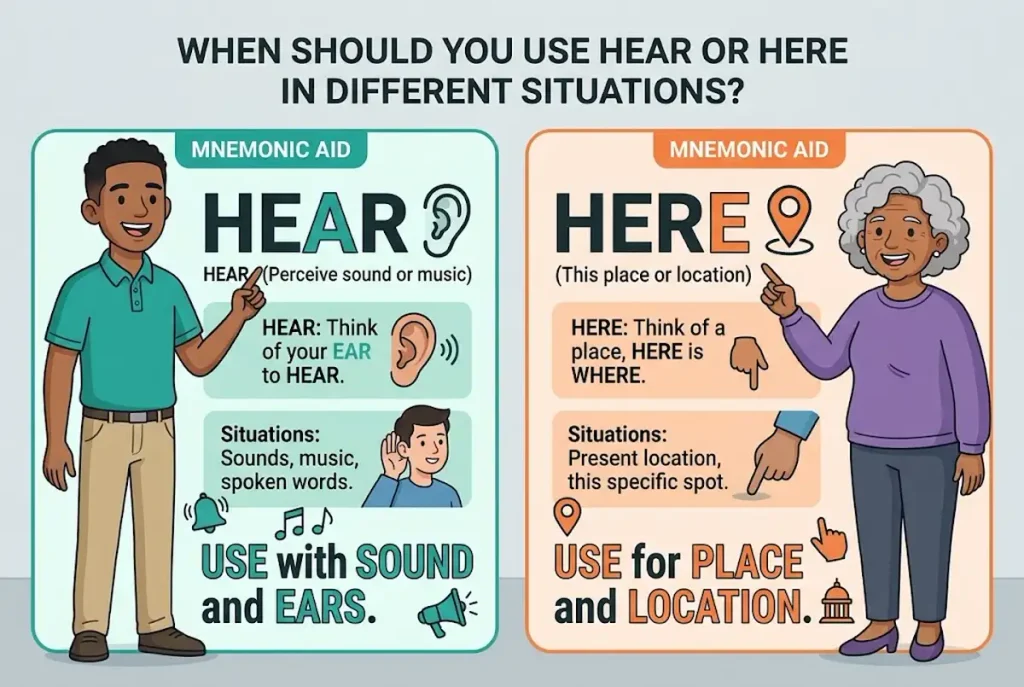
When Should You Use Hear or Here in Different Situations?
The correct choice depends on what you want to communicate. A sound or listening action requires hear, while a place or position requires here.
Which Word Is Best for a Resume?
Use hear when describing listening, communication, or understanding information. Use here only when it naturally refers to a location, which is less common in resume writing.
Resume example:
I listen carefully to customer concerns and communicate solutions clearly.
Another example:
Experienced in hearing customer feedback and identifying service improvements.
The first sentence sounds more natural because listen describes an active communication skill.
Which Word Is Best for an Essay?
Both words can appear in academic writing, but their meanings must remain clear.
Use hear when discussing sounds, communication, or receiving information.
Example:
Students can hear different opinions during classroom discussions.
Use here when referring to a location or a specific point in your explanation.
Example:
Here, the author introduces the main argument of the passage.
Which Word Is Best for Texting?
Both words are common in text messages. Their correct spelling makes your message easier to understand.
Examples:
- Can you hear me?
- I’m here outside.
- I can’t hear anything.
Which Word Is Best for an Email?
Use hear when discussing information, calls, feedback, or communication. Use here when identifying a location or directing someone to a particular part of a message.
Examples:
- I would love to hear your feedback.
- Please find the requested information here.
- I hope to hear from you soon.
- You can contact me here if you need assistance.
Both words are useful in professional emails, but they perform different jobs.
Which Word Is Best for Speaking?
In spoken English, both words sound the same. Listeners understand the intended meaning from the sentence and its context.
Examples:
- Can you hear the music?
- Please come here.
- I heard your announcement.
What Are 15 Examples of Hear and Here in Real Situations?
Examples make the difference easier to understand. The following sentences show how these words work in daily life, school, work, and personal communication.
What Are Examples of Hear in Everyday Sentences?
1. I can hear the children playing outside.
Hear describes the sound reaching someone’s ears.
2. Did you hear the phone ringing?
It asks if someone noticed a particular sound.
3. We heard a loud noise during the storm.
Heard is the past tense of hear.
4. I want to hear your side of the story.
Hear refers to listening to someone’s explanation.
5. She loves to hear her grandmother’s stories.
The word describes receiving spoken information.
6. Can you hear me clearly during this call?
Hear refers to receiving someone’s voice.
7. I heard that the school is closed tomorrow.
Heard describes receiving information.
8. The doctor wants to hear about your symptoms.
Hear refers to listening to information from a patient.
What Are Examples of Here in Everyday Sentences?
9. Please sit here beside me.
Here identifies a particular place.
10. Your shoes are right here.
Here shows where the shoes are located.
11. We have been living here for five years.
It identifies the place where someone lives.
12. Come here before the movie starts.
Here refers to the speaker’s location.
13. Here is the book you asked for.
Here introduces something being presented.
14. I left my wallet here yesterday.
Here identifies the place where the wallet was left.
15. There are many beautiful places here.
Here refers to the current area.
How Do Hear and Here Work Together?
You can use both words in the same sentence because they have different meanings.
Examples:
- Come here so you can hear the announcement.
- I can hear the birds singing here.
- We heard the news while sitting here.
- Stand here if you want to hear the speaker clearly.
- I heard someone calling me from here.
These examples are especially useful because they show how the words work together without replacing each other.
What Is the Difference Between Hear and Listen?
Hear and listen are closely related, but they do not mean exactly the same thing.
Hear describes receiving sound through your ears. Listen means making an effort to pay attention to sound.
| Hear | Listen |
|---|---|
| Usually happens naturally | Usually involves attention |
| Focuses on receiving sound | Focuses on paying attention |
| Can happen without intention | Usually involves intention |
| I hear the rain. | I listen to the rain. |
Examples:
- I heard the teacher speaking while I was writing.
- I listened to the teacher because I wanted to understand the lesson.
In the first sentence, the person simply noticed the sound. In the second, the person intentionally paid attention.
Another important grammar difference is that listen is commonly followed by the preposition to.
Correct: Listen to the music.
Incorrect: Listen the music.
Hear generally does not need to before its object.
Correct: I hear the music.
Incorrect: I hear to the music.
What Is the Difference Between Here and There?
Here and there both refer to locations, but they describe different positions.
Here usually refers to the place where the speaker is or a location being treated as close.
There usually refers to another place, often one farther away or already mentioned.
| Here | There |
|---|---|
| Refers to this place | Refers to another place |
| Identifies the current location | Identifies a different location |
| Come here. | Go there. |
| Your book is here. | Your book is there. |
Examples:
- I am here, but my brother is there.
- Put your bag here, not there.
- We have a beautiful garden here.
What Are the Common Mistakes With Hear and Here?
Even fluent English speakers sometimes confuse words that sound alike. These mistakes often happen when someone types quickly or relies on pronunciation instead of meaning.
Mistake 1: Using Here Instead of Hear
Incorrect: I can’t here you clearly.
Correct: I can’t hear you clearly.
Why? The sentence describes receiving someone’s voice. It needs the verb hear.
Mistake 2: Using Hear Instead of Here
Incorrect: Please come hear.
Correct: Please come here.
Why? The sentence asks someone to move to a particular location. It needs here.
Mistake 3: Confusing Them in Emails
Incorrect: I hope to here from you soon.
Correct: I hope to hear from you soon.
Why? The sentence refers to receiving a response or message.
Mistake 4: Confusing Them in Location Instructions
Incorrect: Your package is hear.
Correct: Your package is here.
Why? The sentence identifies the package’s current location.
Mistake 5: Choosing the Wrong Word in Questions
Incorrect: Can you here the announcement?
Correct: Can you hear the announcement?
Why? The question asks about someone’s ability to receive sound.
When Should You Not Use Hear or Here?
Avoid using hear when you are describing a location. Similarly, don’t use here when you mean listening or receiving sound.
Consider these examples:
| Intended Meaning | Incorrect | Correct |
|---|---|---|
| Receive sound | I can here music. | I can hear music. |
| Identify a place | Come hear. | Come here. |
| Receive a reply | I hope to here from you. | I hope to hear from you. |
| Show a location | Your bag is hear. | Your bag is here. |
| Ask about sound | Did you here that? | Did you hear that? |
What Are the Antonyms of Hear and Here?
Antonyms are words with opposite meanings. Neither hear nor here has one perfect opposite in every situation, but several words express contrasting ideas.
What Is the Opposite of Hear?
The closest opposite depends on the intended meaning.
| Word | Meaning | Example |
|---|---|---|
| Ignore | Pay no attention | He ignored the warning. |
| Miss | Fail to notice or receive | I missed the announcement. |
| Overlook | Fail to notice something | She overlooked the instruction. |
| Be silent | Make no sound | The room was silent. |
For example, if someone cannot hear a sound because they fail to notice it, miss may be appropriate. However, it is not a universal opposite of hear.
What Is the Opposite of Here?
The most useful opposite depends on the location being described.
| Word | Meaning | Example |
|---|---|---|
| There | At another place | Your friend is there. |
| Away | At a distance | He went away. |
| Elsewhere | In another place | We can meet elsewhere. |
| Absent | Not present | She is absent today. |
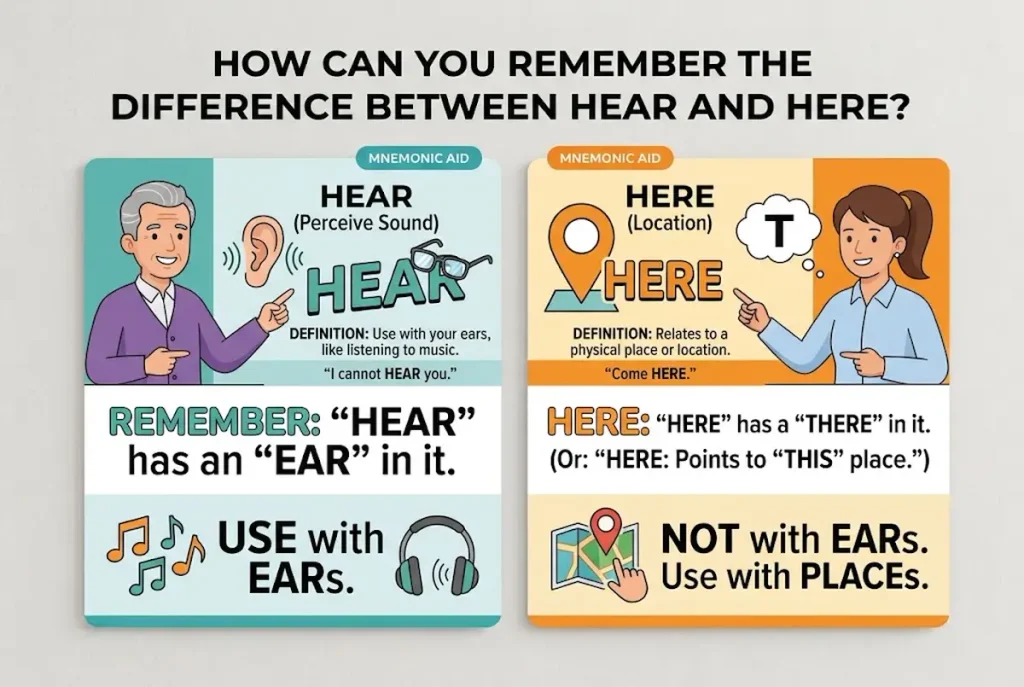
How Can You Remember the Difference Between Hear and Here?
Remembering these two words becomes easier when you connect each spelling with its meaning.
What Is the Easiest Memory Trick?
Use these two simple associations:
- Hear contains the word ear. Your ears help you hear sounds.
- Here points to a place. Think of the phrase come here when someone asks you to move closer.
How Can You Check Your Sentence Quickly?
Before choosing a word, ask yourself what your sentence describes.
| Question | Correct Word |
|---|---|
| Am I talking about sound? | Hear |
| Am I talking about listening? | Hear or listen, depending on the action |
| Am I describing a location? | Here |
| Am I asking someone to come to my position? | Here |
| Am I talking about receiving information? | Hear |
Conclusion
Understanding hear vs here becomes easy when you focus on what each word means instead of how it sounds. Hear is a verb that describes receiving sounds or information through your ears. Here is an adverb that identifies a place, position, or location.
Both words are pronounced alike in standard American English, but their spellings and grammatical functions are different. Remember the simple connection: your ears help you hear, while here tells someone where something is.
Use these meanings when writing emails, completing assignments, sending messages, or having everyday conversations. With regular practice, you’ll recognize the correct word without stopping to think twice. A little attention to context can make your English writing much clearer and more accurate.
Frequently Asked Questions
What is the main difference between hear and here?
Hear means to receive or notice sound through your ears, while here means in this place or at this location. One describes hearing, and the other describes a position.
Are hear and here pronounced the same?
Yes, both words are pronounced the same in standard American English. They are homophones because they share a pronunciation but have different spellings and meanings.
How do I remember when to use hear or here?
Remember that hear contains the word ear, which helps you connect it with listening. Use here when talking about a place or location.
Is hear a verb or an adjective?
Hear is a verb. It describes receiving sounds or information through your ears.
Is here a verb or an adverb?
Here is mainly an adverb of place. It identifies where someone or something is located.
Can I use hear and here in the same sentence?
Yes, you can use both words in one sentence. For example, Come here so you can hear the announcement.
Why do people confuse hear and here?
People confuse these words because they sound identical when spoken. Their different meanings and grammatical roles make context the best way to choose the correct spelling.
What’s another way to say hear?
Depending on the sentence, you can use listen, notice, perceive, detect, or overhear. Each word has a slightly different meaning, so choose the one that best describes the action.

Daniel Grammarfield — The Language Learner
Age: 28Occupation: ESL Learner & Digital Professional
Bio:Daniel is a non-native English speaker who wants to communicate more confidently at work and online. He uses Synotrench to improve grammar, understand confusing words, learn correct sentence structures, and build everyday English skills. He prefers simple explanations with practical examples.
Goals:
Master English grammar rules
Avoid common language mistakes
Improve professional communication
Learn English through real-life examples
Quote:“Learning English is not about memorizing rules — it’s about expressing ideas clearly.”
3 thoughts on “Hear vs Here: Simple Ways to Know the Difference (2026)”