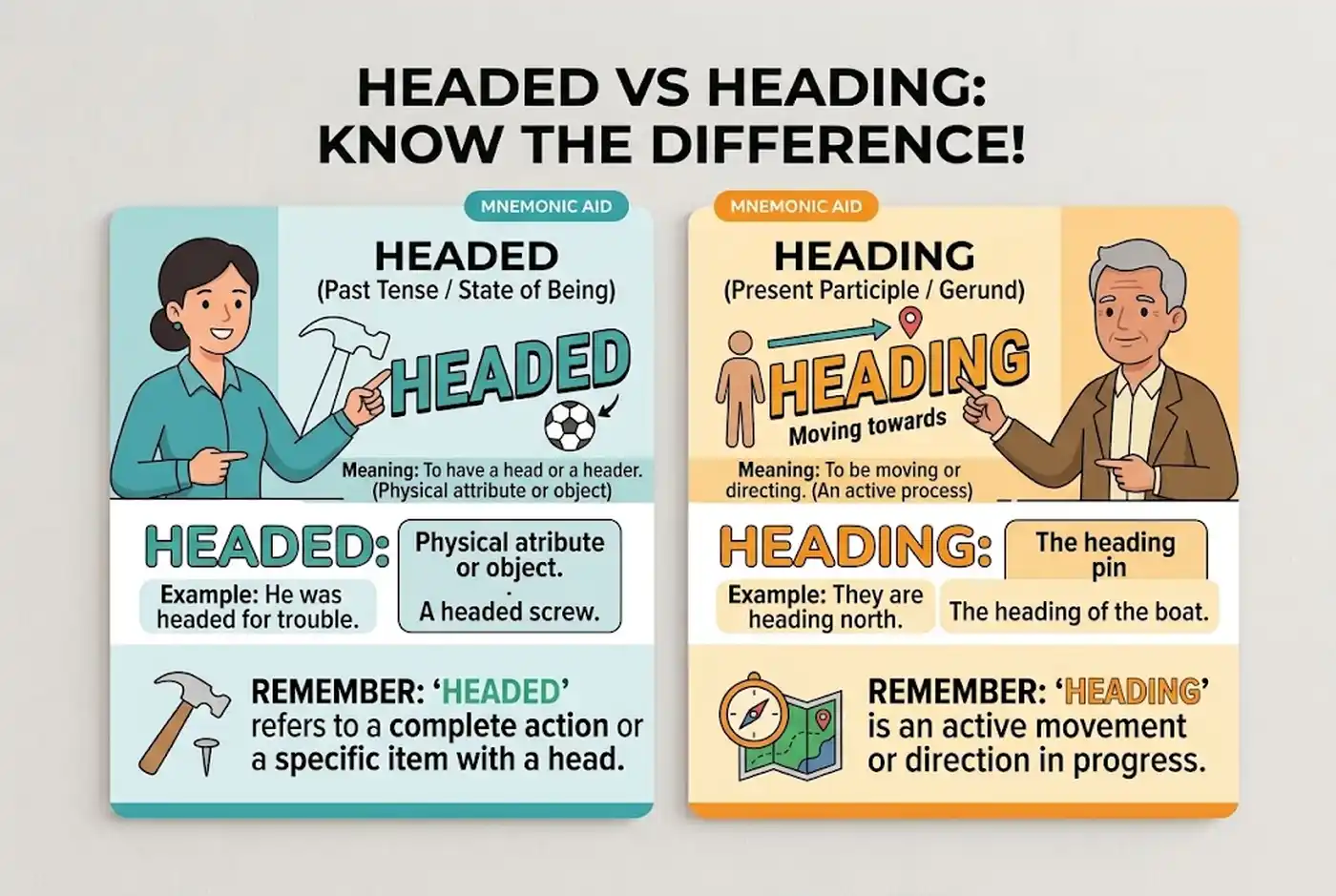
Headed vs heading are closely related because they both come from the word head. However, they have different grammatical forms and uses. One often describes a direction, destination, or leadership role, while the other can describe movement, a title, or an action happening right now.
Imagine you’re writing an email about your weekend plans. You want to tell a friend that you’re going toward New York. Should you write, “I am headed to New York” or “I am heading to New York”? Both sentences sound natural, but what is the difference between these two words?
The simple answer is that headed is the past tense and past participle of the verb head, while heading is its present participle and can also be used as a noun. Both can describe movement toward a place, but they work differently in sentences.
Understanding their meanings will help you choose the right word when writing emails, school assignments, professional documents, and everyday messages. This guide explains their origins, grammatical differences, synonyms, examples, common mistakes, and the best ways to use each word.
What Is the Difference Between Headed and Heading?
The main difference comes down to grammar and sentence structure. Both words are forms of the verb head, but they don’t always serve the same purpose.
What Does Headed Mean?
Headed is the simple past tense and past participle of the verb head. It commonly means moving toward a particular place, leading a group, or being directed toward a destination.
When someone says they are headed somewhere, they mean they are going in that direction.
Examples:
- We headed toward the beach after breakfast.
- She is headed to the office this morning.
- The students headed home after the final class.
- Our team is headed in the right direction.
Headed can also describe leadership or responsibility.
For example:
- Sarah headed the marketing department for five years.
- The committee was headed by an experienced manager.
In these sentences, headed describes someone who led or was responsible for a group.
What Does Heading Mean?
Heading is the present participle of the verb head. It describes an action that is happening now or continuing over a period of time.
It is commonly used with helping verbs such as am, is, are, was, and were.
Examples:
- I am heading to the grocery store.
- They are heading toward the stadium.
- He was heading home when it started raining.
- We are heading in the right direction.
Heading can also function as a noun. In writing, it refers to a title or short label that introduces a section of text.
Examples:
- Add a heading before the next paragraph.
- The main heading explains the topic of the article.
- Each chapter has a separate heading.
Therefore, heading has two important uses: it can describe movement or serve as a title.
Headed vs Heading at a Glance
| Feature | Headed | Heading |
|---|---|---|
| Word type | Verb form | Verb form and noun |
| Main grammatical role | Past tense and past participle | Present participle |
| Basic meaning | Went toward or led | Going toward or leading |
| Movement | Describes a completed or resulting action | Often describes an ongoing action |
| Writing | Not normally a title | A title or section label |
| Example | We headed home. | We are heading home. |
The easiest way to remember the difference is to look at the action and the sentence structure. Use headed for the past form of head and heading for an ongoing action or a title.
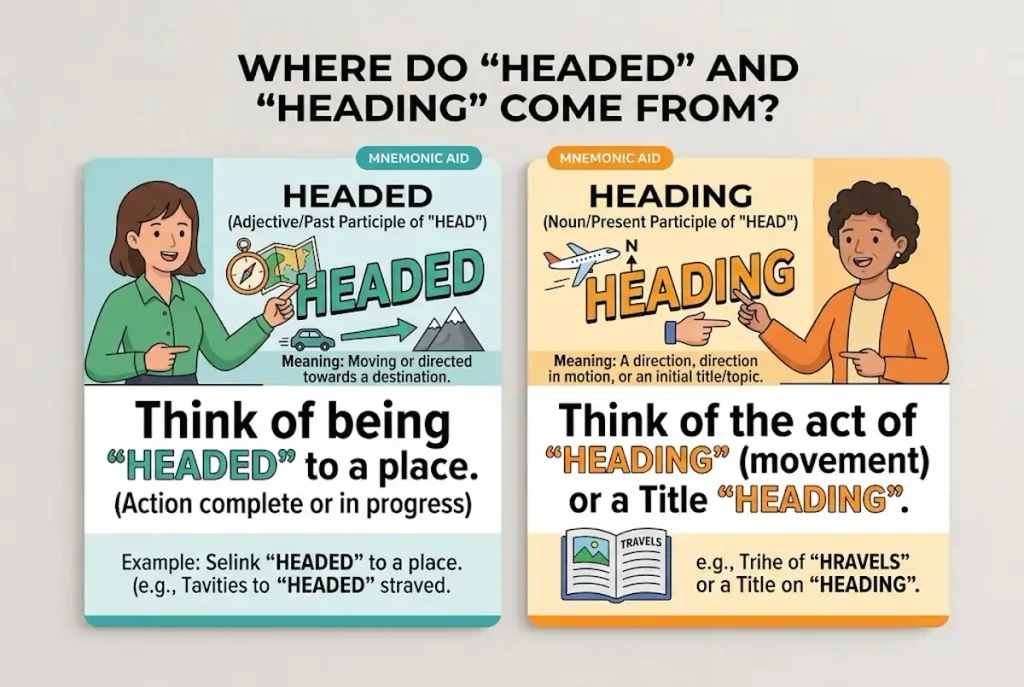
Where Do Headed and Heading Come From?
Understanding the history of these words makes their relationship easier to remember.
Both words come from the English word head, which has roots in Old English.
The Origin of Headed
The word head comes from the Old English word heafod, which referred to the upper part of the human or animal body.
Over time, head developed additional meanings. It began to describe the leader of a group, the top or front part of something, and the person responsible for an organization.
The verb head developed from these meanings. It can describe moving toward something or taking a leading position.
Adding the regular past tense ending -ed creates headed.
For example:
- Head: I head toward the station.
- Headed: I headed toward the station.
The change shows that the action is expressed in the past tense.
The Origin of Heading
Heading is formed by adding -ing to the verb head.
The -ing ending commonly creates a present participle, which can describe an action in progress.
For example:
- Head: They head toward the exit.
- Heading: They are heading toward the exit.
Heading also developed as a noun meaning a title or label used to identify a section of writing.
This use is common in books, newspapers, academic papers, websites, reports, and other written materials.
Both forms share the same root, but their grammatical functions give them different meanings in everyday English.
What Are the Synonyms of Headed and Heading?
The best replacement depends on what you want to express. Headed and heading can describe movement, direction, leadership, or a title. No single synonym works in every situation.
The following words are grouped by their common uses.
Simple Synonyms
These words are easy to understand and work well in everyday conversations.
| Word | Meaning | Tone | Example |
|---|---|---|---|
| Going | Moving toward a place | Simple | We are going home. |
| Moving | Changing position or direction | Simple | They are moving toward the exit. |
| Leaving | Going away from a place | Simple | She is leaving for school. |
| Walking | Moving on foot | Simple | He is walking toward the park. |
| Traveling | Going from one place to another | Simple | We are traveling to Boston. |
| Title | Name of a written section | Simple | Give the paragraph a title. |
| Label | A word identifying something | Simple | Add a label to the section. |
Everyday Synonyms
These words are useful in normal conversations, messages, and informal writing.
| Word | Meaning | Tone | Example |
|---|---|---|---|
| Heading out | Leaving a place | Everyday | I’m heading out now. |
| Setting off | Beginning a journey | Everyday | We are setting off early. |
| Making your way | Moving toward a destination | Everyday | She is making her way home. |
| Going toward | Moving in a particular direction | Everyday | They are going toward the station. |
| On the way | Traveling toward a destination | Everyday | We are on the way to school. |
| Leading | Guiding a person or group | Everyday | He is leading the team. |
| Section title | Name of a document section | Everyday | The section title needs editing. |
Formal Synonyms
These alternatives are useful in academic assignments, business writing, professional reports, and formal communication.
| Word | Meaning | Tone | Example |
|---|---|---|---|
| Proceeding | Continuing toward a destination | Formal | The delegation is proceeding to the venue. |
| Departing | Leaving a particular place | Formal | The guests are departing at noon. |
| Advancing | Moving forward | Formal | The project is advancing toward completion. |
| Traveling | Moving between locations | Formal | The representatives are traveling to Washington. |
| Directed | Guided toward a destination | Formal | The visitors were directed to the main entrance. |
| Supervising | Managing or overseeing a group | Formal | She is supervising the department. |
| Subheading | A secondary title in a document | Formal | Add a subheading to this section. |
Which Words Are Best for Different Levels of Movement?
Sometimes, you need a word that describes a small movement. Other times, you want to show a stronger or more purposeful action.
Choosing the right expression can make your writing more accurate.
Mild Movement
Use these words when the movement is slow, simple, or does not require much effort.
- Going: Moving toward a place.
- Walking: Moving on foot.
- Moving: Changing position.
- Making your way: Slowly or steadily traveling somewhere.
Examples:
- We are going to the library.
- She is walking toward the entrance.
- The children are making their way home.
Moderate Movement
These words suggest a clear direction or a planned journey.
- Heading: Moving toward a destination.
- Traveling: Going from one location to another.
- Proceeding: Continuing toward a place.
- Setting off: Beginning a journey.
Examples:
- We are heading toward the airport.
- The visitors are proceeding to the main hall.
- They are setting off for their trip.
Strong or Purposeful Movement
These words suggest progress, speed, or a clear goal.
- Advancing: Moving forward.
- Rushing: Moving quickly.
- Marching: Walking with firm steps.
- Charging: Moving forward forcefully.
Examples:
- The soldiers were marching toward the base.
- The rescue team was rushing to the scene.
- The company is advancing toward its main goal.
How Do Headed and Heading Work as Different Parts of Speech?
One of the easiest ways to avoid mistakes is to understand how each word functions grammatically.
Headed as a Verb Form
Headed is mainly used as the simple past tense or past participle of head.
Examples:
- We headed toward the mountains yesterday.
- She headed the organization for several years.
- The group has headed home already.
In the first sentence, headed describes movement in the past.
In the second sentence, it describes leadership.
Heading as a Present Participle
Heading is used with helping verbs to describe an action in progress.
Examples:
- I am heading to work.
- They were heading toward the river.
- He has been heading the project since January.
The word heading can also appear in a participial phrase.
Example:
- Heading toward the station, we noticed a crowded street.
Here, heading describes an action connected to the main sentence.
Heading as a Noun
Heading is also a common noun in written English.
It describes a title or label placed above a section of text.
Examples:
- The heading is too long.
- Use a clear heading for every main section.
- The report needs a new heading.
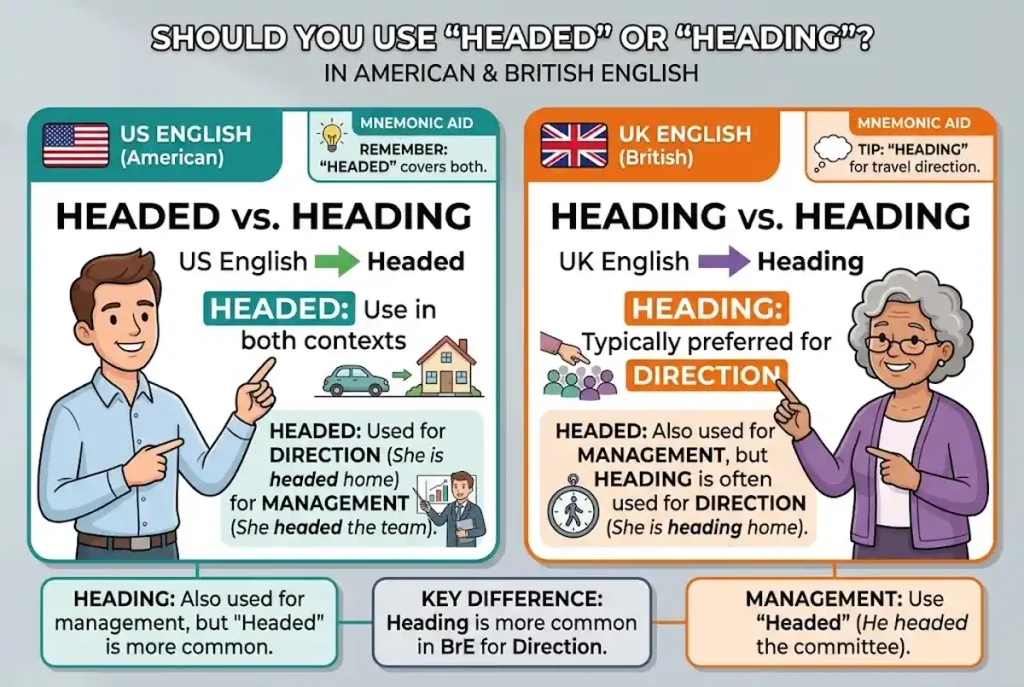
Should You Use Headed or Heading in American and British English?
Both headed and heading are standard in American and British English. Their basic meanings and grammatical rules remain the same.
There is no major regional spelling difference between these words.
American English
In the United States, both forms are common in conversations, emails, news reports, and professional writing.
Examples:
- I’m headed to Chicago tomorrow.
- I’m heading to the office now.
- Add a heading to the first section.
British English
British speakers also use both forms naturally.
Examples:
- We are headed for London.
- She is heading home after work.
- The report needs a clear heading.
The prepositions may vary slightly depending on the sentence. For example, both toward and towards are used in English, with toward being more common in American English and towards often preferred in British English.
However, this difference does not change the meaning of headed or heading.
Is There a Difference in Formal Writing?
Neither word is automatically more formal than the other.
The choice depends on its grammatical purpose.
For example:
- Formal: The committee headed the research project.
- Formal: The committee is heading the research project.
- Formal: The document requires a clear heading.
Which Word Should You Use in Different Writing Situations?
The right choice depends on the message, audience, and purpose of your writing.
Which Word Is Better for a Resume?
Use headed when describing a leadership role or a completed responsibility. Use heading when describing an ongoing leadership responsibility.
Examples:
- Headed a team of 12 employees during a major company project.
- Currently heading the customer service department.
- Headed the development of a new marketing strategy.
For a resume, headed is useful when describing previous achievements. Heading can work when explaining a current role, although a strong action verb often makes a resume more effective.
Which Word Is Better for an Essay?
Both words are suitable for essays, but they serve different purposes.
Use headed to describe a past action or direction.
Use heading when describing an action in progress or a section title.
Examples:
- The explorers headed toward the northern region.
- The group was heading toward a major discovery.
- The next heading introduces the main argument.
Academic writing should use each word according to its grammatical function.
Which Word Is Better for Texting?
Both are natural in text messages.
Heading is common when telling someone where you are going right now.
Headed is also common when talking about a destination or a planned trip.
Examples:
- I’m heading home now.
- We are headed to the mall.
- Just heading out. See you soon.
- Headed your way!
In casual messages, either form can sound natural. The surrounding sentence matters more than formality.
Which Word Is Better for Emails?
Use the word that accurately describes your action.
Examples:
- I’m heading to the conference now and will call you later.
- We headed to the client’s office after lunch.
- Please add a heading to the second section of the report.
- The department is headed by our senior manager.
For professional emails, make sure the sentence clearly explains the action or identifies the document section.
Which Word Is Better for Speaking?
Both words are widely used in spoken English.
Heading is especially common when describing an action happening now.
Headed is common when discussing a past journey or a destination.
Examples:
- I’m heading to the store.
- We headed home before sunset.
- Where are you headed?
- I’m headed downtown.
You don’t need to choose one word for every conversation. Just match the form to the meaning and sentence structure.
What Are 12 Examples of Headed and Heading in Real Sentences?
Examples make grammatical differences easier to understand. The following sentences show how both forms work in everyday situations.
Examples Using Headed
- We headed toward the airport early in the morning.
- My brother headed home after finishing his work.
- The children headed outside when the rain stopped.
- Our school team headed to the competition with confidence.
- She headed the company before accepting a new position.
- The tourists headed toward the museum to see the new exhibition.
In these examples, headed describes a past action, a completed movement, or a leadership role.
Examples Using Heading
- I am heading to the supermarket to buy some groceries.
- They are heading toward the city center.
- The manager is heading a new development project.
- We were heading home when we received your message.
- The article needs a better heading before publication.
- Are you heading to the meeting this afternoon?
These sentences show that heading can describe ongoing movement, leadership, or a title in a document.
What Is the Difference Between Headed and Going?
Headed and going can sometimes communicate the same basic idea, but they have slightly different uses.
Headed
It often emphasizes the direction or destination of movement.
Example:
- We are headed toward the beach.
This sentence focuses on the direction in which the group is traveling.
Going
Going is a general word for movement from one place to another.
Example:
- We are going to the beach.
This sentence simply tells the reader the destination.
| Headed | Going |
|---|---|
| Often emphasizes direction | Describes general movement |
| Common in conversational English | Very common in all types of English |
| Can describe leadership | Does not normally mean leading a team |
| Example: I’m headed home. | Example: I’m going home. |
What Is the Difference Between Heading and Heading Out?
These expressions look similar, but they don’t always communicate the same idea.
Heading
Heading usually means moving toward a particular place or directing something.
Example:
- We are heading to the office.
The destination is clearly stated.
Heading Out
Heading out usually means leaving your current location.
Example:
- We are heading out now.
The sentence focuses on departure rather than the final destination.
| Heading | Heading Out |
|---|---|
| Moving toward a destination | Leaving a current place |
| Destination can be included | Destination is often unstated |
| Example: I’m heading to work. | Example: I’m heading out. |
What Common Mistakes Should You Avoid?
Even though both words are easy to recognize, writers sometimes use them incorrectly.
Mistake 1 Using Heading for Every Past Action
Incorrect: Yesterday, we heading toward the station.
Correct: Yesterday, we headed toward the station.
Why? Heading is not the simple past tense. Use headed when describing a completed action in the past.
Mistake 2 Using Headed Instead of Heading With Am or Is
Incorrect: I am headed to the office right now, if you mean to describe the ongoing action using the present continuous?
This sentence is actually grammatically correct. However, it has a different structure and emphasis from the following sentence:
I am heading to the office right now.
The first uses headed as a past participle in a construction describing a state or direction. The second uses heading as the present participle in the present continuous tense.
Both are natural and correct.
Mistake 3 Confusing a Heading With a Verb
Incorrect: Please write a headed above the paragraph.
Correct: Please write a heading above the paragraph.
Why? A heading is a noun meaning a title or label. Headed is a verb form and cannot replace it in this sentence.
Mistake 4 Forgetting the Helping Verb
Incorrect: She heading to school.
Correct: She is heading to school.
Why? When heading describes an action in the present continuous tense, it normally needs a helping verb such as am, is, or are.
Mistake 5 Using Headed When You Mean a Title
Incorrect: Add a headed to the first page.
Correct: Add a heading to the first page.
Why? A heading identifies a section of writing. Headed does not have this meaning.
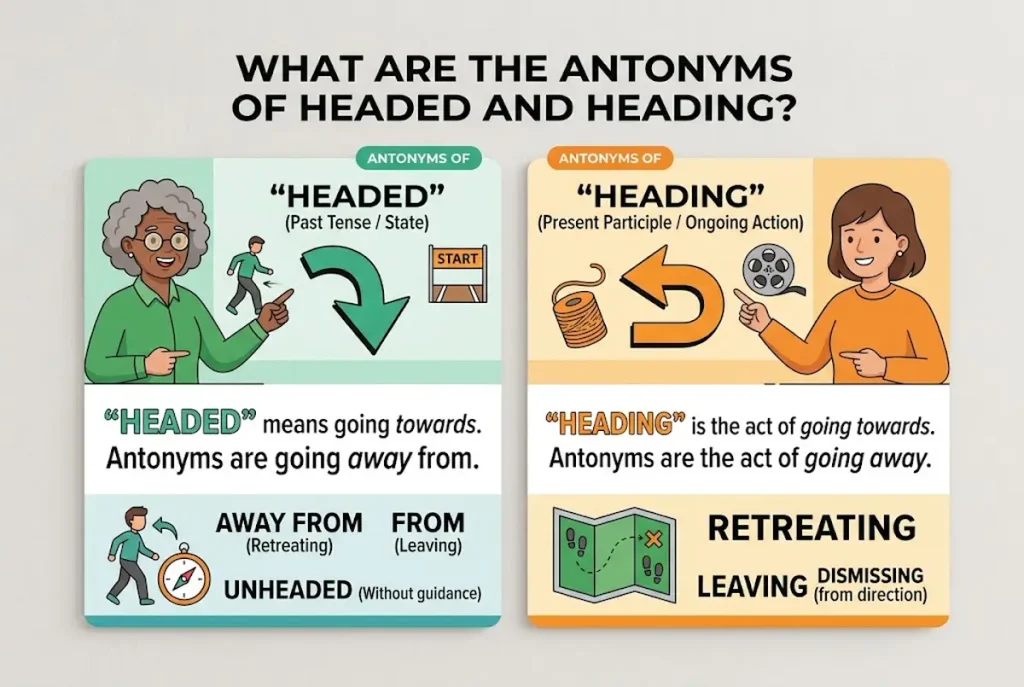
What Are the Antonyms of Headed and Heading?
Antonyms are words with opposite or contrasting meanings. Since headed and heading have several uses, their opposites depend on the context.
Opposites Related to Movement
| Word | Opposite | Example |
|---|---|---|
| Heading toward | Moving away | We are moving away from the station. |
| Going | Staying | I am staying at home today. |
| Departing | Arriving | The train is arriving at the station. |
| Advancing | Retreating | The soldiers are retreating. |
| Moving forward | Moving backward | The vehicle is moving backward. |
Opposites Related to Leadership
| Word | Opposite | Example |
|---|---|---|
| Leading | Following | The students are following their teacher. |
| Directing | Obeying | The workers are obeying the instructions. |
| Managing | Being managed | The department is being managed by a new director. |
How Can You Choose Between Headed and Heading?
Choosing the correct word becomes much easier when you follow a few simple rules.
- Use headed when you need the simple past tense of head. Example: We headed home after dinner.
- Use heading with am, is, or are to describe an ongoing action. Example: She is heading to work.
- Use heading as a noun when referring to a title or section label. Example: The heading needs improvement.
- Check the time of the action. A completed past action may need headed, while an ongoing action may need heading.
- Look at the helping verb. Am, is, and are commonly work with heading in the present continuous tense.
Conclusion
Understanding the difference between headed and heading comes down to recognizing their grammatical roles. Headed is the past tense and past participle of head, commonly used for completed movement or leadership. Heading is the present participle, often used for ongoing actions, and it can also function as a noun meaning a title or section label.
Both words are correct in American English and British English. The important part is choosing the form that matches your sentence. If you’re describing a past journey, use headed.
If you’re naming a section of a document, use heading as a noun. With these simple rules and examples, you’ll be able to use both forms naturally and confidently.
Frequently Asked Questions
Is headed or heading grammatically correct?
Both words are grammatically correct, but they serve different purposes. Headed is the past tense and past participle of head, while heading is its present participle and can also be a noun.
Should I say I am headed or I am heading?
Both expressions are correct. I am heading usually describes an action in progress, while I am headed commonly describes your direction or destination.
Is heading a noun or a verb?
Heading can be both a noun and a verb form. As a noun, it means a title above a section of writing. As a verb form, it describes an ongoing action.
What is the past tense of heading?
The simple past tense of heading is headed. For example, I am heading home today becomes I headed home yesterday.
Can I say I am headed home?
Yes, I am headed home is grammatically correct and widely used. It describes your destination or direction.
What’s another way to say heading somewhere?
You can say going somewhere, traveling somewhere, making your way somewhere, or setting off for a destination. The best alternative depends on the sentence and situation.
Is heading out the same as heading home?
No, they have slightly different meanings. Heading out means leaving your current location, while heading home means traveling toward your home.
Can heading mean a title in an essay?
Yes, heading is a noun that refers to a title identifying a section of an essay, report, or other written document. It helps readers understand what a section discusses.

Daniel Grammarfield — The Language Learner
Age: 28Occupation: ESL Learner & Digital Professional
Bio:Daniel is a non-native English speaker who wants to communicate more confidently at work and online. He uses Synotrench to improve grammar, understand confusing words, learn correct sentence structures, and build everyday English skills. He prefers simple explanations with practical examples.
Goals:
Master English grammar rules
Avoid common language mistakes
Improve professional communication
Learn English through real-life examples
Quote:“Learning English is not about memorizing rules — it’s about expressing ideas clearly.”
3 thoughts on “Headed vs Heading The Simple Guide to the Difference”