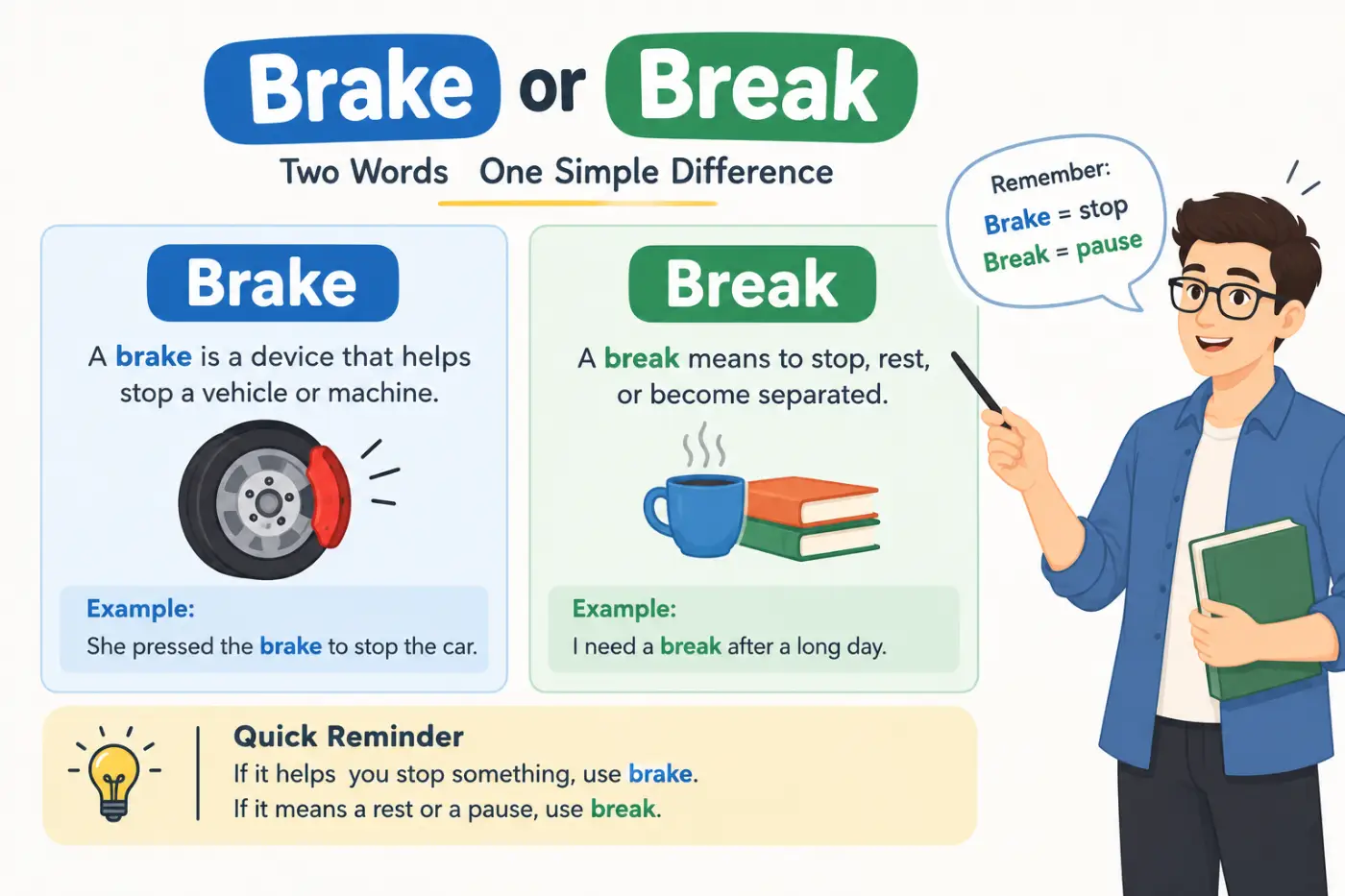
If you are writing an email, finishing an essay, or sending a quick text, you may stop because you are not sure if you should write brake or break. The two words sound exactly the same in most forms of American English, but they have completely different meanings. One is connected to stopping or slowing something. The other can describe damage, rest, interruption, or separation.
Answer: Brake is a device or action used to slow or stop movement. Break usually means to damage, separate, interrupt, or pause something.
This guide explains the difference between these confusing words, where they came from, how they work in sentences, and which alternatives fit different situations. You will also find examples for school, work, texting, resumes, emails, and everyday conversation.
What does brake mean in plain English?
Brake is mainly connected with stopping or slowing movement. It can be a noun or a verb.
As a noun, a brake is a device that slows or stops a vehicle, bicycle, machine, or another moving object.
Example:
The driver pressed the brake before the traffic light.
As a verb, brake means to slow down or stop by using a braking system.
Example:
She braked quickly when a dog ran into the road.
The word is strongly associated with cars, trucks, buses, motorcycles, bicycles, trains, and other machines. You can also use it more generally when something is being slowed down.
Example:
The new policy could brake the rapid growth of the company.
That formal use is less common in everyday American English. In normal conversation, slow, stop, limit, or control may sound more natural.

What does break mean in plain English?
Break has many meanings, which is one reason it causes confusion.
It can mean to damage something.
Example:
Be careful not to break the glass.
It can mean to separate something into pieces.
Example:
The child broke the cookie in half.
It can mean to stop working.
Example:
My phone screen broke.
It can mean to take a short period of rest.
Example:
Let’s take a break after this lesson.
It can mean to interrupt something.
Example:
Please don’t break the conversation.
It can also describe violating a rule or law.
Where did brake come from?
The history of brake is connected to the idea of controlling movement.
The English word developed from older European words associated with tools or devices used to restrain or stop movement. Over time, its meaning became closely connected with mechanical systems that slow vehicles and machines.
Modern brakes became especially important as transportation developed. As vehicles became faster and heavier, people needed reliable systems for controlling speed.
Today, brake most commonly refers to a mechanical or electronic system that slows or stops a vehicle.
You can see this meaning in words such as:
- Brake pedal.
- Brake pad.
- Brake fluid.
- Brake light.
- Brake system.
- Emergency brake.
- Parking brake.
- Disc brake.
- Brake rotor.
- Bicycle brake.
These expressions all relate to stopping or controlling movement.
Where did break come from?
Break has a much older history and a much wider range of meanings.
It comes from an old Germanic word family connected with separating, damaging, or breaking something apart. Similar forms appear in several Germanic languages.
Over centuries, English expanded the word’s meaning. Today, break can describe physical damage, emotional experiences, interruptions, rest periods, rule violations, and changes in continuity.
That is why you can say:
She broke the plate.
I need a break.
He broke the law.
The machine broke down.
They broke the silence.
The news broke this morning.
These sentences use the same basic word but express different ideas.
What is the easiest way to remember words?
A simple memory trick is to connect brake with a car.
Think:
Brake = stop a vehicle.
If you are talking about a car slowing down, a bicycle stopping, or a machine controlling movement, brake is usually the word you need.
For other common meanings, break is usually correct.
Think:
Break = damage, separate, interrupt, or rest.
For example:
- Press the brake.
- Take a break.
- Break the glass.
- Break the rule.
- Break the silence.
- Break the record.
- Break a promise.
This simple distinction handles most everyday situations.
What are the main synonyms for brake?
| Word | Meaning | Tone | Example |
|---|---|---|---|
| Stop | Bring movement to an end | Simple | Stop the car. |
| Slow | Reduce speed | Everyday | Slow the vehicle. |
| Halt | Stop movement | Formal | The train halted suddenly. |
| Restrain | Hold something back | Formal | The system restrained the movement. |
| Check | Control or reduce | Formal | The policy checked further growth. |
| Control | Manage speed or movement | Everyday | The driver controlled the car. |
| Decelerate | Reduce speed | Technical | The vehicle began to decelerate. |
| Arrest | Stop movement | Formal | The device arrested the machine’s motion. |
| Curb | Limit or control | Formal | The measure curbed spending. |
| Suppress | Prevent or reduce | Formal | The system suppressed unwanted movement. |
| Slow down | Reduce speed | Everyday | Slow down near the school. |
| Pull up | Stop a vehicle | Everyday | Pull up near the entrance. |
| Come to a stop | Stop moving | Neutral | The bus came to a stop. |
| Ease off | Reduce pressure or speed | Informal | Ease off the pedal. |
| Hold back | Prevent forward movement | Everyday | The barrier held back the crowd. |
Some of these are not exact replacements in every sentence. Context matters.
For example, decelerate works well in a technical explanation but sounds unnatural in a casual text about driving.
What are the main synonyms for break?
Break has a much larger synonym family because it has many meanings.
Simple alternatives
| Word | Meaning | Tone | Example |
|---|---|---|---|
| Damage | Harm something | Simple | The fall damaged the phone. |
| Split | Divide into parts | Simple | Split the paper in half. |
| Crack | Make a narrow break | Everyday | The heat cracked the glass. |
| Tear | Pull apart | Everyday | She tore the paper. |
| Rest | Stop to relax | Simple | I need to rest. |
| Pause | Stop briefly | Neutral | Pause the video. |
| Stop | End or interrupt | Simple | Stop the noise. |
| End | Bring something to a close | Neutral | They ended the meeting. |
Everyday alternatives
| Word | Meaning | Tone | Example |
|---|---|---|---|
| Shatter | Break into many pieces | Strong | The window shattered. |
| Smash | Break violently | Informal | He smashed the old box. |
| Burst | Break open suddenly | Everyday | The balloon burst. |
| Ruin | Damage badly | Everyday | Water ruined the book. |
| Interrupt | Stop something temporarily | Neutral | The call interrupted my work. |
| Rest up | Take time to recover | Informal | Rest up before the game. |
| Divide | Separate into parts | Neutral | Divide the class into groups. |
| Separate | Move apart | Neutral | Separate the two pieces. |
Which synonyms are mild and which are strong?
Choosing a synonym is not only about meaning. Strength matters too.
Mild words
Use mild words when the situation is small or not serious.
- Slow.
- Pause.
- Rest.
- Crack.
- Separate.
- Interrupt.
- Damage.
Example:
The cup has a small crack.
Medium strength words
These describe more noticeable changes or damage.
- Split.
- Tear.
- Disrupt.
- Fracture.
- Ruin.
- Shatter.
- Violate.
Example:
The accident disrupted traffic for an hour.
Strong words
These suggest major damage, force, or serious consequences.
- Smash.
- Shatter.
- Destroy.
- Terminate.
- Breach.
Example:
The impact shattered the windshield.
Choosing a strong word when the situation is minor can make your writing sound dramatic.
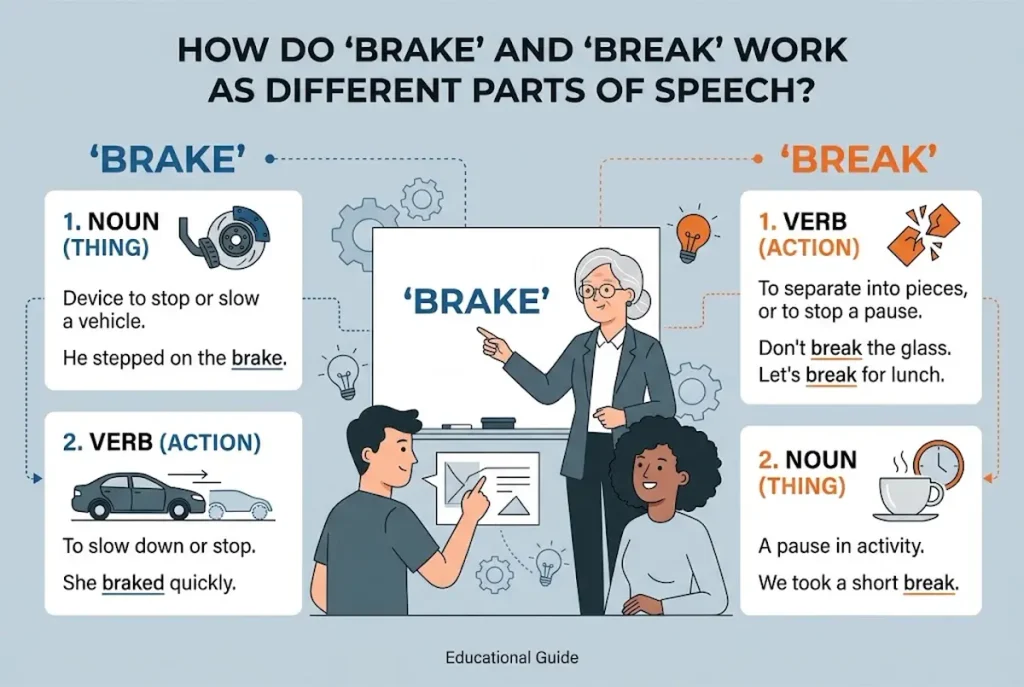
How do brake and break work as different parts of speech?
Both words can work in more than one grammatical role, but break has far more uses.
Brake as a noun
A brake can be a device that slows or stops movement.
Example:
The front brake needs repair.
Brake as a verb
Brake can mean to slow or stop a moving vehicle.
Example:
He braked before the intersection.
Break as a noun
Break can mean a period of rest, a gap, an interruption, or an act of damage.
Examples:
We have a lunch break.
There was a break in the wall.
The break in service lasted ten minutes.
Break as a verb
Break can mean damage, separate, interrupt, violate, or stop functioning.
Examples:
Don’t break the glass.
The machine broke yesterday.
She broke the rule.
Because break has so many grammatical uses, the surrounding words usually make its meaning clear.
Are words different in American and British English?
The spelling difference is basically the same in American and British English.
British English follows the same distinction.
The pronunciation is also usually the same, making these words homophones. That means they sound alike but have different spellings and meanings.
Regional accents can change the exact sound slightly, but the spelling rule does not change.
The main challenge is therefore writing, not speaking. When someone says the word aloud, you need context to know which meaning they intend.
What is the best word for a resume?
For a resume, brake is rarely the word you need unless your job involves vehicles, transportation, mechanics, or engineering.
Break is also not usually used as a general professional synonym for stopping work. Instead, choose a more precise word.
Good professional alternatives include:
- Paused.
- Suspended.
- Interrupted.
- Reduced.
- Resolved.
Example:
The technician repaired the vehicle’s braking system.
If you need to explain a period away from work, do not casually write that you had a break from employment. A clearer phrase may be:
I took a career break to complete professional training.
The best choice depends on what you actually mean.
What is the best word for an essay?
In an essay, precision matters.
Use brake when discussing vehicles, engineering, transportation, or something being slowed.
Example:
Modern braking systems help drivers control speed safely.
Use break when discussing damage, interruption, separation, rules, or rest.
Example:
A short break can help students return to their work with better focus.
For formal essays, alternatives such as interrupt, damage, divide, violate, pause, and disrupt can sometimes make your writing more precise.
Avoid replacing every instance of break with a synonym. Repetition is not always a problem if the original word is the clearest choice.
What is the best word for texting?
In texting, break is extremely common.
Examples include:
I need a break.
Let’s take a break.
Don’t break it.
I broke my phone.
We should take a break from studying.
Brake appears mostly when the conversation is about driving.
Example:
Hit the brake!
The car’s brake light is on.
Because texting is casual, common everyday words usually sound more natural than formal alternatives such as decelerate or terminate.
What is the best word for an email?
For professional email, choose the word that clearly expresses your meaning.
If you are talking about a vehicle:
The brake system needs to be inspected.
If you mean a short rest:
I’ll take a short break and return to the report afterward.
If you mean an interruption:
The power outage disrupted our meeting.
If you mean damage:
The shipment arrived damaged.
If you mean a rule violation:
The employee violated the company’s policy.
Specific language makes professional emails easier to understand.
What is the best word for speaking?
In everyday speech, both words are common.
You might say:
I need a break.
Brake before the turn.
Be careful not to break that.
The brakes aren’t working.
When speaking, listeners rely on context because the two words sound alike.
If you are teaching English, it helps to explain the meaning before focusing on spelling.
What are some real examples of brake?
Here are practical examples from everyday life.
- The driver pressed the brake when the light turned yellow.
- My bicycle brake needs to be adjusted.
- The mechanic replaced the worn brake pads.
- She braked suddenly when the truck stopped ahead of her.
- Check the brake lights before driving at night.
- The emergency brake prevented the car from rolling.
- He gently braked while going down the hill.
- The train began to brake as it approached the station.
- The mechanic said the brake fluid was low.
- The driver used the brake to avoid hitting the barrier.
Notice that every example involves slowing, stopping, or controlling movement.
What are some real examples of break?
Break is much more flexible.
- Please don’t break the glass.
- I need a short break after this meeting.
- The child broke the toy by accident.
- We took a break from studying.
- The computer broke down during the presentation.
- She broke the silence with a question.
- He broke the school rule.
- The storm broke several branches.
- They broke the old record.
- The company announced a break in production.
These examples show why break cannot be explained with only one definition.
what’s the difference between Brake vs slow down?
Brake and slow down can be closely related, but they are not always interchangeable.
Brake specifically suggests using a braking system or applying braking force.
Example:
The driver braked before the corner.
Slow down is broader. It simply means reducing speed.
Example:
Slow down when you enter the neighborhood.
You can slow down without necessarily using a brake.
For example, a runner can slow down. A conversation can slow down. Business growth can slow down.
You cannot normally say you braked a conversation in everyday English.
So, use brake for controlled stopping or slowing, especially with vehicles. Use slow down for the broader idea of reducing speed or activity.
Break vs pause: what’s the difference?
Break and pause can both describe stopping temporarily, but their usual contexts differ.
A pause is often brief and connected to an activity that will continue.
Example:
She paused before answering.
A break is often a period of rest or a temporary interruption.
Example:
We took a ten minute break.
Pause sounds natural for speeches, videos, conversations, and actions. Break sounds natural for work, school, meals, and rest.
Compare these:
Pause the video.
Take a break.
Both mean stop temporarily, but they are not always interchangeable.
Break vs rest: what’s the difference?
Rest focuses on recovering energy.
Example:
I need to rest after the long walk.
Break focuses on stopping an activity for a period of time.
Example:
Let’s take a break from studying.
A break can include rest, but it does not always mean physical recovery.
For example:
There was a break in the meeting.
That does not mean anyone needed to recover physically.
Break vs damage: what’s the difference?
Damage means harm or reduced condition. Break can mean complete physical separation or loss of function.
Compare:
The storm damaged the roof.
The storm broke the window.
Damage can be minor or major. Break often suggests that something cracked, split, separated, or stopped working.
You can damage a computer without breaking it completely.
You can also break something and cause serious damage at the same time.
What are the most common mistakes with these words?
The biggest mistake is choosing a spelling based only on sound.
Because both words sound alike, listening alone cannot tell you which spelling is correct.
Mistake one: using break for a car
Incorrect:
Press the break.
Correct:
Press the brake.
The sentence refers to a vehicle stopping system.
Mistake two: using brake for rest
Incorrect:
I need a brake.
Correct:
I need a break.
Here, you mean a period of rest.
Mistake three: using brake for damage
Incorrect:
Don’t brake the glass.
Correct:
Don’t break the glass.
The meaning is damage, not stopping movement.
Mistake four: confusing brake lights with break lights
The correct phrase is brake lights because the lights show that the vehicle’s brakes are being used.
Mistake five: writing brake down
When a machine stops working, the expression is break down.
Example:
My car broke down on the highway.
Brake down is not the normal expression for mechanical failure.
When should you not use brake?
Do not use brake simply because something stops.
Ask yourself what is stopping.
If a vehicle or machine is being slowed through a braking system, brake may be correct.
If an activity pauses, use break, pause, stop, or interrupt depending on the meaning.
For example:
The meeting broke for lunch.
The meeting paused for lunch.
All three can work in the right context, but brake would be wrong.
You also should not use brake for physical damage.
Use break, crack, shatter, split, tear, or damage depending on the situation.
When should you not use break?
Do not use break when you specifically mean a vehicle’s braking system.
For example:
The car’s brake is damaged.
The brake pedal feels soft.
The driver braked suddenly.
In these cases, brake is the correct spelling.
Also, do not automatically use break when you mean slow. A vehicle can slow without the sentence focusing on the braking system.
What are the antonyms of brake?
The opposite of braking depends on the context.
Common opposites include:
- Accelerate.
- Speed up.
- Move forward.
- Increase speed.
- Release.
- Advance.
Example:
The driver braked before the turn, then accelerated onto the highway.
There is no single opposite that works in every sentence.
What are the antonyms of break?
Break also has several possible opposites.
For physical damage, possible opposites include:
- Repair.
- Fix.
- Mend.
- Restore.
- Strengthen.
For interruption, possible opposites include:
- Continue.
- Resume.
- Maintain.
- Proceed.
The correct antonym depends on which meaning of break you are using.
How can you choose the right word quickly?
Use these simple questions before you type.
Are you talking about a vehicle?
If yes, brake is probably correct.
Example:
The driver hit the brake.
Are you talking about damage?
Use break or a more specific word such as crack, shatter, split, or damage.
Example:
She broke the cup.
Are you talking about rest?
Use break.
Example:
Let’s take a break.
Are you talking about stopping an activity?
Use break, pause, stop, suspend, or interrupt depending on the context.
Example:
Let’s pause the discussion.
Are you talking about a rule?
Use break.
Example:
He broke the rule.

What should you remember about brake or break?
The two words sound alike, but their meanings are different.
Brake is connected mainly with stopping or slowing movement. It is especially common when talking about cars, bicycles, machines, and transportation.
Break has many meanings. It can describe damage, separation, interruption, rest, rule violations, mechanical failure, and more.
A useful memory trick is:
Brake stops. Break changes, damages, separates, or pauses.
If you remember that one distinction, you can avoid most spelling mistakes.
Conclusion
Understanding brake and break becomes much easier once you connect each spelling with its main meaning. Brake is the word used for slowing or stopping movement, especially when talking about a vehicle or mechanical system. Break is much broader and can describe damage, separation, rest, interruption, failure, or violating a rule.
When you are unsure, look at the sentence rather than the sound. If you are talking about a car stopping, choose brake. If you mean rest, damage, interruption, or separation, choose break. This small spelling difference can make a big difference in clear writing.
Keep the basic rule in mind, and you will recognize the correct form much faster in emails, essays, texts, and everyday writing.
Frequently Asked Questions
Is it correct for a car?
Brake is correct when you mean the device or action used to slow or stop a car.
Is it take a brake or take a break?
The correct phrase is take a break because it means to stop working or studying for a short period.
Do words sound the same?
Yes, they are usually pronounced the same in American English, so context is needed to identify the intended word.
What’s another way to say break?
Depending on the meaning, another word for break can be pause, rest, damage, split, interrupt, shatter, violate, or separate.
Should I say brake down or break down?
Break down is correct when you mean that a machine or vehicle stops working.

Daniel Grammarfield — The Language Learner
Age: 28Occupation: ESL Learner & Digital Professional
Bio:Daniel is a non-native English speaker who wants to communicate more confidently at work and online. He uses Synotrench to improve grammar, understand confusing words, learn correct sentence structures, and build everyday English skills. He prefers simple explanations with practical examples.
Goals:
Master English grammar rules
Avoid common language mistakes
Improve professional communication
Learn English through real-life examples
Quote:“Learning English is not about memorizing rules — it’s about expressing ideas clearly.”
3 thoughts on “Brake or Break: The Best Simple Guide (2026)”