If you’re writing an email, finishing an essay, sending a text, or asking someone to carry something for you, you may stop and wonder about Bring vs Take. Both verbs describe moving something from one place to another, so they can seem interchangeable. They aren’t.
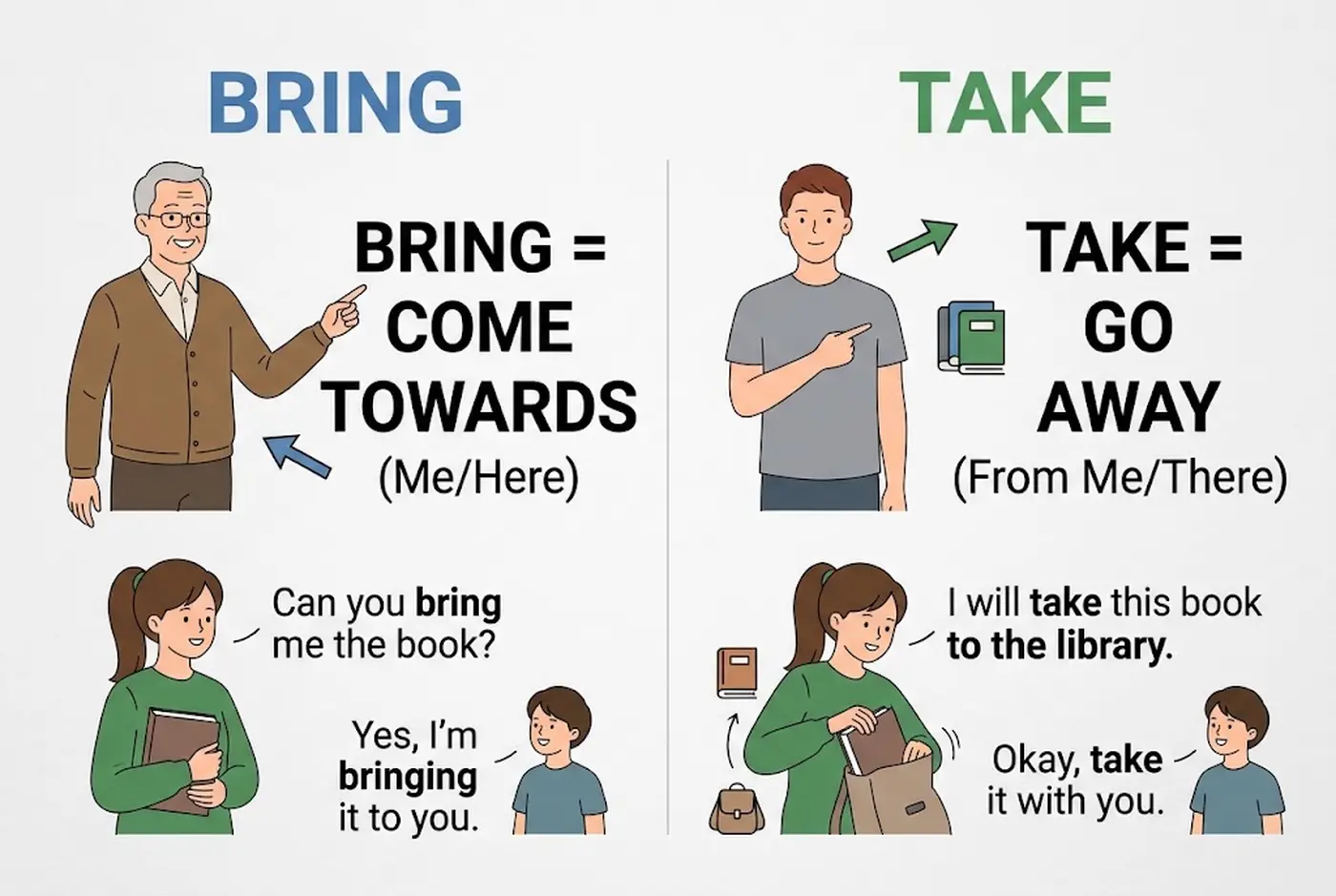
The easiest way to remember the difference is to think about direction. Use bring when something moves toward the speaker, listener, or another place being treated as the destination. Use take when something moves away from the speaker or listener to another place.
Bring means move something toward a person or place. Take means move something away from the current speaker or listener to another place.
This guide explains the meaning and origin of both verbs, shows related words by tone and intensity, compares them in real situations, and gives practical examples for emails, essays, texting, resumes, and everyday speech.
What do bring and take mean?
The main difference is the direction of movement.
Bring usually describes movement toward the person speaking, the person being spoken to, or a destination that has been established as the point of focus.
Take usually describes movement away from the speaker or listener toward another destination.
Consider this simple situation:
You are at home, and your friend is coming to your house.
You might say:
“Please bring your laptop.”
Your friend will move the laptop toward you.
Now imagine you are going to your friend’s house.
You might say:
“Please take your laptop with you.”
The laptop is moving away from you toward another place.
The verbs can describe people as well as objects.
“Bring your brother to the party.”
“Take your brother home.”
The first sentence focuses on the brother arriving at a particular place. The second focuses on moving him away from the current location.
Why do bring and take have different meanings?
The difference comes from the point of view of the speaker.
English often describes movement from a particular perspective. That perspective determines the verb.
Think of bring as movement toward a point of arrival.
Think of take as movement toward a destination that is away from the current point of reference.
For example:
“Bring the documents to my office.”
The office is the destination being treated as the important point.
“Take these documents to the manager.”
The documents are moving from the speaker to the manager.
The distinction becomes especially clear when you imagine an arrow.
Bring:
Person or object → toward me, you, or the destination we are focusing on.
Take:
Person or object → away from me or you toward another destination.
This is why native speakers choose different verbs even though both describe movement.
Where did bring and take come from?
Both verbs are very old English words.
Bring comes from Old English forms related to bringing or carrying something to a particular place. It has remained a common English verb for centuries. Its basic idea has stayed remarkably stable: causing something or someone to come toward a destination or person.
Take also has a long history. It entered English from Old Norse and became established in Middle English. Its meaning developed around getting, carrying, leading, or moving something from one place to another.
The historical details are interesting, but you don’t need to memorize them to use the words correctly. The modern distinction is much more useful.
A simple memory rule works better:
Bring points toward.
Take points away.

What are the main synonyms for bring and take?
Neither word has a perfect synonym in every sentence. The best replacement depends on the direction, situation, tone, and type of movement.
The following list gives a broad vocabulary set that can help you avoid repetition and choose a more precise word.
| Group | Word | Meaning | Tone | Example |
|---|---|---|---|---|
| Simple | carry | Move something while holding it | Neutral | Carry the books upstairs. |
| Simple | move | Change something’s position | Neutral | Move the chair closer. |
| Everyday | carry over | Move something to another place | Everyday | Carry the boxes over to the garage. |
| Everyday | pick up | Collect or get something | Casual | Pick up the package after work. |
| Formal | deliver | Bring something to its intended destination | Formal | The courier delivered the contract. |
| Formal | transfer | Move something or someone to another location | Formal | The patient was transferred to another unit. |
These words overlap in meaning, but they aren’t interchangeable in every sentence.
For example, fetch often suggests going somewhere to get something and returning with it.
“Please fetch the ball.”
Deliver focuses more on reaching a destination.
“The driver delivered the package.”
Carry focuses on the physical act of holding and moving something.
“She carried the boxes upstairs.”
Choosing the right synonym depends on what you want the sentence to emphasize.
Which synonyms sound mild or strong?
Movement words can also differ in intensity.
Some words simply describe movement. Others suggest effort, speed, distance, or purpose.
Mild movement words
These describe ordinary movement without adding much emotional or physical force.
- Move.
- Carry.
- Bring.
- Take.
- Transfer.
- Send.
Example:
“Please move the chair.”
The sentence doesn’t suggest that moving the chair is difficult.
Moderate movement words
These can add a little more information about the action.
- Fetch.
- Deliver.
- Transport.
- Relocate.
- Escort.
- Return.
Example:
“Please fetch my keys.”
Fetch tells us that the person is expected to go get the keys.
Strong or effort focused words
These suggest effort, difficulty, speed, or force.
- Haul.
- Lug.
- Drag.
- Carry.
- Rush.
How do bring and take work as different parts of speech?
Bring and take are both primarily verbs.
They can appear in several forms depending on the sentence.
Bring as a verb
“Bring your notes tomorrow.”
“Please bring some water.”
“Can you bring your sister with you?”
Its common forms are:
| Form | Example |
|---|---|
| Base form | Bring the book. |
| Third person | She brings lunch. |
| Past tense | He brought his camera. |
| Past participle | They have brought enough chairs. |
| Present participle | She is bringing dinner. |
Take as a verb
“Take your umbrella.”
“Please take these files upstairs.”
“She took her dog to the park.”
Its common forms are:
| Form | Example |
|---|---|
| Base form | Take the folder. |
| Third person | He takes the bus. |
| Past tense | She took the keys. |
| Past participle | They have taken the test. |
| Present participle | He is taking the boxes outside. |
One common mistake is forgetting that take has an irregular past tense.
Incorrect:
“She taked the book.”
Correct:
“She took the book.”
Bring also changes irregularly.
Incorrect:
“He bringed the documents.”
Correct:
“He brought the documents.”
Is bring or take more common in American English?
Both are extremely common in American English.
The difference is not mainly about American versus British English. It is mostly about direction and perspective.
American speakers commonly say:
“Bring your ID to the office.”
“Take this form to the front desk.”
The same basic distinction is used in British English.
There can be small regional differences in how people describe destinations, especially when a speaker is imagining a future location.
For example, someone may say:
“Bring it to the party.”
Even if the speaker isn’t physically at the party, the party can be treated as the shared destination or point of focus.
That is why rigid rules such as “bring always means toward me” can sometimes cause confusion.
A better rule is to ask:
“Where is the action heading?”
Then consider which person or place is being treated as the point of reference.
Which word is best for a resume?
Bring in a resume
Bring can work in a resume when you’re describing results, ideas, skills, or value.
Example:
“Brings strong communication skills to cross functional teams.”
However, resume writing often benefits from more specific verbs.
Instead of:
“Brought ideas to the team.”
You could write:
“Presented new marketing ideas to the team.”
Instead of:
“Brought improvements to the department.”
You could write:
“Introduced process improvements that reduced response time.”
Specific verbs tell the reader exactly what you did.
Take in a resume
Take is common in phrases related to responsibility or action.
Examples include:
“Took responsibility for customer accounts.”
“Took the lead on a six person project.”
These can work, but stronger resume verbs may be available.
Instead of:
“Took care of customer complaints.”
Try:
“Resolved customer complaints and improved response time.”
The more specific sentence gives the reader more useful information.
Which word is best for an essay?
Bring in an essay
Bring works well when discussing ideas, evidence, examples, or attention.
Examples:
“This example brings attention to the writer’s main concern.”
“The study brings new evidence to the discussion.”
“The character brings hope to the community.”
Bring can be useful when an idea or effect is introduced into a discussion.
Take in an essay
Take appears in many academic expressions.
Examples:
“The novel takes the reader into a different culture.”
“The argument takes a different approach.”
“The study takes several factors into account.”
For formal writing, take is often part of a larger phrase rather than a simple movement verb.
Which word is best for texting?
Bring in texting
Bring is natural when you’re asking someone to carry something to your location.
“Can you bring snacks?”
“Bring your charger.”
“Bring your jacket.”
“Can you bring your notes tonight?”
These are short, natural messages.
In texting
Take is natural when someone is leaving with something.
“Take an umbrella.”
“Can you take this to Mom?”
“Take the leftovers home.”
Texting usually doesn’t require a formal explanation. The direction of movement makes the choice clear.
Which word is best in an email?
Bring in an email
Bring works well when the recipient is coming to a meeting, office, event, or other destination.
Example:
“Please bring a copy of your identification to the meeting.”
Another example:
“Please bring any questions you have to our next session.”
The second sentence uses bring in a less physical sense. It means to present or introduce questions during the meeting.
Take in an email
Take is useful when you’re asking someone to carry or deliver something somewhere else.
Example:
“Please take the signed form to the finance office.”
Another example:
“Please take the equipment to Room 204 after the meeting.”
The destination is away from the current point of reference.
Which word sounds more natural in speaking?
In everyday conversation, both words are very common.
Native speakers often choose them automatically based on the situation.
Imagine you’re hosting a dinner.
You say:
“Can you bring some plates?”
The plates are coming toward the dinner location.
If you are leaving the dinner and someone asks what you are doing with the plates, you might say:
“I’ll take these plates to the kitchen.”
The plates are moving away from the current location toward the kitchen.
The same principle works with people.
“Bring your friend.”
“Take your friend home.”
“Bring your children.”
“Take your children to school.”
The destination and point of view determine the choice.

What are some real examples of bring and take?
Here are examples from common situations.
- “Please bring your passport to the appointment.”
The passport needs to come with you to the appointment.
- “Please take these documents to the front desk.”
The documents need to move from your current location to the front desk.
- “Can you bring me a glass of water?”
The water is coming toward the speaker.
- “Can you take this glass to the kitchen?”
The glass is moving away from the current location.
- “Bring your laptop to class tomorrow.”
The laptop should arrive at the class.
- “Take your laptop home after class.”
The laptop should leave the classroom and go home.
- “She brought her daughter to the doctor.”
The daughter came with her to the doctor’s office.
- “He took his son to school.”
The son was moved from the current location to school.
- “I’ll bring dessert to the party.”
The speaker will carry dessert toward the party.
- “I’ll take the empty plates to the kitchen.”
The speaker will move the plates toward the kitchen.
Bring vs take when the destination is not obvious
Sometimes the hardest sentences are the ones where the destination isn’t physically stated.
Consider:
“Don’t forget to bring your notes.”
Where are the notes going?
The answer depends on the shared situation. Perhaps the speaker and listener are meeting at a study session. The study session is the understood destination.
Now consider:
“Don’t forget to take your notes.”
This usually suggests that the listener is leaving the current place with the notes.
The surrounding conversation gives you the missing information.
This is why native speakers don’t use the words based only on the physical movement of an object. They also consider the situation and the point of reference.
Bring vs carry: what’s different?
Bring and carry can describe similar physical actions, but they focus on different ideas.
| Bring | Carry |
|---|---|
| Focuses on movement toward a destination or person | Focuses on physically holding and moving something |
| Direction matters | Physical movement matters |
| Often includes an understood destination | Doesn’t necessarily identify a destination |
| “Bring the books to class.” | “Carry the books carefully.” |
You can carry something without bringing it.
For example:
“He carried the boxes around the room.”
The sentence doesn’t tell us that he moved them toward a particular person or destination.
You can also bring something by carrying it.
“She brought the boxes to the office.”
The sentence focuses on the destination.
Bring vs deliver: what’s different?
Bring is more general and conversational.
Deliver usually emphasizes completing a trip to a specific recipient or destination.
Compare:
“Bring these papers to me.”
“Deliver these papers to the client.”
The first sounds natural in everyday conversation.
The second sounds more professional and emphasizes the recipient.
Deliver can also suggest a service or official responsibility.
“The company delivers packages nationwide.”
You wouldn’t normally replace deliver with bring in that sentence.
Bring vs fetch: what’s different?
Fetch has a special meaning.
It usually means going somewhere to get something and then returning with it.
For example:
“Can you fetch my jacket?”
The request suggests that the person will go get the jacket.
Bring focuses on moving something toward the destination.
“Bring my jacket upstairs.”
The speaker is focused on where the jacket should end up.
A useful distinction is:
Fetch = go get it.
Bring = move it here or toward the destination.
Take vs carry: what’s different?
Take focuses on movement toward another destination.
Carry focuses on the physical act of holding something while moving.
Compare:
“Take these boxes to the garage.”
“Carry these boxes carefully.”
The first sentence tells you where the boxes should go.
The second tells you how to physically handle them.
You can take something without carrying it yourself.
“I took the bus to work.”
You aren’t carrying the bus. Take describes your movement using the bus.
What are the most common mistakes with bring and take?
Using bring for every kind of movement
Some learners use bring whenever an object moves.
That doesn’t work.
Incorrect:
“Please bring this document to the post office.”
This can be correct in a context where the post office is the shared destination, but if the speaker is clearly sending the document away from the current point of reference, take may be more natural.
“Please take this document to the post office.”
The second sentence clearly describes moving it from the current location to the post office.
Using take when something is coming toward the speaker
Incorrect in the usual context:
“Please take your ID to my office.”
If the listener is coming to the speaker’s office, bring is usually more natural.
“Please bring your ID to my office.”
Confusing past forms
Bring becomes brought.
Take becomes took in the simple past.
Examples:
“She brought her notebook.”
“He took his notebook.”
Do not write:
“She bringed her notebook.”
“He taked his notebook.”
Assuming the speaker must always be physically present
This is another common problem.
Bring doesn’t always mean physically toward the speaker.
A destination can become the point of reference.
For example:
“Bring your swimsuit to the beach.”
The speaker may not be standing on the beach. The beach is the destination being discussed.
Context matters.
When should you not use bring?
Don’t use bring simply because something is moving.
Choose another verb if another action is more specific.
For example:
“Submit your application.”
is better than:
“Bring your application.”
if the action is an official submission.
Similarly:
“Deliver the package.”
may be better than:
“Bring the package.”
when you’re describing a professional delivery service.
Use a more precise verb when the action matters.
When should you not use take?
Don’t use take when a more exact verb explains the action better.
For example:
“Submit the form.”
is more precise than:
“Take the form.”
if the point is official submission.
“Transport the equipment.”
may be more precise than:
“Take the equipment.”
when discussing a logistics operation.
“Escort the visitor.”
is better than:
“Take the visitor.”
when the meaning is accompanying someone for safety or guidance.
Take is useful, but it is broad. Specific writing often benefits from a more exact verb.

What are the antonyms of bring and take?
There isn’t one perfect antonym for both words because their meanings depend on direction.
Useful contrasting verbs include:
| Word | Basic contrast |
|---|---|
| Leave | Stay behind instead of going |
| Remove | Move something away |
| Return | Go back to an earlier place |
| Keep | Not move or give something away |
| Drop | Let something fall or leave it somewhere |
| Abandon | Leave someone or something behind |
| Stay | Remain in the current place |
For example:
“Bring the files here.”
contrasts with:
“Leave the files there.”
“Take the package to the office.”
contrasts with:
“Leave the package here.”
The best opposite depends on the exact sentence.
What is the easiest memory trick?
Remember this short rule:
Bring it here.
Take it there.
For example:
“Bring your coat here.”
“Take your coat there.”
The words here and there make the difference easy to see.
You can expand the rule:
Bring = toward the point of reference.
Take = away from the point of reference.
When you’re unsure, imagine where the object will end up.
If it is coming toward the speaker, listener, or shared destination, bring is usually the better choice.
If it is leaving the current point and going somewhere else, take is usually the better choice.
Conclusion
The difference between Bring vs Take becomes much easier once you focus on direction and point of view. Bring normally describes movement toward the speaker, listener, or a destination being treated as the main point of reference. Take normally describes movement away from that point toward another place.
You don’t need to memorize dozens of grammar rules. Picture the movement in your mind. Ask where the person or object is going and which place matters in the conversation. Then choose the verb that matches that direction.
Also remember that context can change the natural choice. A shared destination can make bring sound right even when the speaker isn’t physically there. When a more specific verb such as deliver, fetch, carry, or submit fits better, use it.
With a little practice, these two common verbs will start to feel natural instead of confusing.
Frequently Asked Questions
What is the simple difference between bring and take?
Bring usually means move something toward a person or destination, while take usually means move something away from the current point of reference.
Is it correct to say bring it or take it?
Both can be correct. Say “bring it” when the object should come toward the relevant person or destination, and “take it” when the object should move somewhere else.
Should I say bring this or take this?
Use “bring this” when you want someone to move the item toward you or another shared destination. Use “take this” when you want someone to carry it away to another place.
Can bring and take be used for people?
Yes. You can say “Bring your friend to the party” when the friend is coming to the relevant destination, and “Take your friend home” when the friend is leaving the current location for home.
What’s another way to say bring or take?
Depending on the situation, you can use carry, fetch, deliver, transport, move, send, transfer, relocate, haul, or lug. The best choice depends on the exact type and direction of movement.
Is bring more formal than take?
No. Both are common everyday verbs. Neither is automatically more formal than the other.
Why do Americans say bring instead of take sometimes?
American speakers choose bring based on the point of reference and the destination being discussed. A destination can be treated as the shared focus even when the speaker isn’t physically there.

Daniel Grammarfield — The Language Learner
Age: 28Occupation: ESL Learner & Digital Professional
Bio:Daniel is a non-native English speaker who wants to communicate more confidently at work and online. He uses Synotrench to improve grammar, understand confusing words, learn correct sentence structures, and build everyday English skills. He prefers simple explanations with practical examples.
Goals:
Master English grammar rules
Avoid common language mistakes
Improve professional communication
Learn English through real-life examples
Quote:“Learning English is not about memorizing rules — it’s about expressing ideas clearly.”
2 thoughts on “Bring vs Take: Simple Guide to Using Them Right (2026)”