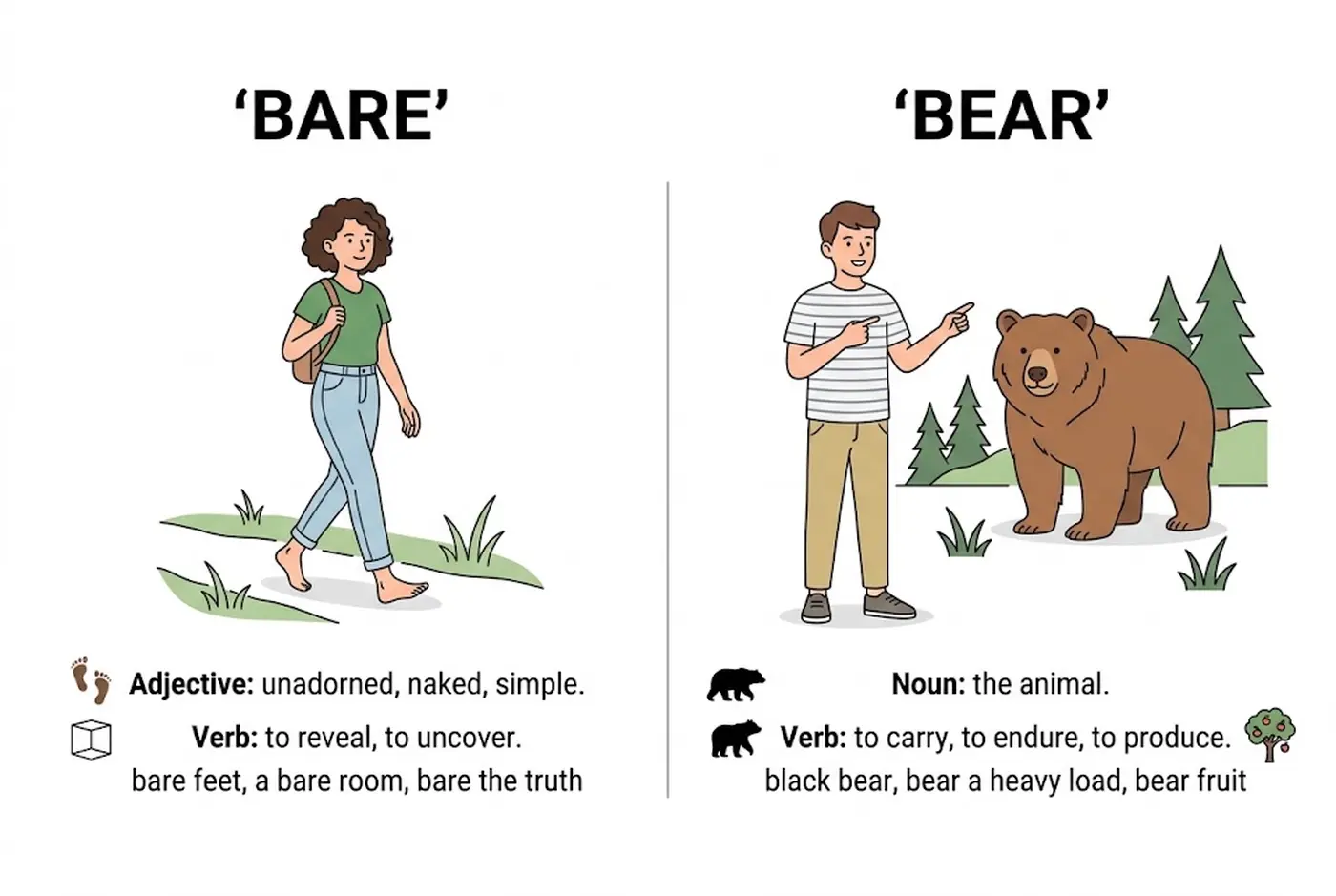
Have you ever typed a quick text, email, or school assignment and stopped at a word that sounds right but looks completely different? Bare vs Bear are a classic example. If you are trying to remember the difference between bare and bear, the key is simple: bare usually means uncovered or without something, while bear can mean to carry, support, tolerate, or refer to the large animal.
The two words sound the same in most varieties of English, but they have completely different meanings and uses. This makes them homophones. They can be easy to confuse because spelling alone does not tell you which one belongs in a sentence.
Answer box: Bare means uncovered, exposed, or without the usual covering. Bear usually means to carry, support, tolerate, or endure, and it can also name a large wild animal.
This guide explains the meanings, origins, related words, common mistakes, regional differences, sentence examples, and the best choice for emails, essays, resumes, texting, and everyday speech. By the end, you will have a simple way to choose the right word without guessing.
What does bare mean in simple English?
Bare usually describes something that is uncovered, empty, plain, or without something that is normally present.
For example:
- The floor was bare.
- He walked across the bare ground.
- The room had bare walls.
- She told me the bare facts.
- The tree had bare branches.
The basic idea is the absence of a covering or extra material.
Bare can work as an adjective, verb, and sometimes a noun in specialized uses.
As an adjective, it describes something uncovered or lacking something.
Example:
The walls were bare.
As a verb, bare means to uncover or reveal something.
Example:
The workers bared the old stone beneath the paint.
Bare can also appear in expressions such as bare feet, bare hands, bare minimum, bare facts, and bare essentials.
What does bear mean in simple English?
Bear has several meanings, so it can be more confusing than bare.
As a verb, bear can mean to carry or support something.
Example:
The bridge can bear the weight of several trucks.
It can also mean to tolerate or endure something.
Example:
I can’t bear the noise anymore.
Bear may also mean to give birth.
Example:
The animal bore three cubs.
As a noun, bear refers to a large mammal.
Example:
We saw a bear near the forest.
Bear can also appear in financial and business language. A bear market is a period when prices generally fall or when investors expect declining prices.
The important point is that the meaning of bear depends heavily on the sentence.
Where did bare come from?
Bare has very old Germanic roots. It is related to Old English words that carried the idea of being uncovered, naked, or without clothing or protection.
Over time, the meaning expanded beyond the human body. English speakers began using bare for uncovered surfaces, empty spaces, limited amounts, and things without decoration.
That is why we can talk about:
- Bare feet.
- Bare walls.
- Bare ground.
- Bare branches.
- Bare facts.
- The bare minimum.
All these uses share a central idea: something is exposed, plain, or lacking something extra.
The word has kept this basic meaning for hundreds of years.
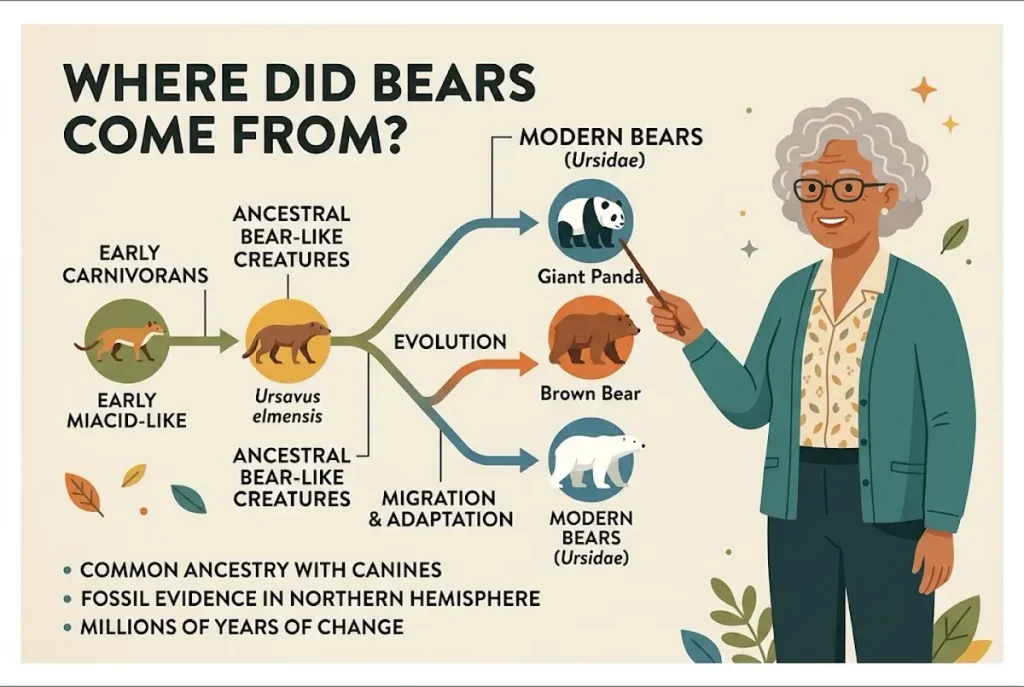
Where did bear come from?
Bear has a different history even though it sounds like bare.
The animal noun bear comes from an old Germanic word related to terms in other Germanic languages. The verb bear has a separate historical development connected with ideas such as carrying, bringing, producing, and enduring.
These different histories explain why the words should not be treated as spelling variations of one another.
The modern meanings are also very different:
| Word | Core idea | Common use |
|---|---|---|
| Bare | Uncovered or without something | Bare feet |
| Bear | Carry, endure, support, or animal | Bear the weight |
| Bare | Reveal or uncover | Bare the truth |
| Bear | Tolerate | Bear the pain |
| Bear | Large mammal | A black bear |
A useful memory trick is this:
Bare has the idea of something being exposed or uncovered.
Bear has the idea of carrying, enduring, or the animal.
What are the main meanings of bare?
Bare has several related meanings. Knowing them helps you understand why it appears in many different expressions.
Bare can mean uncovered
This is the most basic meaning.
Example:
He stood on the bare floor.
The floor has no carpet or covering.
Bare can mean without clothing
Example:
The children ran around with bare feet.
Here, bare means uncovered.
Bare can mean empty or plain
Example:
The apartment had bare walls.
The walls did not have pictures, decorations, or other coverings.
Bare can mean only the minimum
Example:
They had only the bare essentials.
This means they had the minimum things needed.
Bare can mean basic or limited
Example:
The report gave only the bare facts.
The report included the basic facts without much additional explanation.
Bare can mean reveal
As a verb, bare means to uncover or expose.
Example:
The investigation bared several problems.
This use is less common than the adjective but is still correct.
What are the main meanings of bear?
Bear has more meanings and forms.
Bear can mean carry
Example:
The truck can bear a heavy load.
Bear can mean support
Example:
The columns bear the weight of the roof.
Bear can mean tolerate
Example:
She couldn’t bear the pain.
Bear can mean endure
Example:
He bore the difficult situation patiently.
Bear can mean produce
Example:
The tree bears fruit every summer.
Bear can mean give birth
Example:
The mother bear bore two cubs.
Bear can mean an animal
Example:
We saw a brown bear in the distance.
Bear can appear in financial language
Example:
Investors were concerned about a bear market.
The word has a wide range of meanings, so context is especially important.
Which words describe something from mild to strong?
Some related words describe degrees of exposure or difficulty. Choosing the right strength can make your writing more precise.
Mild words for exposure
- Plain.
- Simple.
- Open.
- Uncovered.
Example:
The room looked plain.
This does not necessarily suggest anything dramatic.
Stronger words for exposure
- Exposed.
- Revealed.
- Unprotected.
- Naked.
Example:
The damaged wires were exposed.
This suggests a greater lack of protection.
Mild words for tolerating something
- Handle.
- Accept.
- Manage.
- Take.
Example:
I can handle the pressure.
Stronger words for tolerating something
- Endure.
- Withstand.
- Tolerate.
- Suffer.
Example:
The structure can withstand strong winds.
The choice depends on the situation. A resume may need a more precise formal word, while a text message usually sounds more natural with an everyday word.
How do bare and bear work as different parts of speech?
Bare and bear are not simply interchangeable words. They also perform different grammatical jobs.
| Word | Part of speech | Meaning | Example |
|---|---|---|---|
| Bare | Adjective | Uncovered or plain | He walked on the bare floor. |
| Bare | Verb | Uncover or expose | The workers bared the surface. |
| Bear | Verb | Carry or support | The bridge can bear the weight. |
| Bear | Verb | Tolerate | I can’t bear the noise. |
| Bear | Verb | Produce | The tree bears fruit. |
| Bear | Noun | Large animal | A bear crossed the road. |
This distinction is especially useful when proofreading.
If you are describing a noun, bare may be the word you need.
If you are describing carrying, enduring, producing, or the animal, bear is more likely.

Is the difference between bare and bear the same in US and UK English?
Yes. The basic distinction between bare and bear is the same in American and British English.
Both varieties use bare for meanings such as uncovered, plain, and without something.
Both use bear for meanings such as carry, tolerate, produce, and the animal.
The pronunciation is also the same in standard forms of both varieties, which is one reason the words are often confused.
Regional accents can change the exact sound of many words, but they do not normally create a different spelling rule for these two words.
What is the best choice for a resume?
On a resume, use bare only when you mean something is uncovered, minimal, or without additional features.
Bear is useful when the meaning is carrying responsibility or handling a difficult situation, although another more precise professional verb may sometimes be better.
Example:
She can bear significant responsibility.
A more direct resume sentence might be:
She handles significant responsibility.
For professional writing, clarity is usually more valuable than forcing a particular word into a sentence.
What is the best choice for an essay?
In an essay, choose based on the exact meaning.
Use bare when discussing something uncovered, plain, limited, or reduced to its essentials.
Example:
The author presents the bare facts before explaining the larger issue.
Use bear when discussing carrying, enduring, supporting, or producing.
Example:
The community had to bear the cost of the disaster.
Both words are useful in academic writing because they can express precise ideas without sounding overly complicated.
What is the best choice for texting?
Texting is often where context makes these words easy to confuse.
Use bare for uncovered or plain.
Example:
I walked across the bare floor.
Use bear for tolerate.
Example:
I can’t bear this traffic.
A quick memory check helps:
If you could replace the word with uncovered, think bare.
If you could replace it with tolerate or endure, think bear.
What is the best choice for email?
In an email, use the word that matches the intended meaning.
Example with bare:
The office has bare walls, so we may need some decorations.
Example with bear:
We may have to bear the additional cost.
For business communication, avoid choosing a word just because it sounds familiar. Check what the sentence actually means.
What is the best choice when speaking?
When speaking, the problem becomes harder because bare and bear sound alike.
You cannot rely on pronunciation alone.
Instead, listen for the meaning.
If someone says:
I can’t bear it.
They mean they cannot tolerate or endure it.
If someone says:
He was walking with bare feet.
The meaning is uncovered feet.
When you are unsure while speaking, think about the sentence rather than the sound.
What are some original examples of bare and bear?
Here are examples from common situations.
- The children walked across the bare grass without shoes.
- The old house had bare walls and wooden floors.
- We had only the bare essentials for the camping trip.
- The tree had bare branches after the winter storm.
- The investigation began to bare the problems inside the company.
- The bridge was designed to bear a very heavy load.
- I can’t bear listening to that alarm all morning.
- She had to bear the responsibility for the mistake.
- The apple trees bear fruit every year.
- A large bear appeared near the edge of the forest.
- He stood with bare feet on the cold floor.
- The report contains the bare facts but leaves out important background information.
- The old wooden supports could not bear the extra weight.
- She couldn’t bear the thought of leaving her hometown.
- The walls were bare after the furniture was removed.
- The machine must bear constant pressure during operation.
- The hikers were warned not to approach the bear.
- We packed only the bare minimum for the short trip.
- The company may have to bear higher operating costs.
- The artist left the canvas almost bare.
These examples show why context matters. The sound does not tell you which spelling to use.
what’s the difference?
Bare and exposed are close in meaning, but they are not always equal.
Bare often means something has no covering, decoration, or additional material.
Example:
The room had bare walls.
Exposed often emphasizes that something has been made visible or left without protection.
Example:
The electrical wires were exposed.
Compare them like this:
| Word | Main idea | Example |
|---|---|---|
| Bare | Without a covering or extra material | Bare walls |
| Exposed | Made visible or left unprotected | Exposed wires |
You can sometimes use exposed where bare works, but the reverse is not always natural.
For example, bare feet is a common expression. Exposed feet sounds unusual in ordinary conversation.
what’s the difference between bear and endure?
Bear and endure can both mean tolerate or experience something difficult.
Bear is common in everyday expressions.
Example:
I can’t bear the noise.
Endure often sounds more formal and emphasizes continuing through difficulty.
Example:
The workers endured difficult conditions.
| Word | Main idea | Tone | Example |
|---|---|---|---|
| Bear | Tolerate or experience | Everyday to formal | I can’t bear the pain. |
| Endure | Continue through hardship | More formal | They endured years of hardship. |
In casual conversation, bear often sounds more natural. In formal writing, endure may provide a stronger sense of prolonged difficulty.
What are the most common mistakes with bare and bear?
The biggest mistake is choosing the spelling based on sound.
Because the words are homophones, pronunciation cannot help you.
Mistake with tolerate
Incorrect:
I can’t bare the noise.
Correct:
I can’t bear the noise.
Bear means tolerate in this sentence.
Mistake with uncovered
Incorrect:
He walked on bear feet.
Correct:
He walked on bare feet.
Bare means uncovered here.
Mistake with the animal
Incorrect:
We saw a bare in the woods.
Correct:
We saw a bear in the woods.
Bear is the animal.
Mistake with carrying weight
Incorrect:
The bridge cannot bare the weight.
Correct:
The bridge cannot bear the weight.
Bear means support or carry the weight.
Mistake with minimum
Incorrect:
We brought only the bear essentials.
Correct:
We brought only the bare essentials.
Bare means only the minimum necessary.
When should you not use bare?
Do not use bare when your sentence means tolerate, carry, support, or the animal.
For example:
I can’t bare the pressure.
This is incorrect because the intended meaning is tolerate.
Use bear instead.
Also remember that bare does not automatically mean bad, poor, or low quality. A room can be bare simply because it has little furniture or decoration.
When should you not use bear?
Do not use bear when you mean uncovered or plain.
For example:
She walked with bear feet.
This is incorrect if you mean her feet were uncovered.
Use bare instead.
Also avoid assuming that bear always refers to an animal. The verb is extremely common in phrases such as bear the cost, bear the responsibility, bear the pressure, and bear the pain.
What are the antonyms of bare and bear?
The opposite of bare depends on the meaning.
For uncovered, possible opposites include:
- Covered.
- Protected.
- Decorated.
- Filled.
- Furnished.
Example:
Bare walls can become decorated walls.
For bear meaning tolerate or endure, possible opposites include:
- Reject.
- Avoid.
- Escape.
- Refuse.
- Give up.
For bear as a verb meaning carry or support, an opposite may be abandon or drop, depending on the sentence.
There is no single antonym that works for every meaning of bear.
How can you remember bare and bear?
A simple memory method can make the difference easier.
Think of bare as uncovered
Bare feet are feet without shoes.
Bare walls have no decorations.
The common idea is something being without an extra covering or addition.
Think of bear as carry or tolerate
A bridge bears weight.
A person bears responsibility.
Someone bears pain.
You bear a difficult situation.
A bear is also the animal.
When you see a sentence, ask what action or idea is being expressed.
If it means uncovered, choose bare.
If it means carry, support, tolerate, endure, produce, or the animal, choose bear.
What is the quickest way to choose the right word?
Use this five second test.
| If you mean… | Choose |
|---|---|
| Uncovered | Bare |
| Without decoration | Bare |
| Minimum | Bare |
| Reveal or uncover | Bare |
| Carry | Bear |
| Support | Bear |
| Tolerate | Bear |
| Endure | Bear |
| Produce | Bear |
| Large animal | Bear |
You can also substitute a simpler word.
If uncovered fits, use bare.
If tolerate fits, use bear.
This method works especially well during proofreading.
Why do these words cause so many spelling mistakes?
English contains many homophones. These are words that sound alike but have different meanings and spellings.
Bare and bear are one example.
Other common pairs include:
- To and too.
- There and their.
- Your and you’re.
- Right and write.
- Hear and here.
- Sea and see.
- Allowed and aloud.
The problem is not that the speaker does not understand the meaning. Often, the mistake happens because the writer hears the word mentally and chooses the spelling that looks familiar.
The solution is to connect the spelling with the meaning.
For bare, picture something uncovered.
For bear, picture the animal or something carrying a heavy load.
What should you remember about bare and bear?
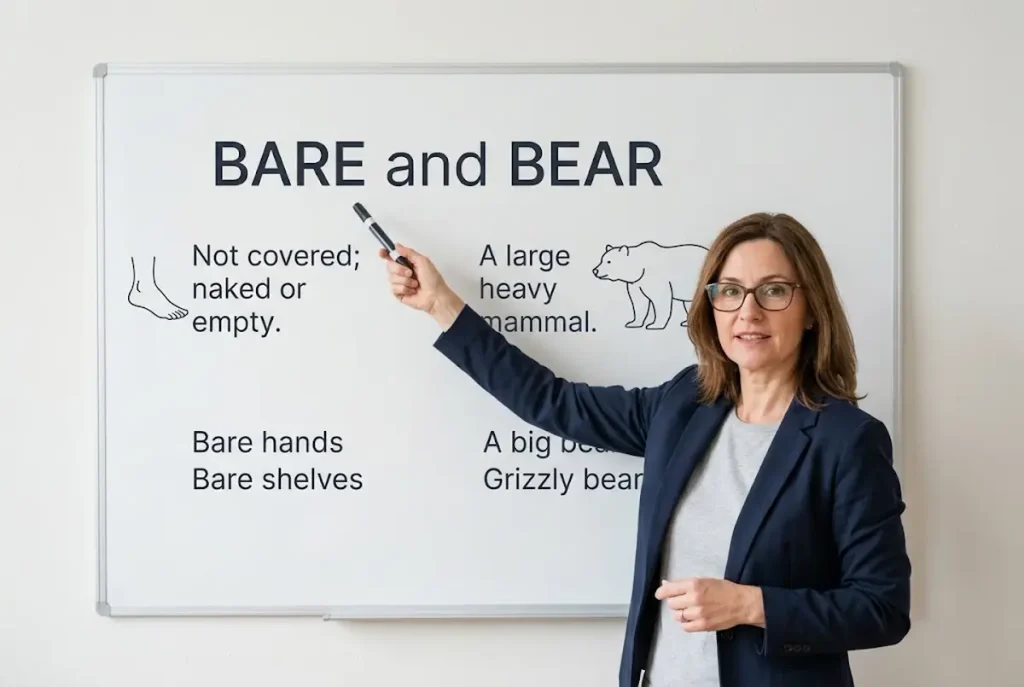
Bare and bear sound alike, but their meanings are different.
Bare usually relates to being uncovered, plain, empty, or without something extra. It can also work as a verb meaning to uncover or reveal.
Bear can mean to carry, support, tolerate, endure, or produce. It can also refer to the large mammal.
A useful sentence pair makes the difference clear:
She walked on bare feet.
She couldn’t bear the pain.
The first sentence describes uncovered feet. The second describes tolerating pain.
Once you connect each spelling with its core idea, the confusion becomes much easier to avoid.
Conclusion
The easiest way to remember bare and bear is to focus on meaning rather than sound. Bare describes something uncovered, plain, exposed, or reduced to the minimum. Bear can mean carry, support, tolerate, endure, or produce, and it is also the name of a large animal.
When you see the words in writing, ask yourself what the sentence is trying to say. If you mean uncovered or without something, choose bare. If you mean carrying, tolerating, supporting, producing, or the animal, choose bear.
With a little practice, these homophones become much easier to spot and use correctly. The next time you are writing an email, essay, text, or professional document, check the meaning first and let the meaning guide the spelling.
Frequently Asked Questions
What is the difference between bare and bear?
Bare usually means uncovered, plain, or without something, while bear can mean carry, tolerate, support, produce, or the animal.
Is it bear feet or bare feet?
The correct expression is bare feet because bare means uncovered.
Is it I can’t bare it or I can’t bear it?
The correct form is I can’t bear it because bear means tolerate or endure.
Is bare and bear pronounced the same?
Yes, they are homophones in standard English, so they normally have the same pronunciation even though their meanings and spellings differ.
What’s another way to say bare?
Depending on the sentence, you can use uncovered, exposed, plain, empty, minimal, or basic. The best alternative depends on the exact meaning.
What’s another way to say bear when it means tolerate?
You can often use endure, tolerate, handle, stand, or put up with. The tone and sentence structure determine which option sounds most natural.
How do I remember bare vs bear?
Remember bare as uncovered and bear as carry, tolerate, or the animal. This simple meaning based rule works in most everyday situations.
Can bear be used as a verb?
Yes. Bear can mean carry, support, tolerate, endure, produce, or give birth, depending on the context.

Daniel Grammarfield — The Language Learner
Age: 28Occupation: ESL Learner & Digital Professional
Bio:Daniel is a non-native English speaker who wants to communicate more confidently at work and online. He uses Synotrench to improve grammar, understand confusing words, learn correct sentence structures, and build everyday English skills. He prefers simple explanations with practical examples.
Goals:
Master English grammar rules
Avoid common language mistakes
Improve professional communication
Learn English through real-life examples
Quote:“Learning English is not about memorizing rules — it’s about expressing ideas clearly.”
2 thoughts on “Bare vs Bear: Simple Guide to the Difference (2026)”