
When you’re writing an essay, card, text, poem, or even a short social media caption, a simple flower description can feel flat. Saying a flower is pretty tells the reader very little. A comparison can make the image much clearer. Beautiful flower similes help you compare flowers with familiar things so readers can picture their color, shape, softness, movement, or charm.
Beautiful flower similes use the words like or as to create a direct comparison. For example, “The rose was as soft as velvet” compares the rose’s delicate texture to velvet, while “The flowers danced like tiny stars in the breeze” creates a picture of flowers moving gently.
This guide explains where the idea of a flower simile comes from, which words work best for different moods, and how to choose a comparison for an essay, email, poem, text, or everyday conversation. You’ll also find original examples, close comparisons, common mistakes, and practical tips for making your own.
What are beautiful flower similes?
A simile is a figure of speech that compares two different things using words such as like or as. The two things do not need to be literally alike. The comparison simply helps the reader imagine a quality they share.
For example:
“The daisy was as white as fresh snow.”
The daisy is not snow. The comparison focuses on color. Both are white, so the reader quickly understands what the flower looks like.
Another example is:
“The tulips stood like colorful cups in the garden.”
Tulips and cups are different objects, but their shapes can create a useful mental picture.
The strongest flower comparisons usually focus on one clear quality. That quality might be:
- Color.
- Shape.
- Size.
- Texture.
- Scent.
- Movement.
- Brightness.
- Delicacy.
- Beauty.
- Emotional feeling.
A good simile should help the reader see or feel something. It should not exist just to make a sentence sound fancy.

Where does the idea of a flower simile come from?
The word simile comes from the Latin word similis, meaning similar or like. The basic idea is simple: one thing is described by showing how it resembles another thing.
People have used comparisons in storytelling, poetry, songs, speeches, and everyday conversation for centuries. Flowers are especially common subjects because they already carry strong associations with beauty, youth, love, peace, growth, and nature.
Flower comparisons also appear across many cultures. A rose may represent love, while a lily may suggest purity or peace. A sunflower often suggests warmth and happiness because of its bright color and connection with sunlight.
Still, the meaning of a flower depends on context. A red rose in a romantic poem can feel passionate. The same rose in a description of an old garden may simply add color.
That is why the best comparison depends on the exact image you want to create.
How do flower similes work in plain English?
A flower simile takes a quality that readers understand and connects it to a flower.
Consider this sentence:
“The petals were soft like silk.”
The flower is not silk. The writer is comparing the smooth, delicate feeling of the petals with silk.
Now consider:
“The sunflower stood like a golden lantern.”
This comparison focuses on the flower’s bright yellow color and its ability to stand out in a garden.
You can think of the structure this way:
| Pattern | Example |
|---|---|
| Flower + is like + image | The rose is like a velvet jewel. |
| Flower + looks like + image | The lily looks like a white bell. |
| Flower + moves like + image | The petals moved like tiny wings. |
| Flower + is as + quality + as + image | The daisy was as white as snow. |
| Flower + blooms like + image | The garden bloomed like a painted field. |
The comparison does not have to be complicated. Simple images are often the easiest to understand.
What are the best flower similes by intensity?
Not every situation needs a dramatic comparison. A school paragraph may need a simple image, while a poem may call for something stronger.
Mild flower comparisons
Use mild comparisons when you want a natural and believable description.
Examples:
- The daisy was white like a small cloud.
- The petals were soft like cotton.
- The flowers moved like gentle feathers.
- The garden smelled fresh like rain.
- The tulips stood like colorful cups.
These comparisons are easy to understand and work well in school writing.
Medium flower comparisons
Medium comparisons create a stronger picture without sounding overly dramatic.
Examples:
- The roses glowed like tiny lanterns.
- The garden spread like a colorful blanket.
- The petals opened like little umbrellas.
- The flowers swayed like dancers in the wind.
- The purple blooms looked like jewels among the green leaves.
Strong flower comparisons
Strong comparisons are useful for poetry, creative writing, speeches, and emotional descriptions.
Examples:
- The garden exploded with color like fireworks across the sky.
- The field of flowers looked like a living rainbow.
- The roses shone like rubies beneath the morning sun.
- The blossoms floated like stars scattered across the earth.
- The flower bed looked like a painted dream brought to life.
The key is balance. A small garden does not need to be described as an entire universe unless the writing is intentionally poetic.
What parts of speech are used in flower descriptions?
The phrase is mainly a noun phrase, but the words around a simile can include several parts of speech.
Nouns
Nouns name the flower or the image being compared.
Examples:
- Rose.
- Lily.
- Daisy.
- Sunflower.
- Jewel.
- Star.
- Cloud.
- Butterfly.
- Velvet.
- Rainbow.
Example:
“The rose looked like a ruby.”
Rose and ruby are nouns.
Adjectives
Adjectives describe qualities.
Examples:
- Soft.
- Bright.
- Delicate.
- Radiant.
- Colorful.
- Elegant.
- Tiny.
- Fragrant.
Example:
“The delicate petals looked like silk.”
Verbs
Verbs show what the flowers do.
Examples:
- Bloom.
- Sway.
- Open.
- Dance.
- Glow.
- Shimmer.
- Bend.
- Rise.
Example:
“The flowers danced like children in the rain.”
Adverbs
Adverbs can explain how an action happens.
Example:
“The petals gently moved like feathers in the breeze.”
Adverbs are useful, but you usually do not need many. A strong verb can often do the work by itself.
Do flower similes change in US and UK English?
The basic idea of a simile is the same in American and British English. There is no major grammar difference in how similes are formed.
The main differences may come from vocabulary, spelling, or cultural preference.
For example, American English commonly uses words such as color, while British English uses colour. The comparison itself does not change:
“The flowers were as colorful as a rainbow.”
British English:
“The flowers were as colourful as a rainbow.”
Regional experiences can also affect the comparisons people find familiar. Someone living near the coast may compare petals to seashells, while someone living in a snowy region may use snow, ice, or winter clouds.
The best comparison is usually the one your intended reader can picture quickly.
What are the best flower for a resume?
A resume usually should not contain poetic flower comparisons. Resumes need clear, professional language.
If you are describing a personal project, garden business, floral design job, or creative portfolio, a light comparison may work in a profile or portfolio description.
Example:
“My floral designs combine soft colors like a watercolor painting.”
Another example:
“I create arrangements that look as balanced as carefully arranged artwork.”
For most professional resumes, direct descriptions are stronger than decorative language.
Avoid writing:
“My flowers are as magical as stars in the universe.”
That sounds creative, but it does not tell an employer much about your skills.
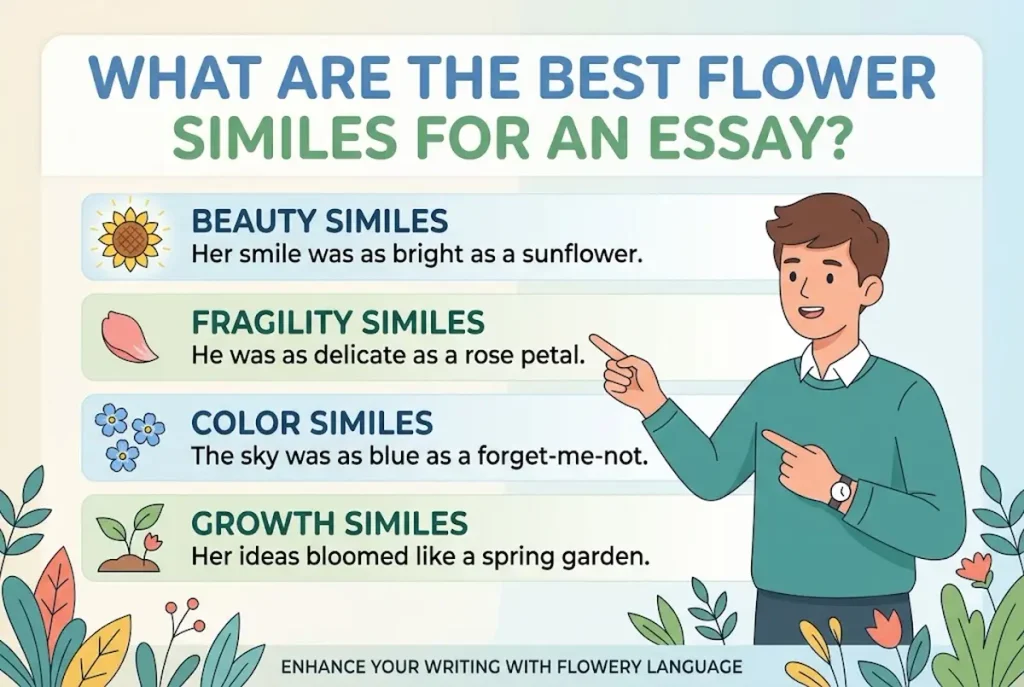
What are the best flower similes for an essay?
Essays benefit from clear comparisons that support the main point.
Example:
“The garden was as peaceful as a quiet lake.”
This works well in descriptive writing because it connects the garden with a familiar peaceful scene.
Another example:
“The field of sunflowers looked like a golden sea stretching toward the horizon.”
This comparison gives the reader a sense of color, size, and distance.
For academic writing, keep the comparison relevant. Avoid adding a simile simply because it sounds pretty.
What are the best similes for texting?
Text messages are usually casual, so short comparisons work best.
Examples:
- “Those flowers are pretty like little stars.”
- “Your bouquet looks like a rainbow.”
- “These roses are soft as velvet.”
- “The garden looks like a fairy tale.”
- “Those flowers are glowing like tiny suns.”
You can also use playful language with friends:
“That sunflower is basically a tiny sun.”
Technically, this is more metaphorical than a traditional simile because it does not use like or as. Still, it shows how everyday flower descriptions can be flexible.
What are the best flower for an email?
In an email, the best comparison depends on why you are writing.
For a thank-you message:
“Your flowers were as cheerful as a sunny morning.”
For a customer message:
“The arrangement looked like a small spring garden.”
For a personal email:
“The flowers made the room feel as peaceful as a quiet meadow.”
Keep the comparison natural. You do not need several similes in one short email.
What are the best similes for speaking?
When speaking, choose comparisons that people can understand immediately.
Examples:
“The flowers looked like tiny stars.”
“The petals were soft as silk.”
“The garden was bright like a rainbow.”
“The roses smelled sweet like fresh fruit.”
Simple comparisons are easier to understand when someone hears them instead of reading them.
What are some original flower simile examples?
Here are original examples covering different flowers, settings, moods, and writing situations.
- The white daisies looked like little stars scattered across the grass.
- The red roses were as bright as rubies beneath the afternoon sun.
- The lavender flowers swayed like tiny purple dancers in the breeze.
- The sunflower stood like a golden lantern above the garden.
- The cherry blossoms floated through the air like pink snow.
- The tulips stood like colorful cups along the garden path.
- The orchid looked as delicate as a butterfly resting on a leaf.
- The rose petals felt soft like velvet beneath my fingers.
- The garden smelled fresh like rain after a warm afternoon.
- The wildflowers spread across the field like a painted blanket.
- The tiny blossoms opened like little windows toward the morning sun.
- The yellow blooms shone like small pieces of sunlight.
- The white lilies stood as quietly as candles in a peaceful room.
- The flower field looked like a rainbow stretched across the countryside.
- The petals fell like colorful confetti after the celebration.
- The pink blossoms looked as soft as cotton candy.
- The roses climbed the old wall like colorful ribbons.
- The flowers appeared like scattered jewels after the rain.
- The petals trembled like tiny wings in the cool breeze.
- The blossoms opened like sleepy eyes when the morning arrived.
These examples show that a simile can describe more than beauty. It can describe motion, color, texture, atmosphere, size, and emotion.
Flower simile vs metaphor: what is the difference?
A simile and a metaphor both create comparisons, but they usually do it in different ways.
| Simile | Metaphor |
|---|---|
| Uses like or as | Directly says one thing is another |
| The rose is like a ruby. | The rose is a ruby. |
| The petals are soft like silk. | The petals are silk. |
| The garden looks like a rainbow. | The garden is a rainbow. |
The simile makes the comparison clear. The metaphor is more direct and imaginative.
For beginners, a useful test is simple: if you clearly use like or as to compare two different things, you probably have a simile.
Flower simile vs personification: what changes?
Personification gives human qualities to nonhuman things.
For example:
“The flowers danced in the wind.”
Flowers cannot literally dance like people. The sentence gives them a human action.
Now compare:
“The flowers moved like dancers in the wind.”
This is a simile because the flowers are being compared to dancers.
The two techniques can also appear together:
“The flowers danced like graceful ballerinas.”
Here, danced is personification, while like graceful ballerinas creates a simile.
Using both can make creative writing more vivid, but the techniques have different jobs.
When should you not use a flower simile?
A comparison is not automatically good just because it sounds poetic.
Avoid a simile when it makes the sentence harder to understand.
For example:
“The daisy was as white as the silence of a forgotten moon.”
This is unusual, but the image is difficult to picture.
A simpler version is:
“The daisy was as white as snow.”
You should also avoid using too many comparisons in a small space.
Weak:
“The rose was like a ruby, the petals were like velvet, the leaves were like emeralds, and the garden was like a rainbow.”
The reader may feel overwhelmed.
Better:
“The red rose stood out like a ruby among the green leaves.”
One strong comparison can do more than four weak ones.
What are common mistakes?
Using like incorrectly
A common mistake is creating a comparison that does not make sense.
Incorrect:
“The flower was like beautiful.”
Beautiful is an adjective, so the comparison is incomplete.
Better:
“The flower was beautiful like a painting.”
Even better:
“The flower looked like a delicate watercolor painting.”
Mixing two comparisons
Avoid combining images that compete with each other.
Confusing:
“The rose was like a ruby and soft as a cloud of fire.”
The images do not work together clearly.
Better:
“The rose was red like a ruby and soft like velvet.”
Choosing an image readers cannot picture
A simile should make the description clearer.
If the comparison is too abstract, readers may have to stop and figure it out.
Choose familiar images when clarity matters.
Overusing beautiful
If every sentence uses beautiful, the writing loses variety.
Try:
- Delicate.
- Radiant.
- Bright.
- Graceful.
- Colorful.
- Elegant.
- Fragrant.
- Charming.
- Luminous.
- Exquisite.
The best word depends on what you are describing.
Forgetting the purpose of the writing
A poem can handle imaginative comparisons. A business email usually needs a lighter touch.
Always consider your reader first.
What are the antonyms of words used for beautiful flowers?
Antonyms can help you understand the opposite side of a description.
| Positive word | Possible opposite |
|---|---|
| Beautiful | Ugly |
| Bright | Dull |
| Colorful | Colorless |
| Delicate | Rough |
| Soft | Hard |
| Graceful | Awkward |
| Fresh | Wilted |
| Radiant | Dim |
| Elegant | Clumsy |
| Charming | Unappealing |
| Vibrant | Lifeless |
| Luminous | Dark |
Flowers themselves are not always beautiful in the same way. A wilted flower may look sad, tired, dry, or fragile.
For example:
“The wilted petals hung like tired curtains.”
This is still a simile, but the emotional effect is very different from a comparison involving stars or jewels.
How do you choose the right flower simile?
Start with the quality you want to describe.
If you are describing color, think about familiar colorful objects.
Examples:
- Red like a ruby.
- Yellow like sunlight.
- White like snow.
- Pink like cotton candy.
- Purple like amethyst.
- Blue like the morning sky.
If you are describing texture, think about familiar materials.
Examples:
- Soft like silk.
- Smooth like satin.
- Light like a feather.
- Delicate like thin paper.
If you are describing movement, think about things that move naturally.
Examples:
- Like dancers.
- Like butterflies.
- Like waves.
- Like feathers.
- Like flags in the wind.
If you are describing a large flower field, think about things that suggest size.
Examples:
- Like a sea of color.
- Like a giant blanket.
- Like a painted landscape.
- Like a rainbow across the earth.
The comparison should support the exact picture in your mind.
What makes effective?
The strongest comparisons usually share three qualities.
They are easy to picture
“White like snow” creates an immediate image.
They match the quality being described
If you are talking about softness, compare the flower with something soft. If you are talking about brightness, choose something bright.
They fit the tone
A romantic poem can use a more emotional comparison. A school report may need something simple and direct.
For example:
Romantic:
“Her roses glowed like rubies beneath the moon.”
Simple:
“The roses were red like rubies.”
Both work. The first creates a stronger mood, while the second is easier and more direct.
How can you create your own flower similes?
You do not need a huge vocabulary to write an original comparison.
Use this five step method.
- Name the flower.
- Choose one quality.
- Think of something with the same quality.
- Connect the two with like or as.
- Add detail if needed.
This method works with almost any flower.
Try the same process with a rose:
Flower: rose.
Quality: red.
Image: ruby.
Sentence: “The rose was red like a ruby.”
Then make it more specific:
“The rose was red like a ruby glowing beneath the morning sun.”
The second sentence gives the reader more than color. It also creates light and atmosphere.
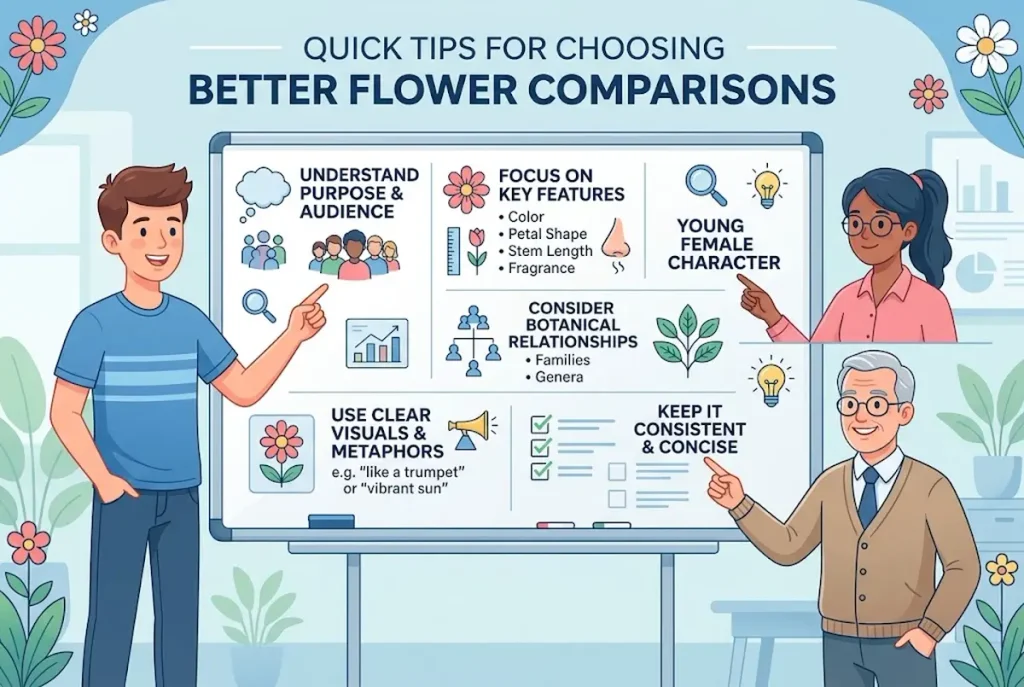
Quick tips for choosing better flower comparisons
- Compare one clear quality at a time.
- Use familiar images when writing for younger readers.
- Use unusual comparisons only when they add something useful.
- Match the comparison to the mood.
- Avoid repeating the same image throughout a paragraph.
- Use like or as when you want a clear simile.
- Read the sentence aloud to check its rhythm.
- Remove a simile if the sentence is stronger without it.
- Think about what your reader already knows.
- Choose precision over decoration.
- Use color comparisons for visual descriptions.
- Use texture comparisons for close descriptions of petals.
- Use movement comparisons for flowers in wind or rain.
- Use larger images for fields and gardens.
- Keep professional writing more restrained.
- Let creative writing take more risks.
A useful final test is to ask: “Does this comparison help me see the flower?”
If the answer is yes, keep it. If it only makes the sentence longer, replace it or remove it.
Conclusion
Good flower comparisons do more than tell readers that something is pretty. They help readers see color, texture, movement, size, and emotion in a way that ordinary descriptions sometimes cannot. The best beautiful similes are clear, natural, and suited to the situation.
A daisy can be white as snow, a rose can glow like a ruby, and a field of wildflowers can spread like a colorful blanket. You do not need complicated vocabulary to create a strong image. Start with one quality, choose a familiar object that shares it, and connect the two with like or as. With practice, you can create original comparisons that make essays, poems, messages, and everyday descriptions much more vivid.
Frequently Asked Questions
What is a good simile for a flower?
A good simile depends on the flower and the quality you want to describe. For example, “The petals were soft like velvet” is useful when you want to emphasize texture.
What’s another way to say a flower is beautiful?
You can say a flower is radiant, lovely, elegant, delicate, stunning, charming, exquisite, or colorful. You can also use a comparison such as “The rose was bright like a ruby.”
What are some examples of words?
Examples include “The daisies were white like snow,” “The roses glowed like rubies,” and “The flowers moved like dancers in the wind.” Each comparison focuses on a different quality.
How do I make my own flower simile?
Choose a flower, identify one quality, think of something that shares that quality, and connect the two with like or as. For example, choose a yellow sunflower, focus on brightness, and compare it with sunlight.
Can be used in everyday conversation?
Yes. Simple comparisons such as “Those flowers look like little stars” sound natural in casual conversation, texts, cards, and social media captions.

Daniel Grammarfield — The Language Learner
Age: 28Occupation: ESL Learner & Digital Professional
Bio:Daniel is a non-native English speaker who wants to communicate more confidently at work and online. He uses Synotrench to improve grammar, understand confusing words, learn correct sentence structures, and build everyday English skills. He prefers simple explanations with practical examples.
Goals:
Master English grammar rules
Avoid common language mistakes
Improve professional communication
Learn English through real-life examples
Quote:“Learning English is not about memorizing rules — it’s about expressing ideas clearly.”
2 thoughts on “Beautiful Flower Similes: Best Examples and Meanings (2026)”