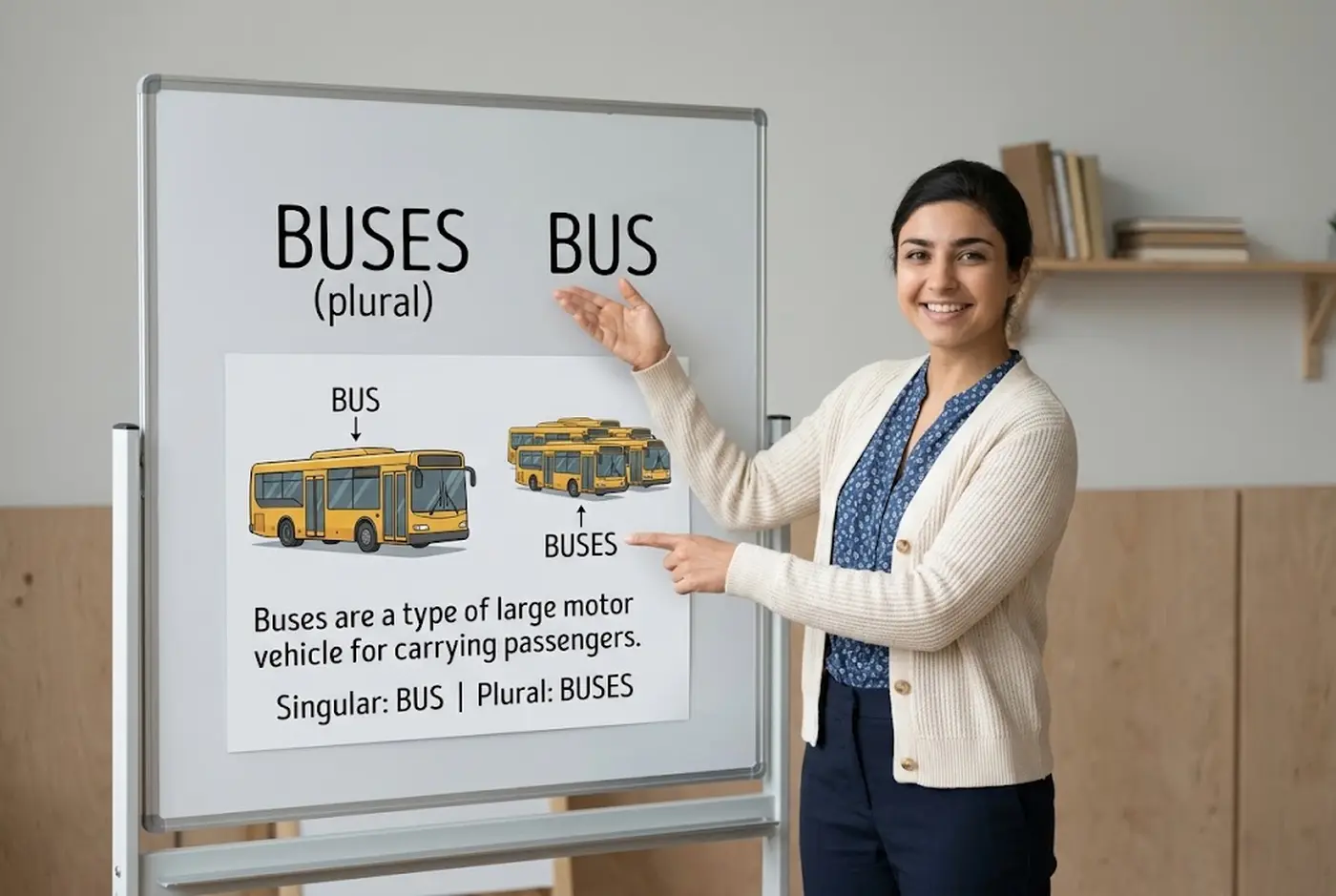
If you’re writing an email, finishing an essay, updating a resume, or sending a quick text about public transportation, you may stop at one small spelling question: busses or buses? Both forms are real English words, but they do not usually mean the same thing. The correct choice depends on the word you mean.
The most common plural of bus is buses. It refers to two or more vehicles that carry passengers. Busses is also a real word, but it is the plural form of buss, an older word meaning a kiss. That difference makes the spelling much easier to remember.
Answer box: Use buses when you mean more than one vehicle used to carry passengers. Use busses when you mean more than one kiss, although buss and busses are uncommon in modern everyday English.
This guide explains the history and meaning of both words, shows how their forms work, compares them with related words, and gives examples for school, work, texting, email, and everyday conversation. You’ll also learn which spelling is best for formal writing and which mistakes to avoid.
What do busses or buses mean?
Both are legitimate English spellings, but they come from different words.
Buses is the standard plural of bus. A bus is a large vehicle designed to carry people from one place to another. City buses, school buses, tour buses, and shuttle buses all belong to this group.
Busses is the plural of buss. A buss is a noun meaning a kiss. It can also be used as a verb meaning to kiss someone. The word is old fashioned and is not common in ordinary modern American English.
So, the distinction is simple:
| Word | Singular form | Plural form | Meaning |
|---|---|---|---|
| bus | bus | buses | Passenger vehicle |
| buss | buss | busses | Kiss |
When you’re talking about transportation, buses is almost always the word you need.
Where did bus come from?
The word bus has an interesting history. It developed from the French word omnibus, which meant for everyone. Omnibus came from Latin and was used for public transportation in the 19th century.
Over time, people shortened omnibus to bus. The shorter word became common in English and eventually developed into the modern noun we use today.
The shortened form was convenient because people often used it in phrases related to public transportation. As transportation systems expanded, bus became a normal everyday word.
The plural form follows the usual spelling pattern for words ending in a single s sound after a consonant. In modern English, the standard plural is buses.
For example:
One bus becomes two buses.
One school bus becomes several school buses.
One city bus becomes many city buses.
The word can also appear in compounds:
bus stop
bus station
These expressions all use bus in the transportation sense.
Where did buss come from?
Buss is a much older word. It means a kiss or an affectionate kiss. It has appeared in English for centuries and was especially common in older literature.
Today, most American English speakers are much more familiar with kiss than buss. You may still see buss in historical writing, poetry, novels, or older expressions.
The plural is busses because buss follows the normal plural pattern for many words ending in s.
For example:
one buss → two busses
one kiss → two kisses
The two words look almost identical, which explains why the spelling can cause confusion. Their meanings, however, are completely different.
Modern writers usually choose kiss and kisses instead of buss and busses. That’s especially true in business writing, school assignments, resumes, websites, and everyday messages.
What is the correct plural of bus?
The standard plural of bus is buses.
If you are talking about passenger vehicles, write buses.
For example:
The buses are waiting outside.
We need three buses for the field trip.
Several buses stopped near the airport.
The school bought two new buses.
This is the spelling you should normally use in American English.
A useful memory trick is to connect buses with transportation. If people are getting on, getting off, driving, waiting for, or riding the vehicles, buses is the right choice.
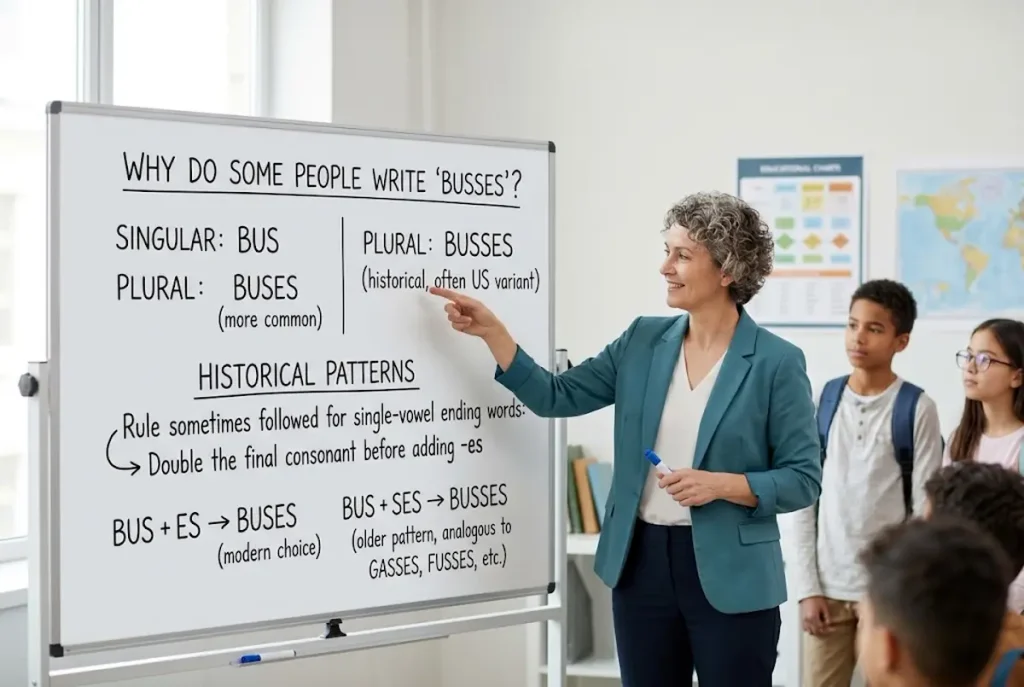
Why do some people write busses for vehicles?
The spelling busses sometimes appears because English has several words that form plurals in different ways. Writers may also assume that a word ending in s should receive es, which makes busses look natural.
There is another reason for the confusion. Bus has historically appeared with more than one plural spelling in English, and older dictionaries and texts may contain variations.
Modern standard usage has settled strongly on buses for the transportation vehicle.
That means you may occasionally see busses used for vehicles, but it is not the preferred spelling in contemporary standard American English.
For schoolwork, professional writing, websites, and general communication, choose buses.
How do you spell the plural of bus?
The plural of bus is buses when you mean passenger vehicles.
The basic pattern is:
bus → buses
Notice that only es is added.
Here are more examples:
school bus → school buses
city bus → city buses
tour bus → tour buses
airport bus → airport buses
shuttle bus → shuttle buses
electric bus → electric buses
public bus → public buses
If you are unsure, remember the sentence:
One bus, two buses.
That simple pattern will help you avoid the most common spelling error.
Master list of related words
The two main words have different meanings, but many related terms appear in the same situations. Learning them together can make word choice easier.
| Word | Meaning | Tone | Example |
|---|---|---|---|
| bus | A passenger vehicle | Everyday | I take the bus to work. |
| buses | More than one passenger vehicle | Everyday | The buses are full. |
| coach | A large passenger vehicle | Formal or everyday | We traveled by coach. |
| shuttle | A vehicle making repeated trips | Everyday | The shuttle runs every hour. |
| shuttle bus | A bus that moves people between locations | Everyday | The shuttle bus goes to the airport. |
| bus driver | Person who drives a bus | Everyday | The bus driver waited for us. |
| transit | Public transportation system | Formal | Transit is cheaper than driving. |
| transportation | Movement of people or goods | Formal | Public transportation reduces traffic. |
| public transport | Shared transportation service | Everyday | Public transport is useful downtown. |
| vehicle | Machine used for transportation | Formal | The vehicle arrived on time. |
| ride | A trip in a vehicle | Everyday | I need a ride home. |
| commute | Regular trip between home and work or school | Everyday | My commute takes 30 minutes. |
| passenger | Person traveling in a vehicle | Formal | Every passenger needs a ticket. |
| route | Planned path from one place to another | Everyday | The route changed today. |
| terminal | Place where transportation begins or ends | Formal | We arrived at the terminal. |
| buss | An old word meaning a kiss | Old fashioned | The novel uses the word buss. |
| busses | More than one buss or kiss | Old fashioned | The poem mentions several busses. |
How do synonyms change from mild to strong?
The word bus itself does not have many exact synonyms because it describes a specific type of vehicle. Still, several related transportation words can replace it in certain contexts.
From more general to more specific, you might use:
- Vehicle
- Transportation
- Transit
- Shuttle
- Coach
- Minibus
- Bus
These words are not perfect replacements in every sentence.
Vehicle is broad. A vehicle can be a car, truck, van, motorcycle, or bus.
Transportation is even broader. It describes the general movement of people or goods.
Transit often refers to public transportation systems.
Shuttle describes transportation that travels repeatedly between particular locations.
Coach often describes a large bus used for longer trips.
Minibus specifically describes a smaller bus.
Bus is the most direct word when you mean the standard passenger vehicle.
For the word buss, the related words are different:
- Affection
- Kiss
- Peck
These words vary in tone. Kiss is neutral and common. Peck often suggests a quick or light kiss. Smooch is informal and playful. Buss sounds old fashioned.
What are the parts of speech?
Bus and buss can both work as nouns and verbs, but their meanings remain different.
Bus as a noun
As a noun, bus means a passenger vehicle.
Example:
The bus stopped near the library.
Its plural is buses.
Bus as a verb
As a verb, bus can mean to transport people by bus.
Example:
The company buses employees to the office.
It can also refer to traveling by bus in certain contexts.
Buss as a noun
As a noun, buss means a kiss.
Example:
The old story describes a gentle buss.
Its plural is busses.
Buss as a verb
As a verb, buss means to kiss.
Example:
The character bussed his child on the forehead.
This use is uncommon in modern everyday English.
The important point is that the spelling changes because the base words are different. Bus and buss are not two spellings of the same meaning.
Are Words different in American and British English?
For modern transportation writing, buses is the standard choice in both American and British English.
The same basic distinction applies to buss and busses.
Regional differences can affect pronunciation, transportation vocabulary, and certain style choices, but they do not normally change the central spelling rule here.
American English commonly uses bus and buses.
British English also commonly uses bus and buses.
You may encounter older texts with different plural forms, but modern readers generally expect buses for the vehicle.
So, if you’re writing for an American audience, buses is the safe and natural choice.
Which word is best for a resume?
Buses for a transportation job
Use buses when your resume discusses passenger vehicles.
Example:
Managed daily inspections of 25 school buses.
Another example:
Coordinated maintenance schedules for city buses.
If you work as a driver, mechanic, dispatcher, or transportation manager, buses is the normal spelling.
Buss or busses in a resume
Avoid buss and busses unless your work history specifically involves an unusual historical, literary, or linguistic context.
A resume should use the clearest modern vocabulary possible. Since buss is uncommon, it can distract the reader.
Which word is best for an essay?
Buses in an academic essay
Use buses when writing about transportation, public policy, education, traffic, or urban planning.
Example:
Many cities are adding electric buses to reduce pollution.
Another example:
School buses help students travel safely between home and school.
Which word is best for texting?
Buses for everyday messages
Use buses in normal text messages about transportation.
Examples:
The buses are running late.
Which buses go to downtown?
I missed the last two buses.
The buses should be here soon.
Writing busses in these messages may make your spelling look incorrect because most readers expect buses.
Busses in a casual text
Busses would only make sense if you’re talking about multiple kisses, and even then, kisses sounds much more natural.
For example:
The movie scene had several kisses.
That’s more natural than:
The movie scene had several busses.
Which word is best for email?
Buses in professional email
Use buses when discussing schedules, transportation, routes, or passengers.
Example:
The buses will arrive at the school at 7:30 a.m.
Another example:
Please confirm how many buses are needed for the event.
This spelling is clear, professional, and standard.
Busses in professional email
Avoid busses unless you specifically mean multiple kisses or are discussing the word buss itself.
A transportation email containing busses can look like a spelling mistake.
Which word is best when speaking?
Buses in conversation
When speaking about transportation, say bus and buses.
Examples:
The buses are crowded today.
Two buses are waiting outside.
Which bus goes to the airport?
The buses stop running at midnight.
The context makes the meaning clear, so most listeners will understand you immediately.
If you’re discussing the old word buss, you would normally explain the meaning because many listeners may not recognize it.

What are some real examples of buses?
Here are examples from common situations.
- The buses arrived before the students finished breakfast.
- Several buses were parked outside the stadium after the game.
- We waited for the buses near the main entrance.
- The city plans to replace older buses with electric models.
- Our school uses buses to transport students to sporting events.
- The buses became crowded during the evening commute.
- Two buses stopped at the same station at almost the same time.
- The airport provides free buses between the terminal and parking area.
- The new bus route gives residents another way to reach downtown.
- The transportation company added more buses during the holiday season.
- Passengers should check the route before boarding the buses.
- The buses leave every 20 minutes during the morning.
- We missed our buses because the train was delayed.
- The school ordered smaller buses for younger students.
- Several tour buses were parked near the museum.
All of these examples use buses because they refer to passenger vehicles.
what’s the difference?
The difference is mainly meaning.
| Feature | Buses | Busses |
|---|---|---|
| Base word | Bus | Buss |
| Main meaning | Passenger vehicles | Kisses |
| Common today | Very common | Rare |
| Normal in US English | Yes | Only in special contexts |
| Used in transportation | Yes | No |
| Used in older literary writing | Sometimes | Yes |
| Recommended for school writing | Yes for vehicles | Only when meaning buss |
| Example | Three buses arrived. | The poem mentions busses. |
The easiest way to remember the difference is to look at the singular form.
If the singular is bus, the plural is buses.
If the singular is buss, the plural is busses.
Bus vs buss: what’s different?
The extra s changes the word itself.
Bus refers to a passenger vehicle.
Buss refers to a kiss.
Compare these sentences:
The bus is waiting outside.
The character gave her a buss.
The first sentence concerns transportation. The second uses an old fashioned word for a kiss.
What mistakes should you avoid?
Several mistakes appear often because the two words look so similar.
Mistake 1: Using busses for vehicles
Incorrect:
The busses are late today.
Preferred:
The buses are late today.
If you’re writing about public transportation, buses is the standard modern spelling.
Mistake 2: Assuming busses is always wrong
Busses is not automatically wrong. It is a legitimate plural of buss.
For example:
The old novel describes several busses.
The issue is meaning, not simply spelling.
Mistake 3: Using buss when you mean bus
Incorrect:
I take the buss to school.
Correct:
I take the bus to school.
The first sentence changes the word from a vehicle to a kiss.
Mistake 4: Overusing an old word
If you mean kiss, use kiss in most modern writing.
Buss can sound literary, historical, or old fashioned. It may be correct but still feel unnatural.
Mistake 5: Forgetting the singular form
When you’re uncertain, go back to the singular.
Ask yourself:
Am I talking about a bus?
Or am I talking about a buss?
That question usually solves the spelling problem immediately.
What are the antonyms?
Neither bus nor buss has a direct antonym.
For bus, you can use words that describe different transportation choices, such as:
car
walking
bicycle
train
motorcycle
These are not true antonyms. They’re simply different ways to travel.
For buss, the opposite depends on the context. You might describe distance, avoidance, or rejection, but there is no single standard antonym.
For example:
kiss ↔ avoid physical affection
embrace ↔ reject
Again, these are contextual opposites rather than dictionary antonyms.
How can you choose the right spelling quickly?
Use these simple checks.
Check the meaning
If you mean passenger vehicles, choose buses.
If you mean kisses and are intentionally using the old word buss, choose busses.
Check the singular
Bus becomes buses.
Buss becomes busses.
Think about the audience
Most readers are familiar with bus and buses. Far fewer use buss and busses in ordinary conversation.
If your audience is reading a school assignment, business email, website, or resume, modern and familiar wording is usually best.
Choose the simpler word
If you mean a kiss, kiss is usually clearer than buss.
If you mean passenger vehicles, buses is clear and standard.
Good writing isn’t just about finding a technically possible word. It’s also about choosing the word your readers will understand immediately.
Read the whole sentence
Sometimes a sentence makes the intended meaning obvious.
For example:
The buses were packed with passengers.
There is no reason to use busses because passengers and transportation clearly establish the meaning.
Likewise:
The old poem describes a tender buss.
The literary context signals that buss means a kiss.
Quick tips for remembering the spelling
Keep these rules in mind:
- Bus means a passenger vehicle.
- The plural of bus is buses.
- Buss means a kiss.
- The plural of buss is busses.
- Buses is extremely common in modern English.
A short memory sentence can help:
One bus, two buses. One buss, two busses.
Once you connect the extra s with the old word buss, the difference becomes much easier to remember.
Why does this spelling matter?
A small spelling difference can change the meaning of a sentence. That matters most when the words look almost identical.
Consider:
The buses arrived.
Readers immediately picture passenger vehicles.
Now consider:
The busses arrived.
A careful reader may wonder if you mean kisses. In most transportation contexts, the second sentence looks like a spelling error.
Clear spelling helps readers understand your meaning without stopping to figure out what you intended. This is especially useful in professional writing, academic work, websites, signs, instructions, and public information.
The goal isn’t to memorize every unusual English word. It’s to recognize the few distinctions that can change meaning.
This is one of those distinctions.
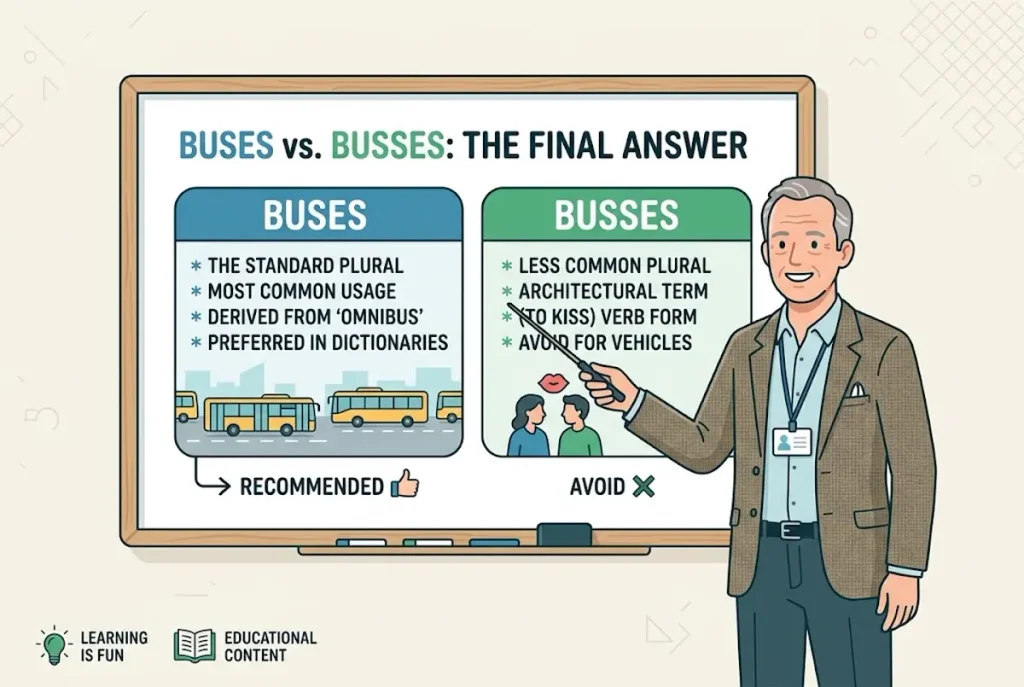
Final Answer About busses or buses
The correct spelling for more than one passenger vehicle is buses. It is the standard plural of bus and is the form you should use in school assignments, professional emails, resumes, articles, and everyday writing.
Busses is also a valid English word, but it comes from buss, an uncommon word meaning a kiss. It is mostly found in older, literary, or specialized writing.
The simplest rule is this: if you’re talking about transportation, use buses. If you’re talking about kisses and deliberately using the old word buss, use busses.
Conclusion
When choosing between words, the correct spelling depends on what you mean. Use buses when you’re talking about two or more passenger vehicles, such as school buses, city buses, or tour buses. Busses is the plural of the much less common word buss, which means a kiss.
In modern American English, buses is by far the more common choice and is the spelling you should use in most writing. If you’re ever unsure, check the singular form first: bus becomes buses, while buss becomes busses. Once you remember this simple difference, you’ll have no trouble choosing the right spelling.
Frequently Asked Questions
Is the plural of bus?
The standard plural of bus is buses. Busses is the plural of buss, an old word meaning a kiss.
Is busses a correct spelling?
Yes, busses is a correct spelling when it is the plural of buss. It is not the standard plural spelling for the passenger vehicle bus.
Which is correct for public transportation?
Buses is correct for public transportation. Use it when referring to two or more passenger vehicles.
Why is buses spelled with one s before es?
Buses comes from the singular word bus. The plural is formed by adding es, giving bus plus es, or buses. Busses comes from a different word, buss.
Can I use busses in a school essay?
You can use busses if you mean multiple kisses and the context calls for the word buss. If you’re writing about transportation, use buses.
What’s another way to say buses?
Depending on the context, you can use terms such as coaches, shuttles, minibuses, transit vehicles, or passenger vehicles. These aren’t exact replacements in every sentence.

Daniel Grammarfield — The Language Learner
Age: 28Occupation: ESL Learner & Digital Professional
Bio:Daniel is a non-native English speaker who wants to communicate more confidently at work and online. He uses Synotrench to improve grammar, understand confusing words, learn correct sentence structures, and build everyday English skills. He prefers simple explanations with practical examples.
Goals:
Master English grammar rules
Avoid common language mistakes
Improve professional communication
Learn English through real-life examples
Quote:“Learning English is not about memorizing rules — it’s about expressing ideas clearly.”
1 thought on “Busses or Buses: The Best Spelling Guide (2026)”