Imagine you’re writing lay vs lie an email, completing a school assignment, or sending a quick text message. You want to tell someone that you need to rest, but you’re unsure whether to write I need to lay down or I need to lie down. Both expressions sound familiar, so choosing the correct one can be confusing.
The confusion happens because lay vs lie have similar meanings and are often used in everyday conversations. However, they follow different grammar rules. One verb needs an object, while the other usually describes a person or thing resting in a position.
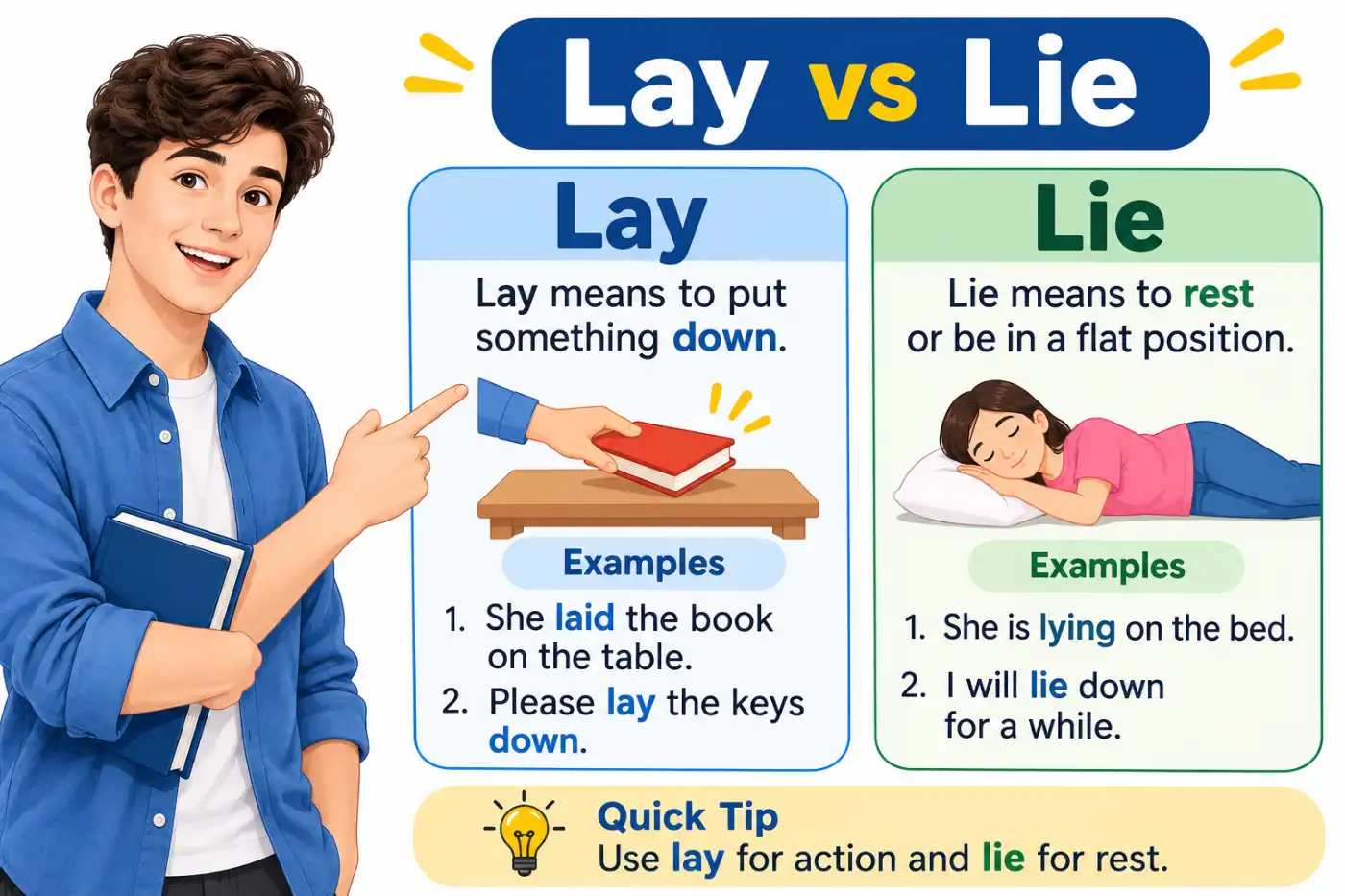
The main difference is that lay means to put or place something down, while lie means to rest or recline. Lay requires a direct object, but lie does not.
This guide explains their meanings, origins, verb forms, synonyms, and differences with simple examples. You’ll also learn how to use both verbs in emails, essays, resumes, conversations, and other everyday situations.
What Is the Difference Between Lay and Lie?
Lay and lie are both verbs, but they describe different actions.
- Lay means to put or place someone or something somewhere. It requires a direct object.
- Lie means to rest, recline, or remain in a particular position. It doesn’t require a direct object.
The easiest way to understand the difference is to ask whether someone is placing something down or resting themselves.
| Word | Meaning | Grammar Rule | Example |
|---|---|---|---|
| Lay | To put or place something down | Requires an object | Please lay the book on the table. |
| Lie | To rest or recline | Doesn’t require an object | I need to lie on the bed. |
How Can You Remember the Difference?
Use this simple trick:
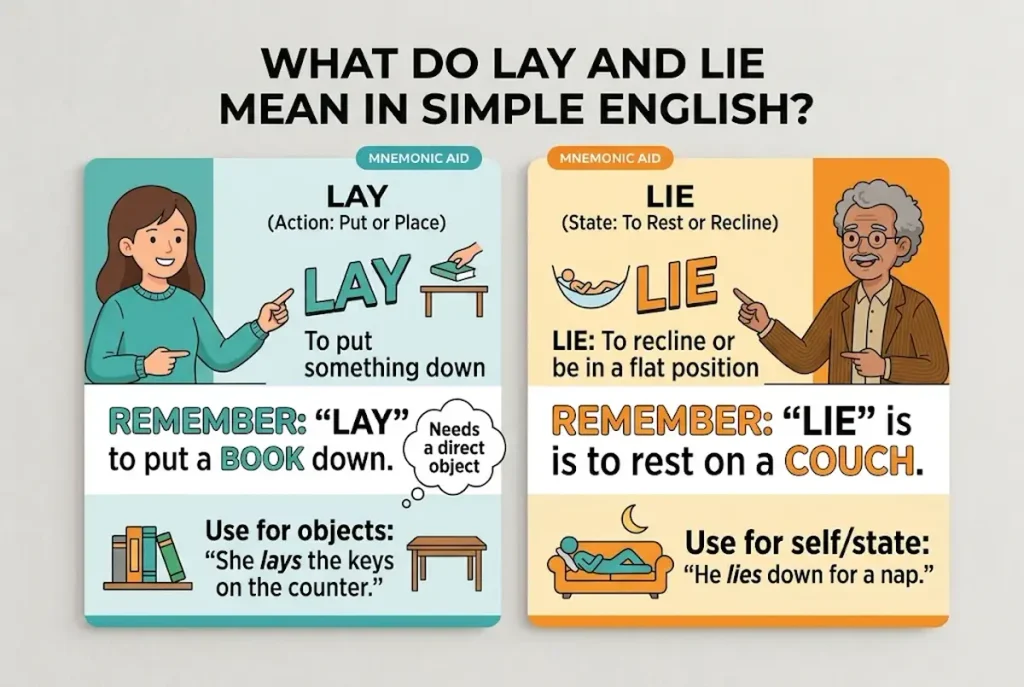
- Lay = Place something.
- Lie = Rest yourself.
For example, if you put your keys on the desk, you lay them there. If you feel tired and want to rest, you lie down.
Remember that lay can also be used in the past tense of lie. This is one reason people often confuse the two verbs. You’ll learn about that important exception below.
What Do Lay and Lie Mean in Simple English?
Understanding the basic meanings makes these verbs easier to use.
What Does Lay Mean?
Lay means to put, place, or set something down in a particular position.
It describes an action that someone performs on an object. The object can be a book, phone, bag, document, or another person.
Examples:
- Please lay your jacket on the chair.
- She laid the baby gently in the crib.
- He lays his keys beside the front door.
What Does Lie Mean?
Lie means to rest, recline, or remain in a horizontal position.
It usually describes a person or animal resting without placing another object somewhere.
Examples:
- I want to lie down for a few minutes.
- She lies on the couch every evening.
- The dog is lying near the fireplace.
- He lay on the grass and watched the clouds.
What Is the Origin of the Words Lay and Lie?
The words lay and lie have Old English and Germanic roots. Their histories help explain why they have different meanings today.
Where Does the Word Lay Come From?
Lay comes from the Old English word lecgan, which meant to place, put, or set something down.
Its original meaning is closely related to its modern use. People still use lay when they describe placing an object or person in a particular position.
Examples include:
- Lay the newspaper on the table.
- Lay the baby in the crib.
- Lay the tools beside the door.
Where Does the Word Lie Come From?
Lie comes from the Old English word licgan, which meant to rest, recline, or remain in a particular position.
Its modern meaning is still connected to this original idea.
Examples include:
- Lie on the bed.
- Lie beneath the tree.
- The book lies on the shelf.
Why Do Lay and Lie Sound So Similar?
Both verbs have several forms that look or sound alike.
For example:
- Lay is the present tense of the verb meaning to place.
- Lay is also the simple past tense of lie.
- Lain is the past participle of lie.
- Laid is the past tense and past participle of lay.
What Are the Different Verb Forms of Lay and Lie?
The verb forms are especially important because lay and lie change differently in the past tense.
What Are the Forms of Lay?
Lay is an irregular verb. Its forms are lay, laid, and laid.
| Verb Form | Word | Example |
|---|---|---|
| Base form | Lay | I lay the book on the desk. |
| Third-person singular | Lays | She lays the blanket on the bed. |
| Present participle | Laying | He is laying the papers on the table. |
| Simple past | Laid | I laid the keys near the door. |
| Past participle | Laid | She has laid the baby in the crib. |
What Are the Forms of Lie?
Lie is also an irregular verb. Its forms are lie, lay, and lain.
| Verb Form | Word | Example |
|---|---|---|
| Base form | Lie | I lie on the sofa. |
| Third-person singular | Lies | She lies on the bed. |
| Present participle | Lying | He is lying on the floor. |
| Simple past | Lay | I lay on the sofa yesterday. |
| Past participle | Lain | I have lain in bed all morning |
Why Is Laid Different From Lain?
Laid belongs to the verb lay, which means to place something down.
Lain belongs to the verb lie, which means to rest or recline.
Compare these sentences:
- She laid the blanket on the bed.
- She has lain on the bed all morning.
What Are the Best Synonyms for Lay and Lie?
Both verbs have several alternatives, but the correct synonym depends on the action.
Lay generally has synonyms related to placing, setting, or positioning something. Lie has synonyms related to resting, reclining, or remaining in a position.
Simple Synonyms for Lay
| Word | Meaning | Tone | Example |
|---|---|---|---|
| Put | Move something into a position | Simple | Put the book on the desk. |
| Place | Position something somewhere | Simple | Place your bag near the door. |
| Set | Put something in a particular position | Simple | Set the cup on the table. |
| Leave | Allow something to remain somewhere | Simple | Leave your shoes outside. |
| Drop | Let something fall | Simple | Drop the keys into the basket. |
| Position | Put something in a specific place | Simple | Position the chair near the window. |
| Arrange | Put things in an organized order | Simple | Arrange the papers on the desk. |
| Spread | Open or extend something over a surface | Simple | Spread the blanket on the floor. |
Everyday Synonyms for Lay
| Word | Meaning | Tone | Example |
|---|---|---|---|
| Set down | Put something on a surface | Everyday | Set down your phone. |
| Put down | Place something somewhere | Everyday | Put down the shopping bags. |
| Rest | Place something gently on a surface | Everyday | Rest your hand on the table. |
| Position | Place something carefully | Everyday | Position the lamp beside the bed. |
| Place down | Move something into a lower position | Everyday | Place down the box carefully. |
| Arrange | Organize items in a particular position | Everyday | Arrange the books on the shelf. |
| Spread out | Extend something across an area | Everyday | Spread out the documents. |
| Deposit | Put something in a particular location | Everyday | Deposit the package at the reception desk. |
Formal Synonyms for Lay
| Word | Meaning | Tone | Example |
|---|---|---|---|
| Position | Place in a particular location | Formal | Position the equipment carefully. |
| Situate | Place something in a specific setting | Formal | Situate the building near the entrance. |
| Install | Put equipment in place for use | Formal | Install the device on the wall. |
| Arrange | Organize or position items | Formal | Arrange the materials in order. |
| Establish | Set something up or create it | Formal | Establish a foundation for the project. |
| Deposit | Place something in a designated location | Formal | Deposit the documents with the clerk. |
| Place | Put something in a specific position | Formal | Place the sample in the container. |
| Settle | Position or place something securely | Formal | Settle the equipment on a stable surface. |
Simple Synonyms for Lie
| Word | Meaning | Tone | Example |
|---|---|---|---|
| Rest | Stop activity and relax | Simple | Rest on the sofa. |
| Recline | Lean or lie backward | Simple | Recline on the comfortable chair. |
| Sleep | Rest with your eyes closed | Simple | Sleep on the bed. |
| Relax | Become comfortable and less active | Simple | Relax on the couch. |
| Stay | Remain in a particular position | Simple | Stay on the floor. |
| Remain | Continue in the same position | Simple | Remain in bed until morning. |
| Stretch | Extend your body while resting | Simple | Stretch out on the rug. |
| Settle | Move into a comfortable position | Simple | Settle on the sofa. |
Everyday Synonyms for Lie
| Word | Meaning | Tone | Example |
|---|---|---|---|
| Lie down | Move into a resting position | Everyday | Lie down for a few minutes. |
| Stretch out | Extend your body while resting | Everyday | Stretch out on the bed. |
| Curl up | Make your body smaller in a comfortable position | Everyday | Curl up under the blanket. |
| Lounge | Relax in a comfortable position | Everyday | Lounge on the sofa. |
| Recline | Rest in a backward position | Everyday | Recline in the armchair. |
| Settle down | Become comfortable and still | Everyday | Settle down on the couch. |
| Rest up | Relax to regain energy | Everyday | Rest up before the journey. |
| Doze | Sleep lightly | Everyday | Doze on the sofa. |
Formal Synonyms for Lie
| Word | Meaning | Tone | Example |
|---|---|---|---|
| Recline | Rest in a leaning or horizontal position | Formal | The patient reclined on the examination bed. |
| Reside | Have a permanent home in a place | Formal | The family resides near the coast. |
| Remain | Continue in a particular state or position | Formal | The documents remain on the desk. |
| Rest | Be supported or placed in a position | Formal | The structure rests on a solid foundation. |
| Abide | Stay or remain in a place | Formal | The guests will abide at the hotel. |
| Occupy | Take up a particular space | Formal | The equipment occupies the central area. |
| Repose | Rest in a quiet or peaceful position | Formal | The statue appeared to repose beneath the trees. |
| Be situated | Be located in a particular place | Formal | The building is situated near the river. |

How Do Lay and Lie Differ by Intensity?
Lay and lie don’t have mild, moderate, or strong levels of meaning in the same way that descriptive adjectives do. However, their synonyms can communicate different levels of movement, comfort, or activity.
Mild Actions
These expressions describe gentle placement or quiet resting.
| Verb | Meaning | Example |
|---|---|---|
| Place | Put something somewhere carefully | Place the book on the shelf. |
| Rest | Allow something to remain on a surface | Rest your hand on the desk. |
| Set down | Put something down gently | Set down the glass. |
| Recline | Lean back comfortably | Recline in your chair. |
Moderate Actions
These expressions describe more noticeable movement or positioning.
| Verb | Meaning | Example |
|---|---|---|
| Arrange | Put things in an organized position | Arrange the files on the desk. |
| Position | Move something into a specific place | Position the table near the window. |
| Stretch out | Extend your body while resting | Stretch out on the sofa. |
| Settle | Move into a comfortable position | Settle into the chair. |
Strong or More Forceful Actions
These expressions describe a stronger or less careful movement.
| Verb | Meaning | Example |
|---|---|---|
| Drop | Let something fall | Drop the bag on the floor. |
| Toss | Throw something casually | Toss the jacket onto the bed. |
| Dump | Put something down carelessly | Dump the boxes near the door. |
| Flop down | Fall into a resting position | Flop down on the couch. |
How Do Lay and Lie Work as Different Parts of Speech?
Lay and lie are primarily verbs. Their grammatical roles can change depending on the sentence, but both commonly describe actions or states.
Lay as a Verb
Lay is a transitive verb. This means it requires a direct object.
Examples:
- She lays the newspaper on the table.
- He laid the baby in the crib.
- I am laying the clothes on the bed.
Lie as a Verb
Lie is usually an intransitive verb when it means to rest or recline. It doesn’t take a direct object.
Examples:
- I lie on the bed.
- The dog lay near the fireplace.
- She is lying on the grass.
Lay and Lie in Other Meanings
Lie can also mean to say something untrue.
Examples:
- Don’t lie to your parents.
- He lied about his age.
- She has lied before.
| Verb Form | Word | Example |
|---|---|---|
| Base form | Lie | Don’t lie to me. |
| Third-person singular | Lies | He lies about his work. |
| Present participle | Lying | She is lying about the result. |
| Simple past | Lied | He lied yesterday. |
| Past participle | Lied | She has lied before. |
Is Lay or Lie Different in American and British English?
American and British English follow the same basic grammar rules for lay and lie.
Both varieties distinguish between placing something and resting in a position.
| Usage | American English | British English |
|---|---|---|
| Place an object | Lay the book on the desk. | Lay the book on the desk. |
| Rest yourself | Lie on the sofa. | Lie on the sofa. |
| Past tense of lay | Laid | Laid |
| Past tense of lie | Lay | Lay |
| Past participle of lay | Laid | Laid |
| Past participle of lie | Lain | Lain |
Which Word Should You Use in Different Writing Situations?
The right verb depends on what you’re describing. Here are practical ways to use both words in common writing situations.
Which Word Is Best for a Resume?
Resumes often describe responsibilities, actions, and achievements. Use lay when explaining that you placed or arranged something.
Examples:
- Laid out project plans to improve team organization.
- Laid the foundation for a new customer service process.
- Positioned equipment to improve workplace efficiency.
Which Word Is Best for an Essay?
In essays, both verbs can appear in descriptive and explanatory sentences.
Examples:
- The historical records lie inside the university archive.
- The responsibility lies with the organization.
- The foundation laid by earlier researchers supports modern studies.
Which Word Is Best for Texting?
In text messages, both verbs are common.
Examples:
- I’m going to lie down for a while.
- Please lay my jacket on the chair.
- The cat is lying on my bed.
- I laid my phone on the kitchen counter.
Keep the sentence simple. Remember that the person rests, but the object gets placed.
Which Word Is Best for Professional Emails?
Professional emails should use standard grammar, especially when giving instructions.
Examples:
- Please lay the signed documents on my desk.
- The original files lie in the shared folder.
- I have laid out the proposed schedule below.
Which Word Is Best for Speaking?
In everyday conversation, people often use these verbs when talking about resting or placing objects.
Examples:
- I need to lie down.
- Lay your phone on the table.
- The dog is lying near the door.
What Are 15 Correct Examples of Lay and Lie in Sentences?
These examples cover common situations at home, school, work, and in everyday conversations.
Examples of Lay in Sentences
- Please lay your notebook on the teacher’s desk.
- She lays her clothes on the bed before getting dressed.
- The workers laid the bricks carefully along the wall.
- He laid the baby gently in the crib.
- I always lay my keys beside the front door.
- The manager laid out the project plan during the meeting.
- They are laying a new carpet in the living room.
- The farmer lays fresh straw inside the animal shelter.
Examples of Lie in Sentences
- I like to lie on the sofa after a long day.
- The dog lies near the fireplace every evening.
- She lay on the grass and watched the birds.
- The children are lying on the floor while playing.
- He has lain in bed since early morning.
- The village lies between two mountains.
- The responsibility lies with the department manager.
What Is the Difference Between Lay Down and Lie Down?
Lay down and lie down are common expressions, but they describe different actions.
Lay down means to put something or someone down. Lie down means to move your body into a resting position.
| Lay Down | Lie Down |
|---|---|
| Requires a direct object. | Doesn’t require a direct object. |
| Describes placing something. | Describes resting or reclining. |
| Lay down the book. | Lie down on the bed. |
| She laid down the baby. | She lay down to rest. |
What Is the Difference Between Laid and Lain?
Laid and lain are past forms of two different verbs.
Laid is the past tense and past participle of lay. Lain is the past participle of lie.
| Laid | Lain |
|---|---|
| Belongs to lay. | Belongs to lie. |
| Means placed something down. | Means rested or remained in a position. |
| She laid the book on the desk. | She has lain in bed all morning. |
| He had laid the tools outside. | He had lain on the sofa for hours |
What Common Mistakes Should You Avoid When Using Lay and Lie?
Even fluent English speakers sometimes mix up these verbs. These mistakes are especially common in informal speech.
Using Lay Instead of Lie for Resting
Incorrect: I want to lay down after lunch.
Correct: I want to lie down after lunch.
The speaker is describing their own resting position. There is no direct object, so lie is correct.
Using Lie Instead of Lay for Placing Something
Incorrect: Please lie the papers on the desk.
Correct: Please lay the papers on the desk.
The papers receive the action, so lay is needed.
Using Laid as the Past Tense of Lie
Incorrect: Yesterday, I laid on the couch.
Correct: Yesterday, I lay on the couch.
The sentence describes resting, so the simple past form is lay.
Using Lain as the Past Tense of Lay
Incorrect: She lain the book on the shelf.
Correct: She laid the book on the shelf.
Lain belongs to lie, not lay.
Confusing the Two Meanings of Lie
Lie can mean to recline or to tell an untruth.
Compare:
- I lie on the bed when I feel tired.
- I never lie to my friends.
The first sentence describes resting. The second describes saying something untrue.
Context helps readers understand which meaning you intend.
Using the Wrong Form After Has or Have
Incorrect: She has lay on the sofa all morning.
Correct: She has lain on the sofa all morning.
When using the present perfect tense of lie, choose lain.
What Are the Antonyms of Lay and Lie?
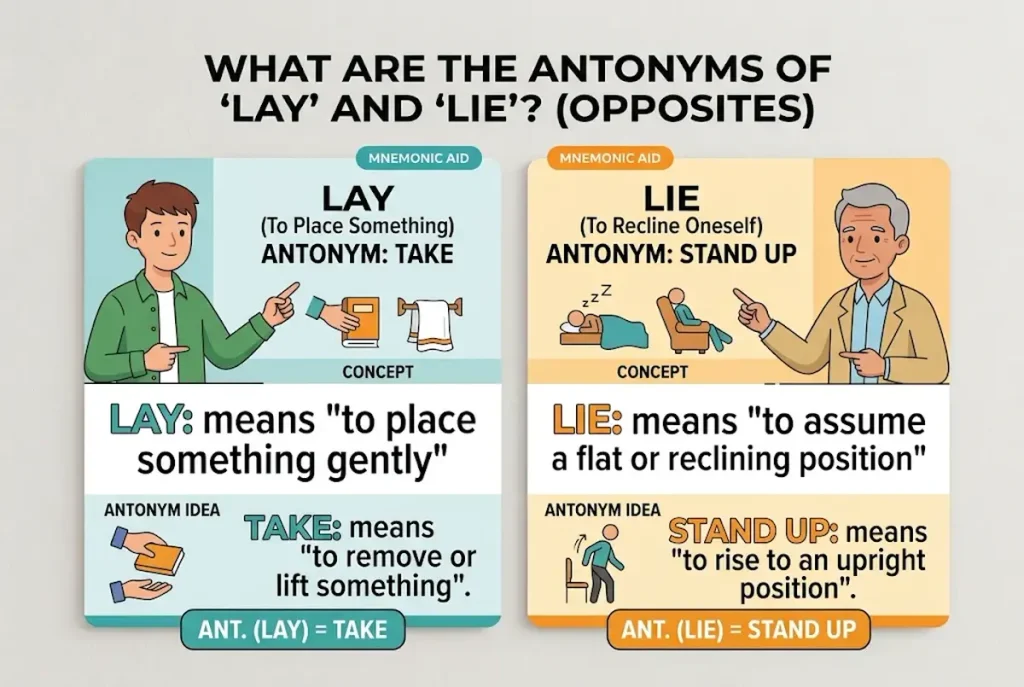
Both verbs have several opposite expressions, depending on their meaning.
| Word | Possible Opposite | Example |
|---|---|---|
| Lay | Lift | Lay the box down vs lift the box. |
| Lay | Raise | Lay the object on the floor vs raise the object. |
| Lie | Stand | Lie on the bed vs stand near the bed. |
| Lie | Sit | Lie on the sofa vs sit on the sofa. |
| Lie | Rise | Lie on the ground vs rise from the ground. |
| Lie | Get up | Lie down for a rest vs get up from bed. |
What Are the Quick Tips for Choosing Lay or Lie?
Use these simple rules whenever you feel unsure.
- Ask whether you’re placing something. If yes, use lay.
- Ask whether you’re resting yourself. If yes, use lie.
- Look for a direct object. Lay normally needs one.
- Remember the past participles. Lay uses laid, while lie uses lain.
- Check the context. Lie can also mean telling an untruth.
Conclusion
The difference between these verbs becomes easier when you focus on the action. Lay means to put or place something somewhere, while lie means to rest, recline, or remain in a particular position.
Remember their verb forms because they cause most of the confusion. Lay changes to laid and laid. Lie changes to lay and lain when it means to rest. For example, you lay a book on the table, but you lie on the sofa. Yesterday, you laid the book down, but you lay on the sofa.
Both verbs are important in everyday and professional English. Practice using them in short sentences, check for a direct object, and you’ll become more confident with each use.
Frequently Asked Questions
Is it lay or lie down?
Lie down is correct when you mean resting your body. Lay down is correct when you’re placing something down, such as a book or phone.
What is the past tense of lie?
The past tense of lie, meaning to rest or recline, is lay. For example, I lie on the sofa today, but I lay on the sofa yesterday.
Is it laid or lain on the bed?
Lain is correct when describing someone who has rested on a bed. For example, She has lain on the bed all morning.
What’s the easiest way to remember lay and lie?
Remember that lay means to place something, while lie means to rest. If the sentence has an object receiving the action, lay is usually the correct choice.
Is it correct to say I laid down?
It depends on the meaning. I laid down the book is correct because book is the object, but I lay down is the standard form when describing your own resting position in the past.
What is the difference between laying and lying?
Laying is the present participle of lay and means placing something. Lying is the present participle of lie and means resting or reclining, or telling an untruth.
Is lay vs lie the same in American and British English?
Yes, American and British English follow the same basic rules for these verbs. Their spelling and principal verb forms are the same.
Can lie mean something other than resting?
Yes, lie can also mean to say something untrue. In that meaning, its forms are lie, lied, and lied, rather than lie, lay, and lain.

Daniel Grammarfield — The Language Learner
Age: 28Occupation: ESL Learner & Digital Professional
Bio:Daniel is a non-native English speaker who wants to communicate more confidently at work and online. He uses Synotrench to improve grammar, understand confusing words, learn correct sentence structures, and build everyday English skills. He prefers simple explanations with practical examples.
Goals:
Master English grammar rules
Avoid common language mistakes
Improve professional communication
Learn English through real-life examples
Quote:“Learning English is not about memorizing rules — it’s about expressing ideas clearly.”
2 thoughts on “Lay vs Lie: The Ultimate Guide to the Difference”